
In 2004, during my last semester in seminary, Mel Gibson’s The Passion of the Christ was released in theaters. A group of us and one of our professors went to a Sunday matinee. Our professor, Father McGlynn, was dressed in his cassock and collar. As we exited the theater, someone waiting to enter asked, “Father, what did you think?” Father McGlynn replied, “It is what it was.” I agreed and still do. However, I did notice several scenes that did not correspond to the Gospel accounts, and I wanted to know the source of the information. Long story short, I discovered The Meditations of Anne Catherine Emmerich—The Dolorous (or Sorrowful) Passion of Our Lord Jesus Christ.
It is a difficult read for several reasons, one of which is the fact that the text is as graphic as the movie. Still, I believe, “It is what it was,” and it is as fascinating as it is terrible, so I’ve read it a couple of times. I wanted to try to understand what Our Lord endured in those last hours of His life. Why? Because He did it for me, and if He did it for me, there must be something I’m meant to learn from His suffering.
During this Season of Lent, we are going to spend some time looking at this text in relation to the trials Our Savior endured. No, I won’t read the more graphic parts, but you will understand what is happening. The point is not to scare or cause you grief but to discover what Jesus, even in His suffering, was trying to teach us.
Finally, the prayer at the conclusion of each sermon comes from On the Passion of Christ: According to the Four Evangelists, written by my friend, the 14th-century monk Thomas à Kempis. At times, those prayers are a bit longer than usual, but as this is Lent, we’ll be OK praying.
So, in the opening words of The Imitation of Christ by Thomas à Kempis, let us “meditate on the life of Jesus Christ.” We begin with the scourging that followed the trial before Pilate.
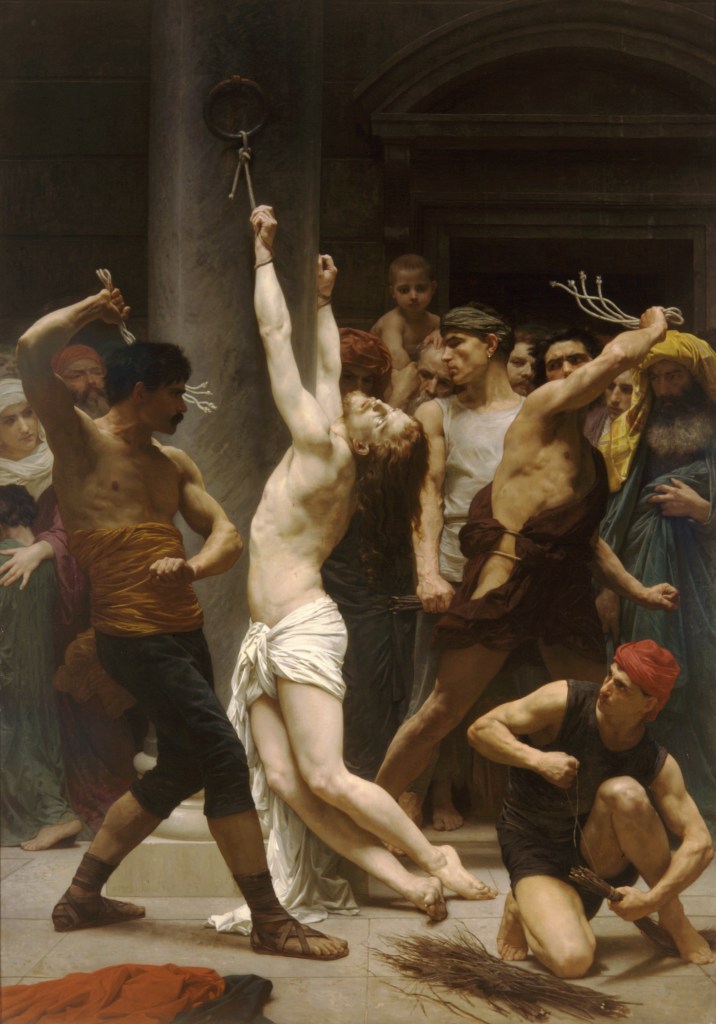
Blessed Catherine writes, “Jesus put his arms round the pillar, and when his hands were thus raised, the [soldiers] fastened them to the iron ring which was at the top of the pillar; they then dragged his arms to such a height that his feet, which were tightly bound to the base of the pillar, scarcely touched the ground. Thus was the Holy of holies violently stretched, without a particle of clothing, on a pillar used for the punishment of the greatest criminals; and then did two furious ruffians who were thirsting for his blood begin in the most barbarous manner to scourge his sacred body from head to foot. The whips or scourges which they first made use of appeared to be made of a species of flexible white wood, but perhaps they were composed of the sinews of the ox, or of strips of leather.”
Jesus endured such suffering, and we want to learn from it. But what can we possibly hope to learn from such senseless brutality that leads to so much agony? The answer is twofold: It teaches us about how we must endure our own suffering and how we are to see others in their trials.
As for us, we find the answer throughout the New Testament. St. Peter teaches that Christ “suffered for you, leaving you an example, so that you might follow in his steps. He committed no sin, neither was deceit found in his mouth. When he was reviled, he did not revile in return; when he suffered, he did not threaten, but continued entrusting himself to him who judges justly.” (1 Peter 2:21-23)
This speaks specifically to suffering for righteousness’ sake, but the Church has long held that it also applies to the hardships we face in the world and our bodies. The lesson is that in His suffering, Jesus entrusted “himself to him who judges justly.” In His suffering, Jesus entrusted Himself to the Father.
When we suffer, we sometimes do the opposite, or, even worse, instead of turning to the Father, we blame Him. Jesus’ final words teach us the correct response, “Father, into your hands I commit my spirit!” (Luke 23:46)
In the scourging of Jesus, for ourselves, we learn that we are not to look down or inward, cursing the world or God. Instead, we are to turn our faces toward Heaven and commit our lives—the good, the bad, and the ugly—to He who loves us and calls us his own.
That is what Jesus can teach us about our own suffering, but how can we learn from Jesus when witnessing the suffering of others?
In his book, The Wounded Healer, Henri Nouwen shares a tale. It’s too much reading for a sermon, but I’m going to read it anyway.
One day a young fugitive, trying to hide himself from the enemy, entered a small village. The people were kind to him and offered him a place to stay. But when the soldiers who sought the fugitive asked where he was hiding, everyone became very fearful. The soldiers threatened to burn the village and kill every man in it unless the young man were handed over to them before dawn. The people went to the minister and asked him what to do.
The minister, torn between handing over the boy to the enemy or having his people killed, withdrew to his room and read his Bible, hoping to find an answer before dawn. After many hours, in the early morning his eyes fell on these words: “It is better that one man dies than that the whole people be lost.”
Then the minister closed the Bible, called the soldiers and told them where the boy was hidden. And after the soldiers led the fugitive away to be killed, there was a feast in the village because the minister had saved the lives of the people.
But the minister did not celebrate. Overcome with a deep sadness, he remained in his room. That night an angel came to him, and asked, “What have you done?” He said: “I handed over the fugitive to the enemy.” Then the angel said: “But don’t you know that you have handed over the Messiah?” “How could I know?” the minister replied anxiously. Then the angel said: “If, instead of reading your Bible, you had visited this young man just once and looked into his eyes, you would have known.” (The Wounded Healer, p.31-2)
What can we learn about others from the suffering Jesus endured? We can learn that within the soul of each and every person is the Image of God, the Messiah. We can learn that when they suffer, regardless of race, creed, or religion, He suffers. In this knowledge, we can remain as bystanders, simply watching the suffering as those who watched Jesus’ scourging did, or like Jesus showed us throughout His life and ministry, we can work to ease the suffering of the world around us, one soul at a time.
Witnessing Christ’s scourging wrecks our souls, and hearing the lashes with the ears of our hearts can bring us to our knees. Yet, Jesus did not endure such pain for us to turn from it or block it out. He endured it so that, in the midst of our own trials, we might learn to entrust our lives to the Father. He also suffered through the lashes so that we might see in Him and respond to the suffering of others.
“By His stripes, we are healed.” Through witnessing His stripes and His suffering, we become like Him.
Let us Pray: Lord Jesus Christ, I praise and glorify you with endless gratitude for your barbarous scourging, for every stinging blow and piercing wound to your most holy and tender body.
O holy son, my God’s beloved Son, what have you done to deserve such dire treatment? Nothing, of course. But I? I am as one who is lost, for I am the cause of all your sorrows and distress. The enormity of my sins has brought this misery upon you, and to forgive my sins it was necessary for the Son of God to pay by suffering these bitter torments.
O most adorable Jesus, who endured that most painful scourging for me, the worst of sinners, grant that with a sorrowful heart I may gaze on each of your wounds and kiss them with a deep burning love. From them I breathe the perfume of life and partake of the medicine of eternal salvation. Inflame me with the fire of your infinite love, for you have indeed manifested that love for me—your servant worthy of being condemned—by enduring so many stripes from the scourges in your tormentors’ hands. Whenever I am faced with trials, send me your grace to bolster my weakness, lest under the weight of these afflictions, I become unduly dejected and agitated, and may I be mindful of your unjust scourging and meekly submit myself to all such ordeals.
Allow me a share in your sufferings and arouse in me the desire to amend my life by taking discipline, and, being thus humbly chastised, I may present myself as being more pleasing to you in the present life and rejoice with you more gloriously in the next, where all the saints, with all fear of evil gone, rejoice in everlasting contentment. Amen.
 Candle in a Cave
That movie always moves me to tears, and I remember it when taking communion, how much Jesus went through to bring us back into intimate fellowship with God!