
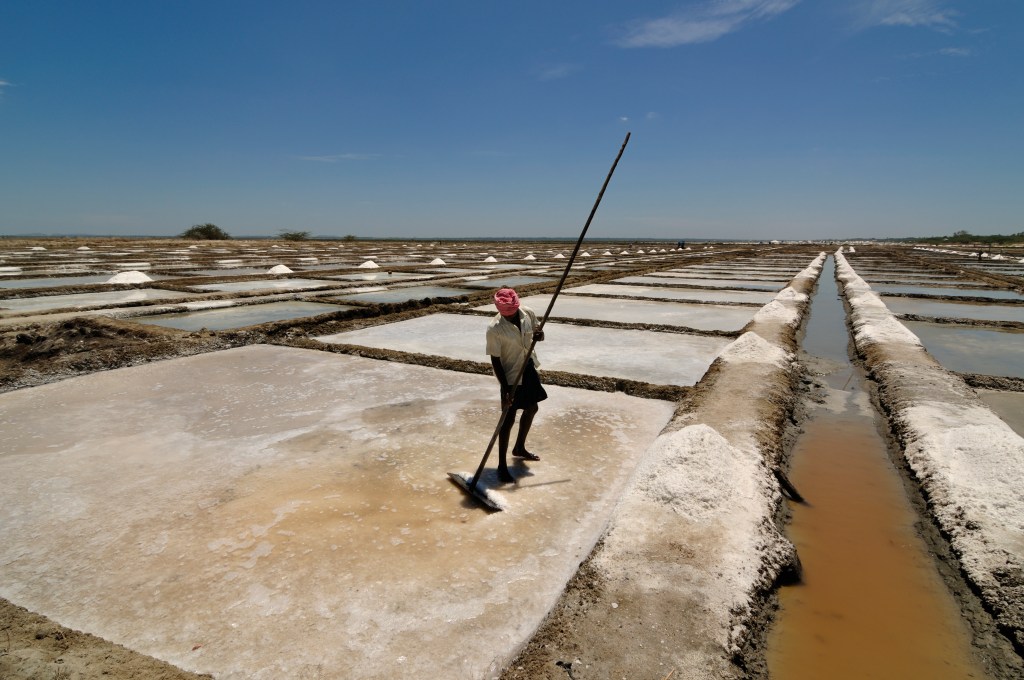
In the far west of India, near the coast of the Arabian Sea, is the Rann of Kutch. For a few months out of the year, it is a marsh submerged underwater, but for the most part, it is a barren wasteland. Even so, some 40,000 families migrate out into this wasteland every year for seven to ten months and call it home. They are the Agariya people, and they have been farming this land for centuries. Not for wheat, corn, or some other crop we typically think of, but for salt, harvesting 76% of the salt produced in India.
I recently watched a documentary on these families, My Name is Salt. It was fascinating. The conditions are harsh. Temperatures can range from 40° to 104°, and the people suffer from various illnesses due to the salt. The average lifespan is only 60. It is a fantastic story, and even more so is how the salt is farmed.
It is a fairly extensive process, but they form “beds” where groundwater is pumped up. Through evaporation, the salt is rendered from these “beds.” To initiate the crystalization process, they lay small branches on the surface of the beds, and the salt begins to form crystals along the branches. When those crystals are large enough, they come along and beat them off the branches, and they continue to grow—you’ll have to watch the documentary to see—but in the end, they have mountains of beautifully white salt.
Today’s Gospel reading from Matthew is a part of the Sermon on the Mount, and what we heard follows closely after the Beatitudes. In the three verses between the Beatitudes and our verses today, Jesus said, “You are the salt of the earth. But if the salt loses its saltiness, how can it be made salty again? It is no longer good for anything, except to be thrown out and trampled underfoot.” Jesus then speaks of light in a similar way, and then then our verses for today.
Taken out of context, the verses we heard seem to indicate that we are in error by not following the Law as prescribed by Moses. But in the context of the Beatitudes and with this idea of being the “salt of the earth,” we begin to understand that Jesus had something else in mind, which is why I thought of those salt farmers.
God gave the Law to Moses. We know the top ten, but there are 613 laws in the Law of Moses. Everything from “Thou shall not murder” to “don’t eat bacon.” There are so many laws, and they are so intricate, that only a very few could remember it all, and none could follow. To remedy this, God sent His one and only Son, Jesus, to “harvest” the Law—to reduce it down to its purest nature, which Jesus did: “Teacher, which is the greatest commandment in the Law?” Jesus replied [with what we know as the Summary of the Law]: “‘Love the Lord your God with all your heart and with all your soul and with all your mind.’ This is the first and greatest commandment. And the second is like it: ‘Love your neighbor as yourself.’ All the Law and the Prophets hang on these two commandments.”
Jesus “harvested” the Law and reduced all there was down to those few statements, and ultimately to one word—love—and “not one letter, not one stroke of a letter, will pass from the law until all is accomplished.”
Like Jesus, we are called upon today to harvest this salt of God’s love. We are to take this beautifully white “salt” of God’s love and season everything we touch with it and then share it. There will be days filled with joy and days when the conditions are harsh, but we are “salt farmers,” and sharing God’s love is what we do.
 Candle in a Cave
This is one of my favorite sermons. So I’m watching Salt Farmers.
Such work and that farmer is tenacious.
mg