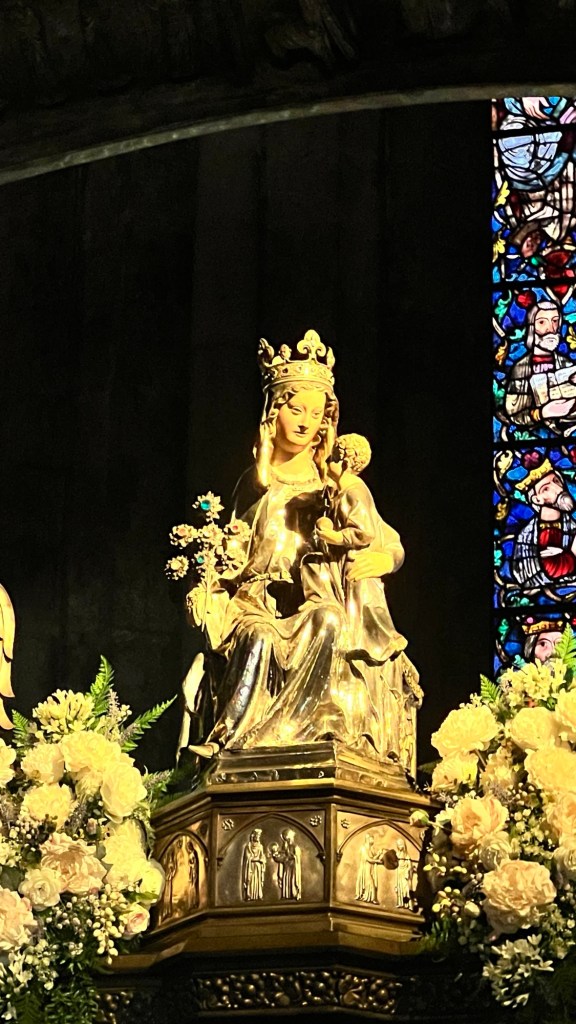
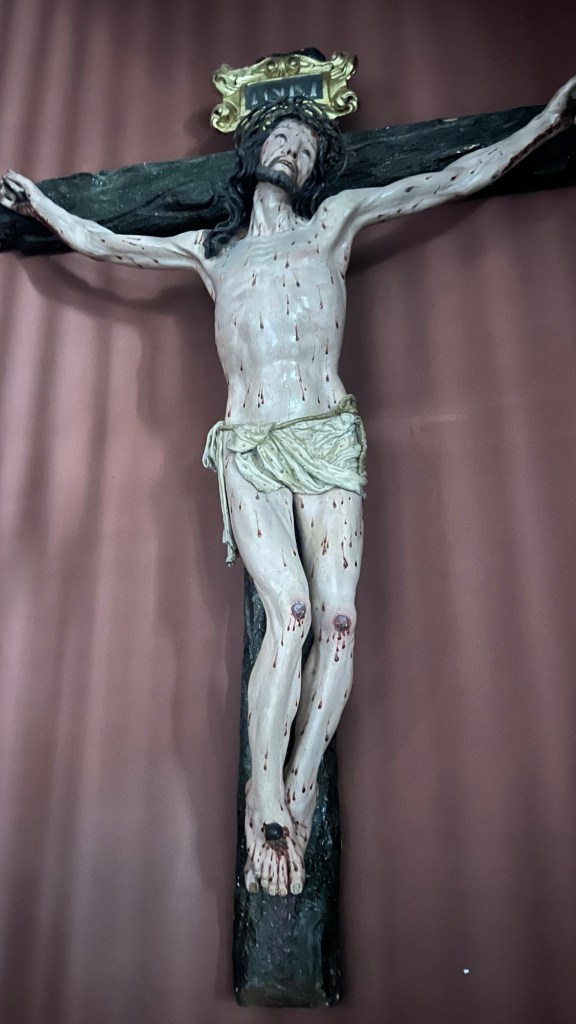
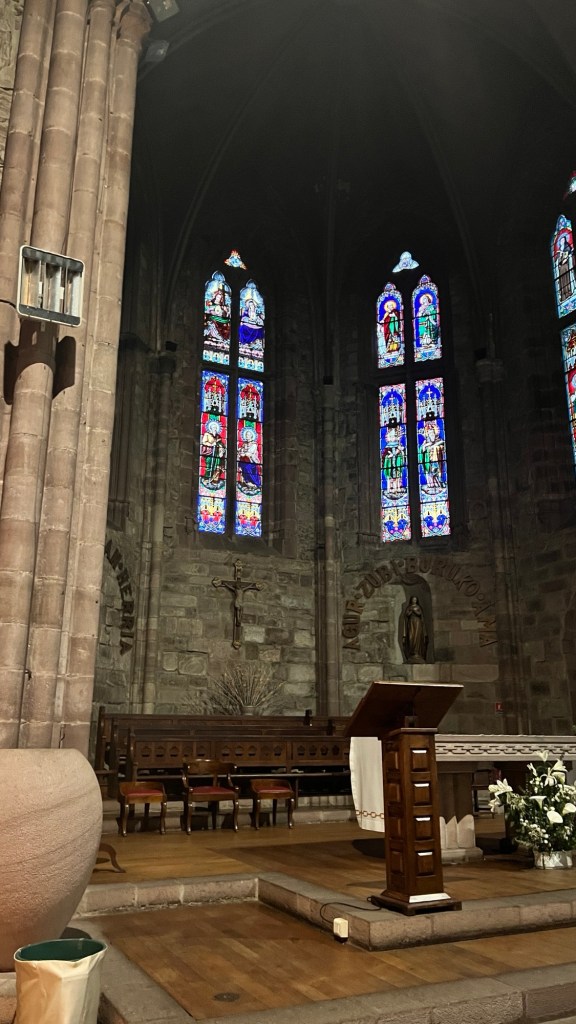
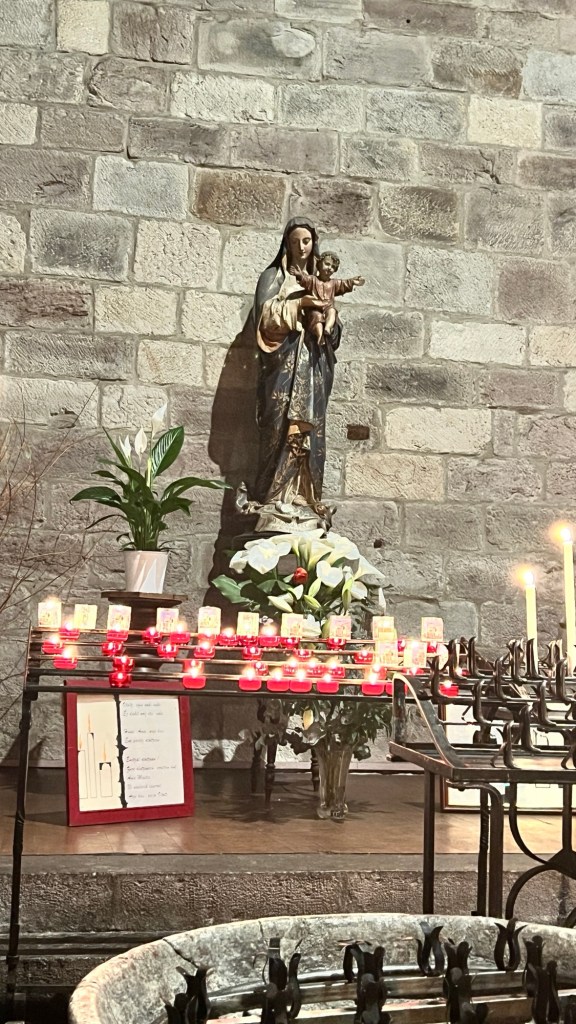
From the website: “The high altar of the temple is watched over by the Imagen de Santa María of Roncesvalles (Image of St. Mary of Roncesvalles), dating from the 14th century, a superb Gothic sculpture in silver-covered wood and decorated in gold.” St. James is there with her as is her crucified Son.
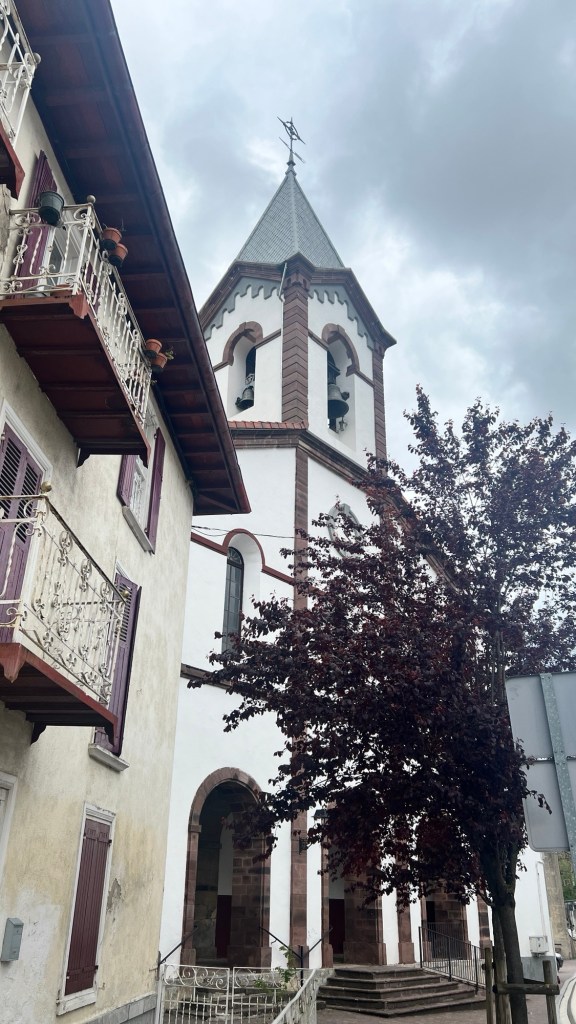
It is difficult to find a church that is open. I suspect most of the problem is related to the shortage of clergy and the decline of Christianity in Europe. it did not stop me from praying. I sat outside and enjoyed the cool breeze.
A lady was out hitting all the local garage sales when she came across an old needlepoint picture that read, “Prayer Changes Lives.” She bought it, took it home, and began to look for just the right place to hang the new picture. Finally, she decided it went well in the dining room over the table.
She admired her garage sale discovery with great pride and could hardly wait to show it to her husband. That evening when her husband arrived home from work, she showed him the picture, but he did not indicate his likes or dislikes of the new picture.
The next day as the lady was cleaning the house, she discovered that the new picture was gone. While cleaning the house, she found the picture behind a bookcase. She thought, “That’s strange,” and re-hung the picture in its original location. The next day, to her dismay, she discovers the picture gone again and again finds it behind the bookcase.
When the husband arrives home, she confronts her husband and asks him if he is displeased with the art of the needlepoint, to which he responds, “No, not at all; it is a great work of art.”
She continues, “Is it the place? Do you not like the place it is hung?” He says, “No, not at all. It is in a great location.”
She concludes that it must be the message, and she asks him if it’s the message that he doesn’t like. He says, “No, not at all; the message is great.”
Finally, she says, “Then what’s the problem?” He says, “I just don’t like change.”
Have you ever been on a prayer walk? It is the practice of going to a particular place, be it a school campus, neighborhood, or even a mall, and as you walk, pray for those concerns you see and the people you encounter or who live there. It helps you get out of your head and your own concerns and see the needs of others. Maybe try it the next time you go to the grocery store—each person you pass, say a prayer for them. You’ll never know how God answers your prayer, but you do know that God heard your prayer and that your prayers affected change.
I also know others who will pray as they walk. The rhythm of the walking, like breathing, brings about a more meditative state, allowing them to focus more clearly on their prayers—just don’t get so wrapped up in your prayers that you forget to look both ways before crossing the street!
Today in our Gospel, we are told of the two disciples walking the road to Emmaus. Although not a prayer walk, their walk does tell us much about prayer and even the liturgy of the Church.
The distance from Jerusalem to Emmaus is seven miles, so even if they were walking slowly, it would have taken them no more than three hours. Along the way, they talk about everything that has happened—hopes, dreams, fears, disappointments. We are told that when Jesus first encountered them, they were “looking sad.”
Hopes, dreams, fears, disappointments, and maybe even looking sad—does that sound like you when you settle in for your prayers?
As these two disciples talked, Jesus came alongside them even though they did not recognize Him. He began to speak to them in such a way that their hearts began to burn within them. He opened up to them the nature of God’s plan and explained the “Why?” behind so many of their questions. He lifted the heavy burdens they had been carrying. When it appeared that He was going to leave them, they asked Him to stay. They invited Him in, and He remained with them.
In our prayers, when the Lord begins to speak to us, making things more clear and calming our souls, we also invite Him to stay so that we may be near Him.
“But wait,” you say. “Jesus disappeared right after breaking bread with the disciples.”
Yes, He did, and He didn’t. Jesus walked the earth two thousand years ago, yet he was limited to one geographical location just as we are limited to one. Jesus could have remained with the two disciples, but He made it possible to be with all God’s people anywhere and at any time.
“When [Jesus] was at the table with them, he took bread, blessed and broke it, and gave it to them. Then their eyes were opened, and they recognized him, and he vanished from their sight.” Jesus vanished from their sight, but He remained with them in the bread, just as He is truly present to us, {Hold up priest host} in the bread.
Those two disciples lived out a prayer. They had all this “stuff” going on inside them; they spoke to one another about it, then they spoke to God about it. In the process, they encountered the Risen Lord, who revealed understanding and Himself, and they were changed. Afterward, they immediately turned from the direction they were going—the direction of disappointment and fear and separation—and returned to the others who had remained in Jerusalem. They returned to the Body of believers.
Sound familiar? From the Baptismal Covenant: “Will you continue in the apostles’ teaching and fellowship, in the breaking of bread, and in the prayers?” “I will with God’s help.” (BCP 304)
The road to Emmaus is a map for understanding prayer and, therefore, also represents the liturgy of the Church—we come together, we walk together, and we bring our concerns and hopes, joys, and disappointments with us. As Jesus opened up the Word of God to the two on the road, through our readings and preaching, we also open up the Word of God. It all leads to an encounter with the Risen Lord in the breaking of bread, the Holy Eucharist, where Christ Jesus is truly made present to us and to all who come seeking. This prayer and this encounter then changes us so that Christ may be revealed in us and that we might do the work of God and His Church.
Mother Teresa said, “I used to pray that God would feed the hungry, or do this or that, but now I pray that he will guide me to do whatever I’m supposed to do, what I can do. I used to pray for answers, but now I’m praying for strength. I used to believe that prayer changes things, but now I know that prayer changes us, and we change things.”
This morning’s Psalm (116) summed up this Road to Emmaus, this road of prayer. Verses 1- 3:
“I love the Lord because he has heard the voice of my supplication, because he has inclined his ear to me whenever I called upon him. The cords of death entangled me; the grip of the grave took hold of me; I came to grief and sorrow. Then I called upon the Name of the Lord: ‘O Lord, I pray you, save my life.’”
He answered his own question by saying,
“I will lift up the cup of salvation… I will fulfill my vows… O Lord, I am your servant… I will offer you the sacrifice of thanksgiving… I will fulfill my vows to the Lord.”
A quote you’ve probably heard is from a pamphlet on reform written by Leo Tolstoy, “Everyone thinks of changing the world, but no one thinks of changing himself.”
“A lady was out hitting all the local garage sales when she came across an old needlepoint picture that read, ‘Prayer Changes Lives.’” That is true, but perhaps a more accurate statement would be, “Prayer Changes You.”
We are still in the Easter Season, and that change that occurs in you through prayer is the work of the Resurrection. Don’t be afraid of the changes that come when you walk the road of prayer.
A prayer from that great Dominican theologian, St. Thomas Aquinas—Let us pray: “Grant us, O Lord our God, a mind to know you, a heart to seek you, wisdom to find you, conduct pleasing to you, faithful perseverance in waiting for you, and a hope of finally embracing you. Amen.”
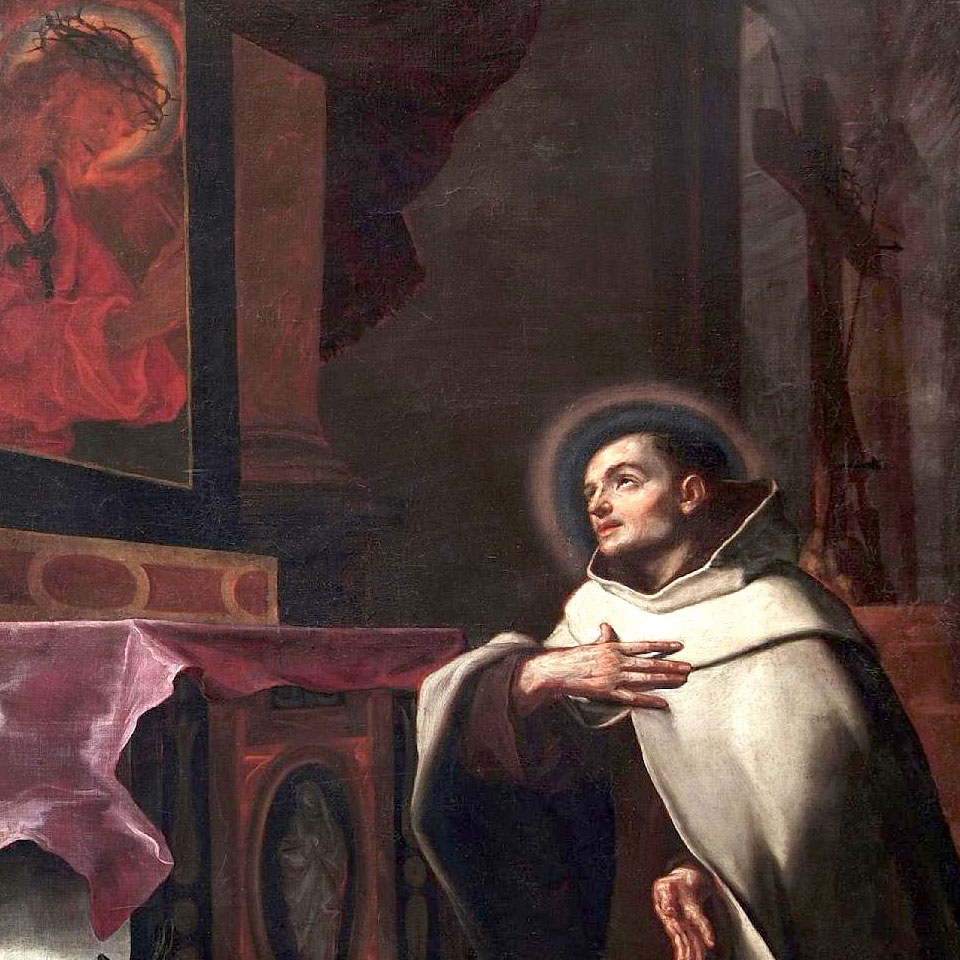
St. John of the Cross died on this day in 1591 at the age of 49. He was a true friend and contemporary of Teresa of Avila. Together, they worked to reform the Carmelite order, which they were a part of, enforcing a much stricter application of the rule. All did not appreciate that enforcement, and John was persecuted and eventually imprisoned by—not the authorities, but by fellow monks who disagreed with him.
His life is an example to us, but the writings he left behind are perhaps his greatest gifts. Of these, he is best know for, Dark Night of the Soul. It began with the writing of a poem, but then he was asked by fellow monks—those who did not want to throw into prison—to write a commentary explaining the work. The commentary of the first three stanzas of eight is all that remains (if there ever was more) and is practical in its approach to prayer.
Today, I would like to share the poem with you. Many translations are available; I’m not sure who gave us this one. When reading the poem, think of prayer. Think of entering into a place of darkness where without light, the fire burning in your heart is your guide that leads you to union with God. Once with God, it is not about speaking to Him but being with him.
Into the darkness of the night With heart ache kindled into love, Oh blessed chance! I stole me forth unseen, My house being wrapped in sleep.
Into the darkness, and yet safe By secret stair and in disguise, Oh gladsome hap! In darkness, and in secret I crept forth, My house being wrapt in sleep.
Into the happy night In secret, seen of none, Nor saw I ought, Without, or other light or guide, Save that which in my heart did burn.
This fire it was that guided me More certainly than midday sun, Where he did wait, He that I knew imprinted on my heart, In place, where none appeared.
Oh Night, that led me, guiding night, Oh Night far sweeter than the Dawn; Oh Night, that did so then unite The Loved with his Beloved, Transforming Lover in Beloved.
On my blossoming breast, Alone for him entire was kept, He fell asleep, Whilst I caressed, And fanned him with the cedar fan.
The breeze from forth the battlements, As then it tossed his hair about, With his fair hand He touched me lightly on the neck, And reft me of my senses in a swoon.
I lay quite still, all mem’ry lost, I leaned my face upon my Loved One’s breast; I knew no more, in sweet abandonment I cast away my care, And left it all forgot amidst the lilies fair.
Jesus said, “I still have many things to say to you, but you cannot bear them now. When the Spirit of truth comes, he will guide you into all the truth; for he will not speak on his own, but will speak whatever he hears, and he will declare to you the things that are to come.” If we are to hear and know those things the Spirit would teach us, then in prayer, we must follow the flame of our heart, which will guide us into that union with God where we can learn even more about our Savior.
A young lady who occasionally walked through the park after work stopped on a particular day to have her picture taken. She was very excited about the whole idea. The photographer charged $5 and used one of the Polaroid instant cameras (the picture slides out and develops in a few minutes.) As she walked out of the park, the picture was fully developed, so she stopped and took a moment to review her purchase. She was not pleased with what she saw, so she turned and headed back to the photographer. When she got to him, she raised her voice and barked: “This is not right! This is not right! I would like my $5 back. You have done me no justice! No justice whatsoever!”
The photographer looked at the picture and then looked at her. Then, returning the picture and her money, he said, “Miss, you don’t need justice. What you need is mercy.”
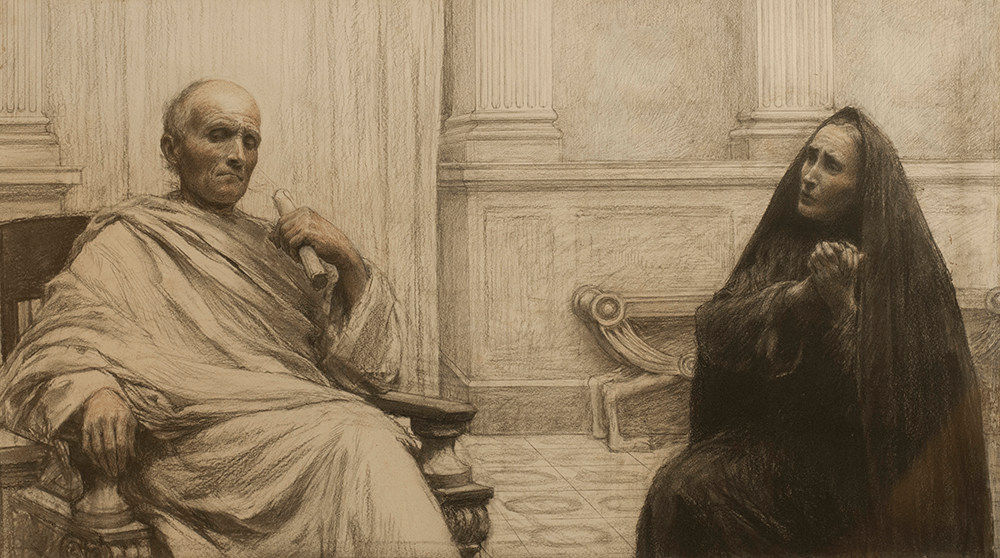
Today is the parable of the unjust judge. The judge doesn’t care what people or God thinks; he does what he wants when he wants. Along comes a widow seeking justice over some matter—we are not told what. At first, the judge ignores her, but she keeps coming. Finally, the judge says to himself, “She’s never going to give me peace, and she’s making me look foolish in the eyes of everyone, so I’ll do what she wants to get her out of my hair.” To those listening, Jesus says, “Listen to what the unjust judge says. And will not God grant justice to his chosen ones who cry to him day and night? Will he delay long in helping them? I tell you, he will quickly grant justice to them. And yet, when the Son of Man comes, will he find faith on earth?”
Jesus says, “If this unjust judge will do what she asks, then imagine how much more your Father in Heaven, who loves you dearly, will do for you.” From this excerpt, we can come to understand that Jesus is speaking about how we can go to the Father in prayer. It ties back very nicely to what Jesus said in chapter seven: “Which one of you if his son asks him for bread, will give him a stone? Or if he asks for a fish, will give him a serpent? If you then, who are evil, know how to give good gifts to your children, how much more will your Father who is in heaven give good things to those who ask him!” All this makes for a good lesson on prayer—I hope so because it is one I’ve preached. The woman is asking for justice. In seeing it as a parable about prayer, we can replace the word “justice” with whatever our petition might be. It works, but in doing so, we’ve missed the point Jesus was making, and we did so by pulling the parable out of context. The parable is about prayer, but it is about praying for one specific thing. That one specific thing is what the widow was asking for: justice. The story began in chapter seventeen when some Pharisees came to Jesus and asked when the Kingdom of God would come.
Jesus began by saying to them, “The kingdom of God is not coming in ways that can be observed, nor will they say, ‘Look, here it is!’ or ‘There!’ for behold, the kingdom of God is in the midst of you.” He then goes on to speak about some believers who would desire God’s Kingdom and who would experience great suffering before it came. He also tells them that it will be like in the days of Noah before the flood. There will be eating and drinking, buying and selling… people will be going about their daily lives, oblivious to what is coming, which is the judgment of God—the end of days when God’s justice is poured out. A justice that will right all the wrongs. The Prophet Isaiah said, “In that day the Lord with his hard and great and strong sword will punish Leviathan the fleeing serpent, Leviathan the twisting serpent, and he will slay the dragon that is in the sea.” Jesus is saying the same thing: On the last day, the Lord will punish the enemies of God’s people and restore them to Himself. Then, with that in mind, Jesus tells them the parable of the unjust judge and the widow who cried out for justice. Her cry is a prayer that runs throughout scripture.
In the sixth chapter of John’s Revelation, the angel of the Lord begins to break the scroll’s seven seals. The first four seals release the four horsemen of the apocalypse, and when the fifth seal is broken, John says, “I saw under the altar [in the throne room of God] the souls of those who had been slain for the word of God and for the witness they had borne. They cried out with a loud voice, ‘O Sovereign Lord, holy and true, how long before you will judge and avenge our blood on those who dwell on the earth?’” The widow’s prayer is the same as these souls: justice. It is also the same one-word prayer of St. Paul that he spoke at the end of his first letter to the Corinthians: Maranatha—“Our Lord, come!” Or “Come, Lord Jesus!” Come, Lord, with your justice. All these and others are crying out for God to exact his justice on the nations. Yet, over time, that cry and that zeal have faded.
You’ve probably figured out by now that I’m not much of a sports person, so I seldom use illustrations from sporting events, but—and this one is going to sting a little for some of you—how about that Texas vs. OU game last week? Forty-nine to Zero. That had to hurt. Anyhow, if you were (maybe you still are) an OU fan, you could have been one that traveled down to Texas for the game, had a tailgate party beforehand, participated in all the bluster, there’s the kickoff and all the cheering. You’re still feeling positive when Texas scores first and maybe even still cheering and excited at the half, even though your team is down twenty-eight to zip. Then in the second half, the writing on the wall becomes quite clear. By the fourth quarter, Texas is likely using their fifth-string quarterback and has put in the water boy as a running back to try and keep from running the score up too much. If you’re even still at the game—you may have gone home and found something better to do with your time—if you’re still there, you’re likely sitting glumly and murmuring to yourself: disheartened, disappointed, and depressed. No more cheers. No more bluster. No more hope. After such a shellacking, you may give up on them all together and never watch another game.
The widow cried out for God’s justice. Those souls in Heaven cry out for justice. So many have cried out for God’s justice to be poured out, but it’s been 2,000 years since Jesus walked the earth, and we’re still waiting; many, like at that football game, have become disheartened, disappointed, and depressed. Some remain, but many have lost their zeal, and many more have simply walked away. What we read this morning from Paul’s letter to Timothy is being fulfilled, “For the time is coming when people will not put up with sound doctrine, but having itching ears, they will accumulate for themselves teachers to suit their own desires, and will turn away from listening to the truth and wander away to myths.” And it is into that very set of circumstances that Jesus speaks the last sentence of our Gospel reading: “And yet, when the Son of Man comes, will he find faith on earth?” The cry for the Lord’s return and zeal for his justice has faded.
As followers of Jesus, we must remember that Christianity is not a faith of immediate gratification. Instead, it is a lifetime of faith and of hope, in good seasons and in bad. Jesus said, “The one who endures to the end will be saved.” Therefore, regardless of current circumstances or perceived loss, be the one who, with great zeal and joy, perseveres until the end. How do you persevere? What is the secret to perseverance? My friend St. Josemaría Escrivá answers that one: “Love. Fall in Love, and you will not leave him.” (The Way #999) Fall in love with God and there will be nothing that dampens your spirit or desire to be with him. In the end, be one who can say with St. Paul, “I have fought the good fight, I have finished the race, I have kept the faith. Henceforth there is laid up for me the crown of righteousness, which the Lord, the righteous judge, will award to me on that day, and not only to me but also to all who have loved his appearing.” (2 Timothy 4:7-8)
Let us pray (a prayer of St. Thomas Aquinas): Grant us, O Lord our God, minds to know you, hearts to seek you, wisdom to find you, conduct pleasing to you, faithful perseverance in waiting for you, and a hope of finally embracing you. Amen.
Boudreaux and Thibodeaux got into a rather heated conversation over religion, so at one point, Boudreaux says to Thibs, “If you are so religious, let’s hear you quote the Lord’s Prayer. I’ll bet you ten bucks you can’t,” he added, fishing a ten dollar bill out of his wallet. Thibs said, “You’re on.” And after putting on his thinking cap and staring up to heaven for several seconds, he began, “Now I lay my down to sleep, I pray the Lord, my soul, to keep. And If I die before I wake, I pray the Lord my soul to take.” Boudreaux handed the ten dollars to Thibs and said, “Wow! I didn’t think you could do it!”
Last week, I shared a quote from Thomas Merton from No Man is an Island: “We cannot be happy if we expect to live all the time at the highest peak of intensity. Happiness is not a matter of intensity but balance, order, rhythm, and harmony. Music is pleasing not only because of the sound but because of the silence that is in it: without the alternation of sound and silence, there would be no rhythm.” (p.134) The idea was to provide our souls the opportunity to catch up in the midst of our busy lives. To find that silent space between the notes of our lives to discover God’s peace. However, being alone and silent does not come easy to us.
I remember being a kid and having a hard time sitting still. Like most kids, I had a lot of energy that needed to be in motion, so time and time again, I heard the words, “Stop fidgeting!” Ever heard or said it? Most likely, yes. We all fidget, but when we get a bit older, we’re not allowed to sit in a meeting with a fidget wheel while the boss is speaking, so we learn to control those fidgets or at least make them less distracting to others. Take a newscaster, for example, I don’t know about FOX and CNN, but if you watch a more ‘normal’ newscaster, you will most often see them holding a pen or a stack of papers. Either that, or they’ll have their hands clasped together in front of them. Remember Johnny Carson? What did he have? Yep. His pencils with an eraser on both ends. He might drum out the occasional beat with one, but mostly he just held it. It gave his hands something to do, just like holding a pen or paper gives the newscasters something to do with their own, so they don’t fidget about. Whether consciously or subconsciously, most learn to stop fidgeting, but that does not mean the impulse or desire is gone—only controlled. Our lives are the same way, there may be times of silence, but our minds are still fidgeting. The being alone and the silence does not come easy to us. We may have learned to control the external noise we make, but our minds are still ‘fidgeting’ away.
There are probably many contributing factors to the mental fidgeting. Still, at the heart of them all, we can discover a central theme: fear, derived from equating solitude and silence with loneliness and boredom.
We are, by nature, social creatures. Not many live as hermits, so we come together, for good or for worse, in larger and larger communities. When we find ourselves outside of community, then we become anxious. There’s no one around, no one to talk to, nothing to do, and no one to do it with, so our minds begin to fidget, trying to fill the silence and solitude. When our minds fail, we try and distract ourselves with activities that may not always be good or healthy, but it is all because of that fear of being alone and bored. We become fearful, and in our fear, we forget the nearness of God. We say we are alone, but how can we be alone if we are friends with God? We say we are bored, but how can you be bored when we have access to the Creator of the Heavens and the Earth? Perhaps the solitude and silence, that space between the musical notes, doesn’t need to be filled with our fidgeting; maybe they are only wasted opportunities to be with God? If so, how do we take advantage of the silence and solitude instead of seeing them as a negative?
Maybe I’ve shared this with you before: the study of spirituality and prayer is known as Ascetical Theology, and when I was in seminary, Bishop Parsons was my Ascetical Theology professor. He told us that the number one thing our congregations would want from us, whether articulated or not, was precisely what the disciples asked of Jesus today: “Lord, teach us to pray.” Lord, we see you in such deep prayer, how important it is even for the Son of God to be in ‘community’ with the Father through prayer, and we want to know how to do that so that we can have it too. “Lord, teach us to pray.” In response, Jesus gave them the words to say, but before doing that, he modeled it for them. What was the model?
Mark 1:35—“And rising very early in the morning, while it was still dark, [Jesus] departed and went out to a desolate place, and there he prayed.”
Luke 5:16—“[Jesus] would withdraw to desolate places and pray.”
There are many other examples of Jesus retreating to a solitary place and praying. Jesus did not avoid the solitude and silence. He sought it out. What did Jesus do when he saw the busyness of life, the fidgeting of minds, begin to wear on the disciples?
Mark 6:31-32—Jesus said to the disciples, “‘Come away by yourselves to a desolate place and rest a while.’ For many were coming and going, and they had no leisure even to eat. And they went away in the boat to a desolate place by themselves.” Jesus said, Come away with me to a place of solitude and silence so that we can have community—or maybe a better way to say it—so that we can have communion.
We can see times of solitude and silence as times of loneliness and boredom, but what if we began understanding them as opportunities to have communion with God. Not just a time of prayer where we lay out the “Honey Do” list for God, but a time of companionship and friendship with Jesus.
The Syrian monk, Isaac of Nineveh (he lived in the 7th century), wrote, “More than all things, love silence; it brings you a fruit that tongue[/speaking] cannot describe. In the beginning, we have to force ourselves to be silent. But then there is born something that draws us to silence… If you only practice this, untold light will dawn on you in consequence. After a while, a certain sweetness is born in the heart of this exercise, and the body is drawn almost by force to remain in silence.”
What does the Psalmist say:
As a deer pants for flowing streams, so pants my soul for you, O God.
My soul thirsts for God, for the living God.
(Psalm 42:1-2)
Our minds push us into thoughts of loneliness and boredom, but our souls are crying out for times of solitude and silence where we might stop all the mental fidgeting and enter into communion with our God. When, through practice, you enter into that place, you can begin to speak, not with your lips, but from your soul, “Our Father, who art in heaven….” And, when you speak, it won’t just be you simply reciting something you’ve memorized. It will be you having a conversation with the One you love, and there will be nothing lonely or boring about it.
Let us pray together: Our Father, who art in heaven, hallowed be thy Name, thy kingdom come, thy will be done, on earth as it is in heaven. Give us this day our daily bread. And forgive us our trespasses, as we forgive those who trespass against us. And lead us not into temptation, but deliver us from evil. For thine is the kingdom, and the power, and the glory, for ever and ever. Amen.
Two weeks!!! How the time flies when you are so busy doing preasty things that you can’t write about the preasty things you do. Sermons. Bible Studies. Last Rites. Kids (what a riot they are!), services, confession (not really… I like to pretend that people still come), and generally walking around in all black spreading the cheer and love of the Lord. I’ll take it. And I love it.
I just want to take a minute here to say how ridiculous newspaper / news websites headlines are. About 50% of the time I’ve no idea what the article is going to be about. Is that the trick? Fool with the headline so they’ll take a peek and we can hit them with more advertising so that we can afford to hit them with more nonsense? I don’t know, but when Britney Spears’ wrestling with papa is a top new story, I’m one who is wondering what they buried back on page 27c! Know what I mean…. yes you do. They all work for the Ministry of Truth and they are out to deceive us so that we’ll look at pictures of kittens and forget about the annihilation of entire races. Rant. Rant. Rant. Thus endeth the rant.
Lisbeth Salander
Movies: we are definitely back to the golden oldies here. The Swedish version of Stieg Larson’s Millennium Series and the 1978 version of The Stand. Both make me immensely happy and at least I don’t have to worry about them being stupid. Speaking of which… books!
I’m on a hardback edition of my favorite books and some new ones. Recently completed A Man Called Ove (which is a new one for me, buy have also added The Stand and 11/22/63 (yes… yes… both by Stephen King) to the stack. These last two are behemoths of a book and that’s just the way I like them. For the Saints Book Club at the church, we will be reading The Hawk and the Dove by Penelope Wilcock (book one in the trilogy). It is a short read, but promises to be a powerful story… keep you posted.
One thing I don’t like about myself when it comes to my vocation (there are several, but this one is sticking out these last two weeks): Last Rites… Ok, I’m supposed to be the professional, which means (at least to me) that I can walk into an emotionally tense situation and be the calming presence. I keep my cool, in hopes that it will bring a sense of calm and peace to those who are grieving. These last two weeks… my goodness… They told us in seminary that after a number of years in the same parish you would have to start burying your friends. This has been happening, but last week… Dang. I don’t want to be that cold distant a-hole of a priest, but wow… living on that emotional edge is an interesting place to be that I’m not entirely use to.
God: now this is the good stuff! God… I’m going to need someone I can sort this out with, but recently I’ve been discovering the lack of boldness in by prayer life… I mean, my prayer life for as long as I’ve had a prayer life! I’m going to need to think on this some, but…. yeah. Maybe I’ll keep this one to myself for a bit until I work it out.
What I’ve learned: My friend Heidi always said that being a priest would be whole lot easier if we just didn’t give a shit. Unfortunately, the longer I am…. yeah. (And I wouldn’t trade it for anything!!) She does too… more than any priest I know.
Thought for the day: Room 217… If you ain’t a Stephen King fan, then that won’t mean a thing, but if you are…. sometimes you’ve got to stroll on up in there, open that door, look the hag in they eye, and give her what for. Ain’t none of it real anyhow (unless you live in SK’s world.)
The Lord bless you all.
P.S. To all my blogging friends: I hope to get caught up on your writings over the next week. I miss your thoughts!






 Candle in a Cave