
A group of women was talking together. One woman said, “Our congregation is sometimes down to 30 or 40 on a Sunday.”
Another said, “That’s nothing. Sometimes our congregation is down to six or seven.”
A maiden lady in her seventies added her bit, “Why, it’s so bad in our church on Sundays that when the minister says ‘dearly beloved,’ it makes me blush.”
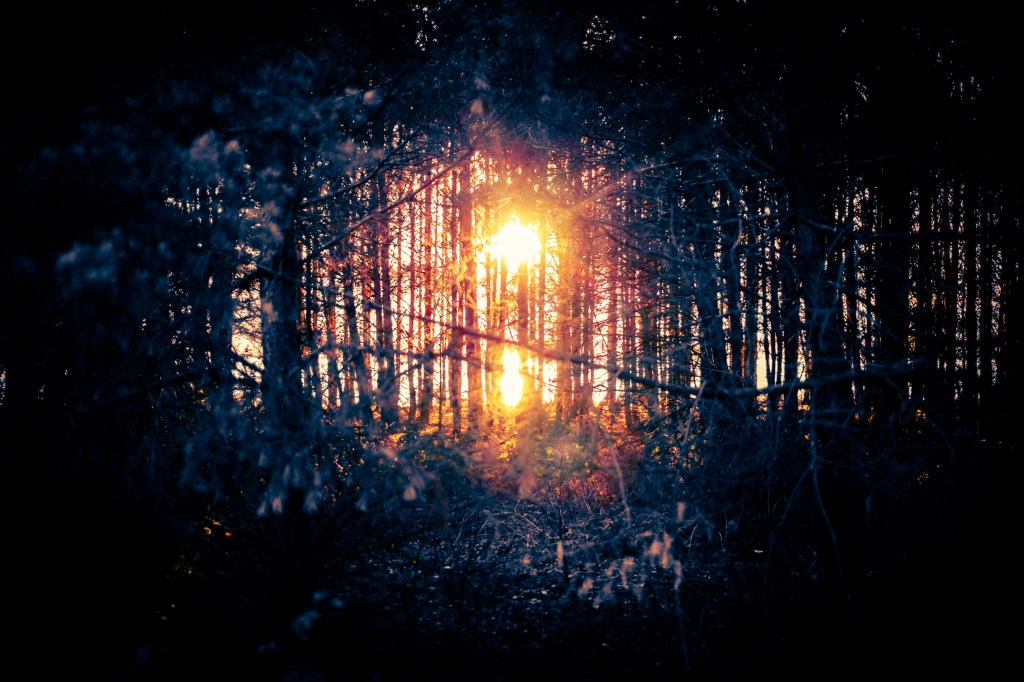
With today being a low Sunday—especially after the wedding last night—I’m delighted to see you all here. Hopefully, you won’t regret your decision after hearing a few verses of this poem by Lord Byron. The title: Darkness.
I had a dream, which was not all a dream.
The bright sun was extinguish’d, and the stars
Did wander darkling in the eternal space,
Rayless, and pathless, and the icy earth
Swung blind and blackening in the moonless air;
Morn came and went—and came, and brought no day,
And men forgot their passions in the dread
Of this their desolation; and all hearts
Were chill’d into a selfish prayer for light.
It goes on from there, and I can assure you it doesn’t get any cheerier. It describes a post-apocalyptic world where the sun and stars have “gone out,” and humanity consumes everything in an attempt to create light, but all is despair. In the dim light of their fires, famine overcomes them. The last remaining survivors come together and build a fire so they can see one another, but they die of fright when they do because of the horror they have become.
In the end,
The world was void,
The populous and the powerful was a lump,
Seasonless, herbless, treeless, manless, lifeless—
A lump of death—a chaos of hard clay.
(Source)
Can I just say “Merry Christmas”?
I’m not sure where Byron was in his head when he wrote that one, but the words of our Gospel kept coming to me as I read it. “The light shines in the darkness, and the darkness has not overcome it.”
In the days leading up to the birth of Jesus, the world’s inhabitants lived in spiritual darkness. We know that there had not been a prophet in the land for over 400 years, and the oppression of the Roman legions was steadily increasing. It seemed that all of God’s promises had proved false. The Prophet Isaiah writes,
“Justice is far from us,
and righteousness does not overtake us;
we hope for light, and behold, darkness,
and for brightness, but we walk in gloom.
We grope for the wall like the blind;
we grope like those who have no eyes;
we stumble at noon as in the twilight,
among those in full vigor we are like dead men.”
(Isaiah 59:9-10)
The people were horrified by what had become of their lives and their dreams. Just as in the poem, a famine plagued the earth—the people were starving for God, for a Redeemer, a Savior. So they prayed, they prayed for the light to come.
And so it was, on a dark night, over the region of Judea above the City of David, which is called Bethlehem, that God once more said, “Let there be light,” and the Light of the World was given to us. It was God giving Himself to us in the form of a Babe, lying in a manger and wrapped in swaddling clothes.
“In him was life, and the life was the light of men. The light shines in the darkness, and the darkness has not overcome it…. The true light, which gives light to everyone, was coming into the world.”
As we declare in the Nicene Creed, “For us and for our salvation he came down from heaven, by the power of the Holy Spirit he became incarnate from the Virgin Mary and was made man.”
The birth of Jesus, the Incarnation of God, was what this dark world had been waiting and praying for. Yet we often make the mistake of limiting the Incarnation of our Lord to a historical event—something that happened 2,000 or so years ago—and we fail to understand its power in this present dark world and in our lives. However, it is an error to limit the Incarnation to a specific time and place. The light that first shone in the world on that first Christmas still shines as brightly today as it did then. It still has the power to dispel the darkness and to bring about our redemption through the forgiveness of sins.
St. Paul confirms this in his second letter to the Corinthians: “For God, who said, ‘Let light shine out of darkness,’ has shone in our hearts to give the light of the knowledge of the glory of God in the face of Jesus Christ.” Through this shining into the darkness, God has qualified us—that is, enabled us—to share in the inheritance of the saints in light. He has delivered us from the domain of darkness and transferred us to the kingdom of his beloved Son, in whom we have redemption, the forgiveness of sins.” (Colossians 1:12-14) And, as St. John tells us, all who believe this and call on Jesus’ Name are given the right by God to become His children.
However, even with this understanding, we are still left with one very important question: Why? Why has God rescued us? Why has He forgiven us? Why has He given us power to become His children?
Why did God become incarnate? Holy Scripture gives one answer to these questions: “Because of his great love for us.” (Ephesians 2:4) Scripture says, “In this the love of God was made manifest among us, that God sent his only Son into the world, so that we might live through him. In this is love, not that we have loved God but that he loved us and sent his Son to be the propitiation for our sins.” (1 John 4:9-10) God loves us so much that He sent His one and only Son into the world to die for us.
As we enter these celebratory times of the year, our hearts are lifted, we experience the joy of God, and this is a wonderful blessing from Him. Still, we can never separate the birth of Christ, His incarnation, from His crucifixion. It was for this reason—this ultimate expression of God’s radical love—that Christ the Savior was born.
In a sermon, St. Augustine said,
“The Lord was born in order to die;
he died in order that we might live.
The wood of the crib was a sign of the wood of the cross;
the narrow manger foreshadowed the narrow tomb.” (Sermon 196)
An elderly priest tells a story from his youth. He says, “I thought Christmas Day would never come, as it seemed like eternity, but the day finally arrived. After a night of tossing and turning, I awoke early in the morning, then ran to the tree and looked under it to see what was there. As I looked, I found nothing under the tree, so I turned to my Father and asked, ‘Where is the gift that you said you gave me?’ He told me that my gift was not under the tree but on it.” The priest reports, “As I looked up, I heard these words, ‘Father, forgive them, for they know not what they do.’ The gift was Jesus, looking down on me from that old rugged tree, the Cross, with love in his eyes.”
On a dark night, over the region of Judea above the City of David, which is called Bethlehem, God once more said, “Let there be light,” and through the Blessed Virgin Mary, the Light of the World was given to us. Mary wrapped him in swaddling cloths and laid him in a manger. For us, for our salvation, and for our sake, and because of his great love, God became one of us.
Give thanks, for the true light, which gives light to everyone, has come into the world.
Let us pray: God of love, Father of all, the darkness that covered the earth has given way to the bright dawn of your Word made flesh. Make us a people of this light. Make us faithful to your Word, that we may bring your life to the waiting world. Grant this through Christ our Lord. Amen.






 Candle in a Cave