
Sam died. His will provided $50,000 for an elaborate funeral.
As the last attendees left, Sam’s wife, Rose, turned to her oldest friend, Sadie, and said, “Well, I’m sure Sam would be pleased.”
“I’m sure you’re right,” replied Sadie, who leaned in close and lowered her voice to a whisper. “Tell me, how much did it really cost?”
“All of it,” said Rose. “$50,000.”
“No!” Sadie exclaimed. “I mean, it was very nice, but really… $50,000?”
Rose nodded. “The funeral was $6,500. I donated $500 to the church for the services, and the reception, food, and drinks were another $500. The rest went for the memorial stone.”
Sadie computed quickly. “$42,500 for a memorial stone?! Wow, how big is it?”
“Five and a half carats,” Rose said, waggling her fingers.
Today is a good day to laugh at death and the devil, for both have been conquered once and for all.
During this past Season of Lent, we’ve been meditating on passages from The Dolorous Passion of our Lord Jesus Christ—a series of visions given to blessed Catherine Emmerich. It was initially published in 1833 and is also the primary source of the movie The Passion of the Christ by Mel Gibson.
The visions provide a brutal account of the events throughout Holy Week, and we’ve looked at some of the more difficult passages, so today, I thought it only fair that I share a portion of the joyous conclusion. When studying these, it is important to keep in mind that they are visions; therefore, they are not biblical—there is no account of the resurrection in scripture. That said, perhaps they may spark our imaginations and offer some insight into that great event.
Chapter 63: The Resurrection of Our Lord.
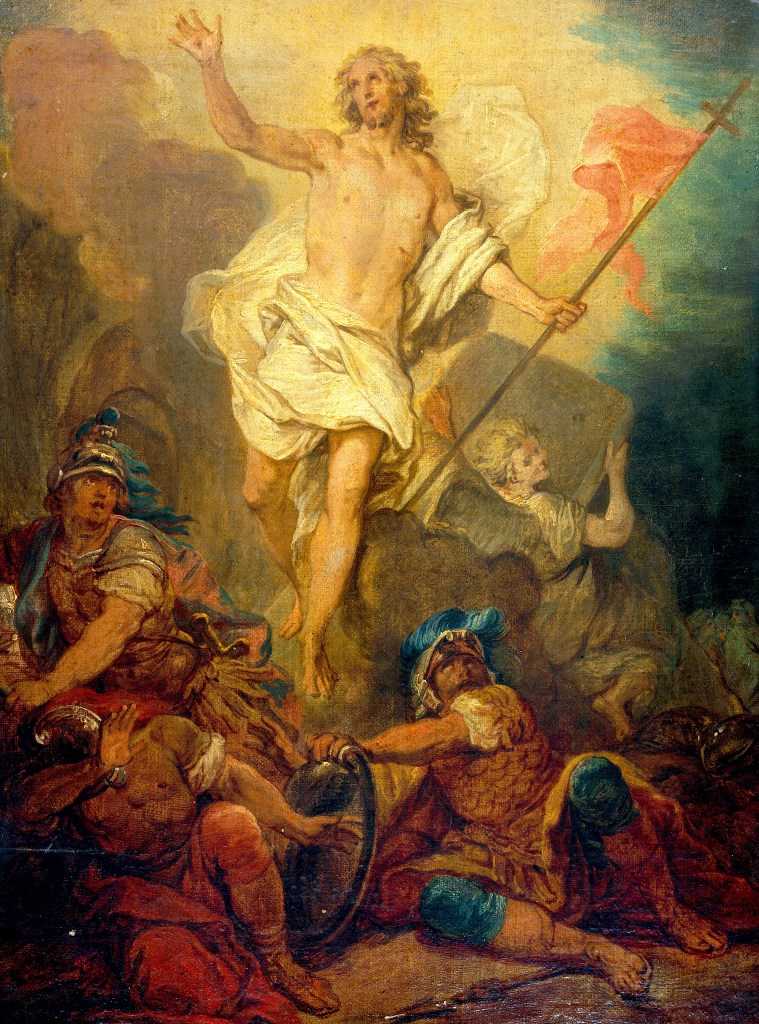
“I beheld the soul of our Lord between two angels, who were in the attire of warriors: it was bright, luminous, and resplendent as the sun at midday; his soul penetrated the rock, touched the sacred body, passed into it, and the two were instantaneously united and became as one. I then saw the limbs move and the body of our Lord, being reunited to his soul and to his divinity, rise and shake off the winding sheet: the whole of the cave was illuminated and lightsome.
“At the same moment, I saw a frightful monster burst from the earth underneath the sepulcher. It had the tail of a serpent, and it raised its dragon head proudly as if eager to attack Jesus; and had likewise a human head. But our Lord held in his hand a white staff, to which was appended a large banner; and he placed his foot on the head of the dragon, and struck its tail three times with his staff, after which the monster disappeared….
“I then saw the glorified body of our Lord rise up, and it passed through the hard rock as easily as if the latter had been formed of some [soft] substance. The earth shook, and an angel in the garb of a warrior descended from Heaven with the speed of lightning, entered the tomb, lifted the stone, placed it on the right side, and seated himself upon it. At this tremendous sight, the soldiers fell to the ground and remained there, apparently lifeless.”
Can you see the angel of the Lord suddenly appearing before those soldiers, a mischievous grin on his face, asking, “How you doin’?” I somehow suspect that after those boys woke up, they probably had to go home and change their shorts.
Honestly, I don’t know how it all happened, but I do know this: Jesus rose from the dead. Say, “Amen.” We learn from the various Gospel accounts that the women and some of the disciples went to the tomb and found it empty. All that remained were the grave clothes. Some encounter angels, and Mary actually encounters the Risen Lord. Can you imagine what they were all thinking?
For me, I think at first I would have been like them—afraid, shocked, wondering what those evil men had done with my Lord’s body. Perhaps after a while, pieces would come into focus, only to blow away like wisps of fog.
The quote from N.T. Wright, which Diane shared with us on Good Friday, holds true not only for John’s Gospel but also for all the Gospel accounts and events of those days. He said, “I don’t know that any of us will ever be able to hold all this in our minds at any one time. John allows the images to build up, one upon another, upon another, until we’re overwhelmed by them. . . . The only way forward is to allow all the different ideas and levels, the clashes of meaning and misunderstanding, to echo around until they produce prayer, awe, silence, and love.” (John for Everyone, Part Two, p.104)
The same must have been true for the Disciples on that first Easter Sunday. Like us, they had all this information—the prophecies from Isaiah and Ezekiel about the coming Messiah, the salvation of the Gentiles, and the Psalmist’s words regarding the piercing of the Messiah’s hands and feet. They also had the sayings of Jesus: “The Son of Man must be killed.” “Destroy this temple, and in three days, I will raise it up.” “This is my body… my blood.” All this information and so much more before Jesus’ death, yet none of it coalesced until after the Resurrection. However, they kept watching and were patient. They remained focused on God, and then, like a rose blooming, it all came together.
St. Paul said to the Colossians, and it is also true for us, “the mystery hidden for ages and generations” has now been “revealed to his saints. To them”—to you!—“God chose to make known how great among the Gentiles are the riches of the glory of this mystery, which is Christ in you, the hope of glory.” (Colossians 1:25b-27)
It would be like stepping out of that tomb on the first Easter morning. While inside, objects are shrouded in shadows and darkness. Your mind races. What happened here? Then you step out into the clear light of the new day and realize this is all God’s doing, and it is all about God’s love for you. Everything, from the first day when God created the Heavens and the Earth, to Jesus’ first breath in the manger on that first Christmas some 2,000 years ago, to the sunrise of that first Easter Sunday, to this very day, everything has been and is about God’s love for you and His desire to draw you to Himself.
Laugh at death. Step out of the darkness and the shadows of your self-created tomb and walk in the light and life of Christ Jesus. Rise with Him into life eternal.
Alleluia. Christ is risen.
The Lord is risen indeed. Alleluia.


 Candle in a Cave