Sermon: Proper 11 RCL C – “Home for the Holy Spirit”


A woman decided to have her portrait painted. She said to the artist, “Paint me with diamond rings, a diamond necklace, emerald bracelets, a ruby brooch, and a gold Rolex.”

“But you are not wearing any of those things,” the artist replied.

“I know,” she said. “It’s in case I should die before my husband. I’m sure he will remarry right away, and I want his new wife to go crazy looking for the jewelry.”

The Golden Jubilee Diamond is the world’s largest cut and faceted diamond. It weighs 545.67 carats and is roughly the size of a golf ball. Its market value ranges from $4 million to $12 million, depending on the market. However, due to its color and clarity, it is not the most expensive diamond. That honor belongs to the Pink Star Diamond, which weighs 59.6 carats and sold for $71.2 million. Both diamonds were cut to maximize their carat weight.

When it comes to cutting diamonds, the round brilliant cut offers the most sparkle, with 57 or 58 facets. 57 if the bottom tip remains pointed, and 58 if the point is cut away. These facets are added to help the stone reflect and refract light, creating, in diamond terms, scintillation. 

Perhaps a lot of unnecessary detail, but the point is that our Gospel reading today—the story of Mary and Martha—appears only in Luke’s Gospel and, when studied, proves to be scintillating in all its facets. There are many ways to interpret it, most of which are true, while some are just silly.

One facet, and perhaps the most apparent one, is the difference between the busy and the prayerful life. Martha is rushing around, taking care of all the chores, while Mary sits at Jesus’ feet, listening to His words. Jesus says that Mary has chosen the better way, so we might say that a contemplative life is preferable to a busy one. It’s a good message, and I have preached it before. However, it does not capture the fullness of what is transpiring. 

To start with, if we claim that life is all about the contemplative, then no work gets done. We end up sitting around all day singing Kum ba Yah, letting someone else handle everything. That was similar to what happened in the time of Paul. Do you know what he said? “If anyone is not willing to work, let him not eat. For we hear that some among you walk in idleness, not busy at work, but busybodies. Now, such persons we command and encourage in the Lord Jesus Christ to do their work quietly and to earn their own living.” (2 Thessalonians 3:10-12) When Jesus says that Mary chose the better, he’s not saying that Martha chose the wrong. Something more is happening.

Another facet has us viewing this through a feminist lens, and I’m not being disrespectful when I say that. During the time of Jesus, within the Jewish home, there were only two places where men and women would mingle: outside or in the marital bedroom. The main public room—think of it as the living room—was the gathering place for visitors, but it was for men only. It was in this public room that Jesus was speaking. Yet, even though it was reserved for men, Mary was there, sitting with the men—the little hussy. She is not fulfilling her duty as a woman by cooking and cleaning. Not only that, she is also sitting in the place of a man. Yet, when Martha complains, Jesus says that Mary has chosen the better part. For some, this interpretation highlights how Jesus leveled the playing field for men and women. It can be viewed as a type of liberation for women, placing them on equal ground with men. Another good sermon, and one I’ve preached before, but even though it makes a good point, it doesn’t capture the bigger picture.

Another facet would be to take this same idea and apply it to how Jesus crossed all boundaries. By making the Gospel accessible to Mary and speaking to her so openly, it can go further to suggest that Jesus is willing to cross all boundaries—ethnic, social, political, cultural, and more—in order to bring the message of God’s love and redemption to everyone. An excellent point, and I’m sure at some point, I’ve preached it.

The ideas of elevating women or crossing boundaries are both valid understandings and teachings, but they are both lacking because they don’t address all aspects of what is happening.

One of the silly interpretations comes from some who suggest that Martha and Mary were deeply in love with Jesus, and that Martha’s jealousy stemmed from Mary’s physical closeness to Jesus. Just for the record, that is not a facet, I haven’t preached it, and I’m never going to. 

As you examine these events, you’ll discover various other facets, but they are simply that, facets. So, this week, as I kept trying to grasp the message, I never felt truly satisfied with my understanding. I kept focusing on the individual characters—Mary, Martha, Jesus, the disciples—and realized I had been approaching it all wrong. Instead of seeking understanding through the facets, I needed to pull back and view the diamond as a whole. 

I believe that this is what Luke was pointing to in the opening sentence: “As Jesus and his disciples went on their way, Jesus entered a certain village, where a woman named Martha welcomed him into her home.” To understand, we don’t focus on the individual characters; instead, we consider the home and what is inside.

There is Jesus, our King and Redeemer. Like Mary, we are called to sit at His feet, learn from Him, and allow Him to guide our lives. At the same time, we are to be like Martha — tending to our individual callings, whether that means being a homemaker, a priest, a clerk, a nurse, or whatever else Jesus has assigned us. In doing so, we find balance. Too much work and we neglect time with Jesus. Although sitting with Jesus is the best choice, we can’t spend all our lives just sitting; we must also do the work. Does that mean we’ve abandoned Jesus? No. He is still in the house. He is still available to us. He is working alongside us.

In the Gospel of John, at the Last Supper, Jesus speaks to the disciples and says, “Whoever has my commandments and keeps them…” (John 14:21). Clarification: What are Jesus’ commandments? He gave them to the disciples just a few minutes earlier: “A new commandment I give to you, that you love one another: just as I have loved you, you also are to love one another. By this all people will know that you are my disciples, if you have love for one another.” (John 13:34-35)

So, “‘Whoever has my commandments and keeps them—that is, whoever loves—he is the one who loves me. And he who loves me will be loved by my Father, and I will love him and manifest myself to him.’ Judas (not Iscariot) said to him, ‘Lord, how is it that you will manifest yourself to us and not to the world?’ Jesus answered him, ‘If anyone loves me, he will keep my word, and my Father will love him, and we will come to him and make our home with him.’” (John 14:21-23)

The events that occur in Martha’s home are an embodiment of Jesus’ words in the Gospel of John. 

Our bodies and our souls are a home. Within our home, we work, play, rest, and pray. We live. If we keep the commandment of Jesus to love one another, He and the Father, that is, the Holy Spirit, will come to us and become part of our home. There, guided by the very Spirit of God, we will live a life that is pleasing to Him.

Pitting Mary against Martha is the wrong approach when admiring this diamond. The former archbishop of Turin expressed it well: “In our house, there is room for Martha and room for Mary, and we must occupy both places. We must be Mary because we are welcoming the Word, and we must be Martha because we are receiving the Son of Man.” We need to be Mary to learn about God’s love, and we need to be Martha to express that love to others. It’s not Mary or Martha, but Mary in Martha (cf. Sanctify Your Daily Life by Stefan Cardinal Wyszynski, p.100), and vice versa, with the Holy Spirit working in both.

When inviting the Holy Spirit into your home, don’t just give it access to the “spiritual” aspects of your life, but instead, allow it to roam freely throughout every room, so you will have access to and benefit from this Gift from God.

Let us pray: Come, O Divine Spirit, fill our hearts with Your heavenly fruits: charity, joy, peace, patience, long-suffering, kindness, goodness, faith, meekness, modesty, self-control, and chastity, so that we may never grow tired in serving God. Through continued faithful submission to Your inspiration, may we be found worthy to be united forever with You in the love of the Father and the Son. Amen.

Sermon: Proper 10 RCL C – “Mercy”

Remember Otis Campbell? He was the town drunk on The Andy Griffith Show who would lock himself in jail rather than waiting for Andy or Barney to arrest him. Well, imagine another Otis-like character, let’s call him Boudreaux, who doesn’t turn himself in but gets arrested for the umpteenth time and has to appear before the same judge, each and every time. However, on this most recent occasion, he makes a rather unusual request of the judge.

“Your Honor,” Boudreaux says, “if you don’t mind, I would like to try myself and judge myself.”

With nothing to lose, the judge says, “OK, let’s hear it.”

Well, ol’ Boudreaux lets loose on himself. “Boudreaux, you are a low-down, no-good polecat of a man, who has abandoned every responsibility you ever had. You have spent your entire life thinking only of your own selfish desires. And now here you are, once again, throwing yourself on the mercy of this court. However, you will find no mercy today, because you do not deserve it.” Then, turning to the judge, he says, “Your Honor, I find myself guilty as charged, and I sentence myself to a $100.00 fine and 30 days in jail. And I pray that God will help me understand the wickedness of my ways.”

The judge nodded thoughtfully and said, “Boudreaux, I think you really mean it this time. I commend you for your righteousness. I’ll accept your judgment.” 

At which, Boudreaux interrupted the judge and said, “Your Honor, I have one more thing. I suspend my sentence!”

Mercy. When we think of mercy, we often picture throwing ourselves on the mercy of the court. However, I doubt we often consider it as a Christian virtue, even though it is considered the greatest. St. Thomas Aquinas writes in his Summa Theologica, “Mercy is the greatest of the virtues, since it belongs to God to show mercy, and in this His omnipotence is manifested to the greatest degree.” And more simply, Pope Francis wrote, “Mercy is the very foundation of the Church’s life.” (Misericordiae Vultus, 2015) So, what is mercy?

Mercy comes from the Latin word misericordia, which literally means, “having a miserable heart.” Aquinas helps us understand more clearly what this means. He explains that there are two parts of mercy required for it to be considered a virtue—affective mercy and effective mercy.

Affective mercy is an emotional response—how something makes you feel. You see someone suffering in some way, and you feel sympathy or compassion for them. However, simply having sympathy is not a virtue. Consider the words of St. James: “What good is it, my brothers, if someone says he has faith but does not have works? Can that faith save him? If a brother or sister is poorly clothed and lacking in daily food, and one of you says to them, “Go in peace, be warmed and filled,” without giving them the things needed for the body, what good is that? So also faith by itself, if it does not have works, is dead.” (James 2:14-17) What good is it if someone has an emotional response to someone’s suffering but doesn’t act to ease that suffering? Affective mercy is good, but for it to be a true virtue, it must be accompanied by effective mercy.

Effective mercy is actually doing something about the suffering of others. Going back to James, “If a brother or sister is poorly clothed and lacking in daily food,” and you provide them with good clothing and give them something to eat, then you are acting and actually doing something about their suffering. However, effective mercy, action alone is not a virtue. 

Remember the parable Jesus told about the persistent widow who kept coming to the judge seeking justice. Yet, the judge “neither feared God nor respected man.” (Luke 18:2b) The widow kept returning, but the judge didn’t care anything about her; however, he ended up giving her what she wanted, saying, “Though I neither fear God nor respect man, yet because this widow keeps bothering me, I will give her justice, so that she will not beat me down by her continual coming.” (Luke 18:4b-5) I don’t care anything about this widow, but so that she’ll leave me alone, I’ll give her what she wants. It’s like someone giving to a charity, not because they care about the cause but because they need a tax write-off. Affective mercy is action toward someone who is suffering, but without sympathy or compassion for them, it is not a virtue. 

For mercy to be a virtue, it must be both effective and affective. Mercy as a virtue is defined by Aquinas “as the compassion in our hearts for another person’s misery, a compassion which drives us to do what we can to help him.” (Source)

The greatest act of mercy is witnessed in Christ upon the Cross. Through His compassion and sympathy for our fallen state, He submitted Himself to “death, even death on a cross.” And, from this example, we draw our inspiration. 

Perhaps Shakespeare expressed it most eloquently when he gave the words to Portia in The Merchant of Venice.

“The quality of mercy is not strain’d,
It droppeth as the gentle rain from heaven
Upon the place beneath: it is twice blest;
It blesseth him that gives and him that takes:
‘Tis mightiest in the mightiest: it becomes
The throned monarch better than his crown;
His sceptre shows the force of temporal power,
The attribute to awe and majesty,
Wherein doth sit the dread and fear of kings;
But mercy is above this sceptred sway;
It is enthroned in the hearts of kings,
It is an attribute to God himself;
And earthly power doth then show likest God’s
When mercy seasons justice.”
(Shakespeare, The Merchant of Venice, Act 4, Scene I)

Mercy is an attribute of God, and when we show mercy, combining affective and effective, we reflect God’s nature.

“Teacher, what must I do to inherit eternal life?” 

“What is written in the law? What do you read there?”

“You shall love the Lord your God with all your heart, and with all your soul, and with all your strength, and with all your mind; and your neighbor as yourself.” 

“You have given the right answer; do this, and you will live.”

“And who is my neighbor?”

The Parable of the Good Samaritan answers the question. Your neighbor is the one who shows mercy. Your neighbor is the one who feels compassion and sympathy for you and acts to help alleviate, if not all, then at least part of your suffering. Jesus says, if that is indeed how your neighbor acts towards you, “Go and do likewise.”

Yes, Jesus, I hear what you’re saying, but they are not like us. I mean, just look at them. They certainly don’t look or act like any of my neighbors. 

Jesus says, “Did I stutter? Go and do likewise.”

From Thomas Merton, “Our job is to love others without stopping to inquire whether or not they are worthy. That is not our business and, in fact, it is nobody’s business. What we are asked to do is to love, and this love itself will render both ourselves and our neighbors worthy.” (Disputed Questions, p.122) Why are we not to put qualifiers on our love and who may or may not be our neighbor? In the same paragraph, Merton answers by referring to 1 John 4:19: “We love because [God] first loved us.” St. Paul says something similar in his letter to the Romans. “God shows his love for us in that while we were still sinners, Christ died for us.” (Romans 5:8)

God did not stop to question whether or not we were worthy of His love or whether or not He should show us mercy. He loved, and He was merciful. Go and do likewise. 

As God’s beloved children, redeemed by the blood of His Son, this is what is required of us. The Prophet Micah writes,

“With what shall I come before the Lord,
    and bow myself before God on high?
Shall I come before him with burnt offerings,
    with calves a year old?

Will the Lord be pleased with thousands of rams,
    with ten thousands of rivers of oil?
Shall I give my firstborn for my transgression,
    the fruit of my body for the sin of my soul?”

He has told you, O man, what is good;
    and what does the Lord require of you
but to do justice, and to love mercy*
    and to walk humbly with your God.”

If you feel sympathy and compassion for someone, then do something to help alleviate their suffering. This is how God loved us and how we should love others in return.

A prayer given to us by St. Ignatius. Let us pray: Dear Lord teach us to be generous; teach us to serve you as you deserve, to give and not to count the cost, to fight and not to heed the wounds, to toil and not to seek for rest, to labor and not to ask for reward, save that of knowing that we do your will. Amen. 

* The ESV translates חֶסֶד as kindness, but the Hebrew is written וְאַהֲבַת חֶסֶד, which can rightly be translated as mercy andconveys the sense of undeserved compassion and covenantal faithfulness that Micah is emphasizing. All that to say, I like the ESV version, but tweaked it for what I believe is a better understanding. 

Sermon: Aquila and Priscilla


This past Sunday, we read in our Gospel the words of Jesus: “The Lord appointed seventy others and sent them on ahead of him in pairs to every town and place where he himself intended to go. He said to them, ‘The harvest is plentiful, but the laborers are few; therefore ask the Lord of the harvest to send out laborers into his harvest.’”

In discussing this, we found that the Lord was appointing ambassadors. Those seventy and the disciples can be considered the first generation of ambassadors. Today, we honor Aquila and Priscilla, husband and wife, as second-generation ambassadors.

Around 40 A.D., Claudius was emperor, and at that time, disturbances erupted between the Christian-Jews and the Gentile Christians over the Messiahship of Jesus. The Roman historian Suetonius, lumping the two groups together, wrote that the Jews “were rioting on account of someone named Chrestus.” Emperor Claudius, caring nothing about the argument, resolved it by expelling all the Jews from Rome, two of them, Aquila and Priscilla. After the expulsion, they traveled about 750 miles to Corinth, where they continued their trade of tent making. 

Perhaps because they heard him preach or because they shared the same trade of tent making, Priscilla and Aquila came into contact with Paul and became close companions in the work of the Gospel. Eighteen months later, the three traveled to Ephesus to continue God’s work, and shortly after, Paul went on to Antioch, but the couple remained in Ephesus. In writing to the Church in Corinth, Paul says in his closing, “The churches of Asia send you greetings. Aquila and Priscilla, together with the church in their house, send you hearty greetings in the Lord.” By mentioning them by name, Paul demonstrates the great esteem he had for them, and also tells us that Priscilla and Aquila started a church in their home. This was typical, as churches did not begin meeting in dedicated buildings until the third century.

The Acts of the Apostles also describe Aquila and Priscilla’s encounter with the Alexandrian Jew, Apollo. “He had been instructed in the way of the Lord. And being fervent in spirit, he spoke and taught accurately the things concerning Jesus, though he knew only the baptism of John.” So, after hearing him preach, Aquila and Priscilla “took him aside and explained to him the way of God more accurately.” Aquila and Priscilla were second-generation Christians, and by teaching Apollo, they helped raise up and train the next generation.

President Ronald Reagan said, “Freedom is never more than one generation away from extinction. We didn’t pass it to our children in the bloodstream. It must be fought for, protected, and handed on for them to do the same, or one day we will spend our sunset years telling our children and our children’s children what it was once like in the United States where men were free.” Replace the word ‘Freedom’ with ‘Christianity’ and you’ll have another truth.

Aquila and Priscilla returned to Rome, where they were eventually martyred for their faith, but they did not allow their faith to die with them. They serve as an example of what it means to be an apostolic church—a church that passes on the teachings and practices to the next generation, ensuring the faith of our fathers and mothers remains alive for all future generations.

Aquila and Priscilla are like the seventy Jesus sent out as ambassadors. So are we. Pass on your faith to the next generation so that the light of the Gospel may continue to shine in this dark world. 

Sermon: Moses the Black

Moses the Black, an Ethiopian living in Egypt during the 4th century, was born a slave and later became a bandit. After years as a feared criminal, he repented and approached the doors of a desert monastery, weeping for his sins. Because of his past, the monks did not allow him entry, even afraid at the mention of his name. However, after some time, they received and accepted him.

Although a member of the monastery, his passions continued to wage a spiritual battle, so he sought the help of the elder Abba Isidore. Moses followed Isidore’s instructions, from eating just enough to sustain himself while remaining hungry at all times, to standing all night in prayer. At night, Moses was led by the ladder to take on the task of fetching water from the well for the other brothers, especially those who were older and lived farthest from the well.

One night, while drawing water, Moses felt a sharp blow to his back and was knocked into the well, where he lay until he was found the next morning when the other brothers discovered him. A year passed before he was fully recovered, and it was then that Isidore declared him to be clean of his demons and ordered him to be ordained a deacon. On the day of his ordination, the bishop clothed Moses in white robes and declared, “Now Abba Moses is entirely white!” Moses replied, “Only outwardly, for God knows that I am still dark within.”

Continuing to protest his worthiness to serve at the altar, the Bishop set out to test him and ordered the other clergy to drive Moses from the altar and the church. Moses accepted this without protest. Witnessing this and being convinced of Moses’ humility, the Bishop ordained him a priest, a role he faithfully served for fifteen years until his martyrdom in 400 AD. 

Moses learned that the monastery would soon be attacked by bandits and encouraged the others to flee. All did, except for seven who remained with Moses. When he was urged to leave, he responded, “For many years already I have awaited the time when the words which my Master, the Lord Jesus Christ, should be fulfilled: “All who take up the sword, shall perish by the sword” (Mt. 26:52). (Source)

The good thief hanging on the cross to the right of Jesus rebuked the other thief, saying, “Do you not fear God, since you are under the same sentence of condemnation? And we indeed have been condemned justly, for we are getting what we deserve for our deeds, but this man has done nothing wrong.” 

I don’t know why Moses chose to remain, knowing that staying would almost certainly be a death sentence. Perhaps he thought he could buy the others more time to escape if he put up a fight. Whatever the case, I wonder if he heard the words of the good thief as he waited, “We indeed have been condemned justly.” I also wonder if he heard the words of St. Paul, “Wretched man that I am! Who will deliver me from this body of death? Thanks be to God through Jesus Christ our Lord!” (Romans 7:24-25a)

We are all rightly condemned for our actions. Thanks be to God through Jesus Christ, our Lord! Through Him, we are saved. He remembers us and, on our last day, brings us into the eternal paradise of His kingdom. 

Sermon: Proper 8 RCL C – “How to Play God”

Photo by Artur Aldyrkhanov on Unsplash

You know him, but you probably don’t know him by name—Jonathan Goldsmith. A few facts about his life: his passport requires no photograph, his business card simply says ‘I’ll Call You,’ and he brought a knife to a gunfight—just to even the odds. He is The Most Interesting Man in the World, and from 2006 to 2016, he was often heard saying, “I don’t always drink beer, but when I do, I prefer Dos Equis.” Of course, the internet got hold of that, and the memes continue to explode.

I don’t always live dangerously, but when I do, I press send before proofreading.

I don’t always pass slow drivers, but when I do, I check to see if they look as stupid as they drive.

I don’t always “Whoop,” but when I do, there it is.

On days when I know I have a service or will be out and about doing priesty things, I wear my cassock and collar. It really does change the way people look at me and respond. When I’m dressed in regular street clothes, most folks just pass by. When I’m in the cassock and collar, most will speak. The cassock and collar identify me with the church, faith, and hopefully, God. I believe it’s important and helps people see “the church” in the world. The other day, I made a hospital visit, so I was in cassock and collar. On the way back to my car, a mom, a dad, and their four children were heading in. One of the boys looked over at me and then shouted, “Dad, it’s the Pope!” His dad corrected him and told him that I was a priest, but it made me think, “I don’t always wear a cassock and collar, but when I do, people think I’m the Pope!” How you doin’?

There are certain individuals, organizations, and ideas that hold a place of honor in our lives. When we see or think about them, we want to be associated with them. If we can’t necessarily be in a relationship with them, then we will seek ways to be identified with them. Can I just say, “Go, Thunder!” Score of 103-91. A few years ago, I attended an OSU basketball game, but it and the final against the Pacers were the only basketball games I’ve seen in at least a decade, if not more. Yet, when the Thunder won, I—and I’m sure every other Oklahoman—didn’t say, “The Thunder won!” Instead, it was, “WE won!” We won the national championship. Yes, indeed. The most difficult thing I did that entire evening was feeding myself, but WE won. We celebrate in the parade, we wear our gear, and we boast that we are champions.

No, I don’t believe that I’m the Pope, but I do closely associate and am aligned with the Church. My identity is deeply tied to it. This association, I pray that this connection also reflects my relationship and identity in God: Father, Son, and Holy Spirit. 

Being associated and finding identity with the Church, God, and even the Thunder isn’t a bad thing. It brings joy, happiness, and, for the Church and God, a sense of purpose. It fulfills me. However, such connection and identity can sometimes lead to undesirable effects and actions.

In Luke’s Gospel, leading up to our reading today, the Apostles witnessed and experienced many exciting and miraculous events. They saw Jesus calm the storm, feed the 5,000, cast out demons, and heal the sick. Peter declared Jesus to be the Christ, and together with James and John, they witnessed the Transfiguration. Additionally, Jesus sent them out to do the same works He was doing: preaching, healing, and casting out demons. When they return, they report their successes. Because of their association and identification with Jesus, they also began to see themselves as closely linked with the One Jesus identified with—the Father. This, in itself, is a very good thing. They begin to understand that they are truly God’s children; however, after the Transfiguration, things take an unpleasant turn. 

The Apostles begin to think that if they were with Jesus, they could sit in the seats of honor in the coming kingdom, which they still only understood as an earthly kingdom. They start arguing about who is the greatest, so that they can rule, not only over the kingdom but also over each other. Going even further, now that they were in so tight with Jesus and, through association, to the Father, they begin to see themselves having the same rights and powers that belong exclusively to God. When the Samaritan village turns away from Jesus, “James and John saw it, they said, ‘Lord, do you want us to command fire to come down from heaven and consume them?’” 

Remember Abraham’s nephew, Lot. God had enough of the wickedness of Sodom and Gomorrah, so the “Lord rained down burning sulfur on Sodom and Gomorrah—from the Lord out of the heavens. Thus, he overthrew those cities and the entire plain, destroying all those living in the cities—and also the vegetation in the land.” When Abraham looked down from the mountains, “he saw dense smoke rising from the land, like smoke from a furnace.”

James and John believed they had the right to judge as only God can judge. They not only wanted to be associated with and identified with Jesus and the Father, but they also sought God’s power. They wanted to judge, rage against those they saw as God’s enemies, and exact vengeance on them. They wanted to play God. 

I’m not surprised that the Scriptures tell us Jesus rebuked them, but I am actually quite surprised that the Scriptures didn’t say, “And Jesus looked at them in dismay and said, ‘Are ya stupid? Nobody can call down fire from Heaven. That’s the dumbest thing I’ve ever heard.’” Why didn’t He say that? Because maybe we can’t burn a place or person down like what happened at Sodom and Gomorrah, but we can and do call down fire in other ways.

We put on our Jesus gear. We’ve got the crosses we wear and the clothes with messages that proclaim our faith. We talk openly about our faith. We post messages on social media for all the world to see. And if there were a Jesus parade, we’d jump in and want to ride on the float. We want to be associated and identified with Jesus and our faith. Good. Keep it up. There are many ways to proclaim the Good News. But, like the Apostles, we can take this too far.

We can come to believe that because we are with Jesus, we are holy or even holier than others. We can come to believe that if someone opposes our beliefs, they are opposing God, and therefore must be silenced because they are wrong and evil. We may believe that if they fail to keep our standards (even though we fail to do so ourselves), they are weak and unloved by God. We can look at others and then to Jesus and ask, “Lord, do you want us to command fire to come down from heaven and consume them?” When we do this, we take on the exclusive powers of God, playing God ourselves. In doing so, our sins become greater than those we judge, and we are the ones who need rebuking.

However, there is a way for us to play God, and in doing so, we take on not just what we understand as the power of God, but God’s true nature, as witnessed in Jesus. For if we have seen Jesus, we have seen the Father. What do we see in Jesus? St. Paul summed it up for us in his letter to the Galatians that we read this morning. We see in Jesus “love, joy, peace, patience, kindness, generosity, faithfulness, gentleness, and self-control.” Through the Spirit of God, we have the power to live this life.

William Temple was the Archbishop of Canterbury in the early 1940s. He writes,

“It is no good giving me a play like Hamlet or King Lear and telling me to write a play like that. Shakespeare could do it—I can’t. And it is no good showing me a life like the life of Jesus and telling me to live a life like that. Jesus could do it—I can’t. But if the genius of Shakespeare could come and live in me, then I could write plays like this. And if the Spirit [of God] could come into me, then I could live a life like His.”

Children may think I’m the Pope, but I’m smart enough to know I’m not even close. However, I desire to be so closely associated with and identified with Jesus that I begin to resemble Him. This transforming work is accomplished through the Spirit of God living within, and the fruit of this work is “love, joy, peace, patience, kindness, generosity, faithfulness, gentleness, and self-control.” Therefore, we must invite God’s Holy Spirit to take up residence in our soul, in our entire being, so that we may be as He is.

If you want to play God, bring peace. If you want to play God, remain faithful. If you want to play God, show kindness. In this way, you will not only be associated with and identified with the Lord, but you will also become like the Lord.

Let us pray (by St. Augustine): Breathe into me, Holy Spirit, that my thoughts may all be holy. Move in me, Holy Spirit, that my work, too, may be holy. Attract my heart, Holy Spirit, that I may love only what is holy. Strengthen me, Holy Spirit, that I may defend all that is holy. Protect me, Holy Spirit, that I may always be holy. Amen.

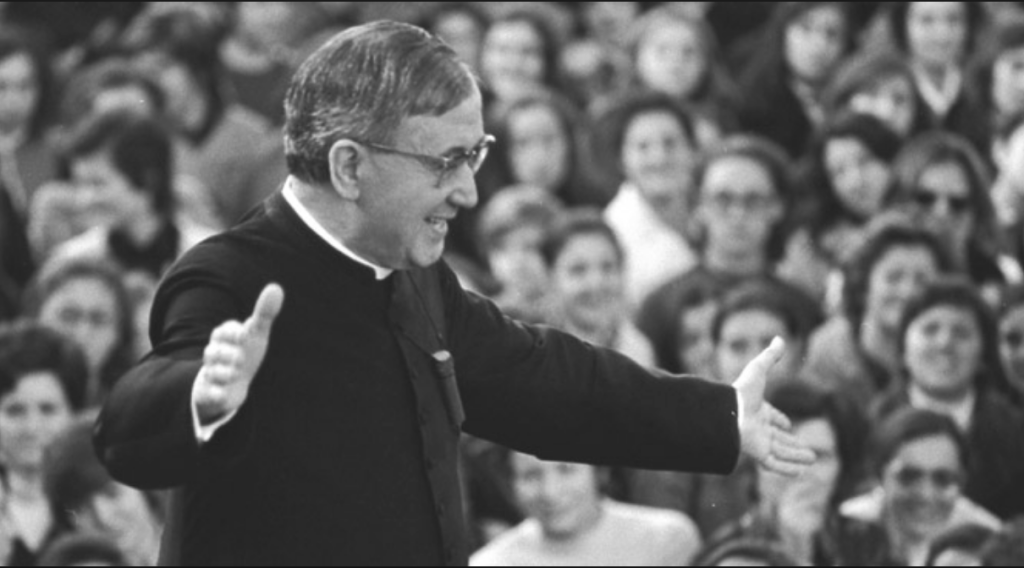
Sermon: Josemaría Escrivá


On October 6, 2002, one of the largest crowds ever to gather at the Vatican (with estimates reaching as high as 500,000) came to witness the canonization of one of my friends, Josemaría Escrivá. He is listed in our calendar of saints, but he is mine. His official feast day is tomorrow, June 26.

Pope John Paul II conducted the service and spoke fondly of the Saint and his close friend. 

“Outstanding in the founder of Opus Dei was his love for the will of God. There is a sure criterion of holiness: faithfulness in fulfilling the divine will to its ultimate consequences. The Lord has a plan for each one of us; he entrusts each one with a mission on earth. The saint cannot even think of himself outside of God’s plan: he lives only to fulfill it.

“St. Josemaría was chosen by the Lord to proclaim the universal call to holiness and to indicate that everyday life, ordinary activities, are the way of sanctification. It might be said that he was the saint of the ordinary.

“In fact, he was convinced that for anyone who lives from the perspective of faith everything offers an opportunity for encounter with God, everything becomes a stimulus for prayer. From this point of view, daily life reveals an unsuspected grandeur. Holiness appears truly within the reach of all.”

“St. Josemaría was profoundly convinced that the Christian life entails a mission and an apostolate: We are in the world to save it with Christ.

“He loved the world passionately, with a redemptive love. Precisely for this reason his teachings have helped so many ordinary members of the faithful to discover the redemptive power of faith, its capacity to transform the earth.

“This is a message that has abundant and fruitful implications for the evangelizing mission of the Church. It fosters the Christianization of the world ‘from within,’ showing that there can be no conflict between the divine law and the demands of genuine human progress.

“This saintly priest taught that Christ must be the apex of all human activity. His message impels the Christian to act in places where the future of society is being shaped.

“From the laity’s active presence in all the professions and at the most advanced frontiers of development there can only come a positive contribution to the strengthening of that harmony between faith and culture, which is one of the greatest needs of our time.”

I’ve read what many consider his most popular book, The Way, a collection of 999 sayings, multiple times. Also, through the internet, I’ve heard him speak at various events. What stands out to me is the difference between the two. When he speaks to others, he is compassionate and supportive, but many of the sayings in The Way can be quite harsh at times. Regarding charity, he writes, “Your charity is presumptuous. From afar, you attract; you have light. From nearby, you repel; you lack warmth. What a pity!” (#459)

Many others are similar, and all the writings are clear and bold, which makes me think that The Way (and I have no way of proving this) was originally a collection of sayings to himself. Words he spoke to himself to bring correction to his own life in areas he thought necessary, and it is that type of self-examination/self-evaluation that would make a Saint. Ever seeking to improve in the eyes of God. Such honesty with oneself can sometimes be quite painful, but as the Proverbs tell us, “Iron sharpens iron” (27:17), and we can all use honesty in our own self-examination and evaluation so that we too become the saints God has called us all to be. 

Sermon: Proper 7 RCL C – “Pigs”


[Place pig on front pew]

Last week, we discussed how we are bombarded with so much information—74 GB every day. It’s no wonder we can never find our keys. Their location gets pushed out to make room for something else.

This week, I would like to talk about stuff. Not in general kind of stuff, but the stuff that fills our houses. I came across some amazing facts on the topic.

I don’t know who collects this kind of data, but the LA Times reports that the average American home contains 300,000 items. This is probably why one out of every ten American homes rents off-site storage and why another 25% of those with two-car garages can’t fit even one car in them.

3.1% of the children in the world live in the USA, but they are responsible for 40% of worldwide toy sales, averaging 238 toys per child.

When it comes to shopping, we spend more on shoes, jewelry, and watches than on higher education. Women in the USA and Europe will, on average, spend 8 years of their lives shopping.

Currently, the 12 percent of the world’s population that lives in North America and Western Europe accounts for 60 percent of private consumption spending, while the one-third of the world’s population living in South Asia and sub-Saharan Africa accounts for only 3.2 percent. Of that consumption, Americans spend $1.2 trillion on nonessential items—things we don’t need.

We have all this and desire even more for ourselves, but what’s funny (not haha) is the fact that even with all we spend, on average, we only donate 1.9% to charitable organizations. (Source for above statistics)

You might say, “None of that is true.” However, if you’ve ever had to move or clean out someone else’s house, you know it’s pretty much spot on.

You all know that my dad died last summer, and we had to go in and clean out his apartment. Throughout his life, he lived in larger places, and each time he moved, he collected more and more stuff. Later in life, he had to downsize. As a result, the number of items he had collected over the years became fewer and fewer. In the years before he died, he had a small but comfortable apartment, and all that stuff was distilled down to what he cherished the most— a piece of art or a picture of him walking on the beach with my niece.

At first, the task of cleaning out was overwhelming. What to do with this or that? Eventually, my brother and I decided that everyone could take what they wanted, and we would give the rest to Goodwill. In the end, my brother had about a shoebox full of things, and I made it up to a paper box along with some pictures. Other family members did the same. When we finished, at least 95% of what my dad valued went to Goodwill. It held value for him but not for anyone else, and that’s OK.

It’s not that we didn’t love our dad; it’s just that he valued things that weren’t important to us. I know that when I’m gone, the same thing will happen. Someone will come and clean out my place. There may or may not be anything that anyone wants to keep. If I’m in Enid, I suspect 98% of what I consider valuable will end up at one of the thrift stores. It’s all just “stuff.” 

That pig right there represents the 98% of my stuff that will end up in the thrift store, but it holds value for me. What would I trade my stuff for? What would I not? Better question: Who would I trade my stuff for? Who would I not?

Our Gospel reading today is from Mark. (The image on the front of your bulletin depicts the same event, but from Matthew’s perspective. Mark says there was only one demoniac, but Matthew says there were two.) Jesus enters the lands of the Gentiles and encounters a man who lives in the tombs near the city. Upon seeing Jesus, the man cries out, “What have you to do with me, Jesus, Son of the Most High God? I beg you, do not torment me.” What follows is the classic order of an exorcism. Jesus commands the demon to come out of the man, eventually gaining the demon’s name. The demon says its name is Legion. A legion in the Roman army consisted of 6,000 soldiers, so the man is possessed by many demons. Knowing that Jesus can cast them back into the abyss, they beg to be sent into a nearby herd of pigs. The demons had brought insanity and chaos to the man’s life, and they do the same to the pigs upon entering them. It drives them to madness, and they drown themselves.

The pigs might disagree, but this would appear to be a happy ending. The man is freed from his demons and asks to follow Jesus. However, the pig herders rushed to town to report what had happened. Upon hearing the news, the townspeople came out and essentially said the same thing to Jesus as the demon had, “What have you to do with us, Jesus, Son of the Most High God? We beg you, go away. We don’t want you here.”

Having witnessed such a miracle, why would the people not welcome Jesus? Why did they send Him away?

There are a number of fringe thoughts on this. Some say they recognized the divine in Jesus, and everyone knows you really don’t want your gods walking around among you. There’s no telling what they’ll do. Closely related to this is the fear of the supernatural. We fear what we don’t understand. Both of these fears are likely part of the answer; however, most people agree that they asked Jesus to leave because He had deprived them of their stuff. 

Mark said it was a “large herd of swine,” and Jesus had just inflicted a huge economic blow through their deaths. Notice that when the townspeople arrived, they didn’t give thanks for the recovery of the demon-possessed man. They didn’t even mention him. No, it was their pigs, which impacted their stuff, that they were upset about. They showed more concern for material possessions than for the soul of a man.

In our lives, we place value on people just as we place value on stuff. Family, spouses, and children are—or should be—at the top of the list. Next come close friends, and, in some cases, friends of friends—I think church family falls into those two categories. Then we have people we don’t even know but feel connected to, such as public figures, celebrities, and the like. These are followed by acquaintances and fellow countrymen (which is naturally divided by our biases: race, religion, creed, etc.), and finally, everyone else. The way we respond to each of these individuals and groups reflects the value we place on them. A child who is sick with a fever will receive far more thought, consideration, compassion, and support than, say, the 279 people who were killed in the Air India crash or the 500K who have been killed in Russia’s war on Ukraine. Stalin summarized this by saying, “One death is a tragedy. A million is a statistic.” It comes down to the way we’re wired, mentally and emotionally.

From that list, who would I trade my stuff for? Who would I not? What part of my stuff is the soul of a loved one worth? What part of my stuff is the soul of someone on the other side of the world worth? 

For someone we love, we’d likely give it all, but what about that person on the other side of the planet? You don’t know them. Maybe they’re Muslim or Hindu. They look very different from you—hair, skin color, clothes. What is the value of their soul?

St. John Chrysostom wrote, “I am not about to mourn over many cities, or whole nations, yet shall I mourn over a soul which is of equal value with many such nations, yea even more precious…. For it is not the overthrow of a city which I mourn, nor the captivity of wicked men, but the desolation of a sacred soul, the destruction and effacement of a Christ-bearing temple.” (Two Exhortations to Theodore After His Fall)

There are many ministries of the Church, but it is the salvation of souls that is our singular calling. So, I’m not going to chastise you over stuff, I don’t know that I’ve got 300,000 items, but I’ve got plenty. I’m not going to ask you to go on mission trips around the world, proclaiming the Good News. I’m not even going to ask you to give money to support the work of spreading the Gospel. Instead, I’m going to ask you to find one person, one soul, and do exactly what Jesus, in our Gospel reading, asks the demoniac to do: “Return to your home, and declare how much God has done for you.” 

Within Judaism, there is a saying from the Mishnah, “Whoever saves a single life is considered to have saved the whole world.” (Mishnah Sanhedrin 4:5) Archbishop of Canterbury, Michael Ramsey, teaches us, “The one man, one woman, one child, are of infinite worth to God. … For the infinite worth of the one is the key to the Christian understanding of the many.” (The Christian Priest Today, 42)

“Return to your home, and declare how much God has done for you,” for the one soul you speak to is of infinite worth to our God.

Let us pray: Heavenly Father, pour forth your Holy Spirit to inspire us. Stir in our souls the desire to renew our faith and deepen our relationship with your Son, our Lord Jesus Christ, so that we might truly believe in and live the Good News. Open our hearts to hear the Gospel and grant us the confidence to proclaim the Good News to others. Pour out your Spirit, so that we might be strengthened to go forth and witness to the Gospel in our everyday lives through our words and actions. Amen.

Sermon: Bernard Mizeki


This isn’t necessarily a sermon; it may be better categorized under the heading, “Things to Ponder.”

Our saint for today, Bernard Mizeki, was from Africa. In my readings about his life, I was reminded of the writings of another African clergy person, Bishop Desmond Tutu.

Bishop Tutu wrote a rather inflammatory book as far as some Christians are concerned—God is Not a Christian: Speaking Truth in Times of Crisis—a collection of sermons and lectures.

From a lecture in 1992, Bishop Tutu says, “Is God dishonoured that Mahatma Gandhi was a Hindu? Shouldn’t we be glad that there was a great soul who inspired others with his readings of satyagraha, who inspired the Christian Martin Luther King Jr in his civil rights campaign? Do we really have to be so ridiculous as to assert that what Mahatma Gandhi did was good, but it would have been better had he been a Christian? What evidence do we have that Christians are better? Isn’t the evidence often overwhelming in the opposite direction?

“Don’t we have to be reminded too that the faith to which we belong is far more often a matter of the accidents of history and geography than personal choice? If we had been born in Egypt before the Christian era, we would have been perhaps worshippers of Isis, and had we been born in India rather than in South Africa, the chances are very, very considerable that we would have ended up being Hindu rather than Christian.” (p.15)

I believe in an omnipotent God, and I believe His word. The Psalmist declares,

“Your eyes [Lord] saw my unformed body;
    all the days ordained for me were written in your book
    before one of them came to be.”

(Psalm 139:16)

I believe the Lord knew us and our lives even before He began the act of creating; therefore, I believe He knew that I was going to be born in Louisiana and into a Christian upbringing. He knew that I would try to follow Him, and that, if it is His will, I will attain salvation through His Son, Jesus. I believe these things. However, with that said, does it also mean that I believe Gandhi was a really great guy and teacher, but because he was Hindu instead of Christian, he cannot attain salvation? That he is damned for eternity? There are plenty who will say, “Yes. He’s going to hell.” As for me, the answer is above my pay grade, but I do know that on the day of judgment, I do not want to be next in line behind Gandhi.

Jesus gave us the Great Commission: “All authority in heaven and on earth has been given to me. Therefore go and make disciples of all nations, baptizing them in the name of the Father and of the Son and of the Holy Spirit, and teaching them to obey everything I have commanded you. And surely I am with you always, to the very end of the age.” (Matthew 28:18-20) If we have one “job” on this planet, it is that; however, what happens to those we don’t reach with that message? What about those who lack the benefit of a Christian upbringing or any access to the Gospel of Jesus Christ? Is it their fault or ours, or did God simply choose who would be saved and who would not? I don’t have answers to these questions, but they are worth pondering, even if they may make us uncomfortable.

Bernard Mizeki was born in 1861 in what is now Mozambique. He later traveled to Cape Town, South Africa, where he came into contact with Anglican missionaries. He converted to the Christian faith and became a catechist in the church. He then obeyed the Great Commission and went out proclaiming. Many came to believe through his work, but in the end, some of those he was seeking to bring the message of God’s love to killed him, for they failed to understand the Good News.

Perhaps, when we ponder certain questions, we should not be overly concerned with “Who is in and who is out?” Perhaps our concern should be for souls. Who can we, like Bernard, proclaim the Good News of Jesus Christ to? From there, the work is and always has been God’s.  

Sermon: Trinity Sunday RCL C – “Listening”


The story is told of Franklin Roosevelt, who often endured long receiving lines at the White House. He complained that no one truly paid any attention to what was said. One day, during a reception, he decided to conduct an experiment. To each person who passed by and shook his hand, he murmured, “I murdered my grandmother this morning.” The guests responded with phrases like, “Marvelous! Keep up the good work. We are proud of you. God bless you, sir.” It was not until the end of the line, while greeting the ambassador from Bolivia, that his words were actually heard. Nonplussed, the ambassador leaned over and whispered, “I’m sure she had it coming.”

A recent article stated that 96% of people believe they are good listeners. The article also stated, “The bad news is that there’s a massive disconnect between the confidence in our listening and our actual abilities.” 

There are several reasons for this: we are more interested in what we will say than in listening to what the other person is actually saying; we drift off—tune out because we aren’t interested, or we are more interested in something else. Another article stated, “In the act of listening, the differential between thinking and speaking rates means that our brain works with hundreds of words in addition to those that we hear, assembling thoughts other than those spoken to us. To phrase it another way, we can listen and still have some spare time for thinking.” (Source)

Your brain works much faster than a person can speak, although I have known some individuals who can put the words out there at a remarkable pace. In between the spoken words, our brain processes not only what we hear but all sorts of other information. What does this mean? How do I respond? Can this person really be this thick? Did I remember to start the dishwasher? I wonder who just texted me? Oh, heck, I’m going to be late!

There are things we need to hear, but there is so much more information coming at us. “Scientists have measured the amount of data that enter the brain and found that an average person living today processes as much as 74 GB in information a day (that is as much as watching 16 movies), through TV, computers, cell phones, tablets, billboards, and many other gadgets. Every year, it’s about 5% more than the previous year. Only 500 years ago, 74 GB of information would be what a highly educated person consumed in a lifetime, through books and stories.” (Source) That was written in 2012, and if you were listening, you know that the amount of information increases by 5% a year. I’ll let you do the math as to how much information there is now, because I didn’t listen so good in math class, but it is a massive amount of information.

So, when you’re having a conversation with someone and they tell you the time and place of a particular event, and ten minutes later you can’t even remember who you were talking to, much less what the conversation was about… blame it on that 74 GB of information pouring into your head along with your own desire to speak and your general lack of attention.

“Jesus said to the disciples, ‘I still have many things to say to you, but you cannot bear them now. When the Spirit of truth comes, he will guide you into all the truth; for he will not speak on his own, but will speak whatever he hears, and he will declare to you the things that are to come.’” And we all respond, “I’m sorry, JC, what was that?”

The Holy Spirit of God will guide us and speak to us what He hears from Jesus and the Father. Yet, in this noisy world, how easy do you think it will be to truly hear what God is saying to His people? Perhaps if He sent His words out in an email or text message, we might take the time to read them; however, His words are communicated to us far more softly. We must learn to listen, and what is spoken will not always be displayed in flashing neon messages.

You know, I went on vacation to Japan. It was a wonderful trip, but the language barrier is real. While in Osaka, I went to the Doguyasuji Arcade, a large outdoor covered mall filled with hundreds of small and large restaurants. It is also wall-to-wall people, mostly teenagers. At the time of day or the day I visited, I was very much in the minority, and I was surrounded by all these young, energetic Japanese teens, who were all speaking Japanese. In addition, all the signs were in Japanese, and even Google Maps was messing up and showing everything in Japanese, leaving this particular older Caucasian a bit lost. However, as I walked along, there was one thing I briefly heard—two people walking in the opposite direction speaking English. In the midst of that cacophony of noise, language, lights, signs, and information, I could isolate one soft voice that I could hear and understand.

When I lived in Montana, I had some friends who owned a small ranch that was located down in a narrow valley. They kept about seventy cattle, and the second quarter of each year was calving season. One year, they wanted to take a week away and asked if I would watch the ranch. No problem. I had done it before and enjoyed it. Only a few mommas hadn’t calved, and they weren’t expected to that week while I was on duty. To keep me company, other than the cows, there was Bear. Bear was a great big ol’ fluffy mixed-breed of a dog, and Bear never barked—never—unless he spotted a coyote.

One evening, it is about nine o’clock, I’m sitting inside watching TV. I start to hear a dog barking, but I live in town and am accustomed to hearing dogs bark. For probably fifteen minutes, I didn’t think much of it. Dogs are always barking, but then it clicked. I jumped up and ran, stopping only long enough to grab a shotgun on my way out the door. One of the mommas had calved, the coyotes had smelled it and came down into the valley, and Bear, who never barked, was raising a fuss. I was so accustomed to hearing barking dogs that I had almost become deaf to one when it really mattered.

One more story, also from adventures in Japan. Japan is an incredibly clean country. Truly. There is literally no garbage on the streets and no graffiti on the buildings. Shopkeepers are out every day, sweeping up leaves and any other debris. Cement trucks, eighteen-wheelers, and dump trucks—all of them, even though in use, look like they just drove off the showroom floor, spotless and shiny. Additionally, Japan is as safe as it is clean; the crime rate is almost non-existent. 

I’m in Tokyo, and I’ve no idea where I am, but I’m safe and I’m exploring. I turn onto one street and then another. There are a lot fewer people. I see someone sitting on a curb, drinking from a bottle. That was very unusual. Next, for the only time I’m in Japan, someone approaches me and offers to sell me drugs. Wow, I think, this is so weird. I look down, and it strikes me, there’s garbage on the street. It is exceptionally rare and quite small, but I have managed to find the bad side of Tokyo. If I had been paying a little closer attention, I would have picked up on these subtle changes long before I ended up where I shouldn’t have been.

You know how a dog will cock its head when it’s listening, trying to understand and hear more clearly? That should be us as we practice listening to the Holy Spirit. Listening in this way implies a sense of bending or leaning our body or mind toward a source. Since the Holy Spirit isn’t providing God’s word to us through neon signs, we must learn to isolate the Spirit’s voice from the cacophony of voices that surrounds us, knowing that the Spirit’s voice is the voice of truth. We must not become so accustomed to listening to all the other voices and the incessant flow of information that we grow deaf to the voice of the Spirit, ignoring it when it truly matters. We must also open our eyes, paying attention to the subtle changes around us and acknowledging that these changes may very well be the Spirit’s voice warning us of potential dangers. 

In these and many other ways, God speaks His truth to us, speaks His word to us, and guides and teaches us. We may get by with truly hearing only 50% of what other people may say to us, but we can ill afford to listen to only 50% of what God tells us.

When the Lord wanted to speak to the young Prophet Samuel, Eli the priest instructed the boy to say, “Speak, Lord, for your servant is listening.” This must be our prayer as well: “Speak, Lord, for your servant is listening—listening in all the many ways You may speak to Your people—so that I may grow in Your ways, know Your truth, and follow where You lead.”

Let us pray:
Come, Holy Spirit, Creator blest,
and in our souls take up Thy rest;
come with Thy grace and heavenly aid
to fill the hearts which Thou hast made.
O comforter, to Thee we cry,
O heavenly gift of God Most High,
O fount of life and fire of love,
and sweet anointing from above.
Amen.