Several years ago, archaeologists began excavating in the courtyard of a medieval monastery and discovered seeds that had remained dormant for over 400 years. King Henry VIII closed the monastery in 1539, causing the herbs tended by the monks to perish, but the seeds sprouted to life again after the archaeologists disturbed the soil. For hundreds of years, the seeds lay there, and then, without warning—life.
A seed is planted in the ground; it may lie dormant for years, or the germination time might last several months, but something is happening below the surface. Like the seeds in the monastery, they may be surviving until a more opportune climate arises, or they might be developing an extensive root system for optimal growth. It is a mystery, but when God breathes life, the plant breaks through the surface of the ground and grows.
The ministry of Jesus was very much the same way. In the beginning, it just didn’t look like much was happening. Twelve bungling fellas, who, like the rest of the folks, didn’t “get it,” had to have private tutoring lessons after class. But just when that seed appears to grow, it gets splayed upon a cross and dies; then the stone is rolled away, and once again—life.
Jesus said, “The kingdom of God is as if a man should scatter seed upon the ground, and should sleep and rise night and day, and the seed should sprout and grow he knows not how.” What is meant by saying that the man “sleeps and rises” is that after he scattered the seed, the man went about his day-to-day business. He had done all he could do. The sprouting and growing was the work of the Lord. The Lord would do what the farmer could not—give life. The same is true with the work of the Church. We seek to do the will of God. We till the soil, we remove the rocks, we set up the irrigation, we scatter the seed, but it is the Lord who will give life, and He will do it in His own time. Much of this work of the Lord is performed below the surface, out of sight. He instructs us not to make a big show of ourselves and to be humble, so it only stands to reason that He will act in a similar manner. We should never be fooled by the perceived lack of activity or the silence, because when you least expect it—what was hidden will come to life; therefore, just as the farmer in the parable was ready at once to harvest the crop, we also must be prepared for when the harvest comes in.
James Lloyd Breck, whom we celebrate today, was someone who planted many seeds. He planted the seed of Nashotah House, where I attended seminary. He also sowed the seeds for numerous other organizations and churches, which, to this day- over 150 years later- continue to yield fruitful crops. St. Matthew’s is 132 years old this year. If the Lord has not returned by then, I pray that the seeds we are planting will produce bountiful crops 132 years from now, just as the seeds that Breck planted continue to multiply.
On the first Sunday of Lent, I shared that the movie The Passion of the Christ was heavily inspired by the text we’ve been meditating on for the past three weeks—The Dolorous Passion of Our Lord Jesus Christ by Anne Catherine Emmerich. One of the scenes in the movie, which is not found in Scripture, originates from Chapter 39.
I apologize in advance for reading too much to you today.
In the movie, the cross lies on the ground while Jesus is nailed to it. A hole has been dug at the base of the cross to allow it to stand upright. Now, with ropes tied to it, the soldiers are lifting the cross so that it will settle into the hole. When the cross is finally vertical, it drops violently a few feet into the prepared hole.
In chapter 39, Catherine speaks of this sudden violent dropping, the sound of it, and the result.
The cross was “raised up in the midst of the vast concourse of persons who were assembled all around…. The air resounded with acclamations and derisive cries when they beheld it towering on high, and after vibrating for a moment in the air, fall with a heavy crash into the hole cut for it in the rock. … When the solemn sound of the fall of the cross into the hole prepared for it in the rock was heard, a dead silence ensued, every heart was filled with an undefinable feeling of awe—a feeling never before experienced, and for which no one could account, even to himself; all the inmates of hell shook with terror, and vented their rage by endeavouring to stimulate the enemies of Jesus to still greater fury and brutality; the souls in Limbo were filled with joy and hope, for the sound was to them a harbinger of happiness, the prelude to the appearance of their Deliverer. Thus was the blessed cross of our Lord planted for the first time on the earth; and well might it be compared to the tree of life in Paradise, for the wounds of Jesus were as sacred fountains, from which flowed four rivers destined both to purify the world from the curse of sin, and to give it fertility, so as to produce fruit unto salvation.
The eminence on which the cross was planted was about two feet higher than the surrounding parts; the feet of Jesus were sufficiently near the ground for his friends to be able to reach to kiss them.”
In the New Testament, the Simon we are most familiar with is Simon Peter; however, there is another Simon, Simon the Pharisee, who we hear about in Luke’s Gospel.
Simon invites Jesus to dinner. While there, “A woman in that town, who lived a sinful life, learned that Jesus was eating at the Pharisee’s house, so she came there with an alabaster jar of perfume. As she stood behind him at his feet, weeping, she began to wet his feet with her tears. Then she wiped them with her hair, kissed them, and poured perfume on them.”
Simon, aware of this woman’s reputation, believes that if Jesus truly is who he claims to be, He would recognize that this woman is wicked. Understanding Simon’s thoughts, Jesus then told a parable.
“Two people owed money to a certain moneylender. One owed him five hundred denarii, and the other fifty. Neither of them had the money to pay him back, so he forgave the debts of both. Now which of them will love him more?”
Simon replied, “I suppose the one who had the bigger debt forgiven.”
Simon receives the gold star. Jesus then says, “Do you see this woman? I came into your house. You did not give me any water for my feet, but she wet my feet with her tears and wiped them with her hair. You did not give me a kiss, but this woman, from the time I entered, has not stopped kissing my feet. You did not put oil on my head, but she has poured perfume on my feet. Therefore, I tell you, her many sins have been forgiven—as her great love has shown. But whoever has been forgiven little loves little.”
To the woman, Jesus says, “Your sins are forgiven…. Your faith has saved you; go in peace.” (Luke 7:36-50)
Gathered around Jesus as He hung upon His Cross were soldiers, religious leaders, gawkers, and followers. However, Catherine tells us that others were present—demons who cheered on those committing these evil acts and souls in Limbo, witnessing the coming of their salvation. Heaven, Hell, and all of creation witnessed the King upon the Cross, which we can break down into their respective categories. However, in the end, there are really only two categories, and Jesus identified them earlier in His ministry. He stated, “Whoever is not with me is against me, and whoever does not gather with me scatters.” (Matthew 12:30)
Gathered around the Cross were those who were either with Jesus or against Him. Present were those whose sins were forgiven and those who stood condemned. There is no gray area. Those who were forgiven, out of the deepest gratitude and adoration, came forward and, like the woman in Simon’s house, kissed the feet of Jesus. Like the Prodigal Son, they were the ones who knew they had been lost but also understood that they had been found, forgiven, and would be received into the Kingdom of God as sons and daughters.
What is particularly interesting is the fact that in the past 2,000 years, nothing has changed. There is our crucified Savior upon His Cross, and gathered around Him are Heaven, Hell, and all Creation. As before, we can categorize them into their respective groups—white/black, Republican/Democrat, male/female, rich/poor, Asian/European, etc., etc., etc. However, as before, there are only two categories—those who are with Jesus or those who are against Him. Sons and daughters of God Most High or condemned. Some will time and time again nail Jesus’ feet to the cross, while others will, out of the deepest sense of gratitude and adoration, come forward and kiss His bloodied feet. There are those who will hear Jesus say, “I never knew you; depart from me” (Matthew 7:21), and there are those who will hear Jesus say, “Your sins are forgiven…. Your faith has saved you” (Luke 7:50).
Have faith. Within your soul, come and kneel before the Cross of Jesus, and kiss the nail-pierced feet. He is the only One who can forgive and save, and He endured all of this for you. He is waiting for you.
Let us pray… Lord Jesus Christ, author of our salvation and most gracious Dispenser of pardon, and most patient in tolerating man’s wickedness, I bless and thank you for the great pain, the many stripes, and the bloody wounds inflicted on your tender and noble body. From the soles of your feet to the crown of your head there was no area without its injury or lesion.
O precious wounds, supreme signs of incomparable love, abounding with divine sweetness, it is from you that the sinner learns abiding trust.. otherwise his guilty conscience would cause him to despair. In these wounds we find the medicine for life, abundant grace, full forgiveness, unstinting mercy, and the gateway to promised glory. Whatever defilement I incur or whatever sins of the flesh I commit, it is in these fountains that I wash myself clean, and am purified, and again made new.
Lord Jesus Christ, fountain of holiness and sweetness, I bless and thank you for your abundant love… Instill in my flesh a fear of you, lest I yield to carnal appetites; pierce my hands, lest I yield to sloth; transfix my feet that I may remain firm and courageously endure toil and sorrows. May your nails enter my heart’s center and there inflict a saving wound, as a consequence of which and because of my overwhelming contrition, may I shed tears and be lost in love of you. Fill me with wonder and increase my devotion, until nothing will be more pleasant or dearer to my heart than Christ Jesus and him crucified. Amen.
This week, we continue our meditations on Chapter 26, “The Crowning with Thorns,” from The Dolorous Passion of Our Lord Jesus Christ by Anne Catherine Emmerich.
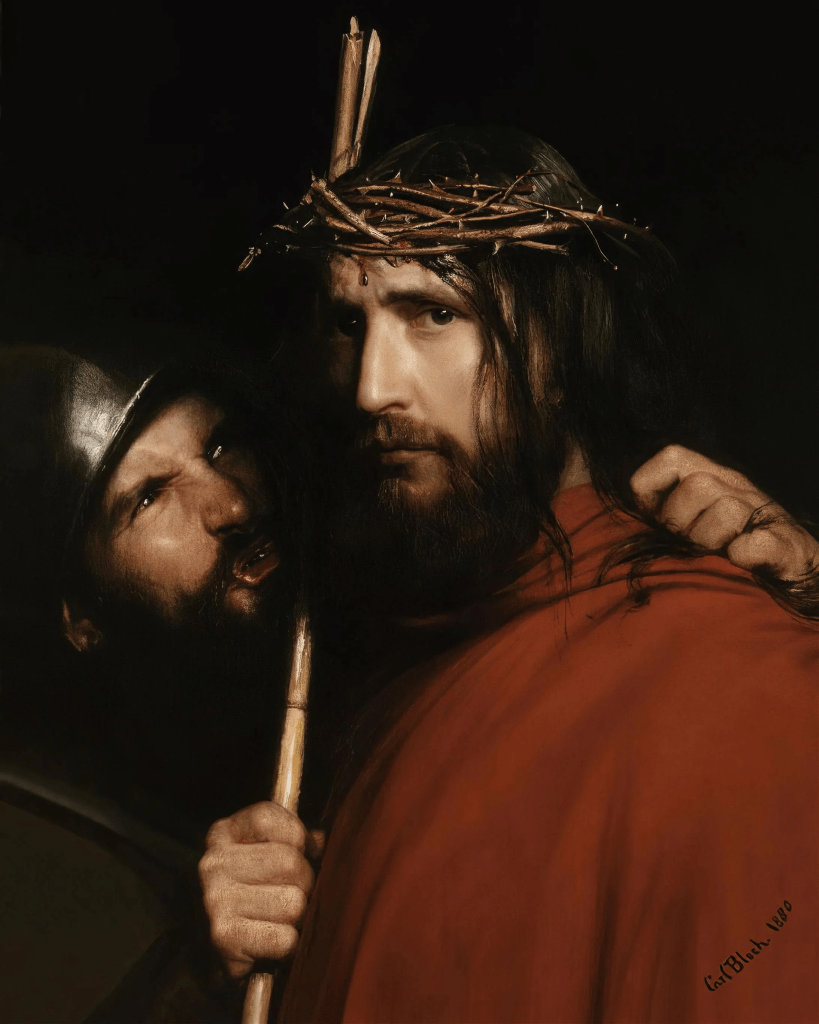
In the middle of the court—where Jesus had been scourged—there stood the fragment of a pillar, and on it was placed a very low stool which these cruel men—who had whipped Jesus—maliciously covered with sharp flints and bits of broken potsherds. Then they tore off the garments of Jesus, thereby reopening all his wounds; threw over his shoulders an old scarlet mantle which barely reached his knees; dragged him to the seat prepared, and pushed him roughly down upon it, having first placed the crown of thorns upon his head. The crown of thorns was made of three branches plaited together, the greatest part of the thorns being purposely turned inwards so as to pierce our Lord’s head. Having first placed these twisted branches on his forehead, they tied them tightly together at the back of his head, and no sooner was this accomplished to their satisfaction than they put a large reed into his hand, doing all with derisive gravity as if they were really crowning him king. They then seized the reed, and struck his head… they knelt before him, derided him, spat in his face, and buffeted him, saying at the same time, ‘Hail, King of the Jews!’ Then they threw down his stool, pulled him up again from the ground on which he had fallen, and reseated him with the greatest possible brutality.
Humility. It is something we all need to learn a bit more about. First, what it is not. Humility does not mean walking around believing you are such a lowly worm that the rest of the world shouldn’t even acknowledge your existence. Humility does not mean becoming a doormat or a punching bag for others. Perhaps C.S. Lewis summed it up nicely when he wrote, “Humility is not thinking less of yourself, but thinking of yourself less.” What does that look like?
Many years back, a Black man walked through an affluent neighborhood of Tuskegee, Alabama, when a wealthy white woman approached him. She asked if he would like to earn a few dollars by chopping wood for her. With no urgent business at hand, the man smiled, rolled up his sleeves, and set about the humble task she had requested. When he finished, he carried the logs into the house and stacked them by the fireplace. The White woman did not know who the man was, but a little girl who passed by did and told her after the man had left. It was Booker T. Washington, professor, and president of the Tuskegee Institute.
The following day, the embarrassed woman visited Mr. Washington in his office at the Institute and apologized profusely. “It’s perfectly all right, Madam,” he replied. “Occasionally, I enjoy a little manual labor. Besides, it’s always a delight to do something for a friend.”
In the Sermon on the Mount, Jesus gave instructions on the core characteristics of humility. He said, “Blessed are the poor, those who mourn, the meek, those who thirst for righteousness, the merciful, the pure, peacemakers, and the persecuted.” However, Jesus did not only teach us through His words. As He stood in that courtyard, enduring the scourging, mocking, spitting, and the crown of thorns, He embodied all these qualities.
He was the King of Kings, yet He wore a crown of thorns. He stood there battered, bruised, and bleeding like one who had nothing or a common criminal. He mourned for those who persecuted Him and showed mercy toward them, later saying, “Father, forgive them.” His hunger and thirst for righteousness—not His own, but ours—was so great that He endured all these trials.
Perhaps the Sermon on the Mount could be summed up in one phrase: “Blessed are you when you wear your own crown of thorns,” for that says, “Blessed are you when you are willing to give up what you see as rightfully yours for the sake of someone else.” Which, ultimately, is the very definition of love: “Willing the good of the other.”
Dutch Reform Pastor Andrew Murray wrote, “Humility is perfect quietness of heart. It is for me to have no trouble; never to be fretted or vexed or irritated or sore or disappointed. It is to expect nothing, to wonder at nothing that is done to me, to feel nothing done against me. It is to be at rest when nobody praises me and when I am blamed or despised.
“It is to have a blessed home in the Lord where I can go in and shut the door and kneel to my Father in secret and be at peace as in a deep sea of calmness when all around is trouble. It is the fruit of the Lord Jesus Christ’s redemptive work on Calvary’s cross, manifested in those of His own who are definitely subject to the Holy Spirit.”
When the pride within you begins to swell and you are feeling puffed up, or when you start to think of yourself as more successful or spiritual than your brothers and sisters in Christ, and something is said that stings your ego, meditate on our Lord Jesus Christ. Visualize the King of Kings and Lord of Lords standing before you with His crown of thorns tightly fitted around His head, and remember how He humbled Himself for your sake.
St. Paul teaches us, “Have this mind among yourselves, which is yours in Christ Jesus, who, though he was in the form of God, did not count equality with God a thing to be grasped, but emptied himself, by taking the form of a servant, being born in the likeness of men. And being found in human form, he humbled himself by becoming obedient to the point of death, even death on a cross.” (Philippians 2:5-8)
Let us pray. “Lord Jesus Christ, glorious King of the saints and radiant Crown of eternal glory… with singular devotion and a heart full of compassion, I praise and glorify you for the brutal punishment you most patiently suffered in the crowning of your sacred head with thorns…. Your sacred head, the most blessed of all Nazarenes, was covered with thorns that pierced so deeply.
“What a sorrowful sight to see the Son of God, in whom no sin could be found, so shamefully and horribly crowned! Because of the soldiers’ raging madness, they did not in the least tremble as they pierced with many a sharp thorn so holy, so handsome, so noble, and so revered a head. They likewise dared to salute the King of angels by publicly ridiculing, striking, and mocking him.
“Most gentle Jesus, King most admirable, Crown of Confessors, Strength of the Church Militant, Delight of the Church Triumphant, and model of all who follow you, how shamefully you were treated, how cruelly tortured! While many a blow was outwardly delivered, you experienced great inward distress, and all this for my sake… to save me from eternal punishment in hell, to cleanse my heart from its vicious habits, and to crown me in heaven with undying glory and honor.
“Cleanse me, Lord Jesus, from the contagion of material possessions. Clothe me with true virtue and grant me to rejoice when I meet contempt. Let me not complain about those who laugh at me, or argue with those who reproach me, but by my remembering your crown of thorns may I calmly accept, for the sake of my salvation, whatever pain and affliction may come my way. Amen.” (On the Passion of Christ: According to the Four Evangelists, p.55-61)
In 2004, during my last semester in seminary, Mel Gibson’s The Passion of the Christ was released in theaters. A group of us and one of our professors went to a Sunday matinee. Our professor, Father McGlynn, was dressed in his cassock and collar. As we exited the theater, someone waiting to enter asked, “Father, what did you think?” Father McGlynn replied, “It is what it was.” I agreed and still do. However, I did notice several scenes that did not correspond to the Gospel accounts, and I wanted to know the source of the information. Long story short, I discovered TheMeditations of Anne Catherine Emmerich—The Dolorous (or Sorrowful) Passion of Our Lord Jesus Christ.
It is a difficult read for several reasons, one of which is the fact that the text is as graphic as the movie. Still, I believe, “It is what it was,” and it is as fascinating as it is terrible, so I’ve read it a couple of times. I wanted to try to understand what Our Lord endured in those last hours of His life. Why? Because He did it for me, and if He did it for me, there must be something I’m meant to learn from His suffering.
During this Season of Lent, we are going to spend some time looking at this text in relation to the trials Our Savior endured. No, I won’t read the more graphic parts, but you will understand what is happening. The point is not to scare or cause you grief but to discover what Jesus, even in His suffering, was trying to teach us.
Finally, the prayer at the conclusion of each sermon comes from On the Passion of Christ: According to the Four Evangelists, written by my friend, the 14th-century monk Thomas à Kempis. At times, those prayers are a bit longer than usual, but as this is Lent, we’ll be OK praying.
So, in the opening words of The Imitation of Christ by Thomas à Kempis, let us “meditate on the life of Jesus Christ.” We begin with the scourging that followed the trial before Pilate.
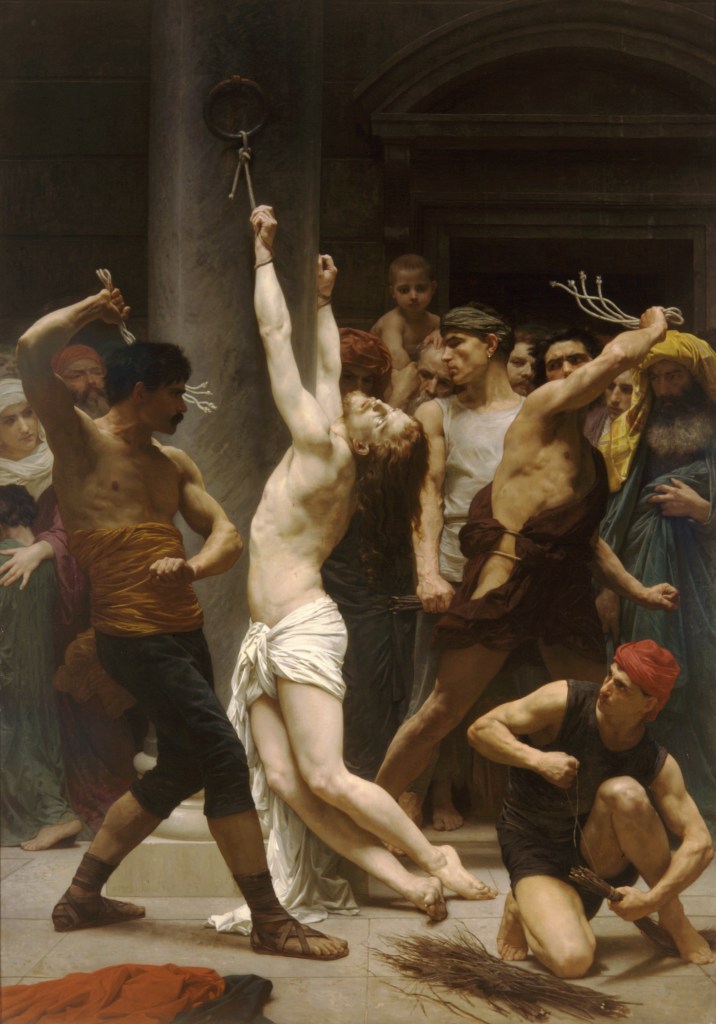
Blessed Catherine writes, “Jesus put his arms round the pillar, and when his hands were thus raised, the [soldiers] fastened them to the iron ring which was at the top of the pillar; they then dragged his arms to such a height that his feet, which were tightly bound to the base of the pillar, scarcely touched the ground. Thus was the Holy of holies violently stretched, without a particle of clothing, on a pillar used for the punishment of the greatest criminals; and then did two furious ruffians who were thirsting for his blood begin in the most barbarous manner to scourge his sacred body from head to foot. The whips or scourges which they first made use of appeared to be made of a species of flexible white wood, but perhaps they were composed of the sinews of the ox, or of strips of leather.”
Jesus endured such suffering, and we want to learn from it. But what can we possibly hope to learn from such senseless brutality that leads to so much agony? The answer is twofold: It teaches us about how we must endure our own suffering and how we are to see others in their trials.
As for us, we find the answer throughout the New Testament. St. Peter teaches that Christ “suffered for you, leaving you an example, so that you might follow in his steps. He committed no sin, neither was deceit found in his mouth. When he was reviled, he did not revile in return; when he suffered, he did not threaten, but continued entrusting himself to him who judges justly.” (1 Peter 2:21-23)
This speaks specifically to suffering for righteousness’ sake, but the Church has long held that it also applies to the hardships we face in the world and our bodies. The lesson is that in His suffering, Jesus entrusted “himself to him who judges justly.” In His suffering, Jesus entrusted Himself to the Father.
When we suffer, we sometimes do the opposite, or, even worse, instead of turning to the Father, we blame Him. Jesus’ final words teach us the correct response, “Father, into your hands I commit my spirit!” (Luke 23:46)
In the scourging of Jesus, for ourselves, we learn that we are not to look down or inward, cursing the world or God. Instead, we are to turn our faces toward Heaven and commit our lives—the good, the bad, and the ugly—to He who loves us and calls us his own.
That is what Jesus can teach us about our own suffering, but how can we learn from Jesus when witnessing the suffering of others?
In his book, The Wounded Healer, Henri Nouwen shares a tale. It’s too much reading for a sermon, but I’m going to read it anyway.
One day a young fugitive, trying to hide himself from the enemy, entered a small village. The people were kind to him and offered him a place to stay. But when the soldiers who sought the fugitive asked where he was hiding, everyone became very fearful. The soldiers threatened to burn the village and kill every man in it unless the young man were handed over to them before dawn. The people went to the minister and asked him what to do.
The minister, torn between handing over the boy to the enemy or having his people killed, withdrew to his room and read his Bible, hoping to find an answer before dawn. After many hours, in the early morning his eyes fell on these words: “It is better that one man dies than that the whole people be lost.”
Then the minister closed the Bible, called the soldiers and told them where the boy was hidden. And after the soldiers led the fugitive away to be killed, there was a feast in the village because the minister had saved the lives of the people.
But the minister did not celebrate. Overcome with a deep sadness, he remained in his room. That night an angel came to him, and asked, “What have you done?” He said: “I handed over the fugitive to the enemy.” Then the angel said: “But don’t you know that you have handed over the Messiah?” “How could I know?” the minister replied anxiously. Then the angel said: “If, instead of reading your Bible, you had visited this young man just once and looked into his eyes, you would have known.” (The Wounded Healer, p.31-2)
What can we learn about others from the suffering Jesus endured? We can learn that within the soul of each and every person is the Image of God, the Messiah. We can learn that when they suffer, regardless of race, creed, or religion, He suffers. In this knowledge, we can remain as bystanders, simply watching the suffering as those who watched Jesus’ scourging did, or like Jesus showed us throughout His life and ministry, we can work to ease the suffering of the world around us, one soul at a time.
Witnessing Christ’s scourging wrecks our souls, and hearing the lashes with the ears of our hearts can bring us to our knees. Yet, Jesus did not endure such pain for us to turn from it or block it out. He endured it so that, in the midst of our own trials, we might learn to entrust our lives to the Father. He also suffered through the lashes so that we might see in Him and respond to the suffering of others.
“By His stripes, we are healed.” Through witnessing His stripes and His suffering, we become like Him.
Let us Pray: Lord Jesus Christ, I praise and glorify you with endless gratitude for your barbarous scourging, for every stinging blow and piercing wound to your most holy and tender body.
O holy son, my God’s beloved Son, what have you done to deserve such dire treatment? Nothing, of course. But I? I am as one who is lost, for I am the cause of all your sorrows and distress. The enormity of my sins has brought this misery upon you, and to forgive my sins it was necessary for the Son of God to pay by suffering these bitter torments.
O most adorable Jesus, who endured that most painful scourging for me, the worst of sinners, grant that with a sorrowful heart I may gaze on each of your wounds and kiss them with a deep burning love. From them I breathe the perfume of life and partake of the medicine of eternal salvation. Inflame me with the fire of your infinite love, for you have indeed manifested that love for me—your servant worthy of being condemned—by enduring so many stripes from the scourges in your tormentors’ hands. Whenever I am faced with trials, send me your grace to bolster my weakness, lest under the weight of these afflictions, I become unduly dejected and agitated, and may I be mindful of your unjust scourging and meekly submit myself to all such ordeals.
Allow me a share in your sufferings and arouse in me the desire to amend my life by taking discipline, and, being thus humbly chastised, I may present myself as being more pleasing to you in the present life and rejoice with you more gloriously in the next, where all the saints, with all fear of evil gone, rejoice in everlasting contentment. Amen.
The second string and benchwarmers are never good enough to have their names in light or pictures on the cover. It’s always the superstars that get all the press, while the rest of the team goes largely unnoticed. It is true in many different arenas.
Before the symphony begins, the stage is crowded with all the musicians warming up, except for the first-string violinist. Just as the performance is about to begin, they come out to the applause of the crowd, followed only by the conductor. It is as though all the other positions are there only to serve these two. Even so, Leonard Bernstein, who conducted the New York Philharmonic from 1958 to 1969, said, “Second fiddle. I can always get plenty of first violinists, but to find one who plays second violin with as much enthusiasm . . . now that’s the problem. And yet if no one plays second, we have no harmony.”
The “second fiddle” of the San Francisco Symphony said, “Playing second fiddle may connote being second best, but the preparation for playing first or second violin is exactly the same.”
When I was playing football in junior high, I was a benchwarmer who dreamed of one day making it to the second string. However, when I went to practice, the coach didn’t say, “You first stringers, give me 50 sit-ups, and you second stringers (or less) give me 25.” When it was time to practice, we all went at it the same way. On game day, we all suited up and were ready to play.
Following the death and resurrection of Jesus and prior to Pentecost, the disciples were gathered in Jerusalem. They had fellowship, prayer, and began establishing a plan for moving forward. In the process, they believed there needed to be twelve disciples, as Jesus had, so the first order of business was to replace Judas, the disciple who betrayed Jesus.
Peter said that the new apostle should be “one of the men who have accompanied us during all the time that the Lord Jesus went in and out among us, beginning from the baptism of John until the day when he was taken up from us—one of these must become a witness with us to his resurrection.”
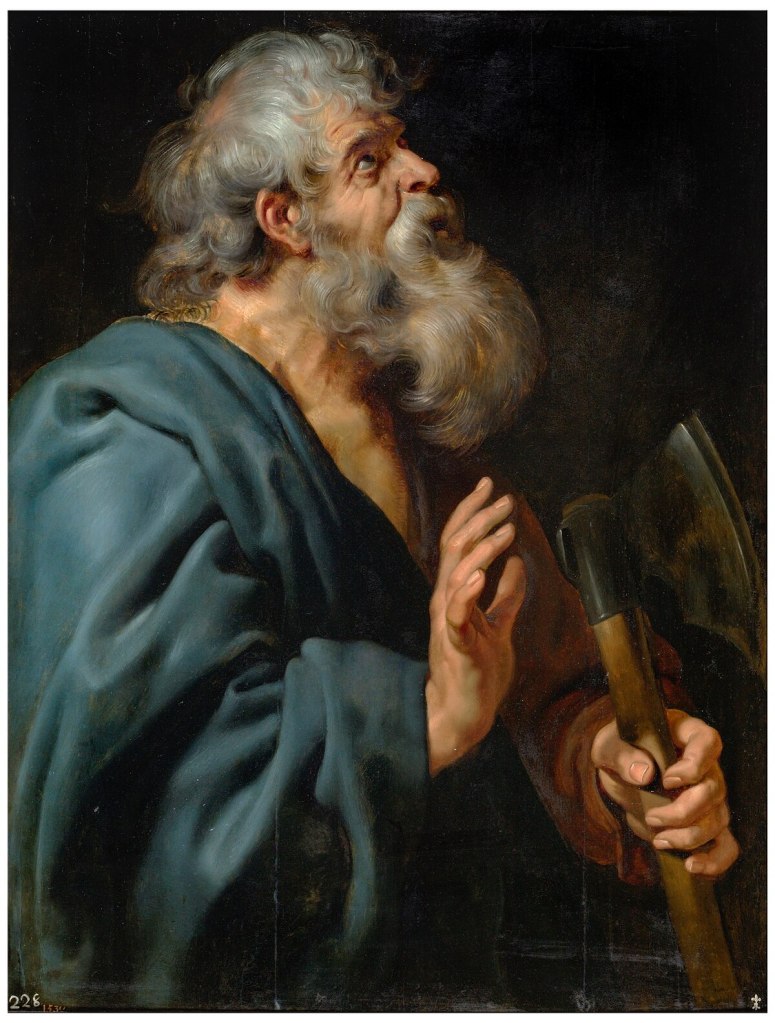
After discussion, it came down to two. Scripture then says, “Then they prayed and said, ‘Lord, you know everyone’s heart. Show us which one of these two you have chosen to take the place in this ministry and apostleship from which Judas turned aside to go to his own place.’ And they cast lots for them, and the lot fell on Matthias; and he was added to the eleven apostles.”
The second string just got their shot at the big league.
Back to my football career, the coach occasionally let me in the game for a few plays, but that was about it. Some fellas were quite a bit better than me, so I understand now why I didn’t get to play much, but I think another problem wasn’t necessarily my lack of talent but the fact that I never believed I would be called up. I never felt that I could actually make first string. I don’t think it was an intentional act not to try harder, but, looking back, I don’t think I was intentional about improving either. I was just happy to be on the team, get to wear a letter jacket, and muddle along.
Perhaps that is OK in Jr. High football and even the symphony, but Matthias teaches us that when it comes to being a disciple of Jesus, we should constantly seek to improve ourselves and maintain our highest level of commitment, for we never know when God will call us into a greater responsibility.
I’ve complained to you once before about the headlines for newspaper articles. The situation has not improved. One newspaper reports, “Woman missing since she got lost.” I don’t know if the city or the newspaper is the rocket scientist on this one, but “City unsure why the sewer smells.” No concerns about the education system as “Hispanics ace Spanish tests.” Nothing offensive here, “Midget sues grocer, cites belittling remarks.” And in keeping with the politics of the day, “Ex-Minister breaks silence, says nothing.” And if you think those are idiotic, try these goofy phrases on for size.
“Love your enemies.”
“Do good to those who hate you.”
“Bless those who curse you.”
“If anyone strikes you on the cheek, offer the other also.”
And the clincher, “Do to others as you would have them do to you.”
The headlines are ridiculous, but when people start talking like this, I generally begin to think that some sort of rehab is in order.
Last week, we read that Jesus came to a level place with His disciples, and a great crowd gathered around them. Jesus then began to teach, saying, “Blessed are you who are poor, for yours is the kingdom of God.” He gave them the beatitudes. Today’s Gospel reading is a continuation of that same sermon, and the things Jesus says are radically the opposite of how people believed God operated and even more so on how the world operates.
For example, take the one mentioned, “Blessed are you who are poor, for yours is the kingdom of God.” The Old Testament does not directly say you are cursed if you are poor, but it does say the opposite. Proverbs 10:22,
“The blessing of the Lord makes rich, and he adds no sorrow with it.”
Deuteronomy says, “You shall remember the Lord your God, for it is he who gives you power to get wealth, that he may confirm his covenant that he swore to your fathers.” (Deut. 8:18)
The Old Testament does not say you are cursed if you are poor, but for many, these texts imply it. If you are rich, then God is blessing you. If you are poor, you must have done something wrong to anger God. All the points Jesus made in our reading today are just as startling.
“Love your enemies.” We never seem to recall hearing this in the Old Testament because the opposite is so prevalent. Remember the Edomites and the Babylonians. They did not play well with others, and the Israelites saw them as bitter enemies. The Psalmist made that point quite clear.
“Remember, O Lord, against the Edomites the day of Jerusalem, how they said, “Lay it bare, lay it bare, down to its foundations!”
O daughter of Babylon, doomed to be destroyed, blessed shall he be who repays you with what you have done to us!
Blessed shall he be who takes your little ones and dashes them against the rock!” (Psalm 137:7-9)
Not quite the love we were hoping for. Yet, Jesus says we are to love our enemies. In the Sermon on the Mount, He even expanded on this by saying, “I say to you, Love your enemies and pray for those who persecute you.” (Matthew 5:43)
We can look at this and everything that Jesus said and understand how radical His teachings were at the time—how controversial they must have been. Fortunately, that’s no longer the case. We love our enemies and never curse anyone. We always turn the other cheek and never strike back. We don’t judge or condemn, and we are incredibly forgiving. Am I right?
I don’t always pull out the Greek Interlinear Bible (it provides a literal translation of the text), but I did with the passage. I was checking on a particular word—“if.” The translation we read says “If” in a few places, but it is not in the original Greek. Therefore, Jesus is not saying, “If you have enemies… if someone curses you… if someone strikes you… if someone steals from you and so on.” Instead, Jesus is saying, “You will have enemies; there will be those that curse you, someone will strike you, and others will steal from you. It will happen, but you are not to treat them like they treat you. You are to treat them the way you want them to treat you.”
I would like to get up every morning and say my Stuart Smalley (Saturday Night Live) affirmations, “I’m good enough, I’m smart enough, and doggone it, people like me.” I would also like to believe that’s true; however, I may be good enough and smart enough, but not everybody likes me. I’m just not their cup of tea. I don’t think the way they think, believe what they believe, hold to the same politics as they do, or any number of other points of contention. The same is true for all of us. It may seem that everyone is giving you a thumbs up, but don’t be fooled; some are giving you a thumbs down (if not worse), so the question is not whether or not you have these people in your life. You do. The question is, how do you treat them? How do you respond to them?
Jesus told us how, and St. Peter reaffirmed it in his first Epistle. He writes, “All of you, have unity of mind, sympathy, brotherly love, a tender heart, and a humble mind. Do not repay evil for evil or reviling for reviling, but on the contrary, bless, for to this you were called, that you may obtain a blessing.” He then quotes a portion of Psalm 34. “For
‘Whoever desires to love life and see good days, let him keep his tongue from evil and his lips from speaking deceit;
let him turn away from evil and do good; let him seek peace and pursue it.’
We are called to be a light unto the nations, but when we act like everyone else, we only bring more darkness. N.T. Wright says that this type of behavior is “Another victory for the hostile world: when Christians ‘give as good as they get,’ repaying slander with slander, they are colluding with the surrounding world, just as surely as if they went along with immorality or financial corruption.” Therefore, our response is that which Jesus calls us to. That is, to behave and respond in a way that is radically the opposite of the world. We are to love instead of hate. Bless instead of curse. Give instead of take. Forgive instead of holding grudges. And this is not easy; even worse, it is not our natural inclination. Most people just aren’t that nice. Therefore, it must be an intentional way of life and a practiced one.
If you want to love your enemies instead of hating them, you must make a conscious decision to love them and then practice it. If you are going to bless instead of curse, you will have to decide this before you even get out of bed, then you must put it into action. And we must do these things, not just with our lips and actions, but also in our hearts. If you are only washing the outside of the pot and the inside is still filthy, what good is that to you?
One final note: Jesus said, “The measure you give will be the measure you get back.” But keep in mind that the measure you “get back” is not from this world. It is from your Heavenly Father. Therefore, not everyone is going to like you, and not everyone is going to play according to the same rules you’ve set for yourself. You may turn the other cheek, but you may also get smacked on that one as well. Yet, don’t let that stop you from living the life God has called you to.
The headlines are ridiculous, and the news behind them is often even more ludicrous and incomprehensible. Yet, amid the insanity of it all and in our personal lives, we are called to a different way of life. Will it be easy? No, and no one ever said it would be. Regardless, “be strong and courageous” and live this radically countercultural life Jesus calls us to.
Let us pray. (This is a prayer from Mother Teresa, and I’ve shared it with you before. Perhaps it is not as much a prayer as a commissioning.)
People are often unreasonable, illogical, and self-centered; forgive them anyway.
If you are kind, people may accuse you of selfish, ulterior motives; be kind anyway.
If you are successful, you will win some false friends and some true enemies; succeed anyway.
If you are honest and frank, people may cheat you; be honest and frank anyway.
What you spend years building, someone could destroy overnight; build anyway.
If you find serenity and happiness, they may be jealous; be happy anyway.
The good you do today, people will often forget tomorrow; do good anyway.
Give the world the best you have, and it may never be enough; give the world the best you’ve got anyway.
You see, in the final analysis, it is between you and your God; It was never between you and them anyway.
What gameshow would you be on if you were in a studio audience filled with people in the wildest costumes, all holding up goofy signs and enthusiastically shouting? Let’s Make a Deal. You’ve got the audience, Jay, the man with the table, pretty Carol Merrill pulling back curtains and striking dramatic poses in front of “A brand new Chevy Vega,” and, of course, Mr. Gameshow host himself, Monty Hall.
I remember watching Let’s Make a Deal as a kid but not really understanding it. Now, you can watch all the episodes on the Internet, and they are funny.
Monty would pick one of the crazy-dressed audience members and offer them $300, or they could make a deal. That’s when Jay would appear, carrying his table with a box sitting on it. You could keep the $300 or trade it for the unknown. The audience member would hem and haw, then make a choice, and it would run from there. One deal after another until the big prize. Some people won big; others may walk away with an ox pulling a cart. However, in the end, for the grand prize finale, Monty makes the final deal. You could keep what you had or have what was behind door number three—and there would be the lovely Carol Merrill posing before the hidden prize.
You’ve got $5,000 in hand, or you could make the deal, give it all up, and see what was behind door number three. What do you do?
The Event Horizon Model describes a phenomenon related to how we categorize memories. For example, consider your time in school.
Your entire experience is of the education process, but that process consists of distinct phases, such as elementary school, high school, college, and graduate school. These represent your education, and you have memories that are stored and sorted within and in the context of each phase. Think of it as a library. In a library, you’ve got the fiction section, non-fiction, biography, etc. In the Event Horizon Model, your memory has a section for grade school, high school, etc., and your memories are filed according to those various events. The current or most recent phase holds the clearest memories, while those from the past are a bit hazy. You’re not forgetful; instead, the information from earlier events is less relevant, so it gets set aside or even offloaded.
Throughout our lives, we have various events. Perhaps it is our schooling. It might also be stages of life—child, teenager, adult, married, married with children, and so on. That is a fairly typical progression. However, have you noticed that when you go from one to the next, it often feels as though you are starting over?
I was in school for a while, then I graduated and started to work. A new event and a new beginning. I decided to get married. I stopped being single and started being a spouse. Another event, but also the process of starting over. It really is a bit like saying, “Monty, I think I’ll take what’s behind door number three.” Everything we think we know is taken from us, and we embark on this new thing, and, for the most part, we’ve no idea what we are doing. This can cause anxiety, confusion, and any number of other negatives that impact our lives.
In situations like this, what is needed is something constant and stable that travels with us from one event to the next. We may choose what lies behind door number three—it’s not a bad thing—but we need a place to stand—a place of grounding.
The scene from our Gospel reading today occurs very early in Jesus’ earthly ministry. Jesus had a meal at Peter’s house, but the disciples didn’t seem to be traveling with Him just yet. On this day, Jesus returns to Bethsaida, Peter’s hometown, and the crowds gather. To address them all, He gets into Peter’s boat and asks him to push out from the shore a bit so that He can see and speak to everyone gathered. Afterward, He instructs Peter to push out into the deep water and fish.
Peter says, “We’ve been doing this all night, but if you say so, we will.” They do, and we have the miraculous catch of fish. Peter doesn’t know what is going on, but he knows he is afraid. This Jesus is a holy man, and he doesn’t feel worthy to be near Him, but Jesus says, “You think this is amazing? Stick with me; I’ll show you something special.”
We can interpret this scene in many ways, but today, I would like you to consider it as a representation of your life.
Peter’s boat is more than just his livelihood. His ability to eat and feed his family, to care for them, and to provide for their other needs revolves around that boat. Peter’s boat is more than his livelihood; it is his life, and Jesus steps into it. Jesus steps into Peter’s life. This is an “invasion of grace.” Jesus, God has not taken away Peter’s free will, but through these actions, Jesus is saying to Peter, “I want to be a part of your life.”
This is also a doorway leading to a new event in Peter’s life. He was a fisher of fish. He is becoming a fisher of men. Going from one thing to the next, and the anxiety is setting in, “Go away from me, Lord, for I am a sinful man!” But Jesus tells him, “Do not be afraid. I will be with you. Always. To the end of the age. I will be with you from one horizon to the next. I will be your place to stand.”
Jesus says the same to us, but He is promising more than simply being present. In the context of this episode, I came to understand this at 1:04 a.m. Wednesday morning, and had to get up and write it down.
Jesus instructed Peter to head out into the deep water and cast his nets. Peter followed his advice, and they experienced a miraculous catch of fish—“They caught so many fish that their nets were beginning to break.” Question: What do you think Jesus was doing while all this was happening?
I always imagined Jesus sitting back and watching, but now I believe quite differently. I think He was right there with Peter. I think He rolled up his sleeves, grabbed hold of the net, and started hauling it in with all the rest. I believe He got soaking wet and stunk of all those fish, right along with Peter and the others. I think He joined His voice with Peter’s and shouted for the others to come and help. He laughed with them when James and John’s boat began to sink under the weight of all those fish. Jesus not only stepped into Peter’s life and turned it upside down, but He stepped into Peter’s life and lived it with him. Not as a bystander or judge to see how Peter would do but as a faithful friend. One who wanted the very best for Peter and the others and wasn’t afraid to step in and get dirty. And One who would be with them as they crossed the new horizons of their lives, providing them a firm place to stand, regardless of what was taking place.
Jimmy Buffett wrote a song—Door Number Three. The third stanza:
And I don’t want what Jay’s got on his table Or the box Carol Merrill points to on the floor No, I’ll hold out just as long as I am able Until I can unlock that lucky door Well, she’s no big deal to most folks But she’s everything to me Cause my whole world lies waiting behind door number three.
Some events in our lives are choices like going for what’s behind door number three. Other events are just life. You are in a phase of life where you are healthy, but life walks you through a doorway that leads to sickness. You are secure in your position then you find yourself unemployed. A relationship goes from good to awful. All these various events, where you pass through the doorway, and a new horizon lies before you, bringing the unknown, the destabilizing, the anxiety. However, if we have a place to stand, if we’ve allowed Jesus to step in our boats, invading our lives with His grace, then He will be with us regardless of the circumstances or the outcome. As with Peter, Jesus will be a faithful friend who is not afraid to get involved in the messiest parts of our lives, and along the way, He will provide that firm place for us to stand as we cross from one horizon to the next.
Jesus has climbed into your boat and asked you to put out into the deep. Do what He asks. Take what’s behind door number three.
Let us pray (pray this one for yourself as I read): Father, I abandon myself into Your hands; Do with me whatever You will. Whatever You may do, I thank You. I am ready for all, and I accept all. Let only Your will be done in me, And in all Your creatures. I wish no more than this, O Lord. Into Your hands, I commend my spirit; I offer it to You, Lord, and so need to give myself, to surrender myself into Your hands, Without reserve and with boundless confidence, For You are my Father. Amen.
St. Francis Xavier first arrived in Japan in 1549 with other Jesuit missionaries and proclaimed the Kingdom of God. They achieved success with an estimated 300,000 converts, but the large number of adherents to a new religion alarmed the Shoguns—How do we deal with them?—leading to a ban on Christianity and the beginning of persecutions. The first martyrs we remember today were six Franciscan Friars and twenty of their converts. They were all crucified. The ban on Christianity lasted 250 years, but it was not until after WWII that true religious freedom arrived in Japan.
The persecution and ban could have easily ended the faith in Japan, but instead, they drove it underground. So today, as we remember those first martyrs, I thought we might look at their legacy, one that remains even today: they are known as the Kakure Kirishitan, or “Hidden Christians.”
Following the ban and the persecutions, those who wished to maintain their Christian faith began to worship in Buddhist and Shinto temples to ‘hide’ among the crowds (Shinto involves the worship of ancestors and nature spirits). Since there were no Christian priests to continue teaching the faith, a rather interesting synergy of Christianity, Buddhism, and Shintoism emerged. Not only did it combine these different practices, but the texts used for worship are a blend of Portuguese, Latin, and Japanese. Today, although they might recite the Our Father, Hail Mary, and other Christian prayers, it is believed they lack a true understanding of their meaning. I do not think this implies unfaithfulness on their part. If anything, I would argue it demonstrates an even greater faith, for even though their understanding may be limited, they have not failed to deny themselves and take up their cross. In no way did they… do they—for a small number still exist today—in no way were they ashamed of the Gospel; they simply carried it on as they understood it.
Fewer than one percent of Japanese people are Christian and the Hidden Christians are gradually disappearing altogether. Patrick Downes, editor of the Hawaii Catholic Herald, reviewed a short film titled Otaiya: Japan’s Hidden Christians by Christal Whelan in 2000. Downes reports that Whelan “captured a unique Kakure Kirishitan funeral practice in which a small piece is cut from a centuries-old kimono which had belonged to a particularly holy Hidden Christian martyr. The two square inches of cloth is wrapped in paper and placed in the hands of the dead.
Today all that remains of the kimono belonging to one of the priests is a small piece of cloth kept folded in a box.
That kimono is a fitting metaphor for the Kakure Kirishitan a religion born of persecution, enfolded in the heavy mantle of Japanese culture, concealed over the ages in a dark lacquer box of secrecy, destined to disappear bit by bit by careful bit as each member passes into eternity.” (Source) https://www.catholiceducation.org/en/culture/catholic-contributions/kakure-kirishitan.html
It would be very easy to dismiss these Hidden Christians, descendants of early Christians and martyrs from Japan. We might say that they are not truly “Christian,” but this kind of judgment should be left to God, because these individuals—more so than many who identify as Christian—are genuinely seeking Him. And in the end, isn’t that what we are all trying to do?
I have one woman at home who rules my life—the Queen (a 9.2-pound feline)—but I also have two women who work for me 24/7. One is Alexa, and the other is Siri. Siri takes care of my personal life. She sets my calendar, wakes me in the morning, sends messages, and makes phone calls. She’s quite handy. Essentially, she runs my life (I’m very thankful that The Queen has not yet learned how to add to my calendar). The other woman is Alexa. Alexa is the house workhorse. She takes care of security, lights, temperature, and things of that nature. If I need to know what’s on my calendar for tomorrow, I ask Siri. If I need to know if the front door is locked, I ask Alexa.
At night, I don’t want any light in my room, so I don’t even have a clock. When I want to know what time it is, I ask, “Alexa, what time is it?” She’s always happy to tell me.
However, one night last year, I woke up and wanted to know the time. I said, “Alexa, what time is it?” But she did not answer me. I thought, OK, maybe I didn’t say it loud enough, so I said again, “Alexa, what time is it?” Still no answer. She was definitely falling down on the job. I said it one more time very loudly and in a kind of rude way (and let me just say that I’m not disrespectful to my AI helpers because I want to be on their good side when they take over the world). Still, I said it kind of loudly. “Alexa, what time is it?” No answer. I opened my eyes and discovered the problem. I was in Norway. Siri travels with me, Alexa does not.
As I laughed to myself about that, I wondered if, when we pray, do we treat God in a similar manner. “Hey God, I need you to take care of .” We wait a little while, and when there’s no answer, we say again, “Hey God, I need you to take care of .” When there is still no answer, we get up on our high and mighty and loudly pray, “God, I need you to take care of _.” When we wise up and open our eyes, we quickly realize that He is God and we are not. We need to remember our place in this relationship.
We must also remember that when we believe our prayer is not answered, God may simply be saying, “No. Not going to happen.” Even so, there are many times when we persist, and the more we want something, the louder and more frustrated our prayers become. It is that frustration that can lead us into trouble. How so?
Peaky Blinders. It is a TV show. I’ve never seen it, but I came across a quote from one of the episodes. I had to sit down and think about it. One of the characters says, “Someone once said to me, ‘The devil… he listens to your prayers too. Doesn’t always come with horns, you know. Sometimes, he looks like everything you ever wanted.’ That stuck.
You see, mate, the devil’s clever, yeah? He don’t come bangin’ on your door wearin’ horns, screamin’, ‘I’m here to ruin ya life.’ Nah, he’s subtle. Slips in quiet, dressed up like all your hopes, all your bloody dreams. Makes you believe he’s the answer you’ve been waitin’ for. But here’s the thing, right? The devil don’t take what you ain’t already offered. It’s a trade, innit? A shiny deal with the kind of cost you don’t see till it’s too late. So, be careful, yeah? ’Cause not every smile is salvation. Some are the first step to destruction.”
There is some debate on whether the devil actually hears our prayers, but all agree that he cannot do anything about them. I’m not swayed either way, but I am firmly convinced he can do nothing about them. However, when we become frustrated, our prayers can fall outside the realm of prayer and into the category of our will instead of God’s Will. These prayers originate from our more base passions—wants, desires, lusts. When this happens, I do believe the devil hears us and says, “Now, that’s something I can work with.”
Perhaps you get a new job. You give thanks for this job and pray that you will do it well. Over time, you begin to think, “I’m good at this; maybe I’ll get a raise or promotion?” At first, you pray rightly that you’ll do a good job and that, if it is God’s will, you will see a reward, but each time you are up for review, nothing happens. You continue to pray but then add, “Well, perhaps if I put in more hours, I’ll get noticed.” And guess what? It works. A raise and a promotion. Are you satisfied? Happy with where you are? For a time, but then… “I could make more money if…?” And the cycle repeats.
By the world’s standards, you are successful. You’ve got a good position making good money. However, in that scenario, there may be some questions you need to ask. When was the last time you spent quality time with your wife? Your children? Have you found yourself wanting more and more, never satisfied with what you have and how fat your bank account is? Are the people you associate with the type who encourage your life with Christ Jesus, or do you no longer have time for that sort of thing? You made a trade. You got a shiny deal, but you never stopped to consider the hidden costs.
Where did you go wrong? You prayed, yes, but you added a bit that wasn’t really a prayer— “Well, perhaps if I put in more hours, I’ll get noticed.” The devil couldn’t do anything about your prayer, but that last bit… that last bit, the devil said, “Now, that’s something I can work with.”
Today is the celebration of the Presentation of Our Lord in the Temple, a fixed feast day forty days after Christmas. Why forty days? The Mosaic Law dictated that the firstborn should be dedicated to the Lord (Exodus 13:2), and after a woman gave birth, she was not to “touch anything sacred nor enter the sanctuary till the days of her purification are fulfilled.” (Leviticus 12:2-8) As part of our remembrance of these events, we light our candles to symbolize God’s Light coming into the world. As Simeon said,
“A Light to enlighten the nations, and the glory of your people Israel.”
In our readings, what struck me the most was Simeon and Anna’s faithfulness and prayer.
Simeon was devout, for the Holy Spirit rested on him. He watched day and night for the consolation of Israel. He prayed, and he believed God would fulfill what had been promised. He added nothing of his own. He gave the devil nothing to work with, and He witnessed the coming of the Lord’s salvation. He said,
“Lord, you now have set your servant free to go in peace as you have promised; For these eyes of mine have seen the Savior, whom you have prepared for all the world to see.”
The Prophetess Anna was at the Temple day and night, never ceasing in her worship and prayer. She sought God and watched for Him to fulfill His promises to the nations. She gave the devil nothing to work with but placed her cares in the hands of the One she knew to be faithful. She was not disappointed and proclaimed to all that redemption had come.
Their examples teach us that the coming, redemption, and salvation from Jesus should be at the center of our prayers. We pray this for all and also specifically for our lives. Instead of giving the devil something to work with from our passions, we remain focused on the One who knows our needs before they are even spoken. As King David wrote,
“Even before a word is on my tongue, behold, O Lord, you know it altogether.” (Psalm 139:4)
Therefore, going back to our example of the new job, in your prayers, instead of placing emphasis on doing a good job so that you can get a raise or a promotion, emphasize doing a good job so that you can bring glory to God. By doing so, you don’t give the devil anything to work with. St. James says we “ought to say, ‘If the Lord wills, we will live and do this or that’” (James 4:15), and not just give that lip service, but truly practice it, not adding on any of those more base practices.
Like Anna and Simeon, in all things, in all endeavors, and all prayer, “seek first the kingdom of God and his righteousness, and all these things will be added to you.” (Matthew 6:33)
When you light the candles that were blessed today, may their light be a reminder to you of the Light that has come into the world and your task of raising it high so that it may be seen and known by all. And, Deo volente—God willing. May our prayers, in accordance with the divine will of God, bring Him glory in all we do.
Let us pray: The light of God surrounds us, The love of God enfolds us, The power of God protects us, The presence of God watches over us, Wherever we are, God is, And where God is, all is well. Amen.







 Candle in a Cave