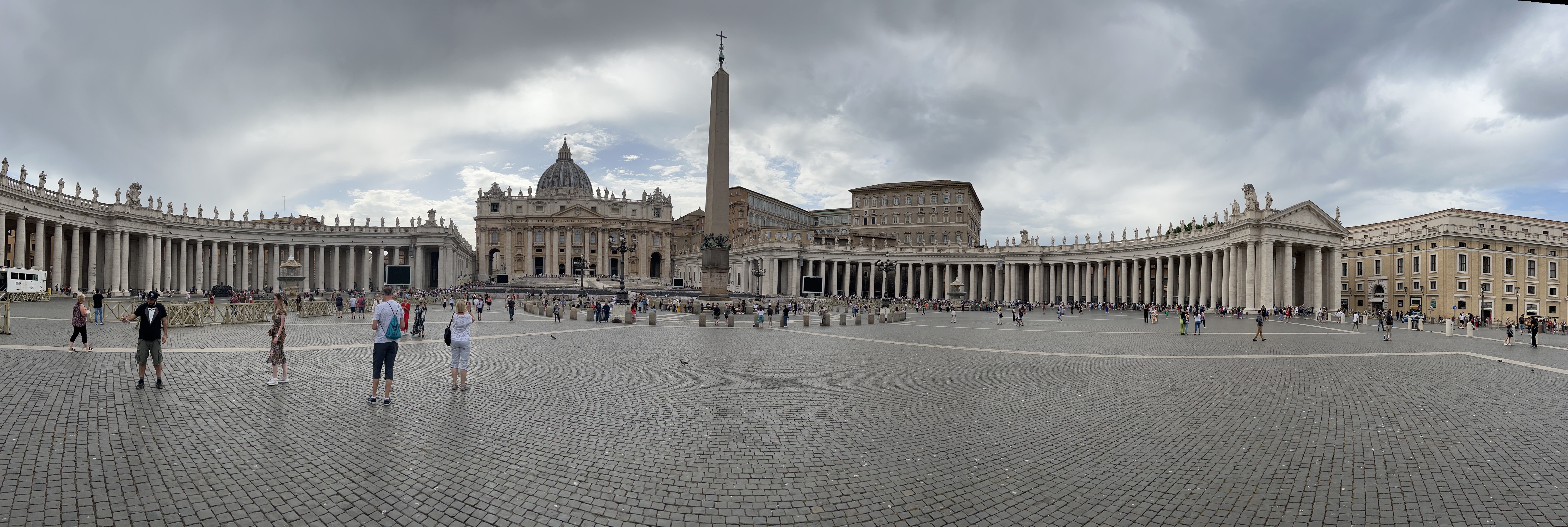
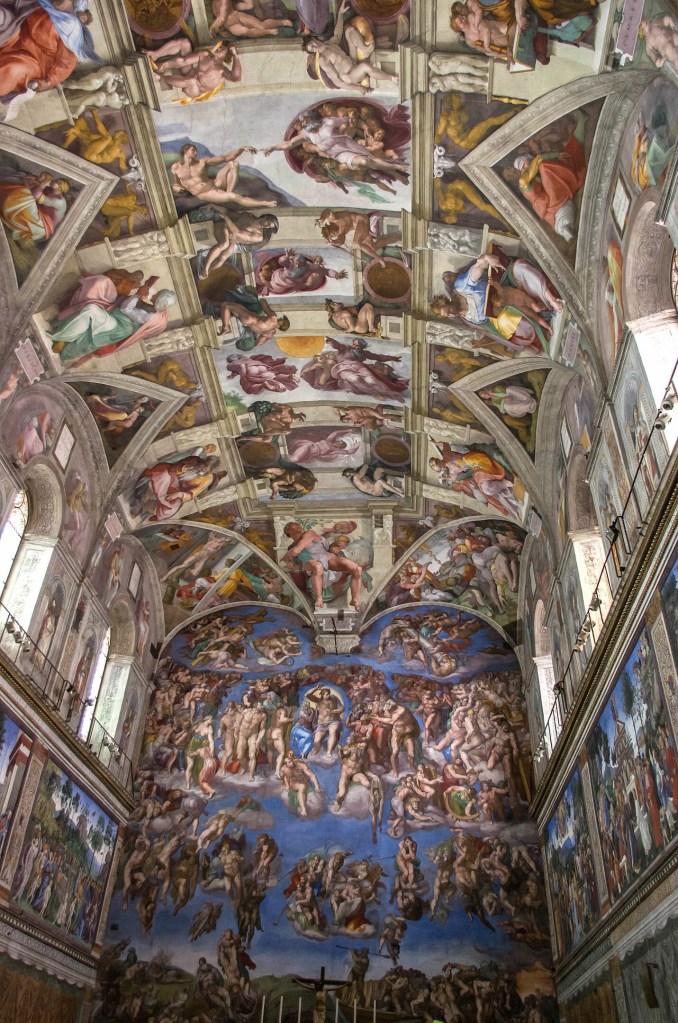
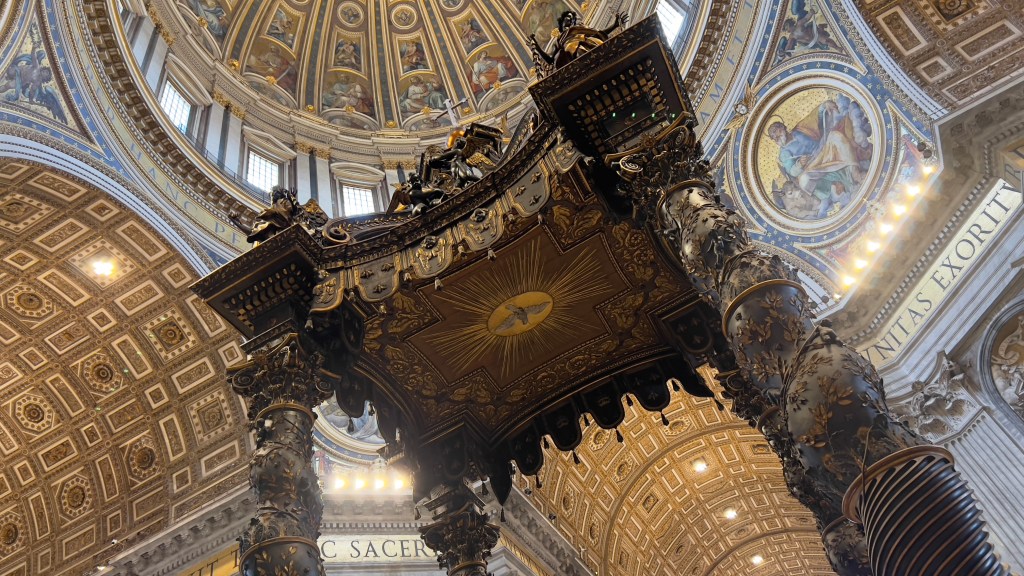
Today was the Vatican and there was so much that it is difficult to know where to begin. The morning was a tour of the Vatican Museum and the Sistine Chapel and the afternoon was a tour of the Scavi (below the main altar of St. Peter’s). You are not allowed to take pictures of the Sistine or the Scavi, so the ones I have were pulled from the internet. I just want to show you what I saw and will comment a few times along the way.
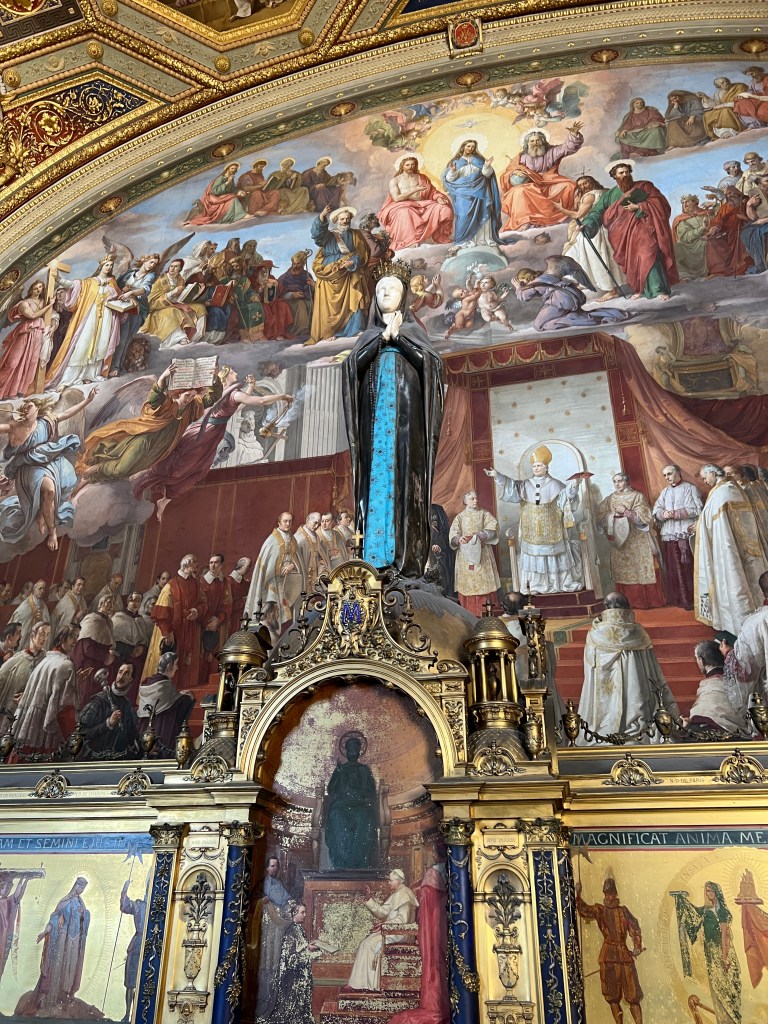
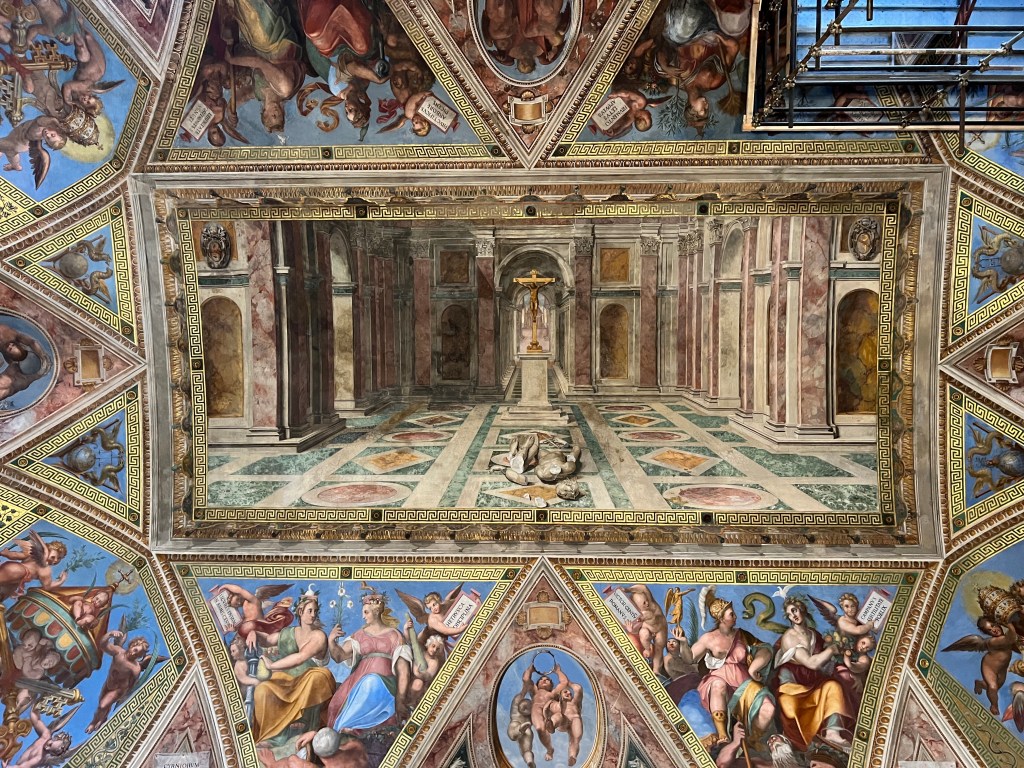
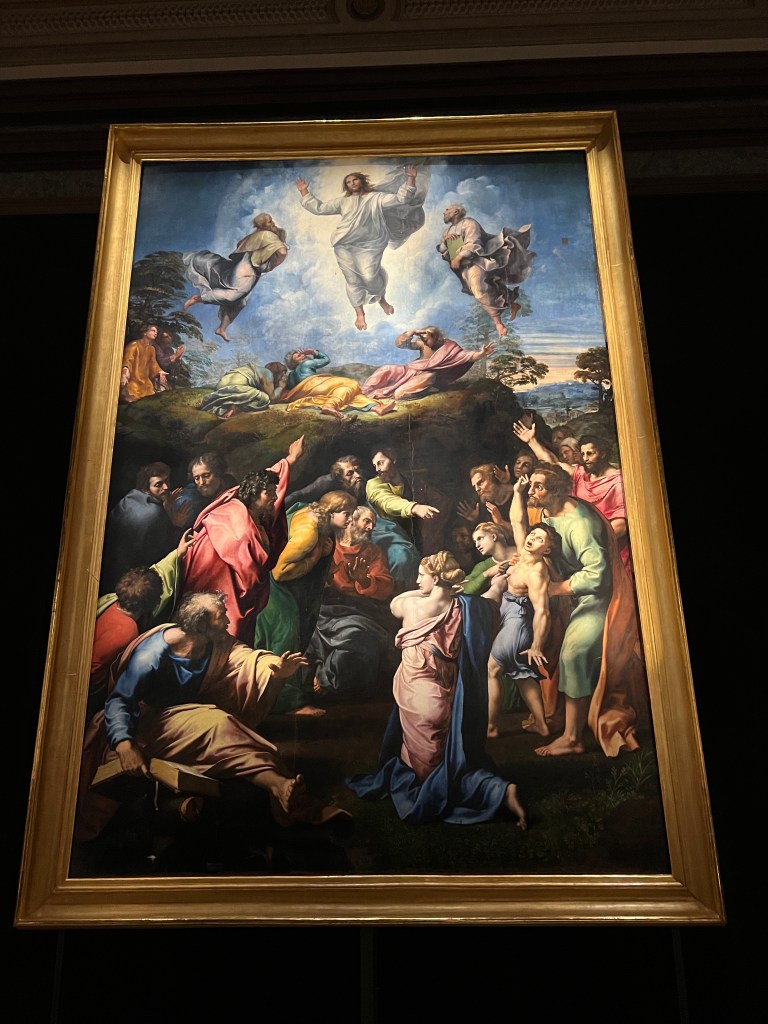
The room dedicated to the pronouncement of the Immaculate Conception of Mary along with the supporting documents in multiple languages.Look closely and you will see the conquest of Christianity over paganism.Ceiling of the hallway leading to the Papal apartments. I was very interested in seeing the apartment of Ricardo Borgia, but we passed through it very quickly. Not necessarily an era they are proud of but more than little colorful.The Transfiguration by Raphael. You see Jesus being transfigured in the upper half and the boy who was demon possessed in the lower right that Jesus would come and heal following the Transfiguration. The Disciples are on the bottom left and were unable to heal the boy.The Sistine Chapel… “Can we talk?” There is so much more going on here than I was aware of. Our tour guide was brilliant in helping me to understand parts of it, but it is definitely worth more time in study. Jesus, Moses, Heaven, hell, Saints, Prophets… I was not here long enough to pray my Rosary but I prayed as much of it as I could before we were ushered out. Yes… I prayed a Rosary in the Sistine Chapel and I felt it. Amazing.
I exited the Vatican at this point and hooked up with Heidi and Scott for lunch. Lunch was nothing to take a picture of but it did fill the hungry zone. We wandered for an hour and then returned to the Vatican for our tour of the Vatican Necropolis (aka – Scavi). These are the catacombs below St. Peter’s that go back to the time before Christ and come forward to the time of Constantine.
It is a fascinating piece of history where you can begin to see the transition from Paganism to Christianity, but after walking through the narrow hallways and low arches…
…you arrive at a darker area where you peer through glass to a small niche about ten feet away and there in an unadorned brass/bronze box are twenty-two bones belonging to The Rock, St. Peter. The inscription above reads, Petros Eni (Greek) translated, “Peter Lies Within”. I teared up then and I’m tearing up now just thinking about it. Catholic/Protestant, the roots of our Faith are rooted deeply in this place.
We returned through to the surface by walking through the grotto where the remains of so many Popes are in interned and came into the Basilica of St. Peter. It is just… I got nothin’. I’m so glad that I get to go back on Friday because I just wasn’t ready to take more in. I was spiritually fried after being so close to one who had been so near to Jesus.
Tomorrow will likely prove to be as moving. I will be visiting the tomb of St. Josemaria Escriva in the morning and St. Paul in the afternoon. I’ll think about that then. For now, I will leave you with a picture of the Queen who is apparently doing quite well.
St. Peter may have his throne but this Queen is the one that currently rules. She is eating well and doing well.
I’ve been working on my mind reading skills. Let’s see how I’m doing (you may want to grab a pen if you need help with some light math. I know I do!):
1. Pick a number from 1-10. Any number.
2. Multiply it by 2.
3. Add 8 to that number.
4. Divide it by 2.
5. Subtract. Current number – Original Number. Take your time to do it right.
6. Match that number to an alphabet letter. For example 1-A, 2-B, 3-C and so on… Got the letter?
7. Think of an European country that starts from that letter
8. Take second letter from that country and what is the first animal you think of that starts with that animal?
9. Now think of the color of that animal
Ready? Ok… let me read your mind… If you are thinking of a grey elephant, please raise your hand.
Why are we concerned with mind readers this morning? Because, after reading that first sentence of our Old Testament lesson, I figured many would need to be a mind reader in order to know what the heck was going on: “Joseph said to his brothers, ‘I am Joseph. Is my father still alive?’ But his brothers could not answer him, so dismayed were they at his presence.” What in the world is this all about? Some will know (and a bit later on I look forward to covering the story in more detail during our Sunday school lessons on the Patriarchs) but maybe we could all use bit of a refresher.
In our study, we know that Abraham was the father of Issac and Issac was the father of Jacob (who will later be named Israel). Jacob will have four wives and twelve sons. His favorite wife was Rachel and his favorite son was Rachel’s first child (and Jacob’s eleventh son), Joseph. Joseph’s younger brother, by Rachel, was Benjamin.
Because Jacob showed favoritism toward Joseph, the ten older brothers did not like him. When Jacob made Joseph a coat of many colors, the ten liked him even less. When Joseph had two dreams demonstrating that his brothers and father would eventually bow down before him… things just got nasty.
One particular day, the older brothers were out tending the flocks and Jacob sent Joseph out to find them. When the older boys saw him coming, one said, “Here comes this dreamer. Come now, let us kill him and throw him into one of the pits. Then we will say that a fierce animal has devoured him, and we will see what will become of his dreams.” They did not end up killing him, but sold him as a slave and Joseph ended up in Egypt. They took Joseph’s colorful coat, covered it in blood, and holding it out to Jacob, their father, told him that Joseph had been killed by wild animals.
Now, fast forward through twenty-two years and many adventures: then a great famine settles in the land. Jacob and his family need food, so Jacob sends those same ten brothers who sold Joseph to Egypt to trade for their needs. In order to receive the food, the ten must go and ask it of the man who in Egypt was second only to Pharaoh. They did not know it, but that man was their brother, Joseph. We are told, “Joseph recognized his brothers, but they did not recognize him.” Eventually, there is the great reveal and Joseph makes himself known. The brothers, seeing Joseph who they had treated so badly, are greatly disturbed by their actions, yet Joseph says to them… insert our lesson from today: “I am Joseph. Is my father still alive?’ But his brothers could not answer him, so dismayed were they at his presence.” He said to them, “Do not be distressed, or angry with yourselves, because you sold me here; for God sent me before you to preserve life.” In other words, Joseph forgave his brothers and said, all that has happened is a part of God’s plan, so that we might be in a position to save God’s people.
Joseph had every reason to hate his brothers; and he was one of the most powerful people in the world, so he could have done whatever he liked to them, from sending them away empty handed, to placing them into slavery, to putting them to death, but he chose another path. A path that led to reconciliation.
With that understanding, hear again the words of Jesus from our Gospel lesson: Jesus said, “I say to you that listen, Love your enemies even if they sell you into slavery, do good to those who hate you even if they think of killing you, bless those who curse you because they do not understand how God is working, pray for those who abuse you, because you may win them back as a brother or sister. If anyone strikes you on the cheek or throws you into a pit, offer the other also and allow God to work his purposes; and from anyone who takes away your coat, even if it is a technicolor coat, do not withhold even your shirt or your life. Give to everyone who begs from you even if that person has done you very wrong; and if anyone takes away your goods, do not ask for them again, for they were God’s goods to begin with. Do to others as you would have them do to you, regardless of how they’ve treated you in the past…. Do not judge, and you will not be judged; do not condemn, and you will not be condemned. Forgive, and you will be forgiven; give, and it will be given to you.’”
I’ll tell you a story that I know I’ve told you before, but like any good story, it doesn’t hurt to hear it again: it takes place in Spain. A father and son got into a tremendous heated argument, which led to the son running away. Almost immediately the father felt remorse over what he had said and so he went in search his son. He searched for months, but he could not find him. Finally, in a last frantic endeavor to find him, the father put an ad in a Madrid newspaper. The ad read: “Dear Paco, meet me in front of this newspaper office at noon on Saturday. All is forgiven. I love you. Your Father.” On that Saturday, 800 boys named Paco showed up, looking for forgiveness and love from their father.
You don’t need to be a mind reader to know that if there is one thing this world needs, it is forgiveness. We need to be forgiven by God. We need to be forgiven by others and we need to forgive those who have hurt us. So we need to stop judging over who may or may not be right. We need to stop condemning and being so stubborn because we simply don’t want to let something go. We need to start forgiving and being forgiven. In that last phrase, Jesus says, “Give, and it will be given to you.” I suppose we could think of that in terms of some sort of material gift: goods, money, etc., but in this context, I don’t think that is what Jesus is asking us to give. I think Jesus is asking us to give love. Love. For in not judging or condemning and by forgiving, we are truly loving; and by loving in such a manner, we are becoming more like Jesus, because that is exactly how he loved us.
“Good nature and good sense must ever join; To err is human; to forgive, divine.” (An Essay on Criticism: Part 2 by Alexander Pope)
In your relations with others, strive for the divine.
Let us pray:
God, our Father, You redeemed us and made us Your children in Christ. Through Him You have saved us from death and given us Your Divine life of grace. By becoming more like Jesus on earth, may we come to share His glory in Heaven. Give us the peace of Your kingdom, which this world does not give. By Your loving care protect the good You have given us. Open our eyes to the wonders of Your Love that we may serve You with a willing heart.
The Greek god Apollo is the is the supposed god of many things, including archery. So, one day, when he encountered Eros, the god of love, Apollo teased Eros about his bow and how it wasn’t really fit for anything. Eros became angry at being teased and devised a plan. He created two arrows, one of gold and the other lead. He then shot Apollo with the gold one, causing Apollo to fall desperately in love with the beautiful river nymph, Daphne, and want to marry her. Eros then shot Daphne with the lead arrow, causing her to hate everything about Apollo. Daphne had no desire to marry anyone, especially Apollo, but when it became evident that Apollo was going to catch her and force her, she called out to her father to save her. As much as it hurt her father, he consented and Daphne was turned into a tree: Laurus Nobilis—a Laurel tree. However, that did not stop Apollo from loving her, saying, “Always my hair will have you, my lyres will have you, my quivers will have you, laurel tree.” And so, after declaring the Laurel tree sacred, Apollo, cut off a branch and made a crown of Laurel leaves and wore it to show his love.
In the second century a coin was minted showing the head of Apollo wearing the crown. From there, the crown of Laurels became a symbol of great success and the winners of the Pythian Games (Olympics) was awarded a Laurel crown for their victory. In later centuries, the phrase, “repose / rest on your Laurels”, became a way of saying that a person, after achieving victory, could rest and enjoy their fame and fortune, but along about the 19th century, the world became more hard-charging and enough was never enough, so instead of being a positive, “resting on your laurels”, the phrase became a negative. It speaks of laziness or an unwillingness to achieve more, thinking you’ve reached your peak.
An example of someone modern “resting on their Laurels” would be Nolan Bushnell. Nolan was the founder of Atari, the creator of those early video games. He was also the founder of Chucky Cheese, that place of loud screaming and birthday parties. He’s done pretty well. Today he is worth about $50 million. However, two young fellas he worked with at Atari, Steve Jobs and Steve Wozniak, had been tinkering around with a few parts from the Atari and created a personal computer, but they needed a bit of start up cash, so they came to their buddy, Nolan Bushnell, and asked him for $50,000. Nolan, who said, “I thought I could do no wrong and I got really sloppy,” turned down the offer. He didn’t think Atari should be making computers. He rested on his success. He rested on his laurels. What would his $50,000 have purchased him? One-third of Apple. Today, one-third of Apple is worth approximately $800 billion. Nolan says, “I was so smart, I said no, and It’s kind of fun to think about that, when I’m not crying about it.”
Today, in our Gospel reading, we read, “John [the Baptist] said to the crowds that came out to be baptized by him, ‘You brood of vipers! Who warned you to flee from the wrath to come? Bear fruits worthy of repentance. Do not begin to say to yourselves, ‘We have Abraham as our ancestor’; for I tell you, God is able from these stones to raise up children to Abraham.’”
We’ve been studying the life of Abraham during our Sunday school lesson and we know that God made His covenant with him. The covenant was the promise to Abraham that through him a great nation would be born. A nation that would be established for all eternity. He was promised by God that his offspring would be more numerous than the stars in the sky or the sand on the sea shores. Through this covenant, the Jewish people became God’s chosen people. Knowing such a thing can change a person. It can create within them a desire to do great things and to live into that promise or it can cause a person to become proud and lazy, thinking they have nothing more to do.
“Hey. I’m God’s chosen, so phooey on you.” “Hey, I’m God’s chosen, so I’m getting into heaven no matter what.” “Hey, I’m God’s chosen, so I can do whatever I like.” “Hey, I’m God’s chosen, so I don’t have to do anything else.” John the Baptist came along and said, “Do not begin to say to yourselves, ‘We have Abraham as our ancestor.’” John the Baptist said, “Hey, I’m God’s Prophet, so don’t be resting on your laurels! That’s not going to save you! So get over yourself and repent.”
That’s what happened to some of the Jewish people. They were cut off. What’s interesting, is that we as a Christian people can fall into the same trap of resting on our Laurels. “Hey, I’ve got Jesus, I’m on the inside.” “Hey, I go to church, so I’m good to go.” “Hey…” and so on. That is the equivalent of saying, “We have Abraham as our ancestor”, but what did Jesus say, “Not everyone who says to me, ‘Lord, Lord,’ will enter the kingdom of heaven, but the one who does the will of my Father who is in heaven.”
St. Paul, using the analogy of an olive tree, speaks to all of this in his letter to the Romans: “If some of the branches were broken off, and you, although a wild olive shoot, were grafted in among the others and now share in the nourishing root of the olive tree, do not be arrogant toward the branches… do not become proud, but fear. For if God did not spare the natural branches, neither will he spare you.”
Jesus said, “Everyone to whom much was given, of him much will be required, and from him to whom they entrusted much, they will demand the more.” We have received so much from this child that was born in the manger: forgiveness of sins, unity with God, eternal life, the very Kingdom of God. These are gifts from God that we can never earn or repay, but let us try. Let us live as though we could, not resting on our laurels, but ever striving to become those who reflect God’s light and love into the world.
Let us pray: Almighty God, give us grace to cast away the works of darkness, and put on the armor of light, now in the time of this mortal life in which your Son Jesus Christ came to visit us in great humility; that in the last day, when he shall come again in his glorious majesty to judge both the living and the dead, we may rise to the life immortal; through him who lives and reigns with you and the Holy Spirit, one God, now and for ever. Amen.
For about the last year, my friend and colleague, The Rev. Sean Ekberg and I have been working on a journal for The Episcopal Church and today it went live. It includes interviews with Bishops in the church, a seminary dean, ministry stories, and more. If you would like to know the bright side of The Episcopal Church, then you’re going to want to take some time reading through the articles. It is not a quick read, but it is well worth the time. There is much that is good happening. If you’ve been wondering where I’ve been spending my extra time… here you go. I believe, if you click the image below, it will take you to the Issuu edition.
Do you remember the name Harold Camping? He died this past December, but for many years was the leader of Family Radio Worldwide. His claim to fame was that through complex mathematical formulas he predicted that on May 21, 2011 the rapture, that is God calling his people home, would occur and the world would end as we know it. Now, if it had occurred and all of you were still here after the rapture, I wouldn’t be surprised, but since I’m still here, I figure he was wrong. For the record, Camping also predicted that the world would end on Sept. 6, 1994 and that didn’t happen either. He wrote that off as errors in his computations. Jesus said, “But of that day and hour no one knows, not even the angels of heaven, nor the Son, but the Father alone.” My logic says, if the angels don’t know the hour or day, then someone with a calculator and a Bible won’t be able to figure it out either.
However, leading up to May 21, 2011, atheist across the country were having all sorts of fun by having “end of the world parties. Although Mr. Camping was wrong, I still don’t know that it is a good idea to mock him and I’ll tell you why: people have been looking for Jesus return for 2,000+ years. They have been praying for his return for 2,000+ years and for good reason. The author Anne Lamott summed it up, she wrote, “We are Easter People, living in a Good Friday World.” We are an Easter people believing in the resurrection, old things passing away, new life, the promises of the Good News, but the world around is in shambles. Some see the world around us and they interpret its condition as the end, “How could we go on anymore?” So in the midst of the shambles, folks want to see the Lord’s return so badly, that they begin to look for it even more closely and want it so much that they even make the mistake of trying to predict it. In a way, it is an act of desperation.
Harold Camping and the others who have predicted Jesus return through this desperation are not alone. Consider the apostles in our Gospel reading today: Jesus has already shared the Last Supper with his disciples, he has predicted his death, he has told Peter and the others that they will deny him.. essentially he is giving final instructions and saying, “Goodbye.” For the apostles, their world is spinning out of control, their world is turning into shambles, so Thomas says to Jesus, “Give us directions on how we can follow you.” Philip wants Jesus to show them the Father. In both cases, instead of breaking out a map or showing a photo, Jesus responds, “I am the way, the truth and the life.” “If you have seen me then you have seen the Father.” For the apostles that still sounds a bit cryptic, because they did not fully understand Jesus’ purpose, what his mission was all about. That understanding would not come until later, but the events surrounding Stephen that we read about today are key to this understanding.
You will recall that after Jesus’ death the apostles went about preaching and teaching; however, as more folks came to belief in Christ it became more difficult for these few followers to care for them all, so they elected seven others – the first deacons – to assist in the ministry. One of those seven was Stephen and he was very passionate about his work. Not only did he do the work of a deacon, but he also proclaimed the Gospel message. Just as the religious leadership did not want to hear it from Jesus, they didn’t want to hear it from this young upstart either. So it came to pass that on one particular day Stephen gave them a great tongue lashing. He said to them, you have always been disobedient to God, you have always limited God, and you have persecuted the prophets that God sent. The crowning jewel of this tongue lashing comes when Stephen tells them, you murdered the Son of God.
It is hear that scripture records an amazing scene, “Filled with the Holy Spirit, Stephen gazed into heaven and saw the glory of God and Jesus standing at the right hand of God. ‘Look,’ he said, ‘I see the heavens opened and the Son of Man standing at the right hand of God!’” For his perceived “blasphemy” they stoned him to death.
In believing and proclaiming the Gospel Stephen, the first martyr of the church, saw the place that Thomas had asked Jesus for directions to and he saw the glory of the Father that Phillip had wanted to see. What Stephen was witness to was the Good News. Jesus’ Kingdom was not bound to an earthly realm. You don’t need directions on how to get there or a photograph to know the Father, you only need one thing. Care to take a guess? Jesus – and that is the Good News.
What kind of person do you think of when you consider a person like Stephen? He knew that because Jesus claimed to be the Son of God it got him crucified, but here Stephen is making the same claims. Don’t you think he had to know that it would incite the religious leaders once again? Was he like one of those street preachers you imagine in Time Square, standing on a milk crate, flailing a Bible around shouting at those passing by, but in the case of Stephen knowing what he said could get him killed? Was he on a suicide mission, simply begging for death? Or was he being the light of the world. That city on a hill that can’t be hidden? Was Stephen a hero? Was he someone whose character and behavior we should model and follow?
Now please don’t think I’m picking on anyone in particular this morning. I’m not. Instead, I’m being very equitable and picking on us all, because we are all guilty of something specific in our Christian walk. Folks like Thomas and Philip ask to see God, others like Harold Camping and his followers want to see God so badly that they predict dates when they actually will, but they are not the only ones? The world is in shambles all around us and folks, whether directly or indirectly, ask us those same questions: “Can you show me the way?” “Can you help me to understand and see God?” Indirectly they may pour out to you the turmoil within their souls, their anxious thoughts, and personal concerns; but when they do, what we are all guilty of is being too polite. How many of you have heard this, “Faith or someone’s relationship with God is a personal matter.” “I don’t want to force my religious views on anyone.” “I might make them angry if I talk about God.”
I asked you if you thought Stephen was some sort of madman or a hero and the correct answer is that he is a hero. We should emulate his behavior, which means we shouldn’t always be so polite and say or do what is considered socially proper when it comes to our faith – It is THE Good News and that Good News is not there just so we can have some comforting words to say at someone’s deathbed or worse, their funeral! The Good News is for today. It is for the living and is for sharing. If someone happens to get angry and throws a few rocks then so be it. I love what St. Josemaria Escriva said on this, “If they break our skulls, we shall not take it too seriously. We shall just have to put up with having them broken.” You are living testimonies to the Good News and it is worth sharing.
Scripture says that Stephen was filled with the Holy Spirit and we too are filled with that same Spirit, which will allows us share the Good News of Jesus Christ as boldly and as unapologetically as Stephen did. The world did not end on May 21, 2011 or today – at least not yet! – so there are many who still want and need to know the way to Jesus. They want to see the Father. You, each and everyone of you, can provide them with directions.
The Psalmist declares, “My mouth will tell of your righteous deeds, of your saving acts all day long— though I know not how to relate them all. I will come and proclaim your mighty acts, Sovereign LORD; I will proclaim your righteous deeds, yours alone. Since my youth, God, you have taught me, and to this day I declare your marvelous deeds. Even when I am old and gray, do not forsake me, my God, till I declare your power to the next generation, your mighty acts to all who are to come.”
Don’ let that simply be something you read or hear. Let it be something you live. A way of life. Be aware of the many opportunities that the Lord provides you to share your faith and then grasp those opportunities and proclaim the Good News that is within you.
Romeo and Juliet, Act 2, Scene 2:
What’s in a name? that which we call a rose By any other name would smell as sweet;
Moses went up on the mountain to see that wondrous sight of the burning bush. When the LORD saw that he had gone over to look, God called to him from within the bush, and the Lord called out to him by name, “Moses! Moses!” And Moses said, “Here I am.” “Do not come any closer,” God said. “Take off your sandals, for the place where you are standing is holy ground… I am the God of your father, the God of Abraham, the God of Isaac and the God of Jacob.”
God appeared to Jacob again and blessed him. God said to him, “Your name is Jacob, but you will no longer be called Jacob; your name will be Israel.”
The Lord called out to the Prophet Samuel when he was still a young boy, “Samuel! Samuel!” Then Samuel said, “Speak, for your servant is listening.”
Jesus called His disciples by name. Jesus looked at one who would become his disciple and said, “You are Simon son of John. You will be called Cephas” (which, when translated, is Peter).
For four days a man lay dead in the tomb, Jesus called in a loud voice, “Lazarus, come out!” and the dead man came out, his hands and feet wrapped with strips of linen, and a cloth around his face.
On the day of the resurrection, Mary Magdalene turned around and saw Jesus standing there, but she did not know that it was Jesus. Jesus said to her, “Woman, why are you weeping? Whom are you looking for?” Supposing him to be the gardener, she said to him, “Sir, if you have carried him away, tell me where you have laid him, and I will take him away.” Jesus said to her, “Mary!” She turned and said to him, “Teacher!”
The Lord called Moses by name and he led the Israelites out of slavery. Jacob was called by name as the father of nations. Samuel – called by name as prophet. Peter as an apostle. Lazarus was called out of death. Mary was called into the understanding of who Christ truly is.
Jesus tells us that – in the end – he will clothe in white those who are victorious in Him and will walk with them. Jesus declares, “I will never blot out the name of that person from the book of life, but will acknowledge that name before my Father and his angels.”
The Lord knows each and every one of us by name and he has known us from the beginning. The Psalmist declares, “You have searched me, LORD, and you know me. For you created my inmost being; you knit me together in my mother’s womb. My frame was not hidden from you when I was made in the secret place, when I was woven together in the depths of the earth. Your eyes saw my unformed body; all the days ordained for me were written in your book before one of them came to be.” The Lord knows us in the fullest sense..
In our Gospel reading to day Jesus says, “The one who enters by the gate is the shepherd of the sheep. The gatekeeper opens the gate for him, and the sheep hear his voice. He calls his own sheep by name and leads them out.”
There are times for all of us when we wonder if God thinks on us. Remembers us. There are presently over 6 billion people on the planet, can he know me as an individual? Yes. The Lord knows each of us by name and he calls us. He calls us to serve Him. He calls us to follow Him. He calls us out of darkness. By name, he calls us out of death. The Lord Your God is a great God. Have peace in knowing that you are His, precious in His sight.
I like for my television programming to be intellectually stimulating. I like to constantly be stretching and growing my mind, so I stay away from things on the History Channel or the Learning Channel and go straight for the meat and potatoes: America’s Funniest Home Videos with an occasional episode or two of Friends. I do watch other things as well that are equally as stimulating. For a while I was on Mythbusters then I moved over to Miami Ink – especially when Kat Von D was on for a while, followed by Deadliest Catch. However, I’ve found one show that I’ve been absolutely hooked on for a while: Ghost Adventures, with my buddies Zak, Nick, and Aaron. Zak is the front man with the weird hair, Nick is the serious one, and Aaron is the one who acts a bit like Shaggy in Scooby Doo.
They’ve got all this really great equipment too for detecting ghosts: digital recorders to capture EVPs – that’s Electronic Voice Phenomenon for you non-ghost believers – night vision cameras, infrared imaging, the works. What is so tragic is that so often the ghosts drain the energy of their cameras, so just when they are about to capture something good like a full body apparition on tape – the camera dies! So they just have to tell you about it instead of showing it to you – I’m so disappointed for them.
The reason I mention this is because of our Gospel reading tonight. Jesus has been dead and in his tomb for three days, yet now he is appearing to the living. Is he a ghost? Is this the full body apparition that Zak, Nick, and Aaron are always talking about, or is it something all together different? The gospel writers are very careful about helping us to understand that what these women are seeing in tonight’s gospel – and for that matter at all the appearances of Jesus following his resurrection – is not a ghost.
For example our Gospel from today said, “Suddenly Jesus met them and said, ‘Greetings!’ And they came to him, took hold of his feet, and worshiped him.” “They took hold of his feet.” All ghost adventuring aside, even the folks in the time of Jesus knew that you could not touch a ghost. In later appearances we are told that others touched him, some walked down the road with him and broke bread with him, and there is the time when he will meet with the disciples on the shore of the sea and have breakfast with them. All of these things occurred after his death and resurrection; and the Gospel writers use these examples to help the reader understand that the Risen Jesus is not a ghost. He is alive.
Following his resurrection we know that he ascended into heaven so that we can no longer see him as he was and for many their response to that event is, “Well isn’t that convenient.” A bit like the Ghost Adventurers’ cameras going dead just as the ghost shows up, leaving only someone’s word that something actually took place. I think the lawyers would say that its all circumstantial evidence.
Perhaps more folks would believe that Jesus is in fact the risen Lord if they could take hold of his feet or have breakfast with him on the shore of the sea. We read in our Gospel tonight, Jesus told Mary, “Tell my brothers to go to Galilee; there they will see me.” Many today would ask, “Where is my Galilee that I might see Him?” You know how I respond to that? Open your eyes. He is all around you. As St. Patrick wrote:
Christ beside me, Christ before me;
Christ behind me, Christ within me;
Christ beneath me, Christ above me;
Christ to right of me, Christ to left of me;
Christ in my lying, my sitting, my rising;
Christ in heart of all who know me,
Christ on tongue of all who meet me,
Christ in eye of all who see me,
Christ in ear of all who hear me.
Open your eyes. You won’t see a ghost. You’ll see the Risen Lord. You’ll see Jesus.
It was George Burns who said, “The secret of a good sermon is to have a good beginning and a good ending, then having the two as close together as possible.” I think you would agree that today the space between the beginning and ending should be even shorter. Truthfully, not much more needs to be said, the liturgy and the readings have spoken for themselves, yet that still won’t stop me from saying a few words.
Following the Exodus from Egypt and their wanderings in the desert for forty years the Israelites came to the Jordan River and it is near that place on Mount Nebo that Moses dies. Following his death, Joshua became the leader of the Israelites and would be the one who would finally lead them across the Jordan River and into the land that God had promised. Several days prior to the crossing the Lord spoke to Joshua telling him that if he and the Israelites followed the Law that had been given to Moses, then they would be prosperous. During this particular discourse – three times – the Lord said to Joshua that during the days ahead he should be “Strong and courageous.” At the third time the Lord said, “Be strong and courageous. Do not be terrified; do not be discouraged, for the Lord your God will be with you wherever you go.” Days later the people would cross the Jordan and conquer the first city they came to – Jericho. From there Joshua and the vast numbers of Israelites went out into the Holy Land as God had commanded.
There is an interesting similarity to that event and Jesus’ triumphant entry into Jerusalem that we read about today. We often get a vision of Jesus traveling up to the gates of Jerusalem and there being met by the people waving palm branches, but as it turns out the crowd has been with him for quite a while. In fact they had been with him for about seventeen miles. Scripture says, “As Jesus and his disciples were leaving [a certain city], a large crowd followed them.” What was that certain city? Jericho.
I found it kind of interesting that Joshua and the Israelites set out from Jericho to conquer the Promised Land and that Jesus also set out from Jericho to conquer the eternal promised land. It made me wonder if in leaving that place and heading to Jerusalem and the cross if Jesus was also comforted by those words that the Lord had spoken to Joshua, “Be strong and courageous. Do not be terrified; do not be discouraged, for the Lord your God will be with you wherever you go.”
The Israelites, then Jesus, but they are not the only ones who must travel that road, for it is one that we too must travel spiritually. Jesus said to his disciples, “Whoever wants to be my disciple must deny themselves and take up their cross and follow me. For whoever wants to save their life will lose it, but whoever loses their life for me will find it.” To be Jesus’ disciples we too must head out from Jericho and take that road to Jerusalem, knowing all along where it leads. Knowing that in the end we will be crucified with Christ, but also knowing that this road leads through some very barren, desolate, and rugged areas. Places where there is no water or nourishment. Places where you can be robbed, beaten, killed. Places where you can very easily lose your way and become lost. Therefore as we travel along that road we must stay near to Jesus. We must keep our eyes firmly fixed on him and where he leads, for He is the Way. If along the way you should become fearful, then listen closely and you too will hear the comforting words of Our Father, “Be strong and courageous. Do not be terrified; do not be discouraged, for the Lord your God will be with you wherever you go.”
Jesus said, “I am with you always, even to the end of the age.” Even on the darkest of nights, you are not alone. Be strong. Be courageous. God is with you.
The young management consultant had an interview with the president of a major advertising firm. The young man was nervous. At that stage in his career, it wasn’t very often that he got to talk to the president of a company. The appointment was at 10:00 a.m., for one hour. He arrived early. Promptly at 10, he was ushered into a large and airy room, with furniture upholstered in bright yellow. The president had his shirtsleeves rolled up and a mean look on his face. “You’ve only got 20 minutes,” he barked. The young man sat there, not saying a word. “I said, you’ve only got 20 minutes.” “Your time’s ticking away. Why aren’t you saying anything?” “They’re my 20 minutes,” replied the young man, “I can do whatever I want with them.”
In Matthew’s Gospel Jesus said, “I tell you the truth, unless a kernel of wheat falls to the ground and dies, it remains only a single seed. But if it dies, it produces many seeds.” Not only is Jesus referring to himself, who died and rose again, but he is also referring to us. We must die to self, grow in Christ, and produce that good fruit. We are called to be the mustard seed in our Gospel today – small, but with purpose and results. Not only is this something Jesus instructs us to do, but is also something we have vowed to do – from the baptismal covenant, “Will you proclaim by word and example the Good News of God in Christ?” Our response, “I will, with God’s help.”
I have been told that there are some folks who can grow corn in Montana. I don’t believe it. I tried in Butte and I tried in Anaconda. The ears I grew were something less than pathetic. Now, when I lived down south with my granddaddy, we could grow just about anything: corn, squash, beans, all the good stuff. One year my Grandaddy got a hankering for some strawberries, so he planted two long rows in the front garden. They came in good and those first strawberries were wonderful; however, by the end of the summer we were swimming in strawberries. We had eaten all the strawberry pies we could eat, canned enough strawberry preserves to last a lifetime, and if we should show up at the neighbors with one more bag of strawberries I feel certain they would have sicced the dog on us.
Now consider this from a spiritual perspective: we are to grow in Christ and we are to produce good fruit. So, if you were called on by the Lord to display the fruit you had produced, what would it look like? My Montana corn or my grandaddy’s strawberries?
One of my favorite sayings of the desert fathers, “If a man settles in a certain place and does not bring forth the fruit of that place, the place itself casts him out, as one who has not borne its fruit.” We are to produce good fruit; therefore, we must wisely use the time we have been given.
That young management consultant had his twenty minutes. We can look at the span of your life as he looked at those 20 minutes. They are ours. We can do anything we like with them. We can squander them. We can spend them building up for yourselves treasures on earth. Or, we can use them – or at least a portion of them, say 10% – to produce an abundance of good fruit. Jesus said, “This is to my Father’s glory, that you bear much fruit, showing yourselves to be my disciples.”
Produce good fruit so that your Father in Heaven is glorified.














 Candle in a Cave