Sermon: Thérèse of Lisieux


I have some excellent yard maintenance skills. Except for a few shrubs, if it is green and grows in my yard… hit it with Roundup. It’s not that I don’t enjoy having flowers; I do, but I don’t want to waste money on plants that are going to die because I know that I’m not going to take care of them. I just really don’t enjoy working in the yard. However, back when the cousin lived in Enid, the yard had all kinds of flowers, and if I planted something, she would take care of it.

Of the few flowers I planted, the one I cherished the most was my John Paul II memorial rose. It was a glorious luminescent white when it bloomed. When that happened, a hundred different types of flowers could be blooming all around it, but that rose would be the only one I noticed.  

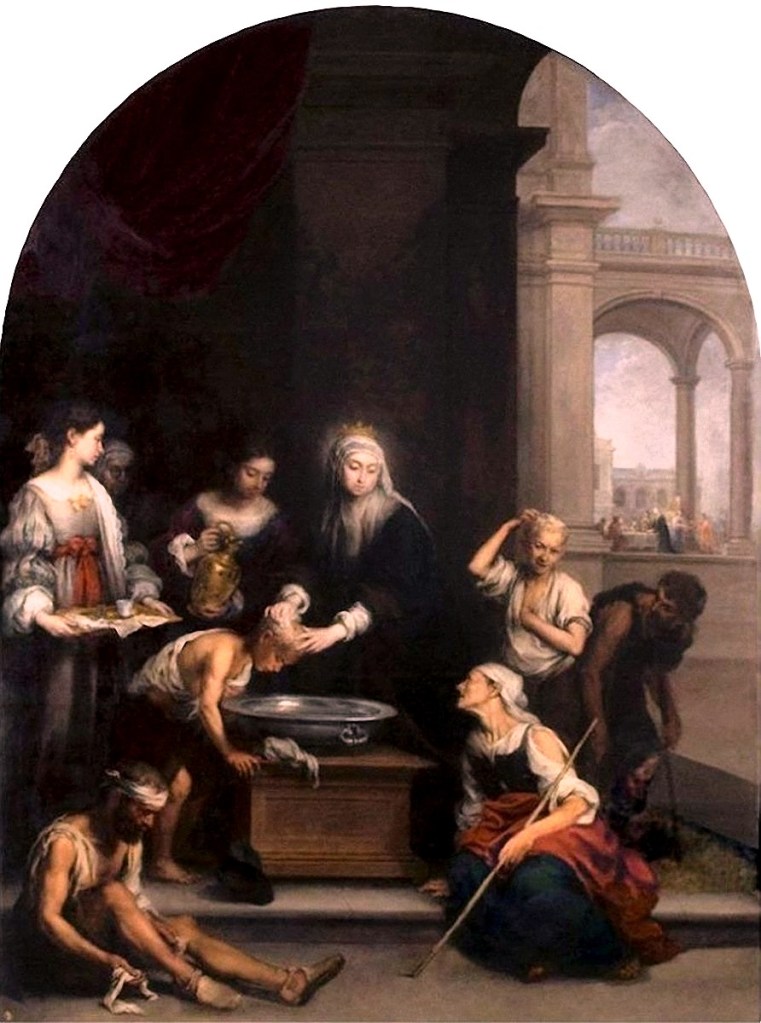
Have you heard of the Saint we celebrate today, Thérèse of Lisieux, also known as the Little Flower of Jesus? Most say yes. She is often considered one of the greatest modern Saints, having died on October 1, 1897. We read her autobiography, Story of a Soul, for one of our Saints Book Club selections. She is a very “popular” saint. Do you know anything about Verissimus, Maxima, and Julia, or have you even heard of them? No? They are also Saints who share the same feast day as Thérèse—October 1st. All three were martyred in Lisbon, Portugal, under Emperor Diocletian’s persecution in 305 A.D. 

When we consider them all together, Thérèse of Lisieux is the St. John Paul II memorial rose, while Verissimus, Maxima, and Julia are seen as little Lantanas or Impatiens. 

Thérèse looked at things differently. She writes, “Jesus set before me the book of nature. I understand how all the flowers God has created are beautiful, how the splendor of the rose and the whiteness of the lily do not take away the perfume of the violet or the delightful simplicity of the daisy. I understand that if all flowers wanted to be roses, nature would lose her springtime beauty, and the fields would no longer be decked out with little wildflowers. So it is in the world of souls, Jesus’ garden. He has created smaller ones, and those must be content to be daisies or violets destined to give joy to God’s glances when He looks down at His feet. Perfection consists in doing His will, in being what He wills us to be.”

There are “big” Saints, and there are “little” Saints, but in the eyes of God, they are all Saints. All—whether we recognize their names or not—have submitted to the will of God and fulfilled His purposes; therefore, they reveal His glory in the world. So, if those are the Saints living their eternal lives in Jesus’ garden, where are we? Are we getting hit with the Roundup, or are we also in that garden? Are we those whom God looks lovingly upon as He passes by? You may not always believe it, but you are in that garden. You are one in whom Christ delights.

In our reading from Colossians, Paul said to us, “Set your minds on things that are above, not on things that are on earth, for you have died, and your life is hidden with Christ in God. When Christ who is your life is revealed, then you also will be revealed with him in glory.” (Colossians 3:4)

We may not always believe that we are worthy of being placed in Jesus’ garden with the likes of Thérèse, Verissimus, Maxima, and Julia, and, in our own right, we are not. However, by setting our hearts and minds on Jesus, as all the Saint have done, it is Jesus and His glory that will be revealed in us—that will bloom in us and make us worthy “to share in the inheritance of the saints in light.” (Colossians 1:12) 

Sermon: Proper 21 RCL B – “No Lifeguard on Duty”


Little Johnny had gone to the beach with his family. After a short time, Johnny asked his mom if he could go swimming in the ocean. His mother said, “Certainly not. The sea’s too rough, there’s a terrible rip tide and a dangerous offshore current, this coast is infested with jellyfish and sharks, and there’s no lifeguard on duty.” Johnny said, “But Daddy’s gone swimming!” His mother, looking out over the water, replied nonchalantly, “I know, but he has excellent life insurance.”

Last week, as we discussed the Epistle of James, we concluded that we can work at avoiding the sting of sin by drawing near to God and walking in the light. St. James, in his Epistle, said to us, “Submit yourselves therefore to God. Resist the devil, and he will flee from you. Draw near to God, and he will draw near to you.” (James 4:7-8)

From this, a good question would be: How do I draw near to God? How do I walk in the light? We know that through prayer and study, we can accomplish this to some extent. However, the devil is crafty. Even in the beginning in the Garden of Eden, we are told, “Now the serpent—the devil—was more crafty than any other beast of the field that the Lord God had made.” (Genesis 3:1) So, even though we may watch and pray and study, the devil is still looking for ways to deceive us. One of the more successful tactics the serpent may take is not by deceiving us directly but by convincing us to deceive ourselves. This goes back to how we, at times, will dabble in our sins or negotiate with them. As we learned last week, you can’t sin just a little. You are either sinning or not. We deceive ourselves when we think otherwise. Unfortunately, we do this, and even though we may be praying and studying, we can become increasingly mired and stuck in the sin that is killing us. 

This is akin to the general confession we make almost every time we gather. On a Sunday, the general confession is the one that we make together following the Creed. It is beneficial, but there needs to be real accountability. Sure, I during the General Confession,I can confess to stealing, but no one is holding me accountable for that sin. No one is asking me to make restitution. No one is around to help me overcome the sin. I confessed the sin of stealing, but I’ve got no skin in the game. So, I am more likely to continue in that sin because I haven’t been “called out” on it and have likely deceived myself and justified my actions. What I really need is for someone to come along and say, “You need to stop stealing, and I’m going to….” Not be your taskmaster, not ride you day in and day out, not condemn you, bash you about the head and neck, none of that. No. What I need is someone to come alongside me and say, “You need to stop stealing, and I’m going to help you to stop deceiving yourself. I’m going to hold you accountable. I’m going to come alongside you and love you.”

This morning, we read the last two verses of the Epistle of St. James. “My brothers and sisters, if anyone among you wanders from the truth—falls into sin—and is brought back by another, you should know that whoever brings back a sinner from wandering will save the sinner’s soul from death and will cover a multitude of sins.” (James 5:19-20) 

We come alongside each other and help one another because to save our souls, we need one another. Jesus never sent the disciples out alone, always two-by-two, so he certainly doesn’t want us to go it alone, either. Why? The world we live in can be like rough seas; there can be terrible rip tides and dangerous offshore currents, jellyfish and sharks that can harm us, and there is no lifeguard on duty.” If we go out alone, any number of things can befall us, but if we have someone with us, the chances for our safety are much greater. 

As I’ve told you several times before, Christianity does not exist in an individual. Christianity exists in a community. A community of believers that support and care for one another. A community of believers who are, despite all their differences, friends. 

If you want warm and sappy, you can always look up quotes about friendship; those quotes often speak about chance encounters. “Friendship is the beautiful chance encounter that enriches our lives.” “In the randomness of life, meeting a friend is a chance worth cherishing.” “A true friend is a rare gem discovered by chance in the vast sea of humanity.” But what if the community we build here and the friends we make are not random chance? 

In The Four Loves, C.S. Lewis discusses this. “In friendship,” he writes, “We think we have chosen our peers. In reality, a few years’ difference in the dates of our births, a few more miles between certain houses, the choice of one university instead of another…the accident of a topic being raised or not raised at a first meeting—any of these chances might have kept us apart. But, for a Christian, there are, strictly speaking, no chances. A secret master of ceremonies has been at work. Christ, who said to the disciples, ‘Ye have not chosen me, but I have chosen you,’ can truly say to every group of Christian friends, ‘Ye have not chosen one another but I have chosen you for one another.’ The friendship is not a reward for our discriminating and good taste in finding one another out. It is the instrument by which God reveals to each of us the beauties of others.” (The Four Loves, p.89)

The author of Ecclesiastes confirms the need for these friendships. “Two are better than one, because they have a good reward for their toil. For if they fall, one will lift up his fellow. But woe to him who is alone when he falls and has not another to lift him up!” (Ecclesiastes 4:9-10)

There is no lifeguard on duty, so, for many reasons, we need one another, one of which is to hold one another accountable. 

Thomas à Kempis tells us, “God has so ordained, that we may learn to bear with one another’s burdens, for there is no person without fault, no person without burden, no person sufficient to themself nor wise enough. Hence, we must support one another, console one another, mutually help, counsel, and advise, for the measure of every person’s virtue is best revealed in time of adversity—adversity that does not weaken a person but rather shows what they are.” (Imitation of Christ 1.16)

How do we do this? Numerous times, the Bible provides us with instruction, and they all speak of gentleness, love, and humility. However, before you set out on such a task, I suggest you check yourself because, so often, when we seek to correct another person, our actions have little or nothing to do with these traits. Remember the cartoon that made the social media rounds? “You were a believer, yes. But you skipped the

not-being-a-jerk-about-it part.” So often, those things we want to correct in another person have absolutely nothing to do with them and everything to do with us. If you want to hold someone accountable, ensure your heart is in the right place. If you feel that it is, then don’t be a jerk. Go to that person and, with kind and gentle words, speak to them. And don’t do it from a place of superiority or even as a parent would talk to a child. Instead, speak to them as an equal, recognizing that you, too, are a sinner in need of a loving God and also recognizing that tomorrow, it will likely be you who is being spoken to for your sins.

If your heart is in the right place and you truly believe a person needs to be held accountable, correct them. Their very soul may depend on your words. But do so with genuine humility and love. 

Jesus said to His disciples, “I no longer call you servants, because a servant does not know his master’s business. Instead, I have called you friends, for everything that I learned from my Father I have made known to you.” (John 15:15)

Jesus calls us friends, so we must be true friends with one another, and the strength of a true friendship can withstand loving one another in such a way that we can hold each other accountable. 

In the novel It, my friend Stephen King wrote, “Maybe there aren’t any such things as good friends or bad friends – maybe there are just friends, people who stand by you when you’re hurt and who help you feel not so lonely. Maybe they’re always worth being scared for, and hoping for, and living for. Maybe worth dying for too, if that’s what has to be. No good friends. No bad friends. Only people you want, need to be with; people who build their houses in your heart.” (p.1,043)

I believe this is the kind of friendship that Jesus desires for us. Be that friend to one another. 

Let us pray:
Guardian Angel,
watch over those who have built houses in my heart.
Guard over them with every care
and make their way easy and their labors fruitful.
Dry their tears if they weep;
sanctify their joys;
raise their courage if they weaken;
restore their hope if they lose heart,
their health if they be ill,
truth if they err,
repentance if they fail.
Amen.

Sermon: Heritage Sunday / Feast of St. Matthew


“The most terrifying words in the English language are: I’m from the government, and I’m here to help.” Ronald Reagan

For those of you who are married, I warn you up front not to laugh at this one. “‘I am’ is reportedly the shortest sentence in the English language. Could it be that ‘I do’ is the longest sentence?” George Carlin

The English language—words and grammar. One misspelled word, and you’ll either end up being holy, someone approaching sainthood (such as myself), or being wholly, someone who’s been shot up the OK Coral. One forgotten comma can turn “Let’s eat, gramma,” a call to supper, into “Let’s eat gramma,” an unfortunate act of cannibalism.

After the basics, you get into nouns and verbs, pronouns and adverbs, which brings me to Little Johnny. Johnny was sitting in English class and not paying attention. The teacher, looking to bring him back from wherever his mind was, pointed at him and said, “Name two pronouns.” Johnny replied, “Who, me?” 

Based on those who laughed, we now know who is good with words and grammar.

“Who, me?” 

In the Church of San Luigi dei Francesi in Rome, there are three magnificent paintings by the great Italian artist Caravaggio. Each of the paintings portrays a significant moment in the life of our Patron Saint, Matthew. There is the Inspiration of St. Matthew, the angel giving Matthew the words of his Gospel, and the Martyrdom of St. Matthew, depicting his death. However, the one that concerns us today is the Calling of St. Matthew. 

In the painting, Matthew is seated with five other tax collectors who are counting their money. Also in the scene are Jesus and Peter, both of whom are pointing at Matthew.

Matthew’s right hand is stretched out on the table, counting coins, while with his left hand, Matthew is pointing back to himself. The expression on his face—“Who, me?”

I know that feeling. When I first heard God calling me into service, my first response was, “Don’t be stupid.” Yet, God was calling me, and God was calling Matthew. Both of us responded, “Who, me?” And in each case, God responded, “Yes, you.”

Another of the greatest artists is Rembrandt. In his early career, Rembrandt was wildly successful. Painting and selling portraits, buying the big house, and all the finest art to fill it—living the life. However, all the big spending eventually caught up to him, and he ended up losing it all and dying penniless. Even though he had lost everything, he continued to paint, and the subject he most frequently painted was himself. Rembrandt painted sixty-three self-portraits. This was not an exercise in vanity, nor was it simply to practice his art. He painted himself, year after year, as a “‘search for the spiritual through the channel of his innermost personality.’ Rembrandt felt that he had to enter into his own self, into his dark cellars as well as into his light rooms, if he really wanted to penetrate the mystery of man’s interiority.” (You are the Beloved, Henri Nouwen, June 27) Through those sixty-three self-portraits, Rembrandt was searching for himself. In the process, he understood that as he lived his life, he was also repainting his interior self—a continuous reworking of an interior self-portrait.

Jesus pointed at Matthew, and Matthew pointed at himself and asked, “Who, me?” Jesus responded, “Yes, you.” So, like Rembrandt, Matthew was left with the option of repainting his interior self-portrait or remaining as he was, sitting at a table counting coins, never realizing the life Jesus was calling him to. It is the same for each of us.

We each have an interior self-portrait that is being continuously repainted as we seek to know who we truly are. This interior self-portrait has little or nothing to do with the portrait and all the masks we show to the world. Instead, the interior self-portrait includes all the light and all the darkness that you don’t show to anyone. Sometimes, that interior self-portrait is so fluid it has difficulty maintaining form, and we begin to wonder who we actually are.

During World War II, the great German theologian Dietrich Bonhoeffer was arrested and imprisoned. He would be executed before he could be freed. Although his writing reflects a deep and abiding faith, he, too, had his doubts as to who he truly was. His interior self-portrait was also fluid. During one of those moments, instead of painting an image, Bonhoeffer wrote a poem—Who Am I?

Who am I? They often tell me,
I step out from my cell,
composed, contented and sure,
like a lord from his manor.

Who am I? They often tell me,
I speak with my jailers,
frankly, familiar and firm,
as though I was in command.

Who am I? They also tell me,
I bear the days of hardship,
unconcerned, amused and proud,
like one who usually wins.

Am I really what others tell me?
Or am I only what I myself know of me?
Troubled, homesick, ill, like a bird in a cage,
gasping for breath, as though one strangled me,
hungering for colors, for flowers, for songs of birds…

Am I then, this today and other tomorrow?
Am I both at the same time? In public, a hypocrite
And by myself, a contemptible, whining weakling?

Who am I? Lonely questions mock me.

He then concludes,

Who I really am, you know me, I am thine, O God! (Voices in the Night, p.45)

One more artist, perhaps you’ve not heard of—Charles Boyer. Boyer began working for Walt Disney and Disneyland in 1960. In one of his paintings, he has Mickey Mouse painting a self-portrait. Mickey is leaning over, looking in a mirror, and busily painting his portrait. However, the image on the canvas is not that of Mickey Mouse. It is Walt Disney. Mickey Mouse is painting the image of his creator that is within him. 

Bonhoeffer asked, “Who am I?” He concluded, “Who I really am, you know me, I am thine, O God!” Bonhoeffer was painting his interior self-portrait and, in doing so, was attempting to paint the image of his Creator that was within him.

Rembrandt looked in the mirror and painted his sixty-three self-portraits, all along, searching for the image of the Creator Who was within him.

Jesus looked at Matthew and said, “Follow me.” In doing so, Jesus invited Matthew to follow Him and repaint the interior self-portrait. At first, Matthew probably thought, “Who, me?” But then we are told, “he got up and followed” Jesus. Matthew repainted the interior self-portrait, and it revealed the image of his Creator.

St. Paul, writing to the Ephesians, tells them “to put off your old self, which belongs to your former manner of life and is corrupt through deceitful desires, and to be renewed in the spirit of your minds, and to put on the new self, created after the likeness of God in true righteousness and holiness.” (Ephesians 4:22-24) We are called to do the same—to put off the old self and to put on the new self. To repaint the interior self-portrait into the image of our Creator… into the image of Jesus. 

When Jesus points to us, we, along with so many others, likely say, “Who, me?” Jesus smiles and says, “Yes, you. You follow me. Repaint the interior self-portrait in My Image, for I am your loving Creator, and you are Mine.”

Today, Jesus hands you a set of paints, some brushes, and a fresh white canvas. He invites you to follow Him. He invites you to repaint yourself in the Image of your Creator. In His Image. You say, “But I can’t paint!” From Proverbs, we read,

“Trust in the Lord with all your heart,
 and do not rely on your own insight.”
(Proverbs 3:5)

You can’t paint? Trust in the Lord to guide you. Don’t rely on yourself; He will reveal His Image in you.

Let us pray:
God, our Father,
You redeemed us
and made us Your children in Christ.
Through Him You have saved us from death
and given us Your Divine life of grace.
By becoming more like Jesus on earth,
may we come to share His glory in Heaven.
Give us the peace of Your kingdom,
which this world does not give.
By Your loving care protect the good You have given us.
Open our eyes to the wonders of Your Love
that we may serve You with willing hearts.
Amen.

Sermon: Ignatius of Loyola

Ignatius of Loyola (as Superior General) by Francisco de Zurbarán

Born in 1491, Ignatius of Loyola began his life as a privileged young man.  In his autobiography, he writes, “Up to his twenty-sixth year, he was a man given over to the world’s vanities and special delight in the exercise of arms with a great and vain desire of winning glory.” That great desire for glory nearly cost him his life as he was severely injured in the battle of Pamplona in 1521. During this time of healing, he had a great spiritual awakening and understood that his life must be dedicated to the work of Jesus. No longer would he be a knight in the battles of the world, but he would become Christ’s knight in the battle for souls.

This dedication led him to write his Spiritual Exercises, a collection of prayers and exercises practiced over 30 days—a rather intense spiritual retreat if practiced fully. Next, following his education, he formed the Society of Jesus, the Jesuits, and became their first Superior General.

His prayers are some of the most beautiful. For example, to maintain his dedication to Christ, he wrote:

O my God, teach me to be generous,
teach me to serve you as I should,
to give without counting the cost,
to fight without fear of being wounded,
to work without seeking rest,
to labour without expecting any reward,
but the knowledge that I am doing your most holy will.

In our Gospel reading, we are told of one coming to Jesus and saying, “I will follow you, Lord; but let me first say farewell to those at my home.” Jesus told him, “No one who puts a hand to the plow and looks back is fit for the kingdom of God.”

I imagine it is the same with our modern farming equipment as it was with oxen in the time of Jesus: If you keep turning to look where you have been instead of where you are going, you will have rows as crooked as Louisiana politicians. You must stay focused on what is ahead, not behind.

The same is very true when Christ calls someone into his service. He calls us to abandon our former way of life and turn to him. Focus on him and him alone. If we are constantly looking back, wondering what we might have done, thinking of the temptations of our old life, or even dwelling on past sins that God has long since forgiven, then—as Jesus states later in Luke’s Gospel—one like this cannot be my disciple.

For us, Ignatius of Loyola is one who put his hand to the plow and appears to have never even considered looking back. He is an example to us of what unwavering faith and dedication to Christ and his Church can accomplish. May we learn from him and emulate his life in keeping our focus on the Master.

A few prayers are near to my heart: Ave Maria/Hail Mary, The prayer to St. Michael the Archangel, and the Anima Christi, Soul of Christ, by Ignatius. I’ll conclude with it. Let us pray:

Soul of Christ, sanctify me.
Body of Christ, save me.
Water from the side of Christ, wash me.
Passion of Christ, strengthen me.
Good Jesus, hear me.
Within the wounds, shelter me.
From turning away, keep me.
From the evil one, protect me.
At the hour of my death, call me.
Into your presence lead me
to praise you with all your saints.
Forever and ever.
Amen.

Sermon: Proper 12 RCL B – “The Boat”

Photo by Mickey O’neil on Unsplash

The report states that on Lake Isabella, in California, a couple were new to sailing. I’ve done a little sailing in the past and know that it requires a bit of instruction before you get out there on your own; however, with only a few hours, the couple purchased themselves a brand new 22-foot sailboat, invited friends, and headed out. Nothing went right. No matter how hard they tried, they couldn’t get the boat going. It was very sluggish in almost every maneuver, no matter how much wind was blowing or power they applied through the inboard motor. After about an hour of trying to make it go, they put into a nearby marina, thinking someone there could tell them what was wrong. A thorough topside check revealed everything was in perfect working condition. So, one of the marina guys jumped in the water to check underneath to see if perhaps the keel was not properly deployed or damaged. He came up choking on water, he was laughing so hard. Under the boat, still strapped securely in place, was the boat trailer! There was no problem with the boat. It was all operator error.

This is reportedly an urban legend, but a fella in Oregon says it really happened. The only difference, he didn’t have to get in the water. He could see the trailer’s license plate sticking up.

My friend St. Josemaría Escrivá wrote, “I never talk politics. I do not approve of committed Christians in the world forming a political-religious movement. That would be madness, even if it were motivated by a desire to spread the spirit of Christ in all the activities of men.” (Christ is Passing By, #153)

I happen to agree with that 100%. After almost a decade of preaching in this church, you may have noticed that I don’t fly anyone’s flag. If we were to fly a flag in this sanctuary, the only thing it would say is “Sinners in the hands of a Loving God,” because once you strip away all the rest, that is all that remains. As the Church and a Christian people, that is what we should be most concerned about. So today, I’m not planning on breaking my rule, but I would like to address how we engage in that realm of politics and what I believe the role of Christianity and the Church should be. If you all walk away unhappy with what I say, then I’ll feel like I did my job.

It begins by understanding truth. Is there such a thing as an ultimate truth? Yes. I’m sure some of you cross your fingers at specific points, but we speak what we believe as the ultimate truth when we confess our faith in the Creeds—“We believe in one God, the Father, the Almighty….” However, for many, the ultimate truth does not end there. We have what we believe are ultimate truths about everything from the abhorrent abomination of mint chocolate ice cream to questions of sexuality, end-of-life issues (euthanasia, assisted suicide, aging), immigration and refugees, the war in Ukraine, Israel, or Africa, etc.

The point is that we have the truth of our Creed, and then we have these other truths, which are often opinions or personal truths. This then leads to a great deal of the current strife we experience—if it is true for me, whether you agree with it or not, then it must unequivocally be true for you. If you disagree with me, which in many cases is the opinion or personal truth of the majority, you are a terrible person. When you say, “I’m going to remain silent,” well, then you are an evil person. This is also where Christianity comes in because Christians love this—someone will haul out the quote from Dietrich Bonhoeffer (even though he never said it): “Silence in the face of evil is itself evil: God will not hold us guiltless. Not to speak is to speak. Not to act is to act.” Therefore, if I speak an opinion or personal truth and you either a) disagree or b) do not stand up in support of my personal truth, then you’re going to hell. I say abortion is evil. You say that not supporting women’s rights is evil. Some choose to remain silent, so we both say they are evil. Ultimately, by calling someone evil, we are saying that God is on our side and we are the righteous. It is this arrogance that leads to heresies like the one we see on the rise today—Christian nationalism.

One of the great contemporary Anglican theologians, N.T. Wright states, “Christian nationalism is impoverished as it seeks a kingdom without a cross. It pursues a victory without mercy. It acclaims God’s love of power rather than the power of God’s love.” He then references our Gospel reading for today when he writes, “We must remember that Jesus refused those who wanted to ‘make him king’ by force just as much as he refused to become king by calling upon ‘twelve legions of angels.’ Jesus needs no army, arms, or armoured cavalry to bring about the kingdom of God. As such, we should resist Christian nationalism as giving a Christian facade to nakedly political, ethnocentric and impious ventures.”

Someone or some group begins to believe that they know the absolute truth, so they demand that this truth be not only believed by everyone but legislated and imposed on everyone. To make their case even more potent, they break the Second Commandment by taking the Lord’s Name in vain, claiming God is on their side. 

In the end, if we continue on this course, we will successfully destroy the nation and, worse, the Church. It is the hard lesson the German Lutherans learned as the Nazis began to rise to power—Christianity and government do not go together. It is why Jesus fled when they tried to make Him king. As the state is on the rise, it will make certain concessions to the Church to gain support; however, once the state has full power, it will expect the Church to make concessions to it, ultimately bringing the Church to a point where it will either compromise the Faith or be persecuted by the state they helped to build. You may be thinking, “Father John, you’ve been reading too many dystopian novels.” Maybe, but that’s not where this line of thought originates. It is coming from history. When the Church gets into bed with the state, it is always the Church that ends up getting short-sheeted.

Enough of that. What’s the point? If this is a problem, then what is the solution? 

The short version of a popular quote, generally attributed to G.K Chesterton, “We are all in the same boat.” The long version of that quote is, “We are all in the same boat in a stormy sea, and we owe each other a terrible loyalty.” However, today, it is popular to say, “We are all in the same storm but not the same boat.” It is then explained that some are in a little dingy without a paddle, others are on super yachts, and others ride around in aircraft carriers. At first, this appears to be a valid point, but it is also a lie. We are all in the same boat, but we’ve forgotten what Chesterton said, “We owe each other a terrible loyalty.” There is nothing wrong with the boat we are in, but someone forgot to detach the trailer. Our boat is good, but operator error is wreaking havoc, and we are the operator.

Whether in the Church or society, it is true (not opinion!), “The eye cannot say to the hand, ‘I don’t need you!’ And the head cannot say to the feet, ‘I don’t need you!’” (1 Corinthians 12:21) Our boat is fine, but so many seem to be under the impression that they’re the only ones in it. 

The storm on the rough waters has always been interpreted as life, and the boat has always represented the Church and our faith. The fantastic thing about that boat is that it has always accommodated and made room for everyone, including those who aren’t even Christian. Why? Because this boat is not of our making. It is of God’s making, and there is not a single person—not one—that our God desires to perish. Every person we allow in is a way of allowing Jesus in. You might not like them, you may disagree with everything they say, you may not want anything to do with them, but let them in the boat. Let Jesus in the boat. They are a child of God and you owe them a terrible loyalty. 

When the disciples saw Jesus walking on the water, they were terrified. Jesus said to them, “It is I; do not be afraid.” Some who walk up to the boat may be so different from us that we become afraid, but Jesus says the same thing to us, “Do not be afraid. Let them on the boat and we will all get safely to the other side.”

Let us pray: Lord Jesus, Son of God, our brother and our savior, we give you glory. Protect your Church and make us one. Send your Spirit to guide us and to lead us back to unity and love. Lord Jesus, we praise your holy name forever. Amen.

Sermon: Mary Magdalene

Judith with the Head of Holophernes, by Cristofano Allori, 1613

The Book of Judith can be found in the Apocrypha, which means, according to Article 6 of the 39 Articles, “The Church doth read for example of life and instruction of manners; but yet doth it not apply them to establish any doctrine.”

The book begins, “It was the twelfth year of Nebuchadnezzar who reigned over the Assyrians in the great city of Nineveh,” which rabbinical scholars state is equivalent to saying, “A long time ago in a galaxy far, far away….”  In other words, it is historical fiction but a great read.

Israel is under attack from the Assyrians in the north. On their way to Jerusalem, the Assyrians conquer everyone in their path, finally coming up against the Jewish city of Bethulia.

The general of the Assyrian army, Holofernes, is all for immediately marching in and conquering it. Still, the Edomites, who are with him, convince him to lay siege instead by cutting off the water supply. They do, and they wait.

After thirty-five days, the people of Bethulia are ready to surrender, but the mayor convinces them to wait five more days, saying that if God did not rescue them after 40 days, he would surrender.

It is then that Judith goes into action. She plans to save her people by whatever means necessary, and the plan requires her to get safely into the Assyrian camp. She will need to lie to do this, so she prays that she can lie well.  We heard part of it today, including the words, “King of all your creation, hear my prayer! Make my deceitful words bring wound and bruise on those who have planned cruel things against your covenant.”  

She is very beautiful, so to accentuate that beauty, she dresses seductively. Then, leaving the city with her maidservant, she allows herself to be taken captive. Because of her beauty, they do not harm her, and when she lies, saying she has information on how to defeat the Israelites, she is taken to Holofernes. Beautiful woman encounters lustful general. Care to guess what the general is thinking?  Yahtzee!  

Judith’s plan works, but she keeps the general’s desire at bay for several days. Eventually, she declares that she will give in to his wishes. He is so excited by the prospect that he celebrates. In fact, he celebrates so much with liquor that he passes out. Scripture picks up: “With that, she went up to the bedpost by Holofernes’ head and took down his scimitar; coming closer to the bed, she caught him by the hair and said, ‘Make me strong today, Lord God of Israel!’ Twice she struck at his neck with all her might and cut off his head.” Then, after escaping through the enemy camps, she returned to the city. She said to the people, “Praise God! Praise him! Praise the God who has not withdrawn his mercy from the House of Israel but has shattered our enemies by my hand tonight!” She then had them place the head of the general on the city gate, which struck fear into the hearts of the Assyrians, which led to great chaos. The Israelites used the chaos, attacked, and drove the Assyrians from their land. I think Judith would have made a good Marine.

Interestingly, this story is tied to the feast of St. Mary Magdalene, which we celebrate today. Why? Because they are both declaring a victory. Judith says, “Praise God! Praise him! Praise the God who has not withdrawn his mercy from the House of Israel but has shattered our enemies.” She is declaring salvation from an earthly enemy. Mary Magdalene says, “I have seen the Lord.” She declares salvation for us all—our salvation over sin and death. In essence, Mary is saying, “Praise God!  Praise Him! Praise the God who I have seen, who has conquered death, once and for all, and brought salvation to all God’s children.”

With her, we say, “Praise God for our salvation through Christ Jesus.”

Sermon: Proper 11 RCL B – “Come Away with Me”

Photo by Ante Hamersmit on Unsplash

Little Johnny got himself a drum for his birthday. It was one like the drummer boy in the infantry might have carried into battle, and Johnny loved his drum. He banged on the drum at home, and even worse; he would go up and down the neighborhood streets making all kinds of racket.  No amount of coaxing would get him to stop, and it was for lack of trying. 

One person told Johnny that he would if he continued to make so much noise, perforate his eardrums. This reasoning was too advanced for Johnny, who was neither a scientist nor a scholar.

A second person told Johnny that playing the drum was a special activity and should be carried out only on rare occasions. A third person offered the neighbors earplugs; a fourth gave Johnny a book; a fifth gave him meditation exercises to make him placid and docile. Nothing worked. Johnny banged away on his drum.

One day, Johnny’s grandpa came to town and wondered what all of the ruckus was about. He surveyed the situation, then went out to the garage. When he came back, he had a hammer and a chisel. He set them on the table in front of Johnny. As he turned to walk away, he said, “I wonder what’s on the inside of that drum?”

Grandpa was nominated for the Nobel Peace Prize.

You are familiar with the story of Elijah, but for a refresher… Elijah showed the strength of the Lord and put to shame the 450 priests of Baal. When the people saw this, they had those priests put to death. When Jezebel, the wife of King Ahab, heard this, she became furious and sent word to Elijah, essentially saying, “I’m coming for you.” Fearing for his life, Elijah ran. Scripture says he “went a day’s journey into the wilderness and came and sat down under a broom tree. And he asked that he might die, saying, ‘It is enough; now, O Lord, take away my life, for I am no better than my fathers.’” (1 Kings 19:4)

Elijah worked tirelessly to convince and convert the people and the king to cease their worship of Baal and follow God. He had performed miracles. He had preached. For his efforts, he received a death sentence. He had done all that he knew to do and was tired, so he said to God, “I’m done. I don’t care anymore. Kill me and let me rest.” 

The drum of Elijah’s life had been pounding and pounding. He had no peace, which drove him to the point of not caring. Not caring for his own life and not really caring anymore about what God had called him to.

We are told that when Elijah reached this point, he had just quit, lay down under a tree, and gone to sleep. After a while, an angel of the Lord came to him, woke him up, and gave him something to eat. Then Elijah slept a bit more. And after another while, the angel of the Lord came to him again, fixed a meal, and woke Elijah, saying, “Arise and eat, for the journey is too great for you.” Elijah did and then continued on his journey to Mt. Horeb, where he would encounter God in the still, small voice. There’s a funny meme that’s made its way around the internet. It reads, “This is your gentle reminder that one time in the Bible, Elijah was like, ‘God, I’m so mad! I want to die!’ So God said, ‘Here’s some food. Why don’t you have a nap?’ So Elijah slept, ate, and decided things weren’t so bad.” The conclusion, “Never underestimate the spiritual power of a nap and a snack.” 

The angel of the Lord said to Elijah, “Arise and eat, for the journey is too great for you.” Through the angel, the messenger, the Lord said, “All that you’ve been through really is too much. I understand that, but I need you to continue in this work, so for a time, quiet the drum of your life and rest for a minute.”

Last week, we spoke about desiring God above all things and how God makes Himself available to us when we do. The Lord says, “You will seek me and find me when you seek me with all your heart.” (Jeremiah 29:13) The Psalmist writes, “The Lord is near to all who call on him, to all who call on him in truth.” (Psalm 145:18) However, there are times in our lives when the drum is beating so quickly and so loudly that we say, “I desire you Lord, but I don’t have the time to seek you. The banging of the drum of my life is so “loud” that I can’t shout above all the racket to call on You.” Like Elijah, the journey is too much for us, and we may reach a point where we love God, but we just can’t find the energy to care.

Thomas Merton writes, “We live in a state of constant semi-attention to the sound of voices, music, traffic, or the generalized noise of what goes on all the time around us. This keeps us immersed in a flood of racket and words… Resigned and indifferent, we share semiconsciously in the mindless mind of Muzak and radio commercial which pass for ‘reality.’” 

The beat of the drum becomes so loud that it drives out everything else and makes us indifferent to many things, including God. This is the “demon of acedia, [defined as] the restless spiritual boredom and disgust with existence that would lure one from prayer into ultimately dissatisfying distractions… and eventually away from God.” (The New Ressourcement, “Thomas Aquinas, the ‘Nones,’ and the ‘Dones’”)

When the beat of the drum, the Muzak, life, the journey becomes too much, the acedia sets in, and we shut down and may even shut off our connection to God. When it happened to Elijah, God said, “Here, have a cookie. Take a nap. Find some silence and rest for a bit. You’ll feel better and then be able to continue.” He did, and it worked. Jesus did the same thing with His disciples after they had been going strong.

We do not know how long they were gone, but prior to our Gospel reading today, we know that Jesus sent the disciples out, two-by-two, and “they went out and proclaimed that people should repent.  And they cast out many demons and anointed with oil many who were sick and healed them.” (Mark 6:12-13) Today’s Gospel begins with their return from this mission trip, and Jesus says to them, “‘Come away to a deserted place all by yourselves and rest a while.’ For many were coming and going, and they had no leisure even to eat. And they went away in the boat to a deserted place by themselves.”

The Lord knew how loudly the drum had been beating in the disciples’ ears. He knew they were exhausted, so instead of allowing them to reach the used-up condition of Elijah, He said to them, “Come away to a quiet place with me. Let’s have a cookie, maybe take a nap, and ‘hang out’ for a while.” As with Elijah, who encountered God in the stillness of the mountain, the disciples were also able to have an encounter with Jesus in the stillness of that place. Sure, the crowds eventually find them, and they all have to go back to work, but for a time, like in the beginning, they were allowed to walk with God in the Garden—to be with one another and enjoy each other’s company and fellowship. In doing so, God was able to heal their weary bodies and souls.

When was the last time you just ‘hung out’ with God? When was the last time you went away to a quiet place and rested in Him? Jesus says, “Come to me, all who labor and are heavy laden, and I will give you rest.” (Matthew 11:28) This rest is a gift offered to us today—the gift of healing, renewal, and refreshment. Give yourself permission to stop. Grab a hammer and a chisel and go to work on that drum. Have a cookie, lie down in the green pasture beside the still waters, take a nap, and spend time being with God. By doing so, He will revive your soul. Like Elijah and the disciples, you can be renewed and then continue with the work He has set before you.

Edwina Gateley is a speaker and spiritual writer. She wrote the poem, Let Your God Love You. It makes for a beautiful prayer.

Let us pray: 

Be silent.
Be still.
Alone.
Empty
Before your God.
Say nothing.
Ask nothing.
Be silent.
Be still.
Let your God look upon you.
That is all.
God knows.
God understands.
God loves you
With an enormous love,
And only wants
To look upon you
With that love.
Quiet.
Still.
Be.

Let your God—
Love you.

(Psalms of a Laywoman, p.59)

Sermon: Proper 15 RCL B – “Desires”


There was a frog that absolutely knew his destiny was to turn into a handsome young prince. But for confirmation, he decided to visit a fortuneteller. The fortuneteller brought the frog in and gazed into her crystal ball. She said, “Oh, I see something. You are going to meet a beautiful young woman.”

The frog gets very antsy, “Yes, I knew it. I’m going to become a prince.”

The fortuneteller continues, “From the moment she sets eyes on you, she will have an insatiable desire to know all about you. She will be compelled to get close to you—you’ll fascinate her.”

The frog is very excited. It is everything he has ever desired. He asks, “Where am I? At a party? A restaurant? A palace?”

The fortuneteller gazes even deeper into her crystal ball, then, looking up, answers, “No, Biology class.”

The things we desire. Author Jackson Brown, Jr. said, “I’ve learned that if you give a pig and a boy everything they want, you’ll get a good pig and a bad boy.” (Live and Learn and Pass it On) There’s a good bit of wisdom in that. Wisdom that Herod could have benefited from.

Today’s Gospel reading is one of the few in our lectionary that does not include the words of Jesus. Instead, we have an incident from the life of Herod and his dealings with John the Baptist.

John the Baptist had condemned Herod for marrying his brother’s wife, Herodias. Was John correct in this condemnation? Yes. From the Law of Moses, “If a man takes his brother’s wife, it is impurity.” Herod may not have minded so much, but Herodias, his wife, took it personally and held a grudge against John. So, when the opportunity arose, it was probably she who convinced Herod to arrest John. 

One day, while John is in prison, Herod throws himself a great birthday party and invites all his little minions to tell him how great he is. To impress them, we are told that he asked his “daughter Herodias” to come in and dance. This is a case of Daryl, his brother Daryl, and their brother Daryl. Herod’s wife is Herodias, and his stepdaughter is Princess Herodias, also known as Salome. Salome comes in and dances. Herod is so impressed with the dance that he makes an outlandish offer to the girl, “Ask me for whatever you wish, and I will give it. Whatever you ask me, I will give you, even half of my kingdom.” Salome is a child and has no idea what to ask for, so she runs to Momma and asks her. Having her grudge against John the Baptist, Momma asked for John’s head, probably because she feared her husband would eventually release John because he liked him. Having made the outlandish offer to the girl in front of all those guests, Herod had to make good on his promise to give her whatever she asked or lose face. Bottom line: John was beheaded.

There’s much we can learn from this, but one of my questions was, why did Herod promise up to half his kingdom to Salome? The answer, or at least part of it, is desire. The girl was young and beautiful, and the dance was provocative. Herod saw something he desired, and that desire drove him to lust for the girl, make outlandish promises, experience pride in his unwillingness to reverse course, go against his conscience, and ultimately to even greater sin in ordering the death of John. All of that because of desire.

There is a healthy desire for something. Such a desire leads to motivation, imagination, hope, and more. But so often, the things we desire are either of no consequence in the larger picture or, like with Herod, sinful.

Think of something you desire or want that falls outside the healthy category. Sometimes, the object of our desire is so elusive or outside the realm of possibility we know we will never be able to obtain it—perfect example: Scarlett Johansson. Never going to happen. You know it, and I know it, and if she knew I even existed, she would know it, but what if I didn’t? What if I became one of those weird, obsessive stalkers? What would that lead to other than a lengthy prison sentence? I would covet what others could have, and in that, I would become disappointed, angry, and frustrated. My actions would probably resemble something of Herod’s or the frog pinned down in a biology class.

At other times, we have the means to obtain those things we desire. Lucky you. However, how many times have you desired something in an unhealthy way, actually ended up getting it, but then being less than 100% happy with it, even disappointed? Sometimes, that’s a bit like reading a good book and hearing they’re making a movie out of the book. You get all excited, await the release date, watch the previews with anticipation, and then… eh. In other cases, when you finally obtain the object of your desire, you ask, “Now what?” “What is there to look forward to?” “What am I supposed to do?” “Is this all there is?” In those cases, instead of being happy, we start wanting something else, and the cycle repeats itself time and time again.

In all of these cases, what did it cost you? Time? Energy? Money? Joy? Peace? Happiness? What did it cost the people around you? Did you even consider them? Was it worth it? In seeking it out, how did you sin? Who did you hurt or neglect? How many blessings did you overlook or ignore because you were so singularly focused on this one desire? At that stage, perhaps we didn’t order anyone’s death, but we are no better than Herod, who desired a dancing girl.

So, again, think of something you desire, even those healthy desires, and replace it. Replace it with God. What if your desire for God was as great as your desire for things of this world? What if you were one of those weird obsessive stalkers, but the object of your obsession, of your desire, is God? Is that an unreasonable or unobtainable desire? No. The Lord says, “You will seek me and find me when you seek me with all your heart.” (Jeremiah 29:13) The Psalmist writes, “The Lord is near to all who call on him, to all who call on him in truth.” (Psalm 145:18) Once you have come into the presence of God will you say, “Now what? Is this all there is?” No. 

“‘Oh, the depth of the riches and wisdom and knowledge of God! How unsearchable are his judgments and how inscrutable his ways!

‘For who has known the mind of the Lord,
    or who has been his counselor?’

‘Or who has given a gift to him
    that he might be repaid?’

For from him and through him and to him are all things.’” (Romans 11:33-36)

The knowledge, wisdom, love, and person of God and His Son Jesus Christ are inexhaustible. You will never delve the depths of God. There is always more, but unlike desiring more of this world, when you desire God, it never gets old or frustrating or boring. It only becomes richer and more exciting. 

St. Augustine wrote his autobiography, Confessions, around the year 400. In the first chapter, he states, “Thou hast formed us for Thyself, and our hearts are restless till they find rest in Thee.” Then he asks, “Oh! how shall I find rest in Thee? Who will send Thee into my heart to inebriate it, so that I may forget my woes, and embrace Thee my only good?”

Like the things of this world, desiring God will cost you time and energy, but as Augustine says, God is the only one—the only desire—that will give you rest, where peace and joy are in such measure that the cup of your soul is overflowing. It might mean that I don’t end up on a date with Scarlett Johansson, but hopefully, I won’t end up splayed out with my hands and feet pinned down in some biology class, either. 

King David wrote, “Whom have I in heaven but you? And there is nothing on earth that I desire besides you.” (Psalm 73:25) What of all the rest? Allow God to work these things out according to His good purposes, for as Jesus tells us, “Seek first—desire first—the kingdom of God and his righteousness, and all these things will be added to you.” (Matthew 6:33) 

Let us pray: Father in heaven, our hearts desire the warmth of your love, and our minds are searching for the light of your Word. Increase our longing for Christ our Savior and give us the strength to grow in love, that the dawn of his coming may find us rejoicing in his presence and welcoming the light of his truth. We ask this in the name of Jesus the Lord. Amen.

Sermon: Easter Sunday 2024


Doc Pierre decided that he wanted to get into the ranching business, so he went out and purchased himself a bunch of cows and put them out on the pasture. He also knew he would need a bull, so he called up one of his hands, Ol’ Boudreaux, and gave him the plan. 

“Boudreaux,” he says, “I’m going out to find the bull. Once I’ve purchased one, you hook the trailer to that pick ‘em up truck of yours and come fetch it.”

“How will I know?” Bou asks.

Doc Pierre says, “I’ll send a telegram,” and it was all set.

Doc Pierre goes out searching for the bull with $5,000 in his pocket. He finds one for exactly $5,000. Hoping to lower the price, he asks the rancher if that is the best offer. “Well, I suppose I could let it go for $4,999.” Doc Pierre thinks it’s a good deal and takes him up on it. Then, he heads to Western Union to send the telegram to Boudreaux, but it is there that he learns it’ll cost him $1 per word, and all he’s got left is a $1. He thinks on it a moment, then writes out a one-word message to Boudreaux.

The telegraph operator looks at it questioningly, then back up to Doc Pierre. Doc Pierre nods in understanding and explains, “Boudreaux don’t read so good, so he’ll have to sound it out first. He’ll get the message.” The telegraph operator said OK and sent the one-word telegram: “Comfortable.”

About an hour later, Boudreaux showed up with the pick ‘em up truck and trailer.

Doc Pierre sent, “Comfortable,” and Boudreaux had to sound it out, “Come.. for… da… bull.”

Have you heard of response latency? It is defined as “The interval of time elapsing between a stimulus and a response.” (Source) You may not have heard of it, but you may have just experienced it. I told you what I hoped was a good joke, and hopefully, you laughed! However, there was a short period of time between the punch line and you getting the joke and laughing. The time between is the response latency. It is the time when you have all the necessary information, but not quite yet understanding. It is the time leading up to a moment of clarity or an “Aha!” moment or epiphany. Response latency.

Our Gospel reading this morning tells us that Mary Magdalene went to the tomb of Jesus, found the stone rolled away, and ran back and told Peter and John. Hearing this, the two disciples take off. John outruns Peter and arrives first. John stands just outside the tomb, but Peter—never really one for restraint—goes barging in. After gaining his courage, John follows. There, they discover the linen shroud that had covered Jesus’ body and the veil that had been over his face, but the body of Jesus is not there. 

The image on the front of your bulletin depicts the scene. The painting St. John and St. Peter at Christ’s Tomb (c.1640) is by the Italian artist Giovanni Francesco Romanelli. Peter, on the left, is pointing at the shroud and seems to be staring off, trying to understand, but for John,  the response latency is ending. The pieces are falling into place. It is like he is holding up his hands to tell Peter to be quiet so that he can think. The reading tells us that the disciple whom Jesus loved, John, “saw and believed.” Romanelli captured that moment.

The reading then tells us that the two returned home, but Mary, who must have followed behind the footrace, remained. She leaned into the tomb and saw and spoke to the angels, then turning, she saw the gardener, not knowing it was Jesus. 

Now, this is an interpretation on my part, but the gardener was there all along, watching. Maybe he was out of sight, or maybe, in all the excitement and rushing about, all three saw him but more or less dismissed him. Either way, I believe the gardener, Jesus, was there watching this entire scene unfold. And I believe Jesus anxiously anticipated the end of John’s response latency when all the pieces came together. When they did, Jesus smiled and said to Himself, “That’s my boy.” Working behind John’s understanding is God’s grace.

St. John later tells us, “We love because he first loved us” (1 John 4:19), and St. Paul tells us, “For by grace you have been saved through faith. And this is not your own doing; it is the gift of God” (Ephesians 2:8). Believing in Jesus is a grace—a gift from God. Jesus anxiously anticipated all the pieces falling together for John to believe, but the reason this could happen for John was because God first loved John—God’s grace was given to John so that he might believe.

Today, we are the ones standing in the tomb. We are the ones seeing the shroud and other linen. Like John, we have all the teachings of the Prophets and all the words and deeds of Jesus at our disposal. In addition, we have the teachings of the Apostles, the Saints, and the Church. We have all the information. Question: have they fallen into place for you, or are you still in that time of response latency? If yes, if they’ve fallen into place, then have a passion for souls and pray that others may receive the light of the Gospel. If not, then pray for God’s grace, so that He might give you understanding.

“Early on the first day of the week, while it was still dark,” and before Mary Magdalene arrived at the tomb, Jesus rose from the dead—He is “the firstborn from the dead.” (Colossians 1:18) He did this out of His great love for us and accomplished it so that you and I might also be given eternal life with Him. 

This is your first day of the week. The empty tomb is before you. Pray that all the pieces, all the information falls into place and that God’s grace pours out upon you that you might believe and live.

In 1917, the Virgin Mary appeared six times to three young children near Fatima, Portugal. On the second appearance, she gave them a prayer that she asked to be added to the end of each decade of the Rosary. Whether you pray the Rosary or not, it is a prayer worth learning. It is known as the Fatima Prayer.

Let us pray: “Oh, my Jesus, forgive us our sins. Save us from the fires of Hell and lead all souls to Heaven, especially those in most need of Thy mercy. Amen.”