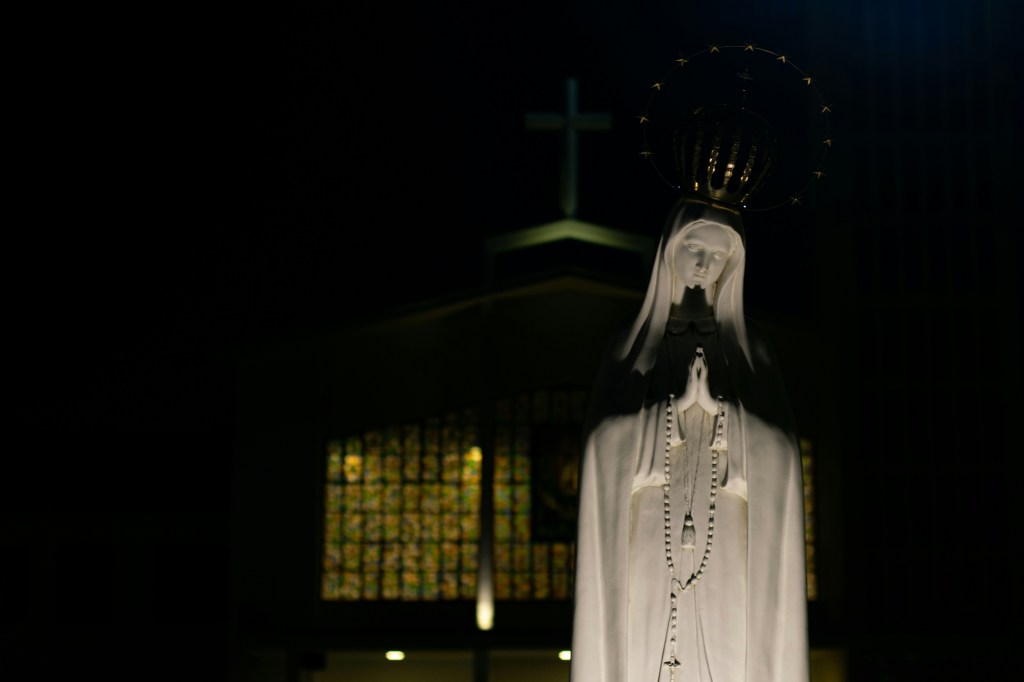
Today, in The Dolorous Passion by Anne Catherine Emmerich, we turn our attention to Jesus’ most Blessed Mother. From Chapter 45:
“What words can, alas, express the deep grief of the Blessed Virgin? Her eyes closed, a death-like tint overspread her countenance; unable to stand, she fell to the ground, but was soon lifted up, and supported by John, Magdalen, and the others. She looked once more upon her beloved Son—that Son whom she had conceived by the Holy Ghost, the flesh of her flesh, the bone of her bone, the heart of her heart—hanging on a cross between two thieves; crucified, dishonoured, condemned by those whom he came on earth to save; and well might she at this moment be termed ‘the queen of martyrs.’”
I wondered about all we have been discussing during this Season of Lent, and then I thought of Jesus’ most blessed Mother. It was thirty-three years ago that she gave birth to him, and she knew Him well. He didn’t have to speak for her to understand how He was feeling. She may have been present when he rode into town on the donkey, the crowds joyful and excited, waving palm branches and shouting, “Blessed is he who comes in the Name of the Lord.” However, one look at Jesus’ face, and she knew something was wrong—terribly wrong.
Over the course of the next few days, she came to understand the inner torment He was experiencing, but there was nothing she could do. A day later, news arrived through one of Jesus’ terrified disciples that He had been arrested. There was the trial, the long road to Golgotha, the crucifixion, and now… now she sits at the foot of the cross, watching her Son die—the Son who was conceived in her by the Holy Spirit.
She was oblivious to the crowds around her, unconcerned about the danger she was placing herself in. Nothing distracted her from her Son on the cross. Not one thing could make her take her eyes off of God because she knew that if she was going to get through this, it would be only through Him, for He had come to save her as well.
We can learn many things from this most blessed of all women. We can learn love, patience, perseverance. We can learn what it means to hunger for God and to comfort one another. Therefore, I encourage you this Holy Week to take Mary as your companion. Ask her to reveal to you the things she witnessed and to help you experience the true Passion of our Lord. Ask her to guide you beyond your own fears and away from the crowds and the noise. Ask her to allow you to join her at the foot of the Cross, and then ask her to show you perfect love—perfect love that was crucified for her and for you.
Let us pray: O Holy Mary, my most gentle Lady, faithful Advocate of all Christians, in view of the extraordinary merits that were yours and which made you most pleasing to God, and in view of your every comforting gesture you made to your Son, as well as the countless tears you shed during his most bitter Passion, I ask you to have pity on me, poor creature that I am. Take me under your maternal care and include me among the number of your servants, whom you hold dear and embrace with your special love.
O glorious Virgin Mary, my only hope, before my soul should leave this body of mine, come and reveal your face to me. Direct your gentle and beautiful eyes of mercy toward me, the very eyes that had joyfully and so often looked upon the fruit of your womb, Jesus, and were wetted because the many tears shed during his Passion. Most holy Mother of Jesus, come and stand at my side together with your group of attending virgins and the holy assemblage of saints, as you had steadfastly and perseveringly stood unto the end, when your most beloved Son was about to die on the Cross. After my Lord Jesus Christ, your only Son, I find none so generous and eager to console someone in need as you, most amiable Mother of the Afflicted. Amen. (On the Passion of Christ: According to the Four Evangelists, p.117)
A man was painting the home of an 89-year-old lady in Spokane. She had a large family Bible prominently displayed on the coffee table and remarked that it was 116 years old and a priceless heirloom. The painter commented on how remarkable that was and added, “It doesn’t matter how old the Bible might be; what’s on the inside is what matters.” She immediately replied, “Oh, I know. That sure is the truth. Why, we have family records and births and marriages, and deaths that go so far back, all recorded in that Bible; we could never replace them.”
Episcopalians may be accused of being the “frozen chosen” or because of the Book of Common Prayer, “Those Who Read to God,” but no one can ever accuse us of not reading our Bibles. I think we read more Holy Scripture on a Sunday than any other church out there.
In the study of Holy Scripture, I know of some who set themselves a plan to read the entire Bible in a year, some in three years, and others – well, others are pretty much like that lady having her house painted. It’s a good book to have around to record family relations or press flowers, but other than that…
I suppose we all have our favorite books of the Bible, but I’ve also heard folks say that if it’s not printed in red (meaning the words of Christ), they can’t be bothered. It is also true for many that they, with perhaps the exception of the Psalms, don’t read any of the Old Testament. Their reasoning is, “I don’t like the God of the Old Testament.”
Yet, what we learn from studying the Gospels is that Jesus was a big fan of the Old Testament. He quoted it about 80 times, the most memorable instance being when he spent 40 days in the desert and rebuked the devil. It seems that Jesus was considering Deuteronomy when the devil came along because all three of those rebukes came from that book.
For us, the Old Testament also enhances our understanding of God and shows how everything that occurred points to the need for a Savior. This is what Jesus referred to in our Gospel today when he said, “Therefore every scribe who has been trained for the kingdom of heaven is like the master of a household who brings out of his treasure what is new and what is old.” To truly know God and Jesus, we must study both the old and the new- the God of the Law and the God of the Law revealed and fulfilled. The same God, but a more complete and accurate picture.
Dietrich Bonhoeffer, whom we celebrate today, understood this. He wrote, “My thoughts and feelings seem to be getting more and more like those of the Old Testament. It is only when one knows the unutterability of the name of God that one can utter the name of Jesus Christ; it is only when one loves life and this earth so much that without them everything seems to be over that one may believe in the resurrection; it is only when one submits to God’s law that one may speak of grace. It is not Christian to want to take our thoughts and feelings too directly from the New Testament.”
The Holy Bible is more than just a collection of Sunday school stories and nice sayings; it is the history of our God. In both the Old and New Testaments, it serves as the place to discover Him, know Him, and be known by Him.
Jesus has spoken His final words, “It is finished” (John 19:30), and given up His spirit, yet the soldiers doubt He is dead. Anne Catherine Emmerich, in The Dolorous Passion of Our Lord Jesus Christ, picks up the story from there in chapter 48, “The Opening of the Side of Jesus.”
The executioners still appeared doubtful whether Jesus was really dead, and the brutality they had shown in breaking the legs of the thieves made the holy women tremble as to what outrage they might next perpetrate on the body of our Lord. But Cassius, the subaltern officer, a young man of about five-and-twenty, whose weak squinting eyes and nervous manner had often excited the derision of his companions, was suddenly illuminated by grace, and being quite overcome at the sight of the cruel conduct of the soldiers, and the deep sorrow of the holy women, determined to relieve their anxiety by proving beyond dispute that Jesus was really dead. The kindness of his heart prompted him, but unconsciously to himself he fulfilled a prophecy. He seized his lance and rode quickly up to the mound on which the Cross was planted, stopped just between the cross of the good thief and that of our Lord, and taking his lance in both hands, thrust it so completely into the right side of Jesus that the point went through the heart, and appeared on the left side. When Cassius drew his lance out of the wound a quantity of blood and water rushed from it, and flowed over his face and body.
The Prophet Ezekiel received a vision from God. In this vision, an angel of the Lord guided him, and Ezekiel saw the heavenly temple and the New Jerusalem, where God brought about the salvation of His people. He reports that the angel led him to “the temple, and behold, water was issuing from below the threshold of the temple toward the east (for the temple faced east). The water was flowing down from below the south end of the threshold of the temple, south of the altar. Then he brought me out by way of the north gate and led me around on the outside to the outer gate that faces toward the east; and behold, the water was trickling out on the south side.” (Ezekiel 47:1-2) However, if we refer back to the original Hebrew Scriptures, we discover that, while accurate, they do not state that the waters originated from the south side of the Temple. Instead, the Hebrew Scriptures indicate that they came from the “right side” of the Temple.
How should we understand the nature of the Temple that Ezekiel describes?
Following the Triumphant Entry, Jesus went to the Temple in Jerusalem. Upon his arrival, He became enraged because, as He stated, “It is written, ‘My house shall be called a house of prayer,’ but you make it a den of robbers.” (Matthew 21:13) He then drove the moneychangers and others out with a whip. When asked by what authority he was doing these things, Jesus replied, “Destroy this temple, and in three days I will raise it up.” They responded, “It has taken forty-six years to build this temple, and will you raise it up in three days?” But he was speaking about the temple of his body. (John 2:19-21)
Ezekiel prophesied that water would flow from the right side of the Temple and the Temple was Jesus. Catherine spoke of this, and it is confirmed in Scripture: “One of the soldiers pierced his side with a spear, and at once there came out blood and water.” (John 19:34)
What purpose does the water serve? Fifty years after Ezekiel, the Prophet Zechariah tells us, “On that day”—that is, the day the Lord intends to bring salvation to His People—“On that day there shall be a fountain opened for the house of David and the inhabitants of Jerusalem, to cleanse them from sin and uncleanness.” (Zechariah 13:1)
The stream flowed from the right side of the Temple, and the Temple was Jesus. Water and blood flowed from Jesus’ right side after He was pierced with the spear, and this water and blood offered forgiveness of sins to all who would believe in Him. Jesus says, “If anyone thirsts, let him come to me and drink.” (John 7:37)
Today, it may seem that the stream from the side of Jesus is only available to us in a spiritual sense, but that’s not the case. Writing in the fourth century, St. Augustine tells us, “The Sacraments flowed out of the side of Christ.”
We who are touched by the waters of Baptism and who partake of the Lord’s body and blood in Holy Communion are the recipients of the same water and blood that flowed from the side of the crucified Lord and in the words of the Eucharistic Prayer, we receive “the innumerable benefits procured unto us by the same.” (BCP 335) That’s good stuff right there. You should say “Amen.”
When Jesus’ side was opened, and his most Sacred Heart pierced, the very Gates of Heaven were opened. The blood and water, the River of Life, flowed out, creating a pathway for the healing of our souls and bodies.
Following the great tribulation in the Book of Revelation, John tells us, “The angel showed me the river of the water of life, bright as crystal, flowing from the throne of God and of the Lamb through the middle of the street of the” New Jerusalem. (Revelation 22:1-2)
On a scorching day in July 1864, weary from the heat, Robert Lowry, a Baptist minister, lay on a couch with no energy to do anything else. As he rested there, he meditated on this vision of the river of the water of life in John’s Revelation. The story goes, “While he was thus breathing heavily in the sultry atmosphere of that July day, his soul seemed to take new life from that celestial outlook. He began to wonder why the hymn-writers had said so much about “the river of death,” and so little about “the pure river of water of life, clear as crystal, proceeding out of the throne of God and of the Lamb.” (Source)
With this in mind, a hymn started to take shape in his mind. When the lyrics and music finally came together, he leaped up from the couch, sat down at his organ, and composed it in its entirety. You’ve likely heard it. The first stanza and refrain:
Shall we gather at the river, where bright angel feet have trod, with its crystal tide forever flowing by the throne of God?
Refrain: Yes, we’ll gather at the river, the beautiful, the beautiful river; gather with the saints at the river that flows by the throne of God.
Through the sacraments, we participate in and receive the blood and water that flowed from Jesus’ pierced side. Therefore, with Robert Lowry, we can confidently say, “Yes, we will gather at the river, the beautiful, beautiful river.”
Give thanks to the Lord our God, for He has literally opened Himself for you so that you may have access to Him.
Let us pray: Lord Jesus Christ, inexhaustible Fountain of love and grace, I bless and thank you for the ruthless piercing of your sacred side after you died. It was then that you, holiest of all who are holy, were brutally struck on your right side by one of the soldiers holding a military lance. It pierced so deeply that it entered the most tender part of your heart and from that wide-open wound there flowed a life-giving fountain of blood and water. Would that the whole world had been sprinkled, it might then be saved!
O most devoted Jesus, you are the source of all our hearts’ secrets and you dwell in the hearts of those who love you! O crucified Lord; you are the object of all contemplation! O Divine Treasury of all gifts and graces, Christ the King and Redeemer of the faithful, you permitted your sacred side to be pierced by the head of a lance. Open for me, I ask, the door of your mercy and permit me to enter through that wide opening in your side to the innermost recesses of your most sacred heart so that my heart may become powerfully inflamed and be united to you by the insoluble bond of love. May I live in you and you in me and may we remain united forever. Amen.
From The Dolorous Passion of Our Lord Jesus Christ by Anne Catherine Emmerich, Chapter Thirty-Eight: “The Nailing of Jesus to the Cross.”
“The executioners did not allow Jesus to rest long, but bade him rise and place himself on the cross that they might nail him to it. Then seizing his right arm they dragged it to the hole prepared for the nail, and having tied it tightly down with a cord, one of them knelt upon his sacred chest, a second held his hand flat, and a third taking a long thick nail, pressed it on the open palm of that adorable hand, which had ever been open to bestow blessings and favors on the ungrateful Jews, and with a great iron hammer….”
You know how that is going to end.
In the beginning, after God created, Adam and Eve were free to live in the Garden, with only one stipulation—God said, “You may surely eat of every tree of the garden, but of the tree of the knowledge of good and evil you shall not eat, for in the day that you eat of it, you shall surely die.” (Genesis 2:16-17) Did they listen? No, they reached out their hand, took, and ate the fruit. What was the first thing they realized afterward? They were naked. Break out the fig leaves. They believed that by eating, by reaching out, and taking what they wanted, even though it was contrary to God’s command, all things would be revealed to them. Instead, they and their sin were the ones revealed, and they became ashamed before God. Ever since, we’ve gone to great lengths to hide our nakedness, both physically (the worldwide fashion industry is worth $1.8 trillion) and spiritually.
At the other end of Holy Scripture, in the Book of Revelation, we get our clothes—not ones we’ve made, but those gifted by God. Clothes that make known our faith in Jesus. John writes, “I looked, and behold, a great multitude that no one could number, from every nation, from all tribes and peoples and languages, standing before the throne and before the Lamb, clothed in white robes.” (Revelation 7:9) When he asks who these people are, he is told, “These are the ones coming out of the great tribulation. They have washed their robes and made them white in the blood of the Lamb.” (Revelation 7:14) It is only through Jesus that we are properly clothed, enabling us to stand before God. How did Jesus accomplish this great work?
As Jesus walked, a man with leprosy approached Him and fell down before Him. The leper said, “‘Lord, if you will, you can make me clean.’ And Jesus stretched out his hand and touched him, saying, ‘I will; be clean.’ And immediately his leprosy was cleansed.” (Matthew 8:2-3)
While in Sidon, the people brought a man who was deaf and had a speech impediment and begged Jesus to help him. “Taking him aside from the crowd privately, [Jesus] put his fingers into his ears [He touched him], and after spitting touched his tongue. And looking up to heaven, he sighed and said to him, ‘Ephphatha,’ that is, ‘Be opened.’ And his ears were opened, his tongue was released, and he spoke plainly.” (Mark 7:33-35)
One day, while Jesus was teaching, the ruler of the synagogue came and pleaded with him to save his daughter, who was near death. Jesus agreed, but by the time they arrived, the daughter was already dead. Jesus told them not to worry; the girl was only sleeping. The people laughed at Him. “Jesus put them all outside and took the child’s father and mother and those who were with him and went in where the child was. Taking her by the hand, he said to her, ‘Talitha cumi,’ which means, ‘Little girl, I say to you, arise.’ And immediately the girl got up and began walking.” (Mark 5:40-42)
Jesus and the disciples had fed the 5,000. Afterward, Jesus sent the disciples back across the lake in a boat while He went up a mountain to pray. A great storm began to blow. Jesus came to them, walking on the water, and impetuous Peter said, ‘Lord, if that is really you, tell me to come to you.’ Jesus replied, ‘Well, come on.’ Peter got out of the boat and also walked on the water, but “when he saw the wind, he was afraid, and beginning to sink, he cried out, ‘Lord, save me.’ Jesus immediately reached out his hand and took hold of him, saying to him, ‘O you of little faith, why did you doubt?’” (Matthew 14:30-31)
Jesus stretched out His hand, touched the leper, and healed him. Jesus stretched out His hand, touched the deaf/mute, and restored his hearing and speech. Jesus stretched out His hand, touched the dead little girl, and gave her life. Jesus stretched out His hand, grabbed hold of Peter, and saved him.
Jesus saved us all and made it possible for us to clothe our spiritual nakedness with white robes, making us worthy to stand before His Father by stretching out His hand one last time. When He did, they drove a spike through it. However, what the devil and all the others who opposed the will of God failed to understand was that the result this one last time would be exactly the same as it had always been. He stretched out His hand on the hard wood of the cross, and He healed, He restored, He gave life, and He pulled us from the grasp of the enemy. With the blood He shed, He washed our robes, and He washed our souls.
Too often, we follow the example of Adam and Eve—reaching out our hands and grabbing whatever we desire, regardless of God’s commands. Instead, we should follow the example of Jesus—reaching out to heal, restore, and show others how they might be raised to eternal life. Like the friends of the deaf/mute, we are to bring others to Jesus so that He might touch them.
When you see the outstretched hands of Jesus nailed to the cross, meditate on what those most sacred hands accomplished, and then commit yourself to continuing that work. Jesus said, “Truly, truly, I say to you, whoever believes in me will also do the works that I do; and greater works than these will he do, because I am going to the Father.” (John 14:12) May we stop always grabbing at the things we want and instead stretch out our hands to continue the healing, restoring, life-giving work of Jesus.
Let us pray… Lord Jesus Christ, most gracious Creator of man and Restorer of his wounded nature… I praise and glorify you for your ever-consuming love for our salvation, for your being so violently stretched out on the hard wood of the Cross, waiting there to receive you…. I praise you for the pungent piercing of your hands….
You allowed your hands to be transfixed by evil men, and in this way your sacred hands, while nailed to the Cross, paid back the heavy debt incurred by Adam, who had extended his deadly hands to the forbidden tree. By your precious blood you wiped away that long-standing debt.
O faithful servant of Jesus, raise your eyes upward, and with a sad heart and grieving face, look upon your God and Redeemer hanging between the lofty arms of the Cross… He stretches out his most loving arms to you; he shows you his open wounds; he bends his head to kiss you; he is prepared to receive you in his favor and without any hesitation to forgive your every sin… Far be it for us to glory in anything but the Cross of our Lord Jesus Christ.
O good and gentle Jesus, beloved Son of God, in following your Father’s will you deigned to take unto yourself the substance of our flesh … and to offer it on the altar of the Cross for the world’s salvation. Have mercy on me, your servant, who now asks your forgiveness and grace. Relying on your goodness and the infinite merits of your Passion, pardon all my sins committed against you, whether recent or old, knowingly or unknowingly. Your merits far exceed mankind’s wickedness and your abounding atonement is much greater than all my iniquity, no matter how frequently committed. Knowing this, I come before you under the protection of the Cross and hope for still greater mercy. From the depths of my heart I ask and seek the remedy that will bring me to salvation. Amen. (On the Passion of Christ: According to the Four Evangelists, p.74-78)
In our study of the Gospels, certain characters beyond Jesus always capture our attention. There is, of course, Jesus’ mother, Mary, the disciples, John the Baptist, and even some antagonists—Pilate, Herod, the religious leaders. However, it seems to me that one character often fades into the background: Joseph, Jesus’ earthly “step-father.” Perhaps that is where he prefers to be, in the background, but as the head of the Holy Family, he should be regarded as one of the primary figures in the life of our Savior.
What do we know about him? He was of the lineage of King David, which was quite special. He worked as a carpenter, an honest trade. He was older than Mary and likely respected in the community. I don’t think he was wealthy, but given his profession, he was comfortable. It seems that his life was probably uncomplicated right up until he discovered that Mary was pregnant. Since they were not yet married, everyone, including Joseph, assumed Mary had committed adultery; therefore, Joseph could have accused her, and she would have faced stoning. Instead, he decided to walk away quietly. However, the angel of the Lord appeared to him in a dream, saying, “Joseph, son of David, do not be afraid to take Mary as your wife, for the child conceived in her is from the Holy Spirit. She will bear a son, and you are to name him Jesus, for he will save his people from their sins.” So, instead of walking away, Joseph followed the angel’s instructions.
It required a great deal of faith, but what Joseph did was truly sacrificial. He would have been justified in accusing her, but he chose not to. He would have had to swallow a bit of pride, yet it would have been even more convenient to just walk away; however, he looked upon Mary and took her as his wife. He regarded her with love. How much did he love her? He loved her enough to say that he would give up everything. He would sacrifice all he had for her.
The love Joseph demonstrates is a sacrificial love. It is completely about and for another, regardless of whether there is any benefit for the one who loves; in fact, it may cost them a great deal. The purpose of such sacrificial love is to see Christ born in another. This is the sacrificial love that Joseph showed to Mary, and it serves as an example for us. We seek to follow Joseph’s example so that we, too, can see Christ born in another.
It’s not an easy question to answer, but what part of yourself would you sacrifice to witness God being born in another? What is so important in you that you couldn’t sacrifice it? If that’s not enough, who would you be willing to sacrifice it for? Who wouldn’t you?
St. Josemaria Escriva writes, “This is the truth of a Christian’s life: self-giving and love—love of God and, for God’s sake, love of one’s neighbor—founded on sacrifice.” The life of St. Joseph exemplified both, as seen in his life of sacrifice. He may prefer to remain in the background, but in our Christian walk, we can look to him as a model for how we are to live and love.
This week, we continue our meditations on Chapter 26, “The Crowning with Thorns,” from The Dolorous Passion of Our Lord Jesus Christ by Anne Catherine Emmerich.
In the middle of the court—where Jesus had been scourged—there stood the fragment of a pillar, and on it was placed a very low stool which these cruel men—who had whipped Jesus—maliciously covered with sharp flints and bits of broken potsherds. Then they tore off the garments of Jesus, thereby reopening all his wounds; threw over his shoulders an old scarlet mantle which barely reached his knees; dragged him to the seat prepared, and pushed him roughly down upon it, having first placed the crown of thorns upon his head. The crown of thorns was made of three branches plaited together, the greatest part of the thorns being purposely turned inwards so as to pierce our Lord’s head. Having first placed these twisted branches on his forehead, they tied them tightly together at the back of his head, and no sooner was this accomplished to their satisfaction than they put a large reed into his hand, doing all with derisive gravity as if they were really crowning him king. They then seized the reed, and struck his head… they knelt before him, derided him, spat in his face, and buffeted him, saying at the same time, ‘Hail, King of the Jews!’ Then they threw down his stool, pulled him up again from the ground on which he had fallen, and reseated him with the greatest possible brutality.
Humility. It is something we all need to learn a bit more about. First, what it is not. Humility does not mean walking around believing you are such a lowly worm that the rest of the world shouldn’t even acknowledge your existence. Humility does not mean becoming a doormat or a punching bag for others. Perhaps C.S. Lewis summed it up nicely when he wrote, “Humility is not thinking less of yourself, but thinking of yourself less.” What does that look like?
Many years back, a Black man walked through an affluent neighborhood of Tuskegee, Alabama, when a wealthy white woman approached him. She asked if he would like to earn a few dollars by chopping wood for her. With no urgent business at hand, the man smiled, rolled up his sleeves, and set about the humble task she had requested. When he finished, he carried the logs into the house and stacked them by the fireplace. The White woman did not know who the man was, but a little girl who passed by did and told her after the man had left. It was Booker T. Washington, professor, and president of the Tuskegee Institute.
The following day, the embarrassed woman visited Mr. Washington in his office at the Institute and apologized profusely. “It’s perfectly all right, Madam,” he replied. “Occasionally, I enjoy a little manual labor. Besides, it’s always a delight to do something for a friend.”
In the Sermon on the Mount, Jesus gave instructions on the core characteristics of humility. He said, “Blessed are the poor, those who mourn, the meek, those who thirst for righteousness, the merciful, the pure, peacemakers, and the persecuted.” However, Jesus did not only teach us through His words. As He stood in that courtyard, enduring the scourging, mocking, spitting, and the crown of thorns, He embodied all these qualities.
He was the King of Kings, yet He wore a crown of thorns. He stood there battered, bruised, and bleeding like one who had nothing or a common criminal. He mourned for those who persecuted Him and showed mercy toward them, later saying, “Father, forgive them.” His hunger and thirst for righteousness—not His own, but ours—was so great that He endured all these trials.
Perhaps the Sermon on the Mount could be summed up in one phrase: “Blessed are you when you wear your own crown of thorns,” for that says, “Blessed are you when you are willing to give up what you see as rightfully yours for the sake of someone else.” Which, ultimately, is the very definition of love: “Willing the good of the other.”
Dutch Reform Pastor Andrew Murray wrote, “Humility is perfect quietness of heart. It is for me to have no trouble; never to be fretted or vexed or irritated or sore or disappointed. It is to expect nothing, to wonder at nothing that is done to me, to feel nothing done against me. It is to be at rest when nobody praises me and when I am blamed or despised.
“It is to have a blessed home in the Lord where I can go in and shut the door and kneel to my Father in secret and be at peace as in a deep sea of calmness when all around is trouble. It is the fruit of the Lord Jesus Christ’s redemptive work on Calvary’s cross, manifested in those of His own who are definitely subject to the Holy Spirit.”
When the pride within you begins to swell and you are feeling puffed up, or when you start to think of yourself as more successful or spiritual than your brothers and sisters in Christ, and something is said that stings your ego, meditate on our Lord Jesus Christ. Visualize the King of Kings and Lord of Lords standing before you with His crown of thorns tightly fitted around His head, and remember how He humbled Himself for your sake.
St. Paul teaches us, “Have this mind among yourselves, which is yours in Christ Jesus, who, though he was in the form of God, did not count equality with God a thing to be grasped, but emptied himself, by taking the form of a servant, being born in the likeness of men. And being found in human form, he humbled himself by becoming obedient to the point of death, even death on a cross.” (Philippians 2:5-8)
Let us pray. “Lord Jesus Christ, glorious King of the saints and radiant Crown of eternal glory… with singular devotion and a heart full of compassion, I praise and glorify you for the brutal punishment you most patiently suffered in the crowning of your sacred head with thorns…. Your sacred head, the most blessed of all Nazarenes, was covered with thorns that pierced so deeply.
“What a sorrowful sight to see the Son of God, in whom no sin could be found, so shamefully and horribly crowned! Because of the soldiers’ raging madness, they did not in the least tremble as they pierced with many a sharp thorn so holy, so handsome, so noble, and so revered a head. They likewise dared to salute the King of angels by publicly ridiculing, striking, and mocking him.
“Most gentle Jesus, King most admirable, Crown of Confessors, Strength of the Church Militant, Delight of the Church Triumphant, and model of all who follow you, how shamefully you were treated, how cruelly tortured! While many a blow was outwardly delivered, you experienced great inward distress, and all this for my sake… to save me from eternal punishment in hell, to cleanse my heart from its vicious habits, and to crown me in heaven with undying glory and honor.
“Cleanse me, Lord Jesus, from the contagion of material possessions. Clothe me with true virtue and grant me to rejoice when I meet contempt. Let me not complain about those who laugh at me, or argue with those who reproach me, but by my remembering your crown of thorns may I calmly accept, for the sake of my salvation, whatever pain and affliction may come my way. Amen.” (On the Passion of Christ: According to the Four Evangelists, p.55-61)
Gregory the Great, whom we celebrate today, was elected Pope in 590 and is one of only four Popes to have received the title “Great,” alongside Leo I, Nicholas I, and John Paul II.
Gregory accomplished much in his ministry, but significant to us is the fact that he sent Augustine, who would become the first Archbishop of Canterbury, on a mission to the Anglo-Saxons in the year 595. This action led the Venerable Bede to refer to Augustine as the Apostle to the English.
In addition to his other work, Gregory was also a prolific writer. Perhaps one of his best-known works is the Book of Pastoral Rule, which provides guidance to clergy on how to shepherd their flocks. As Pope, he viewed himself as the “servant of the servants of God,” making it clear why much of this work emphasizes the service and instruction that clergy are to provide to those in their care. One passage that resonated with me says, “Therefore, it should be said to the humble that whenever they lower themselves, they ascend to the likeness of God. At the same time, it should be said to the proud that whenever they take pride in themselves, they fall into imitation of the apostate angel. And what could be worse than pride, which by holding itself above everything, so unwinds itself from the stature of true greatness? And what is more sublime than humility, which by lowering itself unites with the Creator, who is above all things?”
Gregory speaks about humility and pride, but he also addresses how we are to serve one another. When we humble ourselves in service to others, we take on the likeness of our Savior. Additionally, we should not ask, “What’s in it for me?” If we serve with the aim of gaining something for ourselves or trying to elevate ourselves over others, then we are not truly serving them; we are serving ourselves. Remember what Jesus said: “If you love those who love you, what credit is that to you? For even sinners love those who love them. If you do good to those who do good to you, what credit is that to you? For even sinners do the same. If you lend to those from whom you hope to receive, what credit is that to you? Even sinners lend to sinners, to receive as much again. But love your enemies, do good, and lend, expecting nothing in return. Your reward will be great, and you will be children of the Most High.” In our Gospel, Jesus said, “Whoever wishes to become great among you must be your servant, and whoever wishes to be first among you must be slave of all.” These are the ideas that Gregory had in mind when he referred to the role of Pope as being the “servant of the servants of God,” and it is our calling as well.
You and I are called to be humble servants to each other, just as Jesus was to us. When you serve, do so sacrificially.
One of my favorite prayers by St. Ignatius of Loyola: Teach us, good Lord, to serve you as you deserve, to give and not to count the cost, to fight and not to heed the wounds, to toil and not to seek for rest, to labour and not to ask for any reward, save that of knowing that we do your will. Amen.
The second string and benchwarmers are never good enough to have their names in light or pictures on the cover. It’s always the superstars that get all the press, while the rest of the team goes largely unnoticed. It is true in many different arenas.
Before the symphony begins, the stage is crowded with all the musicians warming up, except for the first-string violinist. Just as the performance is about to begin, they come out to the applause of the crowd, followed only by the conductor. It is as though all the other positions are there only to serve these two. Even so, Leonard Bernstein, who conducted the New York Philharmonic from 1958 to 1969, said, “Second fiddle. I can always get plenty of first violinists, but to find one who plays second violin with as much enthusiasm . . . now that’s the problem. And yet if no one plays second, we have no harmony.”
The “second fiddle” of the San Francisco Symphony said, “Playing second fiddle may connote being second best, but the preparation for playing first or second violin is exactly the same.”
When I was playing football in junior high, I was a benchwarmer who dreamed of one day making it to the second string. However, when I went to practice, the coach didn’t say, “You first stringers, give me 50 sit-ups, and you second stringers (or less) give me 25.” When it was time to practice, we all went at it the same way. On game day, we all suited up and were ready to play.
Following the death and resurrection of Jesus and prior to Pentecost, the disciples were gathered in Jerusalem. They had fellowship, prayer, and began establishing a plan for moving forward. In the process, they believed there needed to be twelve disciples, as Jesus had, so the first order of business was to replace Judas, the disciple who betrayed Jesus.
Peter said that the new apostle should be “one of the men who have accompanied us during all the time that the Lord Jesus went in and out among us, beginning from the baptism of John until the day when he was taken up from us—one of these must become a witness with us to his resurrection.”
After discussion, it came down to two. Scripture then says, “Then they prayed and said, ‘Lord, you know everyone’s heart. Show us which one of these two you have chosen to take the place in this ministry and apostleship from which Judas turned aside to go to his own place.’ And they cast lots for them, and the lot fell on Matthias; and he was added to the eleven apostles.”
The second string just got their shot at the big league.
Back to my football career, the coach occasionally let me in the game for a few plays, but that was about it. Some fellas were quite a bit better than me, so I understand now why I didn’t get to play much, but I think another problem wasn’t necessarily my lack of talent but the fact that I never believed I would be called up. I never felt that I could actually make first string. I don’t think it was an intentional act not to try harder, but, looking back, I don’t think I was intentional about improving either. I was just happy to be on the team, get to wear a letter jacket, and muddle along.
Perhaps that is OK in Jr. High football and even the symphony, but Matthias teaches us that when it comes to being a disciple of Jesus, we should constantly seek to improve ourselves and maintain our highest level of commitment, for we never know when God will call us into a greater responsibility.
I’ve complained to you once before about the headlines for newspaper articles. The situation has not improved. One newspaper reports, “Woman missing since she got lost.” I don’t know if the city or the newspaper is the rocket scientist on this one, but “City unsure why the sewer smells.” No concerns about the education system as “Hispanics ace Spanish tests.” Nothing offensive here, “Midget sues grocer, cites belittling remarks.” And in keeping with the politics of the day, “Ex-Minister breaks silence, says nothing.” And if you think those are idiotic, try these goofy phrases on for size.
“Love your enemies.”
“Do good to those who hate you.”
“Bless those who curse you.”
“If anyone strikes you on the cheek, offer the other also.”
And the clincher, “Do to others as you would have them do to you.”
The headlines are ridiculous, but when people start talking like this, I generally begin to think that some sort of rehab is in order.
Last week, we read that Jesus came to a level place with His disciples, and a great crowd gathered around them. Jesus then began to teach, saying, “Blessed are you who are poor, for yours is the kingdom of God.” He gave them the beatitudes. Today’s Gospel reading is a continuation of that same sermon, and the things Jesus says are radically the opposite of how people believed God operated and even more so on how the world operates.
For example, take the one mentioned, “Blessed are you who are poor, for yours is the kingdom of God.” The Old Testament does not directly say you are cursed if you are poor, but it does say the opposite. Proverbs 10:22,
“The blessing of the Lord makes rich, and he adds no sorrow with it.”
Deuteronomy says, “You shall remember the Lord your God, for it is he who gives you power to get wealth, that he may confirm his covenant that he swore to your fathers.” (Deut. 8:18)
The Old Testament does not say you are cursed if you are poor, but for many, these texts imply it. If you are rich, then God is blessing you. If you are poor, you must have done something wrong to anger God. All the points Jesus made in our reading today are just as startling.
“Love your enemies.” We never seem to recall hearing this in the Old Testament because the opposite is so prevalent. Remember the Edomites and the Babylonians. They did not play well with others, and the Israelites saw them as bitter enemies. The Psalmist made that point quite clear.
“Remember, O Lord, against the Edomites the day of Jerusalem, how they said, “Lay it bare, lay it bare, down to its foundations!”
O daughter of Babylon, doomed to be destroyed, blessed shall he be who repays you with what you have done to us!
Blessed shall he be who takes your little ones and dashes them against the rock!” (Psalm 137:7-9)
Not quite the love we were hoping for. Yet, Jesus says we are to love our enemies. In the Sermon on the Mount, He even expanded on this by saying, “I say to you, Love your enemies and pray for those who persecute you.” (Matthew 5:43)
We can look at this and everything that Jesus said and understand how radical His teachings were at the time—how controversial they must have been. Fortunately, that’s no longer the case. We love our enemies and never curse anyone. We always turn the other cheek and never strike back. We don’t judge or condemn, and we are incredibly forgiving. Am I right?
I don’t always pull out the Greek Interlinear Bible (it provides a literal translation of the text), but I did with the passage. I was checking on a particular word—“if.” The translation we read says “If” in a few places, but it is not in the original Greek. Therefore, Jesus is not saying, “If you have enemies… if someone curses you… if someone strikes you… if someone steals from you and so on.” Instead, Jesus is saying, “You will have enemies; there will be those that curse you, someone will strike you, and others will steal from you. It will happen, but you are not to treat them like they treat you. You are to treat them the way you want them to treat you.”
I would like to get up every morning and say my Stuart Smalley (Saturday Night Live) affirmations, “I’m good enough, I’m smart enough, and doggone it, people like me.” I would also like to believe that’s true; however, I may be good enough and smart enough, but not everybody likes me. I’m just not their cup of tea. I don’t think the way they think, believe what they believe, hold to the same politics as they do, or any number of other points of contention. The same is true for all of us. It may seem that everyone is giving you a thumbs up, but don’t be fooled; some are giving you a thumbs down (if not worse), so the question is not whether or not you have these people in your life. You do. The question is, how do you treat them? How do you respond to them?
Jesus told us how, and St. Peter reaffirmed it in his first Epistle. He writes, “All of you, have unity of mind, sympathy, brotherly love, a tender heart, and a humble mind. Do not repay evil for evil or reviling for reviling, but on the contrary, bless, for to this you were called, that you may obtain a blessing.” He then quotes a portion of Psalm 34. “For
‘Whoever desires to love life and see good days, let him keep his tongue from evil and his lips from speaking deceit;
let him turn away from evil and do good; let him seek peace and pursue it.’
We are called to be a light unto the nations, but when we act like everyone else, we only bring more darkness. N.T. Wright says that this type of behavior is “Another victory for the hostile world: when Christians ‘give as good as they get,’ repaying slander with slander, they are colluding with the surrounding world, just as surely as if they went along with immorality or financial corruption.” Therefore, our response is that which Jesus calls us to. That is, to behave and respond in a way that is radically the opposite of the world. We are to love instead of hate. Bless instead of curse. Give instead of take. Forgive instead of holding grudges. And this is not easy; even worse, it is not our natural inclination. Most people just aren’t that nice. Therefore, it must be an intentional way of life and a practiced one.
If you want to love your enemies instead of hating them, you must make a conscious decision to love them and then practice it. If you are going to bless instead of curse, you will have to decide this before you even get out of bed, then you must put it into action. And we must do these things, not just with our lips and actions, but also in our hearts. If you are only washing the outside of the pot and the inside is still filthy, what good is that to you?
One final note: Jesus said, “The measure you give will be the measure you get back.” But keep in mind that the measure you “get back” is not from this world. It is from your Heavenly Father. Therefore, not everyone is going to like you, and not everyone is going to play according to the same rules you’ve set for yourself. You may turn the other cheek, but you may also get smacked on that one as well. Yet, don’t let that stop you from living the life God has called you to.
The headlines are ridiculous, and the news behind them is often even more ludicrous and incomprehensible. Yet, amid the insanity of it all and in our personal lives, we are called to a different way of life. Will it be easy? No, and no one ever said it would be. Regardless, “be strong and courageous” and live this radically countercultural life Jesus calls us to.
Let us pray. (This is a prayer from Mother Teresa, and I’ve shared it with you before. Perhaps it is not as much a prayer as a commissioning.)
People are often unreasonable, illogical, and self-centered; forgive them anyway.
If you are kind, people may accuse you of selfish, ulterior motives; be kind anyway.
If you are successful, you will win some false friends and some true enemies; succeed anyway.
If you are honest and frank, people may cheat you; be honest and frank anyway.
What you spend years building, someone could destroy overnight; build anyway.
If you find serenity and happiness, they may be jealous; be happy anyway.
The good you do today, people will often forget tomorrow; do good anyway.
Give the world the best you have, and it may never be enough; give the world the best you’ve got anyway.
You see, in the final analysis, it is between you and your God; It was never between you and them anyway.