Sermon: Dame Julian of Norwich

worldDame Julian of Norwich was born in the mid-15th century in England and was an anchoress, that is, one who withdraws from the world for the sake of spending a life in prayer. At age 30 she became ill and was so near death that she was given last rites; however, after seven days she suddenly appeared to heal, and was then given fifteen visions regarding Our Lord’s Passion. She would later write, “From that time I desired oftentimes to learn what was our Lord’s meaning and fifteen years after I was answered in ghostly understanding: ‘Wouldst thou learn the Lord’s meaning in this thing? Learn it well. Love was his meaning. Who showed it thee? Love. What showed he thee? Love. Wherefore showed it he? For Love. Hold thee therein and thou shalt learn and know more in the same.’ Thus it was I learned that Love was our Lord’s meaning.”

Julian recorded these visions – there is a short version and a longer one – and you can find them in the book Revelations of Divine Love. It is a bit too much reading for any sermon, but I would still like to share a short passage from one of the them. It is one of my favorite:

“And in this he showed me a little thing, the quantity of a hazel nut, lying in the palm of my hand, as it seemed. And it was as round as any ball. I looked upon it with the eye of my understanding, and thought, ‘What may this be?’ And it was answered generally thus, ‘It is all that is made.’ I marveled how it might last, for I thought it might suddenly have fallen to nothing for littleness. And I was answered in my understanding: It lasts and ever shall, for God loves it. And so have all things their beginning by the love of God. In this little thing I saw three properties. The first is that God made it. The second that God loves it. And the third, that God keeps it.”

A person could spend hours trying to understand all that is said in that one statement, Julian spent years attempting to understand it herself, but in it we can begin to see the vastness of God. We understand that all of creation rests in the palm of God’s hand. From the smallest particle of the atom to the seemingly infinity of the heavens. But not only does he hold it, but through His Son, Jesus, God is a part of that creation. If it stopped there, then we could at least know that there is someone out there who is in control, but it doesn’t stop there. The first of the three properties were that “God made it.” The third was that “God keeps it.” But the second is that “God loves it.” All that there is was made by God and is held by God and even though he is so vast and we so small, He loves.

The Psalmist asks:

When I consider Your heavens, the work of Your fingers,

The moon and the stars, which You have ordained,

What is man that You are mindful of him,

And the son of man that You visit him?

Why does God care about this small orb He holds in the palm of His hand? Because He loves you. Julian’s most famous passage sums it up for many, “All shall be well, and all shall be well, and all manner of things shall be well.” All shall be well, because God is love and God loves.


Sermon: Producing Good Fruit

22401563_BG1The young management consultant had an interview with the president of a major advertising firm. The young man was nervous. At that stage in his career, it wasn’t very often that he got to talk to the president of a company. The appointment was at 10:00 a.m., for one hour. He arrived early. Promptly at 10, he was ushered into a large and airy room, with furniture upholstered in bright yellow. The president had his shirtsleeves rolled up and a mean look on his face. “You’ve only got 20 minutes,” he barked. The young man sat there, not saying a word. “I said, you’ve only got 20 minutes.” “Your time’s ticking away. Why aren’t you saying anything?” “They’re my 20 minutes,” replied the young man, “I can do whatever I want with them.”

In Matthew’s Gospel Jesus said, “I tell you the truth, unless a kernel of wheat falls to the ground and dies, it remains only a single seed. But if it dies, it produces many seeds.” Not only is Jesus referring to himself, who died and rose again, but he is also referring to us. We must die to self, grow in Christ, and produce that good fruit. We are called to be the mustard seed in our Gospel today – small, but with purpose and results. Not only is this something Jesus instructs us to do, but is also something we have vowed to do – from the baptismal covenant, “Will you proclaim by word and example the Good News of God in Christ?” Our response, “I will, with God’s help.”

I have been told that there are some folks who can grow corn in Montana. I don’t believe it. I tried in Butte and I tried in Anaconda. The ears I grew were something less than pathetic. Now, when I lived down south with my granddaddy, we could grow just about anything: corn, squash, beans, all the good stuff. One year my Grandaddy got a hankering for some strawberries, so he planted two long rows in the front garden. They came in good and those first strawberries were wonderful; however, by the end of the summer we were swimming in strawberries. We had eaten all the strawberry pies we could eat, canned enough strawberry preserves to last a lifetime, and if we should show up at the neighbors with one more bag of strawberries I feel certain they would have sicced the dog on us.

Now consider this from a spiritual perspective: we are to grow in Christ and we are to produce good fruit. So, if you were called on by the Lord to display the fruit you had produced, what would it look like? My Montana corn or my grandaddy’s strawberries?

One of my favorite sayings of the desert fathers, “If a man settles in a certain place and does not bring forth the fruit of that place, the place itself casts him out, as one who has not borne its fruit.” We are to produce good fruit; therefore, we must wisely use the time we have been given.

That young management consultant had his twenty minutes. We can look at the span of your life as he looked at those 20 minutes. They are ours. We can do anything we like with them. We can squander them. We can spend them building up for yourselves treasures on earth. Or, we can use them – or at least a portion of them, say 10% – to produce an abundance of good fruit. Jesus said, “This is to my Father’s glory, that you bear much fruit, showing yourselves to be my disciples.”

Produce good fruit so that your Father in Heaven is glorified.


Sermon: Ash Wednesday

8m

The Bureau of Labor came out with some statistics on how we spend our time.  It breaks down like this:

Working and related activities:  8.7 hours

Sleep:  7.7 hours

Leisure and sports:  2.6 hours

Household activities:  1.1 hours

Eating and drinking:  1.1 hours

Caring for Others: 1.3 hours

Other: 1.5 hours

This means that over half the day is gone, with over 12 hours a day devoted to working, eating, household and caring activities.  Then there is the time for sleeping, 7.7 hours, which leaves only a few hours remaining for anything else.  The majority of that extra time would seem to be assigned to the La-z-boy and the TV.  However, of that “other” category, 16 minutes are given to “organizational, civic, and religious” activities.  If we were being generous with the religious aspect and gave it 50% of that time, we would have 8 minutes per day or 56 minutes per week that we give to God.

Now, the unaware and self-righteous side of me would like to rail against those statistics, start telling folks that they need to get their priorities straight and all that.  Truth is, if I weren’t a priest – receiving a stipend so that I could spend time with God on behalf of the people – if I had a job in the secular world, children to care for, school and family functions, if I had all these things and more, then I’m fairly certain that my minutes per day that I spend with God would be less than eight.  Heck, even as a priest there are days when 8 minutes with God seems like a lot!   But that doesn’t make it right.

Much of our life with Christ is about sacrifice, the giving up of who we are and replacing it with who God is.  It is about a relationship and with any relationship it requires time, nurturing, giving, and sacrifice.

In the time leading up to Lent there are always discussion about what we will be “giving up,” that which we abstain from.  However, this giving up is not about an act of will power: “I’m giving up coffee for Lent or smoking or whatever.”  Heck, I gave up beer one Lent and really learned to enjoy red wine.  The point of abstaining from something is so that you will be able to give that time, those resources, etc. to God.  I’ll give up half an hour of TV a day so that I can spend that time with God.  See how it works?

I read our Gospel today and it speaks of doing certain things for God: giving alms, serving Him, praying, and fasting.  It talks about how we rightly do these things, not in public and not for show, but with a world that is constantly demanding more and more of our time, before we can do these things properly we must first learn to simply DO them.  We discover how to give God more than 8 minutes per day, to sacrifice something of ourselves so that we can enter more deeply into that relationship with Him.  This time with God is not just one more thing that we have to accomplish, as a Christian people, time with God, serving Him is our joy!  Thomas a Kempis understood these things.  In his Imitation of Christ, he writes, “I WILL hear what the Lord God will speak in me… Blessed is the soul who hears the Lord speaking within her, who receives the word of consolation from His lips.  Blessed are the ears that catch the accents of divine whispering, and pay no heed to the murmurings of this world.  Blessed indeed are the ears that listen, not to the voice which sounds without, but to the truth which teaches within.  Blessed are the eyes which are closed to exterior things and are fixed upon those which are interior.  Blessed are they who penetrate inwardly, who try daily to prepare themselves more and more to understand mysteries.  Blessed are they who long to give their time to God, and who cut themselves off from the hindrances of the world…. Consider these things, my soul, and close the door of your senses, so that you can hear what the Lord your God speaks within you, ‘I am your salvation,’ says your Beloved. ‘I am your peace and your life.’”

The Lord is your joy.  Your salvation.  Your peace.  Your life.  During this Holy Lent make the sacrifice, take the time, and hear what the Lord your God will speak in you.

Sermon – Enemies

kife

Thomas a Kempis writes, “If you were but worthy to suffer something for the name of Jesus, what great glory would be in store for you, what great joy to all the saints of God, what great edification to those about you! For all men praise patience though there are few who wish to practice it.”  But it is in the suffering of the cross that we find our victory… Again, Brother Thomas writes, “In the cross is salvation, in the cross is life, in the cross is protection from enemies, in the cross is infusion of heavenly sweetness, in the cross is strength of mind, in the cross is joy of spirit, in the cross is highest virtue, in the cross is perfect holiness. There is no salvation of soul nor hope of everlasting life but in the cross.”  I was reminded of all this in our reading.  We praise patience: those who turn the other cheek, those who gift wrap their cloaks, those who love and pray for their enemies, those who sacrifice.  We praise those who do, but who really wants to practice that?  In the cross – in sacrifice is joy – but who really wants to sacrifice.

Two brothers were playing on the sandbanks by the river. One ran after another up a large mound of sand. Unfortunately, the mound was not solid, and their weight caused them to sink in quickly. When the boys did not return home for dinner, the family and neighbors organized a search. They found the younger brother unconscious, with his head and shoulders sticking out above the sand. When they cleared the sand to his waist, he awakened. The searchers asked, “Where is your brother?” The child replied, “I’m standing on his shoulders.”

Jesus says that we are willing to do this sort of thing for our friends and those we love, but how do we learn to do it for a perfect stranger?  How do we learn to love an enemy in this same way?

The answer and the ability comes only by looking to the example that Jesus has set for us.  Paul says to us, “while we were enemies, we were reconciled to God through the death of his Son.”  We were once enemies of God, but through his great love for us we were reconciled to Him.  Paul goes on to teach us, “Beloved, never avenge yourselves, but leave room for the wrath of God; for it is written, ‘Vengeance is mine, I will repay, says the Lord.’ No, ‘if your enemies are hungry, feed them; if they are thirsty, give them something to drink; for by doing this you will heap burning coals on their heads.’  Do not be overcome by evil, but overcome evil with good.”

It is in our very nature to want to repay the evils that have been done against us and our culture through various media does nothing but reinforce that sentiment, but Jesus would have us address our enemies and those who wish us harm in a different way.  He would have us walk with them.  Pray for them.  Love them.

We may not all have great enemies, but if we can learn to practice this with those who simply irritate us, then we will have made great strides.


Sermon – Be Perfect

keep-calm-and-be-perfect-30

When we think of commandments of God, we always think of the top ten: I am the Lord thy God, Thou shalt have no other gods, Thou shalt not kill, steal, covet, etc.  The Jews considered these to be the first ten of 613 commandments – laws – that can be found in the Old Testament.  To break any of them was a sin and required that some sort of offering be made for atonement, anything from sacrificing a bull to waving a sheaf of grain.

Jesus, in his teachings, summed up the law for us when he said, “‘Love the Lord your God with all your heart and with all your soul and with all your strength and with all your mind’; and, ‘Love your neighbor as yourself.’”  These are also commandments, and for us, just as important as that Top Ten list found in the Old Testament.

In our Gospel reading today, we have another commandment.  It was the last sentence, “Be perfect, therefore, as your heavenly Father is perfect.”  Jesus has commanded us to be perfect.  Can I get a show of hands from those who have reached perfection?  Anybody?  Here is the kicker, if it is commanded – it is possible.  Be perfect – it is commanded by God, therefore it is possible.  To say that it is not is to be disobedient to the command.  So, what’s it going to be?

Would you believe me if I said that you are perfect? The truth is: You are.  St. Paul writes in his letter to the Hebrews, “For by one sacrifice he has made perfect forever those who are being made holy.”  For by one sacrifice – that is Christ death upon the Cross – he has made perfect forever those – that would be you – who are being made holy.

Through Christ, you have been made perfect, but note what Paul also said, “who are being made holy.”  You are perfect and you are being made holy.  St. Francis de Sale summed this up when he said that we are “Perfection seeking perfection.”  We are made perfect in Christ and each day, we seek to be made more perfect.

You may not believe this and believe me, you wouldn’t be the first, but be encouraged.  Think of it this way, expressed by St. Josemaria Escriva, the founder of Opus Dei, “Cast away that despair produced by the realization of your weakness. It’s true: financially you are a zero, and socially another zero, and another in virtues, and another in talent… But to the left of those zeros is Christ… And what an immeasurable figure it turns out to be!”

You may not believe that being perfect is possible, but you are perfect.  You are made perfect because Christ died for you and is in you.  You are perfect.  Your job as a follower of Christ is to seek to be made more perfect.  How do we do this?  My good friend Thomas a Kempis said, “If we were to uproot only one vice each year, we should soon become perfect.”  Perhaps today, though, we’ll stick with the words of Jesus, “If any want to become my followers, let them deny themselves and take up their cross daily and follow me.”  Most hear that verse and think of the cross they must bear and they are correct, but don’t miss that one important word “daily.”  To seek to me made more perfect in Christ is not something we practice only on Sunday.  It is a daily exercise.

You are perfect.  Seek to be made more perfect.

Sermon: Matthew 5:21-37

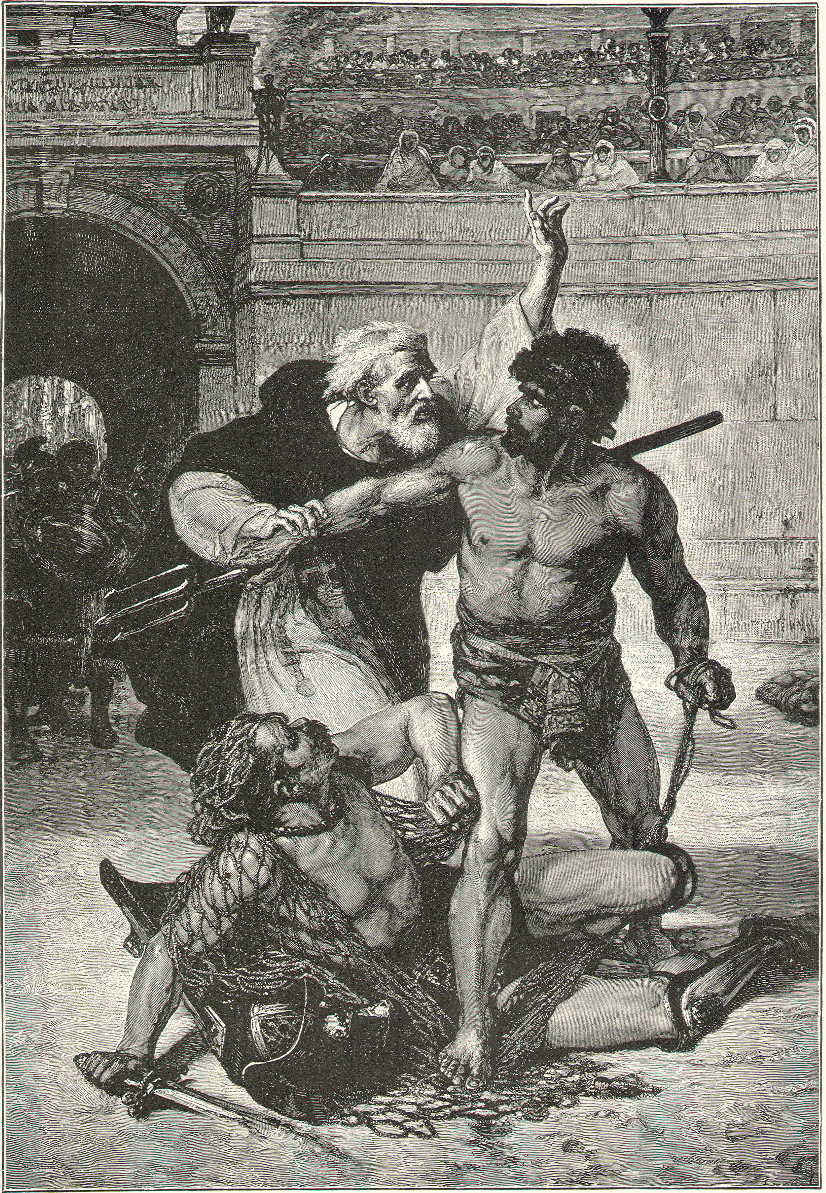
telemachus1

Foxes’ Book of Martyrs tells us the story of Telemachus, a Christian monk who, in 391 AD, went on a pilgrimage to Rome. While there he noticed crowds flocking to the Coliseum to see gladiators do battle. He followed them in, only to witness a sight that repulsed him.

Emperor Honorius was celebrating his triumph over the Goths. Gladiators armed with spears and swords reenacted the battle.  After their reenactment the bodies of the dead were dragged from the arena and its bloodied surface covered with a fresh layer of sand.

In came a new series of gladiators. Some were armed with swords and spears, others with nets. The crowd watched with excitement as they sought to outdo each other. When a gladiator was wounded, his opponent would loom over him, waiting for the crowds verdict on whether to slay him or let him live. So great was the bloodlust that at times wealthier spectators would climb down to get a better view of the execution.

Telemachus watched with horror as people died, battles raged and the crowds cheered. Prompted into action this bald headed, robed figure found his way onto the arena floor. He ran toward two gladiators locked in battle, grabbed one of them and pulled him away. He exhorted the two gladiators to abandon their murderous sport. He appealed to the crowd to not break God’s law by murdering.

The response was anything but favorable. Angry voices drowned out Telemachus’, demanding that the spectacle continue. The gladiators prepared to do battle again, but Telemachus stood between them, holding them apart, urging them to reconsider. Driven by the anger of the crowd and their rage at Telemachus’ interference, the gladiators cut Telemachus to the ground, as the crowd threw missiles at him. Telemachus was killed.

Legend holds that when the crowd saw the little monk lying dead in a pool of blood, they fell silent and then began leaving the stadium, one by one.  Because of Telemachus’ death, three days later, the Emperor by decree ended the Games.

In this brief history we can see the work of a saint, but what struck me today was the crowd.  Most, I would hope, were opposed to the violence of war and murder.  However, having entered into the arena they were swept up in the event.  They cheered on the violence and encouraged the murder of the innocent monk.  They voluntarily subjected themselves to witness these horrors, they engaged a temptation, and in the process became complicit in then sin.

In our Gospel reading today, Jesus makes several statements where he ups the standard, “You have heard that it was said to those of ancient times, `You shall not murder’… But I say to you that if you are angry with a brother or sister, you will be liable to judgment.”  He speaks in a similar manner with regard to adultery, lust, swearing and more.  Like the crowd in the arena, these are offenses that we voluntarily subject ourselves to.  We walk into them knowing full well what we are doing.  Someone might anger us, but they don’t cause that anger to swell into a rage.  I may see a pretty girl walking down the street, but she is not the cause of lust rising up in me.  However, like those in the crowd, when we engage with a temptation instead of immediately walking away, then we may fall into sin.

St. Josemaria Escriva put it this way, “Do not enter into dialogue with temptation.  Allow me to repeat: have the courage to run away and the moral strength not to dally with your weakness or wonder how far you can go.  Break off, with no concession!”

When temptations arise in your life, do not entertain them.  Do not consider the “what ifs.”  Immediately set the temptation aside, not giving it the slightest edge.  In this way we can all live holier lives.

Sermon: New Year’s Day

CHThe following quote was the inspiration behind this sermon, but – in the end – the quote did not make it into the sermon: “Pray that I may never be satisfied with what is easy,” you say.  I’ve already prayed.  Now it is up to you to carry out that fine resolution.   St. Josemaria Esciva, The Way #39

I’m also going to get a bit of mileage out of this one as it will appear as an article in the Billings Gazette on January 11th.

———-

Legend has it that one day Socrates and Plato were walking down the beach, deep in conversation and Plato had expressed to Socrates his desire to gain the wisdom and knowledge that Socrates had.  Socrates didn’t answer him, but instead said, “Walk with me into the ocean.”  So, they turned and walked into the sea together.

Now, in your imagination, picture that happening: Student and teacher, two of the greatest philosophers of history, striding into the surf side by side.

The water started out around their ankles, then rose up to their knees. As the water got higher Plato wondered to himself, “What is the lesson my master is trying to teach me?”

When the water was shoulder height, Socrates asked Plato, “What is it exactly you want from me?” “Knowledge,” Plato answered, at which point Socrates abruptly grabbed Plato’s head and pushed him down under the water. After a half a minute or so Socrates let Plato up and asked him again, “What is it you want?” “Knowledge,” was again Plato’s answer, at which point Socrates shoved him back down under the water.

After a time, when Plato ran out of air, he began to struggle to get his head above the surface. He punched and kicked and grabbed to get free, but Socrates was a strong man and held him down. At the last moment before Plato blacked out, Socrates let him up and asked that same simple question, “What is it you want?” Plato coughed and spluttered finally responding, “Air! I need air!” Socrates calmly stated, “When you desire knowledge as much as you desired a breath of air, then you shall have it.”

Each year, we make our New Year’s resolutions, but really, how seriously are we about fulfilling them? I suppose that Plato could have made a resolution, “Be it resolved that I will gain true knowledge this year,” but as Socrates so politely pointed out to him, resolving to do something is quite a bit more than simply saying you want it. Truthfully, it’s really not a matter of wanting, who doesn’t want to lose weight or be a better a person? Perhaps the question should be, “What are you willing to sacrifice?” In the case of Plato, in order to truly have knowledge, Socrates said that he had to want it as much as he wanted air to breathe, as much as he wanted life itself. So what are you willing to sacrifice in order to fulfill your resolutions?

And I wonder, if you make a resolution to live healthier, regularly balance the checkbook, quit swearing and all that, have you ever made a resolution to God?  “Be it resolved that I will love the Lord my God more deeply.”  “Be it resolved that my life will be a witness to His love.”  “Be it resolved that I will work to fulfill my Baptismal Covenant.”  “Be it resolved that I will accept His forgiveness.” And if you make these resolutions to God, then how badly do you want them? What are you willing to sacrifice of yourself in order to fulfill them?

I resolve to love God as long as it’s convenient?  As long as it doesn’t really cost me anything?  I resolve to forgive others as I have been forgiven, except… except you know who!  I will seek to serve Christ in all persons, as long as they are like me.  I resolve to faithfully continue in the fellowship and the breaking of bread, as long as it fits in with my schedule. Or do you want these things as much as you want air to breathe? As much as you desire your very life?

You’ve made your resolutions to lose weight and all that, now make your resolutions to God and desire to fulfill them as much as you desire air to breathe? As much as Jesus desires you.