Sermon: “I’m just a ____.”

belThe play, Man of La Mancha, is based on the story of Don Quixote. Don Quixote falls for Aldonsa even though she is a prostitute. He begins to woo her with words in an attempt to win her over and refers to her as Dulcinea, “my sweet little one” and My Lady. However, given her hard life, she cannot take such sweet words and eventually becomes angry with him. I was born in a ditch. I have no idea who my father is. I’ve spent most of my life working on my back. She concludes by saying to him, “Blows and abuse I can take and give back again, but tenderness I cannot bear. I’m just a whore.” In God’s eyes, her own eyes, and the eyes of the world around her she thought she knew exactly who she was, a whore.

In our Gospel reading today, Jesus takes the twelve off by themselves to Caesarea Philippi. There he asks them a few questions. First, “Who do the people say that I am?” The apostles give him a few answers: John the Baptist, Elijah, or a prophet like Jeremiah. But then Jesus makes the question a bit more personal, “But who do you say that I am?” Simon Peter answered, “You are the Messiah, the Son of the living God.” Simon Peter got the gold star that day. He answered the question perfectly and the answer was not one that he could have known himself, but one that was revealed to him by God; however, Peter also could not have known that answer unless he first knew himself. Why? Because you can’t know Jesus as the Messiah, the Savior, unless you know yourself as a sinner – one in need of saving.

Peter, he knew the history of his people as well as his own. Like all those that had gone before him, he was unable to remain holy in the eyes of God. He may not have said, “I am just a whore,” but I suspect that he might have said something close to it and it was only in knowing himself that he knew he needed a savior, and was able to recognize that Savior in Jesus Christ.

When Aldonsa declared to Don Quixote, “I am just a whore,” he responded to her, “The past is over and done. We all stumble on the way to maturity. We all look for love in the wrong arms, happiness in the wrong places. But out of it, you’ve become real. You’ve got a heart of immense compassion for the brokenness of others. You are utterly incapable of hypocrisy and I am deeply in love with you.” Silence follows and finally Aldonsa answers, “From this day forward my name is no longer Aldonsa. I am Dulcinea,” My Lady.

We come before God and say to him, “I am a sinner.. a tax collector.. a whore.. a ___.” We know what we are, and in our confession, Jesus responds to us, “The past is over and done. We all stumble on the way. You are My Father’s child and I am deeply in love with you.” It is in recognizing who we are that, from that day forward, we can say to him, “You are the Messiah, the Son of the living God” and know in our hearts that we are free. Free to love and be loved by God.

Jesus asks, “Who do you say that I am?” With all faith we can answer, “You are the Messiah, the Son of the living God. You are my Savior.” Jesus responds, “My child. My beloved.”

Sermon: Pentecost 11 / Proper 16 – “It’s Not Over”

EverestA true story: A man goes to a party and has too much to drink. His friends plead with him to let them take him home. He says no — he only lives a mile away. About five blocks from the party, the police pull him over for weaving and ask him to get out of the car and walk the line. Just as he starts, the police radio blares out a notice of a robbery taking place in a house just a block away. The police tell the party animal to stay put, they will be right back and they hop a fence and run down the street to the robbery.

The guy waits and waits and finally decides to drive home. When he gets there, he tells his wife he is going to bed, and to tell anyone who might come looking for him that he has the flu and has been in bed all day. A few hours later the police knock on the door. They ask if Mr. Joe is there and his wife says yes. They ask to see him and she replies that he is in bed with the flu and has been so all day. The police have his driver’s license. They ask to see his car and she asks why. They insist on seeing his car, so she takes them to the garage. She opens the door. There sitting in the garage is the police car, with all its lights still flashing.

Perhaps we have never been so stupid, but we’ve all had somewhat similar experiences – just when we think we’ve gotten away with something, just when we think we’ve made it, the world crashes in around our ears.

For the last several weeks our Old Testament reading has been the story of Joseph, the favorite son of Jacob. Jacob loved Joseph, because as the scripture says, “He was the son of his old age.” Joseph would later have a dream and the dream was interpreted to mean that all the sons of Jacob and that even Jacob himself would one day bow down to Joseph. Needless to say, no one liked the story, especially his brothers who were so put out that they eventually contrived a plan and sold Joseph into slavery. As we read in our lessons, Joseph rises to power in the land of Egypt and becomes second only to Pharaoh. Time passes and there is a famine in the land and the other sons of Jacob come to Egypt to find food, having no idea that they would be encountering their brother. When they arrive, Joseph’s dream comes true, and the brothers fall down before him and beg for food. Later, Joseph is reconciled to his brothers and says to them, “Do not be grieved or angry with yourselves because you sold me here, for God sent me before you to save you.” Through these events, Joseph became the savior of the nation of Israel. They were given lands and animals. They thrived and grew in numbers and became a great nation, but just when they thought they had made it, “A new king arose over Egypt, who did not know Joseph. He said to his people, ‘Look, the Israelite people are more numerous and more powerful than we. Come, let us deal shrewdly with them, or they will increase and, in the event of war, join our enemies and fight against us and escape from the land.’ Therefore they set taskmasters over them to oppress them with forced labor.”

For 400 years the Israelites were the slaves of the Egyptians. Beaten and bruised, they built the great cities of Egypt and all along wondered what had happened to their salvation. When all seems lost, the Lord sends them another savior, Moses. For several Sundays we are going to be reading about Moses and his fight with Pharaoh. “Let my people go,” Moses will declare. We will hear of the ten plagues that the Lord visited upon the land of Egypt, eventually leading to Pharaoh releasing the Israelites. They will cross the Red Sea, wander in the desert for 40 years, and eventually come to the Jordan river. From there they will cross into the land of milk and honey.

Joseph was Israel’s savior. So was Moses and later it will be King David. Through these saviors Israel succeeded, but just when they think they have finally made it, there is failure, and they are eventually sent once again into captivity due to their sins against God.

It is a pattern that repeats itself: they are in misery, they have their salvation, but it slips through their fingers and they find themselves once again in misery.

George Mallory was the famed mountain climber who may have been the first person ever to reach the top of Mount Everest. In the early 1920’s he led a number of attempts to scale the mountain, eventually being killed in the third attempt in 1924. Before that last and fatal attempt he had said, “I can’t see myself coming down defeated.”

Mallory was an extraordinary climber, and nothing would force him to give up. His body was found in 1999, well preserved by the snow and ice, 27,000 feet up the mountain, just 2000 feet from the peak. Give up he did not. His body was found face down on a rocky slope, head toward the summit. His arms were extended high over his head. His toes were pointed into the mountain; his fingers dug into the loose rock, refusing to let go even as he drew his last breath.

When those who had set up camp for Mallory further down the mountain returned to England a banquet was held for them. A huge picture of Mount Everest stood behind the banquet table. It is said that the leader of the group stood to be applauded, and with tears streaming down his face, turned and looked at the picture. “I speak to you, Mount Everest, in the name of all brave men living and those yet unborn. Mount Everest, you defeated us once; you defeated us twice; you defeated us three times. But Mount Everest, we shall someday defeat you, because you can’t get any bigger but we can.”

Can you almost hear the Israelites declaring the same thing to the world? “You’ve defeated us once. Twice. Three times. But one day we shall defeat you!”

Now, shall I tell you the entire story of Jesus or do you know it? How he came to the people of God and gave them everything they desired, including miracles and teachings. Things were going to be made new. Oh, yes! The crowds gather around him and cheer him on. He asked the disciples, “Who do you say that I am.” Peter responds for them all, “You are the Messiah, the Son of the Living God” You are our savior. Our salvation. The people cry out, “Blessed is he who comes in the name of the Lord.” Yes, He is the savior, he is bringing the long awaited salvation. Yet, just when they thought they had finally made it, everything slips through their fingers as the blood of Christ trickles down that nail pierced cross.

I’ll ask you again, how many of you, just when you think you’ve made it, have had the world come crashing down around your ears? See everything just slip through your fingers like sand on a beach?

Following such events, it is very easy to look at the carnage in our wakes and say, “It’s just not possible.” “It can’t be done.” “All is lost.” We do it when someone is very sick – There is no cure. We do it with society – It’s just the way things are. We, good Christian people, even do it with our faith – God can’t help me. He has forgotten me. We can become like the Israelites in captivity or the disciples who sat at the foot of the cross and watched the life of Jesus slowly slip away. “Has God rejected his people? By no means!” But “Who will rescue” us? “Who then can be saved?” Jesus’ answer, “With man this is impossible, but with God all things are possible.” Three days after his crucifixion Jesus rose from the grave. “Thanks be to God, who gives us the victory through our Lord Jesus Christ.”

Like the Israelites, you may be experiencing one of those times of exile or, like the disciples, you may be in one of those three day periods where all seems lost, but remember, it’s not over. It’s far from it.

Consider the words of our Psalm for today:

Blessed be the LORD!
he has not given us over to be a prey for [the teeth of our enemies.]
We have escaped like a bird from the snare of the fowler;
the snare is broken, and we have escaped.
Our help is in the Name of the LORD,
the maker of heaven and earth.

Perhaps it is oversimplified, but there are days when my soul needs oversimplified, so I’ll put it in the words of the Brazilian writer, Fernando Sabino, perhaps some of you will remember the line from the movie, The Best Exotic Marigold Hotel, “Everything will be okay in the end. If it’s not okay then it’s not the end.”

There will always be those bad days when all seems lost, but to God’s people, not even death itself has the final say. Jesus said, “In this world you will have trouble. But take heart! I have overcome the world.” Jesus has overcome the world and although it may not always seem like it, you are already victorious.


Sermon: Power of the Mustard Seed

mustard-seedI saw an interesting movie this past week: Lucy. The story is based on the scientific premise that we as human beings only use 10% of our brain. It then goes on to hypothesize on what we would become if we began to use 20%. 30%. 50%. 100% of our brain. In movie world, this is all played out by a woman – I won’t spoil it for you – a woman who begins to use more and more of her brain’s power. The things she is eventually able to do are astounding, not to mention a lot of shoot ‘em ups. It’s over simplified and does the movie no justice, but summed up the movie asked the questions, “What is our potential? What can we become?”

The first of the five parables Jesus tells us in our Gospel reading is making a statement, but it is also asking those same questions: “The Kingdom of Heaven is like a mustard seed… the smallest of seeds, but when it has grown it is the greatest.” What is the potential of the Kingdom of Heaven? What can we as individuals, even though small and insignificant in the larger scheme of things, become as children of God?

I could give you the example of a child born in a manger in Bethlehem 2,000 years ago, but some might argue that this is a poor example, given that He was the Son of God. But what about those twelve fellas that followed him around for three years? They were fishermen and tax collectors, but were they able to affect much change in the world? What about a little nun in a blue and white habit walking the streets of Calcutta? Was she able to bring about a portion of the Kingdom of Heaven? Yes, those are a few of the superstars of the faith, but let me ask you this: does a person who feeds one hungry child do any less for the Kingdom than they did?

We only expect to find the kingdom in cathedrals and mega-churches, in professional choirs and pipe organs, and those persons recognized worldwide for their contributions, but the parable of the mustard seed suggest that the real kingdom-power is to be found in the most humble of places and in the most humble of people.

Emil Bruner, a German theologian, writes, “the kingdom’s form is perpetually little, always seed-sized, divinely designed to be a treasure in earthen, not golden, vessels so that the exceeding greatness of the gospel’s power might always be God’s, not human beings.” The greatness of God is revealed in His ability to take the smallest of instruments and do the greatest of works. A still small voice. A little child. A few fish and a couple of loaves of bread. Three nails. That still small voice spoke all of creation into being. That little child was the savior of the world. A few fish and couple of loaves of bread fed thousands. Three nails held the sins of the world to the Cross.

So, what is your potential? What is it that God desires for you to become? What great things has the Lord prepared for you to do? Later in Matthew’s Gospel Jesus tells the disciples, “I tell you the truth, if you have faith as small as a mustard seed, you can say to this mountain, ‘Move from here to there’ and it will move. Nothing will be impossible for you.”

I don’t know what type of power we would have if, like Lucy, we were able to use 100% of our brains, but I do know this: you are a mustard seed and through the power of God, you are able to do great things.  What’s stopping you?

Sermon: “Carrying Donkeys”

aesops_donkeyOne of the fables of Aesop tells the story of a man, a boy, and a donkey. An elderly man was traveling with a boy and a donkey. As they walked through a village, the man was leading the donkey and the boy was walking behind. The townspeople said the old man was a fool for not riding, so to please them he climbed up on the animal’s back. When they came to the next village, the people said the old man was cruel to let the child walk while he enjoyed the ride. So, to please them, he got off and set the boy on the animal’s back and continued on his way. In the third village, people accused the child of being lazy for making the old man walk, and the suggestion was made that they both ride. So the man climbed on and they set off again. In the fourth village, the townspeople were indignant at the cruelty to the donkey because he was made to carry two people. So the boy and the man strapped the donkey to a pole by his feet and began to carry the donkey. Unfortunately, when they came to a bridge, the boy tripped, sending the donkey into the river below where he drowned.

In our Gospel reading, Jesus said, “We played the flute for you, and you did not dance;
we wailed, and you did not mourn.” He then goes on to say that the people criticized John the Baptist for his severe asceticism and criticized him for being a friend to the outcast and sinners. Both at either end of the spectrum and both criticized. What would the critics have preferred? What could John or Jesus have done to not be criticized by anyone? Absolutely nothing. Why? The philosopher Voltaire stated it like this, “If God created us in His image we have certainly returned the compliment.” The people wanted God’s message to be the message they wanted to hear, not the one that God wanted to give them.

We can find ourselves in a similar predicament. If we preach the Gospel message too strongly, then we will be referred to as Bible thumping fundamentalist. If we soften the message to make it more palatable, then we will be labeled apostate liberals. If we try and hold these two things in tension, then it will be lukewarm fence-sitters. What are we to do? The answer lies in following in the footsteps of John and Jesus, which was to disregard the clamoring of their detractors and seek to do God’s will and to please Him alone. Jesus said, “for I have come down from heaven, not to do my own will, but the will of him who sent me.”

If we try and please everyone in the way that we present and live out the Gospel message, then we will end up carrying a donkey that will eventually drown in a river. It just won’t work. But if we seek after God’s will and do as He asks, then we will accomplish much. In doing so, we will still have critics, but God won’t be one of them.

Thomas à Kempis wrote, “Who are you, then, that you should be afraid of mortal man? Today he is here, tomorrow he is not seen. Fear God and you will not be afraid of the terrors of men. What can anyone do to you by word or injury? He hurts himself rather than you, and no matter who he may be he cannot escape the judgment of God. Keep God before your eyes, therefore, and do not quarrel with peevish words.”

Keep God before your eyes. Seek to do His will. And let others carry the donkey.

Sermon – “Our Enemies”

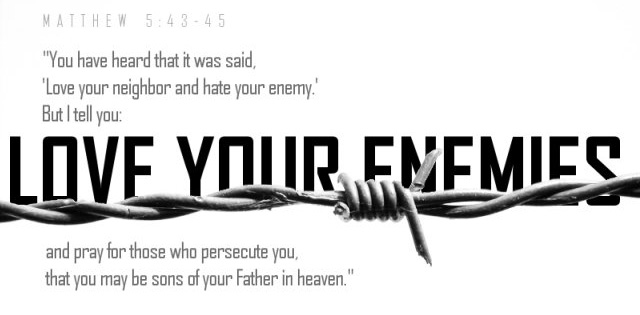
love-your-enemiesPaul W. Chilcote, the visiting Professor of Practicing Evangelism at Duke University tells the story of the first time he met Jürgen Moltmann, a great German theologian. Then a graduate student, Chilcote describes how, over lunch, he told Moltmann about his life as a student at the university and his studies under Frank Baker. At the name of Frank Baker, Moltmann stopped Chilcote and offered a story about Frank and his wife Nellie.

During World War II there was a prisoner of war camp for captured Germans on the northeast coast of England. Frank and Nellie Baker served a small Methodist circuit of churches in the area and felt compelled to minister to captured German soldiers, so, with permission of the prison commander, each Sunday the couple would invite a few of the German prisoners to church to “share in Word and Sacrament” and then have them to their home to share dinner. Moltmann told Chilcote that this “small thing” took place each Sunday for the duration of the war.

Completing his story, Chilcote then says, “This world-famous theologian paused, looked at me intently, and said, ‘One of those soldiers was a young man named Jürgen Moltmann. And I want you to know that the seed of hope was planted in my heart around Frank and Nellie Baker’s Sunday dinner table.’”

Jesus said, “I say to you, Love your enemies and pray for those who persecute you, so that you may be children of your Father in heaven.” During World War II, Frank and Nellie Baker had sufficient reason to hate those German soldiers, but instead, they lived out this teaching of Jesus and changed the heart the enemy. Can we do the same? Yes. We may not always succeed, but we can most certainly try.

In his letter to the Romans, the Apostle Paul expands on these words of Jesus. They are good words to live by:

Let love be genuine; hate what is evil, hold fast to what is good; love one another with mutual affection; outdo one another in showing honor.  Do not lag in zeal, be ardent in spirit, serve the Lord.  Rejoice in hope, be patient in suffering, persevere in prayer. Contribute to the needs of the saints; extend hospitality to strangers. Bless those who persecute you; bless and do not curse them.  Rejoice with those who rejoice, weep with those who weep.  Live in harmony with one another; do not be haughty, but associate with the lowly; do not claim to be wiser than you are.  Do not repay anyone evil for evil, but take thought for what is noble in the sight of all.  If it is possible, so far as it depends on you, live peaceably with all.  Beloved, never avenge yourselves, but leave room for the wrath of God; for it is written, “Vengeance is mine, I will repay, says the Lord.”  No, “if your enemies are hungry, feed them; if they are thirsty, give them something to drink; for by doing this you will heap burning coals on their heads.”  Do not be overcome by evil, but overcome evil with good.

Our enemies may not always turn out to be great theologians like Jürgen Moltmann, but they may end up being our friends. However, we will never know unless we extend to them the hand of love. This does not mean that they won’t try and snap it off, but we are called to love.

Sermon: Pentecost III / Proper 8 RCL A – “I’m a Dork”

youre-a-dorkSo, I am a dork. It’s true. I’ve tried not to be a dork, but it always ends in an epic fail. I think dark socks with sandals are OK. When there is a movie coming out that I’m really excited about, I’ll research movie theaters within a hundred mile radius, just to determine which one will provide the best viewing experience. About a week ago I found this really cool app for my phone that scans the square QR codes you see on some products and then launches your browser to the indicated web site. Yeah, I’m a dork. I don’t know if you have to be a dork to cheer at movies, but when I’m at home by myself watching, say Rocky, and I catch myself sitting in my chair throwing punches with Rocky at Apollo Creed, I kind of feel like a dork then too.

In fact, I have cheered at a number of movies. It’s a bit uncomfortable when you’re the only one in a crowded theater that does, but the folks around me just look at each other and say, “What a dork.” There was that scene at the end of the Matrix when Neo stops a barrage of bullets just by holding up his hand and saying, “No.” I cheered. Harry Potter defeats Voldemort. I cheered. Heck, I probably even cheered when I saw Snoopy defeat the folding chair in “A Charlie Brown Thanksgiving.”

And I remember a scene from the movie The Untouchables that made me cheer. The movie was about Eliot Ness and his team as they try and bring down Al Capone in Chicago. Ness is played by Kevin Costner and he meets this incorruptible Irish cop named Jimmy Malone played by Sean Connery. Malone wants to make sure that Ness really wants to get Capone, so he pulls him into a church for a private word. Malone says to Ness, “You said you wanted to know how to get Capone. Do you really want to get him? You see what l’m saying? What are you prepared to do?” Ness responds, “Everything within the law.” Malone fires back, “And then what are you prepared to do? If you open the ball on these people, you must be prepared to go all the way. Because they won’t give up the fight until one of you is dead.” Ness, “I want to get Capone. I don’t know how.” “Here’s how you get Capone,” says Malone, “he pulls a knife, you pull a gun. He sends one of yours to hospital, you send one of his to the morgue! That’s the Chicago way! And that’s how you get Capone.” I watched that scene – I cheered. Gave it one of those, “Yeah!”

I’m certain that I’m not the only one that cheers at movies or at many things for that matter. We all have those things we get excited about. Here recently it’s been the World Cup, but for some, when the stock market goes up they cheer. Playing golf and we sink a long putt. Cheer. Maybe it is something like the birth of a grandchild. Doing well on a test. Getting your driver’s license. These things make us smile and they make us cheer.

Consider this parable of Jesus, “Suppose one of you has a hundred sheep and loses one of them. Doesn’t he leave the ninety-nine in the open country and go after the lost sheep until he finds it? And when he finds it, he joyfully puts it on his shoulders and goes home. Then he calls his friends and neighbors together and says, ‘Rejoice with me – cheer with me – I have found my lost sheep.’” I guess since they didn’t have the multiplex theater in Jesus’ day that this was the sort of thing folks got excited about. Then Jesus goes on to say, “I tell you that in the same way there will be more rejoicing in heaven over one sinner who repents than over ninety-nine righteous persons who do not need to repent.”

What I find so interesting is the disconnect between the things we find to cheer about and the things that Heaven finds cheers about. I’m not saying that its wrong to cheer at a movie, the birth of a child, or any of that, that’s part of being joyful, it’s part of being alive, but let me ask you this: we read the story of Abraham being called by God to sacrifice his son Isaac. Most folks dislike that story, but there towards the end the angel of the LORD called from heaven, “Abraham, Abraham! Do not lay your hand on the boy or do anything to him; for now I know that you fear God, since you have not withheld your son, your only son, from me.”

When you heard that, did you want to cheer? Did you want to cheer because God spoke from heaven? Or because he provided a substitute for the sacrifice of Isaac? Did you want to cheer because Abraham loved God so much that he was prepared to give it all up, no matter the cost?

How about this – Jesus walked on water. At least for a few steps, Peter walked on the water. Jesus saved Peter as he was sinking. Did that make you cheer? Ever been as excited about telling someone about how Jesus fed 5,000 as you were about telling them the latest tidbit of gossip?

Have you ever gotten excited about sharing the love of God? Saint Therese De Lisieux wrote, “How terrible, I thought, that no act of love is ever made in hell! And I told God that I was ready to go there myself, if it pleased Him to contrive, in that way, that for all eternity there would be one loving soul in that abode of blasphemy.” She was so excited about the love of God that she was prepared to exchange the glories of heaven for the fires of hell, so that there would be one soul in hell proclaiming the love of God.

Do you get excited when you see others living out their Christian faith? Do you want to cheer them on? The apostle Paul wrote to Timothy, “For I am already being poured out like a drink offering, and the time for my departure is near. I have fought the good fight, I have finished the race, I have kept the faith.” When you see someone pouring out their life for the faith like you pour out a glass of water, do you encourage them? Do you cheer them on?

Would this be the kind of life you want for yourself? St. Josemaria Escriva, the founder of Opus Dei, wrote, “To defend his purity, Saint Francis of Assisi rolled in the snow, Saint Benedict threw himself into a thorn bush, St. Bernard plunged into an icy pond. You… what have you done?”

Again, is this the kind of life you want for yourself? A life that is prepared to give it all up? A life that’s not afraid to try and walk on the water? A life that plunges into the icy pond? A life that gets excited about their faith and cheers for the things of God? If you answer, “Yes”, then the question to you is the same that Malone asked Elliot Ness, “What are you prepared to do?” And once you’ve answered that question the next question is the same, “And then… what are you prepared to do?”

To ask, “What are you prepared to do for your faith?” is essentially asking, “What are you prepared to sacrifice?”

If you want your family to thrive, to be happy, and so on, you must sacrifice of yourself. If you want your world to be a better place, you have to sacrifice of yourself. If you want this church to grow and be a holy place, you have to sacrifice of yourself. You have to want it. You have to be excited about your faith and you have to make sacrifices of yourself.

If that is what you truly want, then what holds you back? What prevents you from being that beacon on a hill? If I were to make a wager, I would say that the answer is fear. Fear is what holds us back, because we are so afraid that the world will look at us and say, “God, what a dork!” And you know what? They might, but there will be some who will want what you have and they’ll want to know how they can have it for themselves. They will welcome you into their lives and in doing so will welcome God into theirs. Jesus said, “Whoever welcomes you welcomes me, and whoever welcomes me welcomes the one who sent me.”

Don’t be afraid of being a dork. You have within you something mighty to cheer about. You have within you the ability to show Jesus to the world. It begins by answering that question: What are you prepared to do? What are you prepared to sacrifice?

images-21

Sermon: Pentecost RCL A – “Shhhh”

1028simonandjude8It is beautiful and fascinating to watch people use sign language. All the words, letters, expressions wrapped up in not vocalization, but the movement of the hands. It can be done quite beautifully for music and if done properly, even though you may not understand what is being said, you still get a sense, a feeling of the message being conveyed.

In contrast, have you ever watched two people who are separated by a bit of distance in a noisy room trying to communicate with one another? It looks a bit silly. Like a game of charades gone terribly wrong.

Today in the book of the Acts of the Apostles we read how the apostles were all in one place, suddenly the wind began to blow, divided tongues of fire descended upon the disciples, and they began to speak in various languages.

It is sometimes the custom at some churches on the Day of Pentecost to re-create this event by arranging for a simultaneous reading of one or the other of today’s Scripture lessons in multiple languages.   Depending upon the linguistic gifts of members of the parish community, someone of Hispanic heritage might read the text aloud in Spanish.   Others may join in with their high school French or German, while a recent immigrant from a far-off land speaks in his or her native tongue.   The idea of course is to remind everyone of the Day of Pentecost, when people “from every nation under heaven” heard the disciples proclaim the Good News “in the native language of each.” Although fun the problem is that no one is understood. It ends up making about as much sense as those two folks in the noisy room trying to communicate, or using a biblical example, it takes on more the character of Babel than of Pentecost.

Do you remember the Tower of Babel from the Book of Genesis? It takes place very early on in human history. After the flood the sons of Noah went out with their wives and repopulated the world. As the tribe grew they stayed together and one day decided to build for themselves a great city. They said, “come, let us build ourselves a city, with a tower that reaches to the heavens so that we may make a name for ourselves and not be scattered over the face of the whole earth.” But the Lord saw this and decided that this was not a good idea. His response, “If as one people speaking the same language they have begun to do this, then nothing they plan to do will be impossible for them.” It wasn’t that God wanted to make the challenge more difficult, this was not the divine version of the “Survivor” TV show, instead God understood that if the human race were able to complete such a task, because of pride, it would soon believe that it no longer needed God. So God said, “Come, let us go down and confuse their language so they will not understand each other,” at which point the people gave up the city, gathered by languages, and dispersed. The place became known as Babel, which sounds like the Hebrew word that means “confused,” and my goodness I think we have been confused and tongue-tied ever sense.

What can be misunderstood will be misunderstood.   But Babel, that first clash of cultures and failure to communicate, is more than a explanation of the differences among nations and languages.   It is an apt description of the human condition itself, because the truth is we often do not understand one another even when we speak the same language.   How many arguments have you had with someone over miscommunication? “You say tomato, I say tomato” and all that silliness? Instead of hearing and understanding one another, it is all just a lot of noise. It is as though we were those two people giving goofy hand signals and no one understands anything. It happens on personal levels and and it happens on global levels.

We can point to Babel and say, “Aha,” it’s God’s fault that there are wars and so on, but sense we don’t even get along with each other that argument falls apart. Perhaps Babel was when the languages and tribes were divided, but perhaps it also demonstrates something else to us – how we, through our own pride, have lost the ability to communicate with one another. And not only the ability, but the desire. We just don’t want to put out the effort. Too much work. It’s better to stay in my own little world and let the rest figure it out on their own. However, to act in such a way, to say such things is to announce that Pentecost never occurred. It is to declare that the spirit of Babel is still at work in the world and not the Spirit of God. But you and I know that this is just not so.

On that first Pentecost the Spirit of God comes down upon the disciples, resting on each of them and thereby bringing them—and us—together once again.   The disciples get a crash course in the language of God.    It is fair to say that after Pentecost the days of Babel are over.   The great differences among us, in communication and dialogue, culture and background, wealth and poverty, are scattered in “the rush of a violent wind.” As Acts tells us, the differences are burned away by tongues of fire.   As St. Paul teaches, “There is neither Jew nor Greek, there is neither slave nor free, there is neither male nor female; for you are all one in Christ Jesus.” It does not matter now whether we are Parthians and Medes of old, or Americans, Europeans, and Iraqis of today, and this is made possible through the Holy Spirit of God.

That is what is supposed to have happened at Pentecost. We were all given the same Spirit. So, how is that we still fail to understand each other?   Why does not everyone speak the same language?   Or at least understand the world in the same way?   Is the promise of Pentecost hollow and without meaning?   Good questions.

What happened at Pentecost is important to who we are as followers of Christ, but the reality of Pentecost is universal.   The disciples addressed not just believers but the peoples of the whole known world, and they spoke in a multitude of languages.  What they said wasn’t Babel. It made sense, because they spoke about God in the language of God. Just as Jesus opened the Gospel message to Cleopas and Luke on the road to Emmaus, so the apostles, through the power of the Spirit, revealed this same message to the throngs gathered in Jerusalem.

Yet, perhaps the greatest miracle of Pentecost had nothing to do with all those languages. Perhaps the most remarkable event of that first Pentecost is that the people gathered at Jerusalem actually heard the disciples. In the middle of all the hustle and bustle of the city and the babel of their own lives, not only did the people hear the disciples speaking in their own language, they also heard them in their hearts.  Now, as then, all nations and peoples yearn and need to hear the Gospel message, but we live in a world that does not like to listen.

We don’t like to listen and truly hear what each other has to say and we don’t like to take the time and truly listen to what God has to say, so instead of being drawn together by the Spirit of God, we are pushed apart by all the noise, by all the babble.

What is God’s response to all this racket? From our gospel reading we learn that the disciples are gathered together in a locked room. They are afraid. Confused. What do we do? Where do we go? What’s next? All this racket. Noise. Babel. Suddenly Jesus appears and says to them, “Shh. Shalom. Peace be with you.”

That word Shalom – Peace – in this context is not as simple as you might thing, for it is the culmination of the messages of all the prophets. It is the summation of the Gospel and it is the equivalent of Jesus’ words from the cross, “It is finished.” It is God – through Jesus – stating that there is now nothing between Him and us. No longer does sin separate us. Now there is atonement. Redemption. Salvation. Jesus is announcing that peace has been achieved between God and humankind and when you and I realize this, when we truly hear this message as they did on that first Pentecost, then our babel will be transformed into Pentecost.

No. I’m not so naïve as to believe that we will establish world peace, even Jesus said that there would be wars and rumors of wars; however, if you, through the power of God’s Holy Spirit, through prayer, and through study will truly listen, not just with your ears, but with your heart as well, then you will have the opportunity to experience this peace in your own life. It’s going to take a bit time and work, but it can be yours.

Sermon – “Arrogant Jesus?”

toonIt is a statement that offends many. They consider it religious arrogance: “I am the way, and the truth, and the life. No one comes to the Father except through me.”

Do you see any arrogance in Jesus? As he weeps at the tomb of his friend Lazarus is he declaring his superiority? When Jesus washes the feet of the disciples is he displaying a sense of entitlement? As he hangs naked, beaten, bruised, bleeding, dying on the cross, is this presumption?

No. Jesus is not being arrogant, superior, or presumptuous. So what we must consider when others believe that he is, is that what they are seeing of Jesus is those who act in His Name being arrogant and presumptuous. They believe these things about Jesus because they believe them about us.

Jesus said, “He who has seen me has seen the Father.” Are we showing the Father? Do we stand alongside a world that weeps for its sorrows and pains or do we stand above it, claiming superior knowledge and rights? Do we exhibit the nature of the One we claim is in us or do we demand to have our feet washed? Do we take up our cross and bear it or do we refuse to get our hands dirty? Do we show the world the God of Abraham, Isaac and Jacob and the Father of our Lord Jesus Christ or do we show them the God according to “I”?

I believe that if we as a Christian people do the things that Jesus did, then the world will once again be witness to the God and Father that Jesus demonstrated. It is then that the world will begin to see Jesus and us in an entirely different light. If we continue in the works and ways of Jesus then the world will begin to know for themselves that Jesus is the way, the truth, and the life. It is only then that they will also come to the saving knowledge of Jesus: through Him all may come to the Father.

Thomas a Kempis understood Jesus to say this to him, “Follow Me. I am the Way, the Truth, and the Life. Without the Way, there is no going. Without the Truth, there is no knowing. Without the Life, there is no living. I am the Way which you must follow, the Truth which you must believe, the Life for which you must hope. I am the unbreakable Way, the infallible Truth, the unending Life. I am the Way that is straight, the supreme Truth, the Life that is true, the blessed, the uncreated Life. If you abide in My Way you shall know the Truth, and the Truth shall make you free, and you shall attain life everlasting.”

Our journey through this life will lead us to eternal life, but it is our responsibility to show others that single path that leads to the Father. There is no pride or arrogance involved. It is a path of humility and obedience, but we are called to show it not just to those who think or look like us. Jesus said, “if you love those who love you, what reward do you have? Do not even the tax collectors do the same?  And if you greet only your brothers and sisters, what more are you doing than others? Do not even the Gentiles do the same?” We show the path that leads to eternal life, not just to those who think or look like us, but to all, so that all might come to the saving knowledge of our Lord.

Sermon: Easter V RCL A – “I Will Proclaim”

pointDo you remember the name Harold Camping? He died this past December, but for many years was the leader of Family Radio Worldwide. His claim to fame was that through complex mathematical formulas he predicted that on May 21, 2011 the rapture, that is God calling his people home, would occur and the world would end as we know it. Now, if it had occurred and all of you were still here after the rapture, I wouldn’t be surprised, but since I’m still here, I figure he was wrong. For the record, Camping also predicted that the world would end on Sept. 6, 1994 and that didn’t happen either. He wrote that off as errors in his computations. Jesus said, “But of that day and hour no one knows, not even the angels of heaven, nor the Son, but the Father alone.” My logic says, if the angels don’t know the hour or day, then someone with a calculator and a Bible won’t be able to figure it out either.

However, leading up to May 21, 2011, atheist across the country were having all sorts of fun by having “end of the world parties. Although Mr. Camping was wrong, I still don’t know that it is a good idea to mock him and I’ll tell you why: people have been looking for Jesus return for 2,000+ years. They have been praying for his return for 2,000+ years and for good reason. The author Anne Lamott summed it up, she wrote, “We are Easter People, living in a Good Friday World.” We are an Easter people believing in the resurrection, old things passing away, new life, the promises of the Good News, but the world around is in shambles. Some see the world around us and they interpret its condition as the end, “How could we go on anymore?” So in the midst of the shambles, folks want to see the Lord’s return so badly, that they begin to look for it even more closely and want it so much that they even make the mistake of trying to predict it. In a way, it is an act of desperation.

Harold Camping and the others who have predicted Jesus return through this desperation are not alone. Consider the apostles in our Gospel reading today: Jesus has already shared the Last Supper with his disciples, he has predicted his death, he has told Peter and the others that they will deny him.. essentially he is giving final instructions and saying, “Goodbye.” For the apostles, their world is spinning out of control, their world is turning into shambles, so Thomas says to Jesus, “Give us directions on how we can follow you.” Philip wants Jesus to show them the Father. In both cases, instead of breaking out a map or showing a photo, Jesus responds, “I am the way, the truth and the life.” “If you have seen me then you have seen the Father.” For the apostles that still sounds a bit cryptic, because they did not fully understand Jesus’ purpose, what his mission was all about. That understanding would not come until later, but the events surrounding Stephen that we read about today are key to this understanding.

You will recall that after Jesus’ death the apostles went about preaching and teaching; however, as more folks came to belief in Christ it became more difficult for these few followers to care for them all, so they elected seven others – the first deacons – to assist in the ministry. One of those seven was Stephen and he was very passionate about his work. Not only did he do the work of a deacon, but he also proclaimed the Gospel message. Just as the religious leadership did not want to hear it from Jesus, they didn’t want to hear it from this young upstart either. So it came to pass that on one particular day Stephen gave them a great tongue lashing. He said to them, you have always been disobedient to God, you have always limited God, and you have persecuted the prophets that God sent. The crowning jewel of this tongue lashing comes when Stephen tells them, you murdered the Son of God.

It is hear that scripture records an amazing scene, “Filled with the Holy Spirit, Stephen gazed into heaven and saw the glory of God and Jesus standing at the right hand of God. ‘Look,’ he said, ‘I see the heavens opened and the Son of Man standing at the right hand of God!’” For his perceived “blasphemy” they stoned him to death.

In believing and proclaiming the Gospel Stephen, the first martyr of the church, saw the place that Thomas had asked Jesus for directions to and he saw the glory of the Father that Phillip had wanted to see. What Stephen was witness to was the Good News. Jesus’ Kingdom was not bound to an earthly realm. You don’t need directions on how to get there or a photograph to know the Father, you only need one thing. Care to take a guess? Jesus – and that is the Good News.

What kind of person do you think of when you consider a person like Stephen? He knew that because Jesus claimed to be the Son of God it got him crucified, but here Stephen is making the same claims. Don’t you think he had to know that it would incite the religious leaders once again? Was he like one of those street preachers you imagine in Time Square, standing on a milk crate, flailing a Bible around shouting at those passing by, but in the case of Stephen knowing what he said could get him killed? Was he on a suicide mission, simply begging for death? Or was he being the light of the world. That city on a hill that can’t be hidden? Was Stephen a hero? Was he someone whose character and behavior we should model and follow?

Now please don’t think I’m picking on anyone in particular this morning. I’m not. Instead, I’m being very equitable and picking on us all, because we are all guilty of something specific in our Christian walk. Folks like Thomas and Philip ask to see God, others like Harold Camping and his followers want to see God so badly that they predict dates when they actually will, but they are not the only ones? The world is in shambles all around us and folks, whether directly or indirectly, ask us those same questions: “Can you show me the way?” “Can you help me to understand and see God?” Indirectly they may pour out to you the turmoil within their souls, their anxious thoughts, and personal concerns; but when they do, what we are all guilty of is being too polite. How many of you have heard this, “Faith or someone’s relationship with God is a personal matter.” “I don’t want to force my religious views on anyone.” “I might make them angry if I talk about God.”

I asked you if you thought Stephen was some sort of madman or a hero and the correct answer is that he is a hero. We should emulate his behavior, which means we shouldn’t always be so polite and say or do what is considered socially proper when it comes to our faith – It is THE Good News and that Good News is not there just so we can have some comforting words to say at someone’s deathbed or worse, their funeral! The Good News is for today. It is for the living and is for sharing. If someone happens to get angry and throws a few rocks then so be it. I love what St. Josemaria Escriva said on this, “If they break our skulls, we shall not take it too seriously. We shall just have to put up with having them broken.” You are living testimonies to the Good News and it is worth sharing.

Scripture says that Stephen was filled with the Holy Spirit and we too are filled with that same Spirit, which will allows us share the Good News of Jesus Christ as boldly and as unapologetically as Stephen did. The world did not end on May 21, 2011 or today – at least not yet! – so there are many who still want and need to know the way to Jesus. They want to see the Father. You, each and everyone of you, can provide them with directions.

The Psalmist declares, “My mouth will tell of your righteous deeds, of your saving acts all day long— though I know not how to relate them all. I will come and proclaim your mighty acts, Sovereign LORD; I will proclaim your righteous deeds, yours alone. Since my youth, God, you have taught me, and to this day I declare your marvelous deeds. Even when I am old and gray, do not forsake me, my God, till I declare your power to the next generation, your mighty acts to all who are to come.”

Don’ let that simply be something you read or hear. Let it be something you live. A way of life. Be aware of the many opportunities that the Lord provides you to share your faith and then grasp those opportunities and proclaim the Good News that is within you.