Sermon: Pentecost RCL B – Receive the Holy Spirit

The Western Wall or Wailing Wall is a part of the wall that surrounded the Temple in Jerusalem. It is the holiest site in Judaism and this portion of the wall is of particular significance because it was nearest the Temple itself. You can even go on the Internet and get a live video feed of what is going on there. (http://english.thekotel.org/cameras.asp)

A young woman journalist assigned to the Jerusalem bureau has an apartment overlooking the Wailing Wall. At certain times every day when she looks out her window she sees an old bearded Jewish man praying solemnly, his lips moving and his eyes closed. Certainly, he would be a good interview subject, so the journalist walks down to the Wall and introduces herself to the old man after his prayers.

She asks, “You come every day to the Wall; how long have you done that, and what are you praying for?”

The old man replies, “I have come here to pray every day for 25 years. In the morning I pray for world peace and for the brotherhood of man. I go home have lunch, and in the afternoon I come back and pray for the eradication of illness and disease from the earth, that children will someday not go hungry, and I pray for wisdom for our leaders as they guide us in this fearful world. And, very important, I pray for peace and understanding between the Israelis and Palestinians.”

The journalist is moved to silence, so humbled is she by the sincerity of this old man. Then she remembers her training and asks her second question.

“So,” she asks, “how does it feel to come here every day for 25 years and pray for these wonderful things? What’s it like?”

The old man shrugs his shoulders and replies, “Like talking to a wall.”

Have you ever said your prayers day after day and come away thinking the same thing? God’s not listening. God doesn’t care what I think. God doesn’t love me. I’m talking to a wall! Of course you have. We all have. But, did you ever stop to consider that maybe God looks down on us and thinks the same thing? They’re not listening. They don’t care what I think. They do not love me. “Oy vey! It’s like talking to a wall with these people!” I don’t believe that God is whiny like we can be, but he has said these things in the past and he eventually gets fed up.

During the reign of the Babylonian king, Nebuchadnezzar, the Israelites rebelled against God. They worshipped the false gods, they intermarried with the other tribes, they did not honor the Sabbath, and through this disobedience, they desecrated the Temple of God. He called to them time and time again, but they failed to listen and paid the price for their disobedience. The Prophet Ezekiel, one who had warned them, writes:

The word of the Lord came to me:  You, O mortal, thus says the Lord God to the land of Israel:
An end! The end has come
upon the four corners of the land.

Now the end is upon you,
I will let loose my anger upon you;
I will judge you according to your ways,
I will punish you for all your abominations.

My eye will not spare you, I will have no pity.
I will punish you for your ways,
while your abominations are among you.

The Lord said, “It’s like talking to a wall with these people.” So, the Lord allowed Nebuchadnezzar to attack and destroy the city of Jerusalem and the Temple – this was in the year 586 B.C. In the process 10,000 Israelites were sent into exile in Babylon, hence the name Babylonian Captivity. Among those 10,000 was Ezekiel.

Ezekiel prophesied against the people, but toward the end he began to offer hope. We read a part of it today: “The Lord set me down in the middle of a valley; it was full of bones… Thus says the Lord GOD to these bones: ‘I will cause breath to enter you, and you shall live.’ … and they lived, and stood on their feet, a vast multitude…. ‘I will put my spirit within you, and you shall live, and I will place you on your own soil; then you shall know that I, the Lord, have spoken and will act,’ says the Lord.”

And He did. Seventy years after the fall of Jerusalem, the people were allowed to return. He breathed life into a people who were dead and returned them to the Promised Land. Did it last? No. The cycle repeated itself and again the Lord moved against his people. He is, after all, a jealous God.

The Lord made a covenant with his people, but they were unable to keep it. They tried, but they always failed. Yet this cycle of beginnings and failures served a greater purpose. It allowed the people to understand that they were not able to accomplish God’s commanded holiness on their own and that a permanent solution was needed.

The Eucharistic Prayer we’ve been using during this Season of Easter so beautifully sums it up: “When our disobedience took us far from you, you did not abandon us to the power of death. In your mercy you came to our help, so that in seeking you we might find you. Again and again you called us into covenant with you, and through the prophets you taught us to hope for salvation. Father, you loved the world so much that in the fullness of time you sent your only Son to be our Savior.… To fulfill your purpose he gave himself up to death; and, rising from the grave, destroyed death, and made the whole creation new.”

And, once again, God gives His Holy Spirit “his own first gift to those who believe, to complete his work in the world, and to bring to fulfillment the sanctification of all.”

“To bring to fulfillment the sanctification of all.” To finally bring about the holiness that we could never accomplish on our own. To breath life into these dead dry bones of ours. “For mortals it is impossible, but for God all things are possible.” You have been made holy.

“Once you were not a people,
but now you are God’s people;
once you had not received mercy,
but now you have received mercy.”

Jesus said, “Be perfect, therefore, as your heavenly Father is perfect,” and it is through Jesus and the giving of God’s Holy Spirit that you are indeed made perfect.

The Holy Spirit has many names: The Spirit of Christ, Advocate, Paraclete, Counselor. The Spirit is the Wind, the very Breath of God. The opening verses of Genesis declare, “In the beginning God created the heavens and the earth.  The earth was without form, and void; and darkness was on the face of the deep. And the Spirit of God was hovering over the face of the waters.” It is the same Spirit of God that hovered over the waters that is breathed into us. That same Spirit allows us to become one with God – He in us and we in Him.

When we speak to God, it is not speaking to a wall. When God speaks to us, he is not speaking to a wall. As Paul said to us, “The Spirit helps us in our weakness; for we do not know how to pray as we ought, but that very Spirit intercedes with sighs too deep for words. And God, who searches the heart, knows what is the mind of the Spirit, because the Spirit intercedes for the saints according to the will of God.”

Today, Pentecost, we celebrate the giving of God’s Holy Spirit. In sending the Spirit, Jesus fulfilled his promise. He did not leave us alone, but is with us always. Therefore, as Jesus said to his disciples, I say to you, “Receive the Holy Spirit.”  Receive the Breath of God and live.

///

Pentecost is also considered the birthday of the Church, so on this day it is appropriate that we receive new members into Christ’s One Holy Catholic and Apostolic Church through the sacrament of Baptism. Therefore, continuing on page 301 of the BCP, “The Candidates for Holy Baptism will now be presented.”

Sermon: Alcuin of Tours

For this Season of Easter, the opening sentence of any Eucharistic service has been, “Alleluia. Christ is Risen.” Following Pentecost, we’ll go back to, “Blessed be God: Father, Son, and Holy Spirit.” However, what follows, no matter the season of the church year, is always the same: “Almighty God, to you all hearts are open, all desires known, and from you no secrets are hid:  Cleanse the thoughts of our hearts by the inspiration of the Holy Spirit, that we may perfectly love you, and worthily magnify your holy Name; through Christ our Lord.” It is known as the Collect for Purity.

It is a prayer that started off as one of the many private prayers for clergy that was to be said before the Mass, yet it was deemed too meaningful to be locked away in the sacristy and was eventually introduced into the public prayers of corporate worship.

What does that have to do with today? We are celebrating Blessed Alcuin of Tours, born in the year 730, and it was he who preserved and incorporated that prayer into our worship. Just because we worship with the 1979 Book of Common Prayers does not mean that it is all of modern invention. Over the centuries, many like Alcuin have contributed to that wonderful little red book that automatically falls open to page 355.

Alcuin was one of the great scholars, in fact, at the time he was considered “The most learned man anywhere to be found.” Fr. John Julian says that “Alcuin’s work was seldom highly original, but his own commitment was rather to the protection, compilation, and promulgation of the words of others.” Through these efforts he “was chiefly responsible for the preservation of the classical heritage of western civilization.” And if that weren’t enough, he is also responsible for giving the world the punctus interrogativus. Is that true? Did he really? What could that possibly be? Why, the question mark.

It is this preservation of the ancient writings and presenting them to the church that makes our Gospel reading so relevant for Alcuin. Jesus said, “… every scribe who has been trained for the kingdom of heaven is like the master of a household who brings out of his treasure what is new and what is old.” There is a theological interpretation to this passage, as well as a practical, and it is the practical we understand to apply to Alcuin. The “scribe,” according to Sirach, is one who “will seek out the wisdom of all the ancients.” Think of it in terms of the George Santayana quote, “Those who cannot remember the past are condemned to repeat it.” Alcuin was one who not only sought out the wisdom of the ancients, but as Jesus taught, believed that the teachings of our fathers were worth preserving, not only for their historical value, but for our collective benefit.

He died in the year 804 and a portion of his epitaph reads, “Dust, worms, and ashes now… Alcuin my name, wisdom I always loved, Pray, reader, for my soul.”

When we think on the lives of the Saints, we often think of those like the apostles, martyrs, or evangelist. So, in the midst of them all, did you ever think you would come across a librarian? Don’t get me wrong! In the acknowledgements of my doctoral thesis, I named my local librarians! I think the world of the roles they fill, but a Saint? Absolutely.

Paul writes, “We have gifts that differ according to the grace given to us.” We can hear that and think it means that some are better than others, but that is a worldly perspective. Instead, we see it as God giving us each specific graces – gifts – that when exercised with zeal, benefit the whole. Again, Paul says, “God has appointed in the church first apostles, second prophets, third teachers” and so on. But Paul’s list is not exhaustive, it also implies that God has also appointed doctors, businesspeople, housekeepers, homemakers, and – Yes! – librarians.

Alcuin’s life says to us, “It’s not about the specific gift that God has graced you with. It’s about how you employ that gift.”

God has graced you with many gifts. Don’t squander them or leave them unutilized. Like Alcuin of Tours, practice them to your greatest ability in the work of God’s Kingdom.

Sermon: Easter 6 RCL B – “Chosen”

Sherlock Holmes and Dr. Watson go on a camping trip, set up their tent, and fall asleep. Some hours later, Holmes wakes his faithful friend.

“Watson, look up at the sky and tell me what you see.”

Watson replies, “I see millions of stars.”

“What does that tell you?”

Watson ponders a minute. “Astronomically speaking, it tells me that there are millions of galaxies and potentially billions of planets. Astrologically, it tells me that Saturn is in Leo. Time wise, it appears to be approximately a quarter past three. Theologically, it s evident the Lord is all-powerful and we are small and insignificant. Meteorologically, it seems we will have a beautiful day tomorrow. What does it tell you?”

Holmes is silent for a moment, then speaks. “Watson, you idiot, someone has stolen our tent.”

David wrote in the Psalms, ”The fool has said in his heart, ‘There is no God.’” A quick look around the night sky will only confirm this. When I think on the vastness of the universe I can become overwhelmed.

In 1991 the movie Grand Canyon came out and during a scene one of the main characters talks about his trip to the Grand Canyon. In trying to explain its immensity he said, “Hey, you know what I felt like? I felt like a gnat that lands on the rear of a cow that’s chewing its cud next to the road that you ride by on at 70 miles an hour.” If that’s what the Grand Canyon can make a person feel like, then, when we consider all of creation, we should all just blink out of existence.

Even so, we are here. We are a part of the created, molded by the hand of God from the dust of the earth. That fact is enough to trip up many, but what can make us even more to shake our heads in disbelief is that not only did God create you, He chose you. He chose you even before the firmament hovered over the darkness of the deep. The Psalmist declares, “For he chose us in him before the creation of the world to be holy and blameless in his sight.”

Today, our Gospel reading tells us plainly, Jesus said, “You did not choose me but I chose you.”

This is rather extraordinary. That statement eliminates any idea that we are random, simple blips in the cosmos, and points to the fact that we, individually, are intentional in the mind of God. He did not create humankind in general, but instead, He created you specifically. In His infinite mind and creativity, He formed you just as you are and chose you to serve His purposes. Some of you may be saying, “Well, He could have made me a bit more Brad Pitt-ish or Scarlett Johannson-ish”, but our God is not concerned with human standards of beauty. He is concerned only with the beauty of your soul.

Many of you probably already know this, but St. Julian of Norwich, the Saint whom our chapel is named after wrote of a vision she had concerning all that is created: “God showed me something small, no bigger than a hazelnut, lying in the palm of my hand… I was amazed that it could last, for I thought that because of its littleness it would suddenly have fallen into nothing. And I was answered in my understanding: It lasts and always will, because God loves it; and thus everything has being through the love of God. In this little thing I saw three properties. The first is that God made it, the second is that God loves it, the third is that God preserves it.”

Julian saw all of creation placed in the palm of her hand and she understood that it is all made by God, is loved by God, and is preserved by God; and you were chosen for it and are a part of it.

To be chosen is to be one who is supported by the right hand of God.

To be chosen is to be one under the new covenant, sealed with the blood of Christ.

To be chosen is to be the abode of God, for as Jesus says, “Those who love me will keep my word, and my Father will love them, and we will come to them and make our home with them.”

To be chosen is to have your joy made complete in the person of Jesus.

What does this chosen-ness give you? Freedom.

Freedom from the hands of your enemies and the enemies of God. Freedom to serve Him all the days of your life in holiness and righteousness. Freedom to be the person He created you to be.

You are not a gnat on the backside of some cow. In the words of Peter, you are “a chosen race, a royal priesthood, a holy nation, God’s own people.” In that capacity, St. Josemaría Escrivá, the founder of Opus Dei tells us, “Don’t let your life be barren. Be useful. Make yourself felt. Shine forth with the torch of your faith and your love…. And set aflame all the ways of the earth with the fire of Christ that you bear in your heart.”

That’s who you are as God’s chosen people, that is your mission, so what is stopping you from owning that life for yourself?

The first time I heard the following quote was in the movie Coach Carter. It has been wrongly attributed to Nelson Mandela, perhaps because it is also included in the movie Invictus. However, it is rightly attributed to Marianne Williamson. She writes, “Our deepest fear is not that we are inadequate. Our deepest fear is that we are powerful beyond measure. It is our light, not our darkness that most frightens us. We ask ourselves, Who am I to be brilliant, gorgeous, talented, and fabulous? Actually, who are you not to be? You are a child of God. Your playing small does not serve the world. There is nothing enlightened about shrinking so that other people will not feel insecure around you. We are all meant to shine, as children do. We were born to make manifest the glory of God that is within us. It is not just in some of us; it is in everyone and as we let our own light shine, we unconsciously give others permission to do the same. As we are liberated from our own fear, our presence automatically liberates others.”

“Fr. John is just giving us a pep talk this morning. He obviously wants someone to shout, ‘Amen!,” and then he’ll pat us on the head and send us on our way home, back to our lives in the real world. It’s nice to think about being chosen and setting the world on fire while I’m sitting in church, but he doesn’t honestly believe that’s how the world works, does he? If he does, then he’s out of touch with reality.”

The story of David, the one who slew Goliath, may seem like a child’s bedtime story, but it has many lessons for us. The Lord was looking for someone to replace Saul, the first king of Israel. He sent his prophet Samuel to Bethlehem where he would meet Jesse. Jesse had eight sons, and the Lord told Samuel that one of these would be chosen as the next king.

Jesse’s sons were big, strong, and good looking. As the first son passed before Samuel, he thought, “Surely the Lord’s anointed stands here before the Lord.” But the Lord responded, “Do not look on his appearance or on the height of his stature, because I have rejected him; for the Lord does not see as mortals see; they look on the outward appearance, but the Lord looks on the heart.” With each of the next six, Samuel said, “The Lord has not chosen this one.”

Finally, there was only one remaining, the youngest, the one they didn’t even bother to call, because he was still a weak child only fit for tending the sheep. Yet, when this one was presented, the Lord said to Samuel, “Rise and anoint him; he is the one.”

This chosen one, who was initially considered unworthy, with his harp and voice went on to soothe the evil spirits that tormented Saul, he destroyed Goliath with a simple sling and stone, and rose in power to become the greatest king Israel has ever known.

Long after the death of David, a blind man was sitting on the side of a road when the crowd began stirring and shouting around him. He asked what is going on, “They told him, ‘Jesus of Nazareth is passing by.’  Then he shouted, ‘Jesus, Son of David, have mercy on me!’”

At the end of John’s revelation, John saw and heard Jesus say to him, “I am the root and the descendant of David, the bright morning star.”

Chosen. A scrawny little kid, only good for tending sheep, yet even at the end of days, he – David – is remembered and named by the Savior of us all.

All of our excuses for not living into the life that God has created and chosen us for are rejected.

This isn’t just a Sunday morning pep talk and “No,” I haven’t lost touch with reality. I am as serious as I can be when I say to you: You are the chosen of God, and should you opt to live out that chosen-ness – should you choose to accept this mission – you will reveal the fullness and the beauty of God’s creation and His glory throughout this dark world, you will inspire others to do the same, and you will be called friend of Jesus – child of God Most High.

Set aside your excuses, your fears, and whatever else is holding you back, and live as the chosen of God; and on the last day the Lord will say to you, “Come, you that are blessed by my Father, inherit the kingdom prepared for you from the foundation of the world.”

Sermon: “Friend of Mom’s”

The main place of worship at Nashotah House is The Chapel of St. Mary the Virgin. Perhaps this is why so many of the graduates of the House have such a love for the Blessed Virgin, myself included, to such an extent that there are even jokes about it.

One joke tells of a priest that dies and finds himself standing before Peter at the Pearly Gates. The priest tells Peter who he is, but Peter says that he’s not on the list. “What do you mean. I faithfully served the Church for over 50 years! Please check again.” Peter checks, but comes up with nothing. “Would you please go get Jesus, so that I can talk with him?” Peter obliges, but even Jesus says he’s not on the list. The priest protests again, giving a litany of the things he has accomplished in service to the Lord, hoping something will spark a memory. At one point he says, “I went to Nashotah House,” at which point Jesus holds up and his hand and smiles. Jesus says, “That explains everything! Come on in. Your a friend of Moms.”

For the most part, except for the high churchmen of the Episcopal / Anglican church, the Blessed Virgin Mary is politely forgotten. The more Protestant churches during the Reformation basically demonized her. Statues of her were burned or hacked to pieces after they had been paraded through brothels. Question: “Why?” As Martin Luther stated, “Mary suckled God, rocked God to sleep and prepared broth for God to eat,” but for the most part she has been pushed aside. As one theologian put it, “We drag Mary out at Christmas and then pack her safely back in the crèche box for the rest of the year.” However, Holy Scripture is a testament as to why this shouldn’t be:

The Annunciation
The visitation that we read about today
The nativity and the visitation of the Magi
Present at the dedication with Simeon and Anna
Present at the first miracle
She found Jesus in the temple
She was at the foot of the Cross with John

The list is impressive.

From these events and the related scriptures, it is very clear that Mary’s role and position is being elevated, not only by Scripture and the Church, but by God. I don’t press anyone into believing this, but I have to ask the question, “If Mary appeared in the Gospels so many times and was so significant to the life of Our Lord, then shouldn’t she also be important and significant in our own lives?”

Consider this, at the foot of the cross when Jesus was crucified scripture says, “When Jesus saw his mother there, and the disciple whom he loved standing nearby, he said to his mother, “Dear woman, here is your son,” and to the disciple, “Here is your mother.” Many scholars agree that in saying to John, “Here is your mother,” that Jesus was speaking to us all and declaring his mother, Mary, to be the Mother for all believers.

I’m not naive enough to believe that we are all of the same opinion on the significance of the role of Mary, but I do believe that we should be able to recognize in her something worth aspiring to and should also see her as one, like all the other saints, who can assist us in our daily lives.

She is known as the Mother of God, Queen of Heaven, Bride of Christ, Mother of Mercy and by so many other heavenly titles. Today is one of many feast days that the Church sets aside to celebrate her, so I encourage you to consider her not only as an example to follow, but as the mother of us all. She is full of compassion and mercy. It is good to speak to her and to call out to her as one of her children, for in the time of your deepest need, she will embrace you in the same manner that she embraced the very Son of God.

Sermon: Easter 5 RCL B – “Twenty Minutes”

A very young management consultant had an interview with the president of large corporation. The young woman had been recommended to him by one of his employees who had seen the consultants work and thought she had something to offer. The young woman was nervous. At that stage in her career, it wasn’t very often that she got to talk to the president of a company. The appointment was at 10:00 a.m., for one hour. She arrived early. Promptly at 10, she was ushered into a large and airy room, with furniture upholstered in bright yellow. The president had his shirtsleeves rolled up and a mean look on his face, ”You’ve only got 20 minutes,” he barked. The young woman sat there, not saying a word. “I said, you’ve only got 20 minutes.” Again, not a word. “Your time’s ticking away. Why aren’t you saying anything?” “They’re my 20 minutes,” the young woman replied, “I can do whatever I want with them.”

A few months ago I saw the movie “Lucy.” I enjoyed it enough that recently I went out and bought the BluRay. Aside from the fact that it has Scarlett Johansson in it (can I just say, “Huba huba!”) it is a really great film. The premise is based on the fact that humans only use about 10% of their brains. It then asked the question, “What if we use more?” This of course is played out in the life of Lucy, Scarlett Johansson.

In the movie, the groundwork for establishing the premise is laid out by Professor Norman, played by Morgan Freeman. One of the conclusions he draws as to why we humans use only 10% of our brains caught my attention. He stated, “We humans are more concerned with having than with being.”

This life that God has gifted you with is your 20 minutes. You are free to do with them whatever you like. So what are you going to use them for? Having or being?

From a Christian perspective, one who is concerned with “having” is primarily one who is concerned with self. They are solely motivated with improving their own situation and have little or no concern for the greater good.

One who is concerned with “being” is looking to be a disciple, one who is like Jesus, doing the things that he did. Sacrificing themselves.

Jesus said, “I am the vine, you are the branches. Those who abide in me and I in them bear much fruit, because apart from me you can do nothing…. If you abide in me, and my words abide in you, ask for whatever you wish, and it will be done for you. My Father is glorified by this, that you bear much fruit and become my disciples.”

In the time of Jesus and in Palestine, wine was the number one export, so grapes were one of the most important crops for sustaining the economy. Therefore, those that cared for the vineyards held important jobs, and the pruning of the vines was a very specialized skill. Its not like pruning a tree that we might have in our yard.

The plant is made of the trunk or vine. From the vine grow the branches and growing from the branches are what are known as canes, the long spindly parts of the plant. It is from the canes that the grapes grow. There is also new growth called renewal spurs, which will be the one year old canes next year. So why is pruning a grapevine so specialized?

A grape will only grow on a cane that is one year old. If the cane is two years or older, no grapes. If the cane is new, one of the renewal spurs, no grapes. If you prune out all the renewal spurs, no grapes next year. If you leave too many one-year-old canes to produce this years fruit, then you have too much growth for the plant to support and no grapes. The one who prunes has to know exactly what they are doing.

Jesus says that he is the “true vine,” he is the trunk of the plant from where everything else grows and gets its life. God the Father is the vine grower, the one who prunes the plant. You and I are the branches. From us grow the canes that produce the fruit.

When God the Father prunes us, He is literally cutting out the old canes that produce no fruit and he is thinning out the excess, so that we will not be overburdened. In other words, God the Father is perfectly forming us to produce good fruit. But understand, when he prunes he is cutting out the canes, he is not lopping off the entire branch, unless it produces no canes that produce the fruit. If the branch does not produce fruit, then it is cut off and is “thrown into the fire, and burned.”

Back to the question: This life that God has gifted you with is your 20 minutes. You are free to do with them whatever you like. So what are you going to use them for? Having or being?

Having, self-serving, produces no fruit. Being, sacrificing ones self, living as a disciple of Jesus, produces much fruit.

Sitting in church on a Sunday morning, we all want to shout, “Being! I will be a disciple of Jesus.”

The visiting preacher was really getting the congregation moving. Near the end of his sermon he said this church has really got to walk to which someone in the back yelled, “let her walk preacher” The preacher then said if this church is going to go it’s got to get up and run to which someone again yelled with gusto, “let her run preacher.” Feeling the surge of the church, the preacher then said with even louder gusto, “if this church is going to go it’s got to really fly” and once again with ever greater gusto, someone yelled, “let her fly preacher, let her fly.” The preacher then seized the moment and stated with even greater gusto, “if this church is really going to fly it’s going to need money” to which someone in the back yelled, “let her walk preacher, let her walk.”

We all want to be a disciple of Jesus. We understand that this will require sacrifice on our part and we are prepared to do it, but then we hit something of a spiritual wall when the sacrifice becomes too great. Instead of freely giving of ourselves, we begin to quantify that giving. “I went to church this week. Twice! I’ve prayed every day. I’m tithing. I’ve helped those in need. Etc. I’ve produced some good fruit. Surely it’s enough.”

A young man found a beautiful pearl for sale in a shop. He says to the clerk, “I want this pearl. How much is it?”

“Well,” the seller says, “it’s very expensive.”

“But, how much?”

“Well, a very large amount.”

“Do you think I could buy it?”

“Oh, of course, everyone can buy it.”

“But, didn’t you say it was very expensive?”

“Yes.”

“Well, how much is it?”

“Everything you have,” says the seller.

He makes up his minds, “All right, I’ll buy it,” we say.

“Well, what do you have?” the seller wants to know. “Let’s write it down.”

“Well, I have ten thousand dollars in the bank.”

“Good- -ten thousand dollars. What else?”

“That’s all.. That’s all I have. Well, I have a few dollars here in my pocket.”

“How much?”

He starts digging. “Well, let’s see–thirty, forty, sixty, eighty, a hundred, a hundred twenty dollars.”

“That’s fine. What else do you have?”

“Well, nothing. That’s all.”

“Where do you live?” He’s still probing.

“In my house. Yes, I have a house.”

“The house, too, then.” He writes that down.

“You mean I have to live in my camper?”

“You have a camper? That, too. What else?”

“I’ll have to sleep in my car!”

“You have a car?”

“Two of them.”

“Both become mine, both cars. What else?”

“Well, you already have my money, my house, my camper, my cars. What more do you want?”

“Are you alone in this world?”

“No I have a wife and two children…..”

“Oh, yes, your wife and children, too. What else?”

“I have nothing left! I am left alone now.”

Suddenly the seller exclaims, “Oh, I almost forgot! You yourself, too! Everything becomes mine–wife, children, house, money, cars–and you too.”

Are you more interested in having or being a disciple? Jesus says, “I am the vine, you are the branches.” You are nothing without Jesus. You don’t even exist without him. Be the disciple he is calling you to be, sacrificing everything including your very life in order for Him to produce good fruit through you.

Believe it or not, I know what you’re thinking, “Fr. John, if I say ‘Yes,’ I’ll end up naked and alone in the world?”

At the end of the transaction, the seller of the pearl said to the young man who purchased it, “Now listen–I will allow you to use all these things for the time being. But don’t forget that they are mine, just as you are. And whenever I need any of them you must give them up, because now I am the owner.”

You’ll end up naked and alone? No. Jesus said, “Strive first for the kingdom of God and his righteousness, and all these things will be given to you as well.”

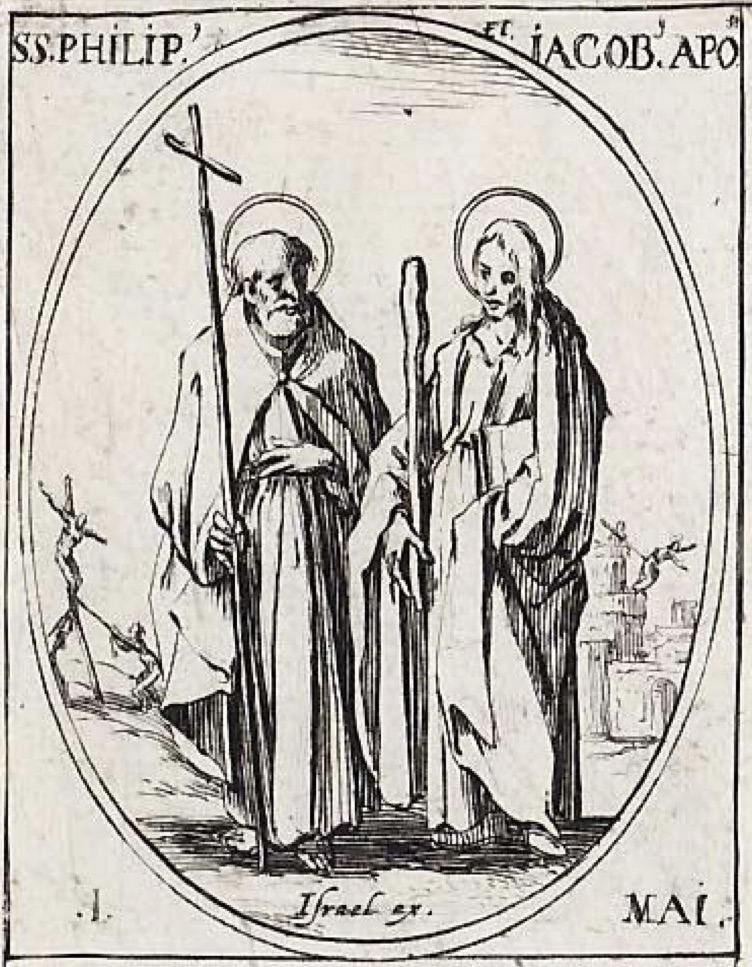
Sermon: Sts. Philip and James

PandJJames Lloyd Breck, his feast day is celebrated on April 2nd, was known as the Apostle to the Wilderness. In the very early days of the church he traveled to foreign countries like Wisconsin and California. In 1842 with two classmates, and under the direction of Bishop Jackson Kemper, he founded Nashotah House and was truly one of the great missionaries.

Many years later, on a gray autumn day in October of 1897, the missionary council of the Episcopal Church gathered at Nashotah House to lay to rest the remains of James Lloyd Breck. In attendance were the students of the House, clergy, and several Bishops including, Bishop Daniel Sylvester Tuttle, the first missionary Bishop of Montana, and Bishop Francis Key Brooke, the first Missionary Bishop of Oklahoma. It was Bishop Tuttle that spoke the words at the graveside following Communion in St. Mary’s Chapel. Bishop Tuttle said:

There was a Grecian race in which the runners were charged to care not for themselves, nor indeed for each other, but for the torch they bore. As one and another, wearied and overcome fell by the way, he held aloft his torch, handing it to a comrade who seized it quickly and sped on. So with the torch borne by the Christian man. It has a triple flame, God’s truth, Christ’s love, men’s good. We are to hold it up and pass it on. One or another of us is soon to fall in the hard-trodden, dusty path. But never mind us, it is dust to dust, though it may be sacred dust that falls, and God will take care of it. Do not mind us; seize the torch, we pray you, and push on to the blessed goal.

Now, at this point you might be thinking to yourself, I thought we were celebrating the feast of Saints Philip and James not James Lloyd Breck the Apostle to the Wilderness, and you would be correct. However, this statement of Bp. Tuttle seems to speak perfectly to these two. James, known as James the Lesser, distinguishes him from James the son of Zebedee and “the brother of Our Lord,” and Philip, is unknown other than a few statements made by him in John’s Gospel. After that, it’s all legend and speculation. I have to wonder though, if this anonymity doesn’t please them immensely.

James and Philip were men who recognized that their lives were not their own. They belonged entirely to God and the work of his Church. They knew that it was not about them. As Tuttle said, it was about the torch, the gospel message of Jesus Christ, and the blessed goal.

We should all be of this mindset, because it is not about us either – those made of that sacred dust – instead it is about the torch with its triple flame: God’s truth, Christ’s love, and men’s good. We must learn to set aside our own agendas, desires and plans and to take up this torch that has been passed on from all the James and Philips, Marys and Theresas, and Brecks and Tuttles. If we do so, then one day they will look back to us and say that we also seized the torch, held it high, and pushed on to the blessed goal.

In our Gospel reading Philip said to Jesus, “Lord, show us the Father, and we will be satisfied.” He would eventually understand that in seeing Jesus, he had seen the Father, and would take part in carrying the message of that revelation into all the world.

Throughout our very busy lives, let us also remember our first love and calling: to carry the torch and allow the light of Christ illumine our every step and the world around us.

Sermon: Easter 3 RCL B – “God Bearer”

plant in handsIn the Far East the emperor was growing old and knew it was time to choose his successor. Instead of choosing one of his assistants or his children, he decided to do something different. He called young people in the kingdom together one day. He said, “”It is time for me to step down and choose the next emperor. I have decided to choose one of you.” The children were shocked, but the emperor continued. “I am going to give each one of you a seed today–one very special seed. I want you to plant the seed, water it, and come back here one year from today with what you have grown from this one seed. I will then judge the plants that you bring, and the one I choose will be the next emperor.”

One boy, named Ling, was there that day and he, like the others, received a seed. He went home and excitedly, told his mother the story. She helped him get a pot and planting soil, and he planted the seed and watered it, carefully. Everyday, he would water it and watch to see if it had grown. After about three weeks, some of the other youths began to talk about their seeds and the plants that were beginning to grow. Ling kept checking his seed, but nothing ever grew. Three weeks, four weeks, five weeks went by, still nothing. By now, others were talking about their plants, but Ling didn’t have a plant and he felt like a failure. Six months went by–still nothing in Ling’s pot.

He just knew he had killed his seed. Everyone else had trees and tall plants, but he had nothing. Ling didn’t say anything to his friends, however. He just kept waiting for his seed to grow. A year finally went by and all the youths of the kingdom brought their plants to the emperor for inspection. Ling told his mother that he wasn’t going to take an empty pot. But his mother asked him to be honest about what happened.

Ling felt sick at his stomach, but he knew his mother was right. He took his empty pot to the palace. When Ling arrived, he was amazed at the variety of plants grown by the other youths. They were beautiful–in all shapes and sizes. Ling put his empty pot on the floor and many of the other children laughed at him. A few felt sorry for him and just said, “Hey, nice try.”

When the emperor arrived, he surveyed the room and greeted the young people. Ling just tried to hide in the back. “My, what great plants, trees, and flowers you have grown,” said the emperor. “Today one of you will be appointed the next emperor!”

All of a sudden, the emperor spotted Ling at the back of the room with his empty pot. He ordered his guards to bring him to the front. Ling was terrified. He thought, “The emperor knows I’m a failure! Maybe he will have me killed!”
When Ling got to the front, the Emperor asked his name. “My name is Ling,” he replied. All the kids were laughing and making fun of him. The emperor asked everyone to quiet down. He looked at Ling, and then announced to the crowd, “Behold your new emperor! His name is Ling!”

Ling couldn’t believe it. Ling couldn’t even grow his seed. How could he be the new emperor?

Then the emperor said, “One year ago today, I gave everyone here a seed. I told you to take the seed, plant it, water it, and bring it back to me today. But I gave you all boiled seeds that would not grow. All of you, except Ling, have brought me trees and plants and flowers. When you found that the seed would not grow, you substituted another seed for the one I gave you. Ling was the only one with the courage and honesty to bring me a pot with my seed in it. Therefore, he is the one who will be the new emperor!”

Jesus said, “Thus it is written, that the Messiah is to suffer and to rise from the dead on the third day, and that repentance and forgiveness of sins is to be proclaimed in his name to all nations, beginning from Jerusalem. You are witnesses of these things.” You are witnesses. You are the ones who proclaim repentance and forgiveness of sins.

The Apostle Paul said to Timothy in his second later, “Hold to the standard of sound teaching that you have heard from me, in the faith and love that are in Christ Jesus.  Guard the good treasure entrusted to you, with the help of the Holy Spirit living in us.”

You are witnesses to that proclaim repentance and forgiveness of sins and you are to guard this treasure that has been entrusted – that has been planted – in you. Question: How’s that working out? Are you guarding what God has planted in you or have you substituted it with something else?

In the beginning, God created the heavens and the earth. On the sixth day of creation “God said, ‘Let us make humankind in our image, according to our likeness.’” From this we have the Latin phrase that refers to humankind, Imago Dei, Image of God. That in itself should be enough to keep us near to God, constantly seeking His face and His will. However, I recently came across another Latin phrase that raised the bar considerably.

St. Ignatius of Antioch: his death is placed somewhere between the year 98 and 117. Legend holds that he was one of the children blessed by Jesus and the 4th century historian Eusebius records that he was a student of the Apostle John and later became the third bishop of Antioch; Peter was the first.

Toward the end of his life there began, under the Emperor Trajan, another persecution of Christians and eventually Ignatius would be arrested and transported to Rome for trial. Along the way, he wrote seven letters that we still have today. He signed the letters, Ignatius Theophorus. Theophorus – God-bearer. Ignatius, one who carries God within himself.

St. Paul wrote to the Galatians, “I have been crucified with Christ; and it is no longer I who live, but it is Christ who lives in me.” Christ lives – notice, that’s not in the past tense – Christ lives in me. Through our baptism, Christ also lives in us.

We are Imago Dei, in the image of God; but we are also Theophorus, God bearers, for God lives in us. We are all Theophorus, God-bearers.

Back to the question: How’s that working out? Are you guarding what God has planted in you, Himself – Christ. Are you bearing Him or have you substituted Him with something else?

Jesus calls us to be witnesses of the truth, repentance and the forgiveness of sins, but if something else has taken root in our souls, then we are no longer witnesses to that truth. Instead, we are witnesses to something foreign and of our own creation and it is not of the One True God.

Did you know that in the world today, it is estimated that there are approximately 41,000 different Christian denominations: Catholic, Episcopal, Baptist, etc.? 41,000! Did you know that it is estimated that the number increases by about 270 every year? About 5 new denominations every week.

luckyOne of those fun cartoons made the rounds awhile back: a pastor has made a diagram. It looks a bit like a family tree of all the denominations. Starts out with one church on the far left and on the far right is this string of various denominations. One of them is circled in red, and pointing at the one the pastor declares, “And this is where our movement came along and finally go the Bible right.” One of the students shouts with joy, “Jesus is so lucky to have us!”

Remember the day that Ling showed up before the Emperor. All the pots with trees, plants, and flowers that had been grown; however, there was only one that was of the Emperor. Only one was bearing, was witness to the truth. 41,000 denominations. Five new every week. Do they all bear the Truth?

We are the Episcopal Church. “Jesus is so lucky to have us!” We are the Episcopal Church and we’ve got more problems than Oklahoma has earthquakes, but that doesn’t mean that we as individuals aren’t called to be witnesses to the Truth.

St. Josemaría Escrivá wrote, ”One ought to be able to apply to every Christian the name that was used in the early ages: Theophorus, Bearer of God. Your actions should be such that you really deserve to be called by that wonderful name.”

There are thousands upon thousands of books and pages that have been written as to what the Truth of Jesus truly is; however, the message is not that difficult. A child can be a witness to it and proclaim it: “The saying is sure and worthy of full acceptance, that Christ Jesus came into the world to save sinners.” “You shall love the Lord your God with all your heart, and with all your soul, and with all your strength, and with all your mind; and your neighbor as yourself.”

This is what we as individuals and the Church are called to be witnesses to. This is the message of the one in whose image we are made and whom we bear in ourselves.

As you go from here to there – wherever “there” may be – allow that Truth to be what flourishes in you. In doing so, you will be a faithful witness to Jesus and you will bear Him into the world that needs this Truth. That needs Him.

Sermon: St. Alphege, Archbishop of Canterbury, and Martyr (1012 a.d.)

img-Saint-Alphege-of-WinchesterThe Psalmist writes:

“Why should I be afraid in evil days,
when the wickedness of those at my heels surrounds me?”

Alphege became Archbishop of Canterbury in 1005 amidst a longstanding war between the Anglo-Saxons and the Danes. Like most such wars, peace often seems to have won the day, when one or the other party does something remarkably stupid that ignites the conflict once again. And it was in 1011 that the battle stirred again.

This time, Canterbury came under siege and fell less than a month later. In the mayhem that followed, Alphege was taken captive. Many of those that were taken captive with Alphege were released after a ransom was paid for their lives, but Alphege refused to pay the ransom himself and refused to allow the members of his church to pay. He believed that they were overburdened as it was and would not allow them to add to it on his behalf.

Despite the fact that he worked tirelessly for the good of his captors, treating their illnesses and proclaiming the Gospel, after seven months he would be tortured and eventually put to death.

The Psalmist asked, “Why should I be afraid of evil days?” And Jesus stated in our Gospel, “I tell you, my friends, do not be afraid of those who kill the body and after that can do no more.” Alphege seems to be one that clearly heard these words.

Fear is not always a bad thing. Fear often prevents us from doing stupid things or from getting into trouble. But fear can also be an inhibitor. Fear of being hurt prevents us from loving another. Fear of failure prevents us from trying. Fear of rejection prevents us from reaching out. The Psalmist, Jesus, and the life of Alphege also say to us that the fear of death, prevents us from fully serving God.

We should not allow our fear of death to constrain us to such an extent that we aren’t willing to risk ourselves for the sake of the Gospel. No, that’s not saying go out and throw yourself in front of a bus to see if God will save you or drink the funny Kool-Aid, but it does say that we understand, as did Alphege, that death does not have the final say in our lives. That is the Easter message.

We hear that message clearly in Paul’s first letter to the Corinthians, “When this perishable body puts on imperishability, and this mortal body puts on immortality, then the saying that is written will be fulfilled:
‘Death has been swallowed up in victory.’
‘Where, O death, is your victory?
Where, O death, is your sting?’”

Therefore, you may have a fear of bungie jumping, but the fear of death should be far less.

St. Josemaría Escrivá tells the story of seeing himself as a little bird. “I see myself like a poor little bird, accustomed only to making short flights from tree to tree, or, at most, up to a third floor balcony… One day in its life it succeeded in reaching the roof of a modest building, that you could hardly call a skyscraper.

“But suddenly our little bird is snatched up by an eagle, who mistakes the bird for one of its own brood. In its powerful talons the bird is borne higher and higher, above the mountains of the earth and the snow—capped peaks, above the white, blue and rose—pink clouds, and higher and higher until it can look right into the sun. And then the eagle lets go of the little bird and says: Off you go. Fly!”

Do not be afraid. Off you go. Fly!

Sermon: Easter 2 RCL B – “Doubting?”

TomasPerhaps you’ve seen the letter. It is to Jesus from Jordan Management Consultants.

It would seem that Jesus used these consultants to help identify potential leaders from his followers. The letter states that JMC has done extensive research on the candidates and then provides it’s recommendations:

Simon Peter is emotionally unstable and given to fits of temper. Andrew has absolutely no qualities of leadership. The two brothers, James and John, the sons of Zebedee, place personal interest above company loyalty. Thomas demonstrates a questioning attitude that would tend to undermine morale.

We feel that it is our duty to tell you that Matthew has been blacklisted by the Greater Jerusalem Better Business Bureau. James, the son of Alphaeus, and Thaddaeus definitely have radical leanings, and they both registered a high score on the manic depressive scale.

One of the candidates, however, shows great potential. He is a man of ability and resourcefulness, meets people well, has a keen business mind and has contacts in high places. He is highly motivated, ambitious, and responsible. We recommend Judas Iscariot as your controller and right-hand man.

Did you ever notice how easy it is to pull a snippet out of a person’s life and from then on judge and label them according to that snippet. We hear the stories of many of the characters in the Bible and do the same thing.

In the Old Testament Abraham lied, David was an adulterer, Moses argued with God, Jonah was flat disobedient, and those are only a few. Those in the New Testament aren’t any better. The apostles questioned the methods of Jesus. They argued amongst themselves. They wanted to call down fire from heaven and destroy cities (I actually kind of like that one). They abandoned Christ in his time of need. They denied him and so on.

And then there is poor old Thomas. It is easy to understand why grade schoolers think his last name was Thomas and his first name was “Doubting.” Doubting Thomas. To tell you the truth, I think he gets a bad wrap, so today I would like to try and remedy that a bit.

Thomas is mentioned in all four gospels and the Acts of the Apostles, but it is John’s gospel where he receives the most attention.

In John’s gospel, he is first mentioned as Jesus is making plans to return to Judea where he would later raise Lazarus from the dead. The disciples are concerned because it was in Judea that the Jews had tried to stone Jesus just a short time earlier. Despite their concerns, Jesus says, “Let us go to Lazarus.”

Have you seen The Lord of the Rings? Great films. Gimli is a main character and a dwarf. There is a huge battle about to take place where the chance of victory is slim, so there is an argument on what they should do. Stand and fight or flee and possibly fight another day. Gimli settles the argument when he states, “Certainty of death, small chance of success- what are we waiting for?”


When Jesus said, “Let us go to Lazarus,” even though there was the possibility of death and everyone else wanted to stay put, Thomas said, “Let us also go, that we may die with him.”

Note to the wise: if you can find a friend like this, don’t let them go. Thomas in this situation demonstrates bravery, loyalty, and dedication. When the rest were “doubting,” Thomas is prepared to lay down his life for the Lord.

In a later event Jesus would cryptically explain to the disciples that he would be killed and be going to the Father. He goes on to tell them that they know the way to where he is going, yet Thomas says, “Lord, we don’t know where you are going, so how can we know the way?” Jesus goes on to explain that he is “the way and the truth and the Life.”

No one else understood either, but Thomas demonstrates simple honesty in that he did not pretend to understand what Jesus was trying to tell them.

Brave, loyal, dedicated, honest, and now from today’s text – doubting.

When Jesus first appeared to the disciples ten were there who saw and believed. Thomas was not.

Some have suggested that Thomas’ greatest mistake was not his doubting, but his absence. After the death of Jesus, instead of remaining in the Christian community, it is postulated that he withdrew and sought out loneliness. In isolating himself from the community of faith he failed to witness the appearance of Christ.

Whatever the case, Thomas doubts. The Lord appears again and Thomas is present. It is at this appearance that Thomas redeems himself from his initial doubt, because after laying eyes and possibly even his hands on the Risen Lord, he makes a confession of faith regarding Jesus. This confession is greater than what all the rest have said to this point. Thomas declares, “My Lord and my God.”

A football game has been described as eleven men in desperate need of a rest being criticized by thousands in need of some exercise.

Sitting on the sidelines it is easy to criticize Thomas, but it seems that his doubting was brought on by his need for facts. Once certainty was attained, Thomas commits himself fully to Jesus, declaring him to be Lord and God.

Brave Loyal Dedicated Honest Doubting Fully Committed. That’s a better first name than just “doubting”.

The beginning of the Acts of the Apostles records the last appearance of Jesus to the apostles, and Jesus’ final words to them were, “You will be my witnesses in Jerusalem, and in all Judea and Samaria, and to the ends of the earth.” It is clear from the remaining text of Acts that several of the apostles did just as Jesus had commanded them; however, we don’t hear about them all, Thomas being one that scripture is silent on.

There is however what is known as the New Testament Apocrypha. It is not considered scripture or even true, but included in this work is a book titled “The Acts of Thomas.” According to this book, with regard to being “witnesses to the end of the earth,” we learn that the apostles divided up the earth and went out into the world to spread the Gospel message as Jesus had commanded. Thomas, as the legend tells, was assigned to the area we know as India.

When he arrived in India he was enslaved, but it came to the attention of Gustafor, an Indian king, that Thomas was a carpenter. Learning this, Gustafor commanded Thomas to build him a palace. The king gave Thomas a considerable amount of money to buy the materials and pay the workers; however, every time the king gave him money Thomas gave it all the way to the poor. The king finally got suspicious, so he sent for Thomas and asked him, “Have you built my palace?” Thomas answered, “Yes” The king asked when he could go and see this palace and Thomas replied, “You cannot see it now, but when you depart this life, then you will see it.” Thomas was building for the king a palace in heaven through good works. At first, the king was furious and Thomas was nearly put to death, yet through this situation Thomas was able to win the Indian king to Christ. Legend has it that this is how Christianity came to India.

True or false? It’s hard to say, but here’s a fact: to this day, the Church in India traces its roots back to the apostle we refer to as Doubting Thomas.

What can we gain from this apostle with the unfortunate first name? One theologian wrote, “What this church needs is what every church needs a man who knows God at more than second hand knowledge.”

When Jesus first appeared, Thomas wasn’t willing to take the other apostles’ word for it. He didn’t want second hand knowledge. He wanted proof for himself. He wanted to see and hear and lay his own hands on the risen Lord.

That is what we should all want. Jesus does say to Thomas, “Have you believed because you have seen me? Blessed are those who have not seen and yet have come to believe.” It is true. Faith is believing in the things we cannot see, but to bounce along in an unsubstantiated faith is foolish, for when the trials come, that type of faith can abandon us.

Therefore, we must also lay hold of the Risen Lord and we can do so through prayer, study of Holy Scripture, meditation, our own experiences of the Risen Lord, and the witness of others. It is then that the roots of our faith will be grounded in the Rock who is our Lord and our God. Then, when the trials blow through our lives, they may knock us around a bit, but we will not be uprooted. Like Thomas, we will learn to never doubt the one who saves us.