Sermon: Baptism of Our Lord

This 85 year old couple, having been married almost 60 years, had died in a car accident. They had been in good health the last ten years mainly due to her interest in health food, and exercise. When they reached the pearly gates, St. Peter took them to their mansion which was decked out with a beautiful kitchen and master bath suite and Jacuzzi. As they “oohed and aahed” the old man asked Peter how much all this was going to cost. “It’s free,” Peter replied, “this is Heaven.” Next they went out back to survey the championship golf course that the home backed up to. They would have golfing privileges everyday and each week the course changed to a new one representing the great golf courses on earth. The old man asked, “What are the green fees?” Peter’s reply, “This is heaven, you play for free.” Next they went to the club house and saw the lavish buffet lunch with the cuisines of the world laid out. “How much to eat?” asked the old man. “Don’t you understand yet? This is heaven, it is free,” Peter replied with some exasperation. “Well, where are the low fat and low cholesterol tables?” the old man asked timidly. Peter lectured, “That’s the best part, you can eat as much as you like of whatever you like and you never get fat and you never get sick. This is Heaven.” With that the old man went into a fit of anger, throwing down his hat and stomping on it, and shrieking wildly. Peter and his wife both tried to calm him down, asking him what was wrong. The old man looked at his wife and said, “This is all your fault. If it weren’t for your blasted bran muffins and uncountable laps around the mall, I could have been here ten years ago!”

So, how are all those New Year’s resolutions working out for you? Mine seems to be getting more difficult, because instead of losing weight, I’ve already gained an extra few pounds!

Of the top five resolutions, you will almost always find: eating healthier, quit smoking, and getting healthier. I suppose we all want to look better and live healthier, but I would also suggest to you that behind all of these efforts is one single fear. The fear of death. But I’ve got news for you, you can run a hundred miles a day, but you will not outrun death. It will catch you. (Thank you Fr. John for depressing us all this morning! Not my intent, though.)

In the opening chapters of Charlotte Brontë’s Jane Eyre, Mr. Brocklehurst comes to collect Jane from her aunt and uncle’s home and take her to a school for girls. Jane’s aunt, Mrs. Reed, has described Jane to Mr. Brocklehurst as a child with a “tendency for deceit.”

Mr. Brocklehurst, a rather unpleasant man says to Jane, “No sight so sad as that of a naughty child, especially a naughty little girl. Do you know where the wicked go after death?”

“They go to hell,” was Jane’s ready and orthodox answer.

“And what is hell? Can you tell me that?”

“A pit full of fire.”

“And should you like to fall into that pit, and to be burning there for ever?”

“No, sir.”

“What must you do to avoid it?”

Jane deliberated a moment: her answer, when it did come was objectionable: “I must keep in good health and not die.”

I must keep in good health and not die. Even though it is inevitable, like jane, we would like to avoid it, but what Benjamin Franklin said is true, “In this world nothing can be said to be certain, except death and taxes.” Therefore, somewhere in our minds, we accept the inevitability of death and then begin to console ourselves by saying things like, “Dying is just a part of living” and “Death is natural.” But what if I told you that these are just lies? What if I told you that you were not created to die?

Paul wrote in his letter to the Romans, “Just as sin entered the world through one man, and death through sin, and in this way death came to all people, because all sinned.” God did not create death. You were not created to die. It was through our sin that death came into the world. We say with Jane Eyre, “I must keep in good health and not die,” and then make our resolutions to lose weight, quit smoking and all the rest in an attempt to avoid death, because death is not natural. Dying is the most un-natural thing we will ever do, so we fight against it. We may accept it and be reconciled to the fact that it will happen, but every cell of our bodies will reject death’s claim over our lives. And fortunately for us, so does God. God has rejected death’s claim over you and through Christ has restored what was taken through sin.

Again, to the Romans, Paul wrote, “Don’t you know that all of us who were baptized into Christ Jesus were baptized into his death?  We were therefore buried with him through baptism into death in order that, just as Christ was raised from the dead through the glory of the Father, we too may live a new life.”

That ancient serpent holds out his sinful fruit to each of us, and just as Adam and Eve took and ate, so do we. The moment that fateful fruit touches our lips we are dead, but God in His infinite goodness extends to us the one thing that can overcome this sting of death. He extends to us His Son, and through our baptism we are united to Jesus in His death and into His resurrection. Therefore, for us, death is not an end or a destination, it is only something we pass through.

Hear again the words we read earlier that the Lord spoke through the Prophet Isaiah:
Do not fear, for I have redeemed you;
I have called you by name, you are mine.
When you pass through the waters, I will be with you;
and through the rivers, they shall not overwhelm you;
when you walk through fire you shall not be burned,
and the flame shall not consume you.

Jesus’ baptism shows us how we might follow him, and his death provides a way for us to pass through the waters and the fire without being overwhelmed or consumed. One of the great theologians, Hans Urs von Balthasar wrote, “The Church does not dispense the sacrament of baptism in order to acquire for herself an increase in membership but in order to consecrate a human being to God and to communicate to that person the divine gift of birth from God.”

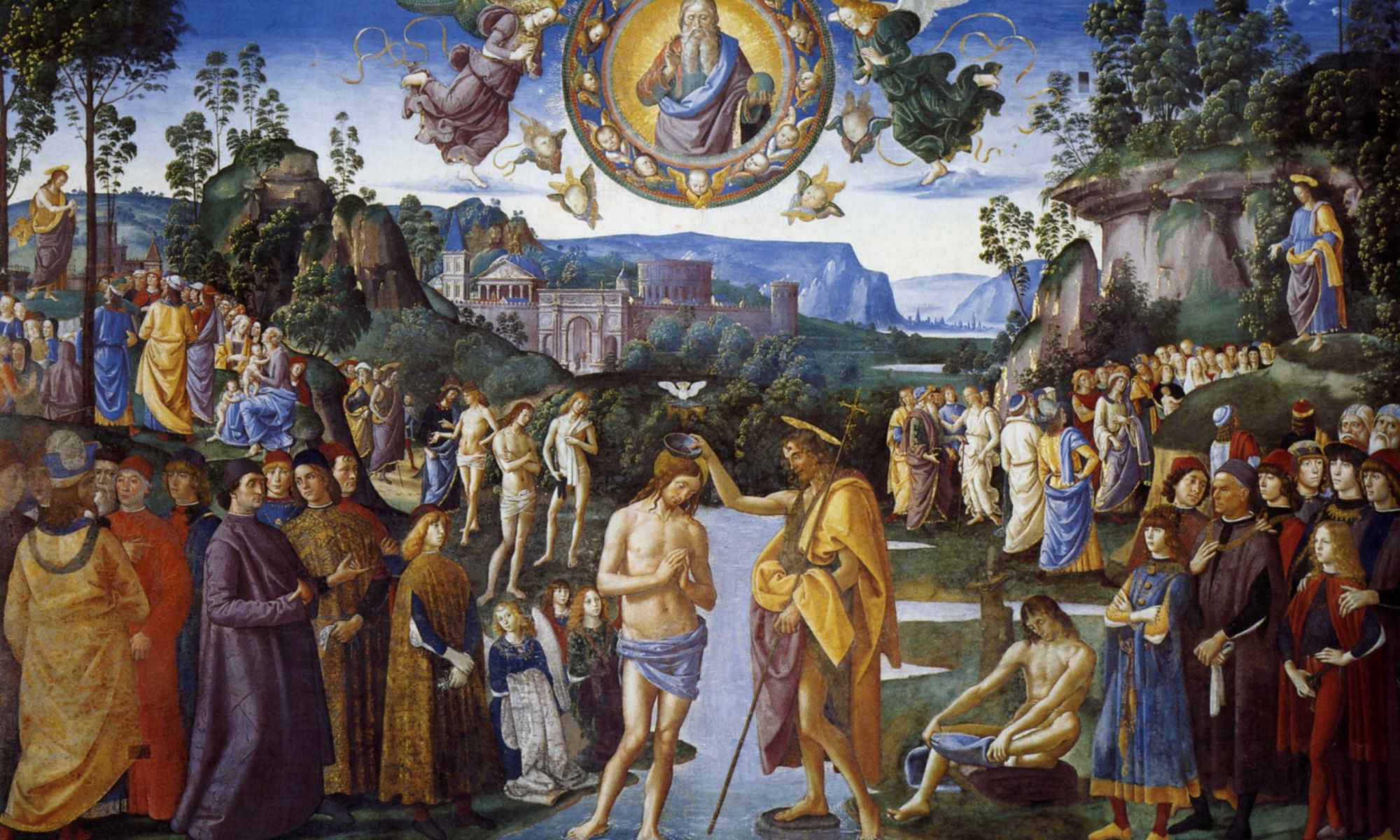
Luke wrote in our Gospel, Now when all the people were baptized, and when Jesus also had been baptized and was praying, the heaven was opened, and the Holy Spirit descended upon him in bodily form like a dove. And a voice came from heaven, “You are my Son, the Beloved; with you I am well pleased.” As we rise from the waters of our own baptism, the voice of God is also heard: “You are my son, my daughter, my beloved; with you I am well pleased.”

Your only real death occurs here—in the waters of baptism—but you do not remain, for through the One born in a manger, the One who was worshipped by shepherds and kings, the one who conquered death once and for all, raises you to new life, consecrating you as sons and daughters of God Most High.

Let us pray: Father in Heaven, when the Spirit came down upon Jesus at His Baptism in the Jordan, You revealed Him as Your own Beloved Son. Keep us, Your children, born of water and the Spirit, faithful to our calling. May we, who share in Your Life as Your children through Baptism, follow in Christ’s path of service to all people. Let us become one in His Sacrifice and hear His Word with faith. May we live as Your children, following the example of Jesus. Amen.

Sermon: Thomas Becket

Thomas Becket and King Henry II were close friends. Even though a deacon in the church, Becket enjoyed a rather worldly life, often going out carousing with the young king. Given there close relationship, Henry believed that he could take a firm grip on the church by appointing his friend as Archbishop of Canterbury; therefore, on June, 2, 1162, Thomas was ordained a priest, in the morning on June 3 he was consecrated a bishop, and that afternoon he was installed as the Archbishop of Canterbury.

However, it was soon clear that Becket’s loyalties had shifted away from Henry to the church and the relationship between the two became strained. This became most evident in an incident where a priest had been accused of murder. At the time, clergy were tried by the church, but Henry wanted such authority under the crown. When the priest was acquitted under the church, Henry was furious and changed the law. From there things deteriorated much more, leading Becket to flee to France in fear for his life.

Eventually Thomas and the king would be somewhat reconciled; however, while Thomas was in exile in France he had excommunicated two bishops in England for giving into the king’s demands, but when he returned to England he refused to lift the excommunication order, which once again infuriated the king. Henry is then reported to have said to four of his knights, “What sluggards, what cowards have I brought up in my court, who care nothing for their allegiance to their lord. Who will rid me of this meddlesome priest.”

The four took these words as a command to go and execute Thomas. They found him at Canterbury Cathedral where they confronted him at the altar of the church. A witness to the events, a monk, Edward Grim wrote, ”The murderers followed him; ‘Absolve’, they cried, ‘and restore to communion those whom you have excommunicated, and restore their powers to those whom you have suspended.’

“He answered, ‘There has been no satisfaction, and I will not absolve them.’

‘Then you shall die,’ they cried, ‘and receive what you deserve.’

‘I am ready,’ he replied, ‘to die for my Lord, that in my blood the Church may obtain liberty and peace. But in the name of Almighty God, I forbid you to hurt my people whether clerk or lay.’

“Then they lay sacrilegious hands on him, pulling and dragging him that they may kill him outside the church, or carry him away a prisoner, as they afterwards confessed. But when he could not be forced away from the pillar, one of them pressed on him and clung to him more closely. Him he pushed off calling him ‘pander’, and saying, ‘Touch me not, Reginald; you owe me fealty and subjection; you and your accomplices act like madmen.’

“The knight, fired with a terrible rage at this severe repulse, waved his sword over the sacred head. ‘No faith’, he cried, ‘nor subjection do I owe you against my fealty to my lord the King.’

And there, inside Canterbury Cathedral, they murdered Thomas. His final words, ‘For the Name of Jesus and the protection of the Church I am ready to embrace death.’

Jesus said, “All men will hate you because of me, but he who stands firm to the end will be saved.”

Albus Dumbledore, Headmaster of Hogwarts School of Witchcraft and Wizardry (Harry Potter character for you muggles) said, “There are all kinds of courage. It takes a great deal of bravery to stand up to our enemies, but a great deal more to stand up to our friends.”

There will be times when we must make a decision between the demands of the world and the demands of God. Thomas Becket shows us how to stand even when the demands of the world are made by our friends. It will not be easy, but through Christ Jesus, we can hold to the faith that is within us and stand firm.

Sermon: Christmas Eve

Little Johnny is told by his mother that he has been very bad this year. Thus, he would probably not get anything for Christmas.

“What? Nothing for Christmas?” cried Johnny.

“Well,” said mom, “maybe if you write a letter to baby Jesus and tell him how sorry you are, Santa will bring you some presents.”

Little Johnny returned to his room and began his letter. With each attempt at writing he would first apologize and then promise to be good for a certain amount of time. Each letter he crumpled-up, and then started again, making the “be good” time shorter with each letter.

Just as he was about to give up in frustration, he was suddenly struck by a bolt of inspiration! Running to the living room he carefully removed the little Virgin Mary figurine from the family’s manger scene, carefully wrapped it in a sock, and placed it in his top dresser drawer. Returning to his desk, he took out a clean piece of paper and began to write: “Dear Baby Jesus, if you ever want to see your Mother again….”

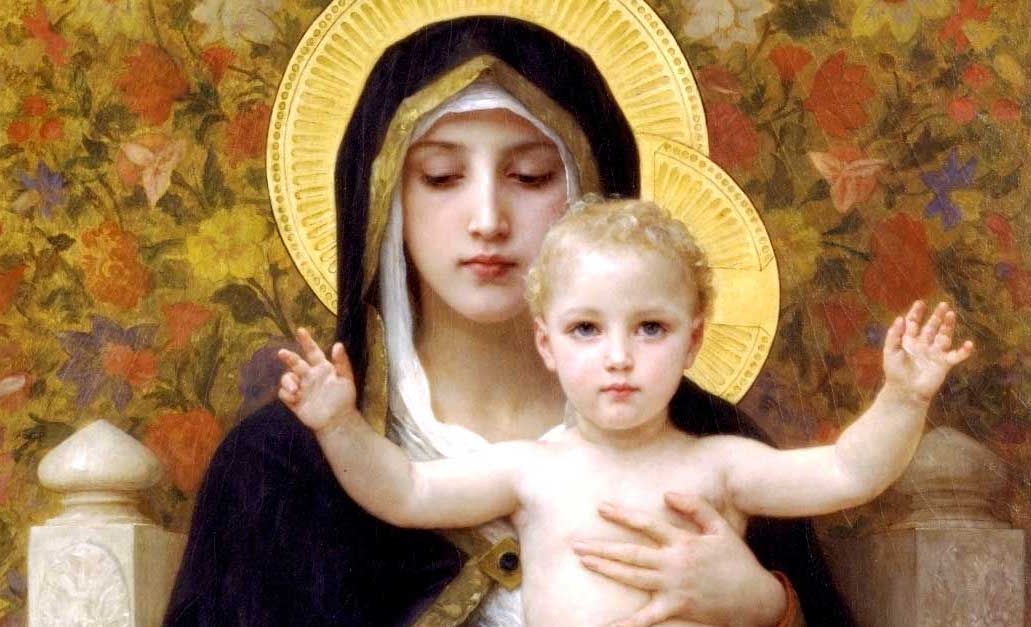
There was a very interesting article that came out in the December issue of National Geographic (I was actually quite amazed to see it!): “How the Virgin Mary Became the World’s Most Powerful Woman.” She fell out of favor with the more protestant leaning churches following the Reformation in the 16th century, but she holds a special place in the hearts of literally billions of people. She is seen as a point of access to God and a means to grace.

At the Annunciation the Angel of the Lord came to her and said, “And now, you will conceive in your womb and bear a son, and you will name him Jesus. He will be great, and will be called the Son of the Most High, and the Lord God will give to him the throne of his ancestor David.” Mary’s response set the stage for the turning point in our relationship with Our Heavenly Father. She said, “Here am I, the servant of the Lord; let it be with me according to your word.”

Soon afterwards, Mary would go and visit her cousin Elizabeth, the mother of John the Baptist, and upon her arrival, Elizabeth declared, “Blessed are you among women, and blessed is the fruit of your womb. And why has this happened to me, that the mother of my Lord comes to me? For as soon as I heard the sound of your greeting, the child in my womb leaped for joy. And blessed is she who believed that there would be a fulfillment of what was spoken to her by the Lord.”

Today, we find Mary in the manger giving birth to the Son of God. The star was shining, the angels were rejoicing, the shepherds came worshiping and told what they had heard from the angels, and Mary, we are told, “treasured all these words and pondered them in her heart.” That means she took all that she knew from the time before the Annunciation, to the words the angel spoke to her then, to the declaration her cousin Elizabeth had made, to what the shepherds had shared with her that night, and tried to understand what it all meant.

So my question for you this evening is this: Have you? All of these events, combined with what we know from Holy Scripture about the life of Jesus—his teachings, the miracles, his death and resurrection—provide a basis for our faith. So, like Mary, have you treasured and pondered these words and events in your heart?

And everybody responds, “Well, Fr. John, we wouldn’t be here if we hadn’t!” But the reason I ask is because of something Dietrich Bonhoeffer wrote: “For those who are great and powerful in this world, there are two places where their courage fails them, which terrify them to the very depths of their souls, and which they dearly avoid, these are the manger and the cross of Jesus Christ.” Why? Because in these two place, more than any other place in time, things happen.

Speaking specifically of the manger and the text we read tonight, Bonhoeffer wrote, “This text speaks of the birth of a child not the revolutionary deed of a strong man or the breath-taking discovery of a sage or the pious deed of a saint. It truly boggles the mind: the birth of a child is to bring about the great transformation of all things, is to bring salvation, and redemption to all of humanity. As if to shame the most powerful human efforts and achievements a child is placed in the center of world history, a child born of humans, a son given by God. This is the mystery of the redemption of the world, all that is past and all that is to come is encompassed here.”

I ask you if, like Mary, you have treasured and pondered these words and events in your heart, because many are afraid to do so. Why? Because one of two things will happen in your life when you do. One, you will reject it and remain as you are. Or, two, you will treasure and ponder these words and events in your heart and be transformed.

Mary is the Mother of God, but it was Meister Eckhart, a German theologian and mystic, who said, “We are all meant to be mothers of God, for God is always needing to be born.” To be transformed by the Word of God is to have God born in you and for some that that can be a terrifying prospect. One of the greatest understatements in all of Holy Scripture is when the Apostle Paul wrote, “It is a fearful thing to fall into the hands of the living God,” because God will not leave you unchanged. He declares, “Behold, I am making all things new,” and what He desires to make new more than anything else is you.

So when that fear of transformation, of being made new, sets in, then hear the words of the angel, Do not be afraid; for see—I am bringing you good news of great joy for all people: to you is born this day in – your very soul – a Savior, who is the Messiah, the Lord.

Allow the Star of the Christ Child to rise above you. Allow your heart to be set as His manger. Allow the Son of God to be born in you. And allow Him to transform you into His image and His glory.

Sermon: Apostolic

Boudreaux and Thibodeaux went hunting and got lost in the woods. When Boudreaux began lamenting their fate, Thibodeaux said, “You know, I heard that the best thing to do if you get lost is to fire three shots in the air.” So they did that, and waited a while. When no rescue party showed up, they fired three more shots. Finally, when there was still no response, Thibodeaux said, “Well, I guess we better fire three more shots.” “OK, if you say so,” said Boudreaux. “But somebody better come soon—we’re about out of arrows!”

One holy catholic and apostolic. We’ve reached the final and fourth mark of the church as described in the Nicene Creed: apostolic.

The apostolic mark of the Church speaks of continuity. It is not a line that goes backward like in a children’s connect the dots puzzle, but a bond, an uninterrupted progression from Jesus and the apostles to us today, made possible through the bishops and the work of all God’s people. It began at the manger in Bethlehem and continues through the witness of every Christian today. However, where one holy and catholic primarily speak about who we are, apostolic speaks mainly about what we do, our work as the Church.

Our work as the Church is summarized nicely in the form of questions that we ask in the Baptismal Covenant: Will you continue in the apostles’ teachings? Will you persevere? Will you seek and serve Christ? Will you strive for justice? As the Church, I believe we do a brilliant job of these things, both individually and corporately. However, although we can always improve, there is one area of our work that we really need to improve. You see, as Episcopalians, we have selective hearing when it comes to the question, “Will you proclaim by word and example the Good News of God in Christ?” As Episcopalians we hear, “Will you proclaim by {mumble mumble} example the Good News in Christ?” It is good to proclaim Christ through our work, but in some cases, it is the equivalent of shooting up arrows and hoping someone will hear you.

An apostolic church is one that has continuity with the past, but it is also one that continues into the future. For that to happen, we must be like those first apostles and proclaim Christ’s message with our deeds, but there are also times when we must speak plainly about our faith.

During this Advent season, we hear God’s word as it speaks about the first and second coming of Jesus. Some will remember our minor prophet’s study when we discussed Joel and how he talked about “the day of the Lord.” Speaking of this day, the Lord said, “I will show portents in the heavens and on the earth, blood and fire and columns of smoke.  The sun shall be turned to darkness, and the moon to blood, before the great and terrible day of the Lord comes.” Yet in the midst of that message of judgment, there was the message of hope, for the Lord adds, “Then everyone who calls on the name of the Lord shall be saved.”

It is the Apostle Paul who quoted this line in his letter to the Romans, “Everyone who calls on the name of the Lord shall be saved.” Paul then adds, “But how are they to call on one in whom they have not believed? And how are they to believe in one of whom they have never heard? And how are they to hear without someone to proclaim him?  And how are they to proclaim him unless they are sent? As it is written, “How beautiful are the feet of those who bring good news!” And, following his resurrection, Jesus said to his apostles, “As the Father has sent me, I am sending you.”

In the movie Gravity, Sandra Bullock plays Dr. Ryan Stone who is aboard the space shuttle when it encounters catastrophic failures (hopefully, I won’t spoil it too much for you if you haven’t seen it). Towards the end, she finds herself alone, with limited oxygen and no way home. She is unable to communicate with mission control on earth, but as she turns the dial, she picks up through the static the voice of a man, Aningang. He can’t hear her, but through her tears she speaks to him: “I’m going to die, Aningang. I mean, we’re all going to die. Everyone knows that. But I’m going to die today… Funny that. To know. And you know what Aningang… I don’t care. I don’t care if I die. I don’t have anything… not anymore. But the thing is… I’m still scared. I’m really scared… No one will mourn me. No one will pray for my soul. Will you mourn me, Aningang? Is it too late to say a prayer? I’d say one for myself, but I have never prayed in my life… no one ever taught me how… No one ever taught me how.”

How would it be to die and to not know how to pray? How would it be to die and not know that there is a God of infinite love? How would it be to die and not know that the God of infinite love, loves you?

Our new Presiding Bishop, Michael Curry, recalls the words of the angel at the empty tomb of Jesus, “This Jesus of Nazareth whom you seek, he is not here, he has been raised as he said he would be and he has now gone ahead of you to Galilee.  There you will see him.  It is in Galilee that the Risen Lord will be found and seen for he has gone ahead of us.”

Bishop Curry goes on to say,

“Galilee.  Which is a way of talking about the world.

Galilee.

In the streets of the city.

Galilee.

In our rural communities.

Galilee in our hospitals.

Galilee in our office places.

Galilee where God’s children live and dwell there.

In Galilee you will meet the living Christ for He has already gone ahead of you.

The church can no longer wait for its congregation to come to it, the church must go where the congregation is.

Now is our time to go.  To go into the world to share the good news of God and Jesus Christ.  To go into the world and help to be agents and instruments of God’s reconciliation.  To go into the world, let the world know that there is a God who loves us, a God who will not let us go, and that that love can set us all free.

Bishop Curry concludes, “This is the Jesus Movement, and we are The Episcopal Church, the Episcopal branch of Jesus’ movement in this world.”

We are one holy catholic and apostolic church. As the Church, we stand at the foot of the cross, made complete in one flesh with Jesus, bound together in love, and made holy by means of grace, and our continuing mission has been firmly established.

Jesus said, “As the Father has sent me, I am sending you.” He sends us all to proclaim by word and example the Good News of God in Christ. You are the Episcopal branch of Jesus’ movement in Enid. Go! Go and make disciples, baptizing them in the name of the Father and of the Son and of the Holy Spirit, and teaching them to obey everything that Jesus has commanded us. And remember, He is with us always, to the very end of the age.

Let us pray—Everliving God, whose will it is that all should come to you through your Son Jesus Christ: Inspire our witness to him, that all may know the power of his forgiveness and the hope of his resurrection; who lives and reigns with you and the Holy Spirit, one God, now and for ever. Amen.

Follow this link to see Bishop Curry’s full message.

Sermon: Ralph Adams Cram, John LaFarge, and Richard Upjohn

Ralph Adams Cram, John LaFarge, and Richard Upjohn: these are not what you would call household names, but their work you may recognize. Cram and Upjohn were both architects and LaFarge was an artist.

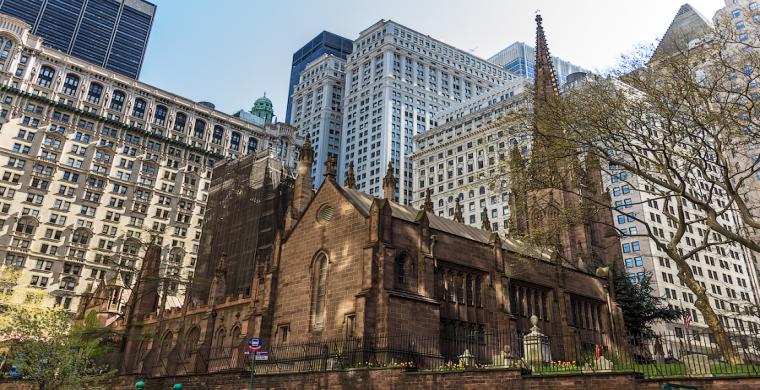
Cram’s work includes All Saints Chapel at Sewanee, The Cathedral of St. John the Divine in New York, and several of the buildings at Princeton University. Upjohn was the architect of Trinity Church in New York and, for those of you who have visited Nashotah House, St. John Chrysostom in Delafield, Wisconsin, along with many other church buildings. LaFarge is noted for his work with Stained glass windows.

We celebrate these three (and I think we should add one more to the list: R. R. Wright who was the architect of St. Matthew’s) because of their contributions to our houses of worship. Frank Lloyd Wright said, “A doctor can bury his mistakes, but an architect can only advise his clients to plant vines.” For these architects and artist, no vines were needed.

The architectural phrase, “form follows function,” is true. A building is most often designed to efficiently serve a particular need. That is true for the church as well, but the church is not designed to build material goods or serve as an office complex. A church is designed to draw you toward the transcendent. To help you enter into the presence of God. So with its high ceilings, stained glass, iconography, altars, and all the other accoutrements, the church building serves as a sanctuary in the midst of a chaotic world designed to draw us nearer to our God.

Those that we celebrate today, created some of our most notable sanctuaries. But even they, standing before their most glorious works, would understand King Solomon’s words that we read. It was at the dedication at the Temple he had built that Solomon prayed, “But will God indeed reside with mortals on earth? Even heaven and the highest heaven cannot contain you, how much less this house that I have built!”

Our sanctuaries are holy places of refuge in this world, but they cannot contain our God. Stephen, the first deacon and martyr declared, just before he was stoned to death, “The Most High does not dwell in houses made with human hands; as the prophet says,

‘Heaven is my throne,
and the earth is my footstool.’”

Our grandest cathedrals cannot house God and even an infinite universe is too small for his greatness, but what is so amazing is that the body of a believer can. You are his temple, so wrote St. Paul in his first letter to the Corinthians, “Do you not know that your body is a temple of the Holy Spirit within you, which you have from God, and that you are not your own?  For you were bought with a price; therefore glorify God in your body.”

The great Anglican poet, George Herbert, understood this and wrote of the altar of God that resides within the temple of us all: the heart.

A broken  Altar,  Lord,  thy servant  rears,
Made  of a heart,  and cemented with  tears,
Whose  parts are as  thy hand  did  frame;
No  workmans tool hath  touch’d the  same.
A    Heart     alone
Is   such  a  stone,
As    nothing    but
Thy pow’r  doth cut.
Wherefore  each part
Of   my  hard  heart
Meets in this frame,
To praise  thy name.
That   if  I  chance  to  hold  my  peace,
These stones to praise thee may not cease.
O   let  thy  blessed   Sacrifice  be   mine
And   sanctifie  this  Altar  to   be  thine.

We celebrate those who build our houses of worship, and along with them, we celebrate the One who builds our bodies into His most Holy Temple.

Sermon: Catholic

A fella reports: I was walking across a bridge one day, and I saw a man standing on the edge, about to jump off.

So I ran over and said “Stop! Don’t do it!”

“Why shouldn’t I?” he said.

“Well, there’s so much to live for!”

“Like what?”

“Well… are you religious?” He said yes.

I said, “Me too! Are you Christian or Buddhist?”

“Christian.”

“Me too! Are you Catholic or Protestant?

“Protestant.”

“Me too! Are you Episcopalian or Baptist?”

“Baptist”

“Wow! Me too! Are you Baptist Church of God or Baptist Church of the Lord?”

“Baptist Church of God!”

“Me too! Are you original Baptist Church of God, or are you reformed Baptist Church of God?”

“Reformed Baptist Church of God!”

“Me too! Are you Reformed Baptist Church of God, reformation of 1879, or Reformed Baptist Church of God, reformation of 1915?”

He said, “Reformed Baptist Church of God, reformation of 1915!”

I said, “Die, heretic scum”, and pushed him off.

Don’t kid yourselves, that joke could very easily apply to Episcopalians and the Anglican Church in North America. Pick your favorite denominational fight and insert the name.

So far in our look at the four marks of the Church – one holy catholic and apostolic – we have covered one and holy. From those two words we can draw the following definition of what we mean when we speak those words as we recite the Nicene Creed: As the Church, we stand as one at the foot of the cross in union with one another and with Christ Jesus, united in one flesh, bound together in love, and made holy, not through our own efforts, but by means of grace, made available through the shed blood of Christ Jesus. Today we look more closely at what it means to be catholic, and I can assure you, shouting “Die, heretic scum,” then shoving someone off a bridge is not in the formula.

For some, this word catholic is understood as our practices. Our liturgy and how we worship. In a way, it does, but that is not a full understanding. For others, catholic is defined as “universal.” But that definition is also lacking, because it is easy to view that as being individual parts, even though geographically separate, coming together under one umbrella, separate yet together. So, perhaps a better way of saying catholic would be to say, whole or complete.

That wholeness or completeness does not begin with the church. It begins with the wholeness of the individual.

Consider the episode in Mark’s Gospel when four individuals bring their friend, who is paralyzed, to Jesus. You’ll remember that the crowd was so large that they couldn’t get into the house where Jesus was, so they carried their friend to the roof and lowered him down to Jesus through a hole they had made. What did they expect by doing this? They thought Jesus would heal his paralysis, but instead, Jesus surprised them all, including the religious leaders, by healing the paralyzed man’s soul. “When Jesus saw the faith of the friends, he said to the paralytic, ‘Son, your sins are forgiven.’”

The religious leaders upon hearing this were angry, “Why does this fellow speak in this way? It is blasphemy! Who can forgive sins but God alone?” Jesus response: “Why do you raise such questions in your hearts?  Which is easier, to say to the paralytic, ‘Your sins are forgiven,’ or to say, ‘Stand up and take your mat and walk’?  But so that you may know that the Son of Man has authority on earth to forgive sins”—he said to the paralytic—“I say to you, stand up, take your mat and go to your home.” And he stood up, and immediately took the mat and went out before all of them.

Yes, Jesus is declaring his authority to forgive sins, but he is also showing his concern for the wholeness of the individual in body and soul. Not only healing the soul, but also healing the body of its affliction. Does that mean that if I’m not healed in body, then I am not made whole in Christ? Absolutely not. For these bodies of ours are only broken temporarily, and as we read in the Book of Revelation: “See, the home of God is among mortals. He will dwell with them; they will be his peoples, and God himself will be with them; he will wipe every tear from their eyes. Death will be no more; mourning and crying and pain will be no more, for the first things have passed away.” And the one who was seated on the throne said, “See, I am making all things new.”

Jesus will make all things new, all things whole. Complete. To the person who is hurting, it can sound a bit trite, but to quote the walrus (a.k.a. John Lennon), “Everything will be okay in the end. If it’s not okay, it’s not the end.”

Archbishop Rowan Williams stated, “The whole human person is touched, healed, and transfigured by the Gospel and the catholic church is the church which is able to address every level of human being; heart, mind, and body.” So the catholic church is one that addresses the wholeness of the individual, but also brings about the completeness of all creation under the authority of Christ.

What does that look like? Today, in a town in rural China, fewer than a dozen people gather at someone’s home to share a meal and worship together as a Christian community. Their existence may or may not be tolerated, depending on the local governments view of Christianity. Yet, they gather. They pray, sing hymns, hear the word of God, and fellowship. They are a part of the catholic church, but not just because they are Christian. They are a part of the catholic church because we are not whole, we are not complete without them and they are not complete without us. As individual congregations, we are each expressions of the Church, but as the catholic church, with all those varying expressions (races, forms of worship, nationalities, etc.) we form the singular expression of the Church. And just as Christ brings healing of body and soul to the individual, he also brings healing of body and soul to the Church, so that even the Reformed Baptist Church of God, reformation of 1879 and 1915 can find peace.

Saint Paul wrote, Indeed, the body does not consist of one member but of many.  If the foot would say, “Because I am not a hand, I do not belong to the body,” that would not make it any less a part of the body.  And if the ear would say, “Because I am not an eye, I do not belong to the body,” that would not make it any less a part of the body…. The eye cannot say to the hand, “I have no need of you,” nor again the head to the feet, “I have no need of you.”… If one member suffers, all suffer together with it; if one member is honored, all rejoice together with it.

The Trappist monk Thomas Merton wrote, “There is something in the depths of our being that hungers for wholeness and finality. Because we are made for eternal life, we are made for an act that gathers up all the powers and capacities of our being and offers them simultaneously and forever to God.”

We are one holy catholic and apostolic church. We are a catholic church, because, as a church under grace, united at the foot of the cross, we offer up all the powers and capacities of our collective being and offer them simultaneously and forever to God. Only in that action do we become whole.

Let us pray: Gracious Father, we pray for thy holy Catholic Church. Fill it with all truth, in all truth with all peace. Where it is corrupt, purify it; where it is in error, direct it; where in any thing it is amiss, reform it. Where it is right, strengthen it; where it is in want, provide for it; where it is divided, reunite it; for the sake of Jesus Christ thy Son our Savior. Amen.

Sermon: Richard Baxter

When it comes to insurance, the cafeteria plan is one that allows a person to pick and choose what coverage they want. For example, someone with no children might choose dental, but not orthodontia. A cafeteria Christian functions in a similar manner. They are ones that choose to follow certain aspects of the faith, while leaving others pieces out. “I can get behind the ‘love your neighbor bit’, but ‘praying for my enemies’ is out of the question, unless of course you are asking me to pray that God will smite them.”

When it comes to Richard Baxter, you might say I’m a cafeteria Richard Baxter fan. There are parts of his writings and work that I think are quite remarkable, but other bits… not so much. Today, I’ll stick with what I agree with him on and let you decide for yourselves on the other, should you choose to read up on him.

On Sundays these past few weeks we have been looking at the four marks of the church: one holy catholic and apostolic, and have come to understand that we can not be one without the other. At the heart of these marks is is union with Christ and with one another. It is to this unity – or disunity – that Baxter partly spoke of in his work The Reformed Pastor, directed at other clergy. It was first published in 1656, but I wonder if you think he might have application for us today with regard to Christian unity.

Consider these words that he addressed to other pastors on the disunity of the Church as he saw it: “And it is not ourselves only that are scorched in this flame, but we have drawn our people into it, and cherished them in it, so that most of the godly in the nation are falling into parties, and have turned much of their ancient piety into vain opinions and disputes and envyings and animosities… they see so many parties, that they know not which to join; and think that it is as good to be none at all, as of any, since they are uncertain which is the right.”

Does any of that sound familiar to you? The latest Pew Research indicates that nearly 20% of Americans – and the fastest growing category – now classify their religious preference as “None,” and we can blame that on culture, but I believe that we can also blame it on the church.

In an attempt to turn the tide of his time, Baxter provided some guidance. Its guidance that was directed toward clergy, but as we all make up what St. Peter calls the Royal Priesthood, then it applies not just to the ordained, but everyone. Baxter writes, “Every time we look upon our congregations, let us believingly remember that they are the purchase of Christ’s blood, and therefore should be regarded by us with the deepest interest and the most tender affection.”

Each of you is “the purchase of Christ’s blood,” as is every member of the faith; therefore, we must all learn to set aside (in the words of Baxter) our, “vain opinions and disputes and envyings and animosities” and rediscover the unity that can be found only in Christ Jesus.

Baxter’s advice to accomplish this: “Take heed to yourselves” and “Take heed to all the flock.” Watch over your own life and assist others in their life with Christ. I may not agree with everything he wrote or said, but that is advice we should all be able to support.

Sermon: Advent 2 – “Holy”

“The church is one because Jesus Christ is one; the church is holy because Jesus Christ is holy; the church is catholic because Jesus Christ is the saviour of all; the church is apostolic because, as the Father has sent Jesus, so Jesus sends us.” (Archbishop of Canterbury, Rowan Williams)

Last week we began looking at the four marks or notes of the Church that we recite each week in the Nicene Creed: one holy catholic and apostolic. We learned that as one in the Church, we stand in union with one another and with Christ Jesus, no longer divided by our differences, but united in one flesh, bound together in love. We also learned that we cannot be one, unless we are also holy catholic and apostolic, so today, we look more closely at the second mark: holy.

Years ago, the chaplain of the football team at Notre Dame was a beloved old Irish priest.

At confession one day, a football player told the priest that he had acted in an unsportsmanlike manner at a recent football game.  “I lost my temper and said some bad words to one of my opponents.” “Ahhh, that’s a terrible thing for a Notre Dame lad to be doin’,” the priest said. He took a piece of chalk and drew a mark across the sleeve of his coat.

“That’s not all, Father. I got mad and punched one of my opponents.”

“Saints preserve us!” the priest said, making another chalk mark.

“There’s more. As I got out of a pileup, I kicked two of the other team’s players.”

“Oh, goodness me!” the priest wailed, making two more chalk marks on his sleeve. “Who in the world were we playin’ when you did these awful things?”

“The Baptists down at Baylor.”

“Ah, well,” said the priest, wiping his sleeve, “boys will be boys.”

Beginning with the top ten, many believe the Christian faith to be about the “You shall” and “Thou shall not” statements. “You shall love the Lord your God…” and “Thou shall not steal, murder, covet and so on.”

When we are able to keep these laws we see success, which we equate to holiness and when we fail to keep these laws, not only do we think we are unholy failures, but we become discouraged from trying. The “You shalls” and “Thou shall nots,” instead of being goals, become constant reminders of our inadequacies of achieving holiness.

Put another way, we think of being holy as not having any chalk marks on our sleeves, as being good little boys and girls. In a way, it’s almost like seeing God as Santa Claus, he knows whose been naughty and nice and he will reward or punish accordingly.

So we strive for success, but we fail. St. Paul understood this: “I do not understand my own actions. For I do not do what I want, but I do the very thing I hate.   Now if I do what I do not want, I agree that the law is good.   But in fact it is no longer I that do it, but sin that dwells within me.   For I know that nothing good dwells within me, that is, in my flesh. I can will what is right, but I cannot do it. For I do not do the good I want, but the evil I do not want is what I do.”

I want to follow the “You shalls” and “Thou shall nots,” but I can’t. I am a failure. I am unholy. We cry out with Paul, “Wretched man that I am! Who will rescue me from this body of death?”

That sounds like failure. Yet, it is in discovering our inabilities to maintain the law and crying out – “Who will rescue me from this body of death?” – that we take our first real step towards holiness, because it is in admitting our failures that we discover our need for a Savior and it is then that we go to the one place where we we can find that Savior and where we can be made holy: the foot of the cross.

Yes, we are walking through Advent toward the manger, but the manger forever lies in the shadow of the cross. Jesus came into the world, born in a manger, yet he achieved holiness for us all in his death on the cross. As Paul clearly states in his letter to the Hebrews, by the will of God, “we have been made holy through the sacrifice of the body of Jesus Christ once for all.”

So at the foot of the cross we cry out, “Wretched man that I am! Who will rescue me from this body of death?” And at the foot of the cross we find the means to our holiness, “Thanks be to God through Jesus Christ our Lord!”

Holiness is not based on what we can do. It is not achieved through our own attempts of keeping the “You shalls” and “Thou shall nots,” but only through the cross and the blood of Christ, only through grace, do we become holy as our God is holy.

Holiness is not about being nice little boys and girls. Holiness is found only in one place and in one person. Holiness is found at the foot of the cross in the person of Jesus Christ. Not only does that apply to individuals, but to the one holy catholic and apostolic Church.

I’ve been in a lot of churches where the building is nice and clean, the people are nice and clean, and the clergy are nice and clean. Everything is nice and clean and I’ve gone to those churches and after leaving, the first thing I wanted to do was go home and take a shower. Nice and clean does not equate to holiness.

A church can think that it holy because it has all the outward appearances of holiness. Smells and bells. People dressed appropriately. Saying the right words. Being nice to one another. A church can appear holy because it has no apparent chalk marks on its collective sleeve, but in truth, unless a church gathers at the foot of the cross recognizing its need for grace that comes only from Jesus, then that church is not holy.

Like individuals, a church can try and follow all the established rules, but before long we will publicly and privately fail. When that happens, members become discouraged, tensions rise, oneness is lost, and holiness is not achieved.

Wretched man that I am! Wretched church that we are! Who will rescue us from this body of death? Thanks be to God through Jesus Christ our Lord!

The holy church is one that recognizes its need for a Savior, not only individually, but corporately. It is a church that is prepared to gather as one at the foot of the cross and as one, be cleansed by the blood of Christ. It is a church that recognizes its own need for grace and it is a church that freely extends that same grace to all those who come seeking the Savior.

In the Greek Orthodox Church, during the Eucharist when the bread and wine are elevated, the priest declares, “Holy things for holy people.” Yet the people don’t agree. They protest saying, “One is holy, one is Lord, Jesus Christ, to the Glory of God the Father.” Alone, we are not holy, but as one flesh with Jesus, we are made holy.

Thanks be to God through Jesus Christ our Lord! Yes, indeed! Thanks be to God through Jesus Christ our Lord!

Let us pray: Breathe in us, O Holy Spirit, that our thoughts may all be holy. Act in us, O Holy Spirit, that our work, too, may be holy. Draw our hearts, O Holy Spirit, that we love only what is holy. Strengthen us, O Holy Spirit, to defend all that is holy. Guard us so, O Holy Spirit, that we may always be holy. Amen.

Sermon: Advent 1 – “One”

Bishop Daniel Sylvester Tuttle is a hero of mine. He was the first missionary Bishop to the Diocese of Montana, and I studied his life while I was in seminary. He arrived in Montana in 1867. He woke the first morning there to two inches of fresh snow on the ground. The date was July 18th. His autobiography, The Reminiscences of a Missionary Bishop, is a delight to read and a glimpse of the early church in America. He writes of his travels, the people he met, his joys and disappointments. From the comfort of my armchair, I found some of his difficulties to be quite humorous.

Writing home to his wife in New York, he described his Sunday School teachers in one of the communities he served: there was “a Quaker, a Baptist, and two Methodists and one ‘churchman’.” Not a bad sounding lot, but of these, one was an absolute drunk and another was a habitual gambler. The vestry was worse. He writes, “Before I went to choir meeting, Major Veale, my only faithful churchman here, called.  He and I are putting our heads together about the election of a new vestry at Eastertide.  We mean to cut down the number from nine to seven.  We mean to throw out at least drunkards and violent swearers.  Aside from him the other six, at the best, will have to be Unitarians, moderate drinkers and decent world’s men.” Now that I think about it, that kind of represents St. Matthew’s vestry.

It is easy to look at the church and define it by what it has done right and what it has done wrong and by what it’s members have done right and wrong. By looking at Bishop Tuttle’s church and how the world would have defined the church based on it, we could shake our heads and wonder how it has lasted so long. But it has.

The world defines the church from the outside looking in, but the church has attempted to define itself. For many, this defining is evolutionary and fluid; however, the early church provided us with a definition that has stood the test of time and is recited each week when we say the Nicene Creed: “We believe in one holy catholic and apostolic Church” – the four marks or four notes of the church. One holy catholic apostolic.

These words were first used in 381 at the Council of Constantinople to describe the church and provide the foundational marks, or characteristics, of the Church.

In the Book of Common Prayer, as you read those words, “one holy catholic and apostolic,” if you are an English teacher, you have probably noticed the lack of commas in that sentence. If you are Grammar Nazi, it probably makes you crazy, but believe it or not, the missing commas are making a theological statement. These words are interdependent. They modify each other and the church, so you cannot omit any of them without fundamentally changing the whole thing. The church is holy because it is one, it is catholic because it is apostolic, and so on. The missing commas demonstrate the inseparable nature of the four marks. Yet the church is none of these things on its own, because without Jesus at the center, it is nothing more than a civic organization with fancy buildings.

The former Archbishop of Canterbury, Rowan Williams, writes, “The church is one because Jesus Christ is one; the church is holy because Jesus Christ is holy; the church is catholic because Jesus Christ is the saviour of all; the church is apostolic because, as the Father has sent Jesus, so Jesus sends us.”

So these four inseparable marks define the Church as it stands with and in Jesus. Although inseparable, to more fully understand their nature, we need to consider them individually, and it begins with “one.”

In 1968 the rock band “Three Dog Night” sang, “One is the loneliest number that you’ll ever do.” (I apologize to those of you who go home with that song stuck in your head.) From a worldly perspective, one can be quite lonely, but for the Church, one is complete unity.

On the night before his crucifixion, Jesus prayed to his Father, “The glory that you have given me I have given them, so that they may be one, as we are one, I in them and you in me, that they may become completely one, so that the world may know that you have sent me and have loved them even as you have loved me.” In Christ we are not lonely individuals, but one. The Apostle Paul understood it this way, “There is one body and one Spirit, just as you were called to the one hope of your calling, one Lord, one faith, one baptism, one God and Father of all, who is above all and through all and in all.” And later Paul writes, “There is no longer Jew or Greek, there is no longer slave or free, there is no longer male and female; for all of you are one in Christ Jesus.”

Jesus prayed that we may be one and through our baptism, we are not joined to Jesus, but made one with him as his body. No longer separated by our differences, but united in one flesh, and allowed to come before the throne of Our Father.

In considering this one body, the Body of Christ, we often think of it as all the Christian people combined, but it is clear in Paul’s earlier writings that he also considered each local community of faith to be the Body of Christ. What does that mean? It means that you can look around you at the people of St. Matthew’s and see and experience the blessings of being the complete Body of Christ. That doesn’t downplay the significance of the larger body, but it does mean that all the gifts and talents are present for us to be what Christ prayed for an intended us to become. That is a tremendous blessing, but it also comes with a responsibility: we all have a part to play. Paul writes, “Now you are the body of Christ and individually members of it.” Individually members of it. Individually you have your part to play as a member of the whole.

Through our combined work, individually and corporately, we become one Church, standing before the one God and Father of us all.

St. Cyprian beautifully describes this one-ness: “Separate a ray of the sun from its body of light, its unity does not allow a division of light; break a branch from a tree; when broken, it will not be able to bud; cut off the stream from its fountain, and that which is cut off dries up. Thus also the Church, shining with the light of the Lord, sheds forth her rays over the whole world, yet it is one light which everywhere diffused, nor is the unity of the body separated. Her fruitful abundance spread her branches over the whole world. She broadly expands her rivers, liberally flowing, yet her Head is one, her source one; and she is one mother, plentiful in the results of fruitfulness: from her womb we are born, by her milk we are nourished, by her spirit we are animate.”

One holy catholic and apostolic Church. As one, we stand in union with one another and with Christ Jesus, bound together in love as the Church.

Let us pray: Heavenly Father, look upon our community of faith which is the Church of your Son, Jesus Christ. Help us to witness to his love by loving all our fellow creatures without exception. Under the leadership of our Bishops keep us faithful to Christ’s mission of calling all men and women to your service so that there may be “one fold and one shepherd.” We ask this through Christ, our Lord. Amen.