Sermon: Patrick

A rich man named Proculus had hundreds of slaves. The slave named Paulus was so trustworthy that Proculus made him the steward over his whole household. One day Proculus took Paulus with him to the slave market to buy some new workers. Before the bargaining began, they examined the men to see if they were strong and healthy.

Among the slaves stood a weak, old man. Paulus urged his owner to buy this slave.

Proculus answered, “But he is good for nothing.”

“Go ahead, buy him,” Paulus insisted. “He is cheap. And I promise that the work in your household will get done even better than before.”

So Proculus agreed and purchased the elderly slave. And Paulus made good on his word. The work went better than ever. But Proculus observed that Paulus now worked for two men. The old slave did no work at all, while Paulus tended to him, gave him the best food, and made him rest.

Proculus was curious, so he confronted Paulus, “Who is this slave? You know I value you. I don’t mind your protecting this old man. But tell me who he is. Is he your father who has fallen into slavery?”

Paulus answered, “It is someone to whom I owe more than to my father.”

“Your teacher, then?”

“No. Somebody to whom I owe even more.”

“Who then?”

“This is my enemy.”

“Your enemy!”

“Yes. He is the man who killed my father and sold us, the children, as slaves.” Proculus stood speechless. “As for me,” said Paulus, “I am a disciple of Christ, who has taught us to love our enemies and to reward evil with good.” (http://www.preachingtoday.com/illustrations/2003/january/14119.html)

Jesus said, “If you love those who love you, what credit is that to you? For even sinners love those who love them.  If you do good to those who do good to you, what credit is that to you? For even sinners do the same.  If you lend to those from whom you hope to receive, what credit is that to you? Even sinners lend to sinners, to receive as much again.  But love your enemies, do good, and lend, expecting nothing in return.”

There is a lot we think we know about St. Patrick, but there is actually very little, except for bits of his writings. From that we know that when he was in his mid-teens, hew was kidnapped and taken to Ireland as a slave and tended the sheep. Six years later he was able to escape and returned to his home. Later, he wrote that during the night he heard “the voices of those who dwelt beside the forest of Focult (in Ireland) which is near the western sea, and they cried, as if with one mouth: ‘Holy youth, we beseech you to come and walk among us once more.’” Patrick understood these words to be a call to go and preach the Gospel to the Irish – to those who had kidnapped him – to his enemies. He would live out the remainder of his days among those people and converted many to Christianity. When the Roman Catholic Church was able to reassert itself into that region of the world, they found a faithful Irish Church that they didn’t even know existed.

How could he bring himself to return to those who treated him so poorly? Why would he do such a thing? It would seem that his thoughts were the same as Paulus, “I am a disciple of Christ, who has taught us to love our enemies and to reward evil with good.”

How do you respond to your enemies, those who treated you poorly? You are a disciple of Christ. Love them. Reward evil with good.

Sermon: Chad of Lichfield

Henry Augustus Rowland, professor of physics at Johns Hopkins University, was once called as an expert witness at a trial. During cross-examination a lawyer demanded, “What are your qualifications as an expert witness in this case?”

The normally modest and retiring professor replied quietly, “I am the greatest living expert on the subject under discussion.” Later a friend well acquainted with Rowland’s disposition expressed surprise at the professor’s uncharacteristic answer. Rowland answered, “Well, what did you expect me to do? I was under oath.” I suppose, under oath, that even a truly humble person must speak the truth.

Chad of Lichfield was an abbot of a monastery who was elevated to the position of Bishop. However, years later, a new Archbishop of Canterbury questioned the legitimacy of the ordination when he discovered that the rite used for the ordination was not according to the Roman custom. Therefore, Chad offered to resign, saying, “Indeed, I never believed myself worthy of it.” Impressed with Chad’s humility, Canterbury reconsecrated him. It is with this same humility that Chad went about the business of caring for his diocese.

Andrew Murray, a South African pastor wrote, “The humble man feels no jealousy or envy. He can praise God when others are preferred and blessed before him. He can bear to hear others praised while he is forgotten because … he has received the spirit of Jesus, who pleased not Himself, and who sought not His own honor. Therefore, in putting on the Lord Jesus Christ he has put on the heart of compassion, kindness, meekness, long-suffering, and humility.”

In our Gospel reading Jesus teaches about humility, saying that when entering a room, we should take the lowest seat, not thinking too highly of ourselves, so that when the owner of the house comes, he will invite us to take a seat of greater honor. This is a true sign of humility, but it must also be done with right intent, for there is also false humility. That person takes the lowest seat, not out of true humility, but knowing full well that the owner of the house will make a big deal over them before others. Their actions were according to the teachings of Jesus, but their intent was consumed with pride.

Using Murray’s description of humility, Chad of Lichfield was one who “received the spirit of Jesus, who pleased not Himself, and who sought not His own honor.” Even as a Bishop, Chad took the lowest seat, recognizing his unworthiness outside of Christ. Perhaps a lesson we can all learn from.

In book three, chapter eight of The Imitation of Christ, Thomas à Kempis writes, “I will speak to my Lord, I who am but dust and ashes. … It is there You show me to myself — what I am, what I have been, and what I am coming to; for I am nothing and I did not know it. Left to myself, I am nothing but total weakness. But if You look upon me for an instant, I am at once made strong and filled with new joy. Great wonder it is that I, who of my own weight always sink to the depths, am so suddenly lifted up, and so graciously embraced by You.”

Like Chad, when we recognize that our only good comes from God, then we can walk in true humility, and by doing so, we will be lifted up, embraced by Jesus, and brought to a seat of honor at the heavenly banquet.

Sermon: Lent 3 RCL C – “Sin of the Fig Tree”

A kindergartner was practicing spelling with magnetic letters on the refrigerator: cat, dog, dad, and mom had proudly displayed for all to see. One morning while getting ready for the day, he bounded into the room with his arms outstretched. In his hands were three magnetic letters: G-O-D. “Look what I spelled, Mom!” with a proud smile on his face. “That’s wonderful!” his mom praised him. “Now go put them on the fridge so Dad can see when he gets home tonight.” The mom happily thought that her son’s religious education was certainly having an impact. Just then, a little voice called from the kitchen: “Mom? How do you spell ‘zilla’?”

No matter the age of a child, from infant to adult, I’m certain parents sometimes wonder if perhaps their child was swapped at birth. Just when you think they are finally getting it, they ask you how to spell “zilla.” Unfortunately, because God, the Father of us all, has probably looked at us in the same way, shaking his head and saying, “Oi! You were created in my image, so how did you get yourselves into this one!?”

In the time of the patriarch Abraham, God made a covenant with his people. It is found in Genesis 12:1-3, The Lord had said to Abram, “Leave your country, your people and your father’s household and go to the land I will show you. I will make you into a great nation and I will bless you; I will make your name great, and you will be a blessing. I will bless those who bless you, and whoever curses you I will curse; and all peoples on earth will be blessed through you.” Last week we read about God renewing this Covenant with Abram.

This is an eternal covenant that is still in effect today. However, as all children sometimes push their parents to the edge, the children of Abraham – his descendant throughout history – also pushed God to the edge.

Yet, because the covenant with God is eternal and because the children of Abraham survived throughout history – in good times and bad – they slowly began to wrongly think that they would be saved, not because of God, but because they were the children of Abraham. For their salvation, they relied on their inheritance – who they were – and not who God is.

Into this atmosphere strolled the prophets, the last being John the Baptist. Standing on the banks of the river, John cried out to the children of Abraham, “You brood of vipers! Who warned you to flee from the wrath to come? Bear fruits worthy of repentance. Do not begin to say to yourselves, ‘We have Abraham as our ancestor’; for I tell you, God is able from these stones to raise up children to Abraham. Even now the ax is lying at the root of the trees; every tree therefore that does not bear good fruit is cut down and thrown into the fire.” He is saying to them, simply being related to Abraham is not enough. You must also produce good fruit. There must be some evidence of God in your life. A rose by any other name is still a rose, but if that rose smells like a pile of dung, then it’s not coming in my house.

Paul teaches us that we, as a Christian people, have been grafted in to the family of Abraham. He wrote to the Galatians, “If you belong to Christ, then you are Abraham’s offspring, heirs according to the promise.” Like the Israelites, we are children of Abraham, and our grafting in was made possible through the new covenant, the one made in Jesus’ blood. Remember: Jesus said, “This cup is the new covenant in my blood, which is poured out for you.”

Through the shed blood of Christ a new covenant was made and we stand as the children of Abraham, but if we simply rely on that grafting in, that name – “Oh, I’m a Christian. I’m covered.” – but fail to produce good fruit, then we stand the chance of being condemned for the exact same reasons as the Israelites.

That is one of the points of the parable of the fig tree that we heard in our Gospel. Jesus said, “A man had a fig tree planted in his vineyard; and he came looking for fruit on it and found none. So he said to the gardener, ‘See here! For three years I have come looking for fruit on this fig tree, and still I find none. Cut it down! Why should it be wasting the soil?’ He replied, ‘Sir, let it alone for one more year, until I dig around it and put manure on it. If it bears fruit next year, well and good; but if not, you can cut it down.’”

When fertile soil is at a premium, which it is in that part of the world, then what is planted is expected to produced. A newly planted fig tree takes three years to produce fruit, so in the third year when this tree produced none, the owner told the gardener to pull it out. It’s no good. The gardener asked for mercy, a bit more time, but the message is clear, “Produce or be replaced.” That was the message to the Israelites and it is one we should hear as well.

One of the desert fathers said: “If a man settles in a certain place and does not bring forth the fruit of that place, the place itself cast him out, as one who has not borne its fruit.” The implication being that not only does God desire that we produce good fruit, but so does the land. It too wants to fulfill its purpose in the Father’s plan.

As a Christian person, we have time to grow in the Lord. To gain knowledge and maturity in our faith, but after a time, it is expected that we will begin producing good fruit in ourselves and in others. This is not saying that we earn our salvation – not possible – but there should be some sign of God working in us.

What are those signs? Paul provides us with a pretty good list to start with: “The fruit of the Spirit is love, joy, peace, patience, kindness, generosity, faithfulness, gentleness, and self-control.” Jesus’ list is a bit shorter, but perhaps more difficult. It includes loving God, loving your neighbor, and loving yourself.

The sin of the fig tree was that after it had reached an age of maturity, it failed to put forth that which it was created to produce. We can be found guilty of the same thing if we fail to produce evidence of God working in us. It’s OK to still need to know how to spell Godzilla, but work to achieve a maturity in your faith that is evident through the good fruit of your life that you were created to produce.

Let us pray: God, our Father, You redeemed us and made us Your children in Christ. Through Him You have saved us from death and given us Your Divine life of grace. By becoming more like Jesus on earth, may we come to share His glory in Heaven. Give us the peace of Your kingdom, which this world does not give. By Your loving care protect the good You have given us. Open our eyes to the wonders of Your Love that we may serve You with a willing heart and produce good fruit. Amen.

Sermon: Lent 2 RCL C – “Covenant”

“When society collapses, I shall rule as the Pudding King!”

Sitting around reading the fine print while you eat your frozen dinner can sometimes prove to be quite profitable.

In 1999, David Phillips was reading the fine print on his Healthy Choice frozen dinner when he came across a promotion. It seems that every ten barcodes you sent in from a Healthy Choice product would earn you 1,000 frequent flyer miles for a particular airline.

Not having much to do that morning, Mr. Phillips did a bit of math and discovered that 10 barcodes of Healthy Choice meals was far cheaper than a 1,000 miles. In particular, he discovered that 10 Healthy Choice puddings, compared to 1,000 miles was a steal, so he ran around town and bought every pudding he could lay his hands on – all 12,150 cups. To avoid suspicion, he told the store managers he was stocking up for Y2K (that now mythical end of the technological world). Hence, “When society collapses, I shall rule as the Pudding King!”

In exchange for the pudding – because, after all, who can eat 12,150 cups of pudding – he enlisted the help of the Salvation Army to help him peel off the barcode labels. They got the pudding and he got the miles, plus an $800 tax deduction for his donation.

In the end, it cost Mr. Phillips about $2,000 for 1.25 million frequent flyer miles. Depending on the carrier, that’s around 50 to 60 roundtrip tickets or about $40 a trip for reading the fine print.

Today we have one of those very curious readings from the Old Testament that makes you want to double-check that you didn’t pick up a Stephen King novel when you thought you were reading the Bible.

The Lord is making His covenant with Abram, telling Abram of the land and descendants He will give to him, but Abram asked the Lord how he was to know that this was really going to happen. The Lord said, “’Bring me a heifer three years old, a female goat three years old, a ram three years old, a turtledove, and a young pigeon.’ He brought him all these and cut them in two, laying each half over against the other; but he did not cut the birds in two. And when birds of prey came down on the carcasses, Abram drove them away.” Later, after Abram had fallen into a deep sleep, “A smoking fire pot and a flaming torch passed between these pieces. On that day the Lord made a covenant with Abram, saying, ‘To your descendants I give this land, from the river of Egypt to the great river, the river Euphrates.’”

What has happened? For us, this may sound quite bizarre, but for Abram, it would have been familiar. The Lord has made a blood covenant with Abram.

At that time, when a treaty was agreed to, the two parties would slaughter the animals and lay one half on either side of a trench where – sorry if this gives you a queasy stomach – but in the trench the blood from the animals would collect, then the two parties would walk through the trench, the act clearly stating, “May this – this carnage and blood – happen to me if I break my treaty with you” (for you Harry Potter fans, think of Severus Snape’s Unbreakable Vow with Narcissa Malfoy).

Abram saw the fire pot and flaming torch – the Lord – passing through the trench that he had made. Abram saw God sealing the covenant in blood. Through these actions, the Lord is saying to Abram, “I will spill my own blood before I break my covenant with you. You will forever be my people and I will forever be your God.” However, for a covenant to remain intact, both parties must keep their end of the deal, which makes God’s actions even more remarkable, for God is also saying, “I will also be responsible for you. I will pay the price if you fail to keep your end of our agreement. I will shed my blood if you fail.”

On the night before he was crucified, Jesus and his disciples gathered in the upper room in Jerusalem. Jesus washed their feet and they shared a meal. “Then Jesus took a loaf of bread, and when he had given thanks, he broke it and gave it to them, saying, ‘This is my body, which is given for you. Do this in remembrance of me.’  And he did the same with the cup after supper, saying, ‘This cup that is poured out for you is the new covenant in my blood.’”

By our sin it is impossible for us to keep the covenant with God; and Jesus said, “What is impossible for mortals is possible for God.” God fulfilled the covenant he made with Abram by the shedding of His Own Precious Blood.

In the world today, like the Pudding King, most are looking for the small print and loopholes. They look for ways to get a piece of the good deals and ways to finagle out of that bad ones. They will work the system to get what they want, and if they cant’ figure it out for themselves, they’ll hire a lawyer to work on their behalf.

Our God is not interested in loopholes or finagling, but he does have a “want,” a desire that He is willing to gain at any cost: He “desires everyone to be saved and to come to the knowledge of the truth.” Because of His great love for us, through Jesus, God satisfied this desire and obtained for us our salvation by fulfilling the blood covenant He made with Abram.

Some 400 years after Abram, Moses said to the people, “Know therefore that the Lord your God is God, the faithful God who maintains covenant loyalty with those who love him and keep his commandments, to a thousand generations.” He kept His covenant then and He keeps it today with us. He is our God and we are His people.

Let us pray: Almighty God, you have given your only Son to be for us a sacrifice for sin, and also an example of godly life: Give us grace to receive thankfully the fruits of this redeeming work, and to follow daily in the blessed steps of his most holy life; through Jesus Christ your Son our Lord, who lives and reigns with you and the Holy Spirit, one God, now and for ever. Amen.

Sermon: Temptations vs. Sin

If I was to have a favorite televangelist it would be Jesse Duplantis. I think his theology is a bit off, but the stories he tells are brilliant.

On one occasion he told of a priest who received a phone call at 2:00 a.m. from a highly agitated parishioner. The problem was temptation. The priest pointed out the time and asked if they might be able to set a meeting for bit later in the day, but the parishioner was insistent. After a few more attempts, the priest agreed to meet the man down at his office. It was about 3:00 a.m. by the time they both arrived and the man immediately began complaining about all the temptation in his life.

“Father, it is always out there. I pass by a bar and I want to go in and have drink. I’m married, but every time I pass by a pretty girly I want to stop and ask her name. All those flashing neon lights at the casinos just make me crazy!” On and on he went.

So after over an hour of this, the priest asked, “So what is it you would like me to do for you?”

“Father, I want you to pray that all the temptation be removed from life.”

“That’s just not possible,” the priest responded.

The man insisted that it was and by the time he finished complaining, the priest was feeling far less than charitable.

Finally having enough of it, the priest said, “Ok. I’m going to lay my hands on you and pray that the Lord will take away all your temptations.”

“Thank you, Father,” the man blubbered.

The priest stood, placed his hands on the man’s head and began by invoking the Holy Spirit and the blessed angels to assist him and then prayed, “Lord, kill this man.”

The problem in our lives is sin, not temptation. As we read today, even Jesus was tempted, and as St. Bernard said, “He that tempted Christ will not be expected to spare men.” However, a mistake that we can make that may cause a certain spiritual anxiety is to equate those temptations to sin and to feel that we have failed simply because we were tempted. That is not the case. And, although we fight to overcome the temptations and pray that we should not be lead into evil, the temptations can serve the purpose of making us stronger, provided we fight against them.

A story from the Desert Fathers: Abbot John prayed to the Lord that all passion be taken from him. His prayer was granted. He became impassible [he didn’t experience the suffering of temptation]. In this condition he went to one of the elders and said: “You see before you a man who is completely at rest and has no more temptations.” The elder surprised him. Instead of praising him, the elder said: “Go and pray to the Lord to command some struggle to be stirred up in you, for the soul is matured only in battles.” Abbot John did this, and when the temptations started up again, he did not pray that the struggle be taken away from him. Instead he prayed: “Lord, give me strength to get through the fight.”

Remember St. Paul’s words to the Corinthians, “God is faithful; he will not let you be tempted beyond what you can bear. But when you are tempted, he will also provide a way out so that you can stand up under it.” Therefore, when you are tempted, don’t see yourself as defeated. The battle is only just beginning. So, pray that short prayer, “Lord, give me strength to get through the fight,” then stand and fight.

Sermon: Epiphany Last RCL C – “Transfigured”

During the 1948-49 war between the Arabs and Israelis the Arabs captured half of the city of Jerusalem. It wasn’t until the 1967 Six Day War that the Israelis were able to once again reunite the city. As I know you are all probably aware, trying to keep track of all the wars in this region of the world is almost an impossibility. At one time or another, I’m sure that everyone involved or watching has lost hope and wondered if these two peoples will ever accomplish peace. Yet, occasionally, there are glimmers of hope.

When the Old and New Cities of Jerusalem were reunited in 1967, a recently widowed Arab woman, who had been living in Old Jerusalem since 1948, wanted to see once more the house in which she formerly lived. Now that the city was one, she searched for and found her old home. She knocked on the door of the apartment, and a Jewish widow came to the door and greeted her. The Arab woman explained that she had lived there until 1948 and wanted to look around. She was invited in and offered coffee.

The Arab woman said, “When I lived here, I hid some valuables. If they are still here, I will share them with you half and half.”

The Jewish woman refused. “If they belonged to you and are still here, they are yours.” After much discussion back and forth, they entered the bathroom, loosened the floor planks, and found a hoard of gold coins. The Jewish woman said, “I shall ask the government to let you keep them.” She did and permission was granted.

The two widows visited each other again and again, and one day the Arab woman told her, “You know, in the 1948 fighting here, my husband and I were so frightened that we ran away to escape. We grabbed our belongings, took the children, and each fled separately. We had a three-month-old son. I thought my husband had taken him, and he thought I had. Imagine our grief when we were reunited in Old Jerusalem only to find that neither of us had taken the child,”

The Jewish woman turned pale, and asked the exact date. The Arab woman named the date and the hour, and the Jewish widow told her: “My husband was one of the Israeli troops that entered Jerusalem. He came into this house and found a baby on the floor. He asked if he could keep the house and the baby, too. Permission was granted.”

At that moment, a twenty-year-old Israeli soldier in uniform walked into the room, and the Jewish woman broke down in tears. “This is your son,” she cried.

This is one of those incredible tales of hope we hear. What followed? The two women liked each other so much that the Jewish widow asked the Arab mother: “Look, we are both widows living alone. Our children are grown up. This house has brought you luck. You have found your son, or our son. Why don’t we live together?” And so they did.

In the midst of bombed out buildings and flying bullets, these two women managed to accomplish what has eluded the region since day one. They found peace and this peace was a glimmer of hope. A revealing of a distant future.

In the Book of Exodus, we learn that when Moses came down off of Mt. Sinai, his face was radiant with the glory of Lord. So much so, that it frightened the people, so afterwards, Moses would go around with a veil over his face. Today, in our reading from Corinthians, St. Paul references that veil, but now it is a veil that hides the mind. For those that do not yet believe, it hides the mind from the glory that is revealed in the Son of God – in Jesus. And I believe, for those who believe, it can also hide the glory of Jesus that is in them. That is in you.

Paul says, “All of us, with unveiled faces, seeing the glory of the Lord as though reflected in a mirror, are being transformed into the same image from one degree of glory to another.” Yet for many, we stand before that mirror and there we see all of our imperfections, our sins, prejudices. We see all those ungodly parts of our souls. However, somewhere in that distorted view, is the very image of God!

On the day that Peter, James and John ascended Mt. Tabor with Jesus, I’m certain they felt the same way that we do. As they sat at a short distance watching Jesus pray, they asked themselves, “Who am I compared to this Jesus? He raises the dead, calms the storms, feeds the multitudes, heals the lame, but who am I?” The veil that hid their minds revealed only their imperfections.

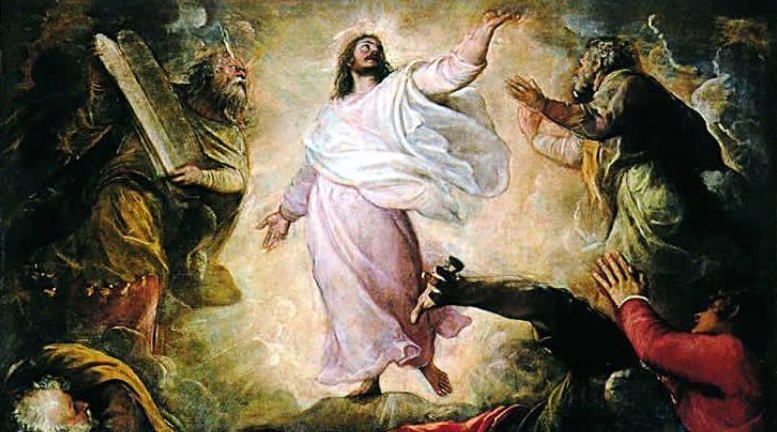
Then suddenly, as the disciples sat watching Jesus, they were aware of a great brightness. They looked toward Jesus. Without thought they rose to their feet in silent reverence. Jesus was transfigured before them. His face shone with an unearthly brilliance. His garments were whiter than snow. Standing beside Him were Moses and Elijah, the representatives of the Law and Prophets who foretold His coming. The Apostles could hardly contain themselves, and then from above a bright cloud overshadowed them, like the cloud that signified God’s presence to the Israelites as they wandered in the desert for forty years. It was then, from the cloud, came the very voice of the Creator. God the Father said, ”This is my Son, my Chosen; listen to him!”

Like the peace between the Arab and Jewish widows, this transfiguration of Jesus was a glimmer of hope, a revealing of a distant future. Jesus did not change from one physical form to another, instead he was making known his true self in all glory and majesty.

What did the that glimmer of hope look like for these apostles? What was this distant future? It was a time when they would stand before the throne of God and serve him day and night in his temple; and he who sits on the throne will spread his tent over them. Never again would they hunger; never again would they thirst. It revealed a time when the sun would not beat upon them, nor any scorching heat. For the Lamb at the center of the throne would be their shepherd and would lead them to springs of living water. It revealed a time when God would wipe away every tear from their eyes.

The transfiguration pointed them toward that distant future and it was the voice of God that told them the way, “This Jesus is my Son. My chosen. Listen to him. Learn from him. Follow him, so that you too may be my son, my daughter, my child.”

Like the Apostles and everyone else who genuinely looks into St. Paul’s mirror with that veil that covers our minds, I don’t like what I see. In that dim image my sins appear like scars, crisscrossing one on top of the other. My clouded eyes are a sign of my poor choices. My weakened muscles are the result of spiritual apathy, and the excess weight is the effect of my lust for the things of this world and not the things of God. At times like this, the despair and self-loathing pummel me to the ground, but then… but then suddenly I become aware of a great brightness and I look toward Jesus. Almost without thought I rise to my feet in silent reverence. Jesus is transfigured before me. The veil is removed from my mind and Jesus’ face shines with an unearthly brilliance. His garments are whiter than snow. And that same glory shines from within me.

For us all, the glory of the Transfiguration burns through the veil and we are given a glimpse of that distant future where there are no longer those imperfections, the cloudiness, or scars. Instead, perhaps for only a moment, we see the road that leads to our salvation and we become aware of who we truly are in Christ.

This isn’t anything weird, but close your eyes for a moment and look into St. Paul’s mirror through that veil. What do you see? You don’t have to name it aloud, but in this moment, name it to yourself. What is there that you don’t like? That you are ashamed of? What is the ungodly that you see? Now, allow the light of the transfiguration, the true light of Christ that has come into the world shine upon you. With this light shining upon you, what you now see is your hope. Your future. It is your salvation and it is who you truly are in Christ Jesus.

Let us pray: Come Holy Spirit, fill the hearts of your faithful and kindle in them the fire of your love. Send forth your Spirit and they shall be created. And You shall renew the face of the earth.

O, God, who by the light of the Holy Spirit, did instruct the hearts of the faithful, grant that by the same Holy Spirit we may be truly wise and ever enjoy His consolations, through Christ Our Lord, Amen.

Sermon: Epiphany 4 RCL C – “Truth Telling”

Little Johnny watched, fascinated, as his mother smoothed cold cream on her face. “Why do you do that, mommy?” he asked. “To make myself beautiful,” she said. After another minute she began removing the cream with a tissue. Johnny looked a bit perplexed as she went about it, then asked, “Why are you giving up so soon?”

Jesus tells us in John’s gospel that the “truth will set us free,” and yes, Jesus is the way, the truth, and the life. The truth is our shield. God is truth. But what I’ve discovered is that for the most part, we don’t want to hear the truth about ourselves and many times we can’t handle it. Our gospel reading is a perfect example about not liking the truth.

To understand it we must remember that the Jews of Jesus’ time were expecting a messiah, but the messiah they expected was something along the lines of a military king. One who would release them from the captivity of the Romans or in a more derogatory sense, one who would release them from those unclean, uncouth, uneverything gentiles, which was everyone but the Jews. These were the Jews in Nazareth that Jesus was speaking to in our gospel.

You see, Nazareth was primarily a Jewish community, where as Capernaum where Jesus lived and where he had already performed many miracles was primarily a gentile community. In fact, there was a large Roman garrison in Capernaum consisting of some 3,000 Roman troops; so when the Jewish people in Nazareth call out to Jesus saying, “perform the same miracles here in Nazareth that you performed in Capernaum,” they are in a sense saying, “perform for us – the Jewish people, God’s chosen, the “It” crowd – the same miracles and even more than those you performed for those unclean, uncouth, uneverything gentiles.” And It is here that Jesus begins speaking the truth that these Nazarites are not going to want to hear.

He begins with that famous line, “no prophet is welcome in his home town,” but then Jesus tells this Jewish crowd about two separate incidents. First, “there were many widows in Israel in the time of Elijah, but, Elijah was sent to none of them except to a widow at Zarephath in Sidon”  This story that Jesus is referring to is from First Kings and it would be a familiar one to the crowd. In the midst of a life-threatening drought, God sent Elijah to Zarephath to ask a poor widow for water and bread. When he did, she protested that she had just enough for one loaf for herself and her son, and then they were going to die.  Elijah asked her to obey in faith and promised, “The jar of meal will not be emptied and the jug of oil will not fail until the day that the Lord sends rain on the earth.” The widow responded as requested, and was duly rewarded.  Later her son died, and Elijah prayed successfully that his life might be restored.  When Jesus reminded the crowd of this lovely story, they would see only one major problem: the widow at Zarephath was not Jewish. She was one of those unclean, uncouth, uneverthing gentiles.

Jesus then reminds them of the second incident: “There were also many lepers in Israel in the time of the prophet Elisha, and none of them was cleansed except Naaman the Syrian.”  This incident is from Second Kings and would have been equally familiar to the crowd in Nazareth, but the same major problem exists, Naaman was also an unclean, uncouth, uneverything gentile.  Not only that, but Naaman was the commander of the Syrian army and at that time, it was the Syrians and not the Romans that were oppressing the Jewish people. Jesus just reminded the crowd that not only did God through the prophet Elisha save a gentile, but he saved a gentile who was their greatest enemy.

During the time of Elijah and Elisha, the Lord had turned his hand against the Israelites because they were doing so much evil in his sight, and so when the Lord acted, it wasn’t to save the Israelites, but the gentiles in the land instead.

The Jews in Nazareth asked Jesus to “perform for us – the “It” crowd – the same miracles and even more than those you performed for those unclean, uncouth, uneverything gentiles,” and Jesus response, “You are acting no better than the Jews did in the time of Elijah and Elisha and therefore God has turned his hand against you and is once again reaching out to the gentiles instead.”

Now don’t misunderstand, this isn’t a slam against the Jewish people. Jesus was a Jew and there were many Jews who accepted Jesus as the Messiah. For starters, all twelve apostles were Jewish and for many years after the death of Jesus, Christianity itself was a sect within Judaism, but as a people most of them rejected Jesus and in the end called for his crucifixion. This incident in Nazareth was part of the beginning of that final rejection and it came about because Jesus spoke the truth. Yet, as the saying goes, To hear truth and not accept it, does not nullify truth. And as we know, many times we don’t want to hear the truth and we can’t handle the truth. Let me give you a modern day example.

In 2003, about 200 mourners gathered in the sanctuary of St. Patrick Catholic Church in a small town in New Mexico for the funeral of one Ben Martinez who died at age 80. Chances are, these mourners expected to hear the priest, Rev. Scott Mansfield, eulogize Martinez as a lifelong Catholic who served his community as a town councilman. Instead, according to members of the Martinez family, Fr. Mansfield stamped their recently departed loved one’s passport to hell. Once they got over their shock, the Martinez family did what millions of Americans of many faiths would do in this day and age, they sued. They claim Fr. Mansfield described Martinez as “lukewarm in his faith” and “living in sin.” Most graphically, the priest reportedly added that, “The Lord vomited people like Ben Martinez out of his mouth and into hell.” The case was dismissed under the 1st Amendment – freedom of speech – and perhaps Fr. Mansfield needs to retake some classes in how to properly care for people (if not completely reconsider his vocation all together) but pretty much everything he said about Ben Martinez was the truth, but folks didn’t want to hear it and they couldn’t handle it.

So the question is, what about you? How do you respond when the Lord speaks the truth to you? Like the Nazarites, do you want to throw him off a cliff in order to shut him up or do you prefer the more modern methods such as suing? I think most of us are much more subtle and employ the tactic of selective listening, only hearing what suits you, the rest of the time, “La la la la! I can’t heeaar youuu.” We all have our tricks; however, to hear truth and not accept it or to pretend to not hear it, does not nullify truth. The proverb is correct, “Whoever loves discipline loves knowledge, but he who hates correction is stupid.”

Therefore, is there a truth that God is trying to speak to you, that you refuse to hear? Could it be that he is asking you to use those gifts that he has blessed you with, but instead, you can’t be bothered? Don’t have the time? Etc. Etc. Etc. Could it be that he is convicting you on some aspect of your life, but instead of confessing you choose to ignore his promptings? Or perhaps its something much simpler. Perhaps all he is asking you to do is apologize for a wrong you committed, but your pride stands in the way of reconciliation?

I don’t know what it might be, but you do, so the question is, when the Lord reveals these truths to you, do you respond appropriately? As we’ve seen, there are numerous ways we can respond, but there is only one correct answer and that is to humbly bow our heads and accept what he teaches.

In Paul’s letter to the Hebrews, he tells us not to forget the exhortation that addresses us as God’s beloved children. He writes, “My child, do not regard lightly the discipline of the Lord, or lose heart when you are punished by him, for the Lord disciplines those whom he loves and chastises every child whom he accepts. Endure trials for the sake of discipline. God is treating you as children and he disciplines us for our good in order that we may share his holiness.”

Let us pray: God, my Father, may I love You in all things and above all things. May I reach the joy which You have prepared for me in Heaven. Nothing is good that is against Your Will, and all that is good comes from Your Hand. Place in my heart a desire to please You and fill my mind with thoughts of Your Love, so that I may grow in Your Wisdom and enjoy Your Peace. Amen.

Sermon: Fabian

“When all the people were being baptized [by John the Baptist], Jesus was baptized too. And as he was praying, heaven was opened and the Holy Spirit descended on him in bodily form like a dove. And a voice came from heaven: ‘You are my Son, whom I love; with you I am well pleased.’”

In the year 236 the Pope had died. The people had gathered in the catacombs below the city of Rome in order to elect a new one. In the crowd was a young man (about 36 years old) from the country, Fabian. He had been visiting the city and when he heard that they were electing a new Pope, he decided to go and watch.

As the proceedings began, the historian Eusebius reports that a dove flew into the catacombs, circled Fabian, and then landed on his shoulder. The people must have immediately recalled the Holy Spirit descending upon Jesus in the form of a dove, for they immediately cried out, “He is worthy! He is worthy!” And this unknown, non-clergyman was elected as Pope. Following his ordinations as deacon and then priest, he was installed as the twenty-first Bishop of Rome and Pope. (The next time the Roman Catholic Church prepares to elect a new Pope, I may be taking a trip!) Fabian would reign for seventeen years.

During his reign and in the early years of the Church, the Roman Empire were generally tolerant of other religions and simply incorporated them into the existing system of pagan gods. However, the the Jews presented a difficult problem: they had the One True God and the commandments forbid them from building any graven image of their God, so the Romans made an exception for them. For a time, the Christians were able to “hide” in the Jewish synagogue, but when it was discovered what they were doing and their beliefs, they were persecuted.

For example, it was believed that Christians practiced incest, because their scriptures instructed them to give the kiss of peace to their brothers and sisters. In addition, they were thought to practice cannibalism because they fed on the Body of Christ. These issues and others led to persecutions. Sometimes they were more localized, but occasionally would spread across the entire empire. The first of these empire wide persecutions occurred in 257 under Emperor Décius and Fabian was one of the first to be martyred. He was beheaded.

Our collect for Fabian – that prayer we read near the beginning of the service – requested: “O God… Grant that those whom you call in any ministry in the Church may be obedient to your call in all humility, and be enabled to carry out their tasks with diligence and faithfulness.” Now that may sound like a nice prayer, because you all can think, “Well, Fr. John, get out there and be humble and obedient in carrying out your task.” And you say that because you think the collect has nothing to do with you. Well, allow me to correct you. From the catechism (which I know you all have read) “Q: Who are the ministers of the Church? A: The ministers of the Church are lay persons, bishops, priests, and deacons.” That means we are all called to be humble and obedient in the ministry that God calls us each to.

That may sound scary at times, but the beauty of God’s action in the world is that just as He enabled His Son and those like Fabian to accomplish the ministry he gave to them through the descending of the dove, the giving of the Holy Spirit, he has also given to you, for do you not know that your body is a temple of the Holy Spirit. Therefore, through the power of that same Spirit, be faithful and obedient in the ministry Christ has called you to accomplish.

Sermon: Octave of the Epiphany

Today we celebrate an unofficial and even suppressed feast day: the Octave of the Epiphany.

Octave means eight and this is the eighth day after the Epiphany. The octave was originally established by the church because certain events in the life of Christ and the church were believed to be of such significance that one day was not enough to celebrate. Feast days that grew to include octaves were Christmas, Easter, Pentecost, and even local celebrations for local or patron saints. The symbolism behind the octave is a bit cloudy, but is likely tied closely with our rebirth in Christ (it is the same reason that baptismal fonts often have eight sides, as the eighth day of creation is considered the day we are created new through our baptism).

Along with these other feast days, the Feast of the Epiphany was given an octave. As you many know, the Epiphany is the day we celebrate the Magi coming and bringing gifts to Jesus. The importance of this event is that the Magi were gentiles, so in visiting and worshiping Jesus, God is revealed to the Gentiles. That revealing is what an epiphany is. A manifestation of God.

The Octave of the Epiphany was a celebration of this great event, but would be formally removed in 1955 from the Roman Catholic calendar. How and when if fell out of favor in the Anglican Church I am not certain. So why are we celebrating it today if it’s not official?

There is a chance that you and I may have come to worship the God of Israel, but it is likely – without the revelation to the Gentiles – that you and I would be worshiping dumb idols (if anything) instead of the One True God. Therefore, it seems to me that such a great event is worth celebrating for more than just one day. In that event it is made evident that this child in the manger is bringing us and not just the Jews our salvation. As Paul said to the Galatians, “So in Christ Jesus you are all children of God through faith, for all of you who were baptized into Christ have clothed yourselves with Christ.  There is neither Jew nor Gentile, neither slave nor free, nor is there male and female, for you are all one in Christ Jesus.” The God of Israel has been revealed as the God of all.

That being true, then, what next? Jesus has been revealed to the world, so what now?

In our Gospel reading today, John the Baptist’s disciples saw Jesus passing by. After a brief conversation with John, they began to follow Jesus.

Turning around, Jesus saw them following and asked, “What do you want?”

They said, “Rabbi” (which means “Teacher”), “where are you staying?”

“Come,” he replied, “and you will see.”

Following the Epiphany of Jesus, His revealing to all humankind, we ask, “What’s next?” Jesus response, “Come and you will see.” It is an invitation to follow Jesus. To take to the road and begin a great journey. A journey of salvation, redemption, ministry, hope… life. There is no limit to the depth of this journey. The only question remaining for you is, “How far are you prepared to go?”