Sermon: Easter 3 RCL C – “Renew”

A preacher retired and moved to the country to enjoy a relaxed life practicing his favorite pastime: yard work. Needing a lawn mower, he rode his bicycle into town to shop for one. On the way he saw a sign advertising a mower for sale. He stopped at the house and a young boy came out to greet him.

The preacher asked about the lawn mower, and the kid said it was behind the house. In the backyard the mower was already running and the engine was sputtering along at idle speed. The preacher increased the speed and mowed a few strips. As he tinkered with the mower, the boy asked the preacher about the bicycle. He said he hadn’t ridden in a few years, but he really wanted a bike. Seeing each had something the other wanted, they decided to make a swap. The boy hopped on the bike and immediately tottered over. The boy looked nervous, but the preacher said, “Keep trying. It’ll all come back to you!”

Later in the day, the boy had gotten the hang of riding his new bike and was riding around town when he spied the preacher pulling on the engine starter rope. The kid stopped and watched for a couple of minutes. He asked, “What’s wrong?”

The reply came, “I can’t get this mower started. Do you know how?”

The kid said, “Yep.”

“Well, how do you do it? Tell me!”, the preacher yelled.

The kid replied, “You have to cuss it.”

The preacher rose up indignantly. “Now you listen here. I am a preacher and if I ever did cuss, not saying I have, I’ve forgotten how to do it after all these years.”

With a wise look on his face well beyond his years, the kid said, “Preacher, you keep on pulling that rope and it’ll all come back to ya.”

I think I was living in Dallas at the time, because I was in a very crowded place – a restaurant or a mall. I was walking along, minding my own business when I suddenly caught the scent of a woman’s perfume. I thought my knees were going to buckle. No, it wasn’t that the perfume was all that remarkable, probably just some dime store variety, but I had this girlfriend in high school and it was the only kind of perfume she wore. I looked around to see if I could spot her, knowing full well that more than one person had worn that brand of perfume. Yet, in that single smell, it all came back to me. All the fun of high school and thinking you were in love. All the memories of friends, hanging out, going to parties, and just being a stupid teenager. It all came back.

I’m weird when it comes to movies. Any movie will probably do, but when I find one I like, I don’t mind watching it again. There are however, some that I’ve watched many times and never seem to get tired of them: Harry Potter – especially 7.1, Lost in Translation, Station Agent, and the Swedish version of the Girl with Dragon Tattoo (I, as a priest would never really watch that, but I’ve heard it’s really good. It stars Noomi Rapace, not quite a Scarlett Johansson huba-huba, but close.) When it comes to these movies, the opening music begins and I’ll just settle in and smile. It all comes back. I know the entire story. I can quote the lines. Happiness.

On the night before He was crucified, we know that Jesus and his disciples shared the Last Supper. Following the meal, he taught them many things, and prayed for them, but just before he prayed he said to them, “You believe at last! But a time is coming, and has come, when you will be scattered, each to his own home. You will leave me all alone.” We know that shortly following these events, he was arrested. At his arrest, we also know that Jesus statement was fulfilled, the disciples fled. One of them, probably Mark, was so afraid that he ran off naked.

These past few weeks we have been reading about the events following his resurrection: the women discovered the empty tomb and how He appeared to the disciples on two separate occasions while they were holed up in the upper room.

Soon afterwards, the disciples must have decided that it was safe to leave, and fulfilling what Jesus had said, they went home, returning to the Lake of Tiberias, also known as the Sea of Galilee. Why? Probably because they did not know what else to do. They knew that Jesus had risen from the dead, but they didn’t yet know what that meant.

So today, we find Peter and the gang sitting by the Sea of Tiberias. Since he didn’t know what to do, Peter decided to go back to what he knew – fishing. The rest of them said they would go, but in doing so, you can feel their disappointment. The last three years had been so amazing. They had walked with the Lord. Witnessed so much – lives changed, miracles, new ways of understanding God, and now… now it was back to the nets and the boats. Back to the way things were. And just to pour a little lemon juice in a paper cut, they fished all night and didn’t catch a thing.

As the sun was coming up, someone called to them, “Children, you have no fish, have you?” Our translations puts a question mark after the sentence, but knowing who said it, I wonder if it should have been a period. Anyhow, he asked if they had any fish, and you hear the answer, “No… does it look like we’ve caught any fish. Oy!” But then they are told to cast their nets on the other side of the boat and they caught so many fish they couldn’t haul them in.

It happened for the disciple whom Jesus loved, John, first: it all came back to him. The voice. The miracles. Purpose. Mission. Life. ”It is the Lord!” When John said this, it also all came back for Peter: “When Simon Peter heard that it was the Lord, he put on some clothes, for he was naked, and jumped into the sea.” It all came back to them and they were restored to Jesus. They were renewed.

There are some, but I do not think there are many who intentionally walk away from God. For most who find themselves distant from the Lord, it has more to do with life, busyness, or simply out of the discipline of what a life with God entails. Whatever the case, there is an emptiness, a dryness that grows between us and our God, which is really unfortunate; but just as that perfume or movie or whatever the “trigger” may be has the potential to bring back memories and emotions, the same is true in our relationship with God, if only we will look up from all the distractions of the world, that busyness, and allow ourselves to once again catch a scent of the Jesus. If we will allow His voice spoken to us through prayer and His Holy Word to remind us of our true First Love. ”It is the Lord!” — Let it all come back to you.

St. Josemaría Escrivá writes, “What a strange capacity man has to forget even the most wonderful things, to become used to mystery! Let’s remind ourselves… that the Christian cannot be superficial. While being fully involved in his everyday work, among other men, his equals; busy, under stress, the Christian has to be at the same time totally involved with God, for he is a child of God.” (http://www.escrivaworks.org/book/christ_is_passing_by-point-65.htm)

Let it all come back to you and rediscover how near your God truly is. Rediscover what it is to be a child of God and renew your purpose in Him.

Let us pray: Glory to you, O Lord our God, Your love calls us to be your people. By sharing our many and diverse gifts we share in your mission. We ask you, Lord, to shape us into a community of faith. Nourish us by your word and sacraments that we may grow into the image of Jesus. Through the power of your Holy Spirit, heal us that we, in turn, may heal the wounded. Form us to be instruments of love, justice, and peace in our land, and send us to proclaim your saving work. Renew us, Lord, that we may renew the face of the earth. Amen.

Sermon: Easter 2 RCL C – “The Space”

There was a large group of people. On one side of the group stood a man, Jesus. On the other side of the group stood Satan. Separating them, running through the group, was a fence.

The scene set, both Jesus and Satan began calling to the people in the group and, one by one – each having made up his or her own mind – each went to either Jesus or Satan. This kept going. Soon enough, Jesus had gathered around him a group of people from the larger crowd, as did Satan. But one man joined neither group. He climbed the fence that was there and sat on it. Then Jesus and his people left and disappeared. So too did Satan and his people. And the man on the fence sat alone.

As this man sat, Satan came back, looking for something which he appeared to have lost. The man said, “Have you lost something?” Satan looked straight at him and replied, “No, there you are. Come with me.” “But”, said the man, “I sat on the fence. I chose neither you nor him.” “That’s okay,” said Satan. “I own the fence.”

On the first Sunday after Easter we always read the account of Doubting Thomas, and I still believe that Thomas gets a bad rap. Yes, he doubted, but it wasn’t long before this that Jesus said he was going to return to Judea and all the disciples were responding in fear, “You can’t do that! They just tried to kill you and you want to return?” Yet it was Thomas who said, “Let us also go, that we may die with him.” That took a lot of courage, so instead of picking on him, I would like us to consider another aspect of our text today. You can actually see it.

Jesus appears to his disciples the second time. Thomas is present. Jesus says, “Peace be with you.” Then he said to Thomas, “Put your finger here and see my hands. Reach out your hand and put it in my side. Do not doubt but believe.” Thomas answered him, “My Lord and my God!”

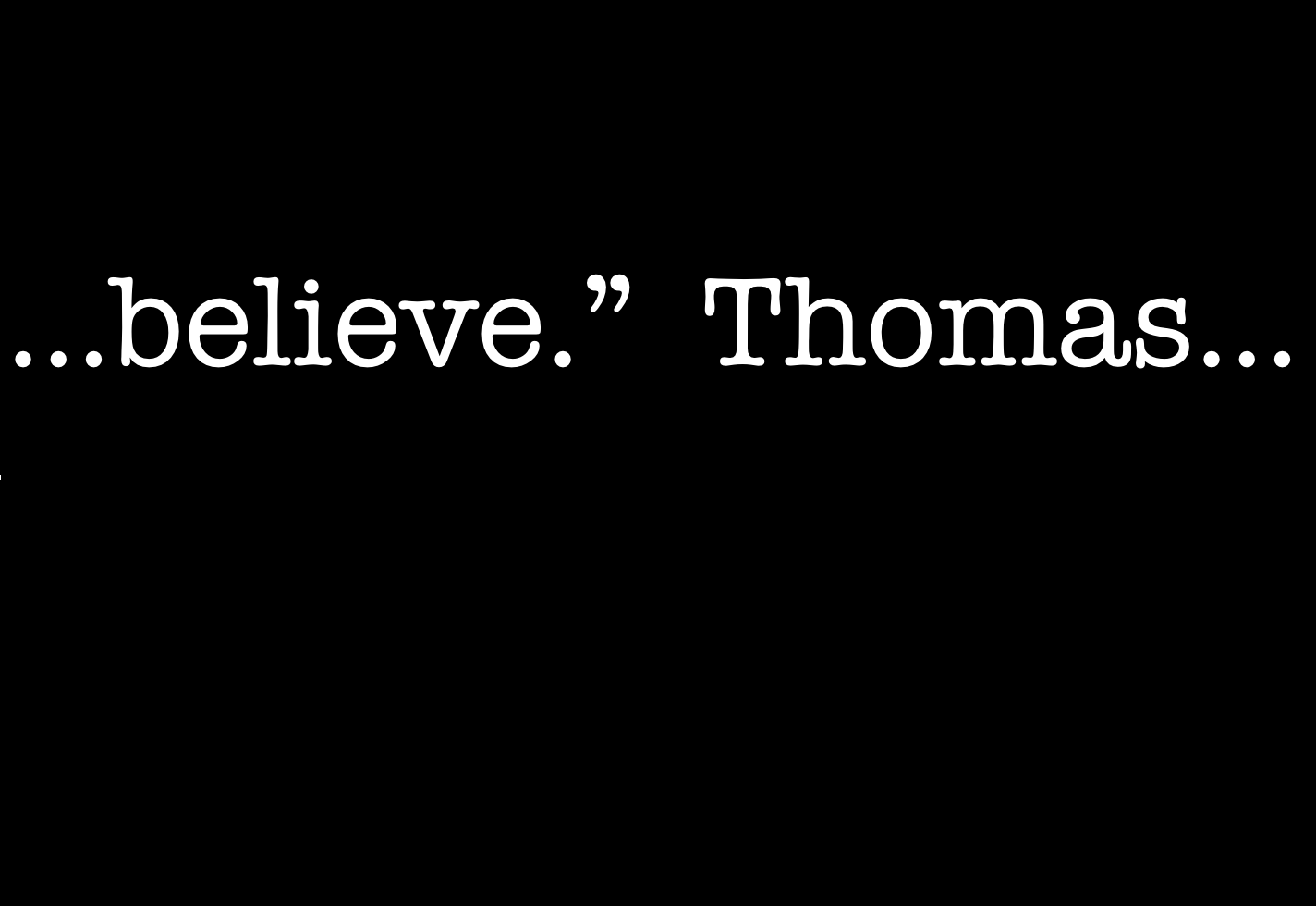
If you look at you insert, you will see Jesus’ words: “Do not doubt but believe,” then there is a period, followed by a closing quote mark, a space, and finally, the word “Thomas” begins the next sentence. Today, I would like us to not consider the words of the text, but instead, that one space. That small space between the time Jesus stopped speaking and Thomas responded, because that one space of time is the most critical moment in Thomas’ entire life. It is the time of decision.

For those of you who know the movie, The Matrix, it is red pill / blue pill time. For those of you who don’t know the movie, The Matrix, it is truly a decision between eternal life and eternal death.

Not all of our decisions are so vital. British prime minister Herbert Asquith once spent a weekend at the Waddesdon estate of the 19th-century Rothschild family. One day, as Asquith was being waited on at teatime by the butler, the following conversation ensued:

“Tea, coffee, or a peach from off the wall, sir?”

“Tea, please,” answered Asquith.

“China, India, or Ceylon, sir?” asked the butler.

“China, please.”

“Lemon, milk, or cream, sir?”

“Milk, please,” replied Asquith.

“Jersey, Hereford, or Shorthorn, sir?” asked the butler.

Life and death are not hanging in the balance with such decisions; however, the decision in that space – that space between the invitation of Jesus to believe and your response to that invitation is vital, and although sitting on the fence is an option, it is not advisable.

Moses led the Israelites out of Egypt and out of slavery. Following their forty year trek through the desert, they came to the Jordan River. However, due to his disobedience, it was not Moses that led the people into the Promise Land. That duty fell to their next leader, Joshua. At a certain point, Joshua summoned all of Israel and had them renew the covenant that they had made with God. In concluding, he said: “Now therefore revere the LORD, and serve him in sincerity and in faithfulness; put away the gods that your ancestors served beyond the River, and in Egypt, and serve the LORD. Now if you are unwilling to serve the LORD, choose this day whom you will serve, whether the gods your ancestors served in the region beyond the River, or the gods of the Amorites in whose land you are living; but as for me and my household, we will serve the LORD.”

Choose this day whom you will serve. That’s one of those verses you will find printed on coffee cups, cross stitched on pillows, and painted on door plaques, but it’s a bit weightier than a simple catch phrase. “Be decisive. Right or wrong, make a decision. The road of life is paved with flat squirrels who couldn’t make a decision.” The author of that is unknown, but since Leslie posted it on Facebook, it must have been somebody important who said it. Joshua said, Choose this day whom you will serve—either God or something else—but don’t be indecisive.

It is a bit lengthy for a sermon quote, but it is too good not to share. From C.S. Lewis’ Mere Christianity: When the author walks on to the stage the play is over. God is going to invade, all right: but what is the good of saying you are on His side then, when you see the whole natural universe melting away like a dream and something else—something it never entered your head to conceive—comes crashing in; something so beautiful to some of us and so terrible to others that none of us will have any choice left? For this time it will be God without disguise; something so overwhelming that it will strike either irresistible love or irresistible horror into every creature. It will be too late then to choose your side. There is no use saying you choose to lie down when it has become impossible to stand up. That will not be the time for choosing; it will be the time when we discover which side we really have chosen, whether we realized it before or not. Now, today, this moment, is our chance to choose the right side. God is holding back to give us that chance. It will not last forever. We must take it or leave it.

Yes, Thomas doubted, but in the space provided, he made a decision. The time is now. Make your’s.

Let us pray: Breathe into us Holy Spirit, that all our thoughts may be holy. Move in us, Holy Spirit, that our work, too, may be holy. Attract our hearts, Holy Spirit, that we may love only what is holy. Strengthen us, Holy Spirit, that we may defend all that is holy. Protect us, Holy Spirit, that we always may be holy. Amen.

Sermon: The Annunciation

For the record, it is only 268 days until Christmas, so today we consider the Annunciation.

After the presentation of Jesus in the temple, Mary and Joseph encounter the prophet Simeon. Simeon blesses God for allowing him to see the Savior and from his words we have the Song of Simeon, which begins: “Lord, you now have set your servant free to go in peace as you have promised.” Following this, Simeon speaks directly to Mary, “Behold, this Child is destined for the fall and rising of many in Israel, and for a sign which will be spoken against (yes, a sword will pierce through your own soul also), that the thoughts of many hearts may be revealed.”

“… and a sword will pierce through your own heart.” Your own soul. We see Mary kneeling at the foot of the cross while watching her son die and we understand that this is what Simeon was speaking. Yet this sword piercing her heart is also speaking of the great faith that Mary must have.

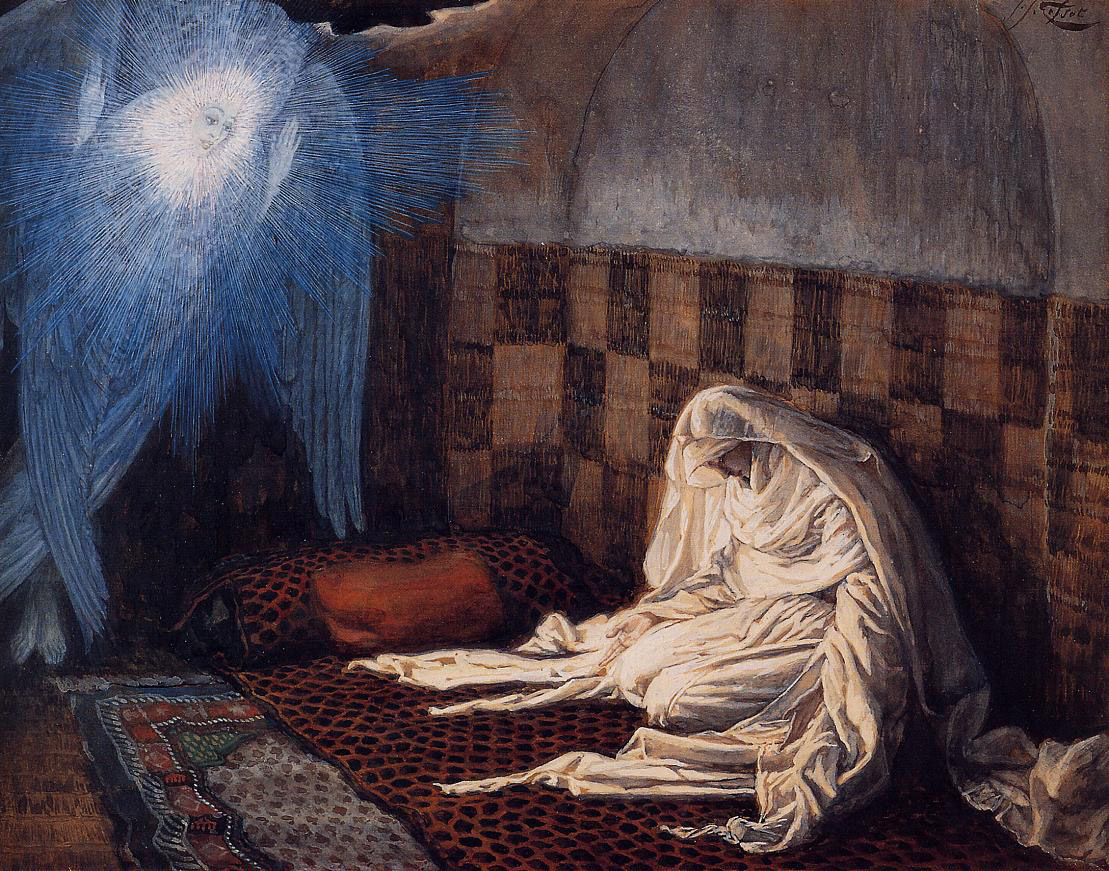
At the Annunciation when the angel Gabriel spoke to Mary and told her that she would bear the Son of God, her response was simple, “Behold the maidservant of the Lord! Let it be to me according to your word.” Through her great faith Mary continued to repeat these words for each step the Lord called her to: “Yes, Lord, let it be done to me. Let your Son be conceived in me. Let them hate me because they think I’m an adulteress. Let me go to Bethlehem. Let me flee to Egypt. Let me return to Galilee and raise Him. Let the sword pierce my soul as I watch him die.”

Mary had faith that allowed the sword to pierce her own heart because she realized that the claims of God on her Son were far greater than any other human claim or attachment. That piercing would be the pain that her motherly love had to experience in order to surrender to God.

Karl Rhaner, a 20th century German theologian, writes that the piercing sword is the way of faith. He says, “Faith is like a sword that pierces and divides as it penetrates to the center of the believer’s heart. Faith is the enduring of this sword. Faith is the readiness to live on in hope when conflict threatens and allows us to entrust ourselves unconditionally to God. It is faith when we accept the blow of the sword in our existence, the sword of the question that finds no answer; the sword that all life in pain ends in death; the sword that not even love dissolves all contradictions in this life; the sword of the leave-takings, disappointments, sickness and isolation.”

And it was this sword, this faith that Mary demonstrated while she knelt at the foot of the cross and watched her son die. What is this faith? There really is no simple definition, because it involves many things. It is the beginning our of salvation. It is that internal light that guides us to God. Faith requires understanding – we must deepen our knowledge in order to deepen our faith.

Faith is also a human act – not only is our intellect involved, but so is our will. A free will that decides to conform to the life God has chosen for us.
Finally, and more importantly than any of these, faith is a grace given to us by God. Before the internal light first shines. Before we begin to seek understanding. Before we study, act, or choose, God through the power of the Holy Spirit must be moving in us. Before any of it, God’s grace must be born in us. And grace incarnate, grace in human form came in the person of Jesus Christ.

We live out this faith when we stand alongside Mary at the Annunciation and declare with her, “Let it be done to me according to your word,” because in those words we take our life and hand it to God as Mary did.

Sermon: Easter Sunday

The Rev. Fred Craddock tells about a friend and his family who were missionaries in China and were at some point put under house arrest.

One day the soldiers arrive and tell them that they could return home to America and had twenty-four hours to pack. One stipulation: they could only take with them 200 pounds of their belongings.

The husband and wife and their children had lived in China for years. What would they decide to bring? They took their scales and began to weigh and soon after the arguments began. We can’t possibly leave without this… But what about that… Oh, wait, we forgot this…. The children wanted their toys and the parents wanted their few valuables. They chose and chose and weighed and weighed until they had exactly two hundred pounds. Typewriter, vase, essential clothes. Two hundred pounds to the ounce.

When they met the soldiers at the airport the commander asked, “Ready to go?”

“Yes.”

“Did you weigh everything?”

“Yes. 200 pounds exactly.”

“Did you weigh the children?”

“The children? No. I didn’t weigh the children.”

“Weigh the children,” he said.

Weigh the children, and in a piercing moment of clarity you finally discover that which is of most importance.

The women returned to the tomb where Jesus was buried, but when they arrived, they discovered that the stone had been rolled away and the body of Jesus was not there. Then the two angels appeared to them and asked, ”Why do you look for the living among the dead? He is not here, but has risen. Remember how he told you, while he was still in Galilee, that the Son of Man must be handed over to sinners, and be crucified, and on the third day rise again.”

Betrayed and handed over to be tried, scourged, put to death, and then rise again. All this Jesus did for them and for us – for you. But why? Why did Jesus do all of these things and endure so much? I’ve given this some thought and I think I’ve got a few answers for you.

Jesus did all these things so that you and I would go to church on Sunday mornings and feel guilty when we don’t. He took the abuse of the soldiers and others so that we would read our Bibles everyday. He allowed the crown of thorns to be placed on his head so that we wouldn’t do things like cuss and watch dirty movies. He endured the scourging so that he might vigorously oppose whatever we vigorously oppose, and to stand with the Democrats or the Republicans or whoever shouts the loudest. Alleluia! Christ is risen! The Lord has risen indeed, so that we might all be nice people, smile at one another, and get along.

Yes, we’ve figured out exactly why Jesus suffered, died, and rose again, but we forgot to weigh the children. When we get so wrapped up in the little things, we forget that which is most important, and in the process, God becomes very small. God is no longer about eternal life, but is instead perceived as a task master intent on us following established rules. When we forget that which is most important, God is no longer interested in making all things new and transforming our lives, but is instead only a genius at pouring on the guilt and shame. When we mistakenly understand our faith to be about what we do for God, instead of what God has done for us, then we are essentially rejecting the work of God’s Holy Spirit in our lives. And God becomes even smaller.

Weigh the children. Seek that which is of most importance. Go to church and read the Bible. Yes. Good. Stop cursing and watching dirty movies. Absolutely! Oppose the injustices of this world. By all means. Democrats… Republican? I got nothin’. Run away. But when it comes to understanding the “Why?” of the life, death, and resurrection of Jesus, understand that these are the vases, books, toys, etc., but these are not the children.

Julian of Norwich, in her Revelations of Divine Love, wrote, “This is the reason why we have no ease of heart or soul, for we are seeking our rest in trivial things which cannot satisfy, and not seeking to know God, almighty, all-wise, all-good. He is true rest. It is His will that we should know Him, and His pleasure that we should rest in Him. Nothing less will satisfy us… We shall never cease wanting and longing until we possess Him in fullness and joy.”

The “Why?” of the life, death, and resurrection of Jesus is so that He could seek and find the lost. So that His Father could become Our Father, so that we could become His children through the forgiveness of our sins. He came so that he could destroy the works of the devil. He came that we might have abundant life and life eternal.

A fun – but as it turns out, untrue – story about the great golfer Arnold Palmer. Legend has it that he was invited to play several exhibition rounds of golf in Saudi Arabia with the king. Following all the events, the king was so impressed that he wanted to give Arnold a gift. Arnold said that it wouldn’t be necessary, that he had enjoyed his time. The king was not pleased with the answer and insisted, so Arnold said that a special golf club would be nice. The king was delighted. The following day, a messenger delivered an envelope to Palmer. It contained the title to a golf club. A 465 acre, thirty-six hole golf club.

When it comes to our King, we are thinking too small. For we think He only wants us to practice our faith, when instead He wants to transform our lives and the world around us. He wants to set us on fire with His love so that we might set the world ablaze around us.

Weigh the children. Your life with God – the life He wants for you – is about far more than anything you could ask or even imagine. Weigh the children and in a moment of clarity, discover how God wants to transform your life.

Let us pray:
God our Father,
by raising Christ your Son
you conquered the power of death
and opened for us the way to eternal life.
Let our celebration today
raise us up and renew our lives
by the Spirit that is within us.
Grant this through our Lord Jesus Christ, your Son,
who lives and reigns with you and Holy Spirit,
one God, for ever and ever. Amen.

Sermon: Great Vigil of Easter

“To be ignorant of what occurred before you were born is to remain always a child. For what is the worth of human life, unless it is woven into the life of our ancestors by the records of history?” – Cicero

This is the night we remember how our lives are woven into the lives of our ancestors.

So what makes this night special? To discover the answer we must go far back into the history of God’s people. Just prior to the Exodus from Egypt and the Israelites captivity there, you will remember the ten plagues. The tenth was the death of the first born. The Israelites were told to sacrifice a lamb and to take some of the blood and put it on the two doorposts and lentil of their house so that when Death came, it would pass over their houses. The Israelites did as the Lord commanded and lived. This is the night that we remember how God caused Death to pass over the Israelites.

God commanded the Israelites to commemorate this night each year with a seven day celebration. The Mishnah is a book of Jewish Law dating back to around the year 200 and it outlines how the laws and holidays are to be observed, including the seder meal, which is eaten on this night in Passover. As part of the ritual, the youngest child is assigned the role of asking some very specific questions, which provides the father with the opportunity to retell the Exodus story. The first question given for the child to ask is, “Why is this night different from all other nights?” and the father proceeds by answering, “This is the night…,”and tells the history of the Israelites salvation.

As a Christian people, we have taken that same idea as the pattern for this night for the telling – in the words of Paul Harvey – “the rest of the story.” For telling how Jesus brought salvation to all through his death and resurrection.

Therefore for us…

This is the night the faithful people of God gather. We come to light a fire in the darkness, to kindle a flame that reveals the content of every shadow, and to light a candle that represents the light of Christ returning from the shadow of death and into the light.

This is the night that we hear God’s holy word as it proclaims to us how he has saved his people throughout history, how he parted the sea so that his people might be saved from their enemy, how he has made an everlasting covenant with his people and proclaims that we will be His people and He will be our God.

This is the night when we renew our Baptismal Covenant, reaffirming the means by which God saved us. As St. Paul writes to the Romans, ”Do you not know that all of us who have been baptized into Christ Jesus were baptized into his death? We were buried therefore with him by baptism into death, so that as Christ was raised from the dead by the glory of the Father, we too might walk in newness of life”

This is the night that we celebrate the great Eucharistic feast to receive the food of our salvation.

This is the night when we begin the great fifty days of Easter leading up to the giving of God’s Holy Spirit on Pentecost.

This night is considered the Queen of Feasts and it is the night that we prepare for the great celebration of Easter, the resurrection of our Lord.

Why is this night different from all other nights? This is the night that Jesus conquered death once and for all and it is the Eve of our Salvation. As the Psalmist declares, “This is the Lord’s doing and it is marvelous in our sight.”

Sermon: Good Friday

“O great Creator of heaven, true God and true Man, that you should be reduced to this extreme state! At the time of your birth, you scarcely had the poorest rags to cover yourself, and now, at death you have lost all your clothing! Previously a narrow manger held an infant’s tender body, now stripped of all your goods there is no place in this world, which you have created, for you to rest your head except on the Cross. You came into this world as one poor and in need and you now desire to leave it naked and as an outcast. At your birth your body was tightly wrapped in swaddling clothes, now at death that body is pierced by nails and a lance.” From On the Passion of Christ by Thomas à Kempis.

One of those movies that sticks with you came out in 1998, Saving Private Ryan. If you haven’t seen it, I’ll tell you that it is brilliant, but pretty tough to watch.

Private James Francis Ryan is one of four brothers who took part in the military operations, including the invasion of Normandy, during World War II. During the opening days of that offensive, all three of Private Ryan’s brothers are killed and it is the intent of the military to insure that he is extracted from the fighting. They are not willing to allow all four sons of a family to be killed.

The mission is assigned to Army Ranger Captain John Miller, played by Tom Hanks, and his squad. In the end of the movie, after much horrible fighting, Private Ryan is still alive, but the squad is wiped out and Captain Miller is wounded and dying. Captain Miller speaks his dying words to Private Ryan, “James, earn this… earn this.” Earn this. Live a life worthy of the sacrifice that has been made for you.

Now, I will tell you that this is really bad theology. That said: from the manger to the cross, Jesus has sacrificed himself for you. He gave up heaven to become a child. He gave up eternity to be present to you. He gave up sinlessness to take on your sin. You know the sacrifice of Jesus and you know what he endured for you on the cross. Earn this. Earn it. Live a life worthy of his sacrifice. No. You can’t really earn it – it is grace, it is the free gift of God – but you can live a life as though you could.

St. Josemaría Escrivá writes, “You owe such a great debt to your Father—God! He has given you life, intelligence, will… He has given you his grace: the Holy Spirit; Jesus, in the Sacred Host; divine sonship; the Blessed Virgin, the Mother of God and our Mother. He has given you the possibility of taking part in the Holy Mass; and he grants you forgiveness for your sins. He forgives you so many times! He has given you countless gifts, some of them quite extraordinary… Tell me, my son: how have you corresponded so far to this generosity? How are you corresponding now?”

You owe such a great debt that you can never repay, but you can try. Earn it.

Let us pray: Gracious Father, let meditating on Jesus Christ and Him crucified be our daily prayer.  Keep Your Son always before our eyes and keep us ever near the foot of His Cross.  Whether in life or in death, allow us to enter the tomb with Jesus so that when He, Who is our life, shall appear again, we will rise with Him in glory.  Amen.

Sermon: Maundy Thursday

It is told that Alexander the Great and a small company of soldiers approached a strongly fortified walled city. Alexander, standing outside the walls, raised his voice and demanded to see the king. when the king arrived, Alexander insisted that the king surrender the city and its inhabitants to Alexander and his little band of fighting men. The king laughed, “Why should I surrender to you? You can’t do us any harm!” But Alexander offered to give the king a demonstration. He ordered his men to line up single file and start marching. He marched them straight toward a sheer cliff. The townspeople gathered on the wall and watched in shocked silence as, one by one, Alexander’s soldiers marched without hesitation right off the cliff to their deaths! After ten soldiers died, Alexander ordered the rest of the men to return to his side. The townspeople and the king immediately surrendered to Alexander the Great. They realized that if a few men were actually willing to commit suicide at the command of this dynamic leader, then nothing could stop his eventual victory.

It is told that the abbot of a monastery took a dead stick and stuck it in the ground, then turning to a monk named John he told him to tend the stick as though it was alive. For the next year John tilled the soil around the stick, kept it weeded, and without exception brought water up twice a day and watered the dead stick.

There is a word that many of us are not so fond of because in most cases it means that we have a superior who commands us. That word is “obedience.” Although we may not like it, we will be obedient for a variety of reasons: fear, loyalty, ideals, and so on. There are various persons who can call us to obedience, but we know that God is most certainly at the head of the list.

Think of Jesus’ first miracle, the wedding at Cana. Jesus’ public ministry has not yet begun, but when the wedding party runs out of wine, Mary – Jesus mother – turns to him and says, “They have no more wine.” “Woman, why do you involve me?” Jesus replied. “My hour has not yet come.” His mother said to the servants, “Do whatever he tells you.” Nearby stood six stone water jars, the kind used by the Jews for ceremonial washing, each holding from twenty to thirty gallons. Jesus said to the servants, “Fill the jars with water”; so they filled them to the brim. Then he told them, “Now draw some out and take it to the master of the banquet.” And of course it was the finest of wines.

Yet when Mary said to the servants, “Do whatever he tells you,” she was not just speaking to them. We know that she also speaks to us and we are given commands by Jesus that we must follow. Being obedient and following these commands is where Maundy Thursday gets its name. From the Old French we have the word mandé which is something commanded and from the Latin mandatum which also means commandment, and Mandatum is the first word of verse 34 that we read today, “Mandātum novum dō vōbīs… A new commandment I give unto you, that you love one another; even as I have loved you, that you also love one another.”

Jesus demonstrates to us how we are to be obedient to this command by serving one another, by loving one another, by taking the lowest position, the position of a slave and washing each other’s feet. As a Christian people, are you prepared to be obedient to this new commandment? If yes, then how far are you willing to go in being obedient? No, I’m not asking you to go jump off a cliff as Alexander’s men did, but like Jesus, would you be obedient? Watering a dead stick might seem silly to the world, but if Jesus asks you to look silly in order to be obedient, will you follow? Would you kneel in front of a stranger and wash their feet? These are the things Jesus calls us to be obedient to, but not out of fear or loyalty or some great idealism, but out of love. “A new commandment I give to you, that you love one another; even as I have loved you, that you also love one another.”

Sermon: Wednesday in Holy Week

It was Vincent Setterholm who put together a flowchart on how to solve problems with your ox according to the Mosaic Law. This is the chart (http://www.christianitytoday.com/ct/2014/february-web-only/bible-ox-law-flow-chart.html). The chart begins by asking, “Was the ox harmed?” Then Mr. Setterholm takes us through several “Yes/No” scenarios according to the Law.

He does this for every Law concerning the ox, one of which includes the question, “Did the ox gore someone to death.” If “Yes,” then there are questions about whether or not the ox has gored someone before, did the owner know, was the owner warned, all the way down to whether or not the person gored to death was a citizen or a slave. If a citizen, then there will be punishment, up to the stoning of the owner of the ox; however, if the person gored to death was a slave, see Leviticus 21:32: If the ox gores a male or female slave, the owner shall pay to the slaveowner thirty pieces of silver, which isn’t very much money.

To prove that it’s not much, thirty pieces of silver comes up again in the Book of the Prophet Zechariah. At one point, as an example of his ministry, he compares himself to a shepherd, who after his service is only paid thirty pieces of silver. Zechariah reports, “The Lord said to me, ‘Throw it into the treasury—this lordly price at which I was valued by them.’” He was being sarcastic when he referred to it as a “lordly price.” Thirty pieces of silver for the work performed was such an insult that it wasn’t even worth keeping.

We are all familiar with the last time thirty pieces of silver is mentioned in Scripture – from Matthew’s Gospel: Then one of the twelve, who was called Judas Iscariot, went to the chief priests and said, “What will you give me if I betray Jesus to you?” They paid him thirty pieces of silver.

Today, Jesus said to Judas, “Do quickly what you are going to do,” and he did. For the price of a slave gored by a bull, for an amount deemed unworthy to keep even by a shepherd (one of the lowest of all positions), Judas betrayed Jesus and turned him over to the authorities.

Why would Judas do such a thing? Jesus did not give him what he wanted, what he thought he needed, what he thought he deserved, so he gave up God for a paltry earthly reward, which unfortunately seems to be a human trait. Adam and Eve gave up paradise for bite of fruit. Lot’s wife gave up her life for one more look back (turned into a pillar of salt). Esau gave up his birthright for a bowl of stew. David gave up his integrity for a pretty girl. All these little things. All these thirty pieces of silver.

When considering our “little” sins and small vices, we often don’t see them as harming anyone, but they are. We are harming ourselves.

St. Josemaría Escrivá said, “Have you ever stopped to consider the enormous sum that many ‘littles’ can come to?” That can be a positive, because by faithfully attending to the little things in our lives, we are doing the will of God, but it can also be a negative, because one little thing done wrong, can bring down every good work.

I’m not really concerned that any of you are planning to go out and commit some great and heinous sin, but we must all be vigilant in watching over ourselves to insure that we don’t stumble over thirty pieces of silver.

Sermon: Palm Sunday RCL C

As we read the various parts of the passion, we can see all the many sins of the people. It is a long list: pride, making false promises, selfishness, betrayal, fighting, lying, passing the buck, taunting, injustice, ridiculing, regretting. On and on. Each individual and group played their part and each individual and group committed their sin.

It is easy for us to point the finger at the apostles, the religious leaders, and the Romans and number their sins. It is simple to see how weak Peter was, how wretched Judas was, how petty the disciples could be. There is also no issue condemning the religious leaders – those Christ killers – or the Romans and their inhumanity. It is easy to look back on these individuals and groups and place blame for the events of that day. However, it is very difficult to look in a mirror and do the same.

A friend of mine once pointed out that the devil only has so many tricks. Unfortunately for us, we just keeping falling for the same ones time and time again. If we examine our lives, as we are called to do during the season of Lent, we will likely discover instances of pride, selfishness, betrayal, injustice, regret – all the same sins those individuals and groups committed in the events surrounding the death of Jesus.

If we examine our lives and are honest with ourselves, we know that David spoke for all of us when he wrote the words of Psalm 51:

I know my transgressions,
and my sin is ever before me.
Against you, you alone, have I sinned,
and done what is evil in your sight,
so that you are justified in your sentence
and blameless when you pass judgment.
Indeed, I was born guilty,
a sinner when my mother conceived me.

We know our transgressions. They are ever before us. With them before, we also know that we will be judged according to our actions. Near the end of the Book of Revelation, John writes, “I saw a great white throne and the one who sat on it… And I saw the dead, great and small, standing before the throne, and books were opened. Also another book was opened, the book of life. And the dead were judged according to their works, as recorded in the books…. all were judged according to what they had done…. and anyone whose name was not found written in the book of life was thrown into the lake of fire.” It is only a fool who does not fear that day.

“Christ will come again” and we as his bride look with great joy and anticipation for the day of his return, yet, when it comes to standing in judgment before the throne of God… I’m not so sure. So, what will you say to God in your defense? How will you answer when God the Father says to you, “Explain yourself.”

Thomas à Kempis, in his work, On the Passion of Christ, provides us with what I think may be the perfect answer: “Most Holy Father, look upon the face of your Christ, hanging on the Cross for me, and in view of your only-begotten Son’s exceptional merits, his being pierced with nails and being covered with his own red blood, be merciful to me a sinner, bound and chained as I am to my many sins. He was wounded to wipe away my iniquities, and he will offer you satisfaction for all my sins and will answer to you in my stead. I offer him to you as a hostage; I choose him as my advocate; I assign him as my mediator; I designate him as defender of my cause. If acceptable to you, he, the blessed fruit of the Virgin’s womb, will make good all my omissions and rectify all my past commissions.”

Our sin will ever be before us, but on the day of judgment, with the Cross as His witness, our mediator, advocate, and the defender of our cause, Jesus the Christ, will stand in our place; and when God the Father says, “Explain yourself, “ Jesus will respond, “Forgiven,” and that long list of sins will be erased.

Ask Jesus to write your name in the book of life and to speak for you on the day of judgment. The means for Him to do so has already been accomplished, it is only your asking that is required.

Let us pray: Most loving Savior, may your last word from the Cross be also our final words in this life. When we are no longer able to utter another word, let this express our definitive desire: “Father, into your hands I commend my spirit. O Lord, God of Truth, you have redeemed me. Amen.”