The Very Reverend John Donne whom we celebrate today died on March 31, 1631. His early career saw him as an aspiring government official and womanizer, but it would seem that somewhere along the way, he discovered God. Later, at the bidding of King James I, Donne would enter Holy Orders, being ordained a priest in 1615 and rising to Dean of St. Paul’s Cathedral in London. His first biographer, Isaac Walton, said that “he had been a Saul… in his irregular youth [and had] become a Paul, and preach[ed] salvation to his beloved brethren.” He was truly one of the great poets and preachers of his time. Of all his writings, it is Meditation #17 which is most familiar. It begins with him hearing the church bell toll, announcing the death of another:
“PERCHANCE he for whom this bell tolls may be so ill as that he knows not it tolls for him. And perchance I may think myself so much better than I am, as that they who are about me, and see my state, may have caused it to toll for me, and I know not that.”
Donne twists the story, and in an almost humorous way proposes that the bell that is ringing, and unbeknownst to him, just might be for him, suggesting that a dead person does not know that they are, in fact, dead. He continues:
“No man is an island, entire of itself; every man is a piece of the continent, a part of the main; if a clod be washed away by the sea, Europe is the less, as well as if a promontory were, as well as if a manor of thy friend’s or of thine own were; any man’s death diminishes me, because I am involved in mankind, and therefore never send to know for whom the bell tolls; it tolls for thee.”
When any of us die, we are all diminished, because even though we are many we are one body. So the tolling bell really is for us all. We’ve all died a little in the death of another. He continues:
“All mankind is of one author, and is one volume; when one man dies, one chapter is not torn out of the book, but translated into a better language; and every chapter must be so translated; God employs several translators; some pieces are translated by age, some by sickness, some by war, some by justice; but God’s hand is in every translation, and his hand shall bind up all our scattered leaves again, for that library where every book shall lie open to one another.”
Using the analogy of a book, we each make a chapter, and the absence of anyone’s chapter makes for an incomplete book. And it is God who is the author of it all. When we die, we are not lost, just written anew. He concludes by telling us that when we hear the bell toll, we should be reminded of our own death and in being reminded, turn toward God, that He might see us through it all and into his heavenly kingdom.
Whether intentional or not, the meditation is in a sense autobiographical. Through his life and the troubles he experienced and witnessed, Donne understood the greater calling, the service of God, and how we are all called to take heed to our own lives in relation to our God.
In about 512 B.C., as Darius I of Persia led his armies north of the Black Sea, the Scythians sent him a message comprised of a mouse, a frog, a bird, and five arrows. Darius summoned his captains. “Our victory is assured,” he announced. “These arrows signify that the Scythians will lay down their arms; the mouse means the land of the Scythians will be surrendered to us; the frog means that their rivers and lakes will also be ours; and the Scythian army will fly like a bird from our forces.” But an adviser to Darius provided a different interpretation: “The Scythians mean by these things that unless you turn into mice and burrow for safety in the ground or into frogs and hide in the waters or into birds and fly away, you will all be slain by the Scythian archers.” Darius took counsel and made a hasty retreat!
According to the International Bible Society, “As of 2020, the full Bible has been translated into 704 languages. The New Testament has been translated into 1,551 languages and parts of the Bible have been translated into 1,160 additional languages.” (Source) Within the English language alone, there are over 100 complete translations: ESV, NIV, KJV, NKJV, RSV, NLT, and an E I E I O. Deciding on which translation is right for you can prove to be challenging, but what we must understand about them all is that while each is seeking to convey the truth, they are all interpretations of the original. The original Old Testament was written in Hebrew and the original New Testament was written in Greek. The correct translation of these ancient languages is difficult enough, but what makes them even more so is that neither of these original languages uses punctuation when writing (no commas, periods, question marks, etc), and the Hebrew texts did not even use vowels. Bottom line: to read the original Bible texts, you are going to have to be an amazing linguistic scholar and even then, you will not likely be able to translate the text perfectly. So we pray that the Holy Spirit has guided each person who has undertaken such a task so that what is given to us is as God intended. All that to ask you one question about our Old Testament lesson: should it be a colon or a period? I’ve highlighted for you the sentence in question.
“I will be with you; and this shall be the sign for you that it is I who sent you [colon] when you have brought the people out of Egypt, you shall worship God on this mountain.”
The colon right there in about the middle is what caught my interest. Is it correctly punctuated or should it be a period?
As we read, Moses saw the burning bush and went up on the mountain to behold this marvelous sight. There, the Lord told him that he has heard the cry of his people Israel and that he is sending Moses to call them out of captivity. The Lord said to Moses, “So come, I will send you to Pharaoh to bring my people, the Israelites, out of Egypt.” But Moses said to God, “Who am I that I should go to Pharaoh, and bring the Israelites out of Egypt?” And then our sentence: “I will be with you; and this shall be the sign for you that it is I who sent you: when you have brought the people out of Egypt, you shall worship God on this mountain.”
“… this shall be the sign…” If in the sentence it is a colon, then the sign to be given is Moses bringing the people out of Egypt and worshipping on the mountain, but… if that colon is supposed to be a period, then the sign is, “I will be with you.” And everyone says, “Fr. John, you’re splitting hairs this morning,” but not really, because you see, if it is a colon, it is about what Moses will do, but if it is a period, it is all about what God will do.
We know that Moses had been a prince of Egypt, but now he is a shepherd. Not only that, he is a murderer, a runaway, and as he will soon confess that he don’t talk so good. Is that the kind of person that can free an entire nation? Not likely. We also know that in the next chapter, God will have Moses cast down his staff and it will turn into a snake. When God tells him to pick up the snake by the tail, it reverts to a staff. Then God tells Moses to place his hand inside his cloak and when he pulls it out it is covered in leprosy. When he repeats the process his hand is healed. Question: what part did Moses play in either of those two events? Other than doing what he was told: nothing. It wasn’t about what Moses could do, it was about what God could do through him: a weak sinful man.
I’m not a biblical language scholar. I got through Greek and Hebrew, but we all get lucky on occasion. That said, I believe that the verse should actually be two sentences… no colon because all that Moses said and did was to reflect what God was doing through him. God being with him was the sign. What happens later only confirms this.
It was when all the Israelites were at Meribah. They were complaining to Moses that there was no water, so the Lord said to Moses, “Take the staff, and you and your brother Aaron gather the assembly together. Speak to that rock before their eyes and it will pour out its water.” However, instead of speaking to the rock, “Moses raised his arm and struck the rock twice with his staff.” By speaking to the rock, it would have been a clear sign that God was working through Moses, but by striking the rock with his staff, Moses made it appear that it was he who had accomplished the miracle. For this, the Lord counted it against him and Moses was not allowed to enter the promised land.
The Lord told Moses to get down to Egypt land and tell old Pharoah, “Let my people go.” Moses responded, “But who am I. I’m a shepherd, a murderer, and my tongue gets tied.” God said to Moses, “Yes you are and yes it does, but I will be with you, and me being with, doing such marvelous works through you, will be a sign to everyone that I AM is with you. That the God of Abraham, Isaac, and Jacob, the God of your forefathers, is with you.”
We see Moses as this giant of a man. A man who talks to God. A savior of Israel, the one who parts the waters, but all that Moses ever did was only accomplished because of his willingness as a weak and sinful man to allow God to work through him.
Question: what does that tell you about yourself? In his weakness, the Apostle Paul cried out to the Lord and the Lord responded, “‘My grace is sufficient for you, for my power is made perfect in weakness.’ Therefore [Paul says] I will boast all the more gladly of my weaknesses, so that the power of Christ may rest upon me. For the sake of Christ, then, I am content with weaknesses, insults, hardships, persecutions, and calamities. For when I am weak, then I am strong.”
My friend, St. Josemaría Escrivá says, “You realize you are weak. And so indeed you are. In spite of that — rather, Just because of that — God has chosen you. He always uses inadequate instruments, so that the ‘work’ will be seen to be his.” (The Way #475)
Gather up all your weaknesses and place them at God’s disposal then witness—not how weak you are—but how mighty He is.
Let us pray: (in honor of St. Patrick, part of an old Irish prayer that you can make your own) As I arise today, may the strength of God pilot me, the power of God uphold me, the wisdom of God guide me. May the eye of God look before me, the ear of God hear me, the word of God speak for me. May the hand of God protect me, the way of God lie before me, the shield of God defend me, and the host of God save me. Amen.
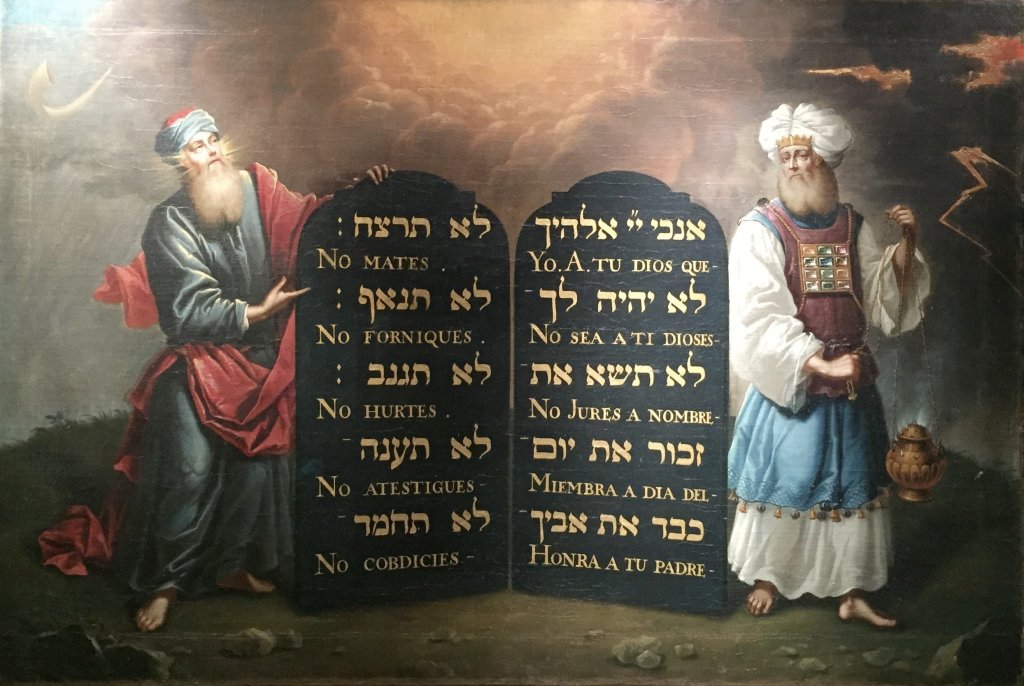
God spake these words, and said: I am the Lord thy God who brought thee out of the land of Egypt, out of the house of bondage. Thou shalt have none other gods but me. Lord have mercy upon us, and incline our hearts to keep this law.
Thou shalt not make to thyself any graven image, nor the likeness of any thing that is in heaven above, or in the earth beneath, or in the water under the earth; thou shalt not bow down to them, nor worship them. Lord have mercy upon us, and incline our hearts to keep this law.
Thou shalt not take the Name of the Lord thy God in vain. Lord have mercy upon us, and incline our hearts to keep this law.
Remember that thou keep holy the Sabbath day. Lord have mercy upon us, and incline our hearts to keep this law.
Honor thy father and thy mother. Lord have mercy upon us, and incline our hearts to keep this law.
Thou shalt do no murder. Lord have mercy upon us, and incline our hearts to keep this law.
Thou shalt not commit adultery. Lord have mercy upon us, and incline our hearts to keep this law.
Thou shalt not steal. Lord have mercy upon us, and incline our hearts to keep this law.
Thou shalt not bear false witness against thy neighbor. Lord have mercy upon us, and incline our hearts to keep this law.
Thou shalt not covet. Lord have mercy upon us, and write all these thy laws in our hearts, we beseech thee.
Cajun Ten Commandments – Jus be one God… and das’ all. – Don’t pray to nuttin’ or nobody… jus’ God. – Don’t be cussin’ at nobody, specially the good Lord. – When it be Sunday… get yo’self to God’s House. – Listen to yo mama an’ you daddy. – Don’t be killin’ no people… duck an’ fish das’ okay. – God done give you a wife, be wit’ jus’ her. – Don’t take nuttin’ from nobody else. – Always told da whole troot. – Don’t go wantin’ somebody’s stuff.
In his syndicated news column, Will Rogers said, “You give us long enough to argue over something and we will bring you in proofs to show that the Ten Commandments should never be ratified.” Sounds funny, but we know it’s true because anytime someone starts talking about putting up the Ten Commandments in a monument or something, there are at least a dozen others trying to tear them all down. I don’t have a dog in that particular fight, but to be honest, they all seem like they should be pretty easy to get behind, that is, as long as you keep Jesus out of it. Once Jesus gets involved, the standard get’s raised quite a bit.
Some might like to argue: Jesus is the God of the New Testament and the Ten Commandments are from the God of the Old Testament, but not only do we know that these are not two separate gods, we also know that Jesus said, “Do not think that I have come to abolish the Law or the Prophets; I have not come to abolish them but to fulfill them. For truly, I say to you, until heaven and earth pass away, not an iota, not a dot, will pass from the Law until all is accomplished.” (Matthew 5:17-18)
That’s why I believe it is so important that we go through the Decalogue at least once a year as we did at the beginning of the service. Not so that we can simply interpret and apply them as they read on the surface, but so that we can understand them in
light of the teachings of Jesus and so that the words of the Prophet Ezekiel, quoted by St. Paul, can be fulfilled:
I will put my laws into their minds, and write them on their hearts, and I will be their God, and they shall be my people. (Hebrews 8:10b)
It is one thing to know and be able to quote the commandments, but when they are written on our hearts, they change who we are. Jesus provided us with a few examples of what this looks like, which you are familiar with: “You have heard that it was said to those of old, ‘You shall not murder; and whoever murders will be liable to judgment.’ But I say to you that everyone who is angry with his brother will be liable to judgment.” (Matthew 5:21-22) “You have heard that it was said, ‘You shall not commit adultery.’ But I say to you that everyone who looks at a woman with lustful intent has already committed adultery with her in his heart. (Matthew 5:27-28) He then continues to teach about divorce, oaths, enemies, and more. He does not exhaust all the possibilities, that would be more burdensome than the Law that was already in place, so he provides a few examples of what it looks like to have this Law of God written, not only on our minds but on our hearts as well. In legal terms, it comes down to (I think!) the difference between a law and a principle. The simplest definition that I read states:
“A law externally compels you, through force, threat or punishment, to do the things someone else has deemed good or right. People follow or break rules.”
“A principle internally motivates you to do the things that seem good and right. People develop principles by living with people with principles and seeing the real benefits of such a life.” (Source)
The Ten Commandments (Ten Laws) teach us, You shall not murder, and Jesus defines the principle behind the original intent of that law: don’t even be angry with one another.
Jesus’ complaint against the religious leaders of his time: they were very concerned with the Law, but paid little or no attention to the principle, that which would govern not only a person’s exterior actions but their interior ones as well. Hence, Jesus’ complaint against them, “Now you Pharisees cleanse the outside of the cup and of the dish, but inside you are full of greed and wickedness.” (Luke 11:39) Jesus wanted them to teach both the Law and the principle so that lives and hearts could be changed, but as was noted, the Law was burdensome enough, and to add even more teaching to it would have been untenable, so instead of proposing that, Jesus provided the summary, the first part of which comes from Deuteronomy 6:5 and the second part from Leviticus 19:18. Combined they read, “You shall love the Lord your God with all your heart and with all your soul and with all your mind. This is the great and first commandment. And a second is like it: You shall love your neighbor as yourself.” (Matthew 22:37-39) So, with that understanding, is love a law or is love a principle? Both. As Jesus commanded it, it is a law, but it is also a principle because it is what should internally motivate us. And not only is it both, but it is God.
When you want to understand the Decalogue, the Ten Commandments, in the way that Jesus would have you… look for the love. When you say, “Lord, have mercy upon us and write all these thy laws in our hearts, we beseech thee”, what you are truly saying is, “Lord, love us, and help us to make love the guiding law and principle of our lives.”
Let us pray: Come Holy Spirit, fill the hearts of your faithful, and kindle in them the fire of your love. Send forth your Spirit and they shall be created. And You shall renew the face of the earth. Amen.
A fella and his wife were shopping a kiosk in mall when a shapely young woman in a short, form-fitting dress strolled by. The man couldn’t help himself and followed her with his eyes.
Without looking up from the item she was examining, his wife asked, “Was it worth the trouble you’re in?”
Temptation and sin: every preachers favorite topic.
I feel quite certain that most of us have at one time or another gone out looking for trouble, but I doubt any of us go out looking for temptation. In most cases, temptation is something that arrives on your spiritual doorstep uninvited, but the temptation is not a sin. What you do with that temptation will determine whether or not you’ve sinned. Man sees a pretty girl, he can a) recognize her as pretty—there’s absolutely nothing wrong with that or b) let his mind loose with all kinds of desires and fall into sin. Not all temptations are as simple as that, but in the end, most come down to that type of decision. You can “Resist the devil [and the temptation], and he will flee from you.” (James 4:7b) or you can give in to its Siren like calling and sin. Again, the temptation is not a sin. It is what you do with the temptation that is the determining factor.
Another aspect of our temptations is that they are tailor made. They suit our weaknesses and passions perfectly. Some people like fast cars and they can’t help but be tempted to speed. Others like to gossip and they can’t help but chat away when they’re around others. Everything from shopping to alcohol to anger to… we don’t have time to include them all, but if you’ve shown a weakness to something in the past, then you know the devil is going to bring it your way again. As my friend always said, the devil isn’t all that smart because he’s only got a few tricks, only trouble is we keep falling for them. What’s a person to do? In the words of Severus Snape (Harry Potter reference for all you muggles): “Control your emotions! Discipline your mind!” And that really is the answer.
Our temptations are also referred to as “occasions of sin.” If someone is a recovering alcoholic, then an occasion of sin or temptation would be for someone to unwittingly offer them an alcoholic drink. There was no malice on the part of the person offering. They were not some agent of the devil trying to bring the other person down, they were simply being friendly, but it has put the recovering alcoholic in an occasion of sin. What is the person to do with the temptation? “Control your emotions! Discipline your mind!” The controlling of the emotions is something that occurs when the drink is offered, but the disciplining of the mind is something that takes practice over time, before the temptation is presented. For whatever trick of the devil’s that you find yourself falling for time and time again, you have to know beforehand how you will respond or you stand a good chance of falling. So, for the recovering alcoholic, they must mentally walk themselves through various scenarios and determine how it is they’re going to react. “Ok. If someone offers me a drink, I’m going to say, ‘Thank you, but I don’t drink.’” And they have to repeat that to themselves over and over again, so that it is ingrained in their minds. So that their minds are disciplined.
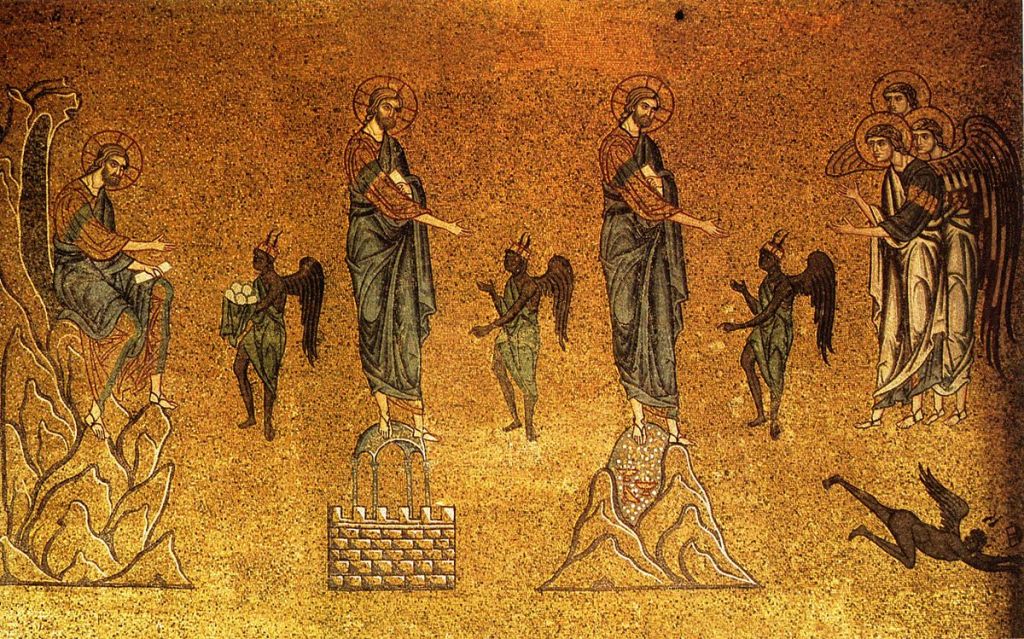
When we talk about temptation and sin, we are talking about the battle for our souls, so this sounds like a rather dry / clinical approach, but ask yourself, “How’s my current method working out?” Then look at the example of our Gospel lesson today: the temptation of Jesus in the wilderness.
Jesus did not go off into the wilderness to be tempted by the devil. We are told that he was “led by the Spirit in the wilderness, where for forty days he was tempted by the devil.” I don’t believe he went out there looking for trouble, but it did arrive on his spiritual doorstep. Did he wring his hands and fret: “What do I do? What do I do?” Nope. He answered the devil’s every temptation with Holy Scripture (specifically from the Book of Deuteronomy.) He had control of his emotions and he had disciplined his mind. He had prepared for just such an occasion of sin in advance. Perhaps he did not know what the temptation would be, but he was not foolish to think that they wouldn’t come at all.
“Resist the devil, and he will flee from you.” But you’re going to want a game plan for the resisting bit. Abraham Lincoln said, “Give me six hours to chop down a tree and I will spend the first four sharpening the axe.” Approach your spiritual battles in the same manner and you will be far more successful in defeating the temptations that wander up to your spiritual doorstep.
Above all your preparations, pray. Pray for God’s strength to defeat your enemies from whatever direction they may come. St. Paul tells us, “No temptation has overtaken you that is not common to all. God is faithful, and he will not let you be tempted beyond your ability, but with the temptation he will also provide the way of escape, that you may be able to endure it.” That way of escape will be made clear to you through your prayer and your preparation.
One final note: if you fall into sin, learn from your mistakes, repent, confess, and get back in the fight. You are a child of God. You have work to do.
Let us pray: Saint Michael the Archangel, defend us in battle. Be our protection against the wickedness and snares of the devil; May God rebuke him, we humbly pray; And do thou, O Prince of the Heavenly Host, by the power of God, thrust into hell Satan and all evil spirits who wander through the world for the ruin of souls. Amen.
In The Ragamuffin Gospel, Brennan Manning quotes from another who writes, “One saint used to say that she was the type of woman who advances more rapidly when she is drawn by love than when driven by fear. She was preceptive enough to know that we are all that type of person. It is possible to attain great holiness of life while still being prone to pettiness and insincerity, sensuality and envy, but the first move will always be to recognize that I am that way. In terms of spiritual growth the faith-conviction that God accepts me as I am is a tremendous help to become better.” (p.49)
Brennan sums this up by saying, “Love is a far better stimulus than threat or pressure.” This understanding leads to the realization that God loves us for who we are. That doesn’t mean that we don’t seek to be holy as our Father in heaven is holy, but it does mean that we learn to accept God’s grace and mercy, so that we don’t become discouraged and fall away.
That said, I’m always encouraging you to make a proper confession, whether that be to sit down with a priest or on your own, but as I have also told you, I hate going to confession. I’m very well aware of weaknesses and faults and I don’t like having to put them out there, but today… a public confession (and everybody says, “Well, this just got interesting!” Not like that, but maybe worse.) Here goes, two parts…
Part one: many struggle with being hard on themselves and many struggle with accepting God’s grace and mercy. The more those types of feelings persist, the harder that person is on themself. Friends: I am not good to myself. In many different ways I punish myself for my shortcomings. I am a priest that knows—for a fact!—that you are loved by God and so very deserving of God’s grace and I will do anything I can so that you can experience that love and grace, but… I have refused to accept it for myself. That’s part one. Part two: I’m tired of feeling this way. I’m tired of standing outside the banquet and missing out on the celebration.
That’s the confession. (Not very juicy, I know.) So, during this season of Lent, what am I going give up? I’ll probably give up something more tangible (that one is between me and God), but I think what I’m really going to give up is the act of pummeling myself and kicking my own backside. I think I’ll give up being a shield to God’s grace and allow him to soften my heart toward myself. As I said, I’m tired of being on the outside of the banquet, trying to make myself worthy to enter in, all the while, forgetting that this is a work that Jesus has already accomplished.
We always think of the ashes on ash Wednesday as a sign of penance and our mortality, our death. They are, but Thomas Merton looked at them from the other side. He wrote, “The ashes become a health-giving medicine and they bring wholeness, cleanness to the body as well as protection to the soul, both of these availing for the remission of sins. They bring the grace of that humility which they signify, they bring also the pardon which we implore by the fact of receiving them.”
The ashes are a sign of penance and death, but when we receive them with true humility, they are not only a sign of sin and death, but of forgiveness and life.
I invite you to continue on the path for this Lent that you have set for yourself, but, if you find yourself in the boat with me, then I invite you to join me in recognizing the fact that God accepts you as you, so that you can then experience His grace and love.
Charlie Brown: Lucy says, “If I was in charge of the world, I’d change everything.” Charlie turns and says, “That wouldn’t be easy. Where would you start?” Lucy looks directly at him, and without hesitation responds, “I’d start with you!”
Here’s a question for you: what color is a chameleon’s skin? It is actually translucent. There is still a bit of a mystery as to why it occurs, but the scientist have learned that it is the cells below the skin that are moving so as to refract a particular color, but this idea of changing color has also entered into the way we understand the brain and how we interact with one another. It is the Chameleon Effect and helps us to understand things like why yawns are contagious (yes, you may yawn, because now that I’ve said it, your minds are wanting to). It also explains why laughing is contagious and how, most times, if you smile at someone—even a perfect stranger—they’ll smile back (I like to do that anyway because even if they don’t smile back, you will make them nervous.) The point being, one person’s behavior can affect another person’s behavior. Chain reaction, domino effect, a string of random acts of kindness: all of these speak of this Chameleon Effect. This is even true in our life with God.
Rabbi Elimelech of Lizhensk, who lived in Poland and died in 1786, said: “One must always pray for his friend, as one cannot do much for himself, for ‘One does not deliver oneself from imprisonment.’ But when asking for his friend, he is answered quickly. Therefore, each one should pray for his friend, and thus each works on the other’s desire until all of them are answered. This is why it was said, ‘Jewish people [and I would add Christian people] are areivim, responsible and sweet for one another,’ where areivim means sweetness, as they sweeten for each other by the prayers they pray for one another, and by this they are answered.” (Source)
The word, areivim is further defined as sweetness, intertwined, and mutually responsible. (Source) I think we can look at it like sugar added to coffee, the sugar—the sweet—intertwines with the coffee and together make the change. So Rabbi Elimelech is saying that I can’t change myself without having the “sweetener” of you in my life. From there the Chameleon Effect plays through us all as we pray for one another. So when Lucy says she wanted to change the world and she would start with Chuck, she could if she came alongside him in prayer—instead of the manner in which she was most certainly thinking.
What is important to note is that the sweetener does not change the external circumstances, it only changes the person and how that person is able to respond and relate to those external factors.
Leading up to our Gospel reading today of the Transfiguration, we are told that about a week before, Peter had confessed Jesus as the Christ, the Son of the Living God. Matthew and Mark tell us it was six days later and Luke tells us that it was about eight days later that Jesus took with him Peter, James and John and ascended the mountain, and while Jesus “was praying, the appearance of his face changed, and his clothes became dazzling white.” He was transfigured before their eyes.
We know that the light that surrounded Jesus was not from above, but was instead from within. He revealed to the three apostles his glory. Something I recently read also said that it was a grace bestowed upon Peter, James, and John for them to actually be able to see this transfiguration. Without that grace, even if they had been present, they would not have seen it.
Following this event, all three Gospels have Jesus and the disciples descending the mountain, where they meet the other disciples along with a large crowd and arguing religious leaders. It is also then that Jesus heals the demon-possessed boy.
Given the nature and intensity of the ministry at that time, I suspect that those six to eight days prior to the transfiguration were quite similar to the day that followed: crowds, healings, teachings, arguments, etc. All the external factors were the same, but…
I don’t know why Jesus chose to only be transfigured before Peter, James, and John, but I can only imagine how the impact of witnessing such an event would have affected them. How would they have seen the ministry of Jesus prior to the transfiguration and then how would they see this same ministry following it? The light of Jesus’ transfiguration and the grace to see that light must have been like an areivim to them: a sweetener, that bound them to Jesus in a way they had not experienced before and gave them a recognition that they had a responsibility to share it with others. To lift up others with this knowledge. The one event of the Transfiguration was like the effect of a skipped stone on the smooth surface of the water: ripples going out affecting one another and affecting others. The water—the external circumstances—remains water, but how it is seen and perceived is completely different.
The Transfiguration is also like an oasis in a vast desert. It is a place of nourishment, water, rest, and so on, but it is also a vision of what can be and that vision does not leave you. Even when you must go back into the desert, you carry that vision with you as a hope and a promise. And as you travel along, you will encounter others who have been traveling in the heat of the day and who are thirsty and have been eating sand for days, but when they see you—someone who has been given food and water and is healthy—like that Chameleon Effect, they too will see that there is hope and if you will be a sweetener to them, their hope will be fulfilled by the promise… the promise of life-giving water. The promise of Jesus.
Jesus said, “Watch out that no one deceives you. For many will come in my name, claiming, ‘I am the Messiah,’ and will deceive many. You will hear of wars and rumors of wars, but see to it that you are not alarmed. Such things must happen, but the end is still to come. Nation will rise against nation, and kingdom against kingdom. There will be famines and earthquakes in various places. All these are the beginning of birth pains.
“Then you will be handed over to be persecuted and put to death, and you will be hated by all nations because of me. At that time many will turn away from the faith and will betray and hate each other, and many false prophets will appear and deceive many people. Because of the increase of wickedness, the love of most will grow cold, but the one who stands firm to the end will be saved.”
That is our world and those are our external circumstances, but we as a Christian people have been to the oasis—we come to it every week in the Blessed Sacrament—so we know of the hopes and promises of God. Like Peter, James and John, we have witnessed the light of the transfiguration in our own lives and in the lives of those around us, therefore we must be the areivim for others. The external circumstances are not likely to change, but we are called to share the sweetener of the Transfiguration with all.
Don’t be afraid or disturbed by what you hear and read: these things are going to happen and must happen, but you… you keep skipping stones: sweetening the lives of those you know and being a witness of hope to the others around you.
Let us pray: Almighty God, from whom all thoughts of truth and peace proceed, kindle in the hearts of all people the true love of peace, and guide with Your pure and peaceable wisdom those who make decisions for the nations of the earth; that in tranquility Your kingdom may go forward, till the earth be filled with the knowledge of Your love; through Jesus Christ our Lord. Amen.
I’ve been working on my mind reading skills. Let’s see how I’m doing (you may want to grab a pen if you need help with some light math. I know I do!):
1. Pick a number from 1-10. Any number.
2. Multiply it by 2.
3. Add 8 to that number.
4. Divide it by 2.
5. Subtract. Current number – Original Number. Take your time to do it right.
6. Match that number to an alphabet letter. For example 1-A, 2-B, 3-C and so on… Got the letter?
7. Think of an European country that starts from that letter
8. Take second letter from that country and what is the first animal you think of that starts with that animal?
9. Now think of the color of that animal
Ready? Ok… let me read your mind… If you are thinking of a grey elephant, please raise your hand.
Why are we concerned with mind readers this morning? Because, after reading that first sentence of our Old Testament lesson, I figured many would need to be a mind reader in order to know what the heck was going on: “Joseph said to his brothers, ‘I am Joseph. Is my father still alive?’ But his brothers could not answer him, so dismayed were they at his presence.” What in the world is this all about? Some will know (and a bit later on I look forward to covering the story in more detail during our Sunday school lessons on the Patriarchs) but maybe we could all use bit of a refresher.
In our study, we know that Abraham was the father of Issac and Issac was the father of Jacob (who will later be named Israel). Jacob will have four wives and twelve sons. His favorite wife was Rachel and his favorite son was Rachel’s first child (and Jacob’s eleventh son), Joseph. Joseph’s younger brother, by Rachel, was Benjamin.
Because Jacob showed favoritism toward Joseph, the ten older brothers did not like him. When Jacob made Joseph a coat of many colors, the ten liked him even less. When Joseph had two dreams demonstrating that his brothers and father would eventually bow down before him… things just got nasty.
One particular day, the older brothers were out tending the flocks and Jacob sent Joseph out to find them. When the older boys saw him coming, one said, “Here comes this dreamer. Come now, let us kill him and throw him into one of the pits. Then we will say that a fierce animal has devoured him, and we will see what will become of his dreams.” They did not end up killing him, but sold him as a slave and Joseph ended up in Egypt. They took Joseph’s colorful coat, covered it in blood, and holding it out to Jacob, their father, told him that Joseph had been killed by wild animals.
Now, fast forward through twenty-two years and many adventures: then a great famine settles in the land. Jacob and his family need food, so Jacob sends those same ten brothers who sold Joseph to Egypt to trade for their needs. In order to receive the food, the ten must go and ask it of the man who in Egypt was second only to Pharaoh. They did not know it, but that man was their brother, Joseph. We are told, “Joseph recognized his brothers, but they did not recognize him.” Eventually, there is the great reveal and Joseph makes himself known. The brothers, seeing Joseph who they had treated so badly, are greatly disturbed by their actions, yet Joseph says to them… insert our lesson from today: “I am Joseph. Is my father still alive?’ But his brothers could not answer him, so dismayed were they at his presence.” He said to them, “Do not be distressed, or angry with yourselves, because you sold me here; for God sent me before you to preserve life.” In other words, Joseph forgave his brothers and said, all that has happened is a part of God’s plan, so that we might be in a position to save God’s people.
Joseph had every reason to hate his brothers; and he was one of the most powerful people in the world, so he could have done whatever he liked to them, from sending them away empty handed, to placing them into slavery, to putting them to death, but he chose another path. A path that led to reconciliation.
With that understanding, hear again the words of Jesus from our Gospel lesson: Jesus said, “I say to you that listen, Love your enemies even if they sell you into slavery, do good to those who hate you even if they think of killing you, bless those who curse you because they do not understand how God is working, pray for those who abuse you, because you may win them back as a brother or sister. If anyone strikes you on the cheek or throws you into a pit, offer the other also and allow God to work his purposes; and from anyone who takes away your coat, even if it is a technicolor coat, do not withhold even your shirt or your life. Give to everyone who begs from you even if that person has done you very wrong; and if anyone takes away your goods, do not ask for them again, for they were God’s goods to begin with. Do to others as you would have them do to you, regardless of how they’ve treated you in the past…. Do not judge, and you will not be judged; do not condemn, and you will not be condemned. Forgive, and you will be forgiven; give, and it will be given to you.’”
I’ll tell you a story that I know I’ve told you before, but like any good story, it doesn’t hurt to hear it again: it takes place in Spain. A father and son got into a tremendous heated argument, which led to the son running away. Almost immediately the father felt remorse over what he had said and so he went in search his son. He searched for months, but he could not find him. Finally, in a last frantic endeavor to find him, the father put an ad in a Madrid newspaper. The ad read: “Dear Paco, meet me in front of this newspaper office at noon on Saturday. All is forgiven. I love you. Your Father.” On that Saturday, 800 boys named Paco showed up, looking for forgiveness and love from their father.
You don’t need to be a mind reader to know that if there is one thing this world needs, it is forgiveness. We need to be forgiven by God. We need to be forgiven by others and we need to forgive those who have hurt us. So we need to stop judging over who may or may not be right. We need to stop condemning and being so stubborn because we simply don’t want to let something go. We need to start forgiving and being forgiven. In that last phrase, Jesus says, “Give, and it will be given to you.” I suppose we could think of that in terms of some sort of material gift: goods, money, etc., but in this context, I don’t think that is what Jesus is asking us to give. I think Jesus is asking us to give love. Love. For in not judging or condemning and by forgiving, we are truly loving; and by loving in such a manner, we are becoming more like Jesus, because that is exactly how he loved us.
“Good nature and good sense must ever join; To err is human; to forgive, divine.” (An Essay on Criticism: Part 2 by Alexander Pope)
In your relations with others, strive for the divine.
Let us pray:
God, our Father, You redeemed us and made us Your children in Christ. Through Him You have saved us from death and given us Your Divine life of grace. By becoming more like Jesus on earth, may we come to share His glory in Heaven. Give us the peace of Your kingdom, which this world does not give. By Your loving care protect the good You have given us. Open our eyes to the wonders of Your Love that we may serve You with a willing heart.
Back in the frontier days, a westbound wagon train was lost and low on food. No other humans had been seen for days, when finally they saw an “Old Jewish Man” sitting beneath a tree. The leader rushed to him and said, “We’re lost and running out of food. Is there someplace ahead where we can get food?
“Vell,” the old Jew said, “I vouldn’t go up dat hill und down other side. Somevun told me you’ll run into a big bacon tree.”
“A bacon tree?” asked the wagon train leader.
“Yah, ah bacon tree. Trust me. For nuttin vud I lie.”
The leader goes back and tells his people that if nothing else, they might be able to find food on the other side of the next ridge.
“So why did he say not to go there?” some of the pioneers asked.
“Oh, you know the Jews don’t eat bacon.”
So the wagon train goes up the hill and down the other side. Suddenly, bandits attack and massacre everyone except the leader, who barely manages to escape back to the old man.
The near-dead man starts shouting, “You fool! You sent us to our deaths! We followed your instructions, but there was no bacon tree! There was hundreds of bandits, who killed everyone.”
The old Jew holds up his hand and says “Vait a minute.” He then gets out an old English-Hebrew dictionary, and begins thumbing through it. “Oy,” he finally says, “I made myself ah big mistake. It vuz not a bacon tree. It vuz a ham bush!”
“And God said, ‘Let the earth sprout vegetation, plants yielding seed, and fruit trees bearing fruit in which is their seed, each according to its kind, on the earth.’ And it was so. The earth brought forth vegetation, plants yielding seed according to their own kinds, and trees bearing fruit in which is their seed, each according to its kind. And God saw that it was good. And there was evening and there was morning, the third day.” (Genesis 1:11-13)
On the third day, God created the plants and trees of the earth—I do not believe either the bacon tree or the ham bush was on the list—yet the variety was immense. When we begin to consider the trees, we probably often think of the massive Redwoods in California, some of which are thousands of years old or those oddly shaped Baobab trees in Madagascar. In seeing and thinking of these, we miss some other remarkable specimens. For example, there is a White Cedar tree in Canada that is near the Great Lakes. It is over 130 years old, but stands at only four inches tall. And then there’s the tree I was thinking of today: a wild fig tree that grows in South Africa.
Standing at approximately 120 feet, it is an impressive tree, but for an area that only receives about 18 inches of rain a year, how could such a tree grow so tall and produce so much fruit? Of course it is the roots. Generally, the root systems of these trees will be five to six feet deep, but this particular tree has a tap root that travels 400 feet, through solid rock and even a cave system, until it reaches a source of water. It supports the massive tree above by pumping almost seven gallons of water upwards each day.
Charles Darwin wrote, “The tip of the root (of plants) acts like the brain of one of the lower animals.” It is the part of the plant that we do not see, but it seeks out the sources of water and nutrients and will either find it or the entire plant will die in the process.
In our first lesson this morning, the Prophet Jeremiah said to us:
Blessed are those who trust in the Lord, whose trust is the Lord. They shall be like a tree planted by water, sending out its roots by the stream. It shall not fear when heat comes, and its leaves shall stay green; in the year of drought it is not anxious, and it does not cease to bear fruit.
The tree—and we know we are talking about a soul—that is planted near the stream will survive, but we also know that a drought can become quite severe. Lakes and streams can dry up all together, but that’s just on the surface. Down deeper, the water is still available. The plants that lived along the banks can and will die, unless they, like that wild fig tree, go deeper in search of the water.
For a soul, this can be a difficult time. It has not all together been cut off, but it does experience a crisis. Consider the first two verses of Psalm 42:
As a deer pants for flowing streams, so pants my soul for you, O God. My soul thirsts for God, for the living God. (Psalm 42:1-2)
And again, David writes in Psalm 63,
O God, you are my God; earnestly I seek you; my soul thirsts for you; my flesh faints for you, as in a dry and weary land where there is no water. (Psalm 63:1)
David’s soul knows where its life comes from. His soul thirsts for the one thing that can give it life and that one thing is God. He knows that his soul will either find God or die, so it searches, but those times of searching can be lean times. Those are days of struggle and crisis. Those are days when the soul is not 100% sure that it will survive. And those are days that each and everyone us of experience. It is at times like this that some will give up. They feel as though God has abandoned them. They are withering in their search for water, for God, and struggle to see that this is a season and not a lifetime. They forget the days of plenty and the people around them taunt them by saying, “Where is your God?”
You can truly find yourself in that barren and dry land where this no water. You are poor in body, soul, and spirit. You are hungry and thirsty for God. You are saddened by your condition and those around you are no help. You are all these things and… you are blessed. Blessed…
“Blessed are you who are poor, for yours is the kingdom of God. Blessed are you who are hungry now, for you will be filled. Blessed are you who weep now, for you will laugh. Blessed are you when people hate you, and when they exclude you, revile you, and defame you on account of the Son of Man. Rejoice in that day and leap for joy, for surely your reward is great in heaven.”
Days and seasons where there is no water are not days when God has abandoned us. They are days when God is calling us to go deeper, to trust and enter into an even more intimate relationship with him. Yes, you can do nothing and look back on the good ol’ days and in the process become bitter at your current circumstances or you can even quit. You can wither and die there on the banks of a dry river bed or you can push on until you once again encounter the Source… that has always been there! Patiently waiting for you and allowing you to grow through the trials you experience.
In his Revelation, St. John tells us about the New Jerusalem and he says, after seeing the great city, “the angel showed me the river of the water of life, bright as crystal, flowing from the throne of God and of the Lamb through the middle of the street of the city.” (Genesis 22:1-2) On the day we enter into that city, we will always have this source of water readily available to us—it is our hope and the promise that has been made to us by God—but for now, we must at times go deeper in search of that life giving water, but do not fear. It is there, for as St. Paul tells us, “I am sure that neither death nor life, nor angels nor rulers, nor things present nor things to come, nor powers, nor height nor depth, nor anything else in all creation——including droughts, famine, and the lack of water——will be able to separate us from the love of God in Christ Jesus our Lord.” (Romans 8:38-39)
Today, the ground may be dry and cracked, barren and unfit to produce life, but by going below the surface, deep into the earth, we will find Life. Seek God where he wills to be found. Go deeper.
Let us pray: Come, all who are thirsty says Jesus, our Lord, come, all who are weak, taste the living water that I shall give. Dip your hands in the stream, refresh body and soul, drink from it, depend on it, for this water will never run dry. Come, all who are thirsty says Jesus, our Lord. Amen.
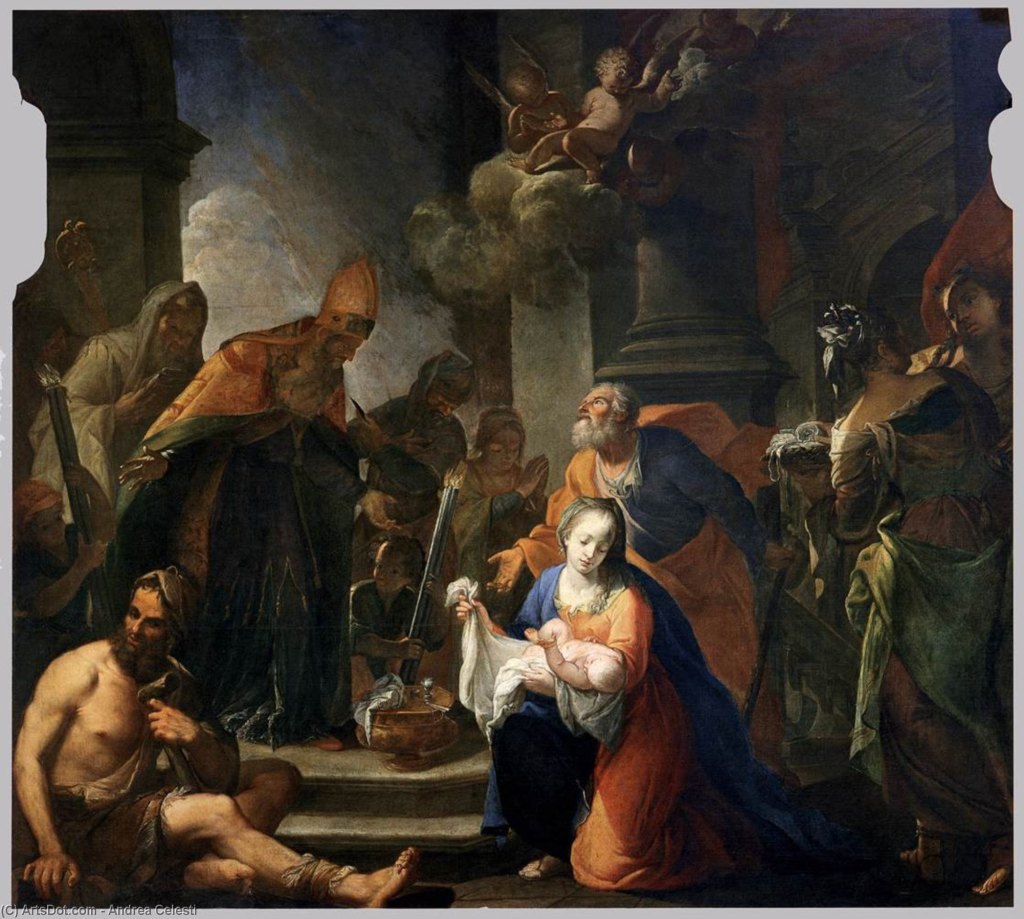
Presentation of Jesus at the Temple (1710) by Andrea Celesti
The prophet Ezekiel has a great vision of the Lord. He writes in chapter one, “As I looked, behold, a stormy wind came out of the north, and a great cloud, with brightness around it, and fire flashing forth continually, and in the midst of the fire, as it were gleaming metal. And from the midst of it came the likeness of four living creatures.”
Remember the Ark of the Covenant, how it was kept in the Holiest of Holies in the Temple and that on the lid of the Ark there are the two cherubim with their wings outstretched towards one another. It is in that place just above where the wings meet that God made his home on earth, where Ezekiel understands this vision to be taking place.
However, as his visions continue, Ezekiel understands that God is about to punish the people for their idolatry and that he intends on doing so through the Babylonians. The people will be carried off into captivity and the city and temple will be destroyed. We learn that this can happen, because God is leaving the Temple. Ezekiel writes in chapter nine: “Now the glory of the God of Israel had gone up from the cherub on which it rested to the threshold of the house.” Then in chapter ten, “Then the glory of the Lord went out from the threshold of the house, and stood over the cherubim. And the cherubim lifted up their wings and mounted up from the earth before my eyes as they went out, with the wheels beside them. And they stood at the entrance of the east gate of the house of the Lord, and the glory of the God of Israel was over them.”
For all those years, God had remained in the Temple, but now he leaves. You can imagine the pain in the peoples’ hearts as they heard these words, but there is hope, because the punishment will not last forever. Chapter forty-three: “Behold, the glory of the God of Israel was coming from the east. And the sound of his coming was like the sound of many waters, and the earth shone with his glory…. As the glory of the Lord entered the temple by the gate facing east, the Spirit lifted me up and brought me into the inner court; and behold, the glory of the Lord filled the temple.”
All that Ezekiel spoke concerning the destruction of the city and the Temple came to pass, but what about God’s return? When would his Glory once again cross the threshold and re-enter the temple? We read about the beginning of this great event today: the Presentation of Our Lord, when Mary and Joseph brought the Son of God into the Temple. As St. Paul tells us in his letter to the Hebrews, Christ “is the radiance of the glory of God and the exact imprint of his nature.” The glory of the Lord was returning and it was Simeon who testified to it:
Lord, you now have set your servant free * to go in peace as you have promised; For these eyes of mine have seen the Savior, * whom you have prepared for all the world to see: A Light to enlighten the nations, * and the glory of your people Israel.
We are also witnesses to God’s glory returning. We see it each time this glory enters into a human temple and radiates God’s word throughout.
The Presentation of the Lord is an ongoing process until the Lord returns in all His fullness. We see it as God enters these human temples of ours and begins his marvelous light. Yet, we are not only witnesses, but participants as we are the ones who carry Him to others. We are the ones who present Jesus at the threshold of souls so that he might enter.







 Candle in a Cave