I had been working on a house, rewiring some outlets. The outlets were on the first floor, but the breaker box was down in the basement. For whatever reason, I could not get this one outlet to work from a switch on the wall, so I would make an adjustment, run downstairs, flip the breaker, run back upstairs, test the switch, and then when it still wouldn’t work, go through it all again.
I don’t know about you, but in the middle of these frustrating projects, I’ll get some less-than-brilliant idea and try something new. In this case, my less than brilliant idea: “I’m tired of going up and down the dang stairs. I can make these adjustments without flipping the breaker.” I was unsuccessful and quickly learned what it felt like to be hit with a cattle prod.
The cattle prod comes in many different forms. There is the electrical node on the end of a stick used to get cattle to move along, and the bark collar is working off that same principle—a rather unkind way of trying to teach a dog not to bark at everything. And then there is the ultimate cattle prod known as the police taser, which attempts to teach hardheaded individuals to stop what they are doing. These devices, especially the cattle prod, are descendants of the ox goad.
The ox goad is a long stick with a sharp metal point on one end. The farmer, behind a plow, would hold the point of the goad around the oxen’s ankles and use it to guide the animal: a tap on the left, go left. A tap on the right, go right. However, the ox—particularly the younger ones—were not accustomed to being harnessed and could become a bit stubborn, so a little prod with that sharp stick was a way to “goad” them and encourage them along. Not only that, but if the ox got out of hand and started kicking, they would prick themselves.
In our reading from Acts, Paul, speaking to King Agrippa, says, “I was traveling to Damascus with the authority and commission of the chief priests, when at midday along the road, your Excellency, I saw a light from heaven, brighter than the sun, shining around me and my companions. When we had all fallen to the ground, I heard a voice saying to me in the Hebrew language, ‘Saul, Saul, why are you persecuting me? It hurts you to kick against the goads.’” In other words, Jesus was saying to him, “Saul, Saul, why are you fighting against my church and me when you know in your heart that I am the Messiah? It hurts you to kick against the goads—it hurts you to continue to be stubborn and to doubt what you know is true.” Paul knew in his heart what the truth was, but he remained stubborn.
What is the root of such stubbornness, of failing to be obedient? Pride. And, like Paul, we can fall into the same error. We pray, “My will be done,” and not, “Thy will be done,” and we kick against the goads. We grab the live wire, even though we know better.
A wonderful saying from St. Josemaría Escrivá: “If obedience does not give you peace, it is because you are proud.” (The Way #620)
If we do not feel peace about our words or actions, if we feel the sharp prick of the goad in our spirit, then perhaps we need to consider whether or not we are being prideful, seeking our own will and our own ways instead of God’s; and then remember that the goading is not God’s way of punishing. His ways are teaching and loving, so that we may stay on the path of righteousness.
After a long dry sermon, the minister announced that there would be a brief meeting of the board immediately after the benediction. Following the services, a stranger was the first to meet the minister up front. “You must have misunderstood the announcement,” said the minister. “I announced a meeting of the board.”
“So I heard,” replied the stranger, “and if there was anyone here more bored than I was, I’d like to meet him.”
To be bored or boredom. A scientist, Winifred Gallagher, says, “[In the English language] boredom has no derivation: That is, it doesn’t come from any other word but was specially created. Moreover, the word didn’t appear in English until the later eighteenth century.” Someone was so bored that they sat around and created a word to express their boredom, and it began with them thinking about a “bore.” Not as a person but as a tool: an augur. A tool that goes round and round, drilling a hole.
Lord Byron, in Don Juan, made use of the new meaning:
“Society is now one polished horde,
Formed of two mighty tribes, the Bores and Bored.”
What’s interesting is that westerners are really the only societies that have this idea of boredom. For the rest of the world, tedium/boredom is just a part of life, so they don’t run around saying, “I’m so bored.” They accept that there are times when nothing is happening—and we think we’re the smart ones. Regardless, we get bored.
We get bored with our work, our hobbies, and our lives. We can even get bored in the relationships we are in. Why is that?
There are many studies on the topic, but much of it leads back to or rewords what is known as hedonic adaptation or the hedonic treadmill. Hedonic relates to those things experienced as pleasurable or unpleasant.
Think about falling in love. When you first fall in love, you’re always thinking about the person, you stay up late talking, you can’t wait to see them again, you worry over things like keeping them happy, how you look—is the hair nicely coiffed, the beer belly hidden, makeup perfect, and so forth. You pour all your energy into it. You are not bored, but the body and the mind cannot maintain this level of tension and enthusiasm. At some point, you will need sleep. You understand that she will eventually recognize that you don’t have a Jason Momoa body. You have other things that you must do, so the mind and the body work to bring all these emotions back down to a more manageable level, the status quo. When this happens… Liza Minnelli. Love Liza. She has a song, You’ve Let Yourself Go. A few of the stanzas:
And where’s that slender youth I knew I fear he’s grown an inch or two Not up and down my joy and pride But more precisely side to side
You never care the way you dress You stay unshaven, you look a mess The smallest thing is too much to do I even hold the door for you
You see the point. There’s all this excitement, but over time, you return to who you really are.
The hedonic treadmill demonstrates how this happens with those things that are pleasant and unpleasant. There are highs and lows, but our minds and bodies work to bring about more of an equilibrium between the two. When we hit that equilibrium, we say, “I’m so bored.” I’m bored with my job, my hobbies, my life, my relationship, etc., etc., etc. Put another way, you’ve lost your passion.
The boredom we experience in our relationships is not limited to our relationships with other people; we can also experience boredom in our relationship with God. It’s not that you no longer love God, but it can be like the Liza Minnelli song, you’ve let yourself go.
I wondered about this as I studied the calling of the Apostles. Jesus called Peter and Andrew, and we are told, “Immediately they left their nets and followed him.” It was similar to the calling of James and John, “Immediately they left the boat and their father, and followed him.” There it is, the new relationship—places to go. People to see. Excitement. Things to learn. Miracles to witness. The curve on the hedonic treadmill leaps, yet, after being with him for three years, things become boring. “Do we really have to go to Jerusalem again? We were just there.” “I mean, seriously, hasn’t he already healed one leper? Now ten more.” “Hey, Jesus, are we there yet? My feet hurt.” “Do you think you could make a nice Cabernet next time? I’m tired of this Chardonnay.”
That is not what happened. In fact, it would seem that it was just the opposite. The disciples became more intense and passionate as time passed, to the point of giving up their own lives for the sake of Jesus and the Gospel.
Andrew – crucified
Bartholomew – flayed
James – beheaded
Peter – crucified upside down
Philip – crucified
The list goes on, but living for the Gospel to such an extent that you are martyred in such a way is not the action of someone who is bored. These individuals were so passionately in love and relationship with God that they cared nothing for their own lives. It is this sense of passion that we need to kindle in our hearts—a passion for Jesus, God, and His Church.
Today we have our Annual Meeting. It is a bit like a stockholders’ meeting for a corporation. Those who own stock, the investors, gather with the board members and other executives. Then there are a series of presentations on what the corporation accomplished in the past twelve months, where they are financially, and what they expect for the future. However, at the end of it, no one at a stockholders’ meeting ever walks away, pumping their fists in the air and shouting, “Let’s do this! This is gonna be great!” Maybe they’re not to the point of being bored, but no one ever leaves those meetings feeling passionate about what’s ahead. Based on my twenty-plus years of Annual Meetings, I can assure you that no one walks away from them feeling passionate either. More likely, it’s, “Thank God that’s done for another year.” But…
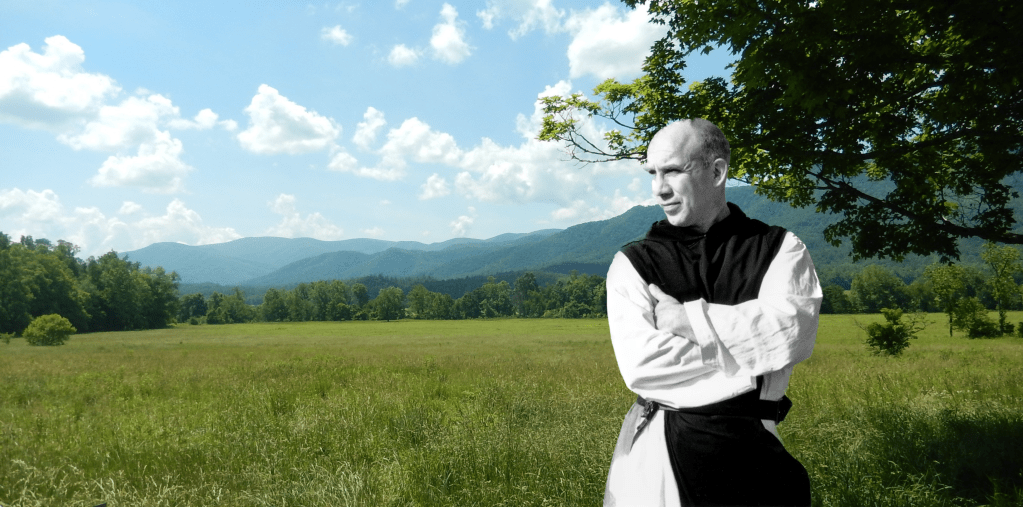
For the last few years, my daily meditation (the first thing I read in the morning) has been from Bishop Robert Barron; however, this year, I switched to Thomas Merton (A Year with Thomas Merton: Daily Meditations from His Journals). The meditations are less than a page long, yet, almost every day has provided some excellent spiritual food for thought. At the top is January 12th. It has held my attention the longest. Merton writes: “I am obscurely convinced that there is a need in the world for something I can provide, and there is a need for me to provide it. True, someone else can do it, God does not need me. But I feel He is asking me to provide it…. The wonder of being brought, by God, around a corner and to realize a new road is opening up, perhaps—which He alone knows. And that there is no way of traveling it but in Christ and with Him. This is joy and peace—whatever happens.” (p.12)
“The wonder of being brought, by God, around a corner and to realize a new road is opening up….” It was that wonder and that realization that gave the Apostles the passion that never wained in their lives. It was never about, “We’ve done this before.” It was always, “What is God going to do next?” And not only that but also, “I get to be a part of it.”
God could have chosen anyone and any church to accomplish the work that He has called you as an individual to and us as a church, but He chose you, and He chose us. He doesn’t need us, but He wants us, and because God wants us, we should be deeply passionate about Him and this work.
The hedonic treadmill trundles on in many areas of our lives, but we must step off of it regarding our relationship with God. Restore your passion for God and let it burn as bright as the Holy Spirit will allow. The road that God is opening up before us is calling.
Let us pray: Heavenly Father, look upon our community of faith which is the Church of your Son, Jesus Christ. Help us to witness to his love by loving all our fellow creatures without exception. Under the leadership of our Bishop keep us faithful to Christ’s mission of calling all people to your service so that there may be one fold and one shepherd. We ask this through Christ, our Lord. Amen.
Mark Twain wrote, “I have found out that there ain’t no surer way to find out whether you like people or hate them than to travel with them.” I think this is probably true and, as most of you know, the day after Christmas, I went traveling again, but this time I went by myself and discovered that I’m not a bad travel companion.
I went to Portugal on this trip and spent most of my time in Lisbon. However, I was able to travel to several nearby locations, including Fatima, the site of perhaps the most significant Marian apparitions.
I left Monday morning and arrived in Lisbon three flights and roughly twenty-six hours later. I want to be able to sleep on planes, especially flights that long, but that is not the case. In addition, the host of the VRBO that I would be staying in gave me a great restaurant to have lunch in when I arrived, so I passed on the last meal offered on the flight. Bottom line: when I got to Lisbon, I hadn’t slept or had anything to eat in quite some time. From there, the situation began to decline.
I had purchased an international data plan for my phone so that I would have access to Google maps and the like, yet, when I arrived, it would not connect, even after I spent half an hour on the phone with the provider. It was at this point that no sleep and no food gave me my first stupid idea: “I can do this. No problem.”
My host told me the subway to take and what stop to get off at. How hard could that be? The only piece of information I forgot was that, at one point, I needed to switch trains. I rode that train and rode that train, and when it finally came to a stop, and everyone was getting off, a little older lady leaned down to me—and I must have been looking baffled at this point—and said, “This is the end of the line.” I said, “Thank you,” but what I thought was, “No…. kidding.” I then proceeded to make my second mistake: I got off the subway and rode the elevator to street level, the entire time thinking, “Surely I’ll be able to recognize something.” The problem: no Google maps or any map for that matter. In The Fellowship of the Rings by J.R.R. Tolkien, Gandalf writes a letter to Frodo and the letter includes a poem. A line from that poem reads, “All that is gold does not glitter, not all those who wander are lost.” I got off that train, and I was one who was not only wandering but also terribly lost and—no sleep, no food—did not have the sense to figure it out, so I found a spot in the shade and just stood there, staring blankly into a city I knew nothing about.
A wristwatch used to have only one function: tell the time. After a while, they added the date, then Seiko and the others added calculators, etc., and now, we have the Apple Watch and other similar devices that have more computing power than the first rocket to the moon. This little watch can do all sorts of things, but for the most, it is tied to your phone, so if your phone has no signal, your watch isn’t going to do much. If it is connected, then you’ll be able to get notifications on your watch.
As I stood there in the shade, staring blankly into that unknown city, my watch vibrated and dinged, and I was suddenly elated. That notification could mean only one thing: I had data services and could find my way out of this mess. However, specific functions on the watch work without data, one of which is the healthcare monitoring functions. Specifically, in this case, it was the heart rate monitor.
I raised my wrist, hoping to have a data-related message, but what I read was this: “High Heart Rate: your heart rate rose above 120 BPM while you seemed to be inactive for ten minutes.” You know you’re a little stressed when your watch tells you to chill out.
I took a deep breath and slowly walked around until I spotted a police officer. He didn’t speak a lick of English, but we were able to mime communicate enough that I could tell him where I was trying to get; when he realized where it was, I didn’t understand what he said, but it meant, “How in blue blazes did you get all the way over here?”
I asked, “How do I get there? Can I walk?” “No,” he said, wide-eyed. He then indicated he would get me to the train station; I said, “No. Taxi.” He then gently took me by the arm and led me to the street. Standing there with me, he flagged me a cab. He had a conversation with the taxi driver and told him where I needed to go. There was more to the conversation than this, but I didn’t understand any of it other than the grin, and the eye roll exchanged between them.
I don’t know either of these two individuals’ names, but the police officer I named Angel because, following a fifteen-minute taxi ride, I was deposited in the exact spot I needed to be.
For the duration of the trip, when I was out and about, I had no data services, but André, my VRBO host, was brilliant and helped me learn how to get around. After a thirteen-hour nap and some tasty food the following day, I set off into that remarkable city and had a brilliant time. I got lost a few more times and occasionally missed a train stop, but I really had no problem getting around after that first day.
St. Augustine of Hippo (d.430) was one of the greatest theologians the Church has known. One of his books is the City of God. In it, he writes of the City of Man and the City of God, where “the earthly city glories in itself, the Heavenly City glories in the Lord.” There are many other comparisons: “The earthly city was created by self-love reaching the point of contempt of God, the Heavenly City by the love of God carried as far contempt of self.” Although there are two cities, they are intertwined, just as in the parable of the wheat and the weeds that grow in the field together.
Augustine says that it is in this intertwined city that we live, and it is a place where, for the most part, “the strongest oppress the others because all follow after their own interests and lusts.” It is a city where it is easy to become lost, bouncing from one thing to another, never settled, anxious, and not truly knowing where you are going.
It was in such a city, such a time, that Jesus was born and lived. People wandered in the city, lost with no means of finding their way. Anxious, with no knowledge of how to calm their hearts and their souls. But then, like my angel in Lisbon, along came John the Baptist, who took them by the arm and directed them to the one… the only one, who could bring peace to their souls and get them to where they needed to be: “Here is the Lamb of God who takes away the sin of the world!” So, coming to Jesus, they asked, “Rabbi—teacher—where are you staying?” “Where are you staying? We are lost. How do we get there?” And Jesus responds, “Come and see.” Jesus says, “Come with me, and I will show you the way through this city. I will show you the path that leads to God, for not only can I show you the way, but I Am The Way.”
If you are anxious and lost in the city, there are many here who can help show you to the one who is the Way. If you know of someone who is lost, be a John the Baptist to them, be an Angel to them, and point them to the Lamb of God, who will give them safe passage through this City of Man to the Eternal City, the City of Our God.
While in Portugal, I had the opportunity to visit Fatima, the site of the great Marian Apparition. During one of the apparitions, the Virgin Mary gave the children a prayer she asked to be prayed at the end of each decade of the Rosary. It is brief but addresses our most profound need while we walk the streets of this City of Man. Let us pray: “O my Jesus, forgive us our sins, save us from the fires of hell, lead all souls to Heaven, especially those most in need of Thy mercy. Amen.”
Today is a feria, a word that means weekday and, liturgically speaking, a day when no saint is celebrated, so the readings for the day are the readings we had this past Sunday: The Baptism of Our Lord.
Much of what God continues to do today was prefigured in what he did early on. For the baptism of our Lord, we can begin, “In the beginning, God created the heavens and the earth,” but it becomes more apparent if we move a little further along in history to the great flood, to when God became grieved because of our sinfulness. “The Lord said, ‘I will blot out man whom I have created from the face of the land, man and animals and creeping things and birds of the heavens, for I am sorry that I have made them.’ But Noah found favor in the eyes of the Lord.”
Noah built the Ark and was saved from the rising waters that covered the entire face of the earth. When the rain stopped, Noah sent forth a raven that found no place to rest, then a dove that also returned. Seven days later, he sent forth another “dove out of the ark. And the dove came back to him in the evening, and behold, in her mouth was a freshly plucked olive leaf.” The waters raged, yet Noah and all with him on the Ark were saved. When God’s wrath was complete, a dove was sent forth and brought back the olive leaf, a sign of peace.
We read today, “When Jesus had been baptized, just as he came up from the water, suddenly the heavens were opened to him, and he saw the Spirit of God descending like a dove and alighting on him.” There are the waters and the dove, but what of the olive leaf, the sign of peace? St. Paul tells us, “For in [Jesus] all the fullness of God was pleased to dwell, and through him to reconcile to himself all things, whether on earth or in heaven, making peace by the blood of his cross.” (Colossians 1:19-20) The olive leaf becomes the cross, the sign of peace established between God and us.
The events of Noah prefigured what God would accomplish through his Son and what continues to happen with us. In our baptism, through water and the Holy Spirit, we are baptized into the death—the cross—and resurrection of Jesus.
St. John Chrysostom writes in his commentary, “The dove is a gentle and pure creature. Since then, the Spirit, too, is ‘a Spirit of gentleness,’ he appears in the form of a dove, reminding us of Noah, to whom, when once a common disaster [the flood] had overtaken the whole world and humanity was in danger of perishing, the dove appeared as a sign of deliverance from the tempest, and bearing an olive branch, published the good tidings of a serene presence over the whole world. All these things were given as a type of things to come. . . . In this case, the dove also appeared, not bearing an olive branch, but pointing to our Deliverer from all evils, bringing hope filled with grace. For this dove does not simply lead one family out of an ark, but the whole world toward heaven at her appearing. And instead of a branch of peace from an olive tree, she conveys the possibility of adoption for all the world’s offspring in common.”
“She conveys adoption of all the world’s offspring,” making us the very children of God. God has been working out our salvation since the day of the fall in the Garden of Eden, and it all hinged upon the Cross, the means and sign of peace between our God and us.
I walked about fifteen minutes to the Barrio Alto Hotel where I met my guide and travel companions. There were eight of us in all—myself, an Armenian couple now living in Las Angeles, a Chinese couple now living in Michigan, and a family of three from Buenos Aries, Brazil (the history of Portugal and Brazil is closely knit together.)
From there, we drove north (our driver averaged 95 mph in the Mercedes van) to Fatima (about an hour). Along the way, the guide explained to us (first in English, then in Portuguese) the significance of the site, the apparitions, the three shepherd children, and all. It is fascinating to hear, even if you are familiar with the story.
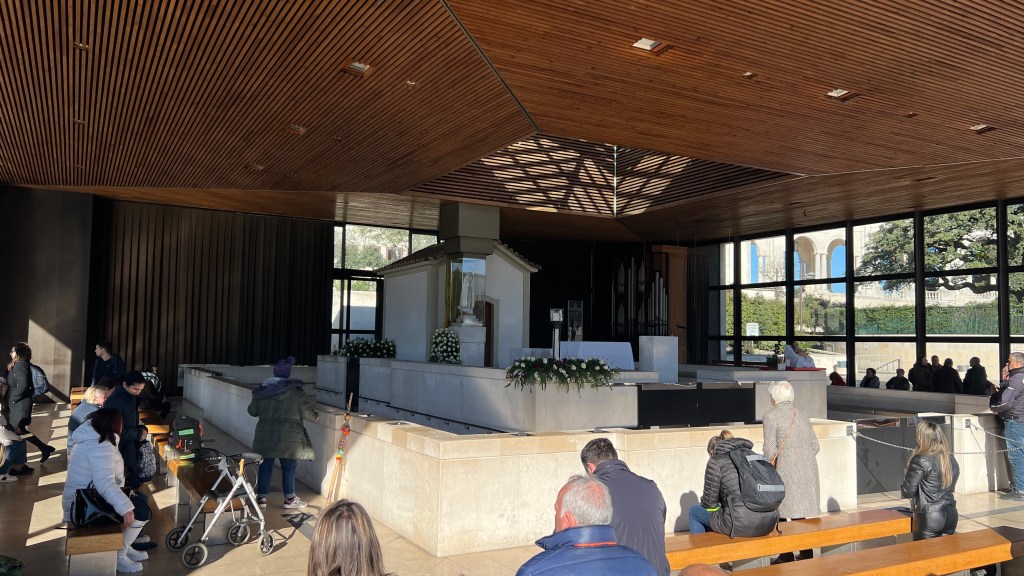
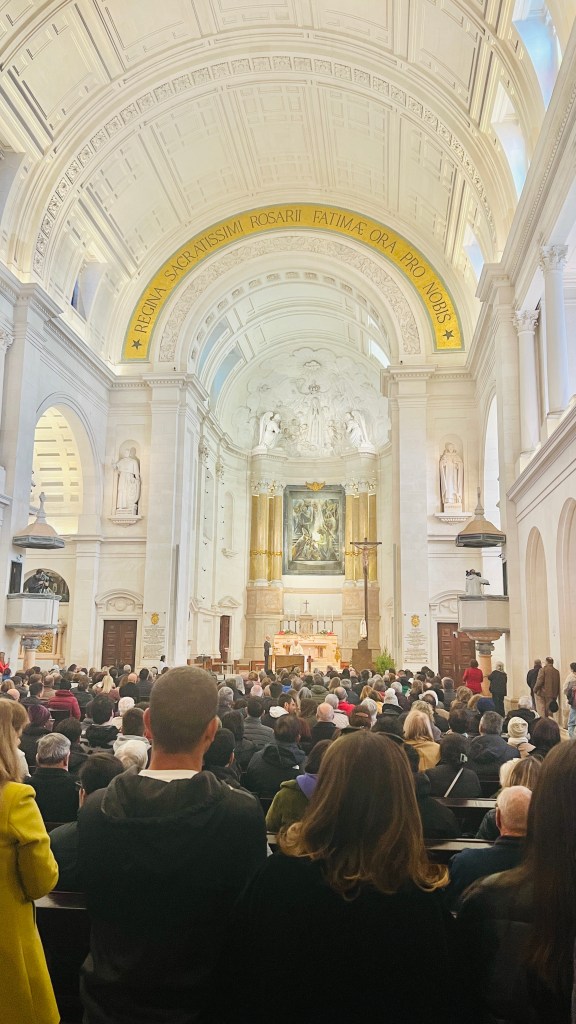
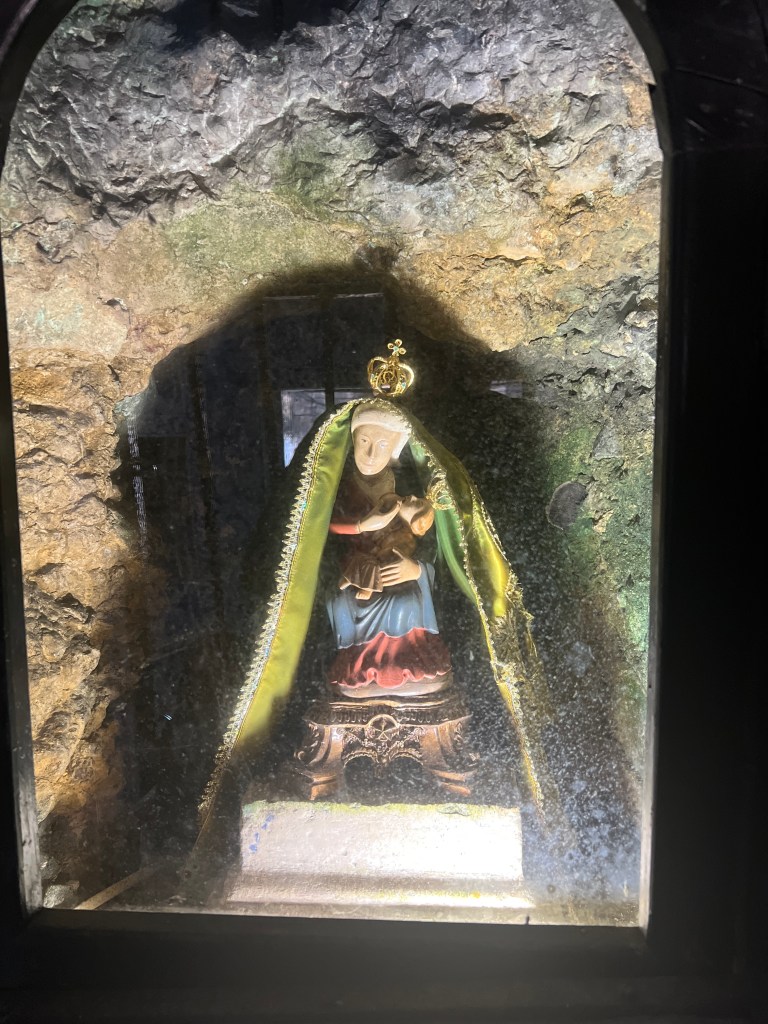
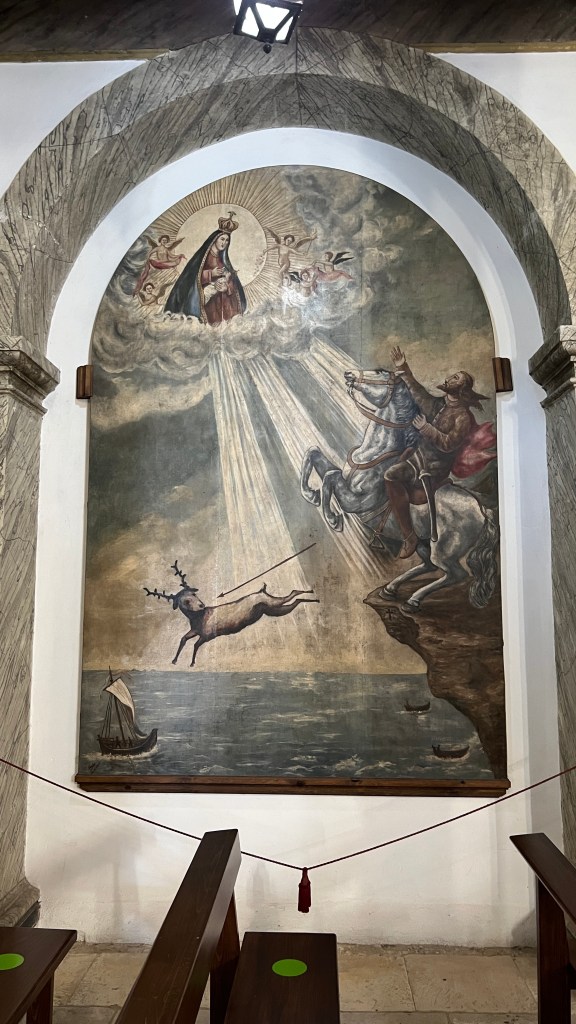
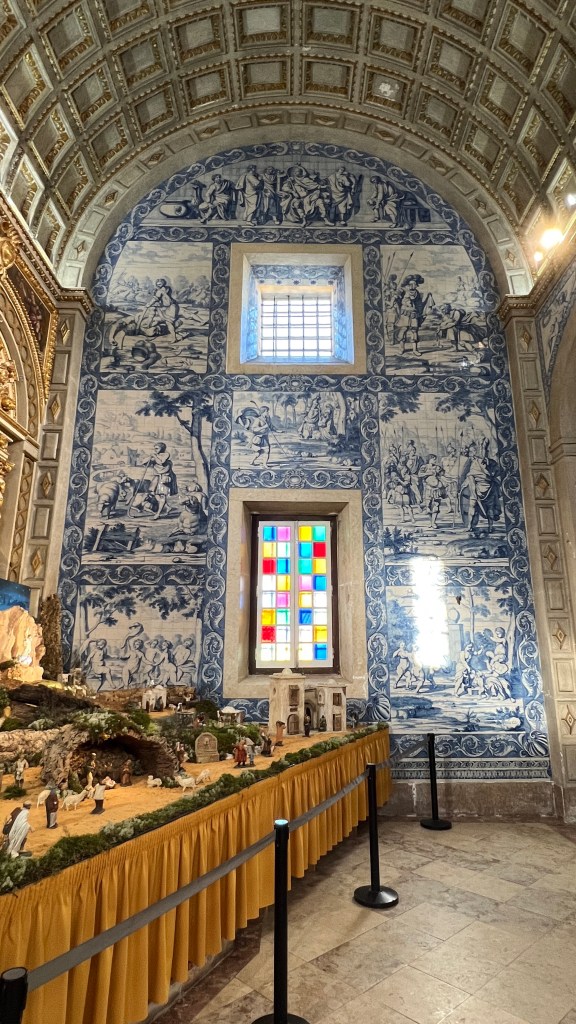
When going to Fatima, it is not about the buildings. It is about the location and the events that occurred there. The buildings came much later. The first picture below shows the actual location of the apparitions and the original place of worship that the Virgin Mary asked to be built. The second, the church, was built later as the site grew in importance and more pilgrims arrived. There is now a third church, which is more like an auditorium, that will hold 8,000. I was glad that the Pilgrim’s Mass was held in the first church.
The Vatican has not yet revealed all the messages that were given but have officially declared the apparitions to be valid; this is primarily due to the fifth apparition: the Virgin Mary asked that six individuals be brought on that day so that they could be healed. When the day arrived, there were at least 40,000 in attendance and 500 to 1,000 were healed and… all reported that the sun danced in the sky. I encourage you to read more about this miraculous event.
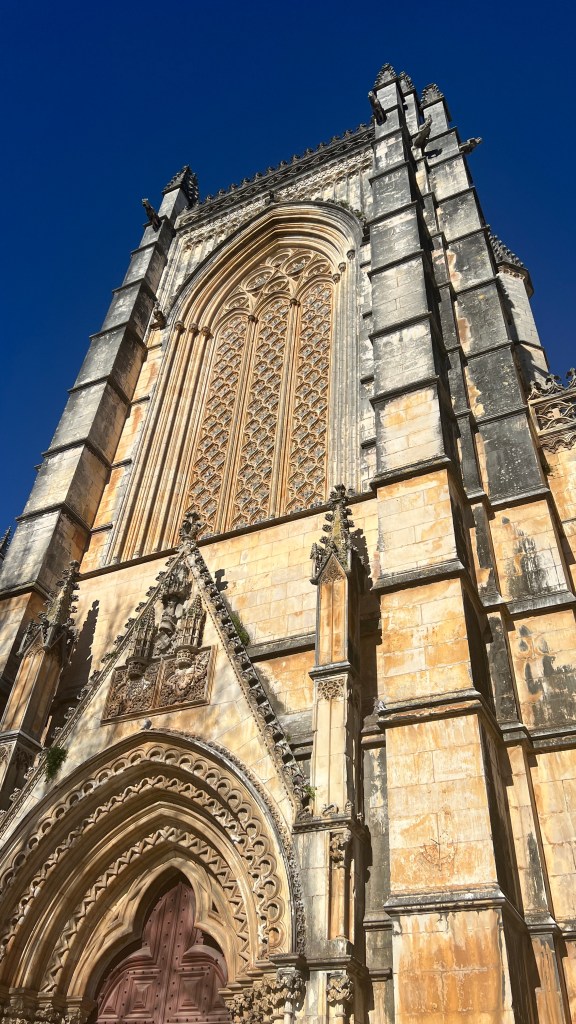
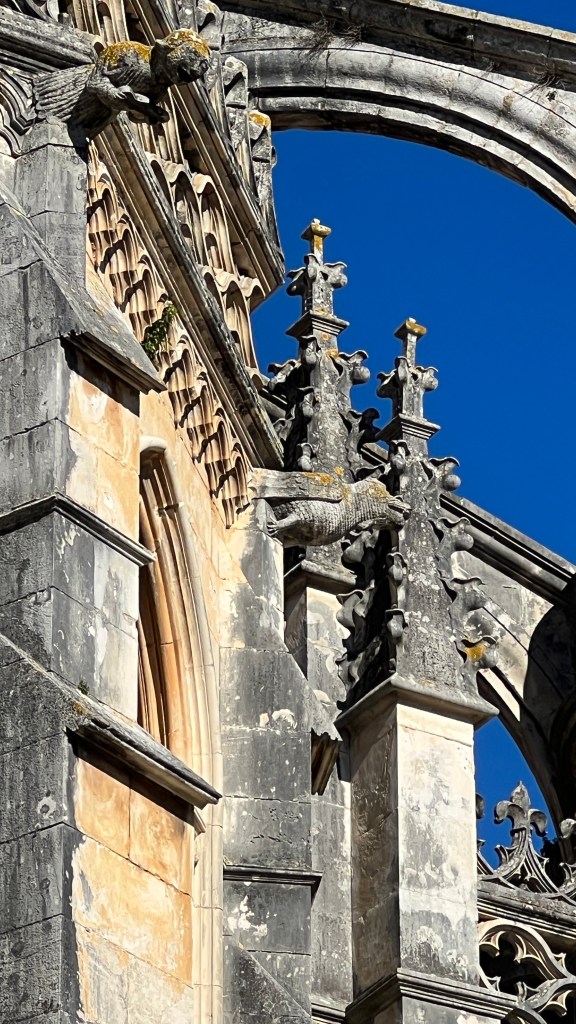
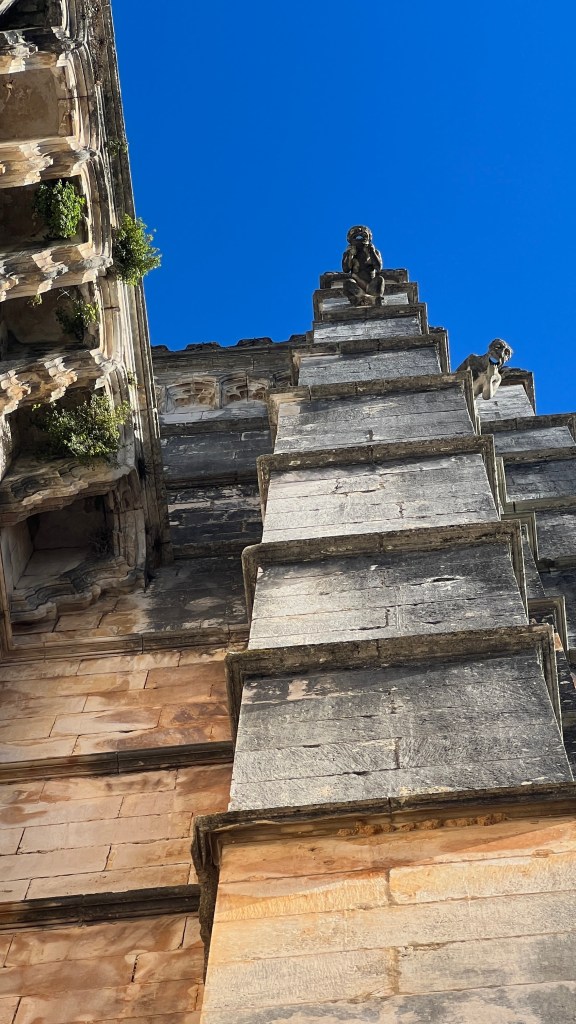
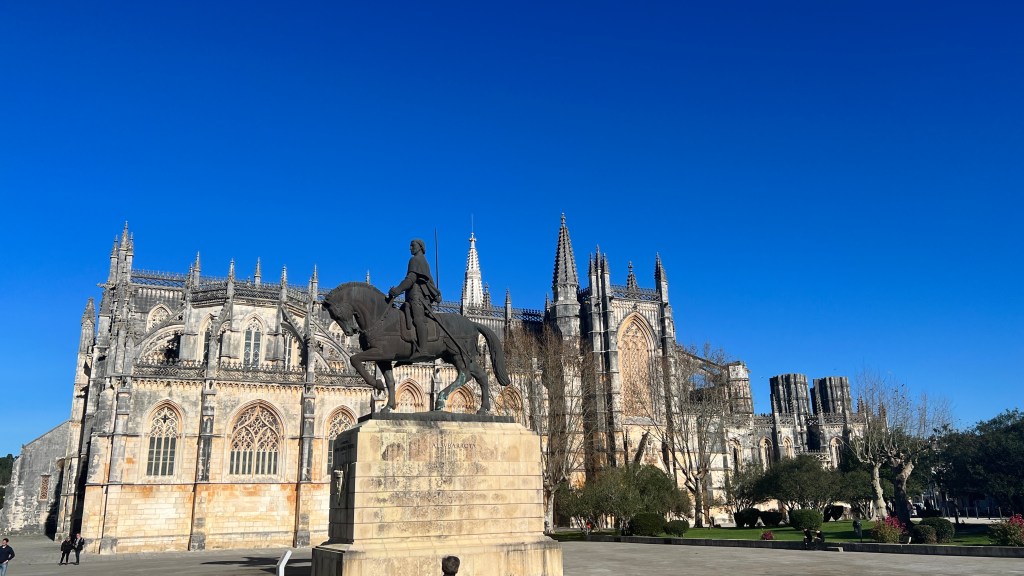
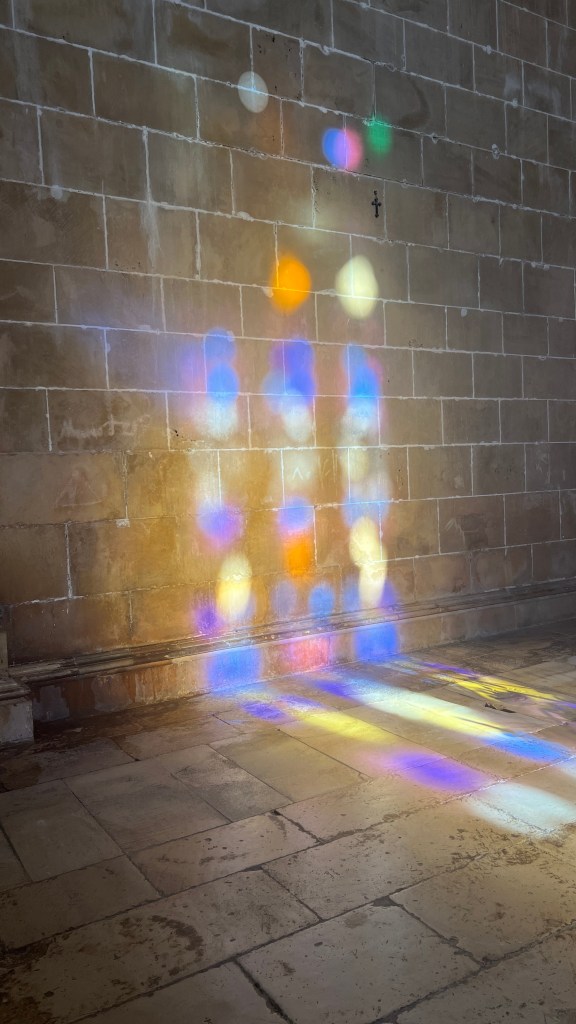
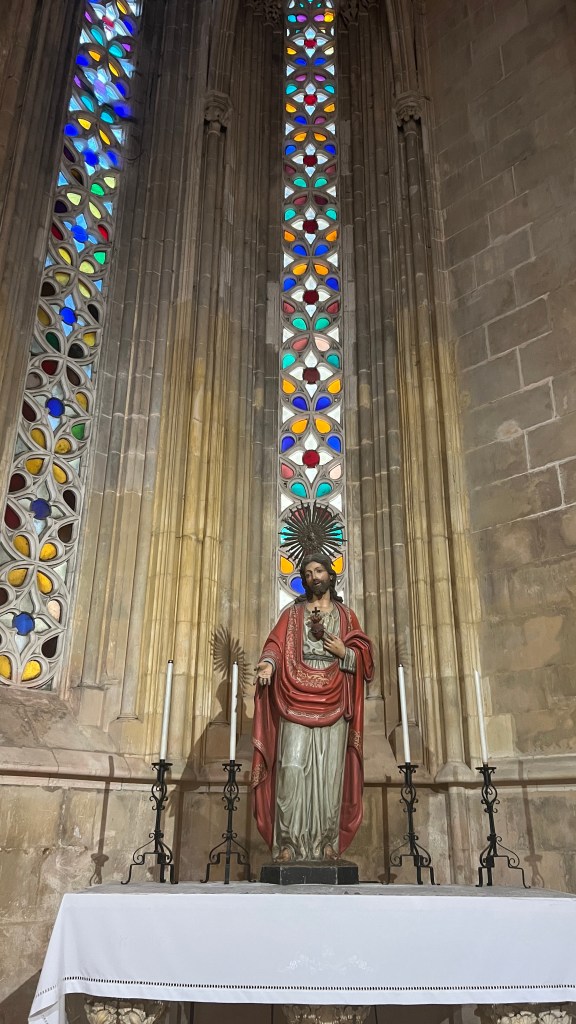
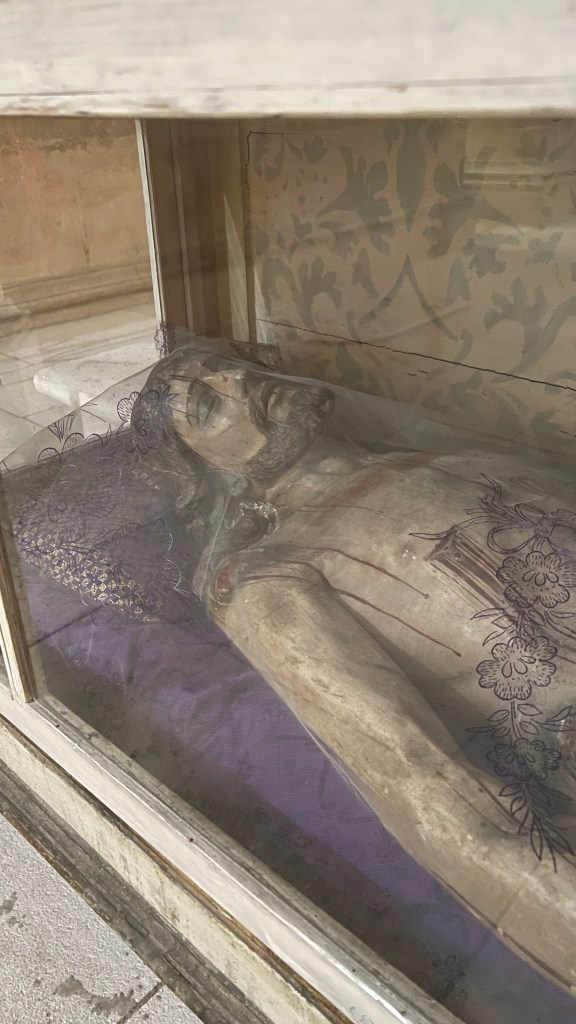
From Fatima, we travelled to Batalha (means battle) the site of a great battle and the location of the Monastery of Saint Mary of the Victory. Construction began in 1386 in thanksgiving for the victory at the battle of Aljubarrota between the Spanish and the Portuguese (these people still don’t like one another, and our guide tells us that anyone who says differently is lying.) There are some fantastic circumstances regarding the battle, but in the end, 6,000 Portuguese defeated 36,000 Spanish in about forty-five minutes. I would probably have built a church myself. At the far right side of the church you see columns that appear to be incomplete… they are. After 129 years of construction, the government said, “Enough,” and put the resources elsewhere.
A note on paying your artist: the one who crafted the horse and rider (general who led the battle) was never paid properly, so the artist made a few “mistakes” in creating the horse. 1) both left feet of the horse are off the ground. Guess what happens when both the left/right feet of a horse are off the ground. 2) It is a male horse that has three of what it should only have two and none of what it should have one. I’ll let you sort that all out.
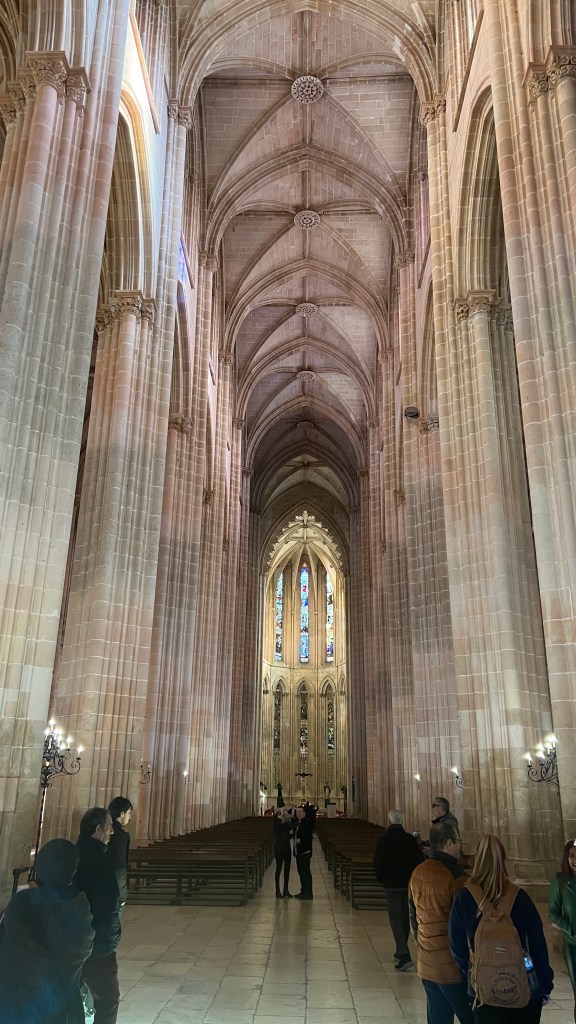
Moving indoors…
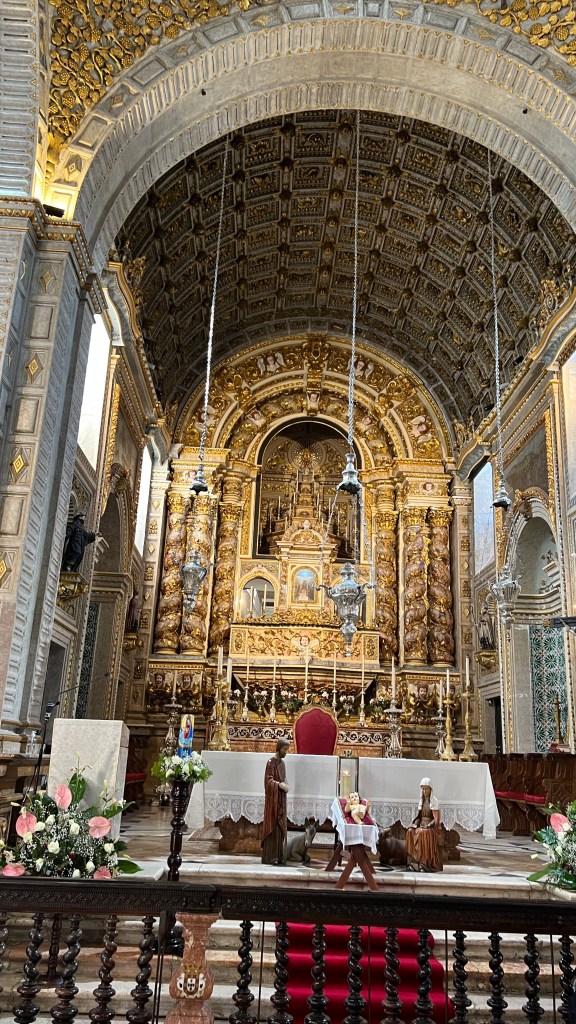
It is as though they were attempting to enclose heaven itself in such a dramatic space. The acoustics are incredible as the sound bounces off the ceiling (106 feet) and around the columns.
Other images…
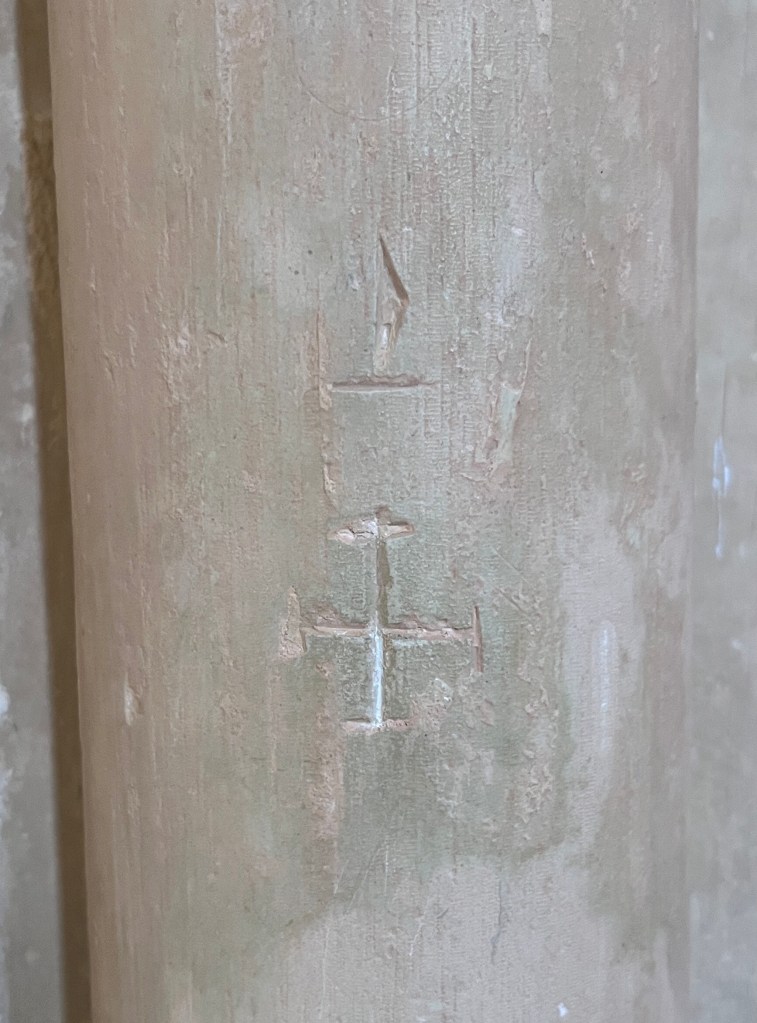
On each stone, you will see certain marks. These are the marks of the stonecutter. No mark = no pay. When a stone has two marks, it means that it was cut by an apprentice under the tutelage of a master.
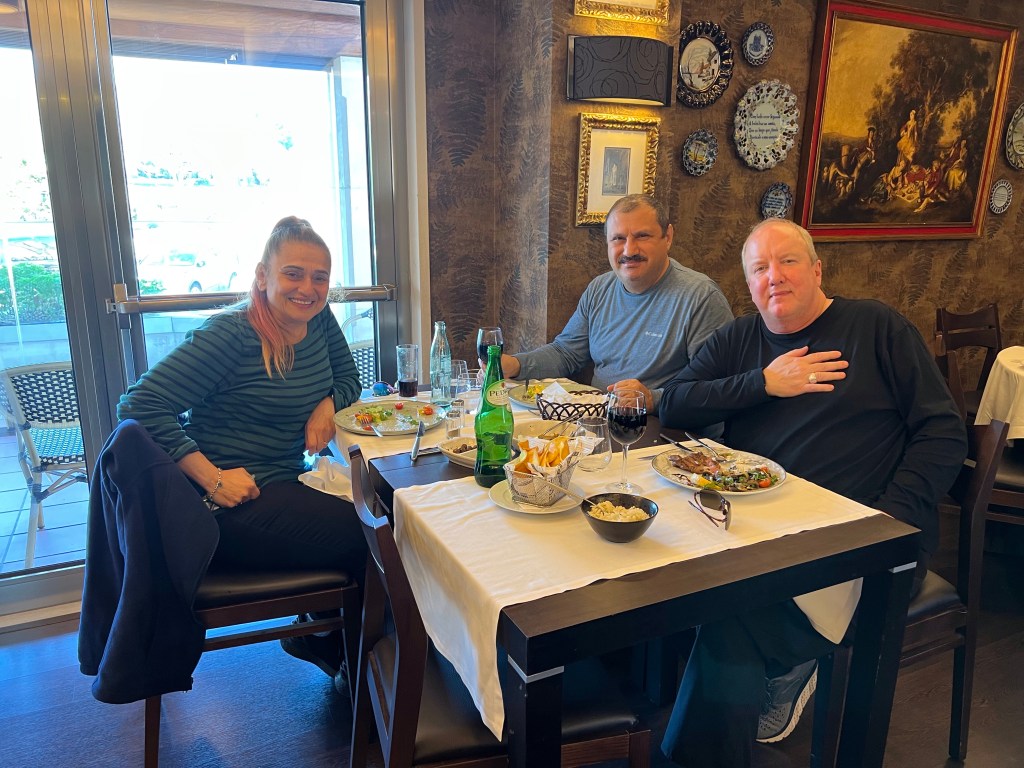
I shared lunch with this delightful Armenian couple who insisted on paying for mine. I protested, but he gave me a look that informed me I would not “win” the argument, so I said, “Thank you.”
Nazaré was next. It is known for its waves and the last three world records surfing have been attained here. Most tourists come for the huge waves, but as our guide explained, it is only about five days out of the year that the massive ones (120+ feet) come in. It was still spectacular.
If you think that the name, Nazaré, sounds remarkably close to Nazareth (my Armenian friend pointed this out), then you would be correct. A wonderful legend. You can find it here.
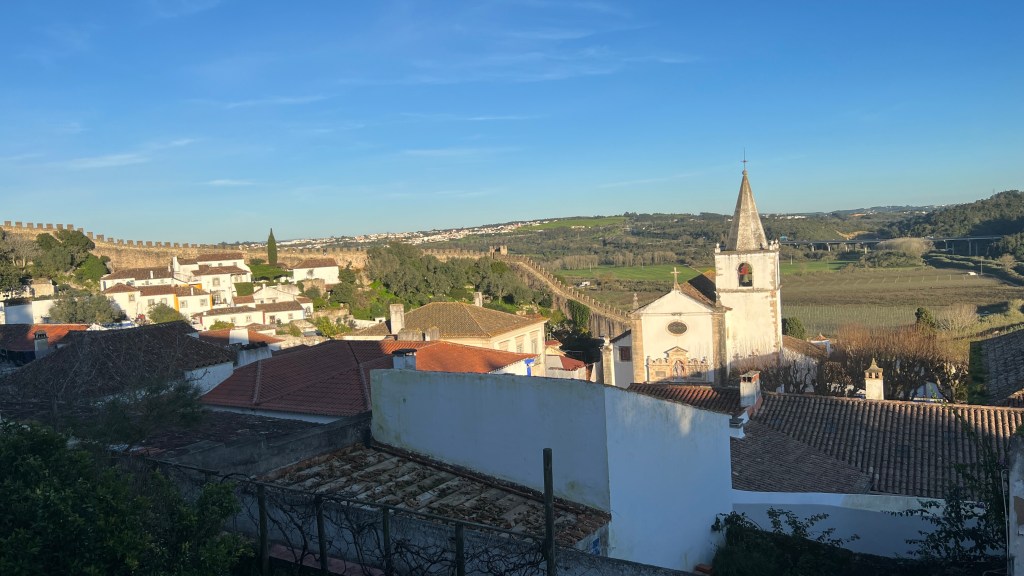
And then we were off to Óbidos (I’ll never get the hang of the language, but it doesn’t sound like it reads.) It is a well preserved example of early life in the region and is surrounded by the castle walls. It became a part of the queen’s dowry, so she would dictate the color that all the houses must be painted, which was white, but the owners had the option of color for “framing” the house.
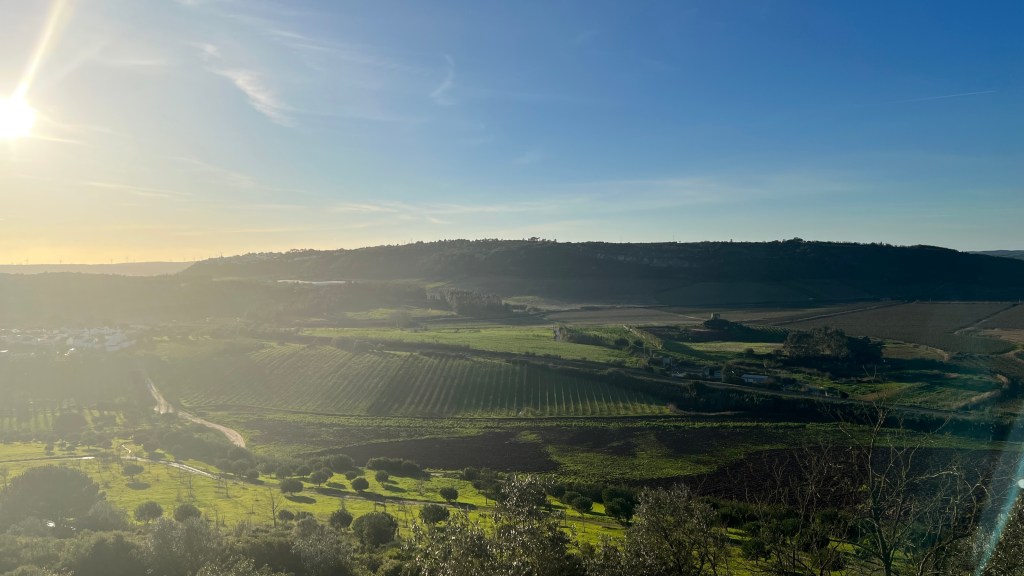
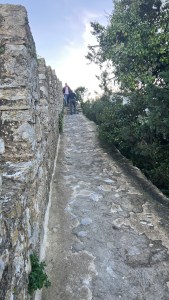
You are allowed to walk along the top of the wall and you do so at your own risk (definitely not OSHA approved!) By this time of the day, I was pooped out, so I did not take my chances in going all the way around, but the view…
The van was quiet for the ride home. All of us, including our guide, had a very full day. When I returned to the apartment, I had a couple of boiled eggs and a piece of bread, then put my feet up.
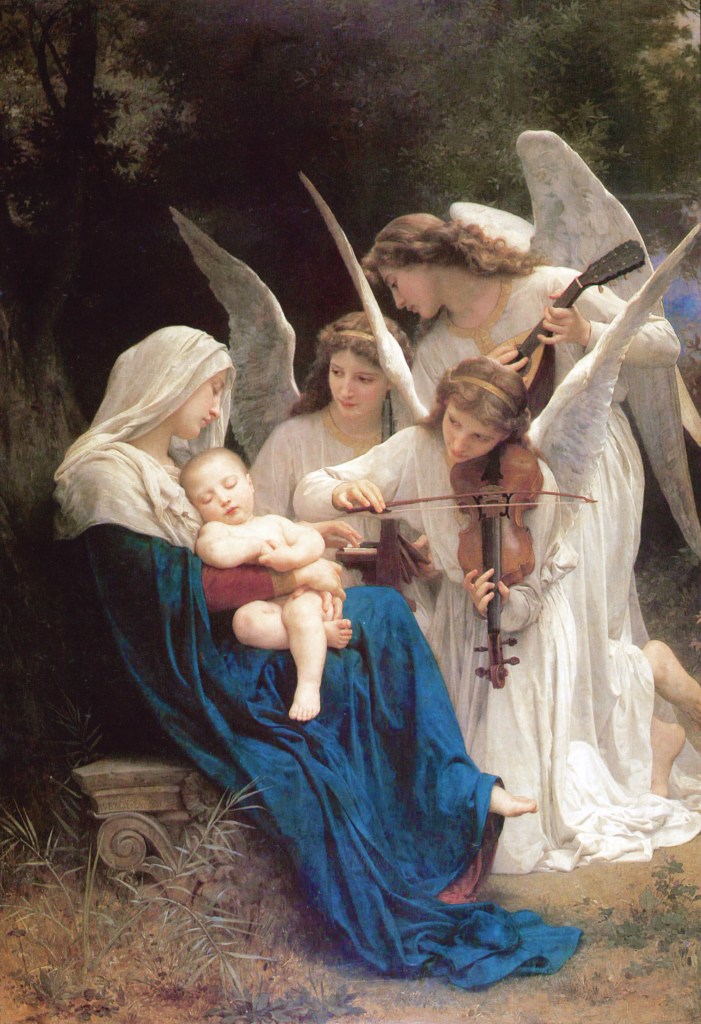
The Virgin with Angels, also known as The Song of the Angels by William-Adolphe Bouguereau
An elderly man in Phoenix calls his son in New York and says, “I hate to ruin your day, but I have to tell you that your mother and I are divorcing; forty-five years of misery is enough.”
“Pop, what are you talking about?” the son screams.
“We can’t stand the sight of each other any longer,” the old man says. “We’re sick of each other, and I’m sick of talking about this, so you call your sister in Chicago and tell her,” and he hangs up.
Frantic, the son calls his sister, who explodes on the phone.
“They’re not getting divorced if I have anything to do about it,” she shouts, “I’ll take care of this.”
She calls Phoenix immediately and screams at the old man, “You are NOT getting divorced. Don’t do a single thing until I get there. I’m calling my brother back, and we’ll both be there tomorrow. Until then, don’t do a thing, DO YOU HEAR ME?” and hangs up.
The elderly man hangs up his phone, turns to his wife, and says, “Okay, they’re coming for Thanksgiving… now what do we tell them for Christmas?”
When it comes to being together, we can go to a great extent—anything from traveling long distances to manipulating the circumstances—whatever it takes. St. Paul speaks to us about being the Body of Christ, but being together is even more than that.
Maybe you remember from school Maslow’s Hierarchy. It is the pyramid that breaks down the various needs in our lives. At the top are the physiological needs: air, food, sleep, and the like. Next are the safety needs: health, security, etc. And immediately following this is our need for belonging and being loved—the need for others.
There are many, myself included, who can spend extended periods of time by themselves, but eventually, even the greatest of loners need companionship. We see this even in God: Father, Son, and Holy Spirit. Richard of St. Victor has a beautiful explanation of why God is a Trinity of Persons—I won’t bore you with the details tonight—but it is based on love and this need, even for God, to have relationship.
The relationship between the Holy Trinity is perfect, but we know that our relationships, even the very best, are far from perfect. They tend to be messy. If that is the case, God is perfect, and we are messy, then why would he bother becoming one of us?
We read tonight that as the shepherds were tending their flocks, an angel of the Lord appeared to them and said, “Do not be afraid; for see– I am bringing you good news of great joy for all the people: to you is born this day in the city of David a Savior, who is the Messiah, the Lord. This will be a sign for you: you will find a child wrapped in bands of cloth and lying in a manger.” The angel announced the birth of God into the world.
Jesus’ birth will ultimately bring about our salvation—eternal life with God in that Heavenly Kingdom, but what about in the meantime? From the day we are born to the day we die? Why would God, who is in a perfect relationship, choose to enter into our lives and become a part of our far from perfect, messy relationships? It’s not like God needed us. So, why?
OSur relationship with God was wrecked in the Garden of Eden when Adam and Eve took a bite of that apple, but it was fully restored with the birth of Jesus. It was restored so that we can always be with Him, whether we are alone or with others. God humbled himself to be born—not because he needed us, but because we need Him… and He knows it.
Henri Nouwen writes, “God came to us because he wanted to join us on the road, to listen to our story, and to help us realize that we are not walking in circles but moving towards the house of peace and joy. This is the great mystery of Christmas that continues to give us comfort and consolation: we are not alone on our journey. The God of love who gave us life sent his only Son to be with us at all times and in all places, so that we never have to feel lost in our struggles but always can trust that he walks with us…. Christmas is the renewed invitation not to be afraid and to let him—whose love is greater than our own hearts and minds can comprehend—be our companion.” (You Are the Beloved, p.391)
Tonight, we light the Christ candle.
“In the beginning was the Word, and the Word was with God, and the Word was God. He was in the beginning with God. All things were made through him, and without him was not any thing made that was made. In him was life, and the life was the light of men. The light shines in the darkness, and the darkness has not overcome it.”
Jesus is this light… our light… shining in the darkness. He came, as Nouwen told us, “because he wanted to join us on the road” to “be our companion.” Jesus said, “I am the light of the world. Whoever follows me will not walk in darkness, but will have the light of life.” Jesus came to join us on the road of our lives. To be—not “a” light, but the light that guides us. He also came to give us this light of himself so that we could become “children of light.” (1 Thessalonians 5:5)
Tonight, I invite you to step out of the darkness and walk with Jesus on the road. I’ve no idea where God will lead you in this life, but I do know the final destination, which is what the journey is ultimately all about, for he will be with us now so that we can be with him then, having eternal life in Our Father’s Heavenly Kingdom.
“Do not be afraid; for see—this is good news of great joy for all people: for us was born in the city of David a Savior, who is the Messiah, the Lord… the Light of all who call on his name.”
Let us pray: Gracious and loving Father, you make this holy night radiant with the splendor of Jesus Christ our light. We welcome him as Lord, the true light of the world. Bring us to eternal joy in the kingdom of heaven, where he lives and reigns with you and the Holy Spirit, one God, for ever and ever. Amen.
A new soldier was on sentry duty at the main gate of a military installation. His orders were clear. No car was to enter unless it had a special sticker on the windshield. A big Army car came up with a general seated in the back. The sentry said, “Halt, who goes there?”
The chauffeur, a corporal, said, “General Wheeler.”
“I’m sorry, I can’t let you through. You’ve got to have a sticker on the windshield.”
The general said to the chauffeur, “Drive on!”
The sentry said, “Hold it! You really can’t come through. If anyone attempts to drive in without a sticker, I have orders to shoot.”
The general barked at the chauffeur, “I’m telling you, son, drive on!”
The sentry walked up to the driver’s window and said quietly to the chauffeur, “I’m new at this. Do I shoot you or the general?”
One article states, “We each have a uniquely valuable perspective on life—a lens through which we interpret our lives. Through our perspective, we define what makes sense to us, which is differentiated from how others see and experience life.” (Source) From the general’s perspective, the world was at his command, and he could do what he wanted regardless of the rule. However, the chauffeur’s perspective was likely considerably different at that moment. The lens through which he was interpreting the situation was the barrel of a gun.
The perspectives we hold are formed by many factors—environment, age, situation, knowledge, etc.—so our perspective is a combination of all these things and is something that is learned over time—according to the article—“Our perspective is arguably the single greatest aspect of our uniqueness.” Our fingerprints are as unique as each individual snowflake, and so are our perspectives.
What’s interesting is when our perspective—the lens through which we view the world—encounters faith. For example, consider St. Peter.
The disciples are crossing the sea in their boat when they see Jesus walking on the water. At first, they are terrified, but then Jesus identifies himself, “Take heart; it is I. Do not be afraid.” Hearing this, Peter says, “Lord, if it is you, command me to come to you on the water.” And Jesus said, “Come.” And we know that Peter had faith, got out of the boat, and walked on the water, but then his perspective changed: “when he saw the wind, he was afraid, and beginning to sink he cried out, ‘Lord, save me.’” I firmly believe that Jesus laughed heartily when he said to soaking-wet Peter, “O you of little faith, why did you doubt?”
From his perspective, Peter, a fisherman who grew up working on the water, walking on water was impossible, yet through faith—at least for a few steps—Peter held a different perspective. Through faith, what he perceived to be impossible, was suddenly possible. When he reverted to his original perspective—doubt—he sank, but for those few steps, there was faith.
If it was night and all the lights were out, and these four candles were all the light in the room, some’s perspectives would still only show them darkness even though there was light. They would see shadows in the corners and blackness under and behind objects. Yet others would see the hope of light. Even if the darkness were vast around them, they would see the light as a way forward. And many others would see both. Fear of the dark, but thankful there is at least a little light to keep some of the darkness at bay. You and I are somewhere on that spectrum. It depends on our perspective, but more importantly, it depends on our faith.
We read of Joseph in our Gospel lesson. Mary was found to be with child before they were married. He had not been with her, so he assumed another man had, so he planned to call off the wedding. Joseph was a kind man, but even so, he was not prepared to be with someone who had been unfaithful. Joseph looked around him and saw the dark and the shadows, and then the angel of the Lord came to him in a dream and said, “Joseph, son of David, do not be afraid to take Mary as your wife.” Joseph was shown the light but was his perspective going to change, or would he remain afraid of the dark—what will others say? How can I ever trust her? Was I really only dreaming and so many more shadows? Yet, another variable came to bear when he woke from his sleep: faith. Through faith, his perspective changed, and “he did as the angel of the Lord commanded him; he took her as his wife.”
There is a story about a train traveling through the night in a violent rainstorm.
The lightning flashes were almost blinding, the rain hitting the windows was deafening, and the strong gust winds rocked the train from side to side.
The passengers could see the rising water along the tracks when the lightning flashed and lit up the darkness.
The engineer—the driver of the train— was unaware, but the storm and rising water created great terror in the minds of the passengers, so the engineer just kept going.
Several passengers noticed that through all the noise, lightning, and wind, one of the passengers, a little girl, seemed to be at perfect peace.
The adult passengers couldn’t figure out why she was so calm. Finally, one passenger asked her, “How can you be so calm when all the rest of us are so worried about what might happen?”
The girl smiled and said, “My father is the engineer.”
Storms. Lightning. Rising waters. Darkness. Shadows. Death. Fear. “My father is the engineer.” Faith.
Joseph experienced those same fears, that darkness, but when he awoke, he had faith and said in his heart, “My father is the engineer.” Faith changed his perspective.
In the opening verses of his Gospel, St. John wrote, “The true light, which gives light to everyone, was coming into the world. He—Jesus—was in the world, and the world was made through him, yet the world did not know him. He came to his own, and his own people did not receive him. But to all who did receive him, who believed in his name, he gave the right to become children of God, who were born, not of blood nor of the will of the flesh nor of the will of man, but of God.”
Jesus, the true Light, came into the world, but many—even though they saw this light—continued to see shadows and darkness all around them. Those with faith received him and became children of God.
I’m not Pollyanna. I am very much aware of the shadows and darkness around us, but we cannot spend our lives dwelling in it. We must, through faith, change our perspective and see this light that has come into the world. It will not eradicate the darkness, but it will show us the way through the dark valley unto the Kingdom of our God… but not just that. It will also show us the way to the Kingdom of our God that is made manifest today, for his name is Emmanuel, which does not mean “God will be with us.” No. His name is Emmanuel, which means “God is with us.” And His Father is the Engineer.
Let us pray: Father in heaven, our hearts desire the warmth of your love, and our minds are searching for the light of your Word. Increase our longing for Christ our Savior and give us the strength to grow in love, that the dawn of his coming may find us rejoicing in his presence and welcoming the light of his truth. We ask this in the name of Jesus the Lord. Amen.
Click the image below to join the conversation on St. Matthew’s Facebook page.
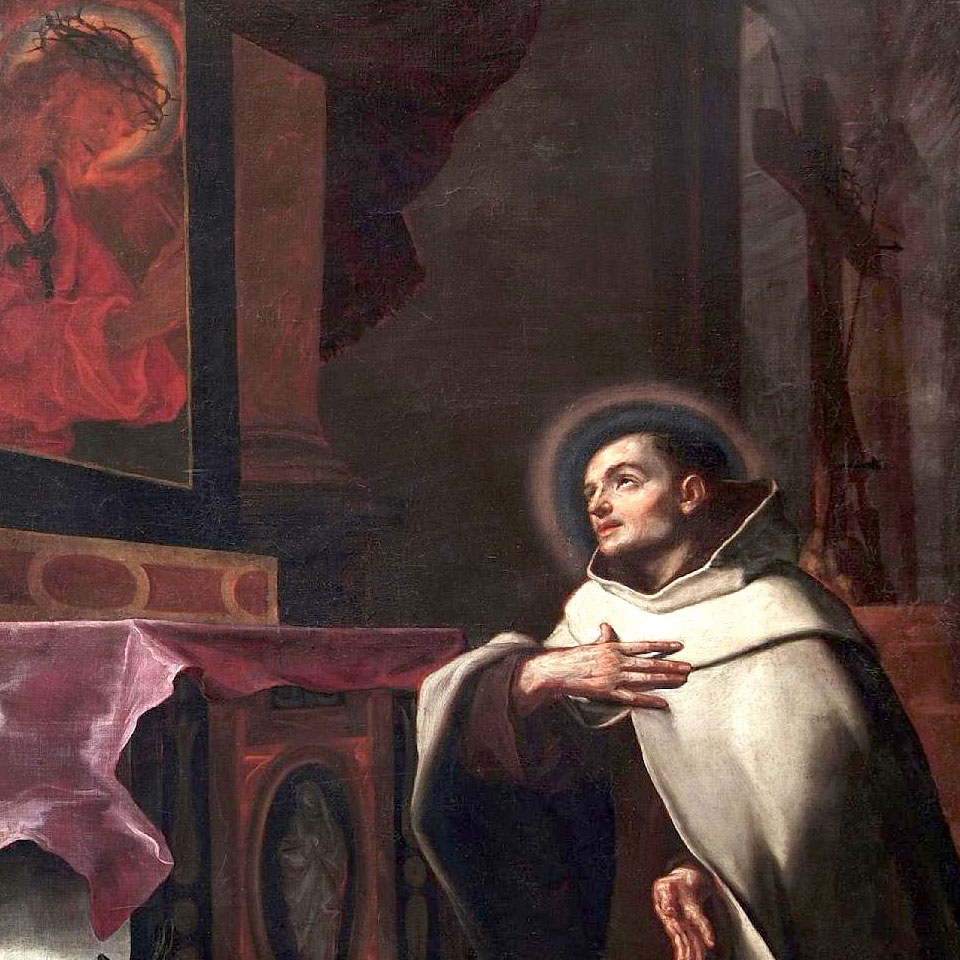
St. John of the Cross died on this day in 1591 at the age of 49. He was a true friend and contemporary of Teresa of Avila. Together, they worked to reform the Carmelite order, which they were a part of, enforcing a much stricter application of the rule. All did not appreciate that enforcement, and John was persecuted and eventually imprisoned by—not the authorities, but by fellow monks who disagreed with him.
His life is an example to us, but the writings he left behind are perhaps his greatest gifts. Of these, he is best know for, Dark Night of the Soul. It began with the writing of a poem, but then he was asked by fellow monks—those who did not want to throw into prison—to write a commentary explaining the work. The commentary of the first three stanzas of eight is all that remains (if there ever was more) and is practical in its approach to prayer.
Today, I would like to share the poem with you. Many translations are available; I’m not sure who gave us this one. When reading the poem, think of prayer. Think of entering into a place of darkness where without light, the fire burning in your heart is your guide that leads you to union with God. Once with God, it is not about speaking to Him but being with him.
Into the darkness of the night With heart ache kindled into love, Oh blessed chance! I stole me forth unseen, My house being wrapped in sleep.
Into the darkness, and yet safe By secret stair and in disguise, Oh gladsome hap! In darkness, and in secret I crept forth, My house being wrapt in sleep.
Into the happy night In secret, seen of none, Nor saw I ought, Without, or other light or guide, Save that which in my heart did burn.
This fire it was that guided me More certainly than midday sun, Where he did wait, He that I knew imprinted on my heart, In place, where none appeared.
Oh Night, that led me, guiding night, Oh Night far sweeter than the Dawn; Oh Night, that did so then unite The Loved with his Beloved, Transforming Lover in Beloved.
On my blossoming breast, Alone for him entire was kept, He fell asleep, Whilst I caressed, And fanned him with the cedar fan.
The breeze from forth the battlements, As then it tossed his hair about, With his fair hand He touched me lightly on the neck, And reft me of my senses in a swoon.
I lay quite still, all mem’ry lost, I leaned my face upon my Loved One’s breast; I knew no more, in sweet abandonment I cast away my care, And left it all forgot amidst the lilies fair.
Jesus said, “I still have many things to say to you, but you cannot bear them now. When the Spirit of truth comes, he will guide you into all the truth; for he will not speak on his own, but will speak whatever he hears, and he will declare to you the things that are to come.” If we are to hear and know those things the Spirit would teach us, then in prayer, we must follow the flame of our heart, which will guide us into that union with God where we can learn even more about our Savior.
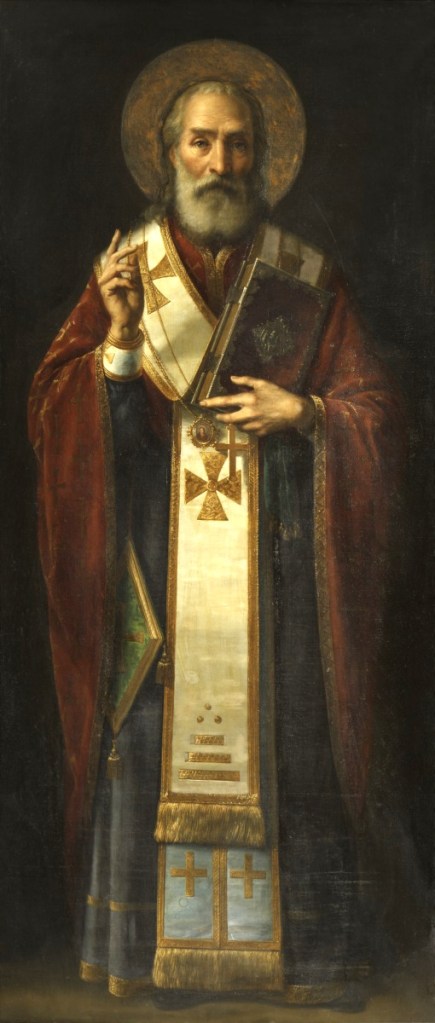
Today is actually the Feast day of Ambrose of Milan, but yesterday was the Feast Day of Nicholas of Myra, and I couldn’t pass up on ol’ St. Nick. He was persecuted under Emperor Diocletian and was most likely one of the Bishops at the Council of Nicea in 325. While there, he is reported to have boxed the ears of a heretic. He is the patron saint of sailors and, of course, children.
The legends are fun. In one, he saves the three daughters of a poor man from becoming prostitutes by providing their dowry; in another, he restores to life three children who had been killed and placed in a vat of brine. Neither or both may be true, but in either case, they likely point to certain truths about the character of this now jolly-red-suit-with-white-fur-trim-clad saint: he showed great compassion for those in need and was called to serve the dispossessed.
These, the needy and the dispossessed, are often the ones we would like to look past. Even as the Church, good Christian people, we often find it challenging to look at the sufferings of others because we spend so much of our time looking in. Self-preservation and self-examination are instinctive and good practices, but they can lead to us becoming self-consumed.
Vince Lombardi was the head coach of the Green Bay Packers from 1959 to 1967. During that time, Bart Starr was the first-string quarterback. Starr, as well as everyone else, knew where they stood with regard to Lombardi. Starr said, as you entered Vince’s office, you noticed a large mahogany desk with an impressive organization chart behind it on the wall. The chart had a small block at the top in which was printed: “Vince Lombardi, Head Coach and General Manager.” A line came down from it to a very large block in which was printed: “Everybody Else!”
When we become self-consumed, we see ourselves in a similar position. We’re at the top, and everybody else is below us.
In his book, Ethics, Dietrich Bonhoeffer wrote, “God loves human beings. God loves the world. Not an ideal human, but human beings as they are; not an ideal world, but the real world. What we find repulsive in their opposition to God, what we shrink back from with pain and hostility, namely, real human beings, the real world, this is for God the ground of unfathomable love.” (p.84)
The world is the ground of God’s unfathomable love, and we, like St. Nicholas, can be the conduits of that love by seeing—not the needy and dispossessed / everybody else—but by seeing the objects of God’s love.
In the time of Jesus, the children were among the needy and dispossessed. They could not work or provide for themselves, yet Jesus said to his disciples who tried to prevent those children from coming to him, “Let the little children come to me; do not stop them; for it is to such as these that the kingdom of God belongs.” We must be wise in our dealings with the world, but we must not become so calloused or self-consumed that we are preventing the children from approaching Jesus; or us. We are to allow them to come so we might point them to the one who is Love.