The Way of Salvation fresco by Andrea di Bonaiuto da Firenze
The Book Ecclesiasticus is from the Apocrypha, and the 44th chapter begins,
Let us now sing the praises of famous men, our ancestors in their generations. The Lord apportioned to them great glory, his majesty from the beginning.
So, on this All Saints Day, let us.
About the year 115 a.d. there lived a man we know as Ignatius of Antioch. Except for a brief history, all we know of him comes to us through legend and seven letters he wrote. Concerning the legend, do you remember the story of the little boy that Jesus picked up? Having brought the child into the midst of the disciples, Jesus said, “Whoever receives one such child in my name receives me, and whoever receives me, receives not me but him who sent me.” (Mark 9:37) Well, the legend of Ignatius tells us that he was this child. Legend/history tells us that Ignatius would go on to become Bishop in Antioch. During one of the many persecutions, he was captured and taken to Rome for trial. He would be tried and executed for treason. However, during the journey between Antioch and Rome, his guards treated him somewhat civilly and were sympathetic to the elderly man, so they allowed him to write letters to the believers back home. Seven of those letters survive to this day, and through them, some of the foundational stones of the Christian Church were laid, especially as they relate to Holy Scripture, the Creeds, Bishops, Priests, Deacons, and the liturgy. Ignatius of Antioch is clearly a Saint in the Christian Church. Let us sing the praises of Ignatius.
Let’s change one word of the verse from Ecclesiasticus and say, “Let us now sing the praises of famous women.” The Blessed Virgin Mary is the most famous, but many others exist. During the time of Emperor Septimus Severus in the early third century, it was illegal to convert to Christianity. This likely deterred some, but not all. If the officials became aware, the convert was arrested and given the opportunity to recant. They were then required to make sacrifices to the Roman gods. Only then could they go about their business. If they refused, they were put to death. Felicity and Perpetua were two women who refused to recant their faith even though they had both only recently been baptized and both had just had children. On the day of their execution, they were given one last chance to recant, and when they refused, a wild bull was released into the cage where they were and trampled. Wounded by the animal, they gave each other the kiss of peace and were then put to the sword. Felicity and Perpetua are martyr saints in the Christian Church. Let us sing the praises of Felicity and Perpetua.
We could do this all day and not even hear the tip of the iceberg because the Church recognizes more than 10,000 official Saints. And when we begin to include individuals such as Dietrich Bonhoeffer, the Martyrs of Uganda, C.S. Lewis, and Evelyn Underhill, the list seems endless. However, we are still not done singing praises. Why? There are many more in the making. Today, my question for you is, “How are you becoming a Saint?” For becoming a saint should be the desire of us all. How do you go about it? My friend, St. Josemaría Escrivá wrote, “Do you really want to be a saint? Carry out the little duty of each moment: do what you ought and concentrate on what you are doing.” (The Way, 815)
Follow in the footsteps of the Saints, and in the end, not only will you hear others sing your praises, but you will hear Jesus as well when He says, “Well done, good and faithful servant…. Enter into the joy of your master.” (Matthew 25:21)
Around 67 A.D., when Nero was Emperor, Paul was imprisoned in Rome. A few years prior, Peter had been crucified in Rome, and a year or so following, Paul would also be put to death, most likely by beheading. We can only imagine the trials that he must have endured during this time, and it was at this time that Paul wrote his second letter to Timothy that we read.
He says to Timothy, “Do your best to come to me soon, for Demas, in love with this present world, has deserted me and gone to Thessalonica; Crescens has gone to Galatia, Titus to Dalmatia. Only Luke is with me. Get Mark and bring him with you, for he is useful in my ministry. I have sent Tychicus to Ephesus.” A few verses later, he says, “Alexander the coppersmith did me great harm; the Lord will pay him back for his deeds… At my first defense no one came to my support, but all deserted me… Erastus remained in Corinth; Trophimus I left ill in Miletus. Do your best to come before winter.”
Paul does not strike me as a whiner, but in reading these verses, you can hear the anxiety in his voice. He knows his death is near, and he is mostly alone. There is mention of some others who are near, but many others have left, deserted, or betrayed him, and there is mention of only one that is with him: “Only Luke is with me.” Today is the Feast of St. Luke, and there are many great things that we can say about him, but for me, that one line seems to sum them all up: Luke is with me.
For Paul, Luke was a friend, companion, ally, support, minister, etc. In short, Luke was the Church to Paul. We all know that the Church is not made of wood and stone but flesh and blood. We also know that it is not perfect but a gathering of souls seeking God and His will. Archbishop of Canterbury Michael Ramsey said, “When I say in the Creed, ‘I believe in One, Holy, Catholic and Apostolic Church,’ I am saying that I believe that there is a divine society, the risen Christ is the glory in the midst of it, the Holy Spirit is at work within it. Wherever its members respond to the reality about themselves and their calling, the marks of saintliness do indeed begin to appear.”
The Church is made of flesh and blood and is not perfect, but it is a divine society made up of those who look beyond themselves, who see into the reality of the world around them, and who desire to seek and serve Christ in all the various situations. They are ones, and the church is one that seeks saintliness. What might that look like? Luke’s example points the way. He demonstrates to us a life of sacrifice, a life that—even though everyone else may quit or abandon or betray—remains faithful, standing firm in Christ and exhibiting the love of Jesus in his every deed and word.
We, as the disciples of Jesus, are called to be that Church. By so doing, as members of the Church, the Body of Christ, when any of us are experiencing those times of great joy or are in our darkest hour, we will be able to confidently say with Paul, “Luke is with me. ___ is with me. ___ is with me. The Church is with me. And because these are with me, Christ Jesus is with me.” We will be confident in saying this because each of us will have sought after that saintliness, not for our own glory, but the glory of God.
The U.S. standard railroad gauge (distance between rails) is four feet, eight-and-one-half inches.
Why such an odd number? Because that’s the way they built them in England, and American railroads were built by British expatriates.
Why did the English adopt that particular gauge? Because the people who built the pre-railroad tramways used that gauge.
They, in turn, were locked into that gauge because the people who built tramways used the same standards and tools they had used for building wagons, which were set on a gauge of four feet, eight-and-one-half inches.
Why were wagons built to that scale? Because with any other size, the wheels did not match the old wheel ruts on the roads.
So, who built these old rutted roads?
“The first long-distance highways in Europe were built by Imperial Rome for the benefit of their legions. The roads have been in use ever since. The ruts were first made by Roman war chariots. Four feet, eight- and-one-half inches was the width a chariot needed to be to accommodate the rear ends of two war horses.”
Some things never change, but perhaps they should, especially if the standard used to measure is a horse’s… backside.
The parable we heard today comes immediately on the heels of the parable we heard last week, the Parable of the Wicked Tenants. In that parable, Jesus condemned the religious leaders because they had not fulfilled the work God had given to them—to be the light of the world. This week’s parable is much the same but is not only applicable to the religious leaders but to everyone.
The king held a wedding feast for his son and sent out the invitations. The recipients of those invitations did not take it seriously. They made trivial excuses as to why they couldn’t attend—I have a hangnail, that’s the day I plan to rearrange my bookcases, I’m pretty sure I’ll have a headache that day, and so on. Upon receiving their invitation, others took it several steps further, abusing or even killing the messengers. All this enraged the king, so he sent in his troops and destroyed the city where those who had been invited lived; then, the king told his servants, “We’re having a wedding feast for my son; invite anyone and everyone.” So they did, and the wedding hall was filled.
In the parable, the king represents God, the people invited are the Israelites, and the messengers are the prophets. Time and again, God invited the people, forgave the people, and implored the people. He tried everything to bring them into a right relationship with Himself, but they refused. The last straw was their refusal to participate in the life of His Son, Jesus. What is stated next in the parable is a prophecy of what will transpire due to their refusal. First, God will burn their city. This is referencing the destruction of Jerusalem that occurred about forty years later in 70 a.d. Second, God invited others into relationship—God invited the Gentiles. He invited us to the wedding, into relationship with Himself through Jesus, and grafted us in. (cf Romans 11:11-24) The wedding hall was full, and they all lived happily ever after. Well, almost all.
“But when the king came in to see the guests, he noticed a man there who was not wearing a wedding robe, and he said to him, ‘Friend, how did you get in here without a wedding robe?’ And he was speechless. Then the king said to the attendants, ‘Bind him hand and foot, and throw him into the outer darkness, where there will be weeping and gnashing of teeth.’ For many are called, but few are chosen.” Who is this guy, and why did he get the boot? We need to go back earlier in Jesus’ ministry for the answer.
In Matthew 7, Jesus said, “Every tree that does not bear good fruit is cut down and thrown into the fire.” (v.19) He then says, “Not everyone who
says to me, ‘Lord, Lord,’ will enter the kingdom of heaven, but the one who does the will of my Father who is in heaven. On that day many will say to me, ‘Lord, Lord, did we not prophesy in your name, and cast out demons in your name, and do many mighty works in your name?’ And then will I declare to them, ‘I never knew you; depart from me, you workers of lawlessness.’” (v. 21-23)
Many appear to have heard the word of God and seem to be doing the work of God. They are doing and saying all the right things, but, as the saying goes, all that glitters is not gold. Soon after today’s parable, Jesus will say, “Woe to you, scribes and Pharisees, hypocrites! For you clean the outside of the cup and the plate, but inside they are full of greed and self-indulgence. You blind Pharisee! First clean the inside of the cup and the plate, that the outside also may be clean.” (Matthew 23:25-26) The man removed from the wedding appeared to be saying and doing everything right. He was all shiny on the outside but not so much on the inside. The man was happy being in his four-foot, eight-and-one-half- inch rut and did not think he needed to change. He said in his heart, take me as I am, or don’t take me at all; and God said, “OK,” and didn’t take him.
We read in St. Paul’s letter to the Philippians, “Beloved, whatever is true, whatever is honorable, whatever is just, whatever is pure, whatever is pleasing, whatever is commendable, if there is any excellence and if there is anything worthy of praise, think about these things. Keep on doing the things that you have learned and received and heard and seen in me, and the God of peace will be with you.” Keep on doing the things you have learned, received, heard, and seen. In other words, you were on a particular path, but you came to understand that it was the wrong path and, therefore, learned a new way. Keep going in this new way.
That old hymn, Just as I am—we can hear those words and think that God will take us just as we are. Will He? Yes, He will. No question. No doubt. Warts and all, but God does not plan on you staying just as you are. The former Bishop of Durham, N.T. Wright says, “When the prostitutes and extortioners came to Jesus, he didn’t say, ‘You’re all right as you are.’ His love reached them where they were, but his love refused to let them stay as they were. Love wants the best for the beloved. Their lives were transformed, healed, changed.” (Matthew for Everyone, vol. 2, p. 84) The man removed from the wedding feast wanted to go to the party but also wanted to stay as he was. In his arrogance, he did not believe he needed to be transformed, healed, and changed.
Peter Senge, a professor at MIT and the author of The Fifth Discipline, a book on business management, recalls the words of a consultant, “People don’t resist change; they resist being changed.” (p.144) That is true in business, and that is true in our daily lives, including our life with God. In our pride, we say, “I’m good enough, and I don’t need to change. God will just have to take me as I am.” We resist the changes that need to be made in our lives in order to reflect the righteousness we are called into. In the context of the parable, we say to the King, “The clothes I have on are good enough for me, so they’ll just have to be good enough for You.” The King says, “The standard by which you are measuring yourself is equal to a horse’s backside. Therefore, refusing to be transformed into the Image of God means you’ll never be anything more than a horse’s… backside.” Your refusal to be transformed means you’ll be removed from the wedding feast.
Jesus said, “Enter [the Kingdom of Heaven] by the narrow gate. For the gate is wide and the way is easy that leads to destruction, and those who enter by it are many. For the gate is narrow and the way is hard that leads to life, and those who find it are few.” (Matthew 7:12-13) Break out of the ruts of your life and follow the path where Jesus has led the way. By doing so, you will not be fashionable or a part of the crowd. As a matter of fact, you may find very few along the way, but if you are following Jesus, then He will lead you through the narrow gate and into the wedding feast.
Let us pray: Father of love, hear our prayer. Help us to know Your Will and to do it with courage and faith. Accept the offering of ourselves, all our thoughts, words, deeds, and sufferings. May our lives be spent giving You glory. Give us the strength to follow Your call, so that Your Truth may live in our hearts and bring peace to us and to those we meet, for we believe in Your Love. Amen.
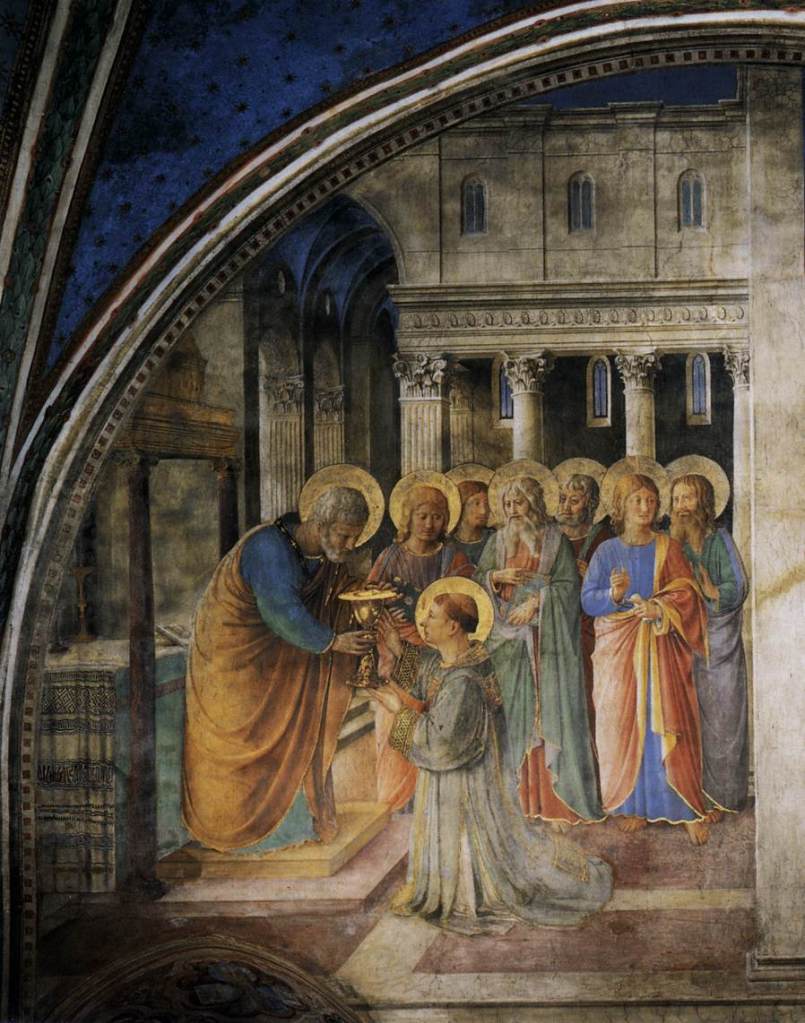
Section of a fresco in the Niccoline Chapel by Fra Angelico, depicting Saint Peter consecrating the Seven Deacons. Saint Stephen is shown kneeling.
Today, we celebrate Philip, but in the New Testament, which is he? There was Philip, the brother of Herod, so I’m pretty sure we can cross him off the list, but then there was also Philip the Apostle. From the tenth chapter of Matthew, “Then Jesus summoned his twelve disciples and gave them authority over unclean spirits…” and Philip is one of the twelve named. However, in the sixth chapter of the Book of Acts, we learn that the disciples are becoming overwhelmed by the amount of work required, so they call seven others to work alongside them in the capacity of what we would now call a deacon. The most famous is Stephen because he is the first martyr of the Church, but included in the list of the seven is another, Philip, and it is this Philip that we celebrate today. How do we know which one he is?
Before Paul (a.k.a. Saul) was converted while traveling the road to Damascus, he acted as one of the early church’s great persecutors, which led to the dispersal of many Christians. Acts 8 describes it: “That day a severe persecution began against the church in Jerusalem, and all except the apostles were scattered throughout the countryside of Judea and Samaria.”
“All except the apostles…” meaning that the Apostle Philip remained in Jerusalem, but just a few verses on, we read, “Now those who were scattered went from place to place, proclaiming the word. Philip went down to the city of Samaria and proclaimed the Messiah to them.” Most scholars agree that Philip, the deacon, became a very influential evangelist in Samaria after the dispersal. He did so well that the disciples in Jerusalem had to see it for themselves: “Now when the apostles at Jerusalem heard that Samaria had accepted the word of God, they sent Peter and John to them.”
The most familiar story we have of Philip is the conversion of the Ethiopian Eunuch, also occurring in chapter 8 of the Book of Acts that we hear today. It takes a good bit of work to sort this story out, but the eunuch was probably not as we understand a eunuch to be, but was most likely the Chancellor (think right-hand person to the Queen) and guardian of the treasury. In addition, he was a God-fearer—he believed in the God of the Jews and had made a pilgrimage to Jerusalem to worship at the Temple. On the return trip, an angel of the Lord brings Philip to him, who opens the scriptures up, proclaims the Good News, and baptizes him. Following this, “When they came up out of the water, the Spirit of the Lord snatched Philip away; the eunuch saw him no more, and went on his way rejoicing.” St. Irenaeus writes that upon returning to Ethiopia, the eunuch founded the Ethiopian Church. As for Philip, he doesn’t return to the story in Acts until chapter twenty-one, about twenty-four years later.
Paul and Luke have been on a missionary journey. Luke writes, “The next day we left [Ptolemais] and came to Caesarea; and we went into the house of Philip the evangelist, one of the seven, and stayed with him. He had four unmarried daughters who had the gift of prophecy.” From there, St. Jerome tells us that Philip went on to become a bishop in the area and is believed to have died peacefully years later.
Philip found a place to call home. He had a wife and children. He did the work quietly and steadily. He was faithful to what he had been called to at a young age. For every one of the great Saints we study, there are 1,000s more who quietly, steadily, and faithfully go about the work of the Kingdom. We can look to these great ones for inspiration, and we can look at these other “great” ones, like Philip, for understanding how to live it out in our daily lives.
Clotile talked ol’ Boudreaux into taking her to New Your City because there was a Broadway show she really wanted to go and see, primarily because Pierre, the lead dancer, was a fella from Louisiana. Well, they fly up to Yankee Central and go to the show.
Soon after the show starts, Pierra walks onto the stage and starts doing the most beautiful, energetic, and exciting dancing that either of them has ever seen. His dances include some elegant ballet and some modern dance. At one point, he incorporates some contemporary dancing like the moonwalk, break dancing, and even some energetic acrobatic dancing. Suddenly, Clotile turns to Boudreaux and, pointing to Pierre on the stage, says, “I didn’t tell you this before, but I know this man from my ‘previous life.’ In fact, he proposed to me nearly 20 years ago, but I quickly rejected him as he just wasn’t my type.”
Boudreaux nodded understandingly and said, “Well, it looks to me like he’s still celebrating!” I’m guessing ol’ Bordeaux was also wishing he had been rejected.
This past week, I came across a short news story about an archeological site in southeastern France. As they went through the dig, they came across a piece of tile flooring, maybe two feet by one foot. There wasn’t anything extraordinary about it—no hieroglyphs or mosaics—but right in the middle was a toddler’s footprint. You can imagine Dad working hard to make the tiles, and while his back is turned, his child walks across the freshly poured tile. It reminded me of a few of the tiles at the Blessed Stanley Rother Shrine. When those were made, they were placed in the sun to dry, and a happy dog had walked across some. I may have mentioned it to you before, but after the guide pointed it out, it was easy to spend more time looking for paw prints than it was looking at the cathedral.
As I was thinking about this, I was reminded of my trip to Portugal and my time in some of the ancient cathedrals and monasteries. During the tour of the Monastery of Batalha—construction began in 1386—our tour guide pointed out various symbols carved into each stone. Each symbol was simple but unique. These are known as “banker’s marks” and are the “signature” of the stone mason who cut the stone so that when the stone arrived at the construction site, the mason could receive payment for his work. Like those paw prints in the tiles at the Rother Shrine, once you knew banker’s marks were there, you looked for them.
With those hand-cut stones, not only were the great cathedrals built, but so were castles, sea walls, and other buildings, public and private. What is so surprising and difficult to understand is that those cathedrals and other structures that were constructed centuries upon centuries ago are still standing. Yet, we’ve got buildings that were built fifty years ago that are completely falling apart. Why? There are several reasons, but part of the answer lies in the concrete used to hold those stones together.
The concrete we use today has a life span of fifty to one hundred years, but the concrete used to build the Mayan temples—temples that are over 1,000 years old and still standing—is still in place and not going anywhere. A recent article stated, “Even in harbors, where seawater has been battering structures for ages, you’ll find concrete ‘basically the way it was when it was poured 2,000 years ago.’” (Source) That being the case, scientists are now studying the makeup and chemistry of the concrete used 1,000s years ago to see if it can be recreated.
Put all that together, if you want to build something that is still standing in a millennium, you’ll need the right material, but you’ll also need a good plan and a solid foundation. In his book Walden, Henry David Thoreau wrote, “If you have built castles in the air, your work need not be lost; that is where they should be. Now put the foundations under them.” (Chapter 18) Once you have these things, good material, and a solid foundation, you lay the first stone—the cornerstone. The cornerstone “is the first stone that is set in the construction of the foundation and all other stones are set in reference to this stone. This stone determines the position of the entire structure.” (Source)
Jesus has made his triumphal entry into Jerusalem, cleansed the temple of the money changers, and been in arguments with the religious leaders. They are not happy with Him. The feeling is mutual. In response to their actions, Jesus said, “Listen to another parable.” He then tells the parable of the wicked tenants.
A man has a vineyard. After everything is in place for its safekeeping, the owner hires some tenants to care for it. Those tenants get to keep a portion of what they grow, but they also owe the owner a significant amount—more than they would get to keep. In the parable, when the owner sends his slaves to collect what is due, the tenants beat, stone, and murder them. The owner then sends his son, thinking the tenants would deal rightly with him, but the tenants say, “This is the heir; come, let us kill him and get his inheritance.” We kill him, and we get everything.
After telling the parable, Jesus asked the religious leaders, “‘When the owner of the vineyard comes, what will he do to those tenants?’ They said to him, ‘He will put those wretches to a miserable death, and lease the vineyard to other tenants who will give him the produce at the harvest time.’” By answering such, the religious leaders have condemned themselves, for in the parable, the vineyard’s owner represents God the Father, the vineyard represents the people of God, the owner’s slaves are the prophets, the son is Jesus, and the tenants are the very same religious leaders Jesus was arguing with.
Jesus was saying to religious leaders that God the Father placed His people into your care, but you didn’t do a good job of it, so God the Father sent his prophets to correct you and show you your errors. And it wasn’t just one prophet, but many, the last being John the Baptist. Yet, in every case, you failed to listen, so Jesus said, the Father has sent Me, His Son, and… well, we all know what you’re planning for me, “Therefore I tell you, the kingdom of God will be taken away from you and given to a people that produces the fruits of the kingdom.”
In the midst of saying all this, Jesus made the comment regarding the cornerstone, which is the explanation as to how they had gotten it all wrong:
“‘The stone that the builders rejected has become the cornerstone; this was the Lord’s doing, and it is amazing in our eyes’?”
The cornerstone “is the first stone that is set in the construction of the foundation and all other stones are set in reference to this stone. This stone determines the position of the entire structure,” but you religious leaders rejected it. You built something, yes, but what you built will not last. It was flawed from the very beginning; therefore, it will be given to others who will rebuild. Not only will these others use quality materials, but they will also use the cornerstone; they will use God—Jesus—as their point of reference for all they do.
What was rebuilt is the Church. St. Paul teaches us in his letter to the Ephesians, “So then you are no longer strangers and aliens, but you are citizens with the saints and also members of the household of God, built upon the foundation of the apostles and prophets, with Christ Jesus himself as the cornerstone. In him the whole structure is joined together and grows into a holy temple in the Lord; in whom you also are built together spiritually into a dwelling-place for God.” (Ephesians 2:19-22)
In this dwelling place of God, you, each of you can be considered a stone, cut by the master stone mason, and on you, he has carved his banker’s mark, “For you were bought with a price.” (1 Corinthians 6:20a) The price being the Blood of Christ. And it is the Holy Spirit of God binding us together (cf. Ephesians 4:3) into this dwelling place of God, His one holy catholic and apostolic Church. Not a building of stone and mortar but one of flesh and blood. Not a building that will crumble and fall after a few years, but one that will last for all eternity.
Today, I ask you to remember that as a part of God’s Church, you are a part of something much larger than yourself. You are a part of something that expands across the earth and time. And not only does it grow outward, but also upward to join with those that have gone before us, those who will come after us, and with the very Throne Room of God. Because we are a part of it, it is far from perfect, but it is the Place where God has chosen to make Himself known, and you, each of you, are His ambassadors.
Let us pray: Everliving God, Whose will it is that all should come to You through Your Son Jesus Christ: Inspire our witness to Him, that all may know the power of His forgiveness and the hope of His resurrection; Who lives and reigns with You and the Holy Spirit, one God, now and for ever. Amen.
The new priest was asked to teach a teens Sunday School class in the regular teacher’s absence. He decided to see what they knew, so he asked who knocked down the walls of Jericho. All the youth denied doing it, and the priest was appalled by their ignorance.
The priest told the members about the experience at the next vestry meeting. “Not one of them knows who knocked down the walls of Jericho,” he lamented. The group was silent until, finally, one seasoned veteran of disputes spoke up. “Father, this appears to be bothering you a lot. But I’ve known all those kids since they were born, and they’re good kids. If they said they didn’t know, I believe them. Let’s just take some money out of the repair and maintenance fund, fix the walls, and let it go at that.”
I’ve never had the experience of teaching in a school, but having taught a few lessons, I know that teaching can sometimes be a challenge. It can become more challenging and even frustrating when individuals are unteachable. I follow this guy on Instagram, Don Huley, who has the Daily Word. Earlier this week, the word was ‘obdurate.’ Don says, “Obdurate. Ob. Dur. It. Adjective. Obdurate is defined as stubbornly refusing to change one’s opinion or course of action.” Unteachable is obdurate.
Is it a thing? Can we become obdurate? I could bring up politics, but you wouldn’t hear anything afterward, so let’s choose something less contentious: flat earth (which is a far more intellectual conversation than the current state of US politics.)
If we have a room full of people, half of which believe planet Earth is a globe, and the other half think it is flat, you will be in a room full of obdurate people. Regardless of all the science and proof you can bring, you will not be able to change the mind of a single individual. They are entrenched in their beliefs, and not only are they mentally entrenched, but they are also emotionally entrenched. Heated arguments will ensue. Obdurate. Unteachable.
Today, in our Gospel, the chief priests and elders came to Jesus and asked him by whose authority He was speaking. Instead of answering directly, Jesus asked them, “Did the baptism of John come from heaven, or was it of human origin?” They refuse to answer because they are caught, and they are cowards. Then, Jesus tells the story of the two brothers.
The father tells the first son to go and work in the vineyard. He tells his father, “No,” but then changes his mind and does as asked. The father also tells the second son to go and work in the vineyard. He says, “Yes,” but then does not. Jesus then asks which of the two sons was obedient. The religious leaders say the first. Jesus responds, “Truly, I tell you, the tax collectors and the prostitutes are going into the kingdom of God ahead of you. For John came to you in the way of righteousness, and you did not believe him, but the tax collectors and the prostitutes believed him; and even after you saw it, you did not change your minds and believe him.”
Jesus said the tax collectors and sinners are like the first son. Early in their lives, they did not follow the ways of God, but upon hearing the truth from John the Baptist, they changed their minds, repented, and followed God. However, you religious leaders who claim to know the truth already are… obdurate! You are unteachable; therefore, you are like the second son. You claim to have known the ways of God all along, but even when you heard the truth, you refused to change.
You are probably familiar with the adage, “A leopard cannot change his spots.” We take it to mean that a person cannot change, but did you know it comes from the Prophet Jeremiah?
The Israelites because of their willful and prolonged lives of sin, God—through the Prophet Jeremiah—threatened them with exile by having the Babylonians come in and take them captive.
“Hear and give ear; be not proud, for the Lord has spoken. Give glory to the Lord your God before he brings darkness,before your feet stumble on the twilight mountains,and while you look for light he turns it into gloom and makes it deep darkness. But if you will not listen, my soul will weep in secret for your pride;my eyes will weep bitterly and run down with tears, because the Lord’s flock has been taken captive…. And if you say in your heart, ‘Why have these things come upon me?’it is for the greatness of your iniquity.” (Jeremiah 13:15-17, 22a)
You are in trouble and will be taken captive because of your sins.
The Lord then says, “Can the Ethiopian change his skin or the leopard his spots?” (Jeremiah 13:23a)
The answer to both those questions is no. A person cannot change the color of their skin, and a leopard cannot change its spots. We always take that idea to have negative connotations. An evil person may appear to have changed, but they’re really still a bad person. It’s just a matter of time. But the Lord, when He spoke those words, meant it for the positive because immediately afterward, the Lord said,
“Then also you can do good who are accustomed to do evil.” (Jeremiah 13:23b)
The Lord said to the Israelites, through the Prophet Isaiah, “I will make you as a light for the nations, that my salvation may reach to the end of the earth.” (Isaiah 49:6b) The Lord said, “A leopard cannot change its spots and neither can you. And I, the Lord your God, created you to do good and to be a light to the nations, but—and there it is—you have become so accustomed to doing evil that you’ve become obdurate. Unteachable.” You’ve got it in your pointy little heads that you know all the answers and that your ways are correct, so when I sent my Prophet, John the Baptist, into the world to show you the error of your ways, the prostitutes and sinners listened, but you did not; therefore, they will enter the Kingdom of Heaven ahead of you. You’ve gotten so stubborn—“stiff-necked” is the phrase in the Bible—that you will not change your mind, repent, and be obedient to the Lord. We can fall into the same mindset.
There are times when we fall into a specific sin. At first, it is a one-off event, but if we repeat it, it can become habitual. Over time, we can get to a place where we no longer even recognize it as a sin, and when someone points it out to us, we become unteachable. It is not that we can’t change; it’s that we willfully choose not to change. Like the Israelites, even though we are created for good, we’ve become accustomed to the evil. Therefore, as the prostitutes and sinners changed their minds about their lives and followed God, so must we. Can you do this on your own? In some cases, yes, but in many… no. What is to be done?
A man had a son who was possessed by an unclean spirit. He brought his son to the disciples, but they could not heal him, so when Jesus arrived, the man asked him to heal his son. Jesus did. Afterward, the disciples came to Jesus privately and asked, “Why could we not cast it out?” And he said to them, “This kind cannot be driven out by anything but prayer.” (Mark 9:28-29)
St. Paul writes in the Letter to the Hebrews, “Take care, brothers, lest there be in any of you an evil, unbelieving heart, leading you to fall away from the living God. But exhort one another every day, as long as it is called “today,” that none of you may be hardened by the deceitfulness of sin. For we have come to share in Christ, if indeed we hold our original confidence firm to the end. As it is said, ‘Today, if you hear his voice, do not harden your hearts as in the rebellion.’” (Hebrews 3:12-15)
If you have fallen into sin, do not harden your heart and become unteachable; instead, allow God to show you the error so you might be cleansed. In the process of confessing, also pray, for God hears the prayers of the humble. The Psalmist writes,
“The Lord is near to all who call on him, to all who call on him in truth. He fulfills the desire of all who fear him; he also hears their cry, and saves them.” (Psalm 145:18-19)
St. Paul teaches, “If anyone is in Christ, there is a new creation: everything old has passed away; see, everything has become new!” (2 Corinthians 5:17) Humble yourself and become teachable, confess your sin, pray, and become that new creation in Christ.
Let us pray: Hear, Lord, the prayers we offer from humble hearts. Have pity on us as we acknowledge our sins. Lead us back to the way of holiness. Protect us now and always from the wounds of sin. May we ever keep safe in all its fullness the gift your love once gave us and your mercy now restores. Amen.
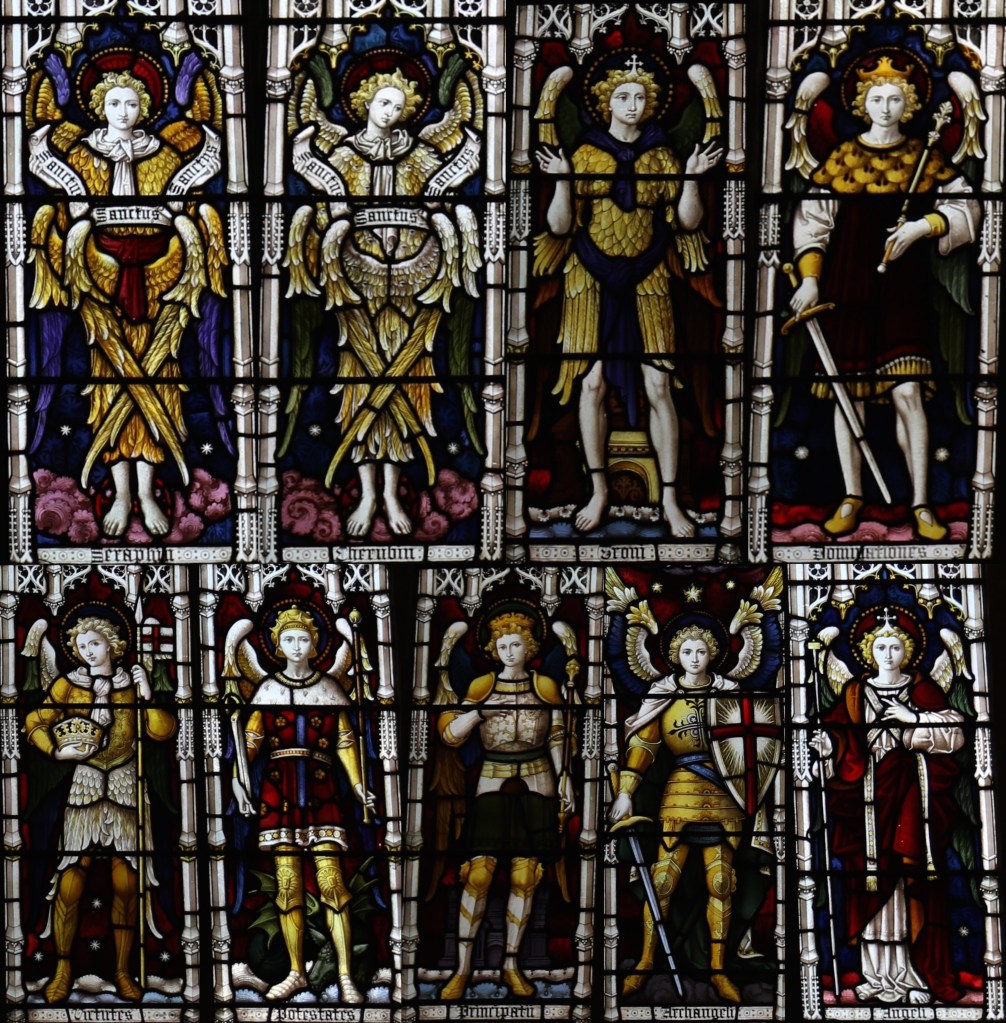
Nine angelic figures depicted on the west window of the Church of St Michael and All Angels in Somerton, which represent the nine ranks of angels. From left to right, first row: Seraphim, Cherubim, Thrones, and Dominions; second row: Virtues, Powers, Principalities, Archangels, and Angels. (License)
TheShepherd of Hermas is a second-century text, sometimes attributed to the brother of Pius, the Bishop of Rome. It is primarily an allegory and contains several visions. For many, it should have been included in the New Testament and was for a time, but eventually fell out of favor. The author’s understanding of Jesus and who He was is quite different from the teachings of the Council of Nicea. Even so, it almost made the cut.
Included in the fifth vision is an explanation of the role of angels. If you’ve ever seen the cartoon of an individual with an angel on one shoulder and a devil on the other, then you get the gist of it. Still, as it is the Feast of St. Michael and All Angels, I wanted to share the text with you. The shepherd begins:
“There are two angels with a man—one of righteousness, and the other of iniquity.”
And I said to him, “How, sir, am I to know the powers of these, for both angels dwell with me?”
“Hear,” said he, and “understand them. The angel of righteousness is gentle and modest, meek and peaceful. When, therefore, he ascends into your heart, forthwith he talks to you of righteousness, purity, chastity, contentment, and of every righteous deed and glorious virtue. When all these ascend into your heart, know that the angel of righteousness is with you.
“These are the deeds of the angel of righteousness. Trust him, then, and his works. Look now at the works of the angel of iniquity. First, he is wrathful, and bitter, and foolish, and his works are evil, and ruin the servants of God. When, then, he ascends into your heart, know him by his works.”
And I said to him, “How, sir, shall I perceive him, I do not know.”
“Hear and understand,” said he. “When anger comes upon you, or harshness, know that he is in you; and you will know this to be the case also, when you are attacked by a longing after many transactions, and the richest delicacies, and drunken revels, and divers luxuries, and things improper, and by a hankering after women, and by overreaching, and pride, and blustering, and by whatever is like to these. When these ascend into your heart, know that the angel of iniquity is in you.
“Now that you know his works, depart from him, and in no respect trust him because his deeds are evil and unprofitable to the servants of God.
“These, then, are the actions of both angels. Understand them, and trust the angel of righteousness; but depart from the angel of iniquity, because his instruction is bad in every deed. For though a man be most faithful, and the thought of this angel ascend into his heart, that man or woman must sin.
“On the other hand, be a man or woman ever so bad, yet, if the works of the angel of righteousness ascend into his or her heart, he or she must do something good. You see, therefore, that it is good to follow the angel of righteousness but to bid farewell to the angel of iniquity.”
That may not be exactly our understanding of angels and devils, but perhaps it is a glimpse. The word “angel” is from the Greek angelos (ἄγγελος), which translates messenger. Jacob saw the angels of God ascending and descending the ladder, and Jesus told Nathanael that he would see the angels of God ascending and descending upon the Son of Man. I believe the angels they saw were fulfilling their duties, bringing messages to God’s people. I believe that work continues to this day, so the next time you think about a word or deed, ask yourself, “Is that one of God’s messengers come to bring me a word, or does it come from the other fella?”
With his ferocious roar, large paws with sharp claws, and prideful mane, an egotistical lion roamed the jungle, asking the other animals who the king of the jungle was. “Who’s the king of the jungle?” the lion roared at a monkey. “Why you are, Mr. Lion,” said the monkey with fear in his voice. The lion continued and found a zebra. “Who’s the king of the jungle?” he snarled. “There is no doubt about it. You are Mr. Lion,” said the zebra.
Then, the lion came upon an elephant. Once again, he roared out the question, “Who’s the king of the jungle?” The elephant used his trunk and grabbed the lion by his tail. He spun him around over his head several times, dunked him in a mud hole, and slammed him into a large tree. Dazed and dirty, the lion said, “Well, just because you didn’t know the answer was no reason to get upset.”
When taken out of context, our Gospel reading today can speak about many things. There is the message of equality: everyone should be treated equally and fairly. I am confident that this is a message that will be preached in many churches today. It is not a wrong message, but it does not appear to be what Jesus was speaking about.
There’s also the message of God’s economy. We remember the verse from Ezekiel, “Have I any pleasure in the death of the wicked, declares the Lord God, and not rather that he should turn from his way and live?” (18:23) Or there’s the one from Second Peter, “The Lord is not slow to fulfill his promise as some count slowness, but is patient toward you, not wishing that any should perish, but that all should reach repentance.” (3:9) That works very well because we see that regardless of someone coming to God late in life—when they go to work in the field—they receive the same reward as those who arrived early. We can even run with that, speaking about our sense of fairness and so on. That also is a good message, but it is not quite right in the context of what is going on around the parable.
In context, the parable is a warning to the disciples because they are acting like that silly prideful lion, walking around as though they were the king of the jungle.
What is the context of the parable? It falls closely on the heels of the Mohammad Ali discussion about who is the greatest, which is closely followed by the disciples rebuking those who were bringing the children for Jesus to bless—a sign that they thought they were too important and too busy to be bothered with such trivialities. Following this is the encounter with the rich young man and his question to Jesus, “Teacher, what good deed must I do to have eternal life?” (Matthew 19:16) We know that he goes away sad because he had much. Jesus told him, “If you would be perfect, go, sell what you possess and give to the poor, and you will have treasure in heaven; and come, follow me.” (Matthew 19:21) When the young man walks away sorrowful, Peter says, “See, we have left everything and followed you. What then will we have?” (Matthew 19:27) Jesus responds, ‘Yes, Peter, you’ll all get a reward,’ but then Jesus adds, “But many who are first will be last, and the last first.” (Matthew 19:30) Immediately after saying that, Jesus tells the parable we heard today.
Yes, taken out of context, it can say many things, but in context, the parable is a response to Peter’s question and a further explanation of what is meant by “Many who are first will be last, and the last first.” It is as though Jesus were saying to Peter and the disciples, “Yes, you’ve been with me from the beginning, but that does not make you a privileged class.” Why would that be? Because what we receive from God is not some sort of payment. There is no time clock where you punch in and get time-and-a-half for overtime. That is not what we receive from God. What we do receive from God is grace, and God’s grace is not measured by our standards but by His, and His standard is Christ Jesus. As St. Paul tells us, “Grace was given to each one of us according to the measure of Christ’s gift.” (Ephesians 4:7) Christ’s Gift is the same for us all. It is not earned in any way, shape or form. You do not receive more than anyone else.
Did the disciples get it? No. Very shortly after the telling of this parable, the mother of James and John came to Jesus—the two of them hiding behind her apron—and she said, “Say that these two sons of mine are to sit, one at your right hand and one at your left, in your kingdom.” (Matthew 20:21) It is one of those moments where you can see Jesus rubbing his forehead in frustration.
The parable of the workers was a message and warning to the disciples; therefore, it is also a message and a warning to us. In this life, so many believe the saying, “Whoever dies with the most toys wins,” but with God, we have all received more than we can ask for or imagine. We do the things we are called to, not because we are hoping to “earn” more, but because God has chosen us to do them.
In Luke’s Gospel, Jesus speaks to the disciples about faithfulness. He says, “Will any one of you who has a servant plowing or keeping sheep say to him when he has come in from the field, ‘Come at once and recline at table’? Will he not rather say to him, ‘Prepare supper for me, and dress properly, and serve me while I eat and drink, and afterward you will eat and drink’? Does he thank the servant because he did what was commanded? So you also, when you have done all that you were commanded, say, ‘We are unworthy servants; we have only done what was our duty.’” (Luke 17:7-10) In today’s parable, those who had worked all day but received the same pay as those who worked only an hour came to the landowner and complained, “These last worked only one hour, and you have made them equal to us who have borne the burden of the day and the scorching heat.” Instead of such complaints, Jesus is saying they should have received with grateful hearts what they received and responded, “We are unworthy servants; we have only done what was our duty.”
That is a hard lesson to hear and understand in our competitive and reward-driven society. Dick Weiss, a former writer and editor for the St. Louis Post-Dispatch, said, “A few years ago, my former newspaper did a study in which interviewers asked readers who or what was most important to them. Their answer was, in some ways, surprising. Many did not say their families, children, or God. Instead, their answer was: ‘Me.’” With God, you are worth the life of His Son, Jesus. That is not in question, but what we must remember is… so is everyone else. In the eyes of God, we are of equal worth, and we have been bought with a price—the Blood of Jesus. If that is the case, then how are we to act?
Have I ever told you that I’m a Trekky? I’ve been watching Star Trek since I was a kid and loving every episode and movie. One of the more recent movies, Into the Darkness, came out in 2009. In this one, Mr. Spock and Lieutenant Uhura (you know who these people are!) have a romantic thing. At one point, there is a devastating event, and Mr.—never show any emotions—Spock becomes very emotional and distressed. Seeing this and wanting to comfort the one she loves, Lieutenant Uhura goes to Spock, kisses him softly, and asks, “What do you need?” Mr. Spock pauses, then responds, “I need everyone to continue performing admirably.”
Jesus said, “Do not lay up for yourselves treasures on earth, where moth and rust destroy and where thieves break in and steal, but lay up for yourselves treasures in heaven, where neither moth nor rust destroys and where thieves do not break in and steal. For where your treasure is, there your heart will be also.” (Matthew 6:19-21) Jesus said, ‘In your work for God, do not live like you are working for a coin. Instead, work with the knowledge that you have already received the greatest gift imaginable.” Don’t act like some prideful lion. You may get slapped around by the elephant. Don’t stop to worry about this person or that, but admirably, continue doing the work you have been chosen to perform so that, in the end, all may receive the greatest gift of all.
Let us pray: Heavenly Father, you have called us all to holiness, which means sharing in your divine life. Fill us with a sense of our true dignity as those called to be your daughters and sons in the world and your ambassadors of justice, love, and peace. Give us the desire to be worthy of this great calling and the courage to live up to it. We ask this through Christ, our Lord. Amen.
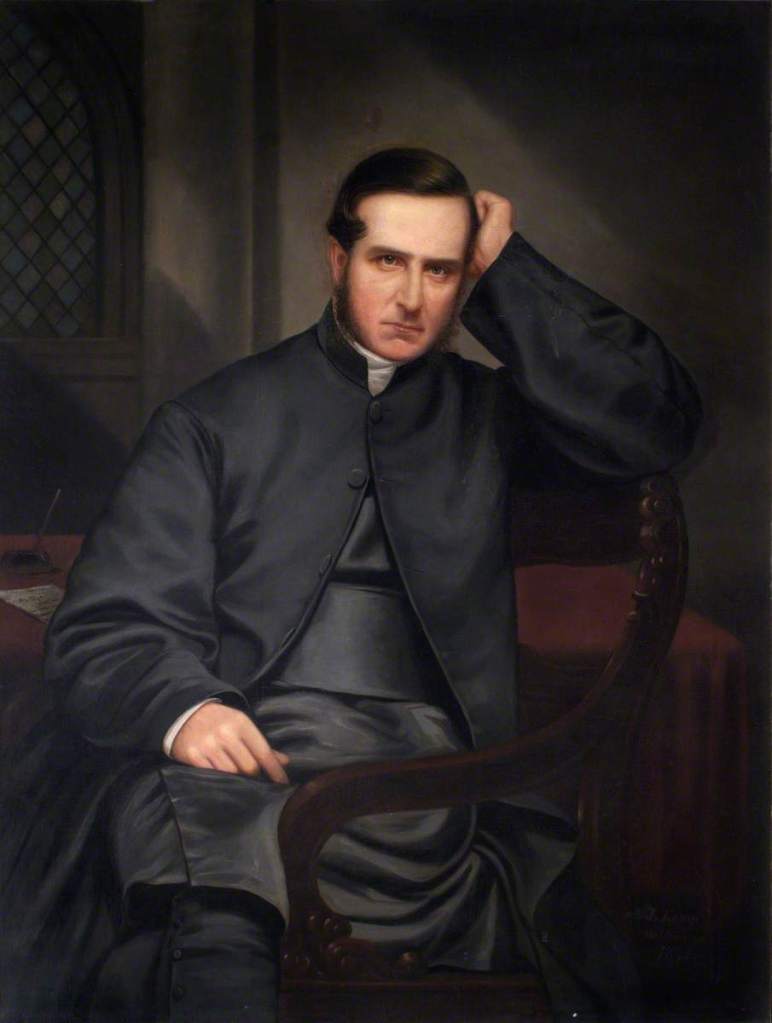
At the age of fourteen, John Patteson knew he was going to be a priest. At the age of twenty-seven, he was. He grew up in England and, in 1855, would go to serve in Melanesia, a chain of some 10,000 islands off the northeast coast of Australia. His Bishop told him his work would include “the evangelization of no less than 20 million.” Just to make it interesting, some of those 20 million were headhunters and cannibals and had the custom of strangling a woman if her husband died. In addition, slave traders roamed the seas, practicing “blackbirding” – capturing the natives and forcing them into slavery on the farms of the Europeans. Patteson was not deterred.
The goal of the mission was to travel to the islands and convince the tribes to allow one or two of the younger boys to leave the island for ten months to a year so that they could be trained in the teachings of Christianity, then take them back to their islands where they would evangelize the rest of the community.
Patteson was successful in this work, gaining the respect of the natives and fellow workers, which led to him being elected as the Bishop of Melanesia. The Bishop of New Zealand wrote, “Anything more conscientious and painstaking cannot be conceived than the way Patteson has steadily directed his talent, every hour and every minute of his life, to the one work he has set before him. However small or uncongenial or drum-drudgery-like his occupation, however hard or dangerous or difficult, it seems to be always met in the same calm.”
This calm and the respect of the natives would eventually lead to his death. The blackbirders learned that the people would come out to greet Patteson, so when they anchored off the coast of one of the islands, they would send messengers to tell the islanders that Patteson was on board and wanted to see them. The natives would go out, only to be taken captive. This led to Patteson’s work becoming all the more dangerous, and he even wrote to his sister, telling her that he feared it would eventually get him killed. It did.
On September 20, 1871, he visited the island of Nukápu. He went ashore with a few others but was immediately taken captive and martyred. Unfortunately, it was a mistake. Earlier that day, the blackbirders had raided the island and murdered five community members. They thought that Patteson and others were those same blackbirders returning.
Learning of his death, Max Muller, a professor at Oxford and friend of Patteson, wrote, “To have known such man is one of life’s greatest blessings… In the distant future, depend upon it, the name of Patteson will live in every cottage, in every school, and every church in Melanesia—not the name of a fabulous saint or martyr, but as the never-to-be-forgotten name of a good, a brave, a God-fearing and God-loving man.”
Was his work and the work of others throughout the region successful? Melanesia is one of the most Christian nations in the world, with over 91% of the population believers. I call that successful. In addition, his death led Queen Victoria to push for the end of all blackbirding.
What led Patteson, at the age of fourteen, to want to become a priest? He heard a sermon while living in Windsor. That evening, he wrote to his mother: “It was beautiful when he talked of his going out to found a church, and then to die, neglected and forgotten: all the people burst out crying.” Jesus said, “If any want to become my followers, let them deny themselves and take up their cross and follow me. For those who want to save their life will lose it, and those who lose their life for my sake, and for the sake of the gospel, will save it.”
John Coleridge Patteson truly gave and lost his life for the sake of the Gospel, so Jesus said to him on this day in 1871, “Come, you that are blessed by my Father, inherit the kingdom prepared for you from the foundation of the world.”