Sixth graders and history do not always go well together. One budding historian wrote, “Ancient Egypt was inhabited by mummies and they all wrote in hydraulics. They lived in the Sarah Dessert. The climate of the Sarah is such that all the inhabitants have to live elsewhere.”
Another writes, “Writing at the same time as Shakespeare was Miguel Cervantes. He wrote Donkey Hote. The next great author was John Milton. Milton wrote Paradise Lost. Then his wife died and he wrote Paradise Regained.”
Finally, if you ask my Old Testament professor in seminary (we did not always see eye-to-eye), he would say that my answers to test questions were about as good as this, “Moses led the Hebrew slaves to the Red Sea where they made unleavened bread, which is bread made without any ingredients. Moses went up on Mount Cyanide to get the Ten Commandments. He died before he ever reached Canada.”
“What is history but a fable agreed upon.” (Bernard le Bovier de Fontenelle) Perhaps, but what many have repeated is true: history repeats itself, and there is a specific pattern, which Lord Byron summed up in Childe Harold’s Pilgrimage,
“There is the moral of all human tales:
‘Tis but the same rehearsal of the past,
First Freedom, and then Glory—when that fails,
Wealth, vice, corruption—barbarism at last.
And History, with all her volumes vast,
Hath but ONE page.” (Canto 04.108)
Regardless of the events, how they can be interpreted depends on who you ask. From the opening lines of A Tale of Two Cities by Charles Dickens (I know, I know… too many quotes):
“It was the best of times, it was the worst of times, it was the age of wisdom, it was the age of foolishness, it was the epoch of belief, it was the epoch of incredulity, it was the season of Light, it was the season of Darkness, it was the spring of hope, it was the winter of despair, we had everything before us, we had nothing before us, we were all going direct to Heaven, we were all going direct the other way.”
History is a peculiar thing. Some enjoy digging into it; others don’t remember what they had for breakfast and don’t care. And, I suspect for many, the history they most care about is their own, especially when you have more days behind you than before. At those times, we remember the good ol’ days when we were young and healthy, and the world seemed kinder and more innocent. Like pulling out old photographs and saying, “I remember when….” While looking at those photos, we can find ourselves longing for those days.
In our first lesson today, the Prophet Isaiah was “looking at some old photographs” and longing for those days.
Because of their sin, the Israelites had been conquered by the Babylonians and carried off into captivity. For 70 years, they were in exile. Now, Cyrus has conquered the Babylonians and allowed the Israelites to return, but things are not going well. There is infighting and turmoil, so Isaiah writes something of a Psalm, a lament. In doing so, Isaiah is looking at an old photograph. He is looking at where they are and longing for the past. In chapter 63, he says,
I will recount the steadfast love of the Lord,
the praises of the Lord,
according to all that the Lord has granted us,
and the great goodness to the house of Israel
that he has granted them according to his compassion,
according to the abundance of his steadfast love. (v.7)
Isaiah then goes on to tell of the days of Moses—how the people had been captive in Egypt. How God had led the people through the divided waters of the sea and saved them, and how, finally,
Like livestock that go down into the valley,
the Spirit of the Lord gave them rest.
So you led your people,
to make for yourself a glorious name. (v.14)
It is a glorious picture of the past, but now, Isaiah looks at their current circumstances. A world where the Lord is angry and has hidden His face from the people. How the Lord has allowed them to melt in the hands of their iniquities. So, looking at his old photograph, Isaiah says in chapter 64 (what we read today)
Oh that you would rend the heavens and come down,
that the mountains might quake at your presence.
And a few lines further,
When you did awesome things that we did not look for,
you came down, the mountains quaked at your presence.
Isaiah is looking at an old photograph. The days of God’s glory, and praying, “Lord, do that again. Come in great power and save your people, like you did in the days of Moses.”
Like the Israelites in Isaiah’s time, the Israelites in Jesus’ time were also occupied and oppressed. This time, it wasn’t the Babylonians but the Romans—an equally oppressive regime. So, like in the time of Isaiah, the people are once again looking for God to act in a mighty way to bring about their freedom. The question that was always before them was, “When will the Lord return to us and save us?” Early on in chapter 13 of Mark’s Gospel, Jesus remarked on that day, so the people immediately asked, “Tell us, when will these things be, and what will be the sign when all these things are about to be accomplished?” (v.4) The reading we heard today—darkened moon, heavens shaken, lesson of the fig tree—are all a part of Jesus’ answer. After saying all these things, He concludes, “Therefore stay awake—for you do not know when” these things will come to pass.
Amid tribulation, Isaiah held up a picture of the past and asked the Lord to return to the glory days. Jesus, on the other hand, amid tribulation, did not hold up a picture of the past. Jesus held up a picture of the future. Question: what did that picture show?
Father John, just read St. John’s Revelation! The seven seals being broken, the sky rolling up like a scroll, the star Wormwood crashing and bitter waters, death, blood, smoke, creatures that sting like scorpions, and things Stephen King couldn’t dream up on his wildest days. That’s the picture that Jesus held up of what is to come.
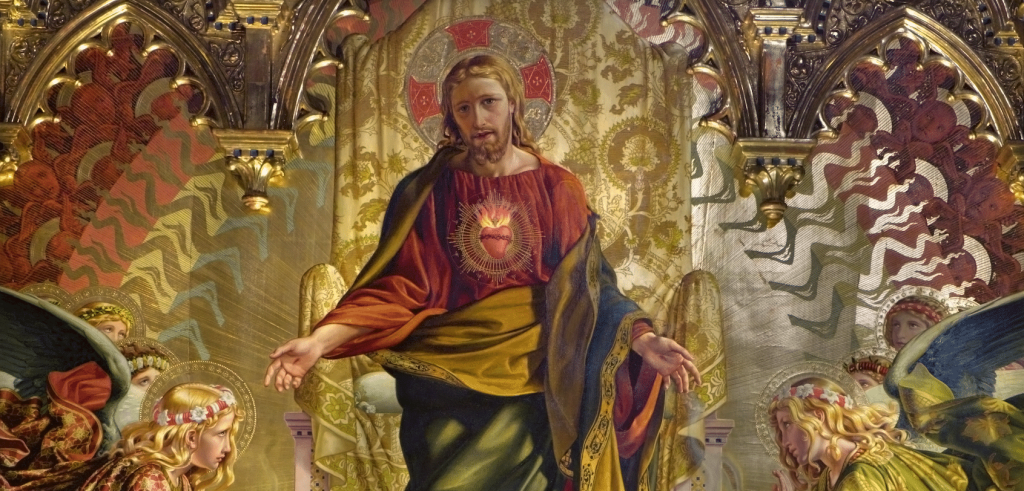
No. It is not. Not even close. Jesus held up a picture that showed a new heaven and, a new earth, and a holy city. A city where “the dwelling place of God is with man.” A city where God “will dwell with them, and they will be his people, and God himself will be with them as their God.” When there, God “will wipe away every tear from their eyes, and death shall be no more, neither shall there be mourning, nor crying, nor pain anymore, for the former things have passed away.” The picture of the future that Jesus showed the people was a place where all things are made new. (cf. Revelation 21:1-5)
Jesus told the people, and in doing so, He’s telling us all that is to take place, not so that we will be afraid and run hide in the mountains, but so that we will be prepared. Those will not be easy times for anyone—the righteous or the unrighteous. So Jesus tells us to remain vigilant in our faith and persevere until the end. As St Paul tells us, “Be on your guard; stand firm in the faith; be courageous; be strong. Do everything in love.” (1 Corinthians 16:13-14) Do these things and have life eternal.
Charles Dickens wrote, “It was the best of times, it was the worst of times.” And we can say with him, “These are the best of times, and these are the worst of times.” These are the best of times because Jesus has “conquered sin, put death to flight, and gave us the hope of everlasting life.” (BCP 835 #69) These are the worst of times because we are in the midst of what Jesus calls “birth pains.” (Mark 13:8) We are in the already and not yet; therefore, “clothe yourself with the Lord Jesus Christ” (Romans 13:14) and hold the picture of His future in your mind.
Let us pray:
Come, King of all nations,
source of Your Church’s unity and faith:
save all humankind, Your own creation!
Come, Lord Jesus, do not delay;
give new courage to Your people who trust in Your love.
By Your coming, raise us to the joy of Your Kingdom,
where you live and reign with the Father
and the Holy Spirit, one God, forever.
Amen.