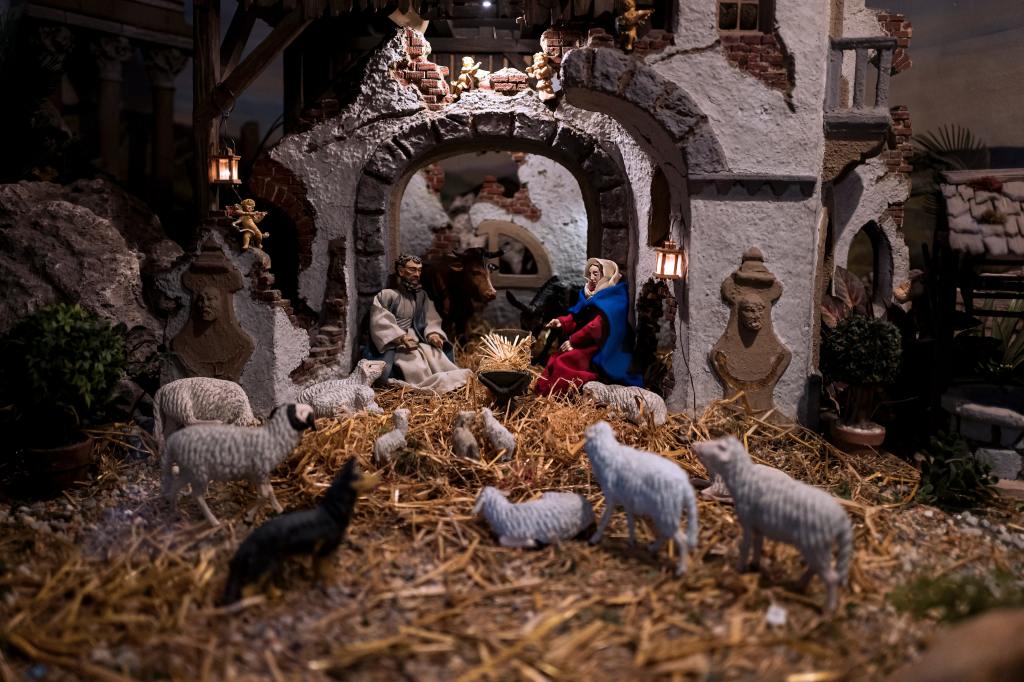
There are far too many quotes in this to call it a sermon, but I was chasing a thought and wanted to share the journey with you.
As we read this Gospel of the Epiphany, we see these two great contrasting approaches to this child lying in a manger. With Herod, there is fear, special advisors, secret meetings, plots, treachery. With Jesus, there is a star for all to see and leading the way, fulfillment of prophecy, homes open and invitations to enter, honor, worship, joy, and more. A king who is terrified and a baby (who is also a king) who welcomes all. That wonderful quote of Dietrich Bonhoeffer proves itself true: “For the great and powerful of this world, there are only two places in which their courage fails them, of which they are afraid deep down in their souls, from which they shy away. These are the manger and the cross of Jesus Christ. No powerful person dares to approach the manger, and this even includes King Herod. For this is where thrones shake, the mighty fall, the prominent perish, because God is with the lowly. Here the rich come to nothing, because God is with the poor and hungry, but the rich and satisfied he sends away empty. Before Mary, the maid, before the manger of Christ, before God in lowliness, the powerful come to naught; they have no right, no hope; they are judged.”
As we’ve noted a few times these past couple of weeks, this is the way all through Jesus’ life, even on his last day. When they came to arrest him in the Garden of Gethsemane: there was fear, anger, they came at night and in secret. Jesus response, “Have you come out as against a robber, with swords and clubs? When I was with you day after day in the temple, you did not lay hands on me. But this is your hour, and the power of darkness.” However, “Nothing is covered up that will not be revealed, or hidden that will not be known.” And so it was.
These two contrasting approaches led me to the Psalm we had a little while back: Psalm 2. You can hear the sarcasm in the Psalmist’s voice as he asks his question and declares the Lord’s response:
Why do the nations rage and the peoples plot in vain? The kings of the earth set themselves, and the rulers take counsel together, against the Lord and against his Anointed, saying, “Let us burst their bonds apart and cast away their cords from us.” He who sits in the heavens laughs; the Lord holds them in derision. Then he will speak to them in his wrath, and terrify them in his fury, saying, “As for me, I have set my King on Zion, my holy hill.”
God set the King, His Son, Jesus, on the throne of the Cross atop a hill outside of Jerusalem. In doing so, Jesus conquered the enemy of us all and gave us life. Then, following the resurrection and the ascension, God set His Son, Jesus, on the throne at His right hand. In time, “He will come again in glory to judge the living and the dead, and his kingdom will have no end.”
We know all this, yet even today, we still ask the Psalmist’s question:
Why do the nations rage and the peoples plot in vain?
The answer lies in Herod’s attitude and Bonhoeffer’s quote: fear. Fear in knowing that they are wrong, but unwilling to change. Fear in giving up themselves and their pride and turning to God. Fear in sacrifice, believing they will lose it all. Fear of so many things. Yet, if like the the Magi, we will enter into the house of God and along with Mary, kneel before this child, giving him our very best gifts, then we will discover the joy and peace and life that he has always desired to give us. Do not be afraid. As the Psalmist also says,
I sought the Lord, and he answered me and delivered me from all my fears. Those who look to him are radiant, and their faces shall never be ashamed. This poor man cried, and the Lord heard him and saved him out of all his troubles. The angel of the Lord encamps around those who fear him, and delivers them.
The headline read, “Jacking Jesus.” The story began by saying, “’Tis the season to be Jesus stealing? Away in a manger, no Christ for the bed? It has become a new Christmas fetish – neutering nativities by jacking the Jesus. Just over the past week, dozens of mini-messiahs have been nabbed from nativities across the country.” I’m not real sure why anyone would get their jollies by stealing Jesus statues from manger scenes, but I suppose it takes all types; however, many churches are fighting back. One church placed a sign in the crib after their Jesus was stolen that read, “Bring Back Baby Jesus and no one will get hurt – signed… God.” But there is a more high-tech approach.
The New York-based firm BrickHouse Security offers free, short term loans of global positioning system to religious institutions. The systems are designed to give a pinpoint location of where Jesus is based on satellite tracking. The ones from BrickHouse Security will notify immediately if the display is moved. Reverend Bob Gorman of St. Ambrose Church in Old Bridge, New Jersey told The Star-Leger, “It’s not a global positioning system. We call it God’s Positioning System.” Their church drilled a hole in Baby Jesus’ backside to slip in the GPS device before the figure was placed in the manger on Christmas Eve. From the sounds of our gospel reading today, Mary and Joseph could have benefited from such a system.
The story begins by telling us that it was Passover. This is the eight day celebration that falls in the Spring and is a festival commemorating God sparing the Jews when he killed the first born of Egypt during the Israelites final days of captivity. The festival is always marked by making a pilgrimage to Jerusalem and this was the trip that Mary, Joseph and Jesus were taking.
In their day, it would have been very common for the entire family or even village to travel together. Safety in numbers. So the Holy Family, they would have been in a large group and it wouldn’t have been uncommon for Mary and Joseph not to see each other at times, much less keep up with an energetic twelve year-old. They knew where he was: he was with friends and family and he was safe. Perhaps there’s a lesson we can keep in mind: everyone looked out for one another and they all looked out for the children.
After the festival had ended, it would have been very natural for Mary and Joseph to assume that Jesus was with the group. They were n’t irresponsible parents. It’s just how things worked and they never thought twice about it. The scripture seems to indicate that they did not start looking for him until the end of the first day—“You be home in time for dinner”—or something along those lines. When he was a no show, they probably didn’t worry much, but after a short time of looking, they went into full parental panic. Realizing he wasn’t with the group, they returned to the big city to search for him. Three days later, they find him, sitting in the temple and asking questions. Mary said to him, “Child, why have you treated us like this? Look, your father and I have been searching for you in great anxiety.” Jesus response, “Why were you searching for me? Did you not know that I must be in my Father’s house?”
We often read this as Jesus rebuking his parents, but when we do, we are putting words and the attitude of an insolent teenager in the mouth of Jesus and assume he is saying, “Duh. Where else would I be?” A more accurate take would be to say that Jesus was surprised. He did not intentionally distress his parents and he wasn’t wising off to them. He honestly thought they would know that if he was not in the house of his father Joseph, then he would be in the house of his Father in Heaven.
So, here’s a question: have you ever had Jesus go missing on you? Said with Mary and Joseph, “He’s lost!” Have you ever needed him and gone looking for him, but without success? We all have, but… did you ever stop to consider that maybe he’s not the one that’s lost? “Jesus, we’ve been searching all over for you!” “Why? I’ve been right here all along. I never left.” You… We are the ones that wandered off. We are the ones that were lost and the—not “Ha ha”—funny thing is: we never even knew it.
Pastor Joseph Stowell talked about going with his wife, three-year-old, and parents to Chicago for the annual Christmas trek at one of those massive malls. At one point, in the midst of all the fun and excitement, the adults suddenly noticed that little three-year-old Matthew was gone. Terror immediately struck everyone’s heart. They had heard the horror stories: little children kidnapped in malls, rushed to a rest room, donned in different clothes and altered hairstyle, and then swiftly smuggled out, never to be seen again. They split up, each taking an assigned location. Joseph’s was the parking lot. He said, “I’ll never forget that night—kicking through the newly fallen snow, calling out his name at the top of my lungs. I felt like an abject fool, yet my concern for his safety outweighed all other feelings.”
Unsuccessful, Joseph trudged back to the designated meeting point. His wife had not found him, nor had his mother. And then his dad appeared, holding little Matthew by the hand. Their hearts leapt for joy. Interestingly enough, Matthew wasn’t the slightest traumatized. He hadn’t even been crying. To him, there had not been a problem. Joseph asked his father where he had found him. “The candy counter,” he replied. “You should have seen him. His eyes came just about as high as the candy. He held his little hands behind his back and moved his head back and forth, surveying all the luscious options.” Matthew hadn’t looked lost. Why? Because he hadn’t even known he was lost. He was oblivious to the phenomenal danger he was in. Joseph concluded by saying, “This is a candy-counter culture, where people don’t look lost and don’t even know they’re lost.”
When Jesus seems lost or missing to you and when you go looking for him, remember: he’s not the one that’s lost. He is very near to the Father and that is where you will find him. When we do finally find him, I bet he speaks the exact same words to us as his mother spoke to him: “Child, why have you treated us like this? Look, your father and I have been searching for you in great anxiety.”
Let us pray: Almighty God and Father of light, a child is born for us and a son is given to us. Your eternal Word leaped down from heaven in the silent watches of the night, and now your Church is filled with wonder at the nearness of her God. Open our hearts to receive his life and increase our vision, that our lives may be filled with his glory and his peace, who lives and reigns for ever and ever. Amen.
As slaves in the land of Egypt, the Israelites did not have access to much food, so they ate whatever they could, and a regular staples on the table was the hard and woody horseradish, so when the great Exodus came, nearly all the fleeing Israelites took horseradish with them. Moshe and Sadie, however, while gathering up their scant belongings, found to their dismay that they had run out of horseradish. Sadie immediately sent Moshe into the field to dig up a large horseradish root to take with them. However, because it was dark and everyone was running around in panic, Moshe dug up a ginger root by mistake.
After forty years in the desert, the Israelites finally entered the Promised Land – all, that is, except Moshe and Sadie. It took them forty-one years to arrive. When asked where they had been, Sadie, now grown old, shrugged her shoulders and replied, “Moshe insisted on taking an alternate root.”
Prior to that great 40 years of wandering in the desert, God gave Moses and the people instruction on how, when, and where they were to worship, a good part of which revolved around the Ark of the Covenant (the golden box that the Nazis stole from Indiana Jones). In Exodus chapter 25, we are provided with considerable detail on how the Ark was to be constructed, which included rings on either side so that poles made of Acacia wood and covered in gold could be slipped in to carry the Ark from place to place, which came in handy with all that wandering.
Because the Ark was to be moved as the people moved, then the “house” for it also had to be transportable; hence, a tent. In chapters 26 and 27 we are told all about this particular tent and it was in no way a two man pup tent. It would have been stunning to see: bronze and gold clasps, fine linen of purple and blue, poles covered in gold, and more. When assembled, it would have been 45 feet deep and 15 feet wide. The courtyard surrounding it was 150 deep and 75 feet wide. Roughly, it would have covered 12,000 square feet. The entire complex was called the Tabernacle and it was the place of the presence of God. (As an aside, the cabinet beneath the sanctuary lamp is called the Tabernacle, because it too is the place of the presence of God found in the Eucharist.)
It is over 400 years since the Exodus to the time of King David and all this time, God has been “living” in this tent, and in our reading today from second Samuel, when King David said, “See now, I am living in a house of cedar, but the ark of God stays in a tent.”—this is the tent he was referring to.
After David had sorted out the country and the enemies, built himself a nice place, he thought that maybe—after 400+ years—it might be a good thing if God had a permanent place of his own.
Initially, the Prophet Nathan agreed, but then the Lord spoke to David through Nathan and essentially said, “This task is not for you.” In first Chronicles we learn the reason, for the Lord God said to David, “You may not build a house for my name, for you are a man of war and have shed blood.” Therefore, the task went to David’s son, Solomon. Apparently God did not mind living in a tent. However, back when David made the offer, the Lord said several other things to David through Nathan.
God begins by reminding David about all the things he has already done for him. Raised him up from a shepherd to be a mighty warrior, brought the people into a land of their own, and given them peace. Then the Lord says, “Moreover the Lord declares to you that the Lord will make you a house. Your house and your kingdom shall be made sure forever before me; your throne shall be established forever.” David says he wants to build the Lord a house. The Lord says, “No, but here’s what I’m going to do: I’m going to build you a house.” David understood this as the establishment and eternal rule of his earthly Kingdom, but that was really only a temporal understanding. God had something eternal in mind.
In our Gospel reading today, we see the final pieces of this eternal plan come together. The angel of the Lord said to the Blessed Virgin Mary, “Do not be afraid, Mary, for you have found favor with God. And now, you will conceive in your womb and bear a son, and you will name him Jesus. He will be great, and will be called the Son of the Most High, and the Lord God will give to him the throne of his ancestor David. He will reign over the house of Jacob forever, and of his kingdom there will be no end.” Through these actions of God, Mary becomes the new Tabernacle. The one in whom the very presence of God was conceived and her child will fulfill the promises that God made to David and even further back, to Abraham. In Jesus, the covenant is fulfilled and the eternal Kingdom is established, but again, God has more than a temporal Kingdom being established through Jesus.
On the night before Jesus was crucified, he said, “If anyone loves me, he will keep my word, and my Father will love him, and we will come to him and make our home with him.” The phrase “make our home” can also be translated as abide. If we love Jesus, he and the Father, through the giving of the Holy Spirit, will come and abide with us. In the Greek, the word “abide” and the word “Tabernacle” have the same root word μονή (mo-na’). If we love God, he will abide with us, he will set up his Tabernacle within us.
The tent was the Tabernacle for the presence of God. The cabinet in our church is the Tabernacle for the presence of God. The Blessed Virgin Mary was a Tabernacle for the presence of God; all this so that we could be transformed into Tabernacles for the presence of our God. When God said to David, “I will build you a house,” David had only limited understanding of what God intended. For where David saw this “house” as an earthly temporal kingdom, God saw this “house” as the soul of the believer.
The promised eternal Kingdom is your very soul.
God does not require a permanent Temple / Tabernacle, because God’s Temple / Tabernacle / Kingdom / presence is established in you. “I am with you always unto the very end of the age.” He didn’t need David or anyone else to build him a permanent home. Why? Because he goes where we go. He is where we are.
Let us pray: Come, Holy Spirit, fill the hearts of Thy Faithful; and enkindle in them the fire of Thy love. Send forth Thy Spirit and they shall be created, and thou shalt renew the face of the earth. Amen.
A few older couples used to get together to talk about life and to have a good time. One day one of the men, Harry, started talking about this fantastic restaurant he went to the other night with his wife. “Really?”, the other of the men said, “What’s it called?” After thinking for a few seconds Harry said, “What are those good smelling flowers called again?” “Do you mean a rose?” the first man questioned. “Yes, that’s it,” he exclaimed. Looking over at his wife he said, “Rose, what’s that restaurant we went to the other night?”
So far, I still have a pretty good memory—I think—except for names. I’ve always had a hard time with them, but what I’m miserable about is timeframes. I know something happened, but I have a terrible time remembering when it happened.
The brain is a complicated thing and memory is even more illusive in understanding, but what scientist have come to learn is that when we remember something, we’re not always remembering the original event, but instead are remembering the last time we remembered it, which means, we can drop a few details.
Neuroscientist Donna Bridge writes, “A memory is not simply an image produced by time-traveling back to the original event—it can be an image that is somewhat distorted because of the prior times you remembered it. Your memory of an event can grow less precise even to the point of being totally false with each retrieval.” (Source)
Put all that together: I remember talking about this in the past, but being bad with timeframes, I don’t remember if I have already told you. What are you going to do? Get to the point, Father John.
Today, in our reading from Isaiah, we hear those very familiar words. They are familiar, not because of reading them in Isaiah, but because they are the words that Jesus spoke at the beginning of his ministry.
“And Jesus came to Nazareth, where he had been brought up. And as was his custom, he went to the synagogue on the Sabbath day, and he stood up to read. And the scroll of the prophet Isaiah was given to him. He unrolled the scroll and found the place where it was written,
‘The Spirit of the Lord is upon me, because he has anointed me to proclaim good news to the poor. He has sent me to proclaim liberty to the captives and recovering of sight to the blind, to set at liberty those who are oppressed, to proclaim the year of the Lord’s favor.’”
Because this is where we remember these verses from, then we don’t really remember all that Isaiah actually said. You see, after the last statement that Jesus reads, “to proclaim the year of the Lord’s favor,” there’s actually a comma, not a period. There’s more to it. Isaiah goes on, where Jesus did not:
“The Spirit of the Lord is upon me… to proclaim the year of the Lord’s favor, and the day of vengeance of our God.”
There’s a semicolon after that, but why would Jesus end with, “to proclaim the year of the Lord’s favor,” and not add the bit about vengeance? Was Jesus simply proof-texting? Picking the bits he liked and ignoring the rest? Or, was there even some deeper meaning behind stopping there? Inquiring minds want to know, but you already know the answer. Jesus was making a point.
During the Season of Advent, we spend the first two Sundays looking ahead to Jesus second coming and the last two are focused on his first coming. Jesus, by leaving off “the day of vengeance of our God” was basically doing the same thing. By ending with “to proclaim the year of the Lord’s favor,” Jesus was declaring the work of his current mission. We see this in John 3:17—“For God did not send his Son into the world to condemn the world, but in order that the world might be saved through him” and again in John 12:47—“If anyone hears my words and does not keep them, I do not judge him; for I did not come to judge the world but to save the world.” With our understanding of what Isaiah said and how Jesus used it, Jesus very well could have been saying, “God did not send his Son into the world this time to condemn” and “I did not come this time to judge.” All of which points us to the two focuses of Advent, Jesus first coming was the time of of repentance and forgiveness and his second coming will be “The day of vengeance.”
However, what Jesus did not say, was the backdrop to everything else that he did, which was a call to faith and discipleship. As St. Paul taught us in his second letter to the Corinthians: “Behold, now is the favorable time; behold, now is the day of salvation,” for there is a day coming when… well, when it will be too late.
Jesus was not proof-texting when he stopped at “the year of the Lord’s favor,” but in a sense, we are when we remember that passage of scripture. We see something so many times in a certain way that we no longer remember it or understand it in its proper context.
I just recently moved and after I got everything out of the old place, I went in and gave it a good cleaning. Everything was out and everything was clean. Someone stops by for a visit afterwards and walks through with me. They took a good look around and then asked me if I planned on leaving a certain picture hanging on the wall, but there were no pictures on the wall. Yet they pointed to it and as if by casting some spell from Harry Potter, there it was, hanging right next to the front door. I had seen that picture so many times in the exact same place, that I literally no longer saw it or remembered it. Memory is a funny thing. Sometimes it’s intentionally selective, while at other times… memories just “drop off.”
Our immortal souls cannot afford to forget that what we celebrate at Christmas—the year of the Lord’s favor—is only part one of two. Part two, we declare it every week: we believe that “He will come again in glory to judge the living and the dead, and his kingdom will have no end.” He will come again to judge. Don’t get so caught up in part one that you no longer remember or see part two. They are both of equal importance.
Let us pray: Father of our Lord Jesus Christ, ever faithful to your promises and ever close to your Church: the earth rejoices in hope of the Savior’s coming and looks forward with longing to his return. Prepare our hearts and remove the sadness that hinders us from feeling the joy and hope which his presence will bestow, for he is Lord for ever and ever. Amen.
A woman reports that her husband, being unhappy with her mood swings, bought her a mood ring so he would be able to monitor her moods.
She said, “We discovered that when I’m in a good mood, it turns green. When I’m in a bad mood, it leaves a big red mark on his forehead.”
The Danish philosopher and theologian, Søren Kierkegaard, is reported to have told the following story: One night, a group of thieves broke into a jewelry store. But rather than stealing anything, they simply switched all the price tags. The next day no one could tell what was valuable and what was cheap. The expensive jewels had suddenly become cheap, and the costume jewelry, which had been virtually worthless before, was suddenly of great value. Customers who thought they were purchasing valuable gems were getting fakes. Those who couldn’t afford the higher priced items were leaving the store with treasures.
Within the Book of Isaiah there are three distinctive sections and the verses we heard today are the beginning of the second part. In part one (we’ve been reading this during Morning Prayer) God has had it with the people’s disobedience and he keeps telling them he’s going to blow them up if they don’t straighten themselves out. In the final chapters of part one, we read about King Hezekiah, who is actually one of the few good kings, but he is not without his faults. The fatal error that he made occurred when he showed the Babylonian emissaries all the gold and fineries of Israel, which means that he showed them the Holiest of Holies, the Ark of the Covenant. God did not appreciate being paraded around in front of foreigners, so Isaiah says, Behold, the days are coming, when all that is in your house, and that which your fathers have stored up till this day, shall be carried to Babylon. It is about 100 years later, but this prophecy comes to pass with the Babylonian captivity that lasted 70 years.
Then, in chapter 40, all the apocalyptic talk ends. We read:
Comfort, comfort my people, says your God. Speak tenderly to Jerusalem, and cry to her that her warfare is ended, that her iniquity is pardoned, that she has received from the Lord’s hand double for all her sins.
What is so fascinating about this passage is that these are words only recorded by the prophet. The conversation itself is between the members of the Holy Trinity. Years before Isaiah, the Prophet Jeremiah had lamented over Jerusalem and speaking the words of God said, “Alas! Lonely sits the city once great with people! … Zion spreads out her hands, she has no one to comfort her” (Lamentations 1:1, 17) Today, God is speaking to God and saying, “Comfort, comfort my people.” Tell them that their punishment—and chasing this one down is a sermon-and-a-half, so we won’t do that today, but—tell them that their punishment has been the equivalent to a blood sacrifice… say, for example, the sacrifice of a lamb on the altar. God says to God, “Speak tenderly to them.” Speak to them in the way that a lover speaks to his beloved. Tell them their sins are forgiven. Tell them that they have received a double pardon for their sins, which is another way of saying, “Tell them that they have received grace.” And let them know that they have received all of this from “the Lord’s hand,” meaning that everything that takes place in their renewal is by divine intervention. God speaking to God. The Father says to the Son. The the Son says to us, “Come to Me, all you who labor and are heavy laden, and I will give you rest.” I will give you rest. I will give you comfort. Love. Grace. Sacrificial lamb. Divine intervention. Jesus. It is the entirety of the Gospel message in two verses.
The Israelites did much evil in the eyes of the Lord, yet God showed grace in the person of His son Jesus. However, before the Israelites could receive that grace, there was a great price that had to be paid. You and I, we have paid no price, but we are also the recipients of this same comfort, love, and grace. However, even though we haven’t paid a price, God’s intervention is still of great value… value beyond priceless and is worth our every effort. Remember the parable that Jesus told: “The kingdom of heaven is like a merchant in search of fine pearls, who, on finding one pearl of great value, went and sold all that he had and bought it.” We do all we can to gain this pearl of great value, but… somebody came in and switched the price tags, and we end up working for a piece of costume jewelry instead of the pearl of great worth. Whether intentional or unintentional or neglect, through our own sin, what cost much we can treat as trinket and what is a trinket we can treat as the greatest worth. Hence, the message of Isaiah and John the Baptist, a message of repentance for the forgiveness of sins. We must realign ourselves to God and not be deceived.
The Season of Advent is often blurred with the joy of Christmas, but Advent is more closely related to Lent than it is to Christmas. Advent is a time of reflection, repentance and preparation. Reflection on our lives to make sure we are rightly oriented toward God, repentance in the event that we have strayed, and preparation for God’s coming, because when the prophet says,
Prepare the way of the Lord, make his paths straight,
he is talking about us. We are the ones that are making a pathway for our God to come to us. We are the ones that are clearing the mountains and the rubble, so that when he arrives, he will find a mansion prepared for himself… a heart, mind, and soul anxiously awaiting his coming.
No, I’m not trying to take the “merry” out of Christmas. Instead, I’m encouraging you, in the midst of preparing for Christmas, to take a little time in preparing for the coming of the King of Glory.
Let us pray: God of power and mercy, open our hearts in welcome. Remove the things that hinder us from receiving Christ with joy, so that we may share his wisdom and become one with him when he comes in glory, for he lives and reigns with you and the Holy Spirit, one God, for ever and ever. Amen.
An English professor wrote the words, “A woman without her man is nothing” on the blackboard and directed the students to punctuate it correctly.
The men wrote: “A woman, without her man, is nothing.”
The women wrote: “A woman: without her, man is nothing.”
Perspective / perception: Anaïs Nin said, “We don’t see things as they are, we see them as we are.”
This Advent, I would like to look at the readings from a different perspective—not look at them as we are, but from the other side of Jesus’ incarnation. In other words, we’ll be studying the Old Testament. Today begins.. and for the next two Sundays.. with readings from Isaiah. The fourth Sunday comes from the second book of Samuel. Let’s begin where all good stories begin this time of year: “Twas the night before Christmas and all through the house, not a creature was stirring, not even a mouse.”
The anticipation of Santa leads to excellent use of a particular parental behavior modifier for at least a month leading up to that most glorious day: Santa knows whose naughty or nice, and if you’re naughty: switches and coal. When I was a kid, it resulted in me pulling down the Sears catalog and opening it to the toys section in an attempt to motivate myself to be good. Of course, I always was. But what if… what if I was good and yet, the man in red didn’t show? Not only did I not get any presents, I didn’t even get the coal and switches. That might begin to get me to question certain things. Perhaps the first year I would mark it up as an anomaly: maybe he thought I moved, Rudolph forgot the GPS, any number of things. But then, it happened again. Nothing. After several years of this, the threat of Santa bringing switches and coal would have no effect, because Santa doesn’t bring anything. However, after many years, what if I begin to really think about this situation and in being honest with myself, I realize that I had only been good in the weeks leading up to Christmas, but other than that, yeah… I was a brat. And in one of those moments of clarity, I realize that Santa knew all along that I was a brat and had, in a metaphysical sense, sent me to my room to “think about what I had done,” hence, no presents or switches. Instead… silence. Eventually, I might write to Santa and say, “I know. I was a brat. And now that you don’t visit, I’m even worse. Please don’t be angry with me. I am truly sorry. Please come and visit me again.”
The Israelites had disobeyed God on so many levels that he first sent the Asyrians to take at least half of Israel into captivity and when that wasn’t enough to get the attention of the other half, he sent the Babylonians to take them. Eventually, there was a little good Babylonian king, Cyrus, who said to the Israelites, “Any of you that would like to return home, may do so.” Many did, but after they did, God was still silent. They were not experiencing the blessings they had in the past, so the Prophet Isaiah calls out to God and begins reminding God of all the wonders he has performed:
I will recount the steadfast love of the Lord, the praises of the Lord, according to all that the Lord has granted us.
Isaiah then takes responsibility for the actions of Israel, confessing to the Lord that they had in fact rebelled and gotten what they deserved, but because of his continued silence, Israel is falling further and further away. They are losing hope that he will relent from his anger. You are our Father, he says to the Lord. Don’t you remember.
Then it comes to our reading today: the Prophet cried out:
O that you would tear open the heavens and come down, so that the mountains would quake at your presence.
And again, the Prophet takes responsibility for the actions of the people:
We have all become like one who is unclean… There is no one who calls on your name
But then there is a dramatic shift of tone. A statement of profound faith and hope: Yet, O Lord, you are our Father; we are the clay, and you are our potter; we are all the work of your hand.
And then Isaiah asks the Lord to once again come and visit his people:
Do not be exceedingly angry, O Lord, and do not remember iniquity forever.
The people had been disobedient. They were punished, but even following the punishment of exile, God was still silent… he was making them sit in their room and think about what they had done, and now they’ve fully understood the consequences of their actions, and in doing so, they become aware of their place in God’s economy: like clay, God is the one who molds them, makes them into his people. Yet, they are also aware of the fact that they are deserving of God’s punishment, to its fullest extent: justice. They deserve all that has befallen them, so they ask God not to be exceedingly angry. In a very real sense, instead of punishing them for their sins as they deserve, they are asking God to find another way. In words that almost break your heart in desperation, the prophet says,
We are all your people.
Instead of punishing us as we deserve, please… please find another way that we might be able to experience your blessings, that you will return to us.
“Behold, the virgin shall conceive and bear a son, and they shall call his name Immanuel” which means, God with us.
Let us pray: Father in heaven, our hearts desire the warmth of your love and our minds are searching for the light of your Word. Increase our longing for Christ our Savior and give us the strength to grow in love, that the dawn of his coming may find us rejoicing in his presence and welcoming the light of his truth. We ask this in the name of Jesus the Lord. Amen.
The original is a bit longer than this, but when I read this story, I didn’t know if it was funny or sad… both perhaps, but the ‘gotcha’ line is…
The king and his entourage were out riding horses, when not too far off the king saw his jester riding as on some errand.
The king wanted to catch the court jester’s attention, and so he called out, “Hey! Hey!” The court jester brought his horse to a halt and walked towards the king. The king said to him, “You are so short, you are so thin, you are so slight — you do not seem to be strong at all. But your horse is so strong, so stout, so beautiful and powerful. How do you keep him so beautiful, powerful, strong and stout? What is the secret to his excellent condition?”
The court jester said to the king, “I feed my horse, your Highness, but you feed me. This is the difference between my appearance and that of my horse.” (Source)
Throughout history, we have witnessed both the good and bad of monarchs and other leaders. Some are those who tend to their horses more than to the people, while others have given their all for the people. The bad ones are easy to spot, but even the good ones are not always so noble. There are plenty of books and movies about them all, and a movie I’ve recently watched (again) is the Kingdom of Heaven.
Let’s just say that is very loosely tied to the actual history, but a fantastic story just the same. It revolves around the Battle of Jerusalem in the 12th century between the crusaders and Saladin. I won’t ruin the story, but it has some great lines, one of which speaks to what it is to be noble.
Godfrey of Ibelin is passing his titles and holdings onto his son, Balian. In doing so, he says, “Be without fear in the face of your enemies. Be brave and upright, that God may love thee. Speak the truth always, even if it leads to your death. Safeguard the helpless and do no wrong; that is your oath.” He then slaps his son, saying, “And that is so you remember it. Rise a knight and Baron of Ibelin.”
Later, Balian will have the opportunity to become close with King Baldwin IV, the King of Jerusalem. In one conversation, the King says to Balian, “A King may move a man, a father may claim a son. That man can also move himself. And only then does that man truly begin his own game. Remember that howsoever you are played, or by whom, your soul is in your keeping alone, even though those who presume to play you be kings or men of power. When you stand before God, you cannot say, ‘But I was told by others to do thus’ or that ‘Virtue was not convenient at the time.’ This will not suffice. Remember that.”
I know, too much reading of other people’s words this morning, but today is the celebration of Christ the King, and those two quotes spoke to me about who we are to be a noble in God’s court and His Kingdom, and it begins with a particular understanding of who Jesus is.
We know Jesus as Savior, friend—what a friend we have in Jesus—advocate, Redeemer, and so on. I doubt I’m the only one, but for me, I always see Jesus as my King. Yes, I understand him as those others, but at the end of the day, he is my King, which gives him absolute authority over my life. My disobedience knows no bounds, but his rule is without question and to the best of my abilities, I am here to serve and follow him. You may not see Jesus as King in such a way, but we must all learn to follow him rightly, and it begins by imitating how he lived. By loving God just as He loves His Father. By loving our neighbors, just as He loves us. As Balian took the oath from his father, we have also been given our directions. St. Paul stated it clearly in his epistle to the Church at Ephesus, “Be imitators of God, as beloved children. And walk in love, as Christ loved us and gave himself up for us, a fragrant offering and sacrifice to God.” (If you need a good reminder of that, let me know and I’ll give you a good slap.)
This is how we live as nobles in God’s court and His Kingdom, but we cannot be compelled to such life. The King of Jerusalem said, “Your soul is in your keeping alone, even though those who presume to play you be kings or men of power.” Even God the Holy Trinity cannot compel you to live such a life and in truth, we cannot even compel ourselves to live such a life, because such a life is not about what we do. It is about who we are. C.S. Lewis: “The Son of God became a man to enable men to become sons of God.” We live in God’s court and His Kingdom, not by doing, but by becoming, being transformed into His image. Paul said to the Corinthians, “We all… beholding the glory of the Lord, are being transformed into the same image from one degree of glory to another.” It is through this process of transformation that we are allowed to enter our King’s courts as sons and daughters:
Free to worship him without fear. holy and righteous in his sight all the days of our life.
We are given the opportunity to live as royals in the Kingdom of Heaven and to serve a King whose love for us is endless. To live as courtiers in that Kingdom is not always easy. It comes with trials and blessings, but if we are faithful in following and serving our King in this life, then at the moment of our last breath, we will hear the words that we all desire to be spoken: “Come, you that are blessed by my Father, inherit the kingdom prepared for you from the foundation of the world.”
Let us pray—this is a portion of Psalm 47: God has ascended amid shouts of joy, the Lord amid the sounding of trumpets. Sing praises to God, sing praises; sing praises to our King, sing praises. For God is the King of all the earth; sing to him a psalm of praise. God reigns over the nations; God is seated on his holy throne. The nobles of the nations assemble as the people of the God of Abraham, for the kings of the earth belong to God; he is greatly exalted. Amen.
A lawyer purchased a box of very rare and expensive cigars, then insured them against, among other things, fire. Within a month, having smoked his entire stockpile of these great cigars and without yet having made even his first premium payment on the policy the lawyer filed a claim against the insurance company. In his claim, the lawyer stated the cigars were lost ‘in a series of small fires.’ The insurance company refused to pay, citing the obvious reason, that the man had consumed the cigars in the normal fashion. The lawyer sued and won! Delivering the ruling, the judge agreed with the insurance company that the claim was frivolous. The judge stated nevertheless, that the lawyer held a policy from the company, which it had warranted that the cigars were insurable and also guaranteed that it would insure them against fire, without defining what is considered to be unacceptable ‘fire’ and was obligated to pay the claim. Rather than endure lengthy and costly appeal process, the insurance company accepted the ruling and paid $15,000 to the lawyer for his loss of the cigars lost in the ‘fires’.
Mark Twain said, “To succeed in life, you need two things: ignorance and confidence.” I’m thinking this particular lawyer easily had both. We live in a society that thrives on success. From our sports to our jobs to who has the prettiest wife or shoots the biggest elk. Success rules. Walt Disney says, “If you can dream it, you can do it” and the rapper Eminem declared, “Success is the only option, failure’s not.”
When you succeed, folks will call you names like: Ace, big man on campus, big brain, winner, the bomb, numero uno, presidential, maniac, and my personal favorite, The Big Gahuna. When words fail, there is always the fist pump, “Whoot, whoot, whoot!” I’m sure our lawyer friend with the cigars received a few of those accolades when he arrived at the Scheister’s Lounge and Bordello, but perhaps not so much the next day.
You see, as it turned out, after the lawyer cashed the check, the insurance company had him arrested on 24 counts of arson! With his own insurance claim and testimony from the previous case being used against him, the lawyer was convicted of intentionally burning his insured property and was sentenced to 24 months in jail and a $24,000 fine. The Big Gahuna had turned into the big loser.
As with winners, we also have wonderful quotes for those who fail. Baseball player Leo Deroucher, “Show me a good loser and I’ll show you an idiot.” And of course no sermon would be complete without the wisdom of Homer Simpson, “Trying is the first step towards failure.” For anyone unfortunate enough to fail, we have all sorts of effigies: stupid, loser, dodo, jerk, zombie, goofball, nutter, a sandwich short of a picnic, twit, geek, out-to-lunch, and on and on the list goes.
When we read our parable today, the parable of the talents, we have a tendency to read it in terms of success and failure. The two with the five and two talents both went out and doubled the kings money. The King was pleased. Success. Two Big Gahunas! Whoot, whoot, whoot. The namby pamby little whiner who did nothing but bury his talents in the backyard displeased the king. Failure. Big “L” to the forehead loser.
But here is the question that came to my mind while thinking on this parable: What if Mr. Five Talents and Mr. Two Talents went out and invested in various options, a bit here and bit there, solid investments, but on Black Friday they lost it all? The price of camels plummeted, there was a margin call on fish futures, and the shekel was seriously devalued. When the dust settled these two were wiped out. How do you think the king would have reacted when these two arrived and reported that all was lost? Well, if Mr. One Talent was cast out into the darkness where there was weeping and gnashing of teeth, then these two would likely be flogged, filleted, quartered, and cast into a place where they would never be seen or heard from again. These two would be the losers and Mr. One Talent would be the hero.
From the world’s perspective, this is true. Lose like that and you are punished and shunned, but a parable of Jesus should never be looked at from the world’s perspective. It should be looked at from God’s. Yes, the world would have thrown these two out on their ears, but not God.
From the Ragamuffin Gospel by Brennan Manning: “In the parable of the talents, the three servants are called to render an account of how they have used the gifts entrusted to them. The first two used their talents boldly and resourcefully. The third, who prudently wraps his money and buries it, typifies the Christian who deposits his faith in a hermetic container and seals the lid shut. He or she limps through life on childhood memories of Sunday school and resolutely refuses the challenge of growth and spiritual maturity. Unwilling to take risks, this person loses the talent entrusted to him or her. ‘The master wanted his servants to take risks. He wanted them to gamble with his money.’”
God does not want us to run off to the tracks and bet everything on the ponies, but God also does not want us to sit hunkered down with the talents, gifts and blessings he gives us. He wants us to have a bit of faith – faith the size of a mustard seed will do – and try. What happens if we fail? Is he going to smite us out of existence?
Consider this: After Jesus was crucified and rose from the dead he appeared to his disciples on several occasions. We read in John’s Gospel, “Jesus appeared again to his disciples, by the Sea of Galilee. It happened this way: Simon Peter, Thomas, Nathanael from Cana in Galilee, the sons of Zebedee, and two other disciples were together. ‘I’m going out to fish,’ Simon Peter told them, and they said, ‘We’ll go with you.’ So they went out and got into the boat, but that night they caught nothing. – they failed – Early in the morning, Jesus stood on the shore, but the disciples did not realize that it was Jesus. He called out to them, ‘Friends, haven’t you any fish?’ ‘No, we’re a bunch of losers,’ they answered. He said, ‘Throw your net on the right side of the boat and you will find some.’” When they did, they were unable to haul the net in because of the large number of fish.” – Success!
When we fail God does not smite us. When we fail God says, “Cast your net on the other side of the boat! Try again.” The sin of Mr. One Talent wasn’t that he didn’t go out and earn more money for the master. In the words of my grandfather, Mr. One Talent sinned by sitting there like a bump on a log and doing nothing.
When we fail we have a tendency to think that all is lost. That we have no recourse, but that simply is not the way with God. Speaking of the Lord, Thomas a Kempis writes, “Believe in Me, and trust in my mercy. When you think I am far from you, I am often nearest to you. When you judge that almost all is lost, then oftentimes it is that you are in the way of the greatest gain of merit. All is not lost when anything falls out contrary to how you would have it. You must not judge according to your present feeling, nor give up in any trouble, however it comes, nor think that all hope of deliverance is gone.” No, when we fail, we are to cast on the other side of the boat, not just leave the net at the bottom of the boat to rot from lack of use.
In our Christian walk, there are many things that we fail at. Sometimes, we gloriously fail at things like holiness, a consistent prayer life, study, blessing, moderation, church attendance (Don’t get me started with that one) forgiving, being forgiven – just to name a few – and we think because we have failed one time or even a hundred times, that all is lost. Jesus doesn’t want us and plans to cast us into the outer darkness where there will be weeping and gnashing of teeth, but nothing could be further from the truth. Instead, all he asks is that we cast our nets on the other side of the boat and try again. If you want to say, “Fr. John, I’ve fished this entire lake and there isn’t a dang thing in it but weeds and sticks!,” then try a different lure, but don’t just give up.
I don’t know if you’ve seen the movie The Lord of the Rings, but just before one of the epic battles when it appears that all the good guys are going to die and they are trying to decide on whether to stay and fight or retreat, Gimli the dwarf says to the group, “Certainty of death, small chance of success… what are we waiting for?” Why just give up? Even our smallest efforts can accomplish much. It may not seem that a tiny pebble can accomplish anything, but cast it into a pond and it will transform the entire surface.
You have not lost simply because you have failed. Instead, you have been given the opportunity to try again. Cast your net on the other side of the boat, there is a catch of immeasurable blessing waiting there for you.
An older lady entered the bank, approached the teller, handed her bank card to the teller, saying, “I would like to withdraw $10.” The teller told her, “For withdrawals less than $100, please use the ATM.” … The lady wanted to know why. The teller returned her bank card and irritably told her, “These are the rules, please leave if there is no further matter. There is a line of customers behind you.” … The lady remained silent for a few seconds and handed her card back to the teller and said, “Please help me withdraw all the money I have.” The teller was astonished when she checked the account balance. She nodded her head, leaned down and respectfully told her, “You have over $300,000 in your account but the bank doesn’t currently have that much cash. Could you make an appointment and come back again tomorrow?” … The lady then asked how much she could withdraw immediately. The teller told her any amount up to $3,000. “Well, please let me have $3,000 now.” The teller kindly handed $3,000. All friendly and with a pleasant smile…. The lady pulled a $10 bill from the stack, placed it in her purse, and then told the teller she would like to make a $2,990 deposit.
In this day and age it may seem a bit odd, but… I confess to not owning a TV set. If I want to watch a movie, I just pull one up on the computer. And if I want to get the news, I read it; however, while on vacation, I stayed in a hotel for a few nights and had access to all the television networks have to offer. It ain’t much and the news channels… not really news. When it was news, it was angry. There was no courtesy or respect. Everyone and everything was treated like that lady who only wanted $10 from her account: unless you can do something for me or are worth something, you serve no purpose and I’ve got no use for you. That’s a fairly sad state of affairs, but I believe we can do something about it, and our parable of the foolish bridesmaids help us to understand what that is.
To this day, a wedding celebration in the Middle-East can take quite some time. Following the ceremony, the newlyweds go to different houses to receive well wishes and all, so you never really know exactly when they are going to arrive for the wedding feast. Everyone is accustomed to the wait, it’s just a part of the celebration.
In the parable, we have ten bridesmaids who are waiting for the couple to arrive and, while they wait, they fall asleep. Later, the cry comes out: the couple is on the way, but when the bridesmaids wake up, five have run out of oil for their lamps. No proper woman is going out in the dark without a lamp, so the five ask the ones who prepared for oil. There’s not enough to go around, so the five send off the “foolish” bridesmaids to find more oil for themselves (exactly where they will find oil in the middle of the night is not addressed, but it is an issue). Finally, the foolish five arrive, knock on the door, only to be turned away by the groom: “Truly I tell you, I do not know you.” From this, we understand the need to be prepared for the return of the Church’s groom: Jesus.
That is perhaps the more traditional view of the parable and it is true. N.T. Wright points out that many give meaning to the oil, but he believes that is an incorrect interpretation, so… well, he’s probably not going to like my take on the parable either, but it is not likely he’ll be clamoring for a copy.
As I was praying a rosary and meditating on this, I kept coming back to the oil, not for itself, but what it meant to run out. If those bridesmaids had no oil, they had no light. And everybody says, “Duh.” But we know that light is one of the most important images in Holy Scripture. “God is light.” “I am the light of the world.” Yet, the imagery of light does not only speak of God, it speaks of how God gives us this light, as the Psalmist tells us, “It is [God] who lights my lamp; the Lord my God lightens my darkness.” So, just as he illumined the wilderness as a pillar of fire when the Israelites wandered in the desert, God gives us light that we might see, and as the Apostle John teaches us, that we may be one: “If we walk in the light, as he is in the light, we have fellowship with one another, and the blood of Jesus his Son cleanses us from all sin.”
God is light, we are to walk in this light, but then we are to reflect this light. Saint Paul: “Do all things without grumbling or disputing, that you may be blameless and innocent, children of God without blemish in the midst of a crooked and twisted generation, among whom you shine as lights in the world.”
Our lady at the bank demonstrates to us that many have grown callous and uncaring, rude and disrespectful. I told you that what I saw on the news portrayed a sad state of affairs. Why? The darkness will never overcome the light, the evil will never overcome good: God wins, but right now, the lamp of this world is low on oil and the flame is flickering dimly. God is doing His part and we must do ours. We can do something about it.
Those of you who are friends with Jean McCollough on Facebook know that she is posting something all the time. You don’t really see anyone else’s posts because Jean puts so much out there… actually it’s just the opposite, so when I came a cross something she felt needed to be shared, I stopped and read it. It was the story of Irena Sendler who died on May 12, 2008 in Warsaw, Poland at the age of 98.
She was a Roman Catholic and a part of the the Polish underground during WWII. Aware of the atrocities committed by the Nazis against the Jews in the Warsaw ghetto, she knew she had to help, so she got a job as a plumbing / sewer specialist, which allowed her free access in and out. In her comings and goings, she smuggled out babies in the bottom of her tool box and she had a burlap sack that she used for larger children. She also had a dog in the back of the truck. The dog was trained to bark at Nazi soldiers, which served two purposes: it masked the sounds of a crying baby or child and if a soldier got too close, the fierceness of the dog discouraged them.
With such a plan, you would think that she might have been able to get out a few dozen children, but before she was caught, she managed to smuggle out some 2,500 infants and children.
When they caught her, they tortured her, breaking both her arms and legs. She managed to escape the death sentence she was given.
Having kept a record of the children and following the war, she attempted to reunite the families, but most of the parents had been murdered by the Germans. She worked tirelessly to find homes for the orphans.
The lamp of this world is low on oil and the flame is flickering dimly, but we can do something about it. How? One baby at a time in the bottom of a toolbox. By assisting the little lady make a $10 withdrawal, regardless of how much she’s worth. By defying a culture that is callous, uncaring, rude, and disrespectful. By discovering those things we hold in common and not always looking for just one more thing to divide us. By setting aside pettiness and our endless defensiveness. By showing and giving one another grace, knowing that none is perfect except One, and by recognizing the fact that we are not that One. By being who we were created to be: the light of the world. You can do these things, because where the lamp of the world may be dim, the light of Christ that guides you and that is in you is the noonday sun.
You can change the world… you can brighten the world, because “he who is in you is greater than he who is in the world.”
Let us pray: God of wisdom and love, you have sent your Son Jesus to be the light of the world, and continue to send your Holy Spirit among us to guide us into the way of truth. Open our hearts to your word and let us ponder your actions among us. Give us your Spirit of wisdom and knowledge, of understanding and counsel. With Mary, may we rejoice in your gifts, and walk in the way of truth and love. With all your people on earth and in eternity, we ask this prayer through our Lord Jesus Christ, in the unity of your loving Spirit, one holy God, for ever and ever. Amen!