Sermon: Proper 27 RCL C – Transformed by Love

The podcast is available here.


A young lady was soaking up the sun’s rays on a Florida beach when a little boy in his swimming trunks, carrying a towel, came up to her and asked her, “Do you believe in God?” She was surprised by the question but she replied, “Why, yes, I do.” Then he asked her: “Do you go to church every Sunday?” Again, her answer was “Yes!”

He then asked: “Do you read your Bible and pray everyday?” Again she said, “Yes!” By now her curiosity was very much aroused. The little lad sighed with relief and said, “Will you hold my quarter while I go in swimming?”

Apparently finding a person honest enough to hold your quarter is a difficult task.

According to a Gallup poll, a number of factors go into how we will perceive a person’s level of honesty, one of which is their profession. Who do we judge as the most honest profession? Nurses. The least honest? Well that one’s not hard—members of congress. Heck, even telemarketers did better than them. Surprisingly (or maybe not so much), clergy came in eighth place, just below funeral directors. (Source) All this talk on honesty to say: this morning, let’s be honest.

As we were saying/singing the Psalm, did you actually pay attention to the words? Listen to this bit again… it begins:

“Hear my plea of innocence, O Lord;
give heed to my cry…”

And then a verse on:

“Weigh my heart, summon me by night,
melt me down; you will find no impurity in me.
I give no offense with my mouth as others do;
I have heeded the words of your lips.
My footsteps hold fast to the ways of your law;
in your paths my feet shall not stumble.”

Honestly… I know that I was lying when I said those words. Honestly, there are more than a few impurities in me, I do offend with my mouth, I don’t always heed the words of the Lord, and honestly, my footsteps take me down some less than holy paths. Yet, when we die, according to what Jesus said to the Sadducees who were quibbling with him this morning, when we die we “are like angels and are children of God, being children of the resurrection.” Honestly, how that occurs is a miracle in itself, but I still have to wonder how it happens. In the end, it is a great mystery, but given the nature of God—God is Love—we may have a clue.

Franz Kafka, author of the novella that many have struggled through, The Metamorphosis, died at the age of forty-one from tuberculosis. A story about him began to circulate following his death that is reported to have taken place in the last year of his life.

It tells of Kafka walking through a park when he encounters a young girl who is distressed and crying, she has lost her doll. Kafka agrees to help her look and when they are unable to find it, volunteers to come back the following day and help her look some more. That evening, Kafka went home and wrote a letter. A letter from the doll to the little girl. In it, the doll says to the girl, “Please do not mourn me, I have gone on a trip to see the world. I will write you of my adventures.” Over the course of the next several weeks, Kafka delivers numerous letters to the little girl from her doll, all telling about her adventures. At their last meeting, Kafka presents the girl with a new doll. It looks nothing like her original, but she accepts it with gratitude.

Years later, the girl, now a woman, discovers a letter that she did not know existed, tucked away in the sleeve of the dolls dress. In the closing paragraph of that letter, the doll stated, “My travels have changed me. Everything that you love, you will eventually lose, but in the end, love will return in a different form.”

My impurities, my offensive mouth, my wandering footsteps—my travels… in me, these are the things that I love, but as I continue to travel, not alone, but with He who created me, I begin to… not necessarily lose, but set aside those things that I love, because a true Love has entered in. My travels with Jesus begin to change me. Not to the point that I can in good conscience declare the Psalm, fully vindicated, but I have begun. It is as St. Paul teaches us, “The Lord is the Spirit, and where the Spirit of the Lord is, there is freedom. And we all, who with unveiled faces contemplate the Lord’s glory, are being transformed into his image with ever-increasing glory, which comes from the Lord, who is the Spirit.” (2 Corinthians 3:17-18) We “are being transformed into his image.” Not there yet, but getting there, so that on the last day, the day of the resurrection of the dead, we will truly be transformed into the children of God. You see, we are all Kafka’s doll, traveling this earth, being changed by Love. Changed by the One who is Love. Therefore, we may not be able to fully declare the words of the Psalmist, but we can declare with Job what we read:

“I know that my Redeemer lives,
and that at the last he will stand upon the earth;
and after my skin has been thus destroyed,
then in my flesh I shall see God,
whom I shall see on my side,
and my eyes shall behold, and not another.”

Now, don’t tune me out here, because you’re going to think that I’m changing the subject on you, but I’m not: this sermon that I’m preaching to you, this is the big pledge sermon. The sermon where I ask you to financially support the church. You should receive your pledge card on Monday. When we think of the pledge drive, we most often think of paying bills and salaries. But I have to be honest with you, paying bills doesn’t do much for me. Does not motivate me. I even occasionally forget to do it, just ask my landlord. And if I were to ask you to give so that we could pay the bills… well, I wouldn’t expect you to be excited or motivated about it either. But the thing is, I’m not asking you to pledge simply so that we can pay bills. I’m asking you to pledge, because as I said a minute ago, we are all Kafka’s doll—not just those of us in this sanctuary, but all, everyone created in God’s image is Kafka’s doll, and we, through the work and ministry of this church, have the capacity to show the world true Love—not just so they can experience the outward expression of love through our works, but more importantly so that they can encounter Love in the person of Jesus Christ.

When I’m honest with myself, I know who I was and and I know who I am today after traveling with Jesus for awhile. I think if you are honest with yourself, you also know the same difference. Not yet perfected, but drawing ever closer with each step. I firmly believe that your pledge does the same for others. As one Kafka doll to another, who has been transformed by Love, I ask that you will prayerfully and faithfully participate in this journey with your pledge to St. Matthew’s.

Let us pray:
O my Divine Saviour,
Transform me into Yourself.
May my hands be the hands of Jesus.
Grant that every faculty of my body
May serve only to glorify You.
Above all,
Transform my soul and all its powers
So that my memory, will, and affection
May be the memory, will, and affections
Of Jesus.
I pray for You
To destroy in me
All that is not of You.
Grant that I may live,
But in You, by You and for You,
So that I may truly say,
With St. Paul,
“I live – now not I –
but Christ lives in me”.
Amen.
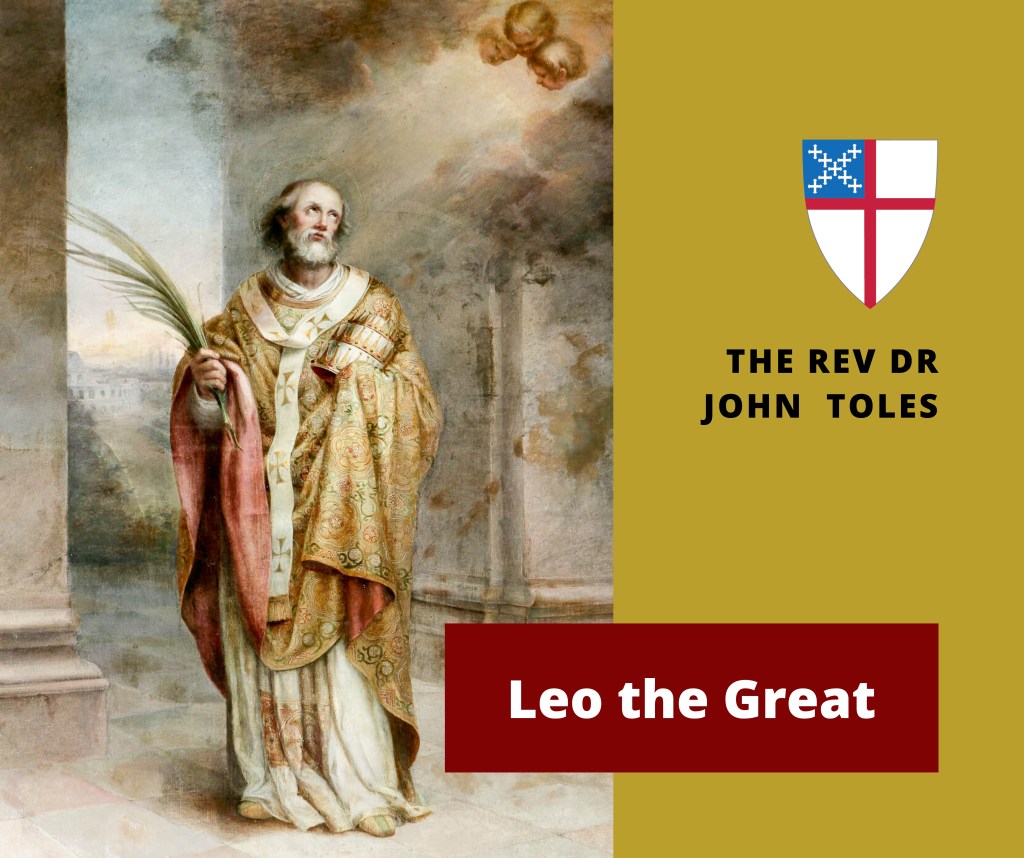
Sermon: Leo the Great

The podcast is available here.


I don’t know that there are many who would have come face-to-face with Attila the Hun, opposed him, and lived to tell the tale, but our saint for today, Leo the Great, was one who did and in the process, convinced him not to sack Rome. However it came about, Leo would later be elected as Bishop of Rome in the year 440 and hold the position until his death on November 10, 461. He received the title “the Great” because of his great work while holding the position.

As I was reading on him, I was struck by a passage from one of his sermons: “There are two loves from which all wishes proceed, and they are as different in quality as they are different in their sources. For the reasonable soul, which cannot exist without love, is the lover either of God or the world… As the world attracts us with its appearance and abundance and variety, it is not easy to turn away from it unless in the beauty of things visible the Creator rather than the creature is loved; for, when He says, ‘You shall love the Lord your God with all your heart, and with all your soul, and with all your mind (Matt. 22:37),’ He wishes us in nothing to loosen ourselves from the bonds of His love.” (Leo the Great, Sermon XC, ch. iii)

“As the world attracts us with its appearance and abundance and variety, it is not easy to turn away from it…” Ever go shopping for a pair of socks and end up walking out of the store with a new suit or a new purse? Ever been in one relationship, only to find that you are suddenly attracted to someone else? Ever sit down, fully intent on saying your prayers, and half an hour later, find yourself cruising the internet? Yes. The world does attract us with its appearance, abundance, and variety, and it really can be difficult to turn away from. As we know, its appearance, abundance, and variety can also draw us away from God. In one instance, we are bathed in the light of the Gospel and in the next… off we go, wandering off into dark recesses.

Jesus said, “You are the salt of the earth; but if salt has lost its taste, how can its saltiness be restored? It is no longer good for anything, but is thrown out and trampled under foot.” How do we lose our saltiness? Jesus said, “No one after lighting a lamp puts it under the bushel basket, but on the lamp stand, and it gives light to all in the house.” How is it we put our light under a basket? We lose our saltiness and hide our light by allowing the attractions of this world to draw us in, and love them more than we love the One who created them. How do we avoid the trap? To use the language of Leo, don’t allow any attraction of this world, no matter how beautiful, to loosen the bonds of love that you have for the Creator—for God. Always keep Him as the center, the focus of your every action and thought, and in this way, you will remain the salt of the earth and the light of the world.

Sermon: Proper 25 RCL C – The Pharisaical Rogue

The podcast is available here.


Photo by JR Korpa on Unsplash

There was a man in England who put his Rolls-Royce on a boat and went across to Europe to go on a vacation. While he was driving around Europe, something happened to the motor of his car. He phoned the Rolls-Royce people back in England and asked, “I’m having trouble with my car; what do you suggest I do?” Well, the Rolls-Royce people flew a mechanic over! The mechanic repaired the car and flew back to England and left the man to continue his vacation. As you can imagine, the fellow was wondering, “How much is this going to cost me?” So when he got back to England, he sent an email and asked how much he owed them. He received a reply from the Rolls-Royce office that read: “Dear Sir: There is no record anywhere in our files that anything ever went wrong with a Rolls-Royce.”

We’ve all been subjected to it more than once and many claim that it is a very misunderstood poem, but for today’s purpose…

Two roads diverged in a yellow wood,
And sorry I could not travel both
And be one traveler, long I stood…
(The Road Not Taken, Robert Frost)

I thought of that when it struck me that today’s parable from Jesus could begin, “Two roads diverged at the Temple doors….” I would like to say that I’m like the guy in the back, and there are some days that I may actually pull it off, but I know that there are other days when I am the Pharisee. To try and squeeze myself in either of the individuals is the square peg round hole problem—it’s not going to work, because I am not either/or… depending on the day, I am both, because there is a certain appeal to both.

The appeal of the Pharisee: black and white, right and wrong. The Pharisee does not really have to think about his faith, he only has to practice it. Thou shall have no other gods: check. Thou shall not commit adultery: check. Thou shall not murder:… ummm… check. Those are easy, until somebody comes along and says things like, “‘You shall not commit adultery.’ But I tell you that anyone who looks at a woman lustfully has already committed adultery with her in his heart.” That aside, why is there this appeal of the Pharisee and the legalistic approach to our faith?

Brennan Manning answered that one nicely in his book Reckless Confidence: “One of the telltale signs in the contemporary American church that trust in God is on the wane is the meteoric rise of legalistic religion. It will continue to flourish and attract an enormous number of devotees. For legalism is born of fear. It is a religious response to human fear. What makes legalism so attractive is that it meets a basic human need—security…. We create a very solid foundation for our lives, because the God who has been absolutized by us can never surprise us.” (p. 138)

Once the Devil was walking along with one of his cohorts. They saw a man ahead of them pick up something shiny. “What did he find?” asked the cohort. “A piece of the truth,” the Devil replied. “Doesn’t it bother you that he found a piece of the truth?” asked the cohort. “No,” said the Devil, “I will see to it that he makes a religion out of it.” (Source)

The appeal of the Pharisee is that he was given the truth in the form of the Mosaic Law, but instead of using the Law to follow God, the Law became the religion. The Law was what was worshipped and adored and not the Giver of the Law. Yet, it is appealing—give me a law and I can be secure in my legalistic faith as long as I follow that law. Give me a law and I can use that law to know who is in and who is out. Who I have to love and who I can cast away. Give me a law and I’ll use it to put you in your place and demonstrate to you how superior I am to you. Only problem: what happens when I’m the one who broke the law, which brings up the appeal of the second path, the path of the tax collector. We’ll call him the Rogue.

The Rogue stands at the back, dares not look toward Heaven. The Rogue is a rogue and he knows it, so speaking softly to God, he says, “God, be merciful to me, a sinner!” “God, be merciful to me, a sinner!” “God, be merciful to me, a sinner!” The appeal of the Rogue: grace, mercy, forgiveness. Going home justified. The Rogue knows he’s a rogue, even though he tries to be a saint. The Rogue humbles himself before a righteous God and begs to be made clean. And the God who created the Rogue, loves him, and makes him whiter than snow. However, the way of the Rogue is not without its pitfalls.

For starters, and this is something we talked about in Confirmation Class this past week: God may send the Rogue home justified, but the Rogue simply does not believe it. Pitfall: spiritual pride—we hear the words of our absolution, but we believe our sin too great to actually be forgiven. When we believe that, we are saying the Cross—the bloody sacrifice of Jesus—is too small to cover my sins, to justify us before God. The Apostle John teaches us, Jesus “is the atoning sacrifice for our sins, and not only for ours but also for the sins of the whole world,” and we add, except for mine. That is one pitfall of the Rogue, hearing that he is justified, but not believing it. Another is actually a combination of the two. Let’s call this one the Pharisaical Rogue.

The Pharisee is one who made a religion out of the Mosaic Law and worshipped it instead of God. The Pharisaical Rogue sits in the pews at church praying, “God, be merciful to me, a sinner!” But at the same time denies others the same mercy and grace that he is requesting for himself. The Pharisaical Rogue has accepted God’s mercy for themselves, but has established his own law that determines who is in and who is out. It is another form of legalism, but it comes with a spiritual arrogance, for it professes to not only know the mind of God, but to also be the gate through which God’s mercy and grace will be allowed to flow. It forgets, “judgment without mercy will be shown to anyone who has not been merciful. Mercy triumphs over judgment.” (James 2:12) The author of Proverbs writes, “Do not withhold good from those to whom it is due, when it is in your power to act.” (Proverbs 3:27)

“Though justice be thy plea, consider this,
That, in the course of justice, none of us
Should see salvation: we do pray for mercy;
And that same prayer doth teach us all to render
The deeds of mercy.”
(William Shakespeare, The Merchant of Venice, Act IV, Scene I)

We are not to withhold mercy, when it is in our power to show it.

Two roads diverged in a yellow wood… Two roads diverged at the Temple doors… and I… I take them both.

What are we to do—and I say ‘we’… and I hope this doesn’t sting too much… I say we, because I know I’m not in this boat alone—What are we to do? I believe we should all remember a couple of things. The first is what St. Paul said to the Corinthians: “We must all appear before the judgment seat of Christ, so that each of us may receive what is due us for the things done while in the body, whether good or bad.” (2 Corinthians 5:10) The second is what Paul said in his second letter to Timothy when Paul was in prison in Rome and had gone on trial: “At my first defense no one came to my support, but all deserted me. May it not be counted against them! But the Lord stood by me and gave me strength.” (2 Timothy 4:16-17a) On the last day, we will all stand before the judgment seat of Christ, and we will either be condemned for the evil we have committed and the mercy we did not show or, it will kinda be like the letter the man received from Rolls-Royce: Jesus will stand beside us and say, “There is no record in God’s files that you have ever done anything wrong. You have been shown mercy. You may enter your eternal home… justified.”

Allow God’s grace and mercy to work in you and allow that same grace and mercy work in others. Allow them to be justified as you have been justified.

Let us pray: Hail, holy Queen, Mother of mercy, hail, our life, our sweetness and our hope. To thee do we cry, poor banished children of Eve: to thee do we send up our sighs, mourning and weeping in this valley of tears. Turn then, most gracious Advocate, thine eyes of mercy toward us, and after this our exile, show unto us the blessed fruit of thy womb, Jesus, O merciful, O loving, O sweet Virgin Mary! Amen.


Sermon: Proper 24 RCL C – Persevere for Justice

The podcast is available here.


The Methodist like to claim him, but John Wesley is one of ours. It was some rabble-rousers that came along later who formed the Methodist Church. Wesley was gifted in many areas, including preaching and teaching, but the one gift that allowed him to have such great influence was his perseverance. A few entries from his diary prove the point:
Sunday, A.M., May 5 / Preached in St. Anne’s. Was asked not to come back anymore.
Sunday, P.M., May 5 – Preached in St. John’s. Deacons said “Get out and stay out.”
Sunday, A.M., May 12 – Preached in St. Jude’s. Can’t go back there, either.
Sunday, A.M., May 19 – Preached in St. Somebody Else’s. Deacons called special meeting and said I couldn’t return.
Sunday, P.M., May 19 – Preached on street. Kicked off street.
Sunday, A.M., May 26 – Preached in meadow. Chased out of meadow as bull was turned loose during service.
Sunday, A.M., June 2 – Preached out at the edge of town. Kicked off the highway.
Sunday, P.M., June 2 – Afternoon, preached in a pasture. Ten thousand people came out to hear me.

I want to thank you all for not turning any bulls loose on me. I really can’t run all that fast. Had Wesley quit at the end of May, he never would have known the great success God had in store for him in two days.

Today’s Gospel reading lends itself for one of those sermons on perseverance with examples like that of Wesley and so many others who just didn’t know the meaning of the word ‘quit,’ and it would also be easy to preach a sermon on prayer, how we need to persist in prayer in order to receive those good things, but as we’ve shown in the past, prayer – even persistent prayer – does not always end with God responding as we would like; otherwise, I would have long since won the lottery and be swimming in the Caribbean with you know who. Our Gospel reading would allow for such thoughts, but in telling the parable, Jesus was clear about what the woman was praying for.

First off, we have to remember that this is a parable. It was a few weeks back that we had the parable of the shrewd manager: his master was going to fire him, so in order to make friends, he went out and cut the amounts of what everyone owed his master. His master commended the shrew manager for his actions. It would seem that Jesus was commending the manager for cheating, but then we understood that the story was not a moral teaching, but a parable. It had a very specific point in mind. The same idea applies to our parable from today: we would think that the judge should be representing God, but the judge says of himself, “I have no fear of God and no respect for anyone.” That certainly doesn’t sound like God, but like with the shrewd manager, this is a parable, not some commentary on the nature of God, and the point of this parable is justice. “In a certain city there was a judge who neither feared God nor had respect for people. In that city there was a widow who kept coming to him and saying, ‘Grant me justice against my opponent.’” So the question is: who is the opponent? We hear about them throughout Holy Scripture: from the book of Proverbs:

There are six things that the Lord hates,
seven that are an abomination to him:
haughty eyes, a lying tongue,
and hands that shed innocent blood,
a heart that devises wicked plans,
feet that make haste to run to evil,
a false witness who breathes out lies,
and one who sows discord among brothers.

These and those like them are the opponents of God that the woman is crying out for justice against. She is saying, Lord, can’t you see: there is evil in the world. It is running rampant! It flies in the face of everything you have taught us. Do something about it. Do something about it. Do something about it. And Jesus’ response: if the unjust judge will grant her justice, simply because he does not want to listen to her complaints week after week, then “will not God grant justice to his chosen ones who cry to him day and night? Will he delay long in helping them? I tell you, he will quickly grant justice to them. And yet, when the Son of Man comes, will he find faith on earth?” ‘Lord, do something about all the injustice in the world.’ ‘I will do something and I will do it quickly. Just have faith.’ To that, we could respond, ‘Lord, we’re trying to have faith here, but it’s been 2,000 years… I don’t call that ‘quickly.’ So, why won’t you do something against these evildoers? Where are you?’

Bishop Roger Herft, former Anglican bishop of Newcastle in Australia, tells of a Croatian refugee he met in 2001. The man had fled his war-torn country and arrived in Australia some years before. Since then his marriage had fallen apart and he lost custody of his children. In addition, during the conflict in Croatia, twenty-four members of his family, including his 84 year old grandfather and four month old niece, had been killed.

He said to Bishop Herft, “Where is God when it really matters? I’ll tell you where. God has got fed up with us. He has put up a board saying, ‘Gone Fishing’, and has left us to live in this bloody mess.”

“When the Son of Man comes, will he find faith on earth?”

Our own experiences may not be as tragic and harsh, but we know they exist. We would have to be deaf and blind not to see the injustices of the world, anyone of which could lead us to say, ‘God’s gone fishing and left us to live in the mess.’

We see what is around us – as the author of Proverbs said, we see the haughty, the lying tongues, the deceivers, the shedders of innocent blood, the sowers of discord, and so much more – we see all these things and we can lose our faith because we do not believe God will respond, that God will act, and so we do not persevere. We do not persevere, because we see all this and in the midst of all this noise and violence we fail to see what is within us and what is in our midst. And what is that?

Just prior to the words of our Gospel reading, Jesus had said to this same group of people, “The kingdom of God is not coming in ways that can be observed, nor will they say, ‘Look, here it is!’ or ‘There!’ for behold… for behold, the kingdom of God is in the midst of you.” We see all the noise and violence, and can come to believe that we are futilely crying out for justice to a God who does not hear and does not care, while failing to recognize that what we are asking for is unfolding before our very eyes. Where is God? The kingdom of God is in the midst of you, is within you. God has not gone fishing, it’s just that we are living in the time of the ‘not yet’ and the ‘now.’ The kingdom of God is not yet fully realized, so we must continue to pray for justice, but the kingdom of God is also now, so we must persevere in living into that kingdom and make our God known. Revealing him to others so that they too might be strengthened and have faith.

As a bonus, would you like to know the secret to perseverance? My friend St. Josemaría Escrivá tells us: the secret of perseverance is “Love. Fall in Love, and you will not leave him.” …. St. Jude tells us, “Beloved, building yourselves up in your most holy faith and praying in the Holy Spirit, keep yourselves in the love of God, waiting for the mercy of our Lord Jesus Christ that leads to eternal life.” Our perseverance is not about an act of willpower on our part. Our perseverance is about our relationship with the One who saves. If you truly fall in love with God, then all of heaven and earth can come against you and you will stand firm in your faith, persevering until the end.

Let us pray: Lord Jesus Christ, we believe in You as our God and our Saviour. Make us more faithful to Your Gospel and commandments. By sharing in the Eucharist, may we come to live more fully in the life You have given us. Keep Your Love alive within our hearts and souls so that we may become worthy of You. Teach us to value and be thankful for all of Your Gifts. Help us to strive for eternal life. Amen.


Sermon: Teresa of Ávila

The podcast is available here.


Although most of you read the autobiography of Teresa of Ávila and know much of her life for yourselves, I hope you aren’t tired of hearing the stories about her life.  One that I find particularly humorous is about establishment of the religious house in Medina.

All the arrangements had been made, but as they drew near to the town, they learned that an Augustinian monastery that was near by was objecting to the sisters establishing another house.  Reason: the Augustinians believed that Teresa and her little gang of nuns would begin to cut into the alms that the people gave in support of them.  So great were the Augustinians fears that they were prepared to file a lawsuit against Teresa.  Teresa, it would seem, was never daunted.  

The solution: say Mass in the new house before the Augustinians even knew they were in town, for once the Mass was said in a new chapel, it was very difficult to remove anyone.  So, instead of arriving in full day when everyone would see, Teresa and her nuns snuck in at midnight.  Teresa writes: “There we were in the streets, friars and nuns, laden with the sacred vessels and vestments necessary for saying the first Mass and fitting up the chapel: we looked like gypsies who had been robbing churches: if we had run into a night patrol we should have spent the rest of the night in jail.”  (Source, p. 123) How did it work out?  The town of Medina woke up that morning to the ringing of the bells, calling people to Mass, at the new convent… and there was nothing anyone could do about it.

Aside from the humor of it all, what strikes me is the significance of saying the Mass.  I could go out and find some building and with the right support, claim it in the name of the church, say Mass and still no one would think twice about demolishing the building as soon as I walked out the doors (or maybe while I was still inside).  To many, nothing special would have occurred within those walls, but for Teresa and the faithful, the Mass was the way of making God truly present.  She writes: “The Lord had given this person such lively faith that, when she heard people say they wished they had lived when Christ walked on this earth, she would smile to herself, for she knew that we have Him as truly with us in the Most Holy Sacrament as people had Him then, and wonder what more they could possibly want.” (Source, p.125)  She expresses there one of the great mysteries of our faith: God chose to humble himself and be born in a manger and God chooses to continue to humble himself and be fully present to us—just as present as he was to the disciples—in the bread and the wine, the body and the blood.

In our Gospel reading, Jesus said, “Let your light shine before others, so that they may see your good works and give glory to your Father in heaven.”  The same source of the light that shines forth from us is contained within the bread and the wine: Jesus.  When you receive communion, remember, it is not ‘what’ you are receiving, but ‘who’ you are receiving.  And then, in the words of Teresa, ask yourself, “What more could I possibly want?”

Sermon: Proper 23 RCL C – Made Clean

The podcast is available here.


Photo by Erda Estremera on Unsplash

In a small town there was a family in one of the congregational churches with the reputation of being the poorest family in the county. One Sunday, the family just stopped coming to church. After a couple of weeks, the preacher had a theory that the family was so ashamed of the way they dressed that they didn’t want to come out into public.

So the preacher put out the word to his congregation that he needed clothing for the family and got some real nice children’s clothes and some for the mother and the father, too. He took the clothes down to the family and they seemed grateful. They said they would come to church the next Sunday.

But Sunday rolled around and they weren’t there. Sunday afternoon, the preacher went to see them and asked: “Where were you this morning?”

And the man of the house said: “Well, preacher, we got all cleaned up and got on those nice clothes you brought, and we looked so good we decided to go to the Episcopal church.”

The numbers are fun: worldwide, the soap bar industry earned $19.2 billion dollars last year. In the US alone, it is estimated that we go through 11.7 billion bars of soap a year. That’s a lot of lathering up to get clean. The most expensive bar of soap is made in Lebanon and cost $2,800 a bar. It is infused with gold and diamond powder dust. The people who make that bar of soap are very smart, because they know that there are plenty of idiots in the world who will buy it.

Anyhow, when we think of soap, most are only concerned with removing the dirt and unpleasant aromas—to get clean—but when it comes to the Hebrew Scriptures, clean and unclean are something very different.

For example, there are foods that are unclean: most know that bacon is unclean, but did you know that grasshoppers are clean? The lowly shrimp is off limits, but the chicken is fine. There are also things that you can do to become unclean. Touching anything dead will make you unclean. And then there are some things, completely out of your control that can make you unclean, one of which is contracting leprosy (which in this context is a very broad term that defines a variety of skin disorders.) And it was these unclean that Jesus encountered in our Gospel reading today.

As Jesus “entered a village, ten lepers approached him. Keeping their distance, they called out, saying, ‘Jesus, Master, have mercy on us!’”

The Mosaic Law was very clear about what was to take place when a person contracted a certain variety of leprosy, “The leprous person who has the disease shall wear torn clothes and let the hair of his head hang loose, and he shall cover his upper lip and cry out, ‘Unclean, unclean.’ He shall remain unclean as long as he has the disease. He is unclean. He shall live alone. His dwelling shall be outside the camp.” (Leviticus 13:45-46) By today’s standards, that sounds harsh, but they didn’t have modern medicine, so a true case of leprosy or other communicable disease (perhaps like the measles) could easily spread to many others, so these persons had to be cut off and removed.

What did it mean for the individual to be cut off? No job, no family or friends (except maybe other lepers), no resources, out in the wilderness outside the city gates, and unprotected, but this wasn’t the worst part. You see, clean and unclean are more accurately translated as pure and impure, and those terms are referring to a person’s relationship to God. And to be impure, with no access to the means of atonement—being made right with God, becoming clean before God—meant that not only are you cut off from the world, but you are also cut off from God. Separated from Him. So, you stand alone, out in the wilderness and cry out, ‘Unclean. Unclean.’ But, you see, I hear those words and they seem more than just a declaration of a person’s current state. Those words also sound like a prayer. A plea to God for washing.

When King David had sinned, when he was impure and cut off from God, he wrote Psalm 51:

Have mercy on me, O God,
according to your steadfast love;
according to your abundant mercy
blot out my transgressions.
Wash me thoroughly from my iniquity,
and cleanse me from my sin!
For I know my transgressions,
and my sin is ever before me.
(Psalm 51:1-3)

To me, David is crying out, ‘Unclean. Unclean.’ Yet, even in that state of impurity, David has hope. Hope in God’s love and mercy, for he goes on to say:

Purge me with hyssop, and I shall be clean;
wash me, and I shall be whiter than snow.
(Psalm 51:1-3, 7)

Lord, I am unclean, but you can wash me. You can make me whiter than snow.

What is the Lord’s response? I refer back to the story of the healing of the leper that I shared with you last week. The leper came up to Jesus and said, “Lord, if you choose, you can make me well.” And the Lord responds, “I do choose, be well.”

The Lord’s response: God chose to make us well, chose to make us clean, and he makes it possible through our participation in the death and resurrection of Jesus. How do we participate in the death and resurrection of Jesus?

“All of us who have been baptized into Christ Jesus were baptized into his death? We were buried therefore with him by baptism into death, in order that, just as Christ was raised from the dead by the glory of the Father, we too might walk in newness of life. For if we have been united with him in a death like his, we shall certainly be united with him in a resurrection like his.”

We participate in the death and resurrection of Jesus through our baptism. When we enter the waters we are unclean and when we rise we are clean. The old self dies and we are “set free from sin” and raised to an eternal and resurrected life in Christ Jesus. What did our Gospel say: The leper that returned “prostrated himself at Jesus’ feet and thanked him…. Then Jesus said to him, “Get up and go on your way; your faith has made you well.” Those words, “get up,” have a very specific meaning… resurrected. Jesus said to the man, “Be resurrected! You have been made clean.”

Prior to our baptism, we are like the leper at the feet of Jesus. We are lying in the dust, we are dead in sin, we cry out, ‘Unclean,’ but through our baptism, Jesus says to us, “Get up! I choose to make you whiter than snow. Be resurrected into eternal life with me.”

And what is our response to this gift? Consider the words of the Psalm from today:

Hallelujah!
I will give thanks to the Lord with my whole heart,
in the assembly of the upright, in the congregation….
He sent redemption to his people;
he commanded his covenant for ever;
holy and awesome is his Name.

Our response to the Lord is thankfulness, because “he sent redemption to his people.” He sent Jesus… “For God so loved the world…” that we might be with Him.

This morning, I pray, that as we baptize Angelica Rose, you will recall the great work that was begun in you through your own baptism—how you passed over from unclean to clean, impure to pure, death to life—and that in your heart and with your words, you will also return to the Lord and give him thanks.

Let us pray… a few more verses from Psalm 51:

Create in me a clean heart, O God,
and renew a right spirit within me.
Cast me not away from your presence,
and take not your Holy Spirit from me.
Restore to me the joy of your salvation,
and uphold me with a willing spirit.
Amen.