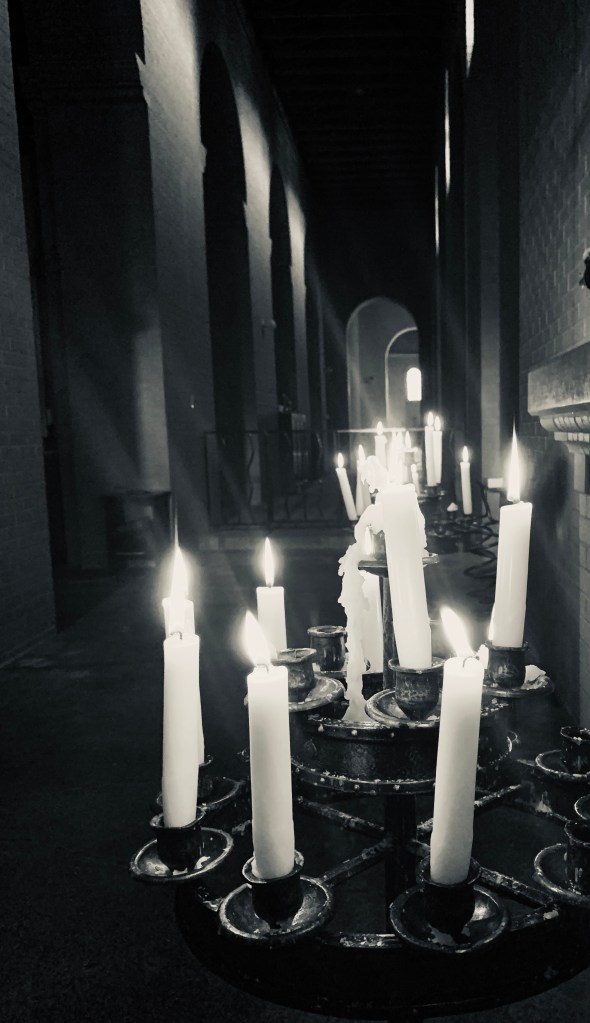
Up at 4:30 a.m. this morning. Showered, dressed (cassock), and in the chapel by 5 a.m. We prayed until 8:15 a.m. After the first two times of prayer—Mattins and Lauds—it was time for Low Masses. This one was completely new to me. There are a total of ten altars (let the Altar Guild beware!) and a Mass was said at each of them simultaneously, but… they were said silently (either that or my hearing is really shot.) If you think we bow and kneel a lot… wow. It is truly beautiful to watch and listen to, which is about all I can do, although I’m beginning to learn how to follow along in the various books. It also helps to sit behind someone who knows what they are doing. (Although we in the Episcopal Church do less of the bowing, etc. I am certain that for someone new to us it feels the same way as I feel here. It is an excellent reminder that we must be who we are, but we also be accessible to those who are unfamiliar with our practices.)
Breakfast: the food is actually pretty good, but it is easy to see why these fellas are all so skinny. Actually, they’re probably just really healthy. I don’t know that we’ve seen a piece of meat yet, which makes me glad I stopped for the Big Mac on the way here (there’s meat in a Big Mac… right?) And I do confess to having smuggled in a few snacks, along with some instant coffee. Speaking of which, the coffee here is brilliant! I plan on seeing if they have some for sale in the bookstore.
During each of the meals we have someone read to us. For breakfast we heard a few chapters from the Rule of St. Benedict. Lunchtime… now that was fun: I doubt it was for my benefit, but being the only Anglican / Episcopalian here I had to stifle a few chuckles. The reading was a bit of church history and we heard about that excommunicated apostate and heretic Queen Elizabeth I. Her daddy got raked over a few coals as well. I think it was just a timing thing—can’t see them hauling that one out just to smack the heretic priest around—but I could almost feel the eyes boring into me. When the Abbot shook his head at one particular Elizabethan atrocity, I made sure I had a clear path to the exit. If I see them stacking wood, I’ll be making an early exit.
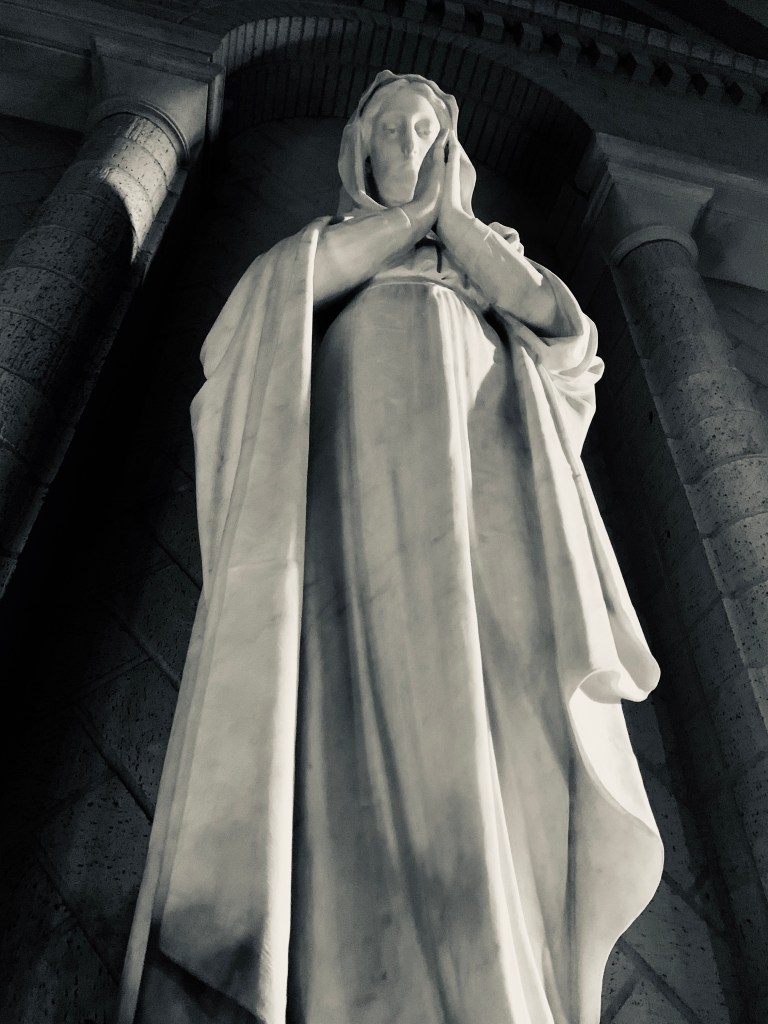
I have a fifteen decade rosary that I prayed today, most of it standing before this statue. (She could easily be the statue in The GoldenFistula. Truly beautiful and cut from a single piece of white marble.) Don’t get me wrong, I love what I do as a priest serving at St. Matthew’s, but to spend an hour and a half praying the rosary is not something I would ever be able to do… and you know… that’s OK. I’m going to find some time today or tomorrow and take a walk with her. She always shows us the most remarkable things and always leads us to her Son. What a great comfort to know we have a Mother who loves and treasures us as she loves and treasures her own Son.
It is 4:15 p.m. right now and Vespers is not until 6:00 p.m., so I’m going to sign off for now and either sneak in that nap or take that walk… be back a bit later in the day…….
The nap won, but I made it up in time for Vespers. Supper, then Compline.
Found a delightful book: Sermon in a Sentence: A Treasury of Quotations on the Spiritual Life by St. Padre Pio of Pietreclina. A bit like the collection of sayings from St. Josemaria Escriva in The Way, et al.
“I hope that Jesus will not only be pleased to enlighten me in the guidance of the souls He entrusts to my care and to sustain and comfort me in difficulties, but that He will Himself make up for my deficiencies.” (L1 1369)
Blessings to you all. I pray for you many times each day.
After watching the Brothers and their praying, those were my first two initial thoughts about myself. Perhaps a bit harsh. Maybe a little truth.
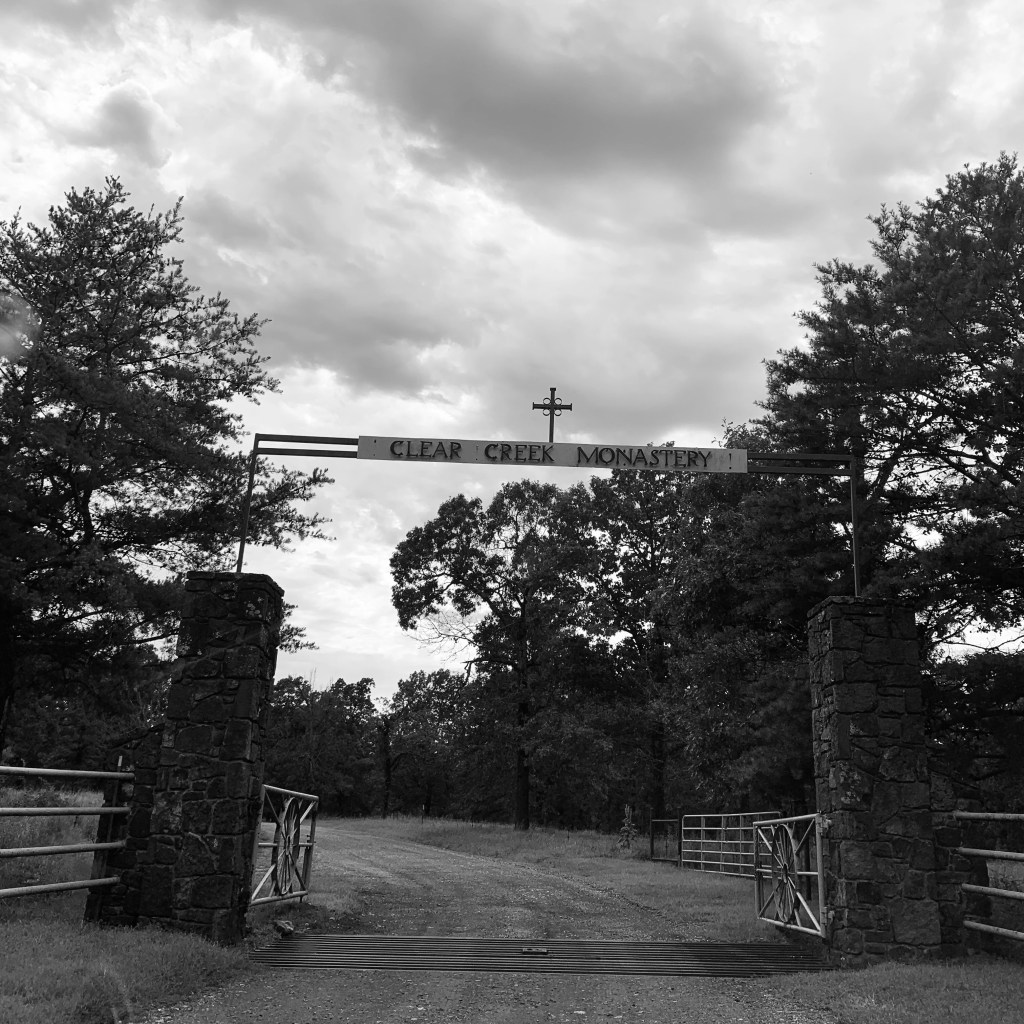
I arrived at the Clear Creek Monastery today around 3 p.m. was greeted by a very kind, very soft spoken Brother. He helped me with my bags (more books than clothes), showed me the basic layout, and then was off to attend other monk duties.
I say ‘monk’, because these fellas are the real deal. Most shocking aspect so far… most of them are very young. I had really expected there to be about eight older men, mostly hunched over. Wrong. There are fifty-four professed monks who spend their lives living, working, and mostly praying in this one place. The simplicity is desirable… I’ll keep you posted on that as I spend more time here. My soul says, “I want to do this!” But my mind says, “Hang on there fat boy.” I have a small home and I like it, but I would imagine that the monks ‘cells’ make my room here look like a mansion. Very sparse, but everything you need. When you are expected to spend your life in prayer, you don’t need much.
Of prayer: I’ve attended Vespers and Compline. The service is entirely sung and is all in Latin, so I just listen. Not a bad thing. It is exactly what you think it would sound like.
Just prior to supper, I was introduced to the Abbot. He washed my hands… yeah. Nothing to add…
Alright, it is 9:33 p.m. and you all are probably just getting started with your evening, but I’m off to bed. The day around here starts pretty early. The first service tomorrow is at 5:15 a.m. I keep looking at the schedule to see when we get nap time, but it doesn’t appear they have plans for that. I’m guessing I’ll work it out.
There is no WiFi and I’ve got one bar on my phone. It may take all night for this to upload…
The Lord bless you all and keep looking for miracles.
A passenger on an ocean liner was enduring a rough Atlantic crossing. As he leaned over the rail, his face a shade of green, a steward came along and tried to encourage him: “Don’t be discouraged, sir! No one’s ever died of seasickness yet!” The nauseous passenger looked up at the steward with horror and said, “Don’t say that! It’s only the hope of dying that’s kept me alive this long!”
Hope. In The Forresters, Alfred Lord Tennyson wrote, “Hope smiles from the threshold of the year to come, Whispering ‘it will be happier’…”
Clearly, Tennyson never heard of 2020. But then, hope is complicated, because we hope for so many different things: death in the midst of being seasick, a new job, better world, sushi for lunch, relationships, peace, cure for cancer… the list is inexhaustible, and it is not a bad thing. Hope is what drives us for something better. It brings joy, stimulates the imagination, props us up even on the dark days. It is not a bad thing, but it can also be unreasonable. (For example, I’ve mostly gotten over the hope having a date with Scarlett Johansson, but… one never knows.) Do we always get what we hope for? According to Mick Jagger and The Rolling Stones:
“You can’t always get what you want But if you try sometime you find You get what you need.”
Unfortunately, that’s not always true either. There are those times when we don’t get what we want, what we hope for and we don’t get what we need. But even then, we do not stop hoping and we never should. John Paul II said, “I plead with you–never, ever give up on hope, never doubt, never tire, and never become discouraged. Be not afraid.” There can always be hope, for there is only one place where all hope dies. Dante tells us about it in Inferno: the inscription over the gates of hell:
“Through me you enter the city of woe, Through me you pass into eternal pain, Through me you join the godforsaken tribe. Justice moved my exalted Creator:
By the divine power was I erected, And by supreme wisdom and primal love. Before I was made nothing had been made But things eternal, and I too am such. Abandon all hope, ye who enter here!”
Hell is the end of hope and I pray that it is something that none of us ever experiences (although some of you should consider confession), but until we enter the final destination—heaven—we will hope. So then, we hope, but where is our hope placed?
The people had discovered where Jesus had gone off to and followed him out into that deserted place. They stayed late. Listening. Being healed. Simply wanting to be near him. The day was coming to a close, so the disciples told Jesus to tell the crowd that it was supper time and they needed go find something to eat. Jesus said, You feed them. The responded, We don’t have enough and we can’t afford more. Jesus response, Just feed them. There’ll be enough. Turns out, there was more than enough. This took place in chapter fourteen of Matthew’s Gospel. It will take place again in chapter fifteen, yet, in John’s Gospel, Jesus is reported to have said to the crowds, “Truly, truly, I say to you, you are seeking me, not because you saw signs, but because you ate your fill of the loaves.” Where was the hope of the people placed? In Jesus or in supper? According to John, it was supper.
Early this week I read a blog post by Niel Knoblauch. His blog is called the Barefoot Ascent. Niel grew up and lived in South Africa, but he and his wife now live in the United Kingdom. Niel’s most recent blog entry is called “The Weight of Hope”, and after reading it, I knew I wanted to share it with you, so I wrote to him and asked for permission. He was kind enough to agree.
Like all of us, Niel has hopes, but there was one particular thing that he had been hoping and faithfully praying for. He knows that God is good, so he had faith that God would answer his prayer. Yet, even after praying for this one thing—for almost a decade—he had still not received it, which led him to be disappointed in God. Yes, disappointed in God, but then it hit him. He was convicted and writes, “I have placed the weight of my hope on what I wanted instead of placing it on Him… I’ve placed my trust in what I wanted and placed the question mark on God’s love and goodness, rather than placing my trust in God and the question mark (the discretion of whether this is what is good for me right now) on what I wanted.” His hope was on the thing and the sign of God’s goodness was whether or not God fulfilled that hope.
The multitudes who had been following Jesus around: perhaps, at first, they followed him for who he is, but that later changed to what he could do for them. In his blog post, Niel asked, “Has God’s goodness been on trial in your heart?” For the multitude, the answer was, Yes. I hope he will feed us supper again. I hope he will heal me. I hope that he will be the leader who gives us freedom… because, if he does these things, then he will really prove to us that he loves us. They placed the weight of their hope on what they wanted instead of placing the weight their hope on Him.
Hope is complicated, so we as a Christian people must remind ourselves of where our hope should be directed, because hope is not only an expression of our desires and our wants, Hope is also a person. St. Paul begins his first letter to Timothy by saying, “Paul, an apostle of Christ Jesus by command of God our Savior and of Christ Jesus our hope, To Timothy, my true child in the faith.” (1 Timothy 1:1-2a) “…by command of God our Savior and of Christ Jesus our hope.” Jesus is hope incarnate, hope made man.
Yes. We have hopes and dreams, but our true hope, above all else, is Christ Jesus. My friend Thomas à Kempis writes, “The wise lover [of God] regards not so much the gift of Him Who loves as the love of Him Who gives. He regards the affection of the Giver rather than the value of the gift, and sets his Beloved above all gifts. The noble lover does not rest in the gift but [the Lord who is] above every gift.” (The Imitation of Christ, Book 3, Chapter 6) The Giver, our Hope, Jesus is the one that we seek. The fact that he feeds us, clothes us, gives us those good things we desire… I would say those things are secondary, but the truth is, they aren’t even on the list. The weight of our hope is what lies behind Jesus’ words, “seek first the kingdom of God and his righteousness, and all these things will be added to you.” Seek God and then consider the Lillies of the field.
Niel writes that seeking God’s kingdom first, “is part of what it means to surrender the control of our lives to God; to die to ourselves, so that we may live in Him and He may live in us; to really and truly follow Jesus. And it starts with putting the weight of our hope – of all our hopes and dreams – on Him. It starts with trusting Him with the most precious treasures hidden in the deepest places of our soul. It’s vulnerable and it’s messy. You see, only the One who made you, only the One who knows the depths of who you are better than you do yourself, are worthy and able to carry the weight of your most cherished hopes.”
So, consider Niel’s question: “Has God’s goodness been on trial in your heart?” Are you hoping in things that will pass away or are you hoping in the one who is Hope? Turn your love, affections and desires to God, offer them to him, then allow Him to give, to respond to your hopes and dreams according to His eternal purposes.
Let us pray: You, O Lord our God, are above all things. You alone are most high, most powerful, sufficient and satisfying. You alone most sweet, consoling, beautiful and loving. You alone are most noble, glorious and above all things. In You is every perfection. Therefore, whatever You give us besides Yourself is too small and insufficient when we do not see and fully enjoy You alone. For our hearts cannot rest or be fully content until, rising above all gifts and every created thing, we rest in You. Amen. (adapted from The Imitation of Christ, Book 3, Chapter 21)
It was Sunday morning and Harry pulled out of his driveway in his 2-seater convertible, with the roof closed because of the pouring rain, and headed for church. As he turned onto the main road he saw ahead of him three people at the bus stop, huddled under a single umbrella. One was Mrs. Fletcher who still insisted on getting to church by herself, despite her arthritis. There was Dr. Jones, the local General Practitioner. Harry virtually owed him his life after the Doctor had diagnosed a rare disease. And the third person was Judith. Harry saw Judith for the first time six months before when she had joined the church and had a crush on her ever sense. Only problem, he never plucked up the courage to ask her out. He knew he had to do something, but maybe had less than three seconds to decide what. There was only one spare seat. Who should he offer a ride? Three seconds were enough. What did he do? He pulled to a halt, jumped out, passed the keys to Dr. Jones, helped Mrs. Fletcher into the passenger seat then waved them good-bye as he huddled close to Judith under the umbrella. Some decisions are easier than others. For the more difficult ones, we can seek what we call “the will of God.”
Before I jump off on this topic and just as a warning: I often joke about reading St. Paul’s writings. They can be very confusing at times. This sermon, in the words of many a rednecks—“Hold my beer.” Let’s see if I can avoid that confusion.
Recently, I’ve been wrestling with the meaning of “the will of God,” and I’ve concluded that it ultimately has to do with the sovereignty of God. So let’s begin there.
The sovereignty of God states that the Lord is in control of all things: omniscient, omnipotent, and omnipresent: all knowing, all powerful, and all present. Because a butterfly flapped its wings in Tibet, two weeks later a tornado occurs in Kansas. The sovereignty of God states that not only did God cause the butterfly to flap its wings, but God knew, before the creation of the world, that it would, and cause all prior and subsequent events, and he was there when Toto landed in Oz. All of it and everything in between. Perhaps it is a bit more complicated than that, but you get the point. God’s sovereignty places everything in his hands and under his dominion.
It is within this sovereignty of God that the will of God is executed. The will of God is the action or expression of the sovereignty of God. Sovereign is who God is and his will is what God does, which all leads back to the question I’ve been wrestling with: we often say that we want to know the will of God for my life, but I’ve come to the conclusion that the will of God isn’t “personalized” in such a manner. Which means, we can’t really say things like, “The will of God for my life is to be a priest, a barber, to get married, to live here, etc.” Instead there is only “The Will” of God—capital “T”, capital “W”, and we are participants in that Will. So, if that’s true—and maybe all this is heresy—then what is it? If there is only The Will of God, then what is that Will?
The Lord states through the prophet Ezekiel, “I have no pleasure in the death of anyone… so turn and live.” (Ezekiel 18:32) St. Paul restates this in his first letter to Timothy: God our Savior “desires all people to be saved and to come to the knowledge of the truth.” (1 Timothy 2:4) The Will of God—not for my life, but The Will of God—period—is for us to have eternal life in Him, and we know that he has provided the Way to that eternal life through the death and resurrection of his One and Only Son, Jesus. That is God’s Will: eternal life in Him. So the question then becomes, if we are participants, then how do we rightly participate in that Will?
My friend, St. Josemaría Escrivá writes: “You and I belong to Christ’s family, for ‘he himself has chosen us before the foundation of the world, to be saints, to be blameless in his sight, for love of him, having predestined us to be his adopted children through Jesus Christ, according to the purpose of his Will’…’this is the Will of God: your sanctification’. Let us not forget, then, that we are in our Master’s sheepfold in order to achieve that goal.” (Friends of God, no.2)
We rightly participate in The Will of God through our faith in Jesus Christ and the process of participation is our sanctification. Our goal, which flows from our faith in Jesus, is to become saints. Yes, we are called to be saints, we’ve talked about this before, understanding that, in this life, our halo might not always look so great. Nelson Mandela said it of himself, “I am not a saint, unless you think of a saint as a sinner who keeps on trying.”
Sanctification, becoming a saint, is a process, a process that we never tire of striving for. God’s Will is that we come to faith in His Son and that we strive for sanctification. But… couldn’t he have made this process of sanctification a tad easier?
In the context of the parable today about the wheat and weeds: why didn’t the master order the weeds pulled up? And in Jesus explanation of that parable: why didn’t God simply remove the evil once it appeared? Was it that he couldn’t? Not at all. He is sovereign even over the evil one, for regardless of whether the weeds grow amongst the wheat, the Garden is still his. In His sovereignty, God could have removed evil, but instead, he allowed it to remain. Why?
Abba Poemen said of Abba John the Dwarf that he had prayed God to take his passions away [to take away the evil] from him so that he might become free from care. He went and told an old man this: ‘I find myself in peace, without an enemy,’ he said. The old man said to him, ‘Go, beseech God to stir up warfare so that you regain the affliction and humility that you used to have, for it is by warfare that the soul makes progress.’ So he besought God and when warfare came, he no longer prayed that it might be taken away, but said, ‘Lord, give me strength for the fight.’
Yes. God could have removed the evil, but those who seek sanctification, need it. We don’t become physically strong by sitting in the Lay-Z-Boy and eating bonbons. We become physically strong by exercising, exerting ourselves, and we become strong in our faith by fighting against the evil. It contributes to perseverance in faith, it can serve as correction for when we are disobedient, it causes us to turn to God in seeking care and protection and forgiveness, it is a part of free will, because just as we are free to choose the righteous, we are also free to choose the evil, and it also serves God’s purposes even when we fail, for it keeps us humble. Paul writes, “To keep me from becoming conceited because of the surpassing greatness of the revelations, a thorn was given me in the flesh, a messenger of Satan to harass me, to keep me from becoming conceited. Three times I pleaded with the Lord about this, that it should leave me. But he said to me, ‘My grace is sufficient for you, for my power is made perfect in weakness.’” (2 Corinthians 12:7-9a) The evil is in no way celebrated, but it is a tool in the process of our sanctification. It is what makes us stronger as we fight against it. And in the end, holiness returns to all creation: “Just as the weeds are collected and burned up with fire, so will it be at the end of the age. The Son of Man will send his angels, and they will collect out of his kingdom all causes of sin and all evildoers, and they will throw them into the furnace of fire, where there will be weeping and gnashing of teeth. Then the righteous will shine like the sun in the kingdom of their Father.”
The fella standing under the umbrella with Judith, watching the Doctor drive Mrs. Fletcher to church: the sovereignty of God puts everything in its proper place, he aligns the world according to his purposes. We exercise our free will through our choices and actions. If we do so rightly, by resisting the evil and working towards our sanctification, then at the end of the age, we, the righteous, the sanctified will shine like the sun in the Kingdom of Our Father.
Let us pray: Most holy Trinity, Godhead indivisible, Father, Son, and Holy Spirit, Our first beginning and our last end, You have made us In accord with your own image and likeness. Grant that all the thoughts of our minds, All the words of our tongues, All the affections of our hearts, And all the actions of our being May always be conformed to your holy Will. Thus, after we have seen here below in appearances And in a dark manner by means of faith, We may come at last to contemplate you face-to-face In the perfect possession of you Forever in heaven. Amen.
Calvin and Hobbes: Calvin is getting dressed for school. The first frame of the comic is him pulling on his tighty-whiteys. Next, in nothing but said tighty-whiteys, he standing in front of the mirror flexing his muscles and has a look of total confidence on his face. Charging out the door, he’s ready for the day. It is not the best day: he sits in gum, gets into trouble, gets beat up, doesn’t know the answer, misses the bus and gets caught in the rain. The last frame is him sitting on the bed with his trusty tiger, Hobbes. Remember those tighty-whiteys? Calvin says to Hobbes, “You know, Hobbes, some days even my lucky rocket ship underpants don’t help.”
That can sum up a good many days for all of us. We’re all ready for the day, but then it is one thing after another. One fail or fall after another.
In the parable today, the parable of the sower, Jesus tells us about the four seeds and then later, he actually explains this parable. The seeds are scattered: some fall on the path, others the rocky ground, more amongst the vines, and the rest in good soil. For me, I understand this parable not only to be talking about an overview of a persons life in general, but I also understand it to speak about daily life, because, like Calvin, I can roll out of the bed with every intention of having a holy and righteous day only to have that plan blown apart almost immediately by any number of things.
You know those games that are mazes? And on the sides are two knobs that you turn, attempting to guide a marble through maze, the only catch being that there are holes all along the path. The makers of the game are very generous in that they even draw the path that you have to follow. I hope Jesus doesn’t smack me for this, but that is pretty much how I understand the parable today. We can start off the day ready to take on the world, but almost immediately there are pitfalls. The devil trying to rob us, the pressures of life dragging us down, and the world trying to entangle us. Occasionally we make it through the day mostly unscathed, but there were more than a few close calls along the way.
The days we make it to the end are tremendous, but is there a remedy to the not so tremendous days? As a matter of fact there is: death. Other than that, we’re going to experience them. So, what’s a person to do?
Admiral William H. McRaven: the things that he has accomplished are quite remarkable, but I doubt most of us would know of him if it weren’t for a commencement speech he gave at The University of Texas at Austin on May 17, 2014. Many of you have probably watched it on Facebook or Youtube or something, but…
He’s at the podium in his white United States Navy officer’s uniform with so many medals down the front that it is surprising the weight of them doesn’t rip a hole in his jacket. He is a very confident man and speaker, but also quite humble, so when it came to giving advice to a graduating class, he didn’t start off with any high flying ideas, instead, he started with the very basics.
“Every morning in basic SEAL training, my instructors, who at the time were all Vietnam veterans, would show up in my barracks room and the first thing they would inspect was your bed. If you did it right, the corners would be square, the covers pulled tight, the pillow centered just under the headboard and the extra blanket folded neatly at the foot of the rack — that’s Navy talk for bed.
“It was a simple task — mundane at best. But every morning we were required to make our bed to perfection. It seemed a little ridiculous at the time, particularly in light of the fact that we were aspiring to be real warriors, tough battle-hardened SEALs, but the wisdom of this simple act has been proven to me many times over.
“If you make your bed every morning you will have accomplished the first task of the day. It will give you a small sense of pride, and it will encourage you to do another task and another and another. By the end of the day, that one task completed will have turned into many tasks completed. Making your bed will also reinforce the fact that little things in life matter. If you can’t do the little things right, you will never do the big things right.”
For the record, I am not a bed maker. Gave it up one year for Lent and never looked back, but I get his point: we are to begin each day rightly. Doing those things that are required of us and those things that will make us stronger. When it comes to our life with God, this includes things such as prayer, study of scripture, attention to our duties of state (family, job, self, etc.). These are the “making your bed” items of our Christian life; and they are required in order for us to accomplish God’s will during the day; always keeping in mind that fulfilling these requirements is no guarantee that you won’t fall down one of the holes in the maze, but their fulfillment does build a foundation for our lives, so that when we do fall, we don’t just keep going.
As Admiral McRaven said, “If by chance you have a miserable day, you will come home to a bed that is made — that you made — and a made bed gives you encouragement that tomorrow will be better.” You may have fallen down a hole along the way, but because you started your day off with the basics, you have something to fall back on. You may have to begin again, but you have the basics in place. When Calvin was sitting on the edge of his bed after that bad day, he said, “You know, Hobbes, some days even my lucky rocket ship underpants don’t help.” Well, thankfully there are talking tigers, because Hobbes replied, “Well, you’ve done all you can do.” It may have been a train wreck of a day, but if you start off by making your bed, by tending and nurturing the foundation of your faith, then tomorrow you’re given the opportunity to begin again. In addition—and this is not easy to accept at the time—but even though we may have had a train wreck of a day, if we began that day in faith, then we will have fulfilled God’s will. As the prophet Isaiah said:
“As the rain and the snow come down from heaven, and do not return there until they have watered the earth, making it bring forth and sprout, giving seed to the sower and bread to the eater, so shall my word be that goes out from my mouth; it shall not return to me empty, but it shall accomplish that which I purpose, and succeed in the thing for which I sent it.”
But why do we do this? Why are we willing, in faith, to try again? Answer: because although some of the seed fell on the road, the rocks, and in the thicket… much of it fell in the good soil. We don’t lose everyday. There are days, despite the holes in the maze, that we produce good fruit. The Apostle Paul wrote, “Forgetting what is behind and straining toward what is ahead, I press on toward the goal to win the prize for which God has called me heavenward in Christ Jesus.” We press on that we might win the prize for ourselves and we press on that we might be witnesses to those around us, that through our perseverance and hope they, might further understand God’s calling in their own lives.
Admiral McRaven said, “If you want to change the world, start off by making your bed.” (Source) If you want to survive the maze with its pitfall, if you want to attain the prize of heaven—regardless of the number of setbacks along the way, if you want to change the world… make your bed. Each and every day, as Paul also teaches us, “Be strong in the Lord and in the strength of his might. Put on the whole armor of God…” that is—make your bed—put on your faith, secured in righteousness and the promise of salvation, and informed and nourished by the very Word of God. “Be strong in the Lord and in the strength of his might. Put on the whole armor of God that you may be able to stand against the schemes of the devil. For we do not wrestle against flesh and blood, but against the rulers, against the authorities, against the cosmic powers over this present darkness, against the spiritual forces of evil in the heavenly places. Therefore take up the whole armor of God, that you may be able to withstand in the evil day, and having done all, to stand firm.”
Be strong in the Lord and begin each day by putting on those things that will see you through the good and evil alike.
From St. Augustine’s Prayer Book… Let us pray: Lord, for tomorrow and its needs, I do not pray; Keep me, my God, from stain of sin Just for today.
Let me both diligently work, And duly pray. Let me be kind in word and deed, Just for today.
Let me be slow to do my will, Prompt to obey; Help me to sacrifice myself Just for today.
And if today my tide of life Should ebb away, Give me thy Sacraments divine, Sweet Lord today.
So for tomorrow and its needs I do not pray, But keep me, guide me, love me, Lord, Just for today.
Did you know that whaling is illegal in Oklahoma? Or that people who make ugly faces at dogs may be fined / jailed. And if you’re ever at a funeral in Oklahoma City, don’t tip over the casket, because that’s illegal. Every state has some crazy laws.
In Louisiana, “Biting someone with your natural teeth is ‘simple assault,’ while biting someone with your false teeth is ‘aggravated assault.’”
And in Alabama: “It is illegal to impersonate a person of the clergy.”
Most of us are familiar with the laws that govern us, at least the more obvious ones: speeding, stealing, etc. Even the people that break them are aware of the fact that they are doing something illegal. When we consider The Law of the Old Testament we are referring to 613 laws that were established by God to govern the people. In our Gospel reading, Jesus said, “Come to me, all you that are weary and are carrying heavy burdens,” it was these laws that he was referring to as a “burden.” Who could keep them? No sooner had you made atonement for the ones you had committed when you discover that you had already broken another.
There is a story about a student at Cambridge University in England who entered the classroom on exam day and asked the proctor to bring him cakes and ale. The proctor refused, expressing astonishment at the young student’s audacity. At this point the student read from the four-hundred-year-old Laws of Cambridge, which were written in Latin and still somewhat in effect. The passage read by the student said, “Gentlemen sitting for examinations may request and require Cakes and Ale.” The proctor was forced to comply. Pepsi and hamburgers were judged the modern equivalent, so the necessary accommodations were made for the student. After all, the law was on his side. Three weeks later the student was summoned to the office of Academic Affairs to face disciplinary action and was assessed a fine of five pounds (about $7.50, the cost of the meal). He was not fined for demanding cakes and ale, but for blatantly disregarding another obscure Cambridge law: he had failed to wear a sword to the examination.
The Mosaic Law was the same way. No one could keep up with the burden of all the obscurities. Addressing this burden, Jesus says, “Come to me, all you that are weary and are carrying heavy burdens, and I will give you rest. Take my yoke upon you, and learn from me; for I am gentle and humble in heart, and you will find rest for your souls. For my yoke is easy, and my burden is light.”
There is a legend concerning Jesus which tells of his carpenter years. The legend claims that Jesus was one of the master yoke-makers and folks came from miles around for a yoke, hand carved and crafted by him.
When customers ordered the yokes they brought the oxen with them and Jesus would take precise measurements. After a week or so the owner would return with the oxen and Jesus would carefully place the newly made yoke over the shoulders of the oxen, then he would “fine tune” the yokes, removing rough spots, smoothing out edges that would eventually rub sores, making the yokes a perfect match for that pair of oxen.
When Jesus says, “my yoke is easy”, a more accurate translation of the Greek would be “well-fitting”. My yoke is well-fitting. Jesus is not saying that there will be nothing for us to carry, because we also know that Jesus says, “Whoever wants to be my disciple must deny themselves and take up their cross and follow me.” The burden – that is the cross – must be carried, but through Jesus it is one that can be borne by us.
So, we are no longer burdened by the Law as given by Moses. We have exchanged that for the yoke of Christ which is well fitting and light. If this is true – which it is – then why do so many of us still carry around such heavy burdens? Such heavy loads? If you dare look in the mirror, you’ll see the answer. So often, the yoke over our shoulders is not the one that has been tailored made by Christ, instead it is the one you’ve made for ourselves. And so often, we carry these self imposed burdens because of our inability to receive the unconditional love of God.
You all know the story of the Prodigal Son. He received his inheritance before his father’s death and went off and squandered it. Ended up broke and starving. So he says, I will return to my father and be a servant, because at least his servants are treated well. Scripture says he returned, “But while he was still a long way off, his father saw him.” When his father saw him, what did his father do? He yelled at him and said, “Step one foot on this property and you’re a dead man!” No. Scripture says that the father “was filled with compassion for him; he ran to his son, threw his arms around him and kissed him.” Yet we hear that passage and we can’t imagine that it is speaking about us. Sure, it is true for everyone else, but not me. We can’t sort it out in our minds and our hearts that Jesus would allow me to exchange the burden of my self-made yoke for the love of God.
We are no longer under the continuous demands of the Law, but we place these huge burdens on our on shoulders before allowing ourselves to receive God’s love. “I can accept God’s love if I do this,” but once we have done “that”, then we say, “God would love me if only I could be forgiven of this”. But it doesn’t stop there, because once we finally forgive ourselves we say, “I will be accepted by God when… if… after… etc… etc… etc.
Think back on the story of Lazarus, the one that Jesus raised from the dead and the brother of Mary and Martha. Jesus arrives at the tomb of Lazarus and tells those gathered there to roll away the stone, but Martha objects, “Lord, by this time there is a stench, for he has been there four days.” Jesus says to us, “Live! Throw down your burdens and accept my love” and we say, “Lord, I can’t. I’ve been dead in sin for so long that I stink.” We don’t believe that we are ones who are worthy to receive the life, the love that he is offering.
Thomas Merton asked the question of himself, “Who am I?” Then he wrote the answer, “I am one loved by Christ.” We must divorce ourselves from our self imposed burdens. We must throw them off and learn to say with Merton, “I am one loved by Christ.” Say that with me, “I am one loved by Christ.” Now, believe it. Yes, we were dead, there was a stench, but we have been raised with Christ because of God’s great love for us. We are given new life and “the old order of things has passed away.”
There is the burden of your own cross that you must bear, but it is well-fitted for you. Unlike the Law, it is not a burden that is carried out of command or compunction, but is one that is given and carried out of love, and there is the difference. Jesus says, “Take my yoke upon you, and learn from me; for I am gentle and humble in heart, and you will find rest for your souls.” St. John Chrysostom, preaching on this passage, says: “Not this or that person, but all that are in anxiety, in sorrows, in sins. Come, not that I may call you to account, but that I may do away with your sins; come, not because I want your honor, but because I want your salvation. “And I,” says he, “will give you rest.” Set down your self imposed burdens and allow yourself to receive the love of God and find rest in him.
Let us pray: Almighty God, our Eternal Father, from the fullness of our souls we adore You. We are deeply grateful that You made us in Your image and likeness, and that You ever hold us in Your loving embrace. Direct us to love You with our hearts, with our souls, and with our minds. Direct us to love all Your children as we love ourselves. O, loving Father, our souls long to be united to You, and to rest in You forever. Have the Holy Spirit touch us so that we may love You as He does, and as Your Beloved Son Jesus does. Amen.
Some of you know that I had an issue with kidney stones a few years back. This is not something I recommend to anyone. They say the pain is equivalent to a woman giving birth. Ladies: I am sorry. We are not worth it. When everything was back in order, I had several follow up visits with the doctor. I asked the Doc a number of questions: it still hurts a bit, what should I do? Answer: drink more water. How can I prevent them from reoccurring? Answer: drink more water. Is there anything else I should be doing? Answer: drink more water. I asked: do things like coffee count? He looked at me blankly, sort of cocked his head to the side and said: drink more water. At this point, I was beginning to catch on. Drink more water. So I do, but what kind? Do I go with regular old tap water or something a bit more… expensive?
Apparently when it comes to drinking more water, it’s not just those of us who’ve had kidney stones that think about that one. The bottle water industry, of course, wants us to think they’ve got a superior product to what comes out of the tap. Why? Money! By 2022 it is estimated that worldwide sales of bottled water will exceed $320 billion. Not surprising, because a bottle of water is about 300 times more expensive than a glass front the tap. And how does that industry dupe us into spending that kind of money on something we can more or less get for free? Answer: fear. And that fear has two major thrusts. The first is the obvious: fear that the water coming out of the faucet is dangerous. There are some instances when those fears are founded, but in most cases, the water in the bottle is no better than the water out of the tap, but the second of those fears is the one that is more interesting and far more subtle, but it is apparently a major driving factor.
Stephanie Cole, performed a research project on the topic. Addressing this second fear, she writes, “There is also a deeper subconscious force at work here, one that caters to our desire for immortality.” (Source) Put another way, we spend umpteen billion dollars on bottled water, because we’re afraid of death. One of the other researchers in the study, Sarah Wolfe, states: “Our results demonstrate that corporate [ad] campaigns appeal to people who measure their personal value by their physical appearance, fitness levels, material and financial wealth, class, and status.”
Do you remember the story of Lazarus and the rich man? It is in Luke’s Gospel. Lazarus was a poor beggar who laid at the gates fo the city. Each day, the rich man passed him by, ignoring Lazarus’ needs. Eventually, they both die and the tables are turned. Lazarus is in eternal glory and the rich man is in hell. Seeing this, the rich man calls out to Father Abraham: “Father Abraham, have mercy on me, and send Lazarus to dip the end of his finger in water and cool my tongue, for I am in anguish in this flame.” Father Abraham replied: “Child, remember that you in your lifetime received your good things, and Lazarus in like manner bad things; but now he is comforted here, and you are in anguish. And besides all this, between us and you a great chasm has been fixed, in order that those who would pass from here to you may not be able, and none may cross from there to us.”
(Now, before you think I’m slapping you around this morning, if you look in my refrigerator, you will find sparkling water in glass bottles, so I’m not judging here!)
Essentially, Father Abraham said to the rich man, you drank bottled water your entire life. You were concerned more about… what did our researcher say… You were concerned with “physical appearance, fitness levels, material and financial wealth, class, and status.” You were concerned with these things and you never gave Lazarus a second glance. In our Gospel reading today, Jesus said, “Whoever gives even a cup of cold water to one of these little ones in the name of a disciple—truly I tell you, none of these will lose their reward.” To the rich man, Father Abraham said, “You want a drop of cool water… a drop… to bring you even a moments relief to your current agony. Yet all Lazarus was ever really looking for from you was a glass of cool water. Had you given him one, you would be with us now.”
Our Gospel reading today is the end of the instructions that Jesus gave to his disciples before sending them out into the world to do the work of teaching and healing, the work he had been doing. So, where I do believe that Jesus, when talking about this cup of cool water, is speaking about caring for the physical needs of others, I think the larger context is providing a cup of cool water for the soul, for Jesus says, “If anyone thirsts, let him come to me and drink. Whoever believes in me, as the Scripture has said, ‘Out of his heart will flow rivers of living water.’” Yes, the disciples when going out were to care for the needs of others, but more importantly, they were to give cups of this eternal life giving water that flowed from them to any of the little ones who asked. As we too are the disciples of Jesus, that is also our duty. We must also be the vessels who carry this eternal life giving water into the world, so that we are able to give cups of cool water… so that we are able to share Jesus. We may not think we are qualified for such work, but the Lord knows differently.
There was once a water carrier in India whose job it was to bring water from the river to his master’s house. Day after day, he would take two pots on a long pole down to the river, fill them up, and bring them back to his master’s house. One day, he fell, and one of the pots was cracked.
The water carrier continued to use both pots, but by the time he arrived at the house from the river, the cracked pot had leaked out half the water.
As this is just a story, pots can talk and have emotions, and the cracked pot eventually became so ashamed of its inability to properly carry water, that it said to the water bearer, “I ask that you simply break me on a rock and throw me on the rubbish pile.”
The water carrier understood the distress of the pot, so he said, “Today, I’m going to make the trip like I always do, but I won’t fill you up. I just want you to look around and tell me what you see. Will you do that?
“Yes,” said the pot, “but when this day is done you are to do as I ask.”
The water carrier only smiled and they made the journey to the river and back. When they returned, the water carrier asked the pot what it had seen.
“I saw the trees, birds, grass and flowers along the path, but I saw nothing to warrant my continued use. None of those things had anything to do with me.”
“Ahhh,” said the water carrier, “but it does. You see, two weeks after I had fallen I noticed that I was leaving a trail of water behind me. That day I took some wildflower seeds and I spread them along that side of the path. You have watered those seeds, which have become flowers, which I pick every day now when I am coming back. Now I do not only grace my master’s table with water, but with beautiful flowers as well.”
None of us may think we are qualified to be the vessels of living water, the ones who are called upon to give cups of cool water to those are thirsty, but the Lord is able to use even a bunch of cracked pots like us.
We are the disciples of Jesus, the ones who are today called upon bring life giving water to the world, a world that is in just as much agony as the rich man in hell. The only difference between the story of the rich man and Lazarus and us today, is that it was too late for the rich man. There was a barrier that could no longer be crossed, but for us today… nothing. Many need to drink more water… life giving water and we choose, we can freely give it to everyone we encounter.
At the beginning of this conversation with the disciples, the Lord said, “The harvest is plentiful, but the laborers are few; therefore ask the Lord of the harvest to send out laborers into his harvest.” We are those laborers and we cannot ignore the thirsty. When he calls, when he asks who will go—who will bear the eternal life giving water into a thirsty world—as his disciples, we respond, “Here am I. Send me!”
Let us pray: Heavenly Father, Lord of the harvest, call many members of our community to be generous workers for Your people and to gather in Your harvest. Send them to share the Good News of Jesus with all the people on earth, that we may be one body and one people. Father, we ask this prayer through Christ our Lord. Amen.
The comedienne Gracie Allen once received a small, live alligator as a gag. Not knowing what to do with it, she placed it in the bathtub and then left for an appointment. When she returned home, she found this note from her housekeeper: “Dear Miss Allen: Sorry, but I have quit. I don’t work in houses where there is an alligator. I’d a told you this when I took on, but I never thought it would come up.”
I can actually appreciate that one, not that I’ve ever found an alligator in a bathtub, but these days have presented a great many things that I had never anticipated showing up in my job description. For example: did you know that when it comes to cables that run to microphones and headsets that there is the TS, the TRS, and the TRRS? Well, neither did I, which is why I invested an additional $30 on cables in trying to get the sound better. I had originally purchased the TRS when in fact I needed the TRRS—and for the record, they are not compatible. And don’t get me started on live streaming software. They keep saying “insert stream key” and I keep thinking, unless you decide to tell me where to insert the stream key, I’ma find you and use my imagination. Know what I mean. My goodness. Does that make we want to resign like Gracie Allen’s housekeeper? Not at all, because no matter the job, whether at home or in the world, there will always be those odd, unexpected, and sometimes irritable aspects of our job description and life in general. You roll with it. And these days, if you don’t roll with it, you’ll find yourself pulling out more hair than you’re losing, because the unexpected is the only thing we can expect (thankfully the murder hornet issue seems to have died off.)
We do, however, attempt to plan for the unexpected. If you try to map out every scenario and everything that could go wrong, then the only thing you’ll ever do is plan and not accomplish anything, but if you lay down some broad strokes and are charitable in defining them, you’ll at least have a starting place. That’s not only true for life in general, but also for our life with Christ and one another. St. Paul brought up baptism this morning, so let’s consider it in this context.
In the Rite of Baptism, the candidates (or their Godparents) are asked, “Do you desire to be baptized?” The response, “I do.” What does that “I do,” mean? Six questions are asked which define it: Will you renounce Satan, the evil powers of this world, your sinful nature… do you accept Jesus as your Savior, put your trust in Him and promise to follow and obey him as Lord. And the candidates respond to each of those questions, “I do.” Each one of those questions is a reaffirmation of the desire to be baptized. In saying, “I do,” you are taking on the responsibility, the “job,” of being a follower and disciple of Jesus Christ. How you will accomplish the work of a disciple is given next in the Baptismal Covenant, a part of which is the Apostle’s Creed, stating what you believe, followed by the job description: continuing in the apostles’ teachings, the Eucharist, and the prayers; persevering in righteousness; proclaiming the Gospel with your life; serving others; and striving to raise up all people. This job description is laid down in very broad strokes, because it is meant to gather the entire life work of the disciple of Jesus. If we define them narrowly, we can show up to church on Sunday morning and call it good. If we define them charitably… “Greater love has no one than this, that someone lay down his life for his friends.” And that is what Jesus was saying in our Gospel reading this morning.
Our reading today was from Chapter ten in Matthew’s Gospel. In Chapter four we have the Temptation in the Wilderness, then Jesus calls his disciples, followed by much teaching: salt and light, lust, love of enemies, giving to the needy, The Lord’s Prayer, and more. There have also been healings and miracles: the leper, the centurion’s servant, calming the storm, the woman with demons; and then that great line: “The harvest is plentiful, but the laborers are few; therefore pray earnestly to the Lord of the the harvest to send out laborers into his harvest.” Jesus then gives the twelve disciples the authority to do the things that he has been doing. They too are to teach, heal, perform miracles, just as he has.
He has given them the job title: disciple. He has given them the job description: heal, teach. They have all they need to accomplish the work, so—in chapter ten, verse five—Jesus sends them out, with a few last minute instructions: go only to the lost sheep of Israel, accept no pay, take nothing extra, only one cloak, one pair of sandals, proclaim and heal in whatever village you arrive at. If they listen good, if not… thumb your nose at them and move on. They have the job title, job description and the knowledge on how to go about doing it. But remember he tells them, “I am sending you out as sheep in the midst of wolves, so be wise as serpents and innocent as doves.” In other words, expect the unexpected. Don’t be surprised if they think you’re the devil, they thought the same of me. Don’t be surprised if some die along the way, that also is expected (and by the way, don’t worry about it if you do, your Father in Heaven knows and loves you.) Don’t be caught off guard if your mother, father, brother, sister, friends and neighbors think you’ve slid off the cracker and want to do you harm. You should expect all these things to happen. You should expect to find alligators in the bathtub. These things are just a part of the job, but if you are faithful, “I will acknowledge you before my Father in heaven.”
All this Jesus summed up in that final statement we read this morning: “Those who find their life will lose it, and those who lose their life for my sake will find it.” Those who find a life apart from God—apart from the life of a disciple—will have the life they choose, but in the end they will lose it all. Those who are joined with God, becoming a true disciple, will lose—that is—freely and sacrificially give up the life they choose, so that they might have the life they were created for and fulfill the will of God.
C.S. Lewis, in Mere Christianity, writes, “Christ says, ‘Give me All. I don’t want so much of your time and so much of your money and so much of your work: I want You. I have not come to torment your natural self, but to kill it. No half-measures are any good… Hand over the whole natural self, all the desires which you think innocent as well as the ones you think wicked—the whole outfit. I will give you a new self instead. In fact, I will give you Myself: my own will shall become yours.’”
Those twelve took the job of disciples, knowing full well that it wasn’t going to be an easy road, but they gave themselves entirely in order to fulfill the will of God, because “Greater love has no one than this, that someone lay down his life for his friends.” You and I, we were baptized for the exact same reason as they were called, with the exact same job description. We are also called to give ourselves entirely to the fulfillment of God’s will, living testimonies to the “greater love,” remembering to expect the unexpected (like alligators in the tub!) and remembering that there will be difficulties along the way, but also knowing that Our Father in Heaven knows every hair on our heads and he loves and cares for us, therefore, as Jesus said in three different ways in this reading, “have no fear… do not fear… do not be afraid.” With boldness and without fear, fulfill the work of one who has been baptized into the death and resurrection of Jesus. Perform the work of the disciple. As the Lord declared to the Psalmist (50:14-15):
“Sacrifice thank offerings to God, fulfill your vows to the Most High, and call on me in the day of trouble; I will deliver you, and you will honor me.”
Let us pray: Lord Jesus Christ, Who, before ascending into heaven, promised to send the Holy Spirit to finish Your work in the souls of Your Apostles and Disciples, graciously grant the same Holy Spirit to us, that Your Spirit may perfect in our souls the work of Your grace and love. Mark us, dear Lord, with the sign of Your true disciples and breathe in us all things necessary for the fulfillment of your will and our our salvation. Amen.











 Candle in a Cave