I should mention that this is Halloween fun. The title sounded more intriguing than “Melancholy Warewolf”

The Rev. Dr. John Toles
I should mention that this is Halloween fun. The title sounded more intriguing than “Melancholy Warewolf”
Essay on St. Dominic
A man curious about Catholicism approached a Dominican friar. He asked the Dominican about various subjects and eventually the conversation turned to religious orders. “So you are a Dominican?”
“Yes.”
“What can you tell me about the Dominicans?”
“Well, in short, we were founded by St. Dominic in the 13th century, in part to counter the Albigensian heresy.”
“I see. What about the Jesuits I keep hearing about?”
“They were founded by St. Ignatius of Loyala in the 16th century, in part to counter the Protestant Reformation.”
“Hmmm … so which is the greater order?”
The Dominican pondered this question for a moment and then replied: “Well, when was the last time you met an Albigensian?”
As many of you are aware, I recently became a Postulant in the Anglican Order of Preachers (a.k.a. The Dominicans). So that you don’t get the impression that I’m about to run off and join a monastery, I’ve decided to write a short series of articles about St. Dominic Guzman, the founder of the Order, and the Dominicans. We’ll come back to the Albigensians in a moment, but we must begin at the beginning and the beginning of this story was a dream. Not mine, but the dream of Jane of Aza.
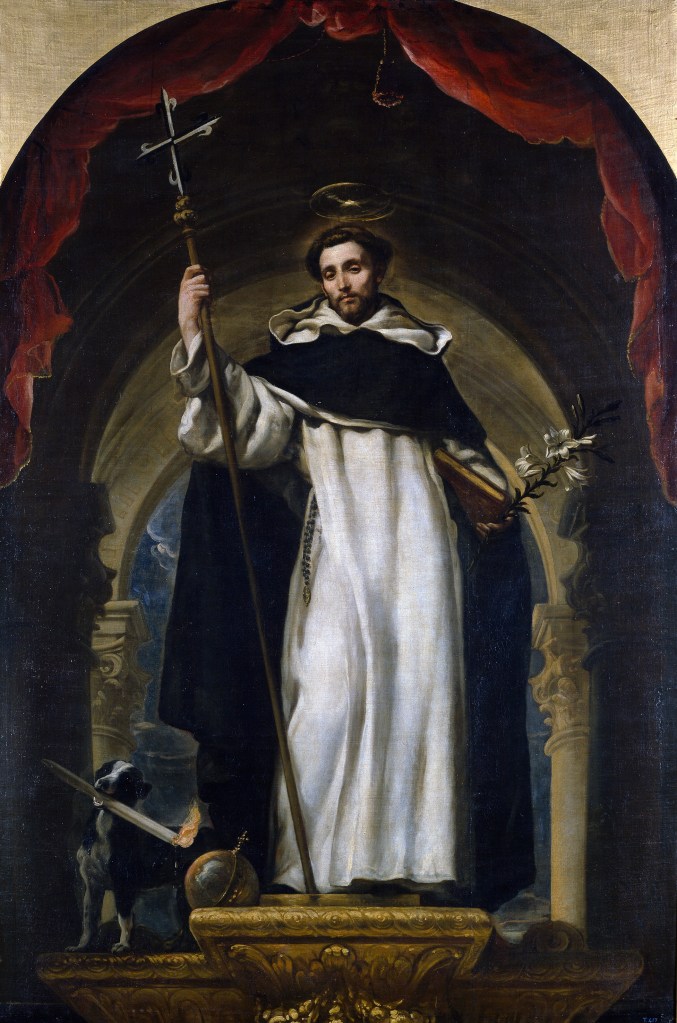
In 1170 a.d., Jane dreamed “that she carried a dog in her womb, and when it was born it broke away from her and ran with a burning torch in its mouth to set the whole world aflame.” Such dreams might seem to spring from the mind of Stephen King, but this one was prophetic in nature and spoke of Jane’s unborn son, Dominic. (Hint: Dominic would become the hound and the flame was the truth of the Gospel message.)
Dominic was born in the rural community of Caleruega, Spain. There he began to receive a formal education, but also an education of faith and charity that was provided by his mother, who was “full of compassion toward the unfortunate and those in distress.” Witnessing such lessons from his mother, led Dominic to later sell his books to aid the poor stating, “How can I keep these dead skins when living skins are dying for hunger?” Perhaps this lesson and others like it laid the groundwork for Dominic’s greater mission of charity towards those who were poor in spirit, for following his university studies and ordination to the priesthood, he began to discern the need for the truth to be preached, particularly amongst those who were either ignorant of that truth or in error, specifically the error of the Albigensians that he first encountered while traveling through southern France.
The error of the Albigensians was the Manichaean Heresy, which taught that there were two gods: the god of the Old Testament (evil) and the god of the New Testament (good). As the god of the Old Testament is the creator god, then the Manichaes taught that the physical world—our bodies included—were evil, therefore, the Albigensians denied the Incarnation of Jesus (how can anything created be good?), insisted on a very austere life, and denied themselves the sacraments, including marriage, amongst other issues. Dominic could not comprehend how anyone could view creation as evil and ignore the teachings of the Church, so he set about the mission of correcting the Albigensians, and in doing so, set aflame, not just that small region of France, but the entire world with the truth of the Gospel and the teachings of the Church. At the heart of the mission—one that continues to this day—is preaching, preaching that finds its inauguration in study and prayer.
The study and learning was so that the friar would become someone who “proclaims with integrity the Word of God as received from the Church” for the purpose of evangelization, and prayer served much the same purpose. To paraphrase Thomas Aquinas, a later Dominican, the purpose of prayer in the life of the Dominican is “to contemplate and to hand on to others the fruits of one’s contemplation.” In other words, for Dominic and the Dominicans, study and prayer are tools and a means to an end, the end being the sermon and the preaching. This may seem odd to us today. We so often see our prayer as a time for petition, intercession, and thanksgiving, but for the Dominican, prayer is very much a tool in the preacher’s tool belt. Those things God shows the Dominican are not only for private consumption, but given to be shared, that others might benefit in their walk with God. So that the friar might focus all of his energies (and her in the Anglican Order of Preachers!) on the “Order’s job” of preaching, Dominic established the three vows of the friar: poverty, chastity, and obedience. The Anglican Order of Preachers translates these into the context of the 21st century: simplicity, purity, and obedience, all three of which are designed to free the life and mind of the Dominican so that there is more space for fulfilling the calling and mission of the Order.
At some point, a Latin pun on the name Dominican was introduced: domini canes or “hounds of the Lord.” Not only does this reference the dream of St. Dominic’s mother, but it also points to the loyal and obedient nature of the Order. An Order that today, combining the Roman and Anglican Churches, consists of over 6,000 members. The Lord has greatly used Dominic’s passion for preaching to indeed set the world aflame with the Gospel.
Bibliography
Deanesly, Margaret. A History of the Medieval Church, 590-1500. London New York: Routledge, 1969.
Goergen, Donald. St. Dominic: the Story of a Preaching Friar. New York: Paulist Press, 2016.
John-Julian. Stars in a Dark World: Stories of the Saints and Holy Days of the Liturgy : with Supplementary Readings According to the use of the Order of Julian of Norwich. Denver, Col: Outskirts Press, 2009.
Jones, Cheslyn, Geoffrey Wainwright, and Edward Yarnold. The Study of Spirituality. New York: Oxford University Press, 1986.
Zagano, Phyllis, Thomas C. McGonigle, and Augustine. The Dominican Tradition. Collegeville, Minn: Liturgical Press, 2006.

Reading and answering question from: Paul Murray O.P. The New Wine of Dominican Spirituality: A Drink Called Happiness. New York, NY: Bloomsbury Publishing, 2006.
Chapter two describes Dominicans in the early days as promoting the idea of happiness; this is often linked to the Beatitudes (Matthew 5:1-12) and describe briefly what struck you most about their experiences and teaching on happiness. What do you think about the idea of happiness in Dominican life as you consider your own calling?
The Name of the Rose by Umberto Eco: I enjoyed both the book and the movie. From the movie: William of Baskerville: “But what is so alarming about laughter?” Jorge de Burgos: “Laughter kills fear, and without fear there can be no faith, because without fear of the Devil there is no more need of God.” Murray is absolutely correct, the faithful have become those with “bowed heads and sad faces” (p.55) when we should in fact be the happiest and most joyful of all. In our preaching, folks need the opportunity to “breathe,” not just for a moment during the sermon (cf. p.69), but I think sometimes for the entirety of the sermon. Not a stand up comic’s routine, but a message that conveys how we are to “have life and have it abundantly.” (John 10:10) An opportunity to experience joy in God, worship, and fellowship. The “Why?” behind this thought was summed up nicely by Thomas of Cantimpré: so that we all may “survive unbroken” (p.57) this world and all it throws at us—we’ll still end up with a few chips and cracks, but hopefully not completely broken.
Perhaps too much information, but for myself and a life as a Dominican, I’m trying to learn (that’s not the right word for it… experience?) this joyful Dominican characteristic. I have been a student of Thomas à Kempis and the Imitation of Christ for almost twenty years, but a few months ago, I set him aside. There is so very much to learn from him, but I tired of keeping my death ever before me as he taught. There is benefit in the practice, but I discovered that I was trying so hard to be a serious saint, that I did not live. That may only make sense to me, but I want to not only share the message of the joy of the Lord, but know it for myself as well.
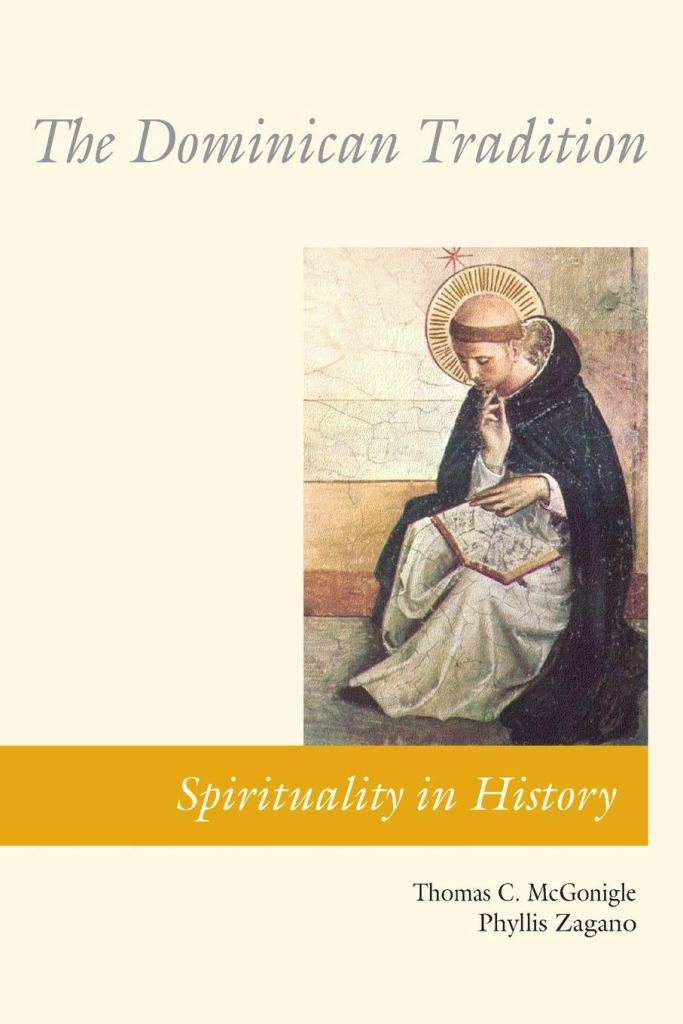
Reading and answering question from: Thomas C. McGonigle, O.P. & Phyllis Zagano, Ph.D. The Dominican Tradition: Spirituality in History. Collegeville, Minnesota: Liturgical Press, 2006.
Professed Anglican Dominicans take vows of obedience, purity, and simplicity. Using information from The Dominican Tradition (p. xiii-xxi), describe your vision of living out these vows. What challenges do you expect to face? What can you do to address these challenges before they become a problem?
Dominic: He asked God for “delight and enjoyment” (Murray p.58), while at the same time he was would “discipline himself with an iron chain.” (M&Z p.7) Such extremes of thought and action seem to be presenting two separate individuals, but Dominic has often demonstrated how he embodies the fullness of the Scriptural teachings. I believe his life was a joyful living out of those words we so often read in Ecclesiastes, which begin: “For everything there is a season, and a time for every matter under heaven: “a time to be born, and a time to die; a time to plant, and a time to…”
Aquinas: There are many forms/styles of preaching, but not all forms are suitable for every occasion. A deeply technical sermon/teaching would be appropriate for a seminar, but not necessarily for a Sunday morning. The preacher must take what they’ve learned through prayer/study/meditation and ‘translate’ the information and insights for the listeners’ edification. The analogy of the iceberg is true: 10% of the iceberg is above the surface, that is the sermon, the other 90%, what is below the surface is what went into the crafting of the sermon. M&Z show us the 90% of Aquinas whereas Murray gives us the 10%.
Eckhart: Of the three, Eckhart was the most difficult. He seems rather elusive in trying to nail down, but as with Aquinas, M&Z focus on the philosophical thinking of Ekhart, while Murray shares the “fruits” of Ekhart’s labors. No disrespect toward Eckhart, but M&Z and the selection of Eckhart’s writings gave me the impression of an individual who never stopped moving, but ceaselessly bounced around. I think he would make you either nervous or agitated (perhaps both!) to be around.
Reading and answering question from: Paul Murray O.P. The New Wine of Dominican Spirituality: A Drink Called Happiness. New York, NY: Bloomsbury Publishing, 2006.
Chapter one describes Dominican spirituality in terms of contemplation, mysticism, liturgy – and preaching. How do you see these working together to create a Dominican way of life? How do they fit your own spiritual life at this time?
Murray’s discussion of God as object and/or subject (p.21) and then as “link for [God’s] activity,” (p.22) reminded me of something I must surely have heard before: preaching as sacrament. The BCP defines the sacraments as “outward and visible signs of inward and spiritual grace, given by Christ,” (BCP 857) The contemplation, mysticism, and liturgy are beneficial gifs in and of themselves, but for the Dominican, they are “tools” for the communication of God’s Word: preaching. In reading this chapter, I felt like I had come home, for so much of the work my position (leading worship, studies, personal prayer, praying the Rosary, attending meetings, and even pastoral care) have as their backdrop, the sermon: the brief ones given during Morning Prayer and the more prepared for Holy Eucharist. The extent to which the preaching becomes a sacrament is truly dependent upon the amount of spiritual work I put into the writing, and the test is always the end result: a sermon done properly accomplishes the “simple intention,” (p.24) whereas one that has not been properly vetted out by the spiritual practices, although perhaps good for the souls of those listening, can be categorized as “right intention.” I do not know if my congregation feels the difference, but I can. Right intention is work. Simple intention is not really me. The difference is that the first is me speaking, the latter—I pray—is “divine praise.” (p.39) This then also supports the idea that the Dominican vocation is a “dynamic vocation” (p.43) in that the sermon is not only formed through study and prayer, but also life, as God “contemplates the world” (p.22) through the one preaching, for if we are to speak God’s word instead of our own, we must not only know the One we speak of, but also the ones we speak to.
Reading and answering question from: Thomas C. McGonigle, O.P. & Phyllis Zagano, Ph.D. The Dominican Tradition: Spirituality in History. Collegeville, Minnesota: Liturgical Press, 2006.
Professed Anglican Dominicans take vows of obedience, purity, and simplicity. Using information from The Dominican Tradition (p. xiii-xxi), describe your vision of living out these vows. What challenges do you expect to face? What can you do to address these challenges before they become a problem?
My vision of living out the vows of obedience, purity, and simplicity: I see myself, fully vested, prostrate before the Tabernacle, in unitive prayer… who am I kidding. Over the portico of the Temple of Apollo at Delphi is the Greek maxim, “Know thyself.” Perhaps I don’t know myself fully, but enough to know that my vision of these vows will closely resemble a tug-of-war between two equal teams. One pulling me toward holiness and fulfillment of the vows and the other… the other likes single malt scotch and women. I cheered at Dominic’s “confession” about being “excited by the conversation of young women.” (Goergen, p.97) So how do I make this work?
Obedience — If there is one vow that I will not struggle with, it is this. My good friend, Thomas à Kempis, writes, “It is a very great thing to obey, to live under a superior and not to be one’s own master, for it is much safer to be subject than it is to command.” (Imitation of Christ, Book 1, Chapter 9) McGonigle confirms Thomas’ understanding: one who loves his/her superior is one who will allow themselves to be lead and directed. If not out of love, I will serve and obey out of loyalty.
Simplicity — I have no spouse or children (unless you count the Queen—a.k.a. Rain—who is a six month old feline.) After the normal bills, my life is my own. I do tithe and have begun to look for other ways that I might share my blessings. In addition, I have taken to wearing a cassock during the work week. For me it is a testimony of a different way. A way that, amongst other benefits, demonstrates a setting aside of excess.
Purity — See “Obedience.” Out of love for my Savior and loyalty to my calling as a priest (and Dominican postulant), I will not become a slave to the callings of the world. I will continue striving to find others as brothers and sisters in Christ.
Above all else, there will be prayer and the sacraments.
A piece I wrote for October 2020 Connections, the newsletter of St. Matthew’s.

When I was nine or ten, I remember coming home from school and wanting to watch cartoons and Star Trek, but every day and every channel was the same boring show. All these people talking. And talking. Sometimes they would become very animated in their talking, but it was always the same. Even though I had no idea what was going on, I would sit and wait, hoping they would get tired of all that talking so that I could see what Captain Kirk was up to (I always hoped for the Klingons to arrive. Very exciting.) What were these folks talking about? At the time, all I knew was that somebody had broken in and stolen a gate from a water building. Who knew they had such valuable things at the waterworks. Months later, we had a new president, the former resigning in shame.
I’ve shared with you in the past: I don’t preach politics. Never have. Never will. Instead, I choose to preach the Gospel, because as I’ve also shared with you, I believe that the Gospel Message is the most radical and revolutionary message every spoken. Politicians come and go and nations do the same, “‘but the word of the Lord remains forever.’ And this word is the good news that was preached to you.” (1 Peter 1:25)
In such heated political times as this, you may be wondering if I’m going to change my “policy” on preaching politics. The answer is: absolutely not, but I would be a poor priest if I did not provide some guidance through it, and the question that keeps running through my mind is: How should we as a Christian people respond? Scream a little louder? Sign another petition? Join a protest? Make nasty comments on social media (the equivalent of doing nothing)? Vote (always a good idea)? Not to be the pessimist in the group, but all of these have been tried and all they’ve really produced are people shouting even more loudly, paper wasted, more violence, a disintegration of tolerance and respect, and politicians who, once in office, end up being no better than their predecessors.
Thank you for the commentary, Fr. John, but you still haven’t answered the question: what should the Christian response look like?
I’m glad you asked!
“You are a chosen race, a royal priesthood, a holy nation, a people for his own possession, that you may proclaim the excellencies of him who called you out of darkness into his marvelous light.” (1 Peter 2:9) What are we to do? We are to be the royal priesthood, proclaiming the Kingdom of God. Not as our earthly leaders do, but as our Lord and Savior has taught us. We are to be a nation, a Christian race that is set apart, not indulging in the sins of the world, but demonstrating the path of righteousness. We are to be the Lord’s possession, not giving our allegiance to things that are passing away, but to Him who was, who is, and who will come again. We are to be all these things, witnessing not to a campaign slogan, but to the eternal Love of God. Unlike everything else that makes the news these days, what we do for the Kingdom won’t make good TV, it won’t draw large crowds, and it will likely only change the lives of a very few, but… You’ve all heard the story before:
A young girl was walking along a beach upon which thousands of starfish had been washed up during a terrible storm. When she came to each starfish, she would pick it up, and throw it back into the ocean. People watched her with amusement.
She had been doing this for some time when a man approached her and said, “Little girl, why are you doing this? Look at this beach! You can’t save all these starfish. You can’t begin to make a difference!”
The girl seemed crushed, suddenly deflated. But after a few moments, she bent down, picked up another starfish, and hurled it as far as she could into the ocean. Then she looked up at the man and replied, “Well, I made a difference for that one!”
That is the ending I’ve always heard, but recently I came across another:
The old man looked at the girl inquisitively and thought about what she had done and said. Inspired, he joined the little girl in throwing starfish back into the sea. Soon others joined, and all the starfish were saved.*
Perhaps that’s just a bit too naïve, too optimistic, but I’m really not a pessimist.
Make a difference… be the light for one person. This is our politics. Be the leader, the royal priest to one person, pointing them to the path of eternal life, so that they may do the same for another. It is through this great work of the Gospel that we will affect eternal change in the lives of many and that we may affect change in our society.
*“The Starfish Story” is adapted from The Star Thrower by Loren C. Eiseley
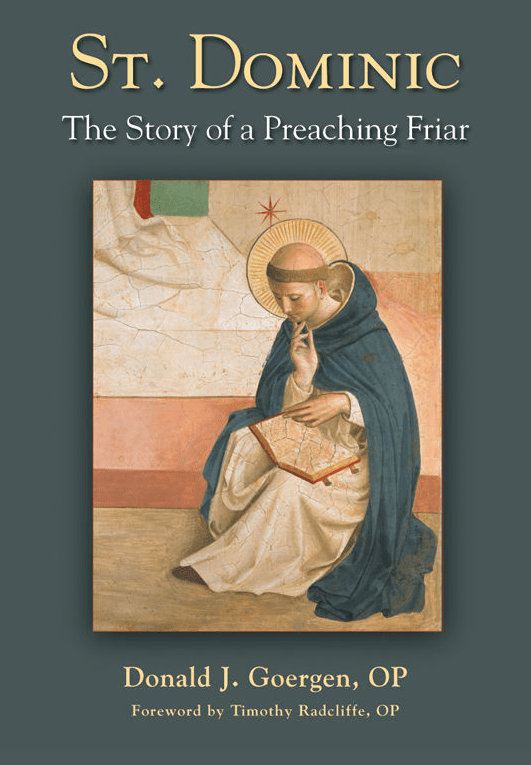
Reading and answering question from: Donald J. Goergen O.P. St. Dominic: The Story of a Preaching Friar. New York, NY: Paulist Press, 2016.
This book gives you a good foundation for your essay on St. Dominic. In responding to this question, however, please focus on Chapter 4, and be selective rather than comprehensive.
Following the meeting with Pope Innocent in 1215, the scope of the OP mission grew from a diocesan program to an organization that now spans the globe and even though Dominic would lead the order in its infancy and early growth, I believe that he always viewed himself as the “humble servant of preaching.” (p.56) “For him it was always the preaching, not the preacher, who was never to get in the way of the Word.” (P.63) From this view and mission, the order developed multiple elements and characteristics which are seen in the AOP.
Organization – The AOP maintains the structure of the order as established by Dominic. “There existed in the Order the two primary instruments of governance: the general chapter, legislative in nature, and the head of the Oder along with local superiors, executive in character.” (P.87) This also is evident in the AOP through the Master, Chapter, Houses, Priors, etc.
Study – “As witness to the value that Dominic placed on study, these first friars in Toulouse began to attend lectures.” (P.50) “The preacher was to be an ongoing student of theology. The order was to be an order of students.” (P.88) As with Dominic, the AOP recognizes that any good preacher will be an educated preacher, so as to preach the truth and recognize error.
Dispersed – From Toulouse he sent the friars out. “The decision to disperse the men was both to protect the preaching and to expand it.” (P.67) “How then will they call on him in whom they have not believed? And how are they to believe in him of whom they have never heard? And how are they to hear without someone preaching? And how are they to preach unless they are sent? As it is written, ‘How beautiful are the feet of those who preach the good news!’” (Romans 10:14-15) The AOP is dispersed, even to far off lands like Oklahoma!
Rule – The rule for Dominic and his friars would be “that of St. Augustine.” (P.59) The AOP also lives under an established rule, that guides daily life of prayer and study, which are set to enhance the preaching.
How did the life and work of St. Dominic lay a foundation upon which the Anglican Order of Preachers is built? What elements or characteristics do you find in this chapter that you can see in our own Order? Be specific, and give at least one reference, with page number or Kindle reference number, for each element or characteristic that you describe.
“To contemplate and to hand on to others the fruits of one’s contemplation,” (P.6/P.134) sums up what it means to be an active Dominican, which finds it roots in the Orders founder, who was “a man of prayer with a mission, a contemplative missionary.” (P.74) Whereas other religious orders find their calling hidden behind the cloister walls, Dominic believed that the purpose behind the contemplative prayer was to be able to share what was learned. “There could be no authentic contemplation without the handing on of it to others and vice versa.” (P.103) Dominic “preached his prayer and prayed his preaching.” (P.102)
To assist in his prayer, “Dominic trusted Mary in his prayer from the beginning.” (P.136) “As Mary gave brith to the Word in her womb, so the Preacher gives birth to the Word in the world.” (P.136) This deep devotion to Mary was of great benefit to Dominic and the Order and it is to her that the Order has been given over to for motherly care (cf. P.137)
Contemplation with the assistance of Mary is and will be a great source of strength and intimacy with Jesus in my life. As I pray / contemplate, if I will first walk with Mary, she will lead me to moments of great communion with Jesus. Dermot Power, in The Spiritual Theology of the Priesthood (1998), discusses the works of Hans Urs von Balthasar. Power writes, “Mary is the prototype of the Church’s responsive faithful love and is the real type and abiding centre of holiness which encompasses the Petrine and ministerial function within the Church. According to Balthasar, the priesthood exists only to nurture, safeguard and make transparent this spousal love of Christ for his Church.” (P.50) Where Power speaks of Church and Priesthood, I believe we can insert the word “preacher,” because the making known—or to use the words of Dominic: the “handing on”—of the message of the love of Christ is the raison d’être of preaching just as preaching is “the raison d’être of the Order.” (P.62) If we are to hand on this message, we must first spend time in contemplation with Him who is Love.
The complete service is available here

R. C. Sproul, he died in 2017, was a Presbyterian theologian. I figure if they can quote C.S. Lewis, we can quote Sproul. He tells the story of when he was a college professor.
At the start of the semester, the class of about one hundred and fifty students had three papers due, equally spaced through the semester. The penalty for a late paper was a zero grade.
When the first paper was due, one hundred and forty students strolled in and put their papers on his desk. Sproul asked the ten students whose papers were late, “Where are your papers?”
“Oh, Professor Sproul,” they pleaded, “we have had so much work, and we are having such a hard time adjusting to college. Please give us an extension.”
“Okay,” said Dr. Sproul, “but the next time your papers are late, you will receive a zero grade. Agreed?”
“Yes,” they all replied.
When the second paper was due, one hundred and twenty five students arrived and put their papers on his desk. Sproul asked the twenty five students whose papers were late, “Where are your papers?”
“Oh, Professor Sproul, we had mid-terms, and we just did not get time to write the papers. Please give us an extension.”
“Okay,” said Dr. Sproul, “but this is your final warning. The next time your papers are late, you will receive a zero grade. Understand?”
“Yes,” they all replied.
During the last class, the final paper was due and only one hundred students put their papers on his desk. Sproul asked the fifty students whose papers were late, “Where are your papers?”
“Oh, Professor Sproul, it’s not a problem! Don’t worry about it! We’ll get the paper to you in a day or two!”
“Each of you will get a one letter grade reduction!” said Dr. Sproul.
Enraged, the students shouted, “That’s not fair!”
“Oh, you want me to be fair!” said Sproul, “I will be fair. I said that if your papers were not on my desk by noon today, you would receive a zero grade. Since they are not here, I will be fair and just, and you will receive a zero grade.”
I have shared with you in the past Portia’s monologue from William Shakespeare’s, Merchant of Venice: “The quality of mercy is not strained. It droppeth as the gentle rain from heaven upon the place beneath.” Portia speaks of how mercy blesses both the giver and the receiver, that it can be used by kings to show love, and that “It is an attribute of God Himself.” She concludes, “And earthly power doth then show likest God’s, when mercy seasons justice.”
With those students, the full enforcement of justice, would have been to give the zeros from the beginning, but mercy was something that Professor Sproul fully understood, even when the students failed to turn in their papers the third time, for where he could have given them the promised zero, he applied justice—lowering the grade—seasoned with mercy—only lowering it one letter. Justice was the full application of the rule: no work, zero grade, which Sproul was within his rights to give: his class, his rules. Yet he chose to show mercy. However, when he did not extend to them 100% mercy, when there were consequences for failure to abide by the rules, the students shouted, “That’s not fair!”
These days, we have come to understand fair in the same manner as those students: fair means we can bend the rules to our liking, so that even though I may have failed, I will be accepted and even rewarded. However, that’s not how fair is defined. Merriam-Webster Dictionary: “fair — marked by impartiality and honesty : free from self-interest, prejudice, or favoritism : conforming with the established rules.” Fair is not the bending or negating of rules to benefit every infraction. Fair… are you ready for this… fair is the application of justice. No deviation from the rules, so when the students cried out, “That’s not fair!”, Sproul responded, “Oh, you want me to be fair!” They didn’t know what the word really meant, but Sproul did and was 100% fair by applying justice minus the mercy he had been showing. No paper, zero grade. “And earthly power doth then show likest God’s, when mercy seasons justice.” But there does come a time when fairness… justice will be applied without mercy, and that is the point Jesus was making today in our Gospel and it made the people very angry. How did that work? It begins with our reading from Ezekiel.
The Lord said, “When the righteous turn away from their righteousness and commit iniquity, they shall die for it; for the iniquity that they have committed they shall die. Again, when the wicked turn away from the wickedness they have committed and do what is lawful and right, they shall save their life. Because they considered and turned away from all the transgressions that they had committed, they shall surely live; they shall not die.” That is God’s fairness. His justice. He says, “I have no pleasure in the death of anyone,” but his justice is such that there is no deviation.
Is there mercy? Of course there is mercy. Basically the entirety of the Old Testament is the telling and retelling of the same story. The people walked with God. The people sinned against God. God may have punished the people, but he didn’t wipe them out, except the one time in the flood. God sent a judge or prophet to tell the people, “You’re sinning in the eyes of the Lord.” The people heard the words of the prophet, repented, returned to the Lord. For his part, the Lord showed mercy and gave them his love and protection once again. What happened next? Rinse and repeat. It was the same with John the Baptist.
When Jesus arrived, the religious leaders came to him and asked by whose authority he was saying and doing these things. Jesus asked them about the baptism of John, but this was just a way of saying to them, here’s another example of the Father calling on you to turn and you ignored Him once again.
But now Jesus comes on the scene and tells the people, the Father is about to apply his justice. In the parable of the two sons, Jesus reminds the people of what the Lord’s justice is all about and they even agree that it is correct: the first son said he would not go into the fields and work (he would be disobedient to the Father), but he repented and went to work. The second son said he would go (he would be obedient to the Father), but he did not. He knew the Father’s desire, but he ignored it. Jesus concludes, “Truly I tell you, the tax collectors and the prostitutes are going into the kingdom of God ahead of you. For John came to you in the way of righteousness and you did not believe him, but the tax collectors and the prostitutes believed him; and even after you saw it, you did not change your minds and believe him.”
The Lord, through John, called you to repentance, and the first son—the one who disobeyed at first—the tax collectors and sinners, heard the call to repent. What did the Lord say through the prophet Ezekiel? “When the wicked turn away from the wickedness they have committed and do what is lawful and right, they shall save their life.” Yet, the second son—the one who said he would obey, but did not—the one who agreed to obey but failed to repent and continued in sin: “When the righteous turn away from their righteousness and commit iniquity, they shall die for it.”
Jesus is saying, “You know the rules. You’ve been warned. God has shown you mercy… time and time again, but now, He is going to apply fairness, a 100% application of justice.” How do the people respond? “That’s not fair!” Yet: God’s house. God’s rules.
He loves us. He wants us to repent. He does not want us to die. But he is going to apply the fullness of his justice to all. Is it any wonder that Paul says to us, “Work out your own salvation with fear and trembling.”
We are called to be like the first son. Repent and return, but there is a problem with that, like the Israelites, we will fall away, and like the Israelites, we are no better off than we were when we were still tax collectors and prostitutes. God the Father will apply 100% of his justice to us and we will die. Something else is needed. “With man this is impossible, but with God all things are possible.” Where there is a 100% application of justice, we need a 100% application of mercy. Where do we find this mercy? “For the Scripture says, ‘Everyone who believes in him will not be put to shame.’ For there is no distinction between Jew and Greek; for the same Lord is Lord of all, bestowing his riches on all who call on him. For ‘everyone who calls on the name of the Lord will be saved.’”
The Lord will apply 100% of his justice to us all and for those who believe in his Son, the Lord will apply 100% of his mercy. That’s not fair… no. That’s love.
Let us pray: O My Jesus, forgive us our sins, save us from the fires of Hell and lead all souls to Heaven, especially those who are in most need of Thy mercy. Amen.
… was the last day I posted a photo.
Let there be color!

no filter
Reading and answering question from: Donald J. Goergen O.P. St. Dominic: The Story of a Preaching Friar. New York, NY: Paulist Press, 2016.
In Chapter 1 we learn about Dominic the man and preacher. “To be a preacher was to mediate God’s Word in human words: a word of love, mercy, and compassion. Mercy (misericordia), truth (veritas), and brotherhood (fraternitas), or the vita communis—the common life—were all sacred words for Dominic, that man of the Lord who was filled with God”. Describe the manifestation of Dominic’s sacred words in his mission as a preacher, using examples. What are your own sacred words that guide your life as a Christian? How might they guide you in your preaching life as a Dominican?
The three sacred words of Dominic—mercy, truth, and common life—seem to closely resemble the “three-legged stool” of Anglicanism—Scripture, tradition, and reason—in that they are dependent and integral to the other; for example, can you have a common life without mercy and truth? Therefore, the examples of these sacred words in Dominic’s life have one dominant trait, but are supported by the other two.
With regard to mercy, I was struck by Dominic’s selling of his parchments during the famine. “How can I keep these dead skins when living skins are dying of hunger?” (p.14) Truth can be seen in his willingness to remain up all night seeking the conversion of a single sinner (p.21) and the common life is made evident in not just the need for traveling companions, but also in discerning the need for the common life in others as in the time when land and housing were purchased for the many Cathar women converts so that they would be able to maintain their austere lives. (p. 33) Such actions demonstrate that these sacred words were lamps on the work, guiding Dominic and the others to “live what they preached.” (p.29)
For my own sacred words, I reflected back on my preaching. From there, I chose loyalty, peace, and transformation, all of which stem from the first and second greatest commandments: love God, love neighbor (to which I like to add, “Until you figure out how to do these two things, leave the details alone.”) Of these three, loyalty may be the most difficult for others to understand why I chose, but I have always understood Jesus as King, so even when I fail him or do not love him as I should, I am always loyal. Although I may not say it directly, this is a trait that I would like to instill in others through preaching. I’m always struck by Richard Burton’s prayer following his consecration in Becket: “Please, Lord, teach me now how to serve you with all my heart, to know at last what it really is to love, to adore.”
Historical events, politics, culture and the guiding hand of the Holy Spirit impacted Dominic’s formative years in much the same way that they will guide your own formation. Describe an example of how each of these four factors influenced Dominic’s early formation. How will these factors impact your own formation as a Dominican preacher?
September 11 occurred during my first week of seminary. We all knew the world would never be the same and it set the stage for things to come. Dominic also experienced such life / world altering events.
The rise of the Cathars / Albigensians (p.19ff) was a significant historical event in the life of Dominic. It was from witnessing the heresy firsthand that Dominic was inspired to consider and then begin the mission for correcting the error. The way into the culture and the fulfillment of the mission was not to adopt the practices of the Catholic Church, but those of the Cathars instead. “If they were to convey the truth of the Catholic faith, their primary witness to that faith would have to be in their way of life,” (p.28) which would closely resemble that of the Apostles.
The passion for such a mission does not derive itself from politics or dogma, but through the Holy Spirit. Dominic was guided by his desire to convert souls to God. He is said “to have agonized about the fate of sinners in general as well as the heretics,” praying “Lord, have mercy on your people, what will become of sinners?” (p.37) These words communicate to me the same message as the Fatima Prayer: “O My Jesus, forgive us our sins, save us from the fires of Hell and lead all souls to Heaven, especially those who are in most need of Thy mercy.”
Finally: politics. Politics had as much influence on Dominic as they do us today, but they did not seem to effect his mission or draw him in. For example, “Whatever he thought of the crusade, we will never know for sure… he never preached it.” (p.38) Instead, even when he was surrounded by the crusaders, he was “constantly preaching the word of God.” (p.42)
Such a commitment to the Gospel in the face of so many factors will certainly be a guide for me. The Gospel message is without a doubt the most radical message ever proclaimed and will go much further in converting sinners and sustaining the faithful than any other message.
 Candle in a Cave