Sermon: Epiphany 4 RCL B – “The Liar”

Photo by Ashkan Forouzani on Unsplash

The Crucible by Arthur Miller: a story of the Salem witch trials and the false accusations that flew. John Proctor, although not an innocent man, is silent until his wife, Elizabeth, is accused and arrested of being a witch. The preacher questions John about his wife and “if” she is innocent. John becomes angry, especially at the girls, Parris and Abigail, who are doing the accusing:

“If she is innocent! Why do you never wonder if Parris be innocent, or Abigail? Is the accuser always holy now? Were they born this morning as clean as God’s fingers? I’ll tell you what’s walking Salem—vengeance is walking Salem. We are what we always were in Salem, but now the little crazy children are jangling the keys of the kingdom, and common vengeance writes the law!”

I came across a story about a middle school class of teens that were learning about the Salem Witch Trials, and their teacher told them they were going to play a game.

“I’m going to come around and whisper to each of you whether you’re a witch or a regular person. Your goal is to build the largest group possible that does not have a witch in it. At the end, any group found to include a witch gets a failing grade.”

The teens dove into grilling each other. One fairly large group formed, but most of the students broke into small, exclusive groups, turning away anyone they thought gave off even a hint of guilt.

“Okay,” the teacher said. “You’ve got your groups. Time to find out which ones fail. All witches, please raise your hands.”
No one raised a hand.

The kids were confused and told him he’d messed up the game.
“Did I? Was anyone in Salem an actual witch? Or did everyone just believe the lie?”

No proof… Vengeance. It was not what they knew of one another, but what they had come to believe, because if enough people believe it, then it must be true. Right?

A man with an unclean spirit entered the synagogue in Capernaum. Seeing Jesus, the unclean spirit cried out: “What have you to do with us, Jesus of Nazareth? Have you come to destroy us? I know who you are, the Holy One of God.” But Jesus wasn’t having any of that nonsense and rebuked the spirit, “Be silent, and come out of him!”

When I read that passage, I can hear the fearful squeaking of the unclean spirit’s voice when it speaks to Jesus and I hear the complete authority of Jesus’ voice when he rebukes that unclean spirit: “Be silent, and come out of him!” However, there are days when I hear the words of the unclean spirit spoken, but it is not that fearful squeaking voice. It is a voice that is full of confidence and sarcasm and vengeance. At times it speaks to me about others. Essentially it is just a variation of the message spoken in Salem. “I know that one, he’s a liar. And that one over there, look how different they are, definitely the wrong sort. Heck. Why care? They aren’t even Christian.” For my part, if I don’t rebuke that voice as Jesus did, then I’ll come to believe it and like those teens did with their classmates, I’ll turn them away.

At other times, that same voice speaks to me, but this time it is filled with condemnation: “I know who you are, ____.” Depending on the day, I can fill in that blank with any number of accusations: “I know who you are, a fraud… hypocrite… bigot… loser… racist, and on and on, and in the end, it all comes down to the cardinal accusation: “I know who you are, a sinner.” And in those words and with that tone, I start to believe it.

There is a political / propaganda tool known as the “big lie” and it has several primary components:
– The more outrageous the lie, the more weight it will carry.
– Strongly assert the lie.
– Repeat, repeat, repeat.
– Massage available data to “prove” the lie as being true.
– Reframe any vigorous denial as proof of guilt.

Does it work? “The rabid, impudent bias and persistence with which this lie was expressed took into account the emotional, always extreme, attitude of the great masses and for this reason was believed ” (Adolf Hitler) “If you tell a lie big enough and keep repeating it, people will eventually come to believe it. (Joseph Goebbels, Hitler’s Minister of Propaganda) Does the big lie work? Absolutely. It worked during the Salem witch trials, the rise of the Third Reich, and so many other times in history; and the evil spirit is so very good at using it on humanity, both as a whole and individuals.

That evil spirit takes our faults and expands on them or it pulls one piece of our history and reminds us of some sinful behavior, then it elaborates on it to prove what horrible people we are and constantly places it before us; as the Psalmist says, “My sin is ever before me.” We try to convince ourselves that we are forgiven through the very blood of Christ, but our defense is twisted and restated as a sign of our continued guilt. “I know you… you are a sinner. You always have been and you always will be.” We hear those words time and time again and we begin to believe them.

Hitler and so many others knew this technique because they learned it from the greatest liar of all. Jesus said, “[The devil] was a murderer from the beginning, and does not stand in the truth, because there is no truth in him. When he lies, he speaks out of his own character, for he is a liar and the father of lies.”

I know that we aren’t supposed to talk about the devil. We are supposed to be too enlightened for such “boogey men”, but in my opinion, to say there is no devil is another of the big lies that we’ve all been conditioned to believe, and it is he that speaks those words in our ears: “I know who they are… I know you, you are….” To that, I say, “Don’t you believe it! For God so loved the world, that he gave his only Son, that whoever believes in him should not perish but have eternal life.”

Don’t you believe the big lies that seek to push others away who are different or rob you of your joy by convincing you that you are unworthy. Both these actions damage our souls and draw us away from God. Don’t you believe it. With Jesus beside you and within you, rebuke that evil spirit as Jesus did: “Be silent!” Be silent, for we were all created in the image of God. Be silent, for I am a child of God. Then… then say to God, “Speak, for your servant is listening” and allow God to speak the truth.

Let us pray:
Father in Heaven,
You made us Your children
and called us to walk in the Light of Christ.
Free us from darkness
and keep us in the Light of Your Truth.
The Light of Jesus has scattered
the darkness of hatred and sin.
Called to that Light,
we ask for Your guidance.
Form our lives in Your Truth,
our hearts in Your Love.
Through the Holy Eucharist,
give us the power of Your Grace
that we may walk in the Light of Jesus
and serve Him faithfully.
Amen.


Sermon: Epiphany 3 RCL B – “The Planted Seed”


The preacher said, “There’s no such thing as a perfect woman. Anybody present who has ever known a perfect woman, stand up.”

Nobody stood up.

“Those who have ever known a perfect man, stand up.”

Well, Ol’ Man Boudreaux stood up.

“Are you honestly saying you knew an absolutely perfect man?” he asked, somewhat amazed.

“Well now, I didn’t know him personally,” Boudreaux replied, “but I have heard a great deal about him.  He was Clotile’s first husband.”

Charles Halloway is the father in Ray Bradbury’s, Something Wicked This Way Comes.  At one point, he comments, “Too late, I found you can’t wait to become perfect, you got to go out and fall down and get up with everybody else.”

That is a very true statement and although we may try to fall as little as possible, we are still going to fall.  However, when it comes to our Christian faith and following Jesus, we’ve come to believe that we must first attain perfection with no falls.  Our pants must be freshly dry cleaned and properly creased, our halos on straight, our eyebrows not too bushy, and our sins far behind us.  Trouble is, we’ll be dead and we still won’t be there.

Imagine, our Gospel reading: “As Jesus passed along the Sea of Galilee, he saw Simon and his brother Andrew casting a net into the sea—for they were fishermen. And Jesus said to them, ‘Follow me and I will make you fish for people.’”  Peter responds, I’m sorry.  I can’t do that right now.  I stink of fish, Andrew is still sporting the black eye from when I popped him one last week for tell me I was getting fat, and I haven’t been to synagogue but twice in the last two months.  Jesus then, turning to look at Peter says with disdain on his face, “You’re right.  Never mind.  You are in fact a complete loser.”

Well, of course Jesus did not say that to Peter, even though most of it could have been true, but Jesus did not come looking for the perfect: “Those who are well have no need of a physician, but those who are sick. I came not to call the righteous, but sinners.” 

A fable tells of a man who was casually shopping in a store but then discovered that God was behind the sales counter.  So the man walked over and asked, “What are You selling?”

God replied, “What does your heart desire?”

The man said, “I want happiness, peace of mind, holiness, to be without sin, freedom from fear… for me and the whole world.”

God smiled and said, “I don’t sell fruit here. Only seeds.”

Jesus saying, “Follow me”, is Jesus desiring to plant a seed within us so that he might begin a great work in our souls.  If there were finished products on the earth, he never would have come in the first place, but there weren’t.  There were people like Peter and Andrew who were no different than the rest, except that they allowed that seed to be planted within them and they allowed it to grow.  They also took their spills along the way.  Everything from denying Jesus, to doubting, disappointed, frustration, and all that we feel.  What made them great, was that they never gave up.  They never uprooted what was planted within them and cast it aside as though it were a weed.

Brennan Manning, author of The Ragamuffin Gospel, wrote, “What makes authentic disciples is not visions, ecstasies, biblical mastery of chapter and verse, or spectacular success in the ministry, but a capacity for faithfulness. Buffeted by the fickle winds of failure, battered by their own unruly emotions, and bruised by rejection and ridicule, authentic disciples may have stumbled and frequently fallen, endured lapses and relapses, gotten handcuffed to the fleshpots and wandered into a far country. Yet, they kept coming back to Jesus.”

Peter, James, John, Andrew and all the rest, we may not read about it in the Acts of the Apostles—seems no one likes to document their own failings—but they, like us, stumbled, fell, wandered and so forth, but they always stood back up again and returned.  Always.  We are going to do the same thing.  Some of those fallings are going to be more spectacular than others, but as long as we don’t intentionally uproot the seed that has been planted within us, then it will continue to grow and we do this to attain two main goals.  The first is perhaps the more selfish one: so that we might attain Heaven.  The second goal is not about us, but about the other… 

There is a legend that recounts the return of Jesus to glory after His time on earth. Even in heaven He bore the marks of His earthly pilgrimage with its cruel cross and shameful death. The angel Gabriel approached Him and said, “Master, you must have suffered terribly for men down there.” He replied that he did. Gabriel continued: “And do they know and appreciate how much you loved them and what you did for them?” Jesus replied, “Oh, no! Not yet. Right now only a handful of people in Palestine know.” But Gabriel was perplexed. He asked, “Then what have you done to let everyone know about your love for them?” Jesus said, “I’ve asked Peter, James, John, and a few more friends to tell others about me. Those who are told will tell others, in turn, about me. And my story will be spread to the farthest reaches of the globe. Ultimately, all of humankind will have heard about my life and what I have done.”

Gabriel frowned and looked rather skeptical. He well knew something about human beings. He said, “Yes, but what if Peter and James and John grow weary? What if the people who come after them forget? What if way down in the twentieth-century people just don’t tell others about you? Haven’t you made any other plans?” And Jesus answered, “I haven’t made any other plans. I’m counting on them.”  (Source)

Jesus says, “Follow me” and if we accept, he plants a seed in our souls.  As it grows, we will experience times of sanctification and we will also stumble and fall, but when we fall, through faith, we rise again that others might know they can do the same, so that in the end, we might all have the seed of Christ planted in us and rise in glory, and together achieve the first goal: Heaven.

Let us pray: Most Holy Spirit of God, make us faithful followers of Jesus, obedient children of the Church and a help to our neighbors. Give us the grace to keep the commandments and to receive the sacraments worthily.  Raise us to holiness in the state of life to which You have called us and lead us to everlasting life. Through Jesus Christ, our Lord.  Amen.

Dominicans: Term 2, Week 3

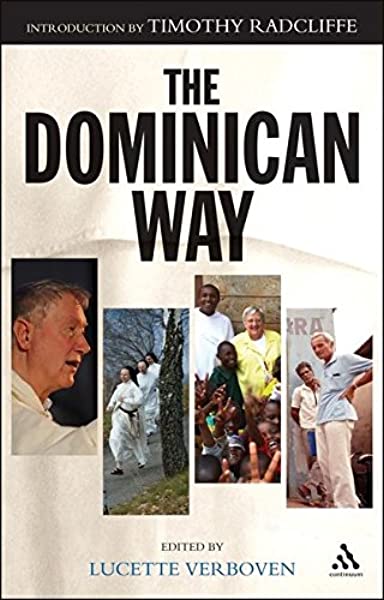
Radcliffe: Part One, 7-9

In these three chapters, Radcliffe looks closely at the Roman Catholic Dominican family, but he speaks also to us as Anglican Dominicans.  Identify one quotation or idea in each chapter that speaks to you, and then summarize how these quotations or ideas  may apply to your own development as a Dominican.

Unity and Diversity: “The preacher must be human to preach this human God.” (p.64)  This reminded of Dominic’s approach in preaching to and living among the Albigensians, which was—simply put—preach the Gospel and model your lifestyle after theirs.  If we take on an air of spiritual pride / arrogance, we will begin to preach our own message instead of the message of Jesus.  The same applies to our lives in the Order.  Should we begin to see ourselves as superior to others—i.e. clergy vs laity—then the Order will fracture along those lines and others.

The Future: “It is true that we cannot let ourselves become museum keepers for tourists.” (p.76)  The future relies on solid proclamation of the Gospel—word and deed—or we risk the people of God becoming spiritual tourist.  Those who walk through the teachings of Jesus and the Church as though casually strolling through a museum: glancing here and there, pondering for a minute or two and then moving onto the next, without ever settling in and truly discovering the beauty.  We must be learned guides who can show and explain the Masterpiece.

Truth: “Knowledge implies intimacy.”  Whether it be a person, text, language, picture, etc., until you become passionate and intimate with them, you will never truly know them.  It is only when we become intimate with the painting, that we begin to see the details and brushstrokes.  It is only in those moments when we are truly intimate with another person that we are willing and even able to share our own secrets.  Part of our “job” is to teach people how to talk to and be intimate with one another and with God.  I actually believe this to be one of the primary reasons they come to church: to learn how to talk to God about their innermost self.


Verboven: Ch. 7-9

Most of us do not lead the extraordinary lives that the Dominicans in these chapters experience.  What can you take from these stories to enrich your own Dominican spirituality?

In many pastoral situations, I often try to remain the “professional,” the stoic, standing outside of the emotions that are boiling all around me.  I think this is necessary to a degree, but Margaret Ormond showed me that it was OK to not only experience the pain of others (which I do!, but try not to show), but to show it.  What is fascinating about her experience is that when she did, she opened up the opportunity for the one who was in pain, to minister to her and to wipe away her tears.  This is new to me, but it seems to be reflective of our shared humanity and the bearing of one another’s burdens. (cf. Galatians 6:2)

With Godfrey Nzamujo’s story, I continue to see how Dominicans adapt (not compromise) to the culture where they are ministering.  Instead of bringing in European / Western culture, he drew upon the strengths of Africa and allowed the people to live into those strengths as opposed to attempting to re-educate them on how they should think / work like Europeans or Americans.  Adapting is the Dominican way.  He also has a trait that all of these Dominicans have shown: passion and drive to not only proclaim and build up spiritually, but also physically—“If one of you says to them, ‘Go in peace; keep warm and well fed,’ but does nothing about their physical needs, what good is it?” (James 2:16)

Timothy Radcliffe continues to speak to us about “the other.”  “If you have a deep friendship with anyone, it means you hear what they are saying, not what you think they ought to be saying.” (p.107)  Perhaps the greatest gift we can give someone is our friendship.

These individuals are like icons, windows into the calling of a Dominican. 

Dominicans: Term 2, Week 2

Radcliffe: Part One, 4-6

In these chapters, Radcliffe describes his life as Master of the Order. What are two or three major characteristics of Dominican life in the Order that he prizes? How do you envision opportunities for these characteristics to be manifested in the Anglican Order of Preachers?

There was one sentence in these three chapters that summed them all up and seemed to me to be an overarching characteristic, it was: “We must not be afraid!” (p.57-8)  We must not be afraid to be friends.  We must not be afraid to love.  We must not be afraid to trust.  We must not be afraid (and here it is again) of the other.

Friends: with friends, the competition is set aside and each is given the opportunity, support, and encouragement to succeed, and that success is celebrated. True friends are not easy to come by, but within the AOP, we can follow the example of those whom Jesus called friends. These had a common mission, which was the proclamation of the Kingdom for the greater good.

Love: not the type of love that show’s up in a Hallmark card (or movie), but the kind of love that allows the other to be. This allows the AOP to provide many different creative expressions of the Gospel and draws people to it instead of pushing them away.

Trust: “Thy will be done.” I heard that petition when I read of Radcliffe accepting the election to Master and again when he stated that Dominicans place themselves in the hands of the Order, “without knowing what they will do with him.” (p.54) It is faith / trust that the Order has properly discerned the call on an individuals life and will act in the best interest of all.

The Other: I am beginning to get the impression that for the Dominican, ‘the other’ is the raison d’être behind all we do. The AOP will do great work if continues to serve the other instead of the self.


Verboven: Ch. 4-6

In these chapters, we learn about three people who had to deal with violence in their Dominican lives.  How can tales of violence in these countries, and sadly in the USA and in your own country affect our own lives and mission as Dominicans?

As a priest, I have attended more than a few deaths.  None are ever easy, but some are more difficult than others.  A teenager killed in an avalanche while snowmobiling and a very violent suicide were days when you just want to go home, turn off the lights, and sit quietly in a room with a stiff drink.  However, the four-year-old little girl who died from her injuries after being thrown against a wall by a babysitter because she wouldn’t stop crying… violence.  

Violence breeds violence and even as the priest, my heart was not pure when it came to thoughts of the young man that committed the crime.  It was as Pierce said, “a wound came in me that I didn’t know what to do with.” (p. 43)  So the question that arises is: How do we respond?  We can respond with ever-escalating violence or like Pierce’s parents, Pierce himself, Maria Hanna, and Henri, we can respond with respect, patience, love, hope, an unshakeable perseverance—even in the face of death—and laugh when the bounty on our heads is lowered.  These characteristics are all summed up in the questions of the 1511 Dominican sermon: “Are these not human beings?  Are you so blind that you do not see the other person?”  (p. 51)  Those two questions direct us to the mission of a Dominican when confronted with or witness to violence: to open the eyes of the blind and to make the invisible visible.

I can honestly say that I have struggled over this question more than any other we’ve addressed.  There is a passion for God and God’s people and an unswerving faith, and I’ve never been “tested” in such a way.  It is that same question that many have asked me about themselves, “Would I be able to stand in the day of trial.”  I’m good with the cheerleader answer, but to stand with the gun ‘truly’ to my head or in the face of a real trial… these people are rockstars and I don’t even know how to play an air guitar.

Sermon: Epiphany 2 RCL B – “Under the Fig Tree”

Photo by Jametlene Reskp on Unsplash

Ol’ Boudreaux was visiting Washington, DC, for the first time. Unable to locate the Capitol, he asked a police officer for directions, “Excuse me, officer, how do I get to the Capitol building?”

The officer replied, “Wait here at this bus stop for the number 54 bus. It’ll take you right there.”

Three hours later, the police officer returned to the same area and, sure enough, Boudreaux was still waiting at the same bus stop.

The officer got out of his car and said, “Excuse me, but to get to the Capitol building, I said to wait here for the number 54 bus, and that was three hours ago! Why are you still waiting?”
Boudreaux replied, “Don’t worry, officer, it won’t be long now. The 45th bus just went by!”

Waiting around for something is always difficult, but we do it a lot. And there are some who spend their entire lives waiting for the perfect moment or perfect place or perfect person, which is probably what led Voltaire to declare, “We never live; we are always in the expectation of living.” There’s a good bit of truth in that.

Here recently, I’ve been thinking about how we’ve all been waiting for the pandemic to be over so that we can “get back to normal,” but in the meantime, we’re missing the now, but that’s a rabbit trail for another day. However, we do spend a good deal of time waiting, and there are certain things that are worth waiting for. In these cases, waiting is best understood as patience. Of patience, the Venerable Fulton Sheen said:

“Patience is power.
Patience is not an absence of action;
rather it is ‘timing’
it waits on the right time to act,
for the right principles
and in the right way.”

The parent never waits on the child to learn to walk or to speak. The parent is patient, allowing the child to grow and develop. The vintner doesn’t impatiently wait for the fermentation of the wine to be complete, but is patient in allowing the yeast to do its work.

Today in our Gospel, we are told “When Jesus saw Nathanael coming toward him, he said of him, ‘Here is truly an Israelite in whom there is no deceit!’ Nathanael asked him, ‘Where did you get to know me?’” In other words, Jesus says to Nathanael, “I know you,” and in response to him Nathanael says, “I’ve never met you before, so how can you know me?” To which Jesus replies, “I saw you under the fig tree before Philip called you.”

“I saw you under the fig tree” has a few different meanings, but one that is more supported by scripture than the others defines it as waiting on the Messianic Age. Waiting on the Savior. Nathanael asked, “How can you know me?” And Jesus responded by saying, “I know you as one who has been waiting on me.” That was all Nathanael needed. Someone to speak to him about his heart’s desire: the coming of the Kingdom of God. Realizing that his waiting was over, Nathanael shouted, “You are the son of God!” But then Jesus gave one more semi-cryptic message: he said to him, “Very truly, I tell you, you will see heaven opened and the angels of God ascending and descending upon the Son of Man.” This is a reference back to the story of Jacob’s Ladder.

Jacob had been traveling and when it got late, he set up camp for the night. When he fell asleep, he had a dream about the place he was camping and in the dream he saw angels ascending and descending a ladder. The angels are those who go about the business of God, so that was a place where the work of God was taking place. God then spoke to Jacob in the dream, reaffirming the covenant that he had made with Abraham. When he awoke, Jacob said, “‘Surely the Lord is in this place, and I did not know it.’ And he was afraid and said, “‘How awesome is this place! This is none other than the house of God, and this is the gate of heaven.’” And Jacob named that place, Bethel, which means, the house of God.

Nathanael, was one who was waiting on the Messianic Age and a savior, which like everyone else meant that he was looking for a Savior like King David, one who would establish his kingdom—his house—for all people, but Jesus says, The new kingdom will not be established in a place, but in himself. Jesus is saying that he is a new Bethel, a place where the angels are ascending and descending, that is, in him, the work of God is being accomplished and the covenant is being fulfilled.

Through our baptism and our faith, we are joined with Christ—one, as he and the Father are one—therefore, we too are a part of Bethel—the house of God—that Jesus established. The angels of heaven ascend and descend upon us. The work of God is set in motion within us, but it is here that the patient waiting continues, because this work of God is made perfect in us through Jesus, but it is also not yet complete, which means, I can say with confidence that God’s work has been accomplished in me, but I also know that there is much left to be done (just ask anybody who knows me!) Think of it in terms of a sculptor. The sculptor has before him a large block of marble and a picture in his mind of how he will transform this piece of raw stone into a work of art. The stone in the one hand and the image in the other, but before he makes the first chip, the stone and the image come together in his mind, that is, the sculptor sees the masterpiece inside the raw stone and he goes about the work of revealing it. We are the same. The perfect work of God is accomplished in you, there’s just more patient work to be done.

You are a temple—a house of God. The angels of God ascend and descend upon you and the work of God is accomplished in you, allowing us all to say with Jacob and about ourselves, “Surely the Lord is in this place, and I did not know it. How awesome is this place! This is none other than the house of God.” Rejoice and be thankful, for you are God’s masterpiece.

Let us pray:
Gracious and Holy Father,
Please give us:
intellect to understand you,
reason to discern you,
diligence to seek you,
wisdom to find you,
a spirit to know you,
a heart to meditate upon you,
ears to hear you,
eyes to to see you,
a tongue to proclaim you,
a way of life pleasing to you,
patience to wait for you
and perseverance to look for you.

Grant us a perfect end,
your holy presence,
a blessed resurrection
and life everlasting.

Amen.

Sermon: Hilary of Poitiers


In Spain there is a statue honoring Christopher Columbus who died in 1506. One of the features of the memorial is a statue of a lion destroying one of the Latin words that had been part of Spain’s motto for centuries. Before Columbus made his voyages, the Spanish thought they had reached the outer limits of the earth. Thus their motto had been “Ne Plus Ultra,” which means “No More Beyond.” The word being torn away by the lion is “Ne” or “no,” making it read “Plus Ultra.” Columbus had proven that there was indeed “more beyond.”

It seems that there was also such a spirit of discovery in our saint for today, Hilary of Poitiers, yet instead of searching for new worlds, Hilary was searching for God and every time someone tried to tell him that there was no more, he kept searching.

He grew up worshiping the pagan gods, but one day, as he tells us, he “chanced upon” the Hebrew Scriptures. It was here that he discovered God’s Name that God had spoken to Moses: “I AM WHO I AM.” Hilary says, “I was frankly amazed at such a clear definition of God, which expressed the incomprehensible knowledge of the divine nature in words most suited to human intelligence.” He had begun his search, but also believed that the God of creation would not leave that creation to simply return to the dust, so he continued the search and in doing so, discovered the readings of the New Testament, and it was in reading the prologue to John’s Gospel that he found the truth he had been searching for: “In the beginning was the Word, and the Word was with God, and the Word was God. He was in the beginning with God….” His soul found peace in Jesus. “No longer did [my soul] look upon the life of this body as troublesome or wearisome, but believed it to be what the alphabet is to children… namely, as the patient endurance of the present trials of life in order to gain a blissful eternity.”

With that knowledge, he would go on to become a bishop of the Church and a defender of the Nicene Creed against the Arians. This led to a three year exile, but he seems to have been relatively unconcerned, but definitely not silent. He wrote letters to the Emperor, argued with the Arian Bishops and produced a great deal of poetry and some of the earliest hymns of the church, one of which is contained in our hymnal.

Hail this joyful day’s return,
Hail the Pentecostal morn,
Morn when our ascended Head
On His Church His Spirit shed.
Like to cloven tongues of flame
On the twelve the Spirit came;
Tongues, that earth may hear the call;
Fire, that love may burn in all.

Hilary died on this day in the year 368, but it is clear that the Spirit and love of God burned brightly in him. Augustine called him “the illustrious doctor of the Churches.” Jerome considered him “the trumpet of the Latins against the Arians.” Today, we remember him as such, but also as one who was willing to put in the work to discover the truth. I encourage you to join with Hilary in seeking the truth and deeper knowledge of God through the reading and study of Holy Scripture.

Sermon: Epiphany 1 RCL B – The Baptism of Our Lord


Photo by Ryan Loughlin on Unsplash

Remember how, just ten days ago, we were so excited to be done with 2020? The worst year ever, we thought. Well, 2021 showed up and said, “Hold my beer.” This past week, with all the happiness going on, the internet produced some fairly humorous thoughts. One person wrote, “I’d like to cancel my subscription to 2021… the 7-day trial was enough.” Another illustrated 2020 and 2021 as the twins from The Shining by Stephen King. And another said, “Seems like 2021 keeps asking, ‘What would 2020 do?’” But it was Mike Rowe who made a sip of coffee come out my nose: Holding up a scotch, he said, “Well, that was fun. Here’s to 2022.” Please, don’t anybody say, “It can’t get any worse.”

Surprisingly, and all joking aside, there is a very simple answer why all these things have happened and will continue to happen, and it has nothing to do with Democrats or Republicans or COVID-19 or anything else of that nature. Would you like to know what that is? St. Paul writes in his letter to the Romans, “The creation was subjected to futility, not willingly, but because of him who subjected it, in hope that the creation itself will be set free from its bondage to corruption and obtain the freedom of the glory of the children of God.  For we know that the whole creation has been groaning together in the pains of childbirth until now.” (Romans 8:20-22)

All creation groans. Creation groans in the physical world around us we have storms, earthquakes, etc, it groans in our bodies through the diseases we suffer and in the way we age, and it groans in our souls through our brokenness and our sin. If this were our eternal state, I don’t know that it would be worth it, but through Jesus, this groaning is only temporary, and Jesus, through his baptism shows us the way out, but in order to see it, we need to go back over a thousand years in the history to understand it, back to the day when the Israelites first crossed over the Jordan River, the same river that Jesus was baptized in.

You’ll recall that the Israelites had freely gone into the land of Egypt when Joseph, the son of Jacob was second only to Pharaoh. They lived a pleasant life, but after many years, they became numerous and the more numerous they became the more nervous the Egyptians became, eventually leading the Egyptians to place them into slavery. For over 400 years they were slaves, then Moses came and said to Pharaoh, “Let my people go.” They had their freedom, crossed through the Red Sea on dry land, received the Commandments, wandered in the desert for 40 years (except for Moshe and Sadie you’ll remember, it took them 41 years because Moshe took an alternate root), and then came to the Jordan River, the last remaining barrier between them and the Promised Land, which was on the west side of the river. The priests, carrying the Ark of the Covenant stepped into the waters on the east shore, the waters drew back, and the Israelites crossed on dry land into the Promised Land. Yet, after all that God had done for them, it still was not enough to heal the brokenness.

God said to the people, if you follow my Law, then this Promised Land will always be yours and if you break my Law and will make the appropriate sacrifices, then I will restore you. But, the land was not enough to inspire them, the sacrifices were not enough to clean them, and the Law only succeeded in pointing out the fact that no matter how hard they tried or didn’t try, they were sinners. The brokenness, the groaning remained.

On the day of Jesus’ baptism, we once again find the Israelites gathered on the banks of the Jordan. “John the baptizer appeared… proclaiming a baptism of repentance for the forgiveness of sins.” Many came and listened and were baptized and then Jesus arrived.

John and Jesus were cousins. We are told that even before John was born, he leapt in his mother’s womb at the sound of Mary’s voice, because Mary’s voice was a sign to him even then that the Savior was present. The scripture indicates that when Jesus arrived, John knew him, and as I thought on this, I could almost imagine a questioning look on John’s face as he looked into his cousin’s eyes: “Do you really mean to go through with this? Do you know what they will do to you?” Jesus did and he submitted to it and to the Father’s will.

God gave the people the Law and the sacrifices and after crossing the barrier of the Jordan River, God gave the people the Promised Land, but there was still this brokenness that we are all born with and born into. So, to heal this brokenness, on the day of his baptism, God the Son didn’t dam up the waters as had been done when the Israelites had crossed the first time, instead, he waded into them. Through his baptism, he became fully immersed into this world all the way to death and when he came up out of those waters, God the Father declared, “You are my Son, the Beloved; with you I am well pleased.”

Origen, one of the great Saints of the third century, tells us, “Baptism means crossing the Jordan.” Jesus showed us the way to cross the Jordan, to cross the barrier. He showed us a way out of the brokenness and groaning and that way is through our own baptism. We still wait for the final restoration of all things, but we know that through our baptism, we are baptized into the death and resurrection Jesus. As we come out of the waters of this world, as we come out of our own Jordan River, we exit our spiritual Egypt—a place of slavery and death—and are given entry into the Promised Land, which is the Kingdom of Heaven—a place of freedom in Christ and eternal life.

Today, as we renew our Baptismal Vows, remember your life in Egypt. Recall how you were once held as a slave in a foreign land, then allow your soul to once again step into the waters of the Jordan and come up a citizen of the Kingdom. If you will and if you will listen, you will hear a voice say to you, “You are my daughter… you are my Son, the Beloved; with you I am well pleased.”

Would you please turn to page 292 of the BCP for the Renewal of our Baptismal Vows.

Dominicans: Term 2, Week 1

READING:


Radcliffe: Part One, 1-3; Verboven Ch. 1-3

In his book (p. 31), Radcliffe writes, “theology is always rooted in a particular cultural and social context.”  In these first six chapters, identify two or three aspects of Dominican spirituality that support this idea. 

The proclamation of the Gospel remains central to Dominican Spirituality as witnessed in the lives of these three individuals and although it is certain that this included proclamation through preaching, for them, the proclamation of the Gospel is in no way limited to preaching, and it is through this non-verbal proclamation that the Dominican Spirituality is most evident.

Radcliffe, Pérennès, and MacMillan each speak of seeking the truth, yet their seeking comes with great humility because they do not seek the truth to be right, but to understand ‘the other.’ This has given them great self-actualization, which in turn has given them freedom to impact the culture through their Christian lives, without having the need to convert the culture. This can be seen in the work in Rwanda and amongst the Muslims. The goal of ‘getting the heathen saved’ has been set aside and in its place the new goal is established: relationship. This is a particularly wise approach given the hostilities towards Christianity that were expressed by all. This then leads to a second aspect of Dominican Spirituality: mediation.

It was in my final assignment for last term that I was able to see this particular trait, but these readings help to further refine it. Then, I had in my mind the trait of mediation more closely associated with arbitrator, but the mediation of the Dominicans is more a mediation of presence than of mediator / arbitrator of formalized agreements. Instead of focusing on our differences, we identify that which we have in common. An excellent example of this is IDEO. A tremendous endeavor, seeking to impact culture by simply living out a Christian life while respecting and honoring ‘the other.’ (This is so contrary to the crusader evangelism of most western churches: conquer and convert!) MacMillan also painted the perfect picture of this in action with Rostropovich playing in the White House and the soldiers not shelling the building, simply because he was present.

The freedom to be and the freedom to allow ‘the other’ to be.