Many of you know that I enjoy writing. Because I do, I joined the Enid Writers Club last year—a wonderful group of people who learn from and support one another. Poets, novelists, short story writers—most genres are represented.
Earlier in the school year, I thought about how we could encourage young writers, and we came up with the idea of a short story scholarship for graduating seniors. $1,000 will be awarded to the winner and paid to the school they will attend. Through our Community Tithe, St. Matthew’s supported the idea by funding the scholarship.
The rules were simple—2,000 words maximum short story and keep it PG13. The competition ended about a month ago, and we had five entries. The winner has been selected and notified, and we’ll make a presentation at the club’s banquet in May.
To get the writers off to a good start, we provided them with a writing prompt that they were to base their story. I wrote that and was hoping to provide a large enough canvas to let their imaginations work, and it did. “You and another person are traveling by car through the mountains. You enter a long tunnel and reach a point where you can no longer see the light from either end. There’s a loud roar and a flash of light. All is black. The vehicle is dead, and nothing works. You have no cell phone signal and only one light source unrelated to the car.”
The students wrote some great stories, but what I found interesting was that four out of five stories were about some aspect of death.
When I wrote that prompt, I thought they might come up with some Stephen King-type stories, but it wasn’t until I reread the prompt that I understood why death was so popular of a topic—tunnel, no light, no communication, all is black. Yep, that sounds like death.
Today, in our Gospel, John also wanted his readers to come to a similar conclusion about one of those he was writing about—Judas. There was talk of betrayal, a cryptic sign about the betrayer, Satan entering Judas, then leaving, and no one knows where he is going, but it wasn’t until those final few words that it is made clear—“he—Judas—immediately went out. And it was night.” He turned from the light, passed through the door, and went into the dark, into death.
Jesus said, “If anyone walks in the day, he does not stumble, because he sees the light of this world. But if anyone walks in the night, he stumbles, because the light is not in him.” (John 11:9-10) Again, a few verses on, He reiterates this point, “The light is among you for a little while longer. Walk while you have the light, lest darkness overtake you. The one who walks in the darkness does not know where he is going. While you have the light, believe in the light, that you may become sons of light.” (John 12:35-36)
In our lives, we can find ourselves in a tunnel without light, and we can intentionally walk out into the night. Still, the greatest danger for a Christian person is to be walking along in the spiritual light and not recognize it is getting dark. Not recognize that we have strayed. Therefore, we must remain alert, keeping our eyes on Jesus, the true light.
St. Paul tells us, “You are all children of light, children of the day. We are not of the night or of the darkness.” (1 Thessalonians 5:5) Remain in the light by remaining focused on Jesus.
During the Mass, the priest recites the words Jesus spoke at the Last Supper, “Do this in remembrance of me.” (Luke 22:19) For us, the word “remembrance” is most often defined as recollecting or bringing to mind. However, when Jesus spoke those words, He had something very specific in mind, and it was far more than a simple remembrance.
The word remembrance is from the Greek word anamnésis (ἀνάμνησις). The word is somewhat nuanced, but what Jesus had in mind was for us to not only remember Him and His words, deeds, and actions but also to make Him present. “Do this in remembrance of me… Do this and make me present.” Truly present in the bread and the wine. It is this understanding of remembrance that we should apply to Holy Week—Palm Sunday through the Sunday of the Resurrection. What would this look like?
Take, for example, Palm Sunday. On this day, we remember Jesus’ triumphal entry into the Holy City of Jerusalem. The Gospel of Luke tells us that as Jesus rode along on the donkey, the people laid their cloaks before Him, waved palm branches, and shouted, “Blessed is the King who comes in the name of the Lord! Peace in heaven and glory in the highest!” (Luke 19:38)
To simply remember this day is to read or hear the words and to see the scene unfold before you as though you were standing above it and watching it from above. To remember—anamnésis—is to be one who is standing alongside the road, crying out the words yourself, laying down your cloak, breathing in the stirred-up dust of all those people welcoming and worshipping the King. To anamnésis is to be one who reaches out and touches the King of Kings as He passes, truly in His presence.
This Holy Week, do more than be an observer of those great events that took place over 2,000 years ago. Be a part of them. Engage with them in such a way that you are in the upper room with Jesus, on the hill outside Jerusalem when He is lifted up, there when He is placed in His tomb and overjoyed as you stand with Mary Magdalene and the other Mary, staring into the empty tomb.
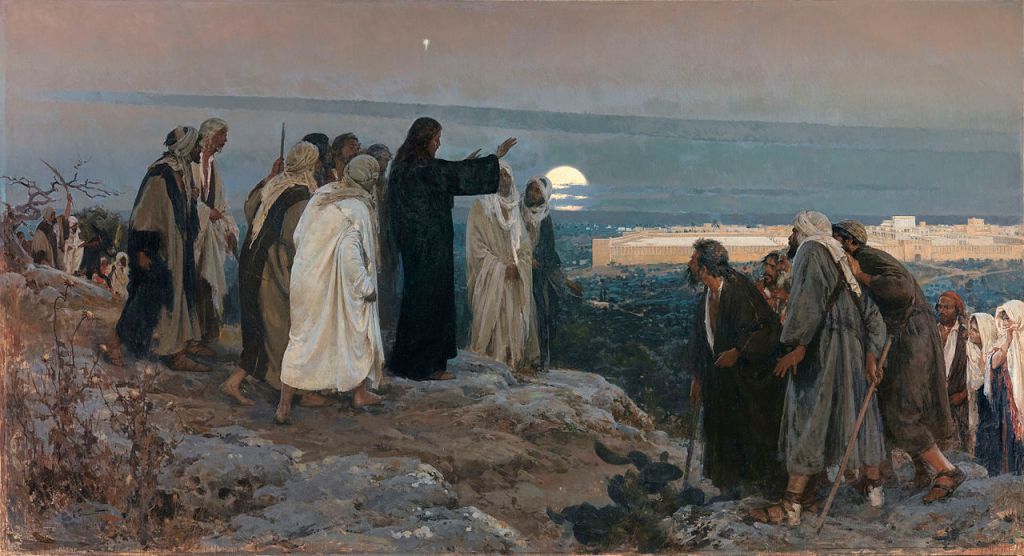
Flevit super illam/He Wept Over It by Enrique Simonet
Five days pass between Jesus’ triumphal entry, which we read about before receiving the palms, and the beginning of the Passion narrative. In those five days, many things happened, including the telling of many great parables, Jesus cursing the fig tree, the institution of the Lord’s Supper, and the washing of the disciples’ feet. Jesus also has several run-ins with the various religious leaders and, at one point, speaks many condemnations to them, saying, “Woe to you scribes and Pharisees, hypocrites.”
Jesus condemns them because of their arrogance in thinking they were better than others, for binding up the people with so many rules and regulations that those who desired to serve God were overwhelmed and disheartened in their faith, for putting faith in things over caring for people, for forgetting to show justice and mercy and to be faithful, for condemning others when they themselves are in error, for hypocrisy and lawlessness, and willful ignorance of their own faults. He then concludes with a lament over Jerusalem,
The lament begins, “O Jerusalem, Jerusalem,”—another way of speaking of the religious leaders and those who have failed to believe—“O Jerusalem, Jerusalem, the city that kills the prophets and stones those who are sent to it! How often would I have gathered your children together as a hen gathers her brood under her wings, and you were not willing! See, your house is left to you desolate. For I tell you, you will not see me again, until you say, ‘Blessed is he who comes in the name of the Lord.’” (Matthew 23:37-39)
With those final words, Jesus repeats to this same group the words proclaimed during the triumphal entry, “Blessed is he who comes in the name of the Lord.” In doing so, He is saying to the religious leaders, “You have not yet believed, but there will come a day when you have no choice but to believe.” As St. Paul said to the Philippians, “God has highly exalted him and bestowed on him the name that is above every name, so that at the name of Jesus every knee should bow, in heaven and on earth and under the earth, and every tongue confess that Jesus Christ is Lord, to the glory of God the Father.” (Philippians 29-11)
“Woe to you, Jerusalem, Jerusalem, you will bend your knee and confess Jesus Christ as Lord, and you will do so either out of love and obedience or out of fear, trembling, and judgment… but you will confess.”
The error we can make today is wrongly believing that these words do not apply to us. That was then; this is now. Woe to those religious leaders and others who do not believe. We are safe, for we are God’s people, but that is the exact same thing those religious leaders thought. Therefore, we must be on our guard so that we do not become Jerusalem, Jerusalem, and it is an easy trap to fall into. We will do so by making the same mistakes as they made in the past—by putting up barriers to God, by caring for things, by not showing justice, mercy, and faithfulness, by condemning the world around us while thinking we are the holy ones, and by being willfully ignorant and turning a blind eye to our own faults.
Declare, not only with your lips but also with your heart and soul—your entire being—declare, “Blessed is he—Blessed is Jesus who comes in the Name of the Lord,” and leave behind that old Jerusalem so that you may become citizens of the New Jerusalem. A city, as St. John tells us in his Revelation—that has been adorned as a bride for her husband, the dwelling place of God, where there are no more tears, no more mourning, crying, pain… no more death. (cf. Revelation 21:1-4) Become citizens of that New Jerusalem where all things have been made new and restored to God.
Question: If I were to say to you, “The world is my oyster,” what would you take that to mean?
{Pause for answers.}
That’s what most would say, but it is actually only half of a line from Shakespeare’s Merry Wives of Windsor.
In Act II, Scene II, two thieves, Falstaff and Pistol, enter and are having a conversation.
Falstaff: I will not lend thee a penny.
Pistol: Why then the world’s mine oyster, Which I with sword will open.
Falstaff: Not a penny.
“Why then the world’s mine oyster,” when the rest of the sentence is added, “Which I with sword will open,” is saying, “Anything I want is mine, and I’ll take by any means necessary, including violence.”
From “Money is the root of all evil” to “Now is the winter of our discontent,” there are many examples of taking a part of a sentence or statement out of context and having it say the complete opposite or never intended interpretation of the original intent. When we do this in working with Holy Scripture, we call it proof-texting, and today, in our Gospel, we have a fine illustration.
“Jesus said to the Jews who had believed in him, “‘If you continue in my word, you are truly my disciples; and you will know the truth, and the truth will make you free.’”
“The truth will make you free,” or “The truth will set you free.” It is everywhere, including titles of books, with those books ranging in topics from psychiatry, finding your true self, and video games. Then you’ve got politicians batting it about, but I don’t know one of them that would know the truth if it smacked them upside the head (but that’s a commentary and not preaching). The trouble is, all of these use the statement out of context, because the truth they are referring to is not the truth Jesus was referring to when he spoke those words. It is not some random truth that will set you free.
St. Thomas Aquinas, that great 13th-century Dominican theologian, wrote, “In this passage, being made free does not refer to being freed of every type of wrong . . .; it means being freed in the proper sense of the word, in three ways: first, the truth of his teaching will free us from the error of untruth …; second, the truth of grace will liberate us from the slavery of sin: ‘the law of the Spirit of life in Christ Jesus has set me free from the law of sin and death’ (Rom 8:2); third, the truth of eternity in Christ Jesus will free us from decay. (cf. Rom 8:2 1)”
There are many truths out there, but the only one that will truly set you free is Jesus, His grace, and His teachings. As Jesus, the Son of God, said, “If the Son sets you free, you will be free indeed.”
You all know that I’m a fan of Stephen King, but many people won’t pick up anything he’s written. Too scary for most, although much of what he writes isn’t what you think it is. To illustrate the point, King tells a story. He says, “I was in a supermarket down here in Florida, and I came around the corner, and there was a woman coming the other way. She pointed at me, she said, ‘I know who you are! You’re Stephen King! You write all of those horrible things. And that’s ok. That’s all right. But I like uplifting things, like that movie Shawshank Redemption.’ And I said, ‘I wrote that!’ And she said, ‘No, you didn’t. No, you didn’t.’” Well, he did write Shawshank Redemption, which is a fantastic story. This week, I was reminded of a particular scene in the movie version.
An old prisoner, Brooks Handlin, has learned that he will be paroled, but instead of being overjoyed, he begins acting very erratic, even threatening to kill another prisoner. It seems odd to most, but Red—another of the characters—understands. Red says, “Brooks is just institutionalized. The man’s been in here 50 years… 50 years! This is all he knows. You know what I’m trying to say? I’m telling you, these walls are funny. First, you hate them, then you get used to them. Enough time passes, you get to depend on them. That’s institutionalized.”
In reading our first lesson today, you would think that Stephen King wrote it—the Valley of Dry Bones. To understand what Ezekiel was writing, we must go back in history.
In Deuteronomy, the Lord says, “If you faithfully obey the voice of the Lord your God, being careful to do all his commandments that I command you today—that is, follow the Law—the Lord your God will set you high above all the nations of the earth.” (28:1) A few verses on comes the “but.” “But if you will not obey the voice of the Lord your God or be careful to do all his commandments and his statutes that I command you today, then all these curses shall come upon you and overtake you.” (28:15) There follows a litany of curses that will befall the people if they break God’s commands, one of which states, “The Lord will cause you to be defeated before your enemies. You shall go out one way against them and flee seven ways before them. And you shall be a horror to all the kingdoms of the earth. And your dead body shall be food for all birds of the air and for the beasts of the earth, and there shall be no one to frighten them away.” (28:25-26) In those days, the victor in a battle would shame the ones they conquered by refusing to allow the bodies of the dead to be retrieved and buried. Those bodies were to lay where they fell as a sign of defeat. God said, if you break my Law, this will happen to you.
We know that the people were disobedient, and in 587 b.c., God had had enough, and the promised curses fell upon the people. Nebuchadnezzar, the king of the Babylonians, sent in his army, sacked Jerusalem, destroyed the temple, and took the people into captivity and exile. During the battle, 4,200 people were killed.
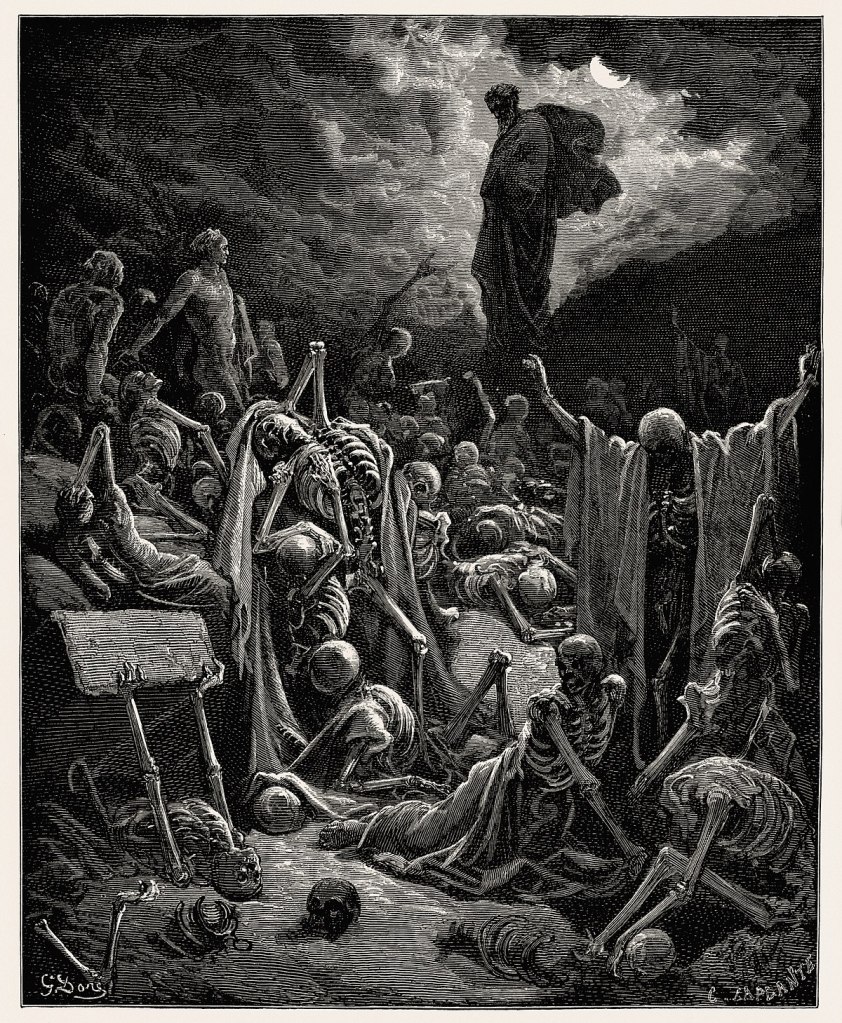
Ezekiel was a prophet and a preacher in Jerusalem. He was there in 587 when the Babylonians attacked, and he went with the people into exile. While in exile, he continued to preach and to have visions. What we read today is one of those visions. It began, “The hand of the Lord was upon me, and he brought me out in the Spirit of the Lord and set me down in the middle of the valley; it was full of bones.” There is no indication in the text that this valley of bones is the land surrounding Jerusalem, but it is safe to assume, given that Ezekiel was there and saw the dead. It is also safe to assume that the Babylonians would not have allowed the dead to be removed from the battlefield so that the Israelites would be further humiliated. So, in his vision, Ezekiel, who was in exile, stood amongst the dried bones of the dead.
While there, God spoke, “Prophesy over these bones, and say to them, O dry bones, hear the word of the Lord.” As he spoke, the bones began to rattle. They put on flesh and skin. Everything was restored except for one thing—life. The Lord spoke to Ezekiel again and said, “Prophesy to the breath; prophesy, son of man, and say to the breath, Thus says the Lord God: Come from the four winds, O breath, and breathe on these slain, that they may live.”
There is a Hebrew word for breath—rûah. There is also the word hārûah—The Breath. Breath is what those corpses needed to have life, but only The Breath—the very Spirit of God that breathed life into the first man, Adam—can give life-giving breath. Both of these words are in what God commanded Ezekiel to do-call on The Breath that life might be restored to those who had been killed, yet not only them but to all. Everyone.
God allowed the Babylonians to conquer the Israelites. It was the fulfillment of the curse that God promised for disobedience. Ezekiel’s vision of The Breath breathing new life into the dead is the sign that God is lifting that curse and restoring the people. For those in exile with Ezekiel, this message is one of great hope because their exile was not only an exile from the land but also an exile from God. Now, they have been given new life.
It is that same new life that we are given. The Breath of God is breathed into us, and we are no longer dried-up bones. Through Jesus, we are fully alive beings in relationship with our God. Yet, we so often still hang around in that valley of dry bones, clinging to our former life. Thomas Merton referred to this clinging as the life of the “old man.”
“For the ‘old man,’” Merton writes, “everything is old: he has seen everything or thinks he has. He has lost hope in anything new. What pleases him is the ‘old’ he clings to, fearing to lose it, but he is certainly not happy with it. And so he keeps himself ‘old’ and cannot change: he is not open to any newness. His life is stagnant and futile. And yet there may be much movement but change that leads to no change. The more it changes, the more it stays the same.
“The old man lives without life. He lives in death, and clings to what has died precisely because he clings to it. And yet he is crazy for change, as if struggling with the bonds of death. His struggle Is miserable, and cannot be a substitute for life.” (A Year with Thomas Merton, p.84)
More simply put, Merton is saying that we are like Brooks Handlin in Shawshank Redemption. We are “institutionalized.” We’ve lived so long in that valley of dry bones that it is all we know. We’ve gotten so used to living that “old man” life that even though we want to change, we cling to… death.
Standing at the tomb of Lazarus, Jesus “cried with a loud voice, ‘Lazarus, come out!’ The dead man came out, his hands and feet bound with strips of cloth, and his face wrapped in a cloth. Jesus said to [the people], ‘Unbind him, and let him go.’” Jesus, The Breath of God, breathed new life into Lazarus, and Lazarus left the tomb, the valley of bones, and removed all that had bound him to it. We are invited to do the same.
Come out! Come out of the valley and enter into this new life. Merton wrote, “For the ‘new man’ everything is new…. The new man lives in a world that is always being created and renewed. He lives in this realm of renewal and creation. He lives in life.” Come out and live in life. It is a gift to you from God.
Let us pray: Breathe in us O Holy Spirit, that our thoughts may all be holy. Act in us O Holy Spirit, that our work, too, may be holy. Draw our hearts O Holy Spirit, that we love but what is holy. Strengthen us O Holy Spirit, to defend all that is holy. Guard us, then, O Holy Spirit, that we always may be holy. Amen.
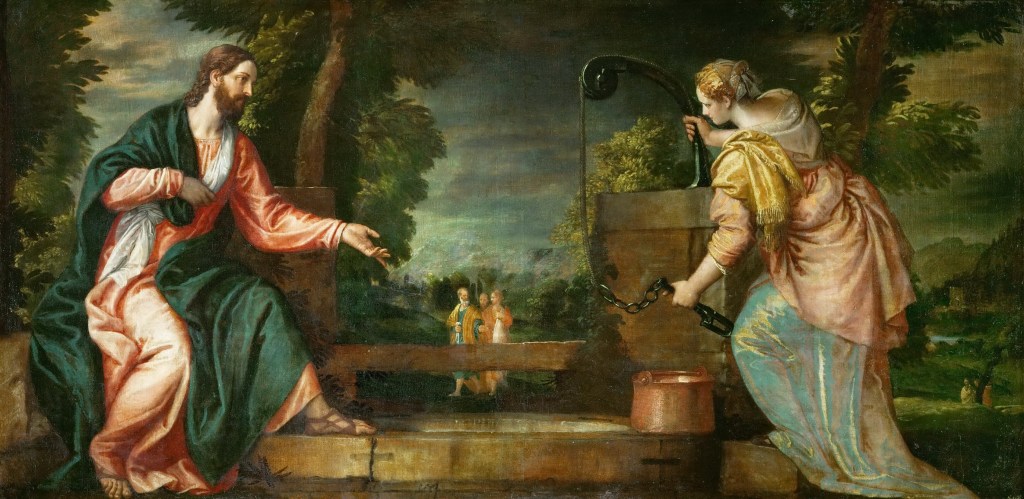
Christ and the Samaritan Woman at the Well by Paolo Veronese
If a company were to commission a study on forgetting things, which company would be the most likely candidate? I would tell you, but I’ve forgotten. No. It is 3M, the parent company of the Post-It Brand, the maker of those brightly colored sticky notes, technically called “repositionable pressure-sensitive adhesive sheet material.” It is estimated that 50 billion of those little sticky notes are created yearly, and I’m a significant contributor to their use.
In the study, it was learned that 56% of men rely on their spouses to remember important things, and over 50% of the women stated that their spouses forgot something important. (Never mind the fact, according to the same study, women are more likely to lie about forgetting something.)
On average, we forget four things daily, totaling 1,460 items per year. A spokesman for Post-It said, “Our days are so jam packed full of tasks whether at work or at home, it’s no surprise people find it hard to keep track of everything. With much longer working hours, financial concerns and just busier lifestyles, even those with the best memory can stumble when it comes to remembering even the most simple of things during a hectic day.”
The top five things forgotten: – Forget what you went into a room for – Misplacing keys – Forgetting things on your grocery list – People’s names when you’re introducing them – Where you put your pen (Source)
We forget things; however, forgetting certain things helps us remember others. There’s quite a bit of science behind it, which does not pertain to forgetting where you put your keys or the effects of dementia and other diseases of the mind, but we forget these additional items because we don’t really need to remember them, and in forgetting, it makes our memories more efficient.
So, with all that talk of memory and forgetting, let’s test yours. Where did Abraham’s servant meet, Rebekah, a wife for Issac? He met her at a well in Haran. Where did Jacob first meet his wife, Rachel? He met her at a well, also in Haran. Where did Moses first meet his wife, Zipporah? He met her at a well in Midian. Do you see a pattern? And today, Jesus meets a woman at the well.
Most women would come to draw water early in the morning or late in the evening, but this Samaritan woman went to the well at noon, the hottest part of the day. Why? As Jesus points out, she has had five husbands, and the man she is with now is not her husband. She likely came to the well when she hoped not to encounter anyone else so that she would not be condemned, criticized, and made to feel ashamed. However, when she arrives, she is met by a Jewish man.
Jews and Samaritans do not associate, and a Jewish man would never address a Samaritan woman. Never. Yet, Jesus says to her, “Give me a drink.” From there, the conversation goes back and forth. Why are you talking to me? How will you draw water? Are you greater than Father Jacob, who dug the well?
She came to the well hoping to avoid others because she knew she would be condemned. Seeing a Jewish man, she probably expected to be ignored entirely or severely condemned. Yet, Jesus spoke to her and pointed her closer to the truth about herself, who He is, and what He has to offer: living water. At first, as she listens, she desires this water that Jesus offers because she believes she will no longer have to return to the well and endure the shame that others pour upon her, but then she begins to understand what Jesus is offering.
Remember Jesus’ words from last week? “Indeed, God did not send the Son into the world to condemn the world, but in order that the world might be saved through him.” The woman begins to understand that Jesus is not talking about water that can be drawn from a well in the ground. She says, “I know that Messiah is coming. When he comes, he will proclaim all things to us.” Jesus said to her, “I am he, the one who is speaking to you.” At that, the woman realizes that the well of the Living Water is Jesus, Himself.
Just then, the disciples return. As for the woman: she “left her water jar and went back to the city.” She forgot her water jar. When she forgot it, was it just one of her four things she was going to forget that day, and all she needed was a post-it note to remind her, or did she forget it because it was something she no longer needed to remember? Not only did she forget her water jar, but she also forgot how others condemned her and that many likely hated her. She forgot the criticisms and the shame she felt because, instead of running away from and avoiding the people of her community, she did just the opposite—she ran to them. Finding them, she said, “Come and see a man who told me everything I have ever done! He cannot be the Messiah, can he?”
She came to the well that was Jesus and drank deeply of the Living Water. The waters of redemption and salvation, of love, mercy, grace, compassion, and more. She drank, and in drinking—like Rebekah, Rachel, and Zipporah—she met her spouse by a well.
In the 19th chapter of his Revelation, St. John writes, “I heard what seemed to be the voice of a great multitude, like the roar of many waters and like the sound of mighty peals of thunder, crying out, ‘Hallelujah! For the Lord our God the Almighty reigns. Let us rejoice and exult and give him the glory, for the marriage of the Lamb has come, and his Bride has made herself ready; it was granted her to clothe herself with fine linen, bright and pure”— for the fine linen is the righteous deeds of the saints.’”
The woman at the well believed and, in believing—she who had had five husbands and was currently living with a man who was not her husband— became a Bride of Christ. She discovered and was wed to the only One who could bring her true happiness and the peace she had been searching for her entire life.
We, each of us, are like the woman at the well. Condemned by Satan, ashamed of our sins, and criticized by our own thoughts and others, but like the Samaritan woman, we can forget our water jars. We can leave behind the bitter poisonous water and come to the Living Water of Jesus, and we can choose to drink the Living Water that is freely offered. In drinking, we are joined to Christ as His Bride. In drinking, we become a new creation. In drinking, we are redeemed and saved and can experience the Messiah’s love, mercy, grace, and compassion.
Forget your water jar. Don’t write yourself a post-it note. You don’t need to remember it. Forget it. Drink the Living Water from the well that is Jesus and enter into this new and eternal life given to you by God.
Let us pray: Come, all who are thirsty says Jesus, our Lord, come, all who are weak, taste the living water that I shall give. Dip your hands in the stream, refresh body and soul, drink from it, depend on it, for this water will never run dry. Come, all who are thirsty says Jesus, our Lord. Amen.
Today I’d like us to take three steps back, tilt our heads slightly to the side and have a look at the church in the West. I think something’s off. Let’s explore together.
The ‘I’ in church
When I look at the church of Jesus today (mainly, but not limited to the West), I see groups of individuals who happen to associate themselves with a particular movement, society or social club. Individual disciples of Jesus, their nuclear families and other people who, for a period of time, gather with other like-minded individuals. The church of Jesus in the West is (at large) an expression of the individualistic West. Which is to say: the individual is the point, the whole serves the individual, and the individual is part of the whole for so long and as long as (s)he gets more out of it than they need to give or put…
1984 is George Orwell’s great dystopian novel. It deals with how a totalitarian state—Big Brother—can control the people. One tool used in controlling is newspeak—the language used to convey ideology and history. It is described as “a purposefully ambiguous and confusing language with restricted grammar and limited vocabulary used in Oceania [the state] to diminish the range of thought. For example, in newspeak, the term “plusgood” replaced words better and “great.” The goal: if you can control the language, you can control the individual’s thoughts. I’m sure we could study this and prove that it is at play in our world today, but we won’t go there. So why talk about it?
Today in our Gospel, Jesus said he came “to give his life a ransom for many.” In our minds, the word “ransom” has a particular meaning, a payment for the release of an individual, and Jesus uses ransom to describe the work he accomplishes on the cross. However, throughout the scriptures and the Book of Common Prayer, many other words are used: sacrifice, atonement, propitiation, oblation, satisfaction, reconciliation, and others. The sentence in the Rite One service that we’ve heard on Sundays combines several of these: “Almighty God, our heavenly Father, for that thou, of thy tender mercy, didst give thine only Son Jesus Christ to suffer death upon the cross for our redemption; who made there, by his one oblation of himself once offered, a full, perfect, and sufficient sacrifice, oblation, and satisfaction, for the sins of the whole world.” (BCP, p.334)
These words can become confusing. In addition, these words have led to different theories on what was accomplished on the Cross.
There is the Ransom Theory, Satisfaction Theory, Christus Victor Theory, Penal Substitutionary Theory, Governmental Theory… the list goes on. When we study each one, we can think, “Well, that sounds right,” and we will feel so until we read the following theory. It gets confusing and, in some cases, contradictory. However, instead of seeing them as such, it is better to understand them in the same way we understand the four Gospels.
With the Gospels, there are times when they can seem confusing and contradictory when compared one to the other, but they are, in fact, pieces of a mosaic. Only when they are brought together will they create a complete image. The same is likely true with the various theories of what took place on the Cross. Each highlights one piece of the mosaic, one piece of the truth, and it is not until they are held together that the entire truth is made evident.
Unlike Orwell’s newspeak, which seeks to define an idea with the least number of words, the death of Jesus and the work He accomplished on the cross uses many different words. In the end, with all the words we use to describe the event, we are left with a highly nuanced event, depending on how we look at it, and that is the purpose—it is a mystery. Christ’s death upon the Cross and all that was accomplished is far beyond our understanding because we lack the intellect and the language to define or adequately grasp it. Therefore, perhaps the best thing to say is what St. Paul said to Timothy, “Christ Jesus came into the world to save sinners.” (1 Timothy 1:15) If we know nothing else, this one piece of information is all we need to be saved.