Within our sanctuary, by the altar, is the tabernacle. Above it, the red sanctuary lamp burns, indicating that the consecrated bread and wine—the body and blood of Our Lord—are present.
For some, the bread and wine (in many cases, grape juice) are only representations or symbols. For others, they hold a slightly higher place and point to something greater but remain bread and wine. For us, we believe that the bread and wine maintain the form of bread and wine but do, in fact, become the body and blood of Jesus, but is there any proof that this transformation has taken place? It is a question of faith, but I came across the following article that may get you thinking about it. (You’ll hear this again on a Sunday.)
“On the evening of the last day of his October 1995 visit to the United States, John Paul II was scheduled to greet the seminarians at Saint Mary’s Seminary in Baltimore. It had been a very full day that began with a Mass at Oriole Park in Camden Yards, a parade through downtown streets, a visit to the Basilica of the Assumption, the first cathedral in the country, lunch at a local soup kitchen run by Catholic Charities; a prayer service at the Cathedral of Mary Our Queen in North Baltimore; and finally a quick stop at Saint Mary’s Seminary.
The schedule was tight so the plan was simply to greet the seminarians while they stood outside on the steps. But the Pope made his way through their ranks and into the building. His plan was to first make a visit to the Blessed Sacrament.
When his wishes were made known, security flew into action. They swept the building paying close attention to the chapel where the Pope would be praying. For this purpose highly trained dogs were used to detect any person who might be present.
The dogs are trained to locate survivors in collapsed buildings after earthquakes and other disasters. These highly intelligent and eager dogs quickly went through the halls, offices and classrooms and were then sent to the chapel. They went up and down the aisle, past the pews and finally into the side chapel where the Blessed Sacrament is reserved.
Upon reaching the tabernacle, the dogs sniffed, whined, pointed, and refused to leave, their attention riveted on the tabernacle, until called by their handlers. They were convinced that they discovered someone there.
We Catholics know they were right—they found a real, living Person in the tabernacle!” (Source)
Today, in our Gospel reading, we hear the story of Jesus appearing to the disciples in the upper room. On that first visit, Thomas was absent. When the other disciples tell him about it… you know the story—Doubting Thomas. “Unless I see the mark of the nails in his hands and put my finger in the mark of the nails and my hand in his side, I will not believe.”
A week later, the Lord appears again, and Thomas is present. Jesus says to him, “Put your finger here and see my hands. Reach out your hand and put it in my side. Do not doubt but believe.” Thomas answered him, “My Lord and my God!”
“Upon reaching the tabernacle, the dogs sniffed, whined, pointed, and refused to leave, their attention riveted on the tabernacle, until called by their handlers. They were convinced that they discovered someone there.” I am convinced that if those dogs, while sitting in front of the tabernacle, could have spoken, they would have professed the same words as Thomas, “My Lord and my God!”
On this Eve of the Feast of St. Thomas, when you receive the Blessed Sacrament, recognize that hidden within is your Lord and your God and receive Him with great humility and thanksgiving.
You knew it was the cry of my breath and you knew you would ignore there were so many cries for life but none that gave you breath
I came from a distant place a place of horrors and peace where the demons shout with glee giving us flight, while we run in terror bleeding in our lost souls
Chase me in the absence remember me when the clouds break I’ll not be there in the lightning in the cacophony in the… hmm … I might be there.
Short life bleeds into years no sense in setting clocks all read the same all chime last call
A monkey churns a tune grinds on I pop when time is… ….. time is ….. time is ….. time is… when you have become the dancing monkey you dance it rains it plays the sounds of the carnival and if you dance the dance
ah!
”Have a nibble. It won’t last but it will bait you along.”
I watched the sun my eyes wide open blistered my vision opened my mind and if it mattered we’d all play the violin and pretend the world was flat
As it is I’ve forgotten my name (thankfully, the Son remembers) fifty-nine years and the plague of our dreams Sai, we know not why skips past and dreams of a better day.
Bring me my life. Bring me my breath. I will live yes I will live
YES
Black, white, and other shades of gray. These are the colors of our mind these are the color we see….. ….. I am blue.
On May 25, 1961, President John F. Kennedy made a speech to Congress titled Urgent National Needs. Among other items, he stated, “I believe this nation should commit itself to achieving the goal, before this decade is out, of landing a man on the moon and returning him safely to earth.” He concluded, “In a very real sense, it will not be one man going to the moon… it will be an entire nation. For all of us must work to put him there.” (Source)
In her book Resonate, Nancy Duarte picks up a part of the story. “Later in the 1960s, JFK was touring NASA headquarters and stopped to talk to a man with a mop. The president asked him, ‘What do you do?’ The janitor replied, ‘I’m putting the first man on the moon, sir.’ This janitor could have said, ‘I clean floors and empty trash.’ Instead, he saw his role as part of the bigger mission that was to fulfill the vision of the president. As far as he was concerned, he was making history.”
Growing up in Louisiana, I remember even there, we could have these cold and rainy Saturdays. A bit too unpleasant to be out, so my brother and I would set up a card table between our twin beds and put together a puzzle. Maybe 250/300 pieces. Nearing the end, we both wanted to place the last piece, so we took to hiding one (or, at least, I did). All the pieces but that one were in place, then you could snatch it out of your pocket and have the thrill of finishing the puzzle. However, there were other times when neither of us would hide a piece, but there would still be one missing, so we would crawl around on the floor searching and only give up once it was found. Why would we do that?
If it was a 300-piece puzzle of a deer in the woods and the piece missing was the head of the deer, I could understand it, but most of the time, it was some random bit of sky or a part of a tree. A piece that was missing but did not detract from the overall picture. You knew what it was. Yet, we would search, and I’m guessing you would too. It’s not that you can’t tell what the picture is supposed to be. It’s just that it is not complete. You look at the picture, and the only thing you can see is the hole where that missing piece belongs. Perhaps a minor part of the overall image, but without it….
Jesus said, “What do you think? If a man has a hundred sheep, and one of them has gone astray, does he not leave the ninety-nine on the mountains and go in search of the one that went astray? And if he finds it, truly, I say to you, he rejoices over it more than over the ninety-nine that never went astray.” (Matthew 18:12-13) The puzzle is incomplete without the one piece, and the flock is incomplete without the one sheep. Each piece and each sheep fulfill a purpose that completes the whole.
In the time of Jesus, we know that the people were looking for a Messiah, but they were also looking for the coming of a particular prophet. In the last book of the Old Testament, Malachi, and the second to last verse of that book, the Lord says through Malachi, “Behold, I will send you Elijah the prophet before the great and awesome day of the Lord comes.” (Malachi 4:5) The people were looking a Messiah and for Elijah. Why Elijah? In 2 Kings 2, we see that Elijah did not die but was carried away into Heaven by a whirlwind. The people were looking for Elijah, the great prophet, to return the same way he went. This is why, in our Gospel reading today, we read that “the Jews sent priests and Levites from Jerusalem to ask him, ‘Who are you?’ He confessed and did not deny it, but confessed, ‘I am not the Messiah.’ And they asked him, ‘What then? Are you Elijah?’ He said, ‘I am not.’ ‘Are you the prophet?’ He answered, ‘No.’” They were trying to ascertain whether or not John was the fulfillment of Malachi’s prophecy. Although John denies it, not believing that he is the Prophet, Jesus will say of John, “He is Elijah who is to come.” (Matthew 11:14b)
However, following John’s denial, the priests will say to John, “‘Who are you? Let us have an answer for those who sent us. What do you say about yourself?’ [John] said, ‘I am the voice of one crying out in the wilderness.’”
In the overall picture, John was unsure who he was, but when asked, “Who are you?” He knew his exact purpose and fulfilled that purpose, preparing the way for Jesus.
President Kennedy asked, “‘What do you do?’ The janitor replied, ‘I’m putting the first man on the moon, sir.’” The priests asked John the Baptist, “Who are you?” Put another way, the priests asked John, “What do you do?” And John said, “I am the voice of one crying out in the wilderness.” Question: what do you do? We are each a piece of the puzzle of God’s plan on earth. Without you—even if, like John, you are uncertain as to what part you play, and even if you think you’re a minor detail of the overall image—the picture is incomplete without you. What do you do? You can’t say, “I serve no purpose.” If you have a heartbeat, you serve a purpose, so what do you do?
If you already know or have an idea, then I pray you are fulfilling your purpose. If unsure, go through a discernment process, intentionally seeking out how God would like to use you. Once you discover it, go to work. What we cannot do is ignore our purpose, thinking someone else will do it. Our piece in the puzzle is as specific as John’s and even Jesus’. Therefore, our last words should be the same as Jesus’ last words, “It is finished.” We should be able to confidently speak those words, knowing that we have finished God’s will and His purposes in our lives.
The Lord says,
“Fear not, for I have redeemed you; I have called you by name, you are mine.” (Isaiah 43:1b)
You were the lost sheep. God went out and found you. Jesus redeemed you. You belong to God. He has a purpose for you. Discover it, and if you have, put it to use in His Kingdom. The work of His Kingdom and His Church needs you. We are making history, and you are a part of it.
Let us pray: Loving Father, faith in Your Word is the way to wisdom. Help us to think about Your Divine Plan so that we may grow in the truth. Open our eyes to Your deeds, our ears to the sound of Your call, so that our every act may help us share in the life of Jesus. Give us the grace to live the example of the love of Jesus, which we celebrate in the Eucharist and see in the Gospel. Form in us the likeness of Your Son and deepen His Life within us. Amen.
Fr. John Julian writes: “When a martyr lives and dies in Sicily, has a world-famous song written about her which is still sung 1500 years after her death [Santa Lucia], has her name included in the Canon of the Roman Mass, is listed in the oldest Christian Sacramentaries, has two churches dedicated to her in pagan England before the 8th century, is the most popular saint in Sweden and Norway, had her biography written by a member of the Saxon royal family, and a poem about her by John Donne, and whose feast day was originally the date of the winter solstice, she has to have been some remarkable lady! And such a person is Saint Lucy—the ever-popular Santa Lucia.” (Stars in a Dark World)
Legend has it that Lucy was born to a noble Sicilian family but secretly decided to remain a virgin and dedicate her life to Christ. Since her mother was unaware of this commitment, she promised Lucy to be married, but when Lucy finally told her of her intentions, her mother allowed Lucy to do as she pleased. However, the suitor was sorely disappointed; he was looking forward to a sizable dowry, so he became angry when the wedding was called off. He turned Lucy into the governor for being a Christian, which was illegal under the current emperor, Diocletian. Brought before the governor, she refused to recant her faith and was ordered to work in a brothel, but when the guards came to take her away, they could not move her from the spot she stood. It only gets gruesome from there, but she was put to death for her faith—a virgin martyr.
Using the old Julian calendar, her feast day, December 13th, was the winter equinox, which is the return of the light with longer days. Given that her name in Latin means light, you can understand why those in the far northern hemisphere would celebrate the Saint who brings the light and the lengthening of daylight to their short winter days. Such is her renown that in these Scandinavian countries, on this night, it is said that you may hear cattle speaking or see running water turn to wine. If, during this season, you have ever seen a young girl wearing a white dress with a red sash and crown of candles, then you have seen a representation of Santa Lucia.
It is a beautiful way to celebrate the season, but it and the equinox also remind us of the words from John’s prologue, “The true light, which enlightens everyone, was coming into the world.” We celebrate this same coming of the Light through our traditions and celebrations, from the lights on our trees to the candles of the Advent wreath—all of which point to the birth of our Savior and the light He brings into the world.
Santa Lucia’s Song speaks of this coming, so I’ll close with it:
Night walks with a heavy step Round yard and hearth, As the sun departs from earth, Shadows are brooding. There in our dark house, Walking with lit candles, Santa Lucia, Santa Lucia!
Night walks grand, yet silent, Now hear its gentle wings, In every room so hushed, Whispering like wings. Look, at our threshold stands, White-clad with light in her hair, Santa Lucia, Santa Lucia!
Darkness shall take flight soon, From earth’s valleys. So she speaks Wonderful words to us: A new day will rise again From the rosy sky… Santa Lucia, Santa Lucia!
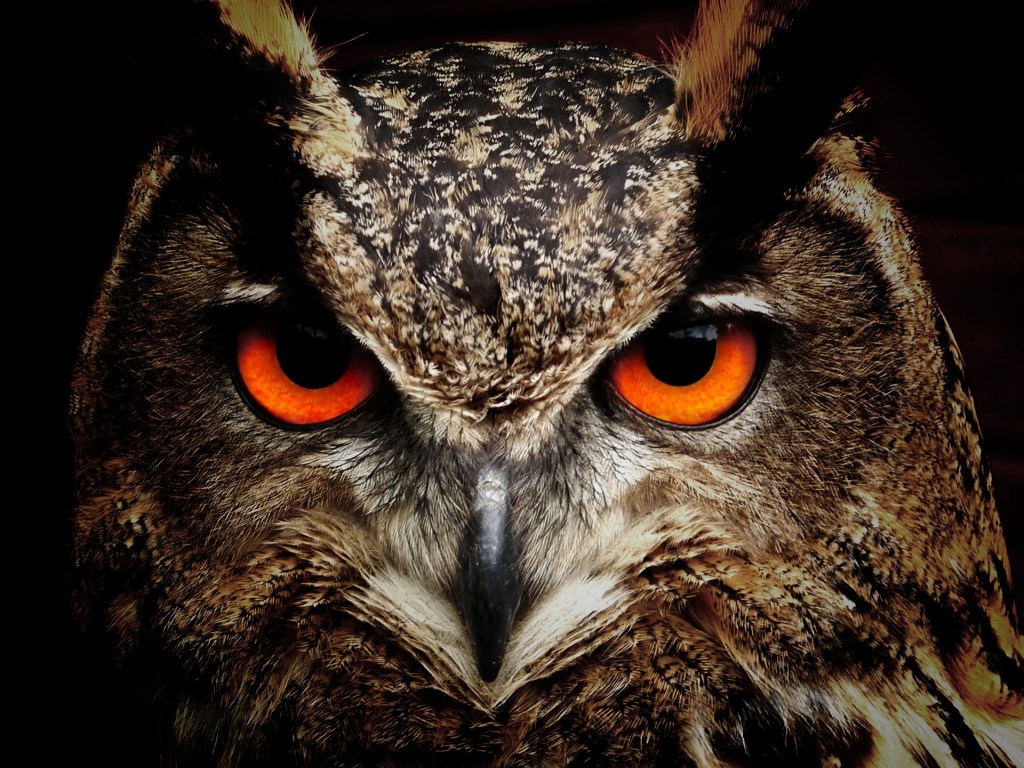
To hoot, or not to hoot, that is the question: For to hoot is to speak in hopes of being heard, To not is silence amongst the trees, Meditating upon the moon and the leaves. If perchance I see a friend, a hoot would surely invite them in, Whereas a foe might seek me out Only to harass, harangue, and steal my house. So, I perch wide-eyed in my hollow oak, Prudence shepherding my unspoken note, Equivocating on whether to hoot or not.
A snap, a twig, a scurrying in the night, My dinner moves cautiously out of sight. Unaware of my presence and eyes so bright, Nor of my taste for furry gray mice. I swoop, I dive, I see my mark. I reach, I grab, I clasp thin air. I sit, I frown, no wages for work, I’ll go hungry this night, my soul in despair.
Once upon a time, the devil decided to destroy humankind. He called in all his little devils to make the plans. Anger came first and asked to be allowed to do the job by setting brother against brother. He would make people angry with each other, and they would destroy themselves.
Lust also offered to go. He would defile minds and turn people into beasts by making love disappear. Next, Greed spoke and offered to destroy humankind with the most destructive of passions: uncontrolled desires. Idleness, Hate, Jealousy, and Envy each claimed in turn that they could do the job. But the devil was not satisfied with any of them.
Finally, the last assistant came forward. He said, “I will talk with people persuasively about all that God wants them to be. I shall tell them how fine their plans are, to be honest, clean, and brave. I shall encourage them in good purposes of life!”
The devil was shocked at such talk. But then the assistant continued, “I shall tell them there is no hurry. They can do all of these things tomorrow. I shall advise them to wait until the conditions become more favorable before they start!” The devil replied, “You are the one who shall go to earth to destroy humans!” The assistant’s name was Procrastination.
According to Merriam-Webster, procrastination is defined as “to put off intentionally the doing of something that should be done.” That much we understand, but there is a bit of science as to why we put things off.
Within the brain, there are various areas. Two small areas, one on each side of the brain, are called the amygdala. They are about the size of almonds. It is the area of the brain that processes emotions and informs our minds about what things might be beneficial or harmful. When the amygdala is happy, it assists in giving your brain a nice shot of the happy chemical—dopamine. What’s something that can make you happy? For me, cat videos. Cat videos make me happy. So, I watch cat videos, even though I have a sermon to write. It is not that I don’t like writing sermons, but it takes a lot more work, but the dopamine happiness kicks in at the end of the task, whereas the cat video gives me that quick fix.
Another part of the brain, the pre-frontal cortex, helps us think, plan, and sort through future projects and needs. It’s what says, “You’ll need to sit down Thursday morning and write the sermon for Sunday; otherwise, you’ll have to write it over the weekend.”
The issue is that where the amygdala works on its own, the pre-frontal cortex requires a conscious decision to get moving. So, if my brain is happy—receiving dopamine—from cat videos, it has little motivation to switch gears and go to work on the sermon, so it procrastinates. “Let’s just sit here, sip coffee, and be happy.” (Source)
It is probably a bit more complicated than all that, but that’s the big picture. Miss Scarlett knew it well, “I can’t think about that right now. If I do, I’ll go crazy. I’ll think about that tomorrow.” (Gone with the Wind) To do what is required means you must consciously decide to get up off your backside and go to it.
Last week, in our Gospel reading, Jesus spoke about the end of days and concluded by saying, “But about that day or hour no one knows, neither the angels in heaven, nor the Son, but only the Father. Beware, keep alert; for you do not know when the time will come.” (Mark 13:32)
In today’s Gospel, John the Baptist said, “The one who is more powerful than I is coming after me,” and those two thoughts are what got me to thinking: no one knows when the end of days will be except for God, but what if we did? What if John the Baptist had said, “The one who is more powerful than I is coming after me, and He’ll be here on December 11, 2023 (that’s tomorrow) at noon.” Question: if you knew that for certain, what would you start to do differently in your life than you are doing now? What would you change?
Some of you may remember the little story I told you a few years ago. The church administrator bursts into the priest’s office and says that Jesus has returned and that He was on His way to their church at that very moment. She then asks the priest, “What should we do?” The priest quickly turns back to his computer and blurts out, “Look busy!”
Perhaps not intentionally or even consciously, but for many, that is their plan. The pre-frontal cortex tells them there will be a day when the Lord will return. It knows that Jesus has told us to stay alert and to watch, but those two little almonds deep down in your brain keep being satisfied with cat videos. I want to be happy now. I want immediate gratification. Yes, yes, I know that the day will come when the Lord returns and that I will be judged, but “I’ll think about that tomorrow.” Today, we choose to procrastinate. We have time to make those changes in our lives. We can align our lives with God’s calling a little later.
To escape that place of procrastination, we must consciously decide to follow God. Not just once, but daily. Joshua told the people, “Choose you this day whom you will serve.” That is not only a one-and-done choice we make for the general direction of our lives, but it should be a guiding principle for each of our days and all of our actions.
St. Peter said in our second lesson, “The day of the Lord will come like a thief… Since all these things are to be dissolved in this way, what sort of persons ought you to be in leading lives of holiness and godliness, waiting for and hastening the coming of the day of God… Therefore, beloved, while you are waiting for these things, strive to be found by him at peace, without spot or blemish.”
If the Lord were to return tomorrow, what would you do differently? I would like to pray more that I might enter into a deeper relationship with God. Do that today. I would like to know more about Holy Scripture. Instead of opening up some social media and watching cat videos, open up God’s Holy Word. I would like to serve those around me. I would like to serve my church. Then, don’t procrastinate. Make that conscious decision and do it.
A king had a court Jester who entertained him marvelously. One day, he told the jester, “O, court jester, you are the biggest fool I know.” He extended to him his royal scepter. He said, “Court Jester, you are the biggest fool I know. Keep it until you find a bigger one.” For years, the court jester kept the royal scepter of the king. Then, the day came when the king knew he would die. He found himself upon his deathbed, never again to arise. He called for his court jester to come in and said, “O, court jester, I am going on a long journey, never again to return.” The court jester said, “O, sir, what preparations have you made for this long journey?” The king shook his head and said, “Alas, I’ve made none.” At that moment, the jester returned the scepter to the king and said, “Here, sir, you are a bigger fool than I. I have jested about things in this life; you have procrastinated about things in the next life.”
St. Paul wrote to the Corinthians, “We appeal to you not to receive the grace of God in vain. For he says, ‘In a favorable time I listened to you, and in a day of salvation I have helped you.’ Behold, now is the favorable time; behold, now is the day of salvation.” (2 Corinthians 6:1b-2)
Our procrastinating in our walk of faith robs us of time with God and one another. Now is the time. “Prepare the way of the Lord, make his paths straight.” Not just at some random tomorrow in the future, but today, for now, is the day of the Lord’s salvation.
Let us pray: Lord, for tomorrow and its needs, We do not pray; Keep us, dear God, from stain of sin Just for today.
Let us both diligently work, And duly pray. Let us be kind in word and deed, Just for today.
Let us be slow to do our will, Prompt to obey; Help us to sacrifice ourselves Just for today.
And if today our tide of life Should ebb away, Give us thy Sacraments divine, Sweet Lord, today.
So for tomorrow and its needs We do not pray, But keep us, guide us, love us, Lord, Just for today.
Sixth graders and history do not always go well together. One budding historian wrote, “Ancient Egypt was inhabited by mummies and they all wrote in hydraulics. They lived in the Sarah Dessert. The climate of the Sarah is such that all the inhabitants have to live elsewhere.”
Another writes, “Writing at the same time as Shakespeare was Miguel Cervantes. He wrote Donkey Hote. The next great author was John Milton. Milton wrote Paradise Lost. Then his wife died and he wrote Paradise Regained.”
Finally, if you ask my Old Testament professor in seminary (we did not always see eye-to-eye), he would say that my answers to test questions were about as good as this, “Moses led the Hebrew slaves to the Red Sea where they made unleavened bread, which is bread made without any ingredients. Moses went up on Mount Cyanide to get the Ten Commandments. He died before he ever reached Canada.”
“What is history but a fable agreed upon.” (Bernard le Bovier de Fontenelle) Perhaps, but what many have repeated is true: history repeats itself, and there is a specific pattern, which Lord Byron summed up in Childe Harold’s Pilgrimage,
“There is the moral of all human tales: ‘Tis but the same rehearsal of the past, First Freedom, and then Glory—when that fails, Wealth, vice, corruption—barbarism at last. And History, with all her volumes vast, Hath but ONE page.” (Canto 04.108)
Regardless of the events, how they can be interpreted depends on who you ask. From the opening lines of A Tale of Two Cities by Charles Dickens (I know, I know… too many quotes):
“It was the best of times, it was the worst of times, it was the age of wisdom, it was the age of foolishness, it was the epoch of belief, it was the epoch of incredulity, it was the season of Light, it was the season of Darkness, it was the spring of hope, it was the winter of despair, we had everything before us, we had nothing before us, we were all going direct to Heaven, we were all going direct the other way.”
History is a peculiar thing. Some enjoy digging into it; others don’t remember what they had for breakfast and don’t care. And, I suspect for many, the history they most care about is their own, especially when you have more days behind you than before. At those times, we remember the good ol’ days when we were young and healthy, and the world seemed kinder and more innocent. Like pulling out old photographs and saying, “I remember when….” While looking at those photos, we can find ourselves longing for those days.
In our first lesson today, the Prophet Isaiah was “looking at some old photographs” and longing for those days.
Because of their sin, the Israelites had been conquered by the Babylonians and carried off into captivity. For 70 years, they were in exile. Now, Cyrus has conquered the Babylonians and allowed the Israelites to return, but things are not going well. There is infighting and turmoil, so Isaiah writes something of a Psalm, a lament. In doing so, Isaiah is looking at an old photograph. He is looking at where they are and longing for the past. In chapter 63, he says,
I will recount the steadfast love of the Lord, the praises of the Lord, according to all that the Lord has granted us, and the great goodness to the house of Israel that he has granted them according to his compassion, according to the abundance of his steadfast love. (v.7)
Isaiah then goes on to tell of the days of Moses—how the people had been captive in Egypt. How God had led the people through the divided waters of the sea and saved them, and how, finally,
Like livestock that go down into the valley, the Spirit of the Lord gave them rest. So you led your people, to make for yourself a glorious name. (v.14)
It is a glorious picture of the past, but now, Isaiah looks at their current circumstances. A world where the Lord is angry and has hidden His face from the people. How the Lord has allowed them to melt in the hands of their iniquities. So, looking at his old photograph, Isaiah says in chapter 64 (what we read today)
Oh that you would rend the heavens and come down, that the mountains might quake at your presence.
And a few lines further,
When you did awesome things that we did not look for, you came down, the mountains quaked at your presence.
Isaiah is looking at an old photograph. The days of God’s glory, and praying, “Lord, do that again. Come in great power and save your people, like you did in the days of Moses.”
Like the Israelites in Isaiah’s time, the Israelites in Jesus’ time were also occupied and oppressed. This time, it wasn’t the Babylonians but the Romans—an equally oppressive regime. So, like in the time of Isaiah, the people are once again looking for God to act in a mighty way to bring about their freedom. The question that was always before them was, “When will the Lord return to us and save us?” Early on in chapter 13 of Mark’s Gospel, Jesus remarked on that day, so the people immediately asked, “Tell us, when will these things be, and what will be the sign when all these things are about to be accomplished?” (v.4) The reading we heard today—darkened moon, heavens shaken, lesson of the fig tree—are all a part of Jesus’ answer. After saying all these things, He concludes, “Therefore stay awake—for you do not know when” these things will come to pass.
Amid tribulation, Isaiah held up a picture of the past and asked the Lord to return to the glory days. Jesus, on the other hand, amid tribulation, did not hold up a picture of the past. Jesus held up a picture of the future. Question: what did that picture show?
Father John, just read St. John’s Revelation! The seven seals being broken, the sky rolling up like a scroll, the star Wormwood crashing and bitter waters, death, blood, smoke, creatures that sting like scorpions, and things Stephen King couldn’t dream up on his wildest days. That’s the picture that Jesus held up of what is to come.
No. It is not. Not even close. Jesus held up a picture that showed a new heaven and, a new earth, and a holy city. A city where “the dwelling place of God is with man.” A city where God “will dwell with them, and they will be his people, and God himself will be with them as their God.” When there, God “will wipe away every tear from their eyes, and death shall be no more, neither shall there be mourning, nor crying, nor pain anymore, for the former things have passed away.” The picture of the future that Jesus showed the people was a place where all things are made new. (cf. Revelation 21:1-5)
Jesus told the people, and in doing so, He’s telling us all that is to take place, not so that we will be afraid and run hide in the mountains, but so that we will be prepared. Those will not be easy times for anyone—the righteous or the unrighteous. So Jesus tells us to remain vigilant in our faith and persevere until the end. As St Paul tells us, “Be on your guard; stand firm in the faith; be courageous; be strong. Do everything in love.” (1 Corinthians 16:13-14) Do these things and have life eternal.
Charles Dickens wrote, “It was the best of times, it was the worst of times.” And we can say with him, “These are the best of times, and these are the worst of times.” These are the best of times because Jesus has “conquered sin, put death to flight, and gave us the hope of everlasting life.” (BCP 835 #69) These are the worst of times because we are in the midst of what Jesus calls “birth pains.” (Mark 13:8) We are in the already and not yet; therefore, “clothe yourself with the Lord Jesus Christ” (Romans 13:14) and hold the picture of His future in your mind.
Let us pray: Come, King of all nations, source of Your Church’s unity and faith: save all humankind, Your own creation! Come, Lord Jesus, do not delay; give new courage to Your people who trust in Your love. By Your coming, raise us to the joy of Your Kingdom, where you live and reign with the Father and the Holy Spirit, one God, forever. Amen.
There was a priest who was such a golf addict that one Sunday, he called in sick and went golfing instead. An angel saw this and reported to God. “Let me handle this,” God said. The angel watched, but to his horror, the priest was playing the best game of his life. On the par three, seventh hole, the priest hit the perfect hole-in-one. The angel was livid. “I thought you were going to do something about this,” he said to God. “I am,” God replied. “Who’s he going to tell?”
Why a golf story? Because the game of golf was invented in Scotland. Why think of Scotland? The Apostle Andrew, the Saint we celebrate today, is the Patron Saint of Scotland. How did a Jewish fisherman from Israel end up the Patron Saint of Scotland? That answer is a bit more fuzzy, but there are two likely scenarios. The first legend tells of Andrew’s extensive travels and that on one occasion, he did come to Fife, a region of Scotland on the northeast shore of England, and established a church there, now known as St. Andrew’s. Perhaps more believable, the second legend is that some of Andrew’s relics were brought to Fife in the 4th century, and a church was built to house them. Whichever the case, Andrew became widely known throughout Scotland, and many churches were named in his honor. As Episcopalians, we also have a connection to Andrew, which is memorialized in the shield of the Episcopal Church.
Our connection starts, of course, with Holy Scripture. We know that Andrew was Peter’s brother and that he was the one, at least in John’s Gospel, who introduced Peter to Jesus. We also know that Andrew was the one who brought the loaves and fish to Jesus before the miraculous feeding. From there, history and legend tell us that, like the other Apostles, Andrew went out proclaiming the Gospel, which eventually led to his arrest and martyrdom. He was to be crucified like Jesus, but he did not deem himself worthy to be crucified in the same manner, so he was instead crucified on a saltire, an “X” shaped cross. This “X” was incorporated into the flag of Scotland, which has a blue background with a large white “X” across it.
As we learned a few weeks ago, following the American Revolution, the fledgling United States had no Bishops, so Samuel Seabury first went to England in an attempt to be consecrated, but when that failed, he went to Scotland, and the bishops there consented. The following two American bishops were consecrated in England, so when James Madison was consecrated by those three, Madison became the first fully American bishop and reunited the Scottish and English lines of the Episcopacy, which brings us to the Episcopal Shield.
As you are aware, on the shield is a large red cross in the center, the Cross of St. George—a shout-out to England because George is the Patron Saint of England, but also, in the upper left quadrant of the shield is that blue field, with the nine small white crosses. Those nine small crosses represent the nine original dioceses of the Episcopal Church, but they are also in the shape of a saltire, an “X” on a blue field, the Scottish flag, and a shout-out to Andrew.
As a Christian people, we are a part of something much larger than ourselves. We, gathered here today, are the Body of Christ, but we, gathered throughout the world and across the centuries, are also the Body of Christ. We stand alongside Andrew and all the others as a Testament to the wondrous workings of our God and the truth of His Word.
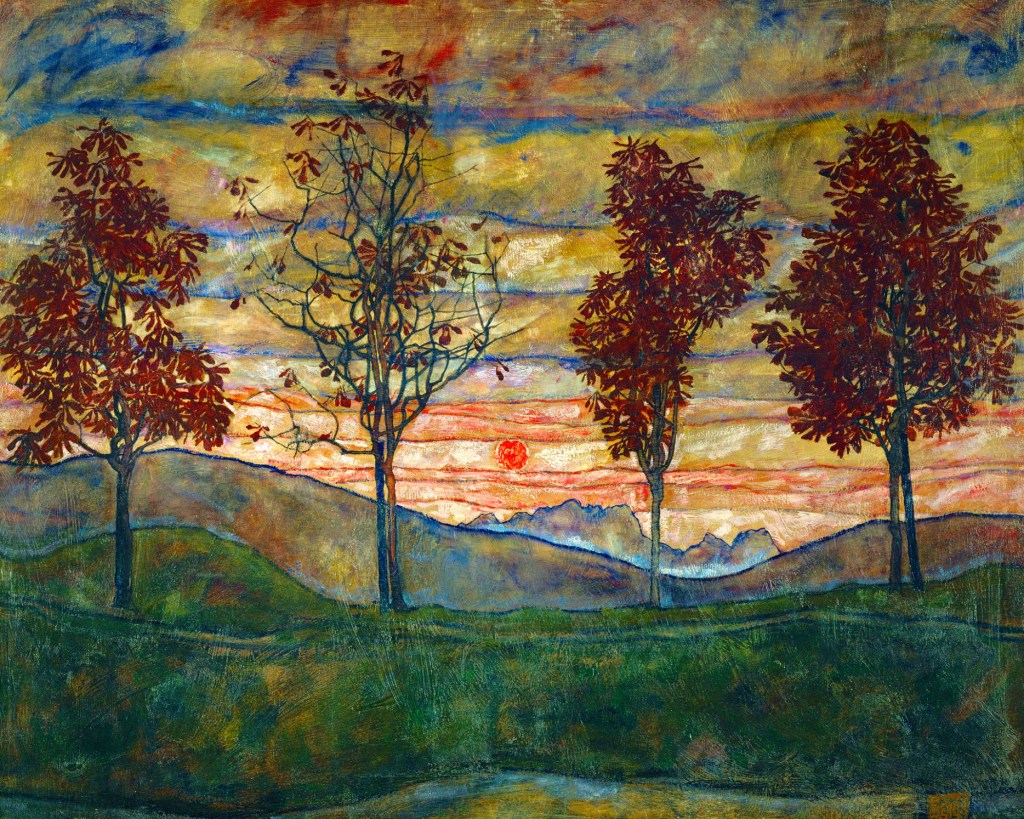
I remember a time when I was probably ten or so, going squirrel hunting with my Grandaddy. It was a beautiful fall day with just a bit of fog. As I walked along looking up in the trees for the crafty squirrel, I came into this slight clearing, and in front of me were these four trees in a row, all the same height and age. Nothing too remarkable about that – trees are as thick as grass in that part of Louisiana – but the first tree was completely bare of leaves, already shed for winter; the second still had its leaves, but they were brown; the third also had leaves, but were this brilliant yellow; and the fourth was still green as though winter hadn’t touched it at all. Perhaps that isn’t so remarkable to some, but it’s been almost fifty years since I saw those trees, and the memory of them still blesses me today. There is a perfect chance that I was the only person on the planet who ever saw them like that, but it was truly remarkable. Yet, had I been wandering around with my head down, I never would have seen them.
Today, we, as the human race, spend a lot of time looking down. We look down at our phones and get caught up in what we see on those tiny screens. We look down because the terrors of the world can sometimes be so overwhelming. We look down, so focused on our own lives—whether because of careers or troubles or vanity—we look down on our own lives and are consumed with our little sphere. But by looking down, we never see God’s blessings around us.
It is time to look up. See the blessing of the smile of the stranger sitting next to you. Look up from the terrors of this world and see the wonders of creation. Look up from yourself and your concerns and see the other. You all have probably heard the words of Mr. Rogers that he spoke to the children while sitting in his neighborhood: “When I was a boy and would see scary things in the news, my mother would say to me, ‘Look for the helpers. You will always find people who are helping.’” Looking up and seeing the helpers is good advice, but I invite you to take it one step further: look up and see God. Look up and see the blessings.
All that is evil in this world could fit on the head of a pin compared to all the blessings surrounding us. Those blessings for which we should give thanks may be four trees in a clearing on a foggy morning that are seen only by you, but they are God’s gifts to you.
Look up. Look up and know that the Lord is God. Look up and experience the joy that God has prepared for his people.
The Psalmist writes,
Make a joyful noise to the Lord, all the earth! Serve the Lord with gladness! Come into his presence with singing! Know that the Lord, he is God! It is he who made us, and we are his; we are his people, and the sheep of his pasture. Enter his gates with thanksgiving, and his courts with praise! Give thanks to him; bless his name! For the Lord is good; his steadfast love endures forever, and his faithfulness to all generations.
Look up and, Give thanks to the Lord; bless His name! For the Lord our God is good.