Enid Writer’s Club April Roll Call. Must be 150 words or less. The prompt: “Jumping from a plane.”
The engine coughed, then died. No option. Quickly shouldering on the parachute, I made ready.
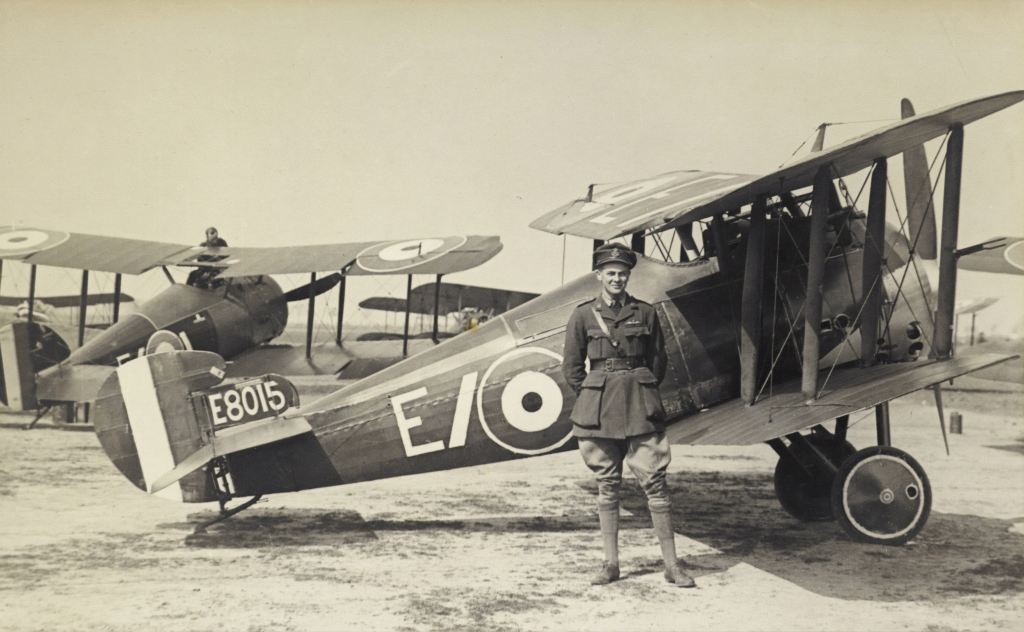
God knows how I would miss this plane. She had been good to me through so many dog fights, even having survived the Red Barron, but not today. Nothing more than a faulty engine and a soon-to-be-fired mechanic.
Racing to the rear of the plane and sliding open the door, I gently kissed the fuselage. “I’ll never forget you,” I said and jumped.
When I landed, my disapproving wife was standing there.
“Harold! You’re an embarrassment,” she said, hands on hips.
“That may be,” I responded, whisking my white silk scarf over my shoulder, “but I’ve got three more quarters.”
The kids standing outside the Piggly Wiggly waiting their turn on the kiddie plane groaned as I inserted my coin and waited for those magical words.
“Barron Killer Nine, you are cleared for takeoff….”
An atheist professor was teaching a college class and told the students that he would prove there was no God. He said, “God, if you are real, then I want you to knock me off this platform. I’ll give you 15 minutes!”
Ten minutes passed, and he kept taunting God, saying, “Here I am, God, I’m still waiting.”
He got down to the last couple of minutes when a 320-pound lineman on the football team happened to walk by the door and heard what the professor was saying. The football player walked into the classroom and, at the last minute, hit the professor with a haymaker, sending him flying off the platform.
When the professor woke up, he stood and, still shaken, said, “Where did you come from, and why did you do that?”
The 320-pound lineman replied, “God was busy; He sent me!”
When you begin to talk to people about what Jesus said, most will believe it. The good solid teachings. They make people want to be better individuals. They teach us how to live. All that talk about “Loving your neighbor” gets people’s motor running.
When you talk about some of the things Jesus did, like flipping over the tables in the Temple or picking and eating grain on the Sabbath, folks are pretty much OK with these as well. Even his trial, death, and crucifixion are believed to be historical facts because most believe in a historical Jesus, and crucifixion was how the Romans dealt with criminals and troublemakers. But when you talk about the miracles Jesus performed, folks start to get a little skeptical.
Giving sight to the blind, healing the lame, feeding the 5000 (that’s a maybe because they can logically figure out how that might have been done. They assume more food was available than was recorded in the Scriptures), walking on water, and casting out demons (this one gets a double negative because you’ve first got to believe in demons.) When you begin to talk about miracles, people start to shake their heads. They say, “Those things just aren’t possible.”
When you bring up Jesus raising the dead, you run into a brick wall. Lazarus, the little girl, and probably others we’re not told about. It’s like St. John wrote at the end of his Gospel, “Now there are also many other things that Jesus did. Were every one of them to be written, I suppose that the world itself could not contain the books that would be written.” (John 21:25) Ask around about raising the dead and you will be told, “Not going there.” And the one that is an absolute hard-stop show-stopper is Jesus being raised from the dead on the third day. You talk about that, and for many, you’ve entered the land of make-believe and fairy tales. To believe in the resurrection makes you a fool.
Can I tell you something that you may already know? I am a fool. I believe, and I would like for you to believe and to be a fool, also. The trouble is I cannot prove any of it to you. Even if I could get a 320-pound lineman to come in, hit you with his best haymaker, and say, “God was busy, so he sent me!” You would still say, “I’m no fool.” Although, perhaps, you would not say it to the 320-pound lineman.
The First Sunday after Easter is always the incident concerning doubting Thomas. You remember the one: “Unless I see in his hands the mark of the nails, and place my finger into the mark of the nails, and place my hand into his side, I will never believe.” (John 20:25) I know why it’s placed on the first Sunday after Easter but I also think it would be very appropriate for Easter Sunday because there are so many who fall into the same category as Thomas. When it comes to the resurrection, their first name becomes, Doubting. So how do we overcome our doubts?
An incident is recorded in Mark’s Gospel: a man comes to Jesus begging that his son be healed. The man says, “If you can do anything, have compassion on us and help us.” And Jesus said to him, “‘If you can’!—Who do you think you’re talkin’ to with all that “if” business—All things are possible for one who believes.” Immediately the father of the child cried out and said, “I believe; help my unbelief!”
“I believe; help my unbelief!” Is a prayer. It is a prayer from one who desires to believe but needs God’s grace in order to believe more fully. You see, believing in God, Jesus, the Holy Spirit, and all they have accomplished, including the resurrection, is not a matter of your reasoning, or your faith, or your understanding. Believing these things is a grace from God. As St. Paul said in his letter to the Ephesians, “For by grace you have been saved through faith. And this is not your own doing; it is the gift of God, not a result of works, so that no one may boast.” (Ephesians 2:8-9) By grace, you have been saved. By God’s grace, we are able to believe, so pray with the man, “I believe; give me Your grace, and help my unbelief.”
Pray for God’s grace and become a fool with me when and so many others. That belief, that faith, comes with some exceptional benefits—not just for when you’re dead and gone but for today. Benefits like peace of body, soul, and mind, joy even in difficult situations, healing—not always the body—but always of the soul and spirit, a love that can be felt and expressed to others, and so much more… and even though you may think me more a fool for saying it, it also comes with eternal life. Life with God and all of God’s children.
Saint Paul says, “Let no one deceive himself. If anyone among you thinks that he is wise in this age, let him become a fool that he may become wise. For the wisdom of this world is folly with God.” (1 Corinthians 3:18-19) And again, speaking of the Apostles and therefore speaking of us, he says it plainly, “We are fools for Christ’s sake” (1 Corinthians 4:10a) becoming spectacles “to the world, to angels, and to men.” (1 Corinthians 4:9b)
Pray that you may become a fool for Christ. Pray that you may receive God’s grace and believe.
Let us pray:
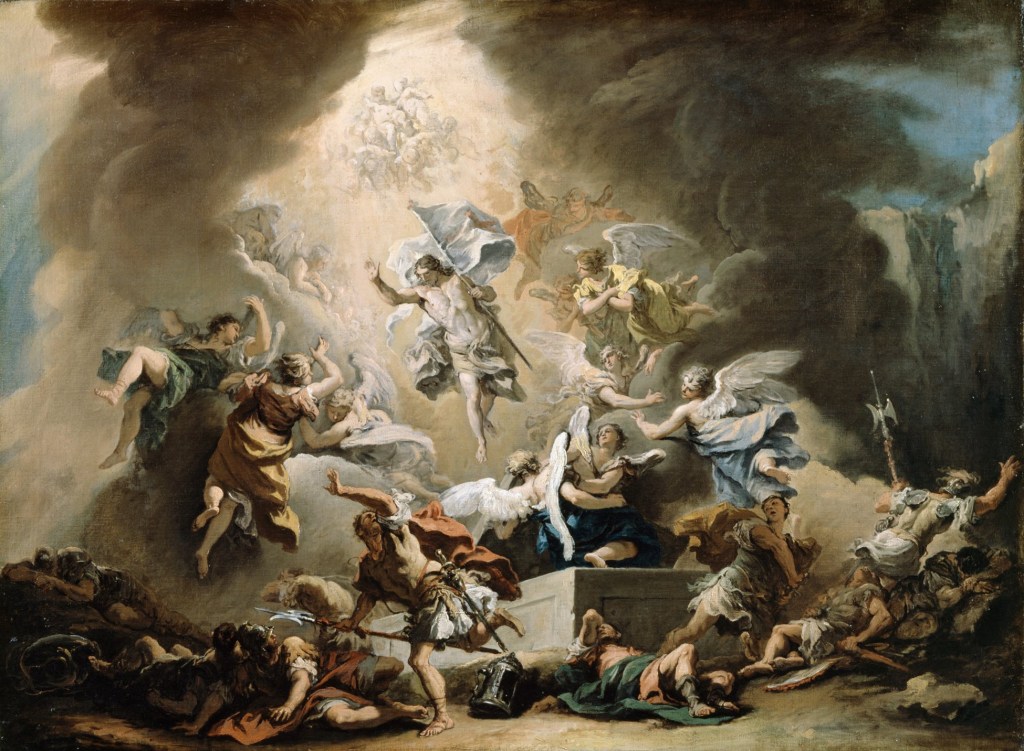
Christ is Risen: The world below lies desolate. Christ is Risen: The spirits of evil are fallen. Christ is Risen: The angels of God are rejoicing. Christ is Risen: The tombs of the dead are empty. Christ is Risen indeed from the dead, the first of the sleepers, Glory and power are his forever and ever.
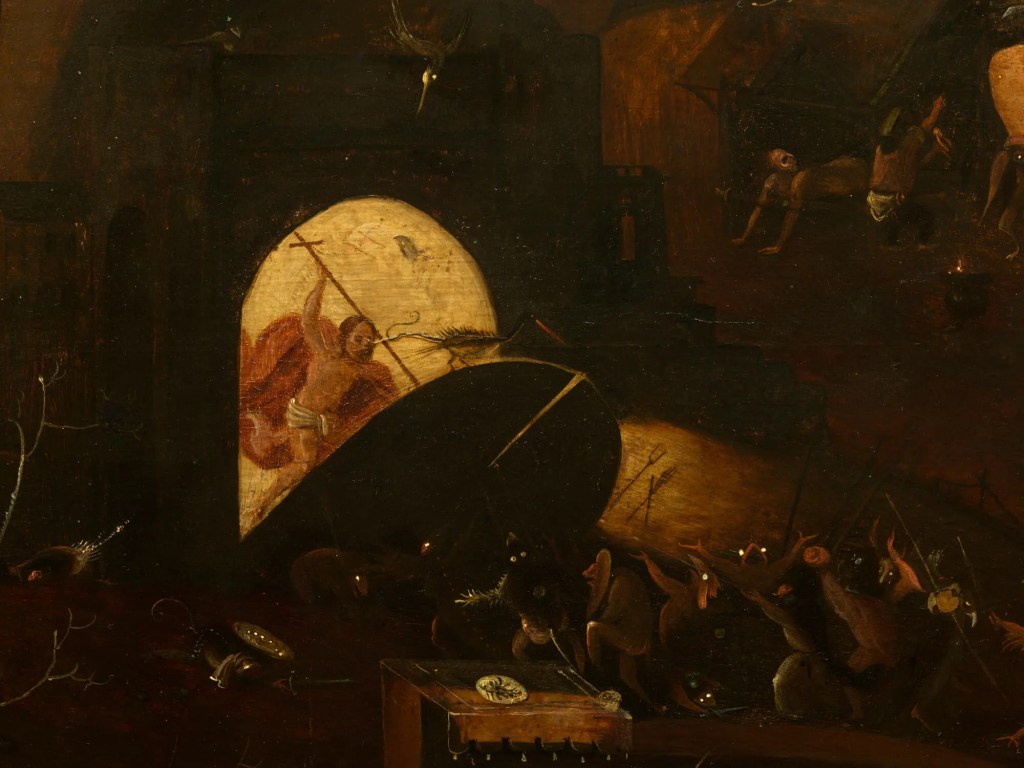
Christ Breaking Down the Gates of Hell by Imitator of Hieronymus Bosch
An Ancient Holy Saturday Sermon – author is unknown
“What is happening? Today there is a great silence over the earth, a great silence, and stillness, a great silence because the King sleeps; the earth was in terror and was still, because God slept in the flesh and raised up those who were sleeping from the ages. God has died in the flesh, and the underworld has trembled.
Truly he goes to seek out our first parent like a lost sheep; he wishes to visit those who sit in darkness and in the shadow of death. He goes to free the prisoner Adam and his fellow-prisoner Eve from their pains, he who is God, and Adam’s son.
The Lord goes in to them holding his victorious weapon, his cross. When Adam, the first created man, sees him, he strikes his breast in terror and calls out to all: ‘My Lord be with you all.’ And Christ in reply says to Adam: ‘And with your spirit.’ And grasping his hand he raises him up, saying: ‘Awake, O sleeper, and arise from the dead, and Christ shall give you light.
‘I am your God, who for your sake became your son, who for you and your descendants now speak and command with authority those in prison: Come forth, and those in darkness: Have light, and those who sleep: Rise.
‘I command you: Awake, sleeper, I have not made you to be held a prisoner in the underworld. Arise from the dead; I am the life of the dead. Arise, O man, work of my hands, arise, you who were fashioned in my image. Rise, let us go hence; for you in me and I in you, together we are one undivided person.
‘For you, I your God became your son; for you, I the Master took on your form; that of slave; for you, I who am above the heavens came on earth and under the earth; for you, man, I became as a man without help, free among the dead; for you, who left a garden, I was handed over to Jews from a garden and crucified in a garden.
‘Look at the spittle on my face, which I received because of you, in order to restore you to that first divine inbreathing at creation. See the blows on my cheeks, which I accepted in order to refashion your distorted form to my own image.
‘See the scourging of my back, which I accepted in order to disperse the load of your sins which was laid upon your back. See my hands nailed to the tree for a good purpose, for you, who stretched out your hand to the tree for an evil one.
`I slept on the cross and a sword pierced my side, for you, who slept in paradise and brought forth Eve from your side. My side healed the pain of your side; my sleep will release you from your sleep in Hades; my sword has checked the sword which was turned against you.
‘But arise, let us go hence. The enemy brought you out of the land of paradise; I will reinstate you, no longer in paradise, but on the throne of heaven. I denied you the tree of life, which was a figure, but now I myself am united to you, I who am life. I posted the cherubim to guard you as they would slaves; now I make the cherubim worship you as they would God.
“The cherubim throne has been prepared, the bearers are ready and waiting, the bridal chamber is in order, the food is provided, the everlasting houses and rooms are in readiness; the treasures of good things have been opened; the kingdom of heaven has been prepared before the ages.”
Broken Windows is the title of an article in an issue of The Atlantic from 1982. It stated, “Social psychologists and police officers tend to agree that if a window in a building is broken and is left unrepaired, all the rest of the windows will soon be broken. This is as true in nice neighborhoods as in rundown ones.” (Source)
Years before the article, a psychologist at Stanford, Philip Zimbardo, had already tested the theory. Instead of looking at windows, he put out cars. One in a “good” neighborhood and the other in a “bad” neighborhood. He removed the license plate on both and left the hood open. Ten minutes after being abandoned in the “bad” neighborhood, a family came along and took the battery and the radiator. Within twenty-four hours, the car was completely stripped and vandalized.
After a week, in the “good” neighborhood, nothing had happened, so Zimbardo went down with a sledgehammer and did some minor damage—nothing like a bit of inspiration. Within twenty-four hours, the car was completely trashed and flipped over.
“Good” neighborhood or “bad” neighborhood did not make a difference. Once the destruction began, it continued until the job was finished. Break a window in a building, and eventually, all the windows will be broken.
In the beginning, God created the Heavens and the Earth. On day six, God created Adam and Eve. They were free to live in the Garden for as long as they liked, provided they didn’t eat from one tree—The Tree of the Knowledge of Good and Evil. Yet, “when the woman saw that the tree was good for food, and that it was a delight to the eyes, and that the tree was to be desired to make one wise, she took of its fruit and ate, and she also gave some to her husband who was with her, and he ate.” (Genesis 3:6)
Adam and Eve took a bite of the fruit, and the Devil picked up a rock, threw it, broke the first pane of glass, and damaged the image of God that is within each one of us. Since that day, the Devil and the world have continued the destruction. We have also thrown a few rocks. Every harsh word, injustice, lack of mercy, bigotry… every sin has been one more broken pane until there are more broken panes than whole.
Even so, God still loves us.
Thomas Merton wrote, “At the end of the first Epistle of Saint Paul to the Corinthians: ‘I shall know even as I have been known.’
“It is in the passion of Christ that God has proved to us that He has ‘known’ us. That He has recognized us in our misery. That He has found His lost image in our fallen state and reclaimed it for His own, cleansed in the charity of His Divine Son.
“It is on the Cross that God has known us: that He has searched our souls with His compassion and experienced the full extent of capacity for wickedness: it is on the Cross that He has known our exile, and ended it, and brought us home to Him.” (A Year with Thomas Merton, p.57)
God looked and saw all that was broken within us, yet He could still see His image, so He declared, “These are My children—they are broken. Through their sin, they are separated from Me, but they are Mine, and I will not abandon them to be utterly destroyed.” So God, in His great love, chose to allow Himself to be destroyed. Destroyed upon a Cross that we might once again be whole.
Jesus said, “‘It is finished.’ Then he bowed his head and gave up his spirit.” Jesus said, “I choose to be destroyed so that you may be made new.”
“On the first day of Unleavened Bread, when they sacrificed the Passover lamb, [Jesus’] disciples said to him, “Where will you have us go and prepare for you to eat the Passover?” And he sent two of his disciples and said to them, “Go into the city, and a man carrying a jar of water will meet you. Follow him, and wherever he enters, say to the master of the house, ‘The Teacher says, Where is my guest room, where I may eat the Passover with my disciples?’ And he will show you a large upper room furnished and ready; there prepare for us.” (Mark 14:12-15)
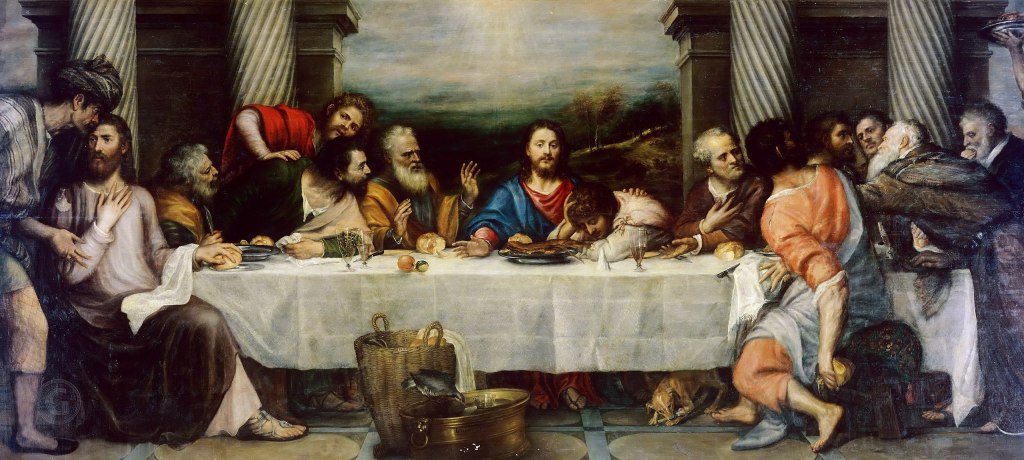
The Last Supper by Leonardo da Vinci is perhaps the most famous, but many others have attempted to capture that scene. The one on the cover of your bulletin was painted by Titian, an Italian artist from the 16th century. If you study it, you will discover many symbols that help identify who each person represents.
Second, from the left, I believe, is James because of the shell on his shoulder. Second, from the right, I think, is Bartholomew. You see, he is wrapped in a cloak, and the edge hangs over the side of the table. If you look closely, the part that hangs over appears to be an upside-down face. Bartholomew was flayed alive, and he is often pictured holding his skin. And, of course, beside him is Judas, the money bag in his left hand. Behind Jesus and to the right is the tree—a representation of the cross that was near to Jesus since his birth. You can notice all these things as you study the painting, but then you see Jesus’ eyes. Everyone else is distracted, looking here and there and engaged in some conversation (except for John, who is sleeping on our Lord’s breast), but not Jesus. Jesus is looking at you. When you see Jesus’ eyes, everything else becomes a bit blurry. Less important. With his hand, he is gesturing. He is inviting you to pull up a chair and join him, but there are so many years between that meal and today. How could we?
in Book 4, Chapter 12 of The Imitation of Christ, my friend, Thomas à Kempis, speaks about Jesus preparing for that last meal with his disciples. Thomas imagines the words of Christ—“I AM the Lover of purity, the Giver of all holiness. I seek a pure heart, and there is the place of My rest. Prepare for Me a large room furnished, and I, with My disciples, will keep the Passover with you. If you wish that I come to you and remain with you, purge out the old leaven and make clean the dwelling of your heart.”
We cannot join Jesus in the upper room that was prepared those years ago, but we can prepare the upper room of our hearts. We, through our confession and devotions, can set the table within. A table covered in fine white linen, adorned with our very best. We can prepare this table of our hearts and say, “Come, Lord Jesus. Dine with me,” and He, with His disciples, will enter in.
Following such a meal, the Lord will get up from the table, take off his outer robe, and tie a towel around himself. Then he will pour water into a basin and wash the feet of all those in the room, including yours, cleansing you of the final remnants of your former self. Making you worthy to enter into His Kingdom.
Look into the eyes of Jesus. He is all that matters. Allow him entry into the banquet you have prepared for Him within your heart.
Many of you know that I enjoy writing. Because I do, I joined the Enid Writers Club last year—a wonderful group of people who learn from and support one another. Poets, novelists, short story writers—most genres are represented.
Earlier in the school year, I thought about how we could encourage young writers, and we came up with the idea of a short story scholarship for graduating seniors. $1,000 will be awarded to the winner and paid to the school they will attend. Through our Community Tithe, St. Matthew’s supported the idea by funding the scholarship.
The rules were simple—2,000 words maximum short story and keep it PG13. The competition ended about a month ago, and we had five entries. The winner has been selected and notified, and we’ll make a presentation at the club’s banquet in May.
To get the writers off to a good start, we provided them with a writing prompt that they were to base their story. I wrote that and was hoping to provide a large enough canvas to let their imaginations work, and it did. “You and another person are traveling by car through the mountains. You enter a long tunnel and reach a point where you can no longer see the light from either end. There’s a loud roar and a flash of light. All is black. The vehicle is dead, and nothing works. You have no cell phone signal and only one light source unrelated to the car.”
The students wrote some great stories, but what I found interesting was that four out of five stories were about some aspect of death.
When I wrote that prompt, I thought they might come up with some Stephen King-type stories, but it wasn’t until I reread the prompt that I understood why death was so popular of a topic—tunnel, no light, no communication, all is black. Yep, that sounds like death.
Today, in our Gospel, John also wanted his readers to come to a similar conclusion about one of those he was writing about—Judas. There was talk of betrayal, a cryptic sign about the betrayer, Satan entering Judas, then leaving, and no one knows where he is going, but it wasn’t until those final few words that it is made clear—“he—Judas—immediately went out. And it was night.” He turned from the light, passed through the door, and went into the dark, into death.
Jesus said, “If anyone walks in the day, he does not stumble, because he sees the light of this world. But if anyone walks in the night, he stumbles, because the light is not in him.” (John 11:9-10) Again, a few verses on, He reiterates this point, “The light is among you for a little while longer. Walk while you have the light, lest darkness overtake you. The one who walks in the darkness does not know where he is going. While you have the light, believe in the light, that you may become sons of light.” (John 12:35-36)
In our lives, we can find ourselves in a tunnel without light, and we can intentionally walk out into the night. Still, the greatest danger for a Christian person is to be walking along in the spiritual light and not recognize it is getting dark. Not recognize that we have strayed. Therefore, we must remain alert, keeping our eyes on Jesus, the true light.
St. Paul tells us, “You are all children of light, children of the day. We are not of the night or of the darkness.” (1 Thessalonians 5:5) Remain in the light by remaining focused on Jesus.
During the Mass, the priest recites the words Jesus spoke at the Last Supper, “Do this in remembrance of me.” (Luke 22:19) For us, the word “remembrance” is most often defined as recollecting or bringing to mind. However, when Jesus spoke those words, He had something very specific in mind, and it was far more than a simple remembrance.
The word remembrance is from the Greek word anamnésis (ἀνάμνησις). The word is somewhat nuanced, but what Jesus had in mind was for us to not only remember Him and His words, deeds, and actions but also to make Him present. “Do this in remembrance of me… Do this and make me present.” Truly present in the bread and the wine. It is this understanding of remembrance that we should apply to Holy Week—Palm Sunday through the Sunday of the Resurrection. What would this look like?
Take, for example, Palm Sunday. On this day, we remember Jesus’ triumphal entry into the Holy City of Jerusalem. The Gospel of Luke tells us that as Jesus rode along on the donkey, the people laid their cloaks before Him, waved palm branches, and shouted, “Blessed is the King who comes in the name of the Lord! Peace in heaven and glory in the highest!” (Luke 19:38)
To simply remember this day is to read or hear the words and to see the scene unfold before you as though you were standing above it and watching it from above. To remember—anamnésis—is to be one who is standing alongside the road, crying out the words yourself, laying down your cloak, breathing in the stirred-up dust of all those people welcoming and worshipping the King. To anamnésis is to be one who reaches out and touches the King of Kings as He passes, truly in His presence.
This Holy Week, do more than be an observer of those great events that took place over 2,000 years ago. Be a part of them. Engage with them in such a way that you are in the upper room with Jesus, on the hill outside Jerusalem when He is lifted up, there when He is placed in His tomb and overjoyed as you stand with Mary Magdalene and the other Mary, staring into the empty tomb.
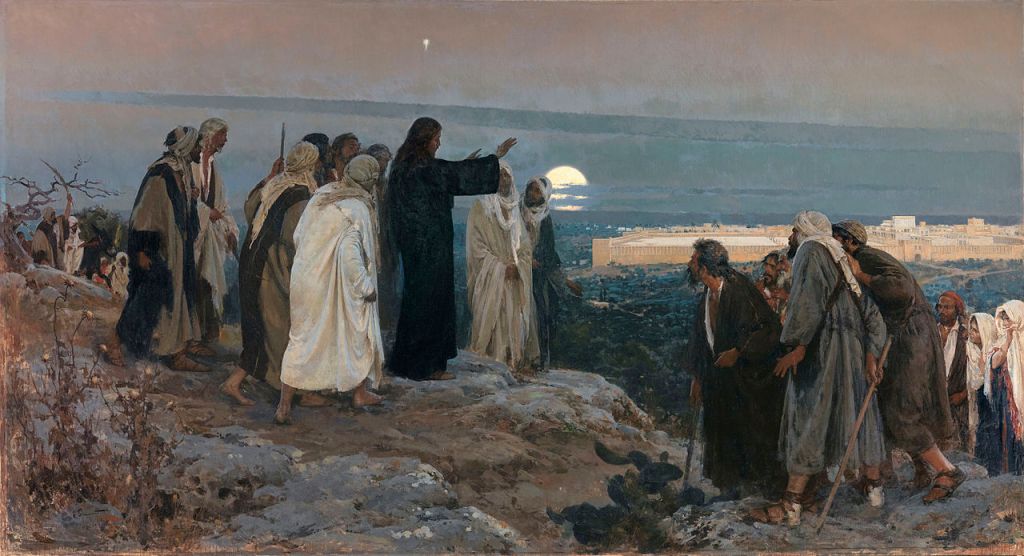
Flevit super illam/He Wept Over It by Enrique Simonet
Five days pass between Jesus’ triumphal entry, which we read about before receiving the palms, and the beginning of the Passion narrative. In those five days, many things happened, including the telling of many great parables, Jesus cursing the fig tree, the institution of the Lord’s Supper, and the washing of the disciples’ feet. Jesus also has several run-ins with the various religious leaders and, at one point, speaks many condemnations to them, saying, “Woe to you scribes and Pharisees, hypocrites.”
Jesus condemns them because of their arrogance in thinking they were better than others, for binding up the people with so many rules and regulations that those who desired to serve God were overwhelmed and disheartened in their faith, for putting faith in things over caring for people, for forgetting to show justice and mercy and to be faithful, for condemning others when they themselves are in error, for hypocrisy and lawlessness, and willful ignorance of their own faults. He then concludes with a lament over Jerusalem,
The lament begins, “O Jerusalem, Jerusalem,”—another way of speaking of the religious leaders and those who have failed to believe—“O Jerusalem, Jerusalem, the city that kills the prophets and stones those who are sent to it! How often would I have gathered your children together as a hen gathers her brood under her wings, and you were not willing! See, your house is left to you desolate. For I tell you, you will not see me again, until you say, ‘Blessed is he who comes in the name of the Lord.’” (Matthew 23:37-39)
With those final words, Jesus repeats to this same group the words proclaimed during the triumphal entry, “Blessed is he who comes in the name of the Lord.” In doing so, He is saying to the religious leaders, “You have not yet believed, but there will come a day when you have no choice but to believe.” As St. Paul said to the Philippians, “God has highly exalted him and bestowed on him the name that is above every name, so that at the name of Jesus every knee should bow, in heaven and on earth and under the earth, and every tongue confess that Jesus Christ is Lord, to the glory of God the Father.” (Philippians 29-11)
“Woe to you, Jerusalem, Jerusalem, you will bend your knee and confess Jesus Christ as Lord, and you will do so either out of love and obedience or out of fear, trembling, and judgment… but you will confess.”
The error we can make today is wrongly believing that these words do not apply to us. That was then; this is now. Woe to those religious leaders and others who do not believe. We are safe, for we are God’s people, but that is the exact same thing those religious leaders thought. Therefore, we must be on our guard so that we do not become Jerusalem, Jerusalem, and it is an easy trap to fall into. We will do so by making the same mistakes as they made in the past—by putting up barriers to God, by caring for things, by not showing justice, mercy, and faithfulness, by condemning the world around us while thinking we are the holy ones, and by being willfully ignorant and turning a blind eye to our own faults.
Declare, not only with your lips but also with your heart and soul—your entire being—declare, “Blessed is he—Blessed is Jesus who comes in the Name of the Lord,” and leave behind that old Jerusalem so that you may become citizens of the New Jerusalem. A city, as St. John tells us in his Revelation—that has been adorned as a bride for her husband, the dwelling place of God, where there are no more tears, no more mourning, crying, pain… no more death. (cf. Revelation 21:1-4) Become citizens of that New Jerusalem where all things have been made new and restored to God.
Question: If I were to say to you, “The world is my oyster,” what would you take that to mean?
{Pause for answers.}
That’s what most would say, but it is actually only half of a line from Shakespeare’s Merry Wives of Windsor.
In Act II, Scene II, two thieves, Falstaff and Pistol, enter and are having a conversation.
Falstaff: I will not lend thee a penny.
Pistol: Why then the world’s mine oyster, Which I with sword will open.
Falstaff: Not a penny.
“Why then the world’s mine oyster,” when the rest of the sentence is added, “Which I with sword will open,” is saying, “Anything I want is mine, and I’ll take by any means necessary, including violence.”
From “Money is the root of all evil” to “Now is the winter of our discontent,” there are many examples of taking a part of a sentence or statement out of context and having it say the complete opposite or never intended interpretation of the original intent. When we do this in working with Holy Scripture, we call it proof-texting, and today, in our Gospel, we have a fine illustration.
“Jesus said to the Jews who had believed in him, “‘If you continue in my word, you are truly my disciples; and you will know the truth, and the truth will make you free.’”
“The truth will make you free,” or “The truth will set you free.” It is everywhere, including titles of books, with those books ranging in topics from psychiatry, finding your true self, and video games. Then you’ve got politicians batting it about, but I don’t know one of them that would know the truth if it smacked them upside the head (but that’s a commentary and not preaching). The trouble is, all of these use the statement out of context, because the truth they are referring to is not the truth Jesus was referring to when he spoke those words. It is not some random truth that will set you free.
St. Thomas Aquinas, that great 13th-century Dominican theologian, wrote, “In this passage, being made free does not refer to being freed of every type of wrong . . .; it means being freed in the proper sense of the word, in three ways: first, the truth of his teaching will free us from the error of untruth …; second, the truth of grace will liberate us from the slavery of sin: ‘the law of the Spirit of life in Christ Jesus has set me free from the law of sin and death’ (Rom 8:2); third, the truth of eternity in Christ Jesus will free us from decay. (cf. Rom 8:2 1)”
There are many truths out there, but the only one that will truly set you free is Jesus, His grace, and His teachings. As Jesus, the Son of God, said, “If the Son sets you free, you will be free indeed.”




 Candle in a Cave
