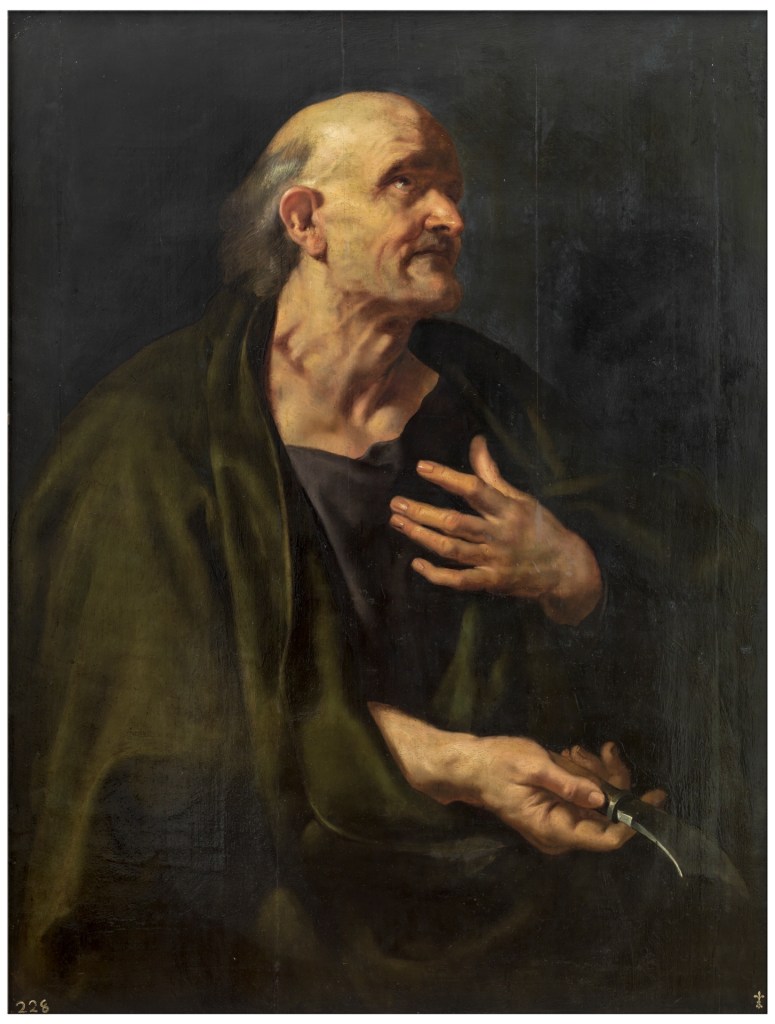
St Bartholomew (c. 1611) by Peter Paul Rubens (Bartholomew is often depicted with a knife that would be used to flay him alive.)
Mark’s Gospel tells us, “Then [Jesus] came to Capernaum. And when He was in the house He asked [the disciples], ‘What was it you disputed among yourselves on the road?’ But they kept silent, for on the road they had disputed among themselves who would be the greatest.”
Then there’s that little episode in Matthew’s Gospel: “Then the mother of Zebedee’s sons came to Him with her sons, kneeling down and asking something from Him. And He said to her, ‘What do you wish?’ She said to Him, ‘Grant that these two sons of mine may sit, one on Your right hand and the other on the left, in Your kingdom.’”
Like the kings of the Gentiles that Jesus spoke of in our Gospel reading or anyone else for that matter, including the disciples, given half the opportunity and the means to do it, many will seek to hold power, whether for good or evil, so that they can hold reign over others. Still, in looking at this issue of power, I came across a recent study completed by three major universities, which states an even deeper root behind certain individuals’ desire for power. Not only do they want to rule over others, but they also want autonomy. They want no one to rule over them. The study’s authors write: “Power as influence is expressed in having control over others, which could involve responsibility for others. In contrast, power as autonomy is a form of power that allows one person to ignore and resist the influence of others and thus to shape one’s own destiny.” (Source) When individuals seek power, yes, perhaps they seek to rule over others, but in many cases, they desire that no one rule over them.
Not only did Jesus tell his disciples that they should not be the ones desiring to rule over others, but he also told them that they should be the servants of all, not seeking their own will, but the will of the Father: “Thy kingdom come… thy will be done.”
That may sound unfair, but it is precisely what Christ did: “Not my will but Yours.” As the Apostle Paul wrote to the church at Philippi, “Have this attitude in yourselves which was also in Christ Jesus, who, although He existed in the form of God, did not regard equality with God a thing to be grasped, but emptied Himself, taking the form of a bond-servant, and being made in the likeness of men.” That is our goal as well, and as it is the Feast of St. Bartholomew, we can see that it was his also. After witnessing the death and resurrection of Jesus, Bartholomew gave up his life, being first skinned alive and then beheaded. He did so for the sake of the Gospel.
Our loyalty to Jesus is not about the power we can gain or wield over others. Instead, it is about His power working in us so that we, through sacrifice, might transform the world around us.
The prayer of St. Theodore the Studite attests to this sacrifice and obedient submission of Bartholomew, so I’ll close with it.
Let us pray: “Hail, O blessed of the blessed, thrice-blessed Bartholomew! You are the splendor of Divine light, the fisherman of holy Church, expert catcher of fish which are endowed with reason, sweet fruit of the blooming palm tree! You wound the devil who wounds the world by his crimes! May you rejoice, O sun illumining the whole earth, mouth of God, tongue of fire that speaks wisdom, fountain ever flowing with health! You have sanctified the sea by your passage over it; you have purpled the earth with your blood; you have mounted to heaven, where you shine in the midst of the heavenly host, resplendent in the splendor of undimmable glory! Rejoice in the enjoyment of inexhaustible happiness! Amen.”
Ol’ Boudreaux had never been up in one of those flying machines until one day when some fella came along offering rides. All of Boudreaux’s friends put down their money and took the ride, but Boudreaux just couldn’t trust it. Finally, when his friends started calling him “chicken” and “scaredy cat,” Bou agreed. He got all strapped in, and the pilot took off. When the flight ended, everyone rushed up and asked how it went. Once he had a little nip and got his nerves back, he said, “It wasn’t too bad, but I never really trusted it, so I never put all my weight down in the seat.”
If I had a favorite televangelist, it would have to be Jesse Duplantis—kind of a crazy southern fella with plenty of stories. When I was living in Montana, Jesse came to the capital city for a revival, and I had to see him, so a friend and I drove up. It was everything I expected, except for the beginning.
If you’ve ever watched one of the events, you know that they do all the preaching and shouting up front, and then at the end, they start the healing—lots of slapping on the foreheads and all that. However, Jesse did just the opposite. He always talked about “being sick and tired of being sick and tired,” so he had the healing service at the beginning. He said, “There’s no point in you sitting all the way through the sermon feeling sick and tired if I can heal you now.” So, he did.
I thought of that for two reasons. First, today, following the confession and before the peace, we will be offering the Sacrament of Unction—the sacrament of healing. For the record, I will not be slapping anyone on the forehead unless they need it. The second reason for telling you about Jesse is because this is back-to-church Sunday. The youth are back in school, and we begin to settle into more of a routine instead of all the goings on of summer. In a way, today is the beginning, and like Jesse, I thought we’d offer the healing up front instead of waiting.
Much is happening in today’s Gospel, but there is the healing of a little girl. A gentile woman came to Jesus and said, “Have mercy on me, Lord, Son of David; my daughter is tormented by a demon.” A discussion follows regarding Jesus’ mission on earth, but in the end, “‘Woman, great is your faith! Let it be done for you as you wish.’ And her daughter was healed instantly.”
Unlike ol’ Boudreaux, who didn’t trust enough to put all his weight down, this woman did. Great is your faith—your trust—in God to do those things you ask.
I found a quote in my daily reading. It is from a 19th-century Russian mystic, Vladimir Soloviev. He said, “It is madness not to believe in God; it is the greater madness to believe in Him only in part.” (Source, August 15) It is madness not to fly. It is even greater madness not to put all your weight down.
If you believe in God, then why do you not trust Him completely? Why do you “believe in Him only in part”? When you call out, “Have mercy on me, Lord, Son of David,” do you believe God will answer, or are you putting it out there just in case He’s in the mood?
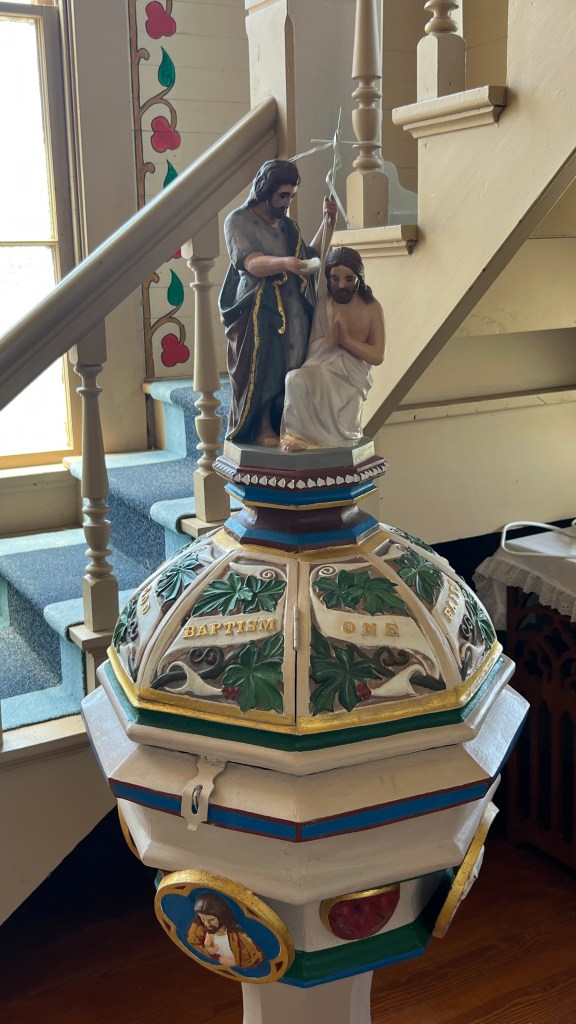
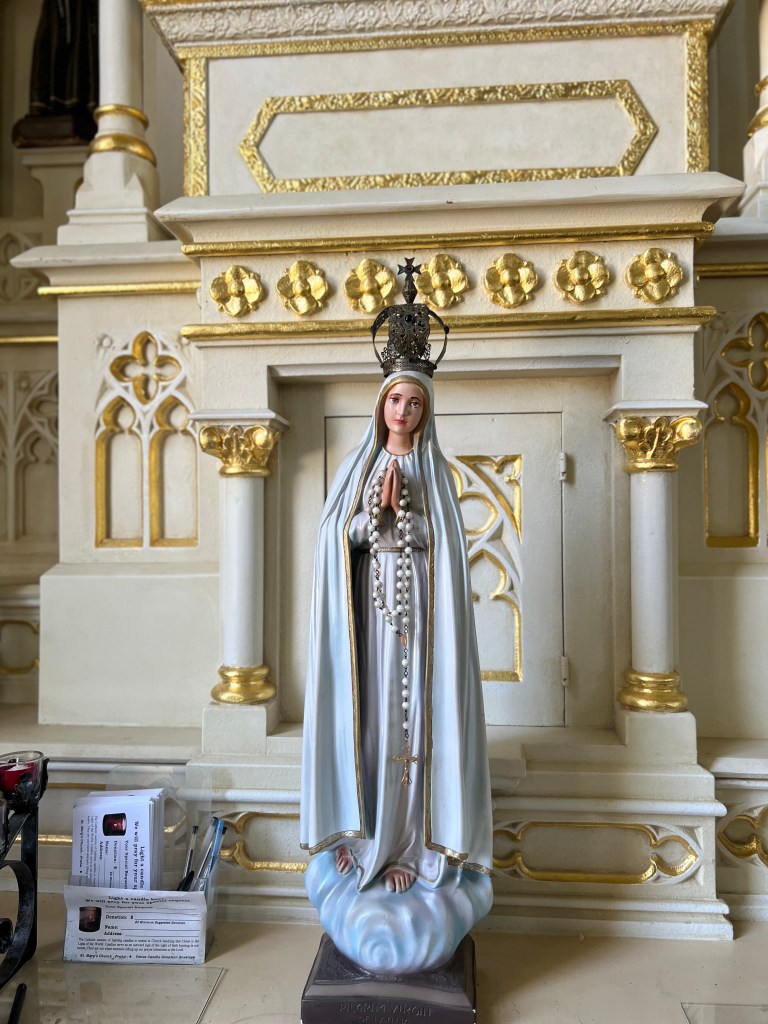
Last week, I went down to Austin to visit friends. While there, I had a few hours to myself, so I did what we all do—I visited a church to pray a rosary.
The church I selected was a Maronite Church. They are an Eastern Catholic Church instead of a Western (Roman) Catholic Church. Anyhow, I read up on them on the internet, saw that they were open, and it was only about a mile away, so I decided to walk.
Did I mention it was 105° and there was an excessive heat advisory? Yeah, Mr. Brilliant here. I take off. I arrive at the church soaking wet, sweat running off me, only to discover that the church is locked up tight. Only the office was open, and no one was around. I look around for a few minutes, then sit on a bench in the shade to cool off. Since I was there, I decided to go ahead and pray my Rosary and then call an Uber to get back to the hotel.
I made it through two decades of the Rosary and had not cooled down at all. It seemed I was only getting hotter, so my prayers were very distracted, and I didn’t feel like I could… connect, so I said to Mary, you could send me a nice cool breeze so I’ll know you’re there. It was more a silly prayer than a proper prayer.
About halfway through the third decade, I heard a noise and looked up. It was the priest (it turns out it was actually the Bishop.) He invited me to come inside and finish my prayers, and I quickly took him up on the offer. Somewhere along the fourth decade of the Rosary, I looked up and burst out laughing as the cool breeze of the air-conditioner blew on me. I never really expected Mary to send me a cool breeze, but she did. I believed, but I didn’t really believe. I never really sat down.
When you call out, “Have mercy on me, Lord, Son of David,” regardless of whether or not you think your request is silly or not, go ahead and sit all the way down. Know that your words are being heard and that your Father in Heaven is answering.
Let us pray: O Christ Jesus, when all is darkness, and we feel our weakness and helplessness, give us the sense of Your presence, Your love, and Your strength. Help us to have perfect trust in Your protecting love and strengthening power so that nothing may frighten or worry us, for living close to You, we shall see Your hand, Your purpose, and Your will through all things. Amen.
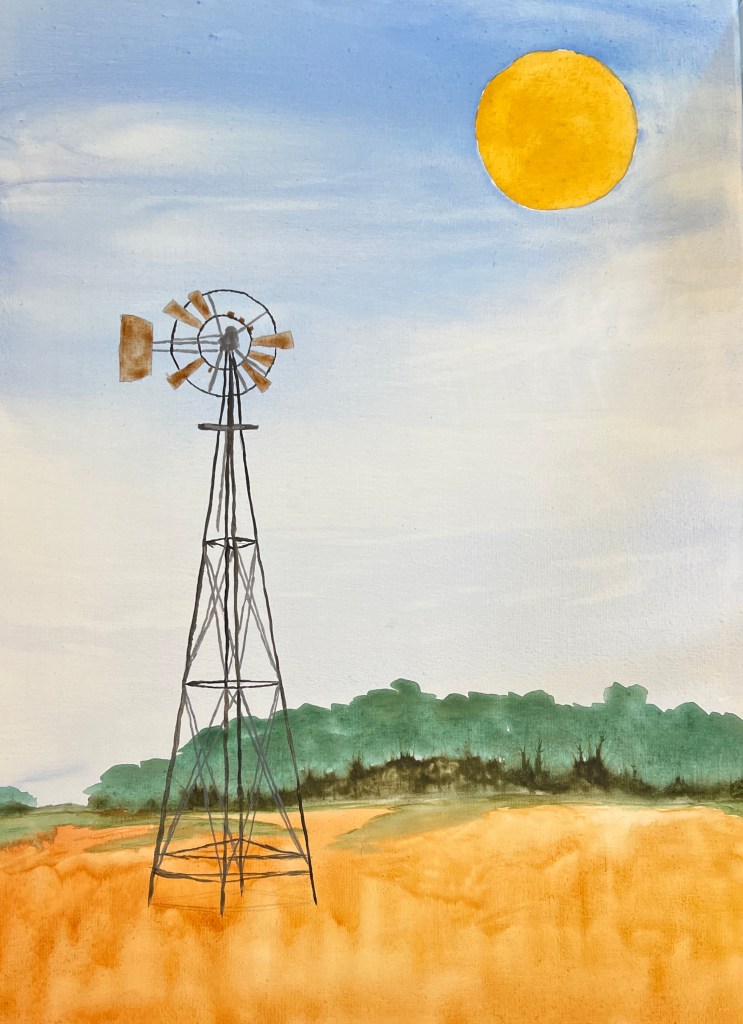
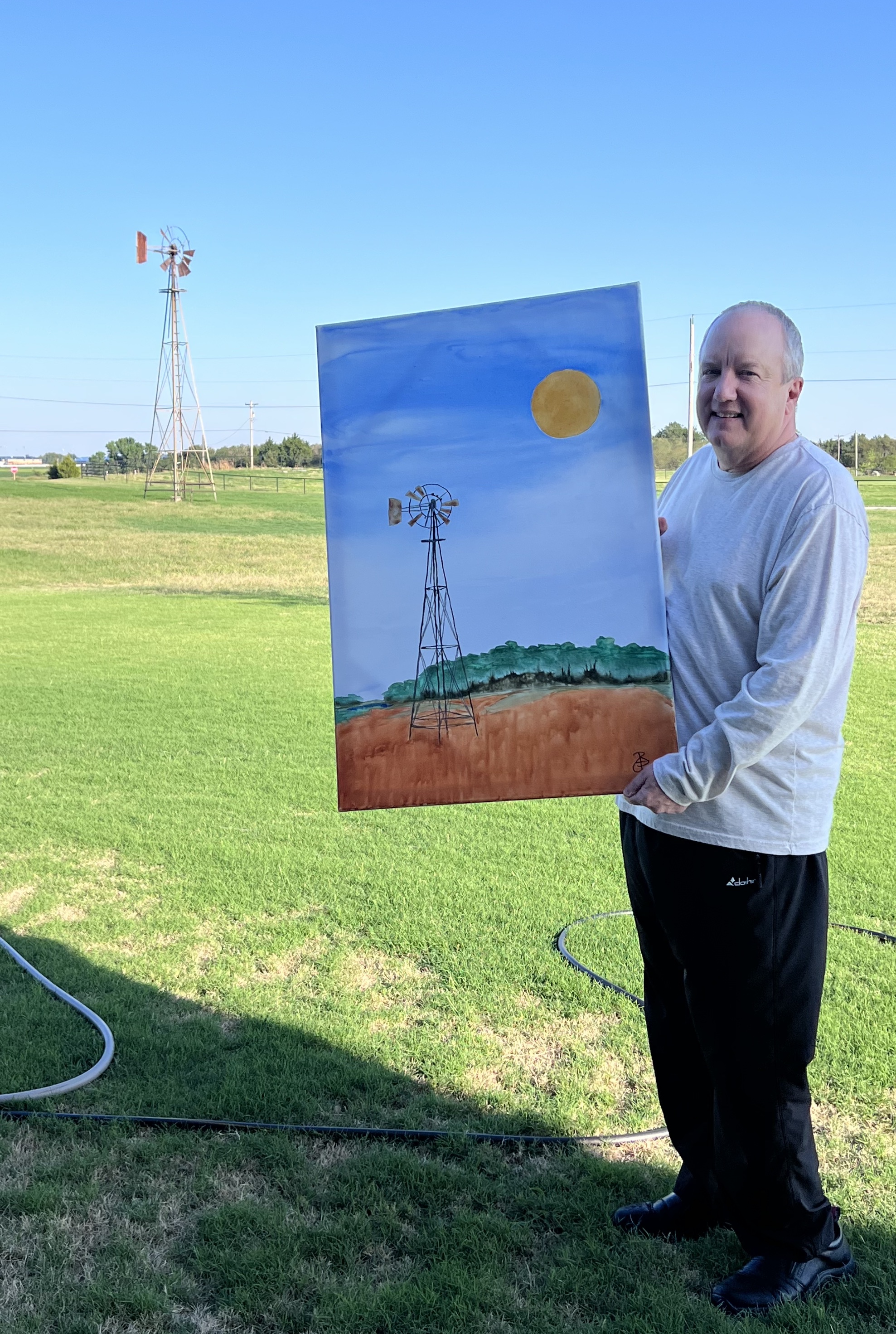
Dora asked me to paint the windmill that is in her yard. At the time, I must have been drinking, because I said, “Sure. I can do that.” The canvas is 2’x3′. Big… As Dora commented, “Go big or go home.”
So, we took a picture.
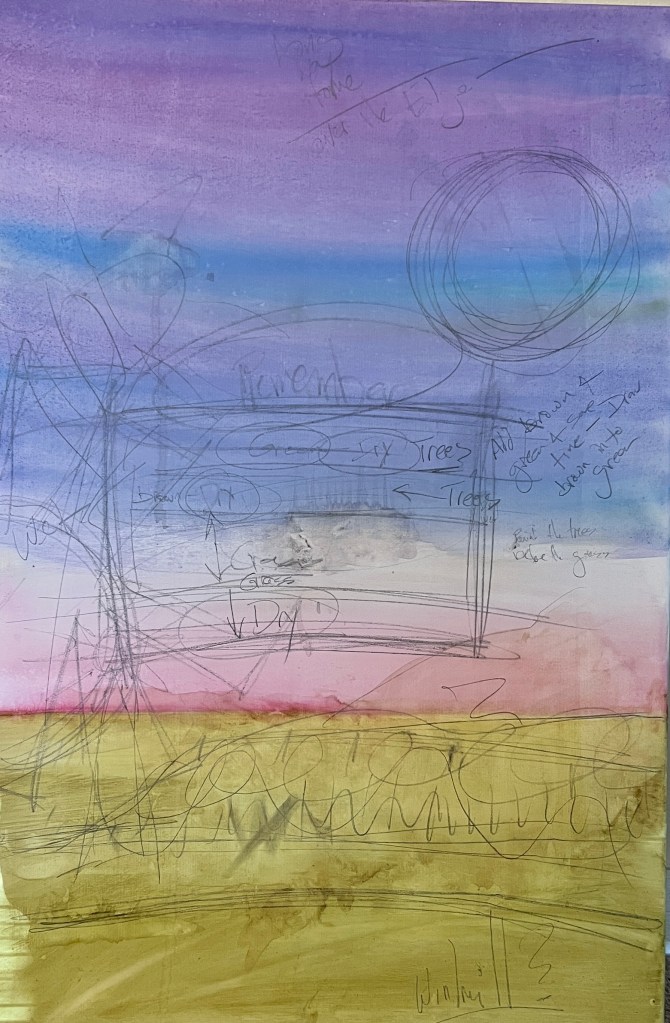
Then I made a first attempt that did not work out, so I made some notes for the second.
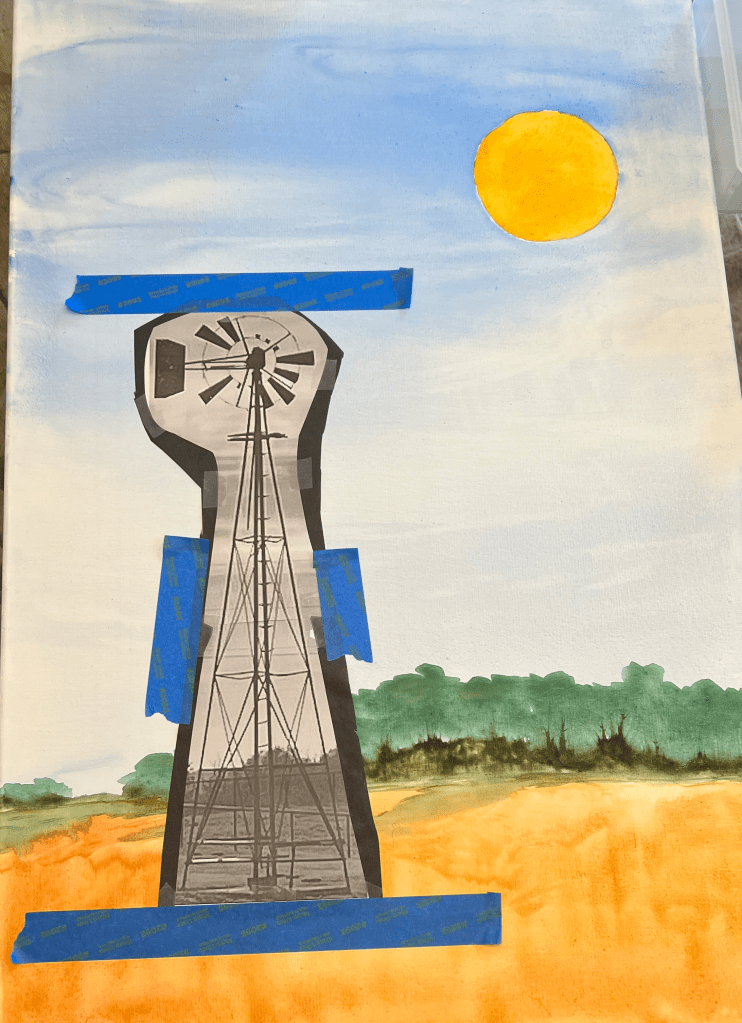
I painted this bit almost two years ago and then set it aside. I had no idea how to proceed.
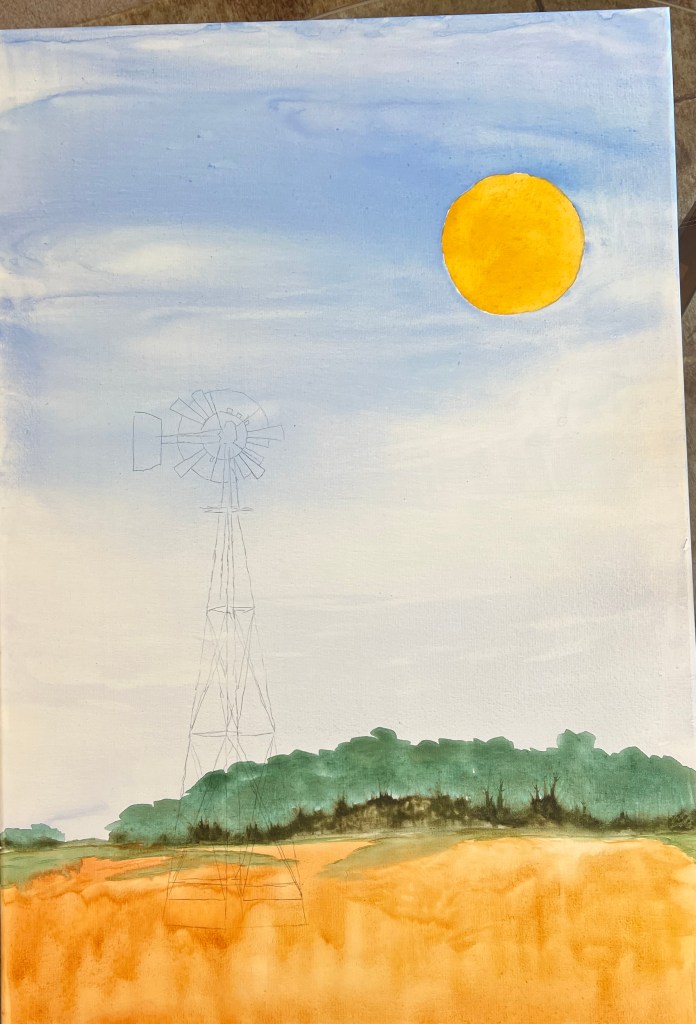
A few weeks ago, Dora took a picture of something, then commented on the empty space, apparently reserved for her windmill. This weekend, I went to work on it and actually finished. I’m very pleased with the end result. I hope she is too.
Although we are not a part of the Roman Catholic Church, we follow many of the practices they have established. Although we are not a protestant church, we believe much of what they have brought to the discussion. We, as Episcopalians, are the “bridge church” between Roman Catholicism and Protestantism, which means, for the most part, we agree with both. That being said, we do pretty well with either, but the two have some significant differences, so if you ever want to watch a catfight between them, bring up some contentious doctrine and step back—take for example, Papal Infallibility. I’ve no way of proving it, but my guess as to the cause of this animosity on this topic is that 95% of both groups have no idea what Papal Infallibility means.
What does it not mean? Papal Infallibility does not mean that every word the Pope speaks is infallible and that he is without error. Even the popes agree with this. Pope Francis stated, “The Pope is not an oracle; he is infallible on the rarest of occasions, as we know.”
So the Popes are not infallible, but there have been occasions when they’ve spoken and what they’ve said is understood as infallible. This occurs when they speak ex cathedra—“from the chair” of St. Peter—and is a very specific process under strict rules. The exact number of times it has occurred is up for debate, but there are only seven definitive incidents. Two of these involved the nature of Christ; one dealt with matters after death, two more were in response to heresy, and the final two pertained to the Blessed Virgin Mary. It is the last that we consider today.
In 1950, Pope Pius XII declared, “By the authority of our Lord Jesus Christ, of the Blessed Apostles Peter and Paul, and by our own authority, we pronounce, declare, and define it to be a divinely revealed dogma: that the Immaculate Mother of God, the ever Virgin Mary, having completed the course of her earthly life, was assumed body and soul into heavenly glory.”
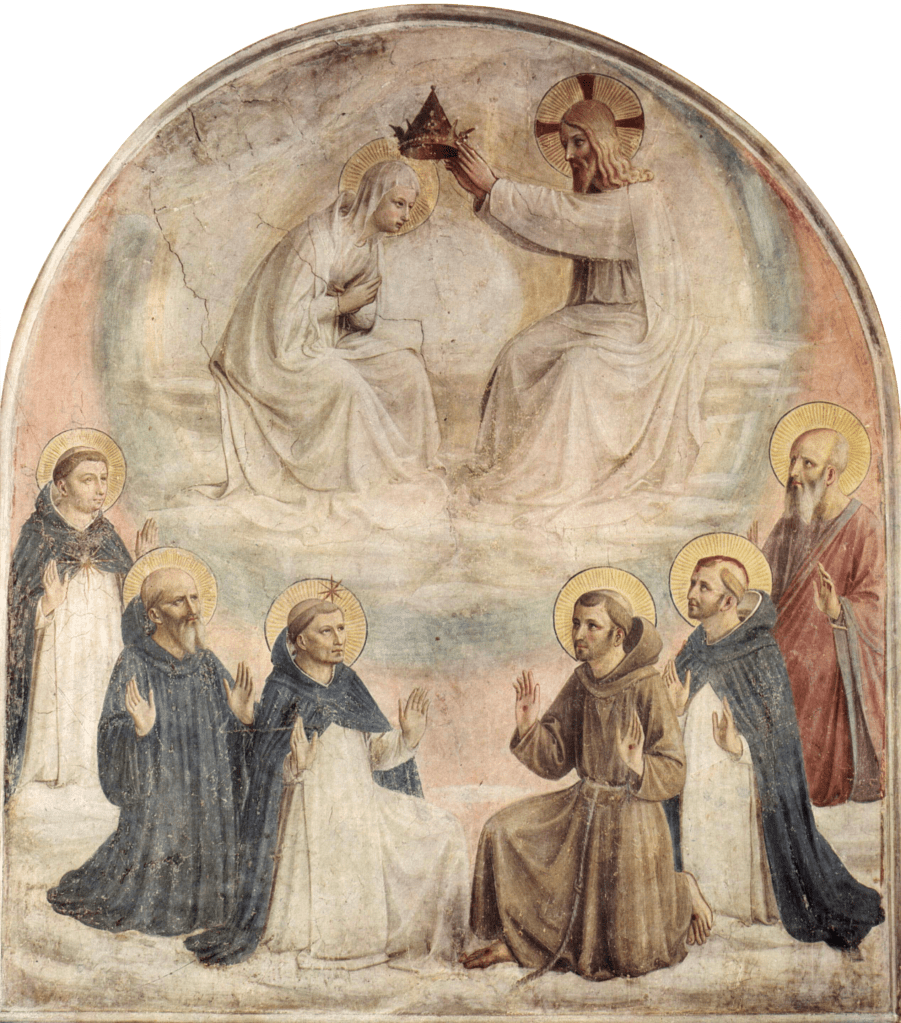
The Assumption of the Blessed Virgin Mary. It could not be imagined that Mary, whom God had chosen to bear His Son, would allow Mary’s body to be corrupted by death, so she was assumed—carried up—into Heaven and now lives the fully resurrected life we will attain on the last day. Some believe that she was carried up before she died, while others say that she died but then was immediately resurrected and carried up. Either way, she lives today as we will one day live.
The Feast of the Assumption fell off the Anglican calendar during the Reformation in England. It returned in the 20th century but has yet to be widely celebrated. Within the Episcopal Church, it remains a high feast day but only takes the general name of St. Mary the Virgin, omitting the word “assumption.”
Your salvation is not dependent upon your belief in this matter. Still, I believe your faith can be more deeply enriched by at least contemplating it, for, other than Christ Jesus, who else more wholly submitted to the will of God than Mary, the Mother of God?
I want to close with an excerpt from a sermon from an unknown Greek author: “Mary stood at your right hand, robed in a gown of gold, with adornment intricately wrought. Just as, being a woman, she was named queen and lady and Mother of God, so also now, standing as queen at the right hand of her most regal Son, she is celebrated in the sacred words of Scripture as clothed in the golden gown of incorruptibility. And so as we gaze upon him who is our king and lord and God, and upon her who is queen and lady and the Mother of God, contemplating them with the clear-sighted eye of our minds, let us repeat again and again unceasingly: The queen stands at your right hand, robed in a gown of gold with adornment intricately wrought.” (Little Office of the Blessed Virgin Mary, p.165)
Blessed are you among women. And blessed is the fruit of your womb. Amen.
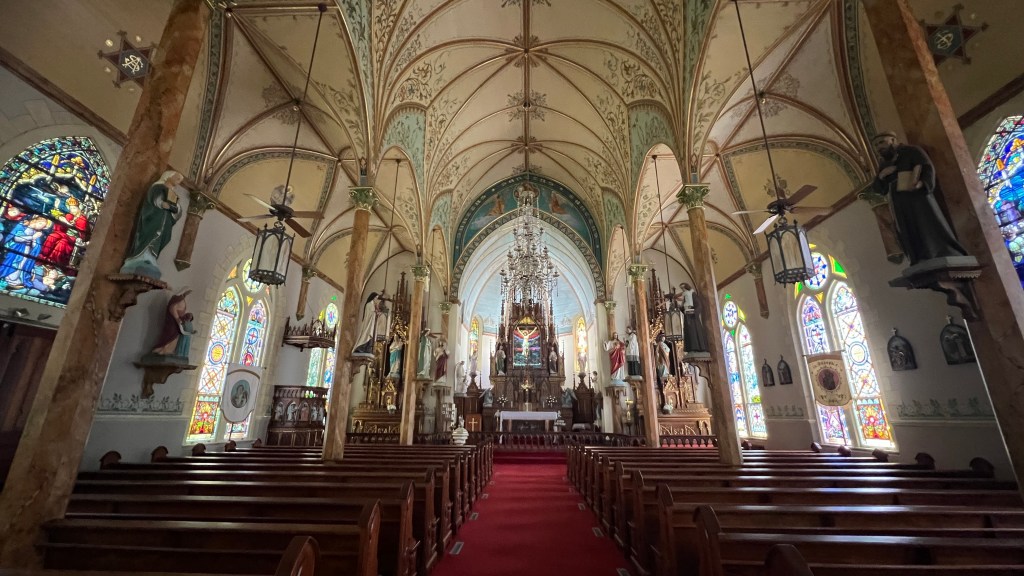
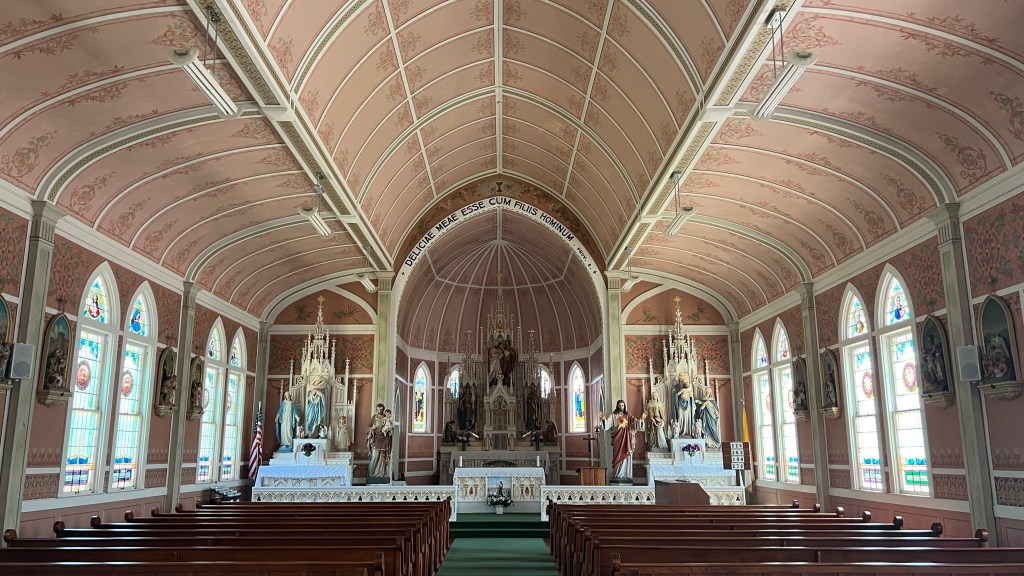
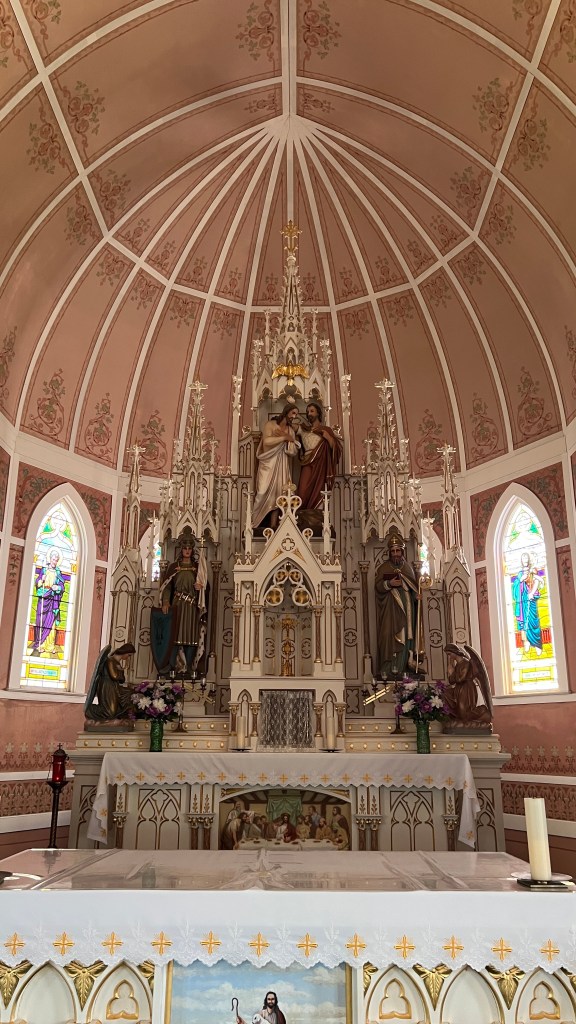
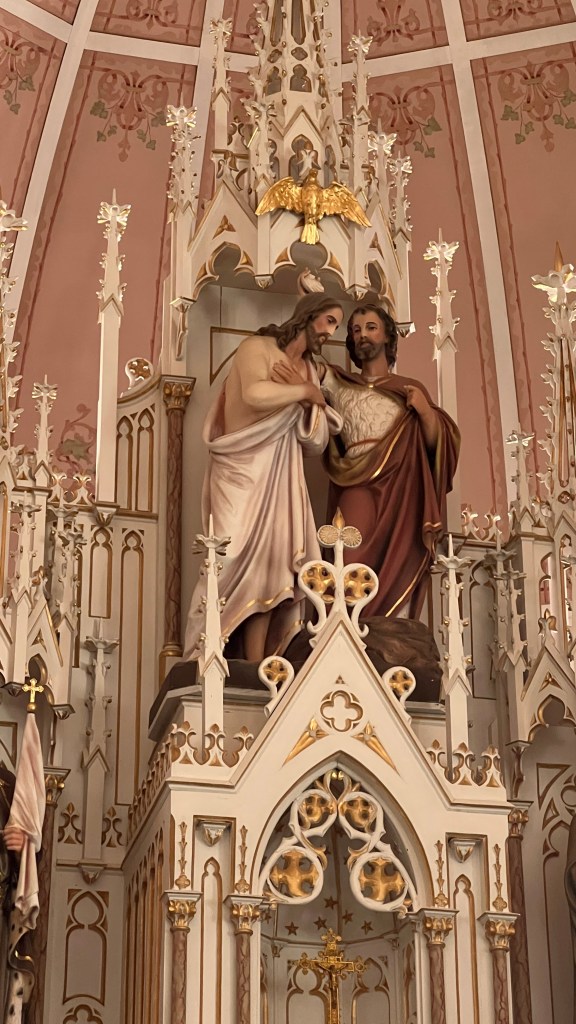
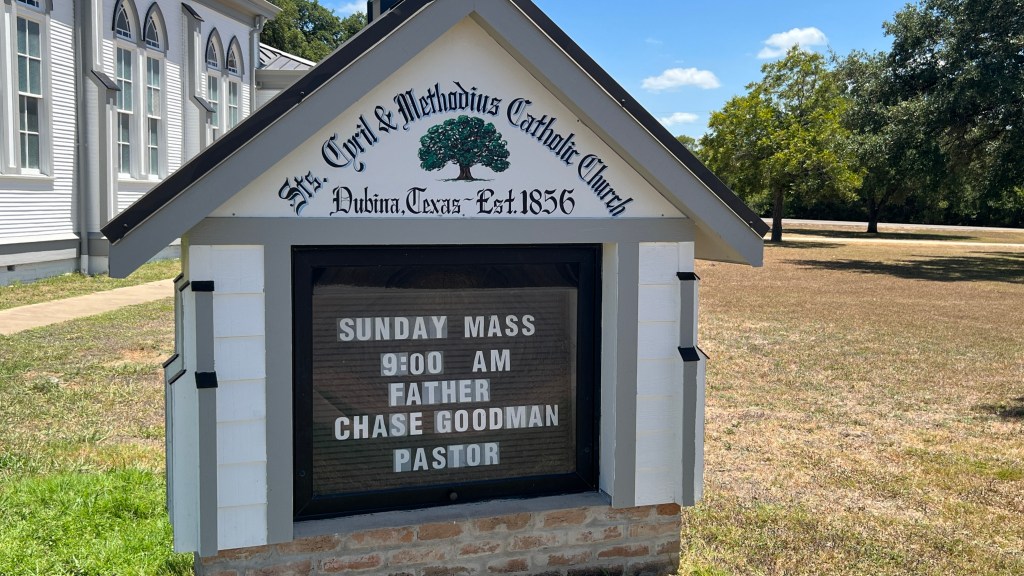
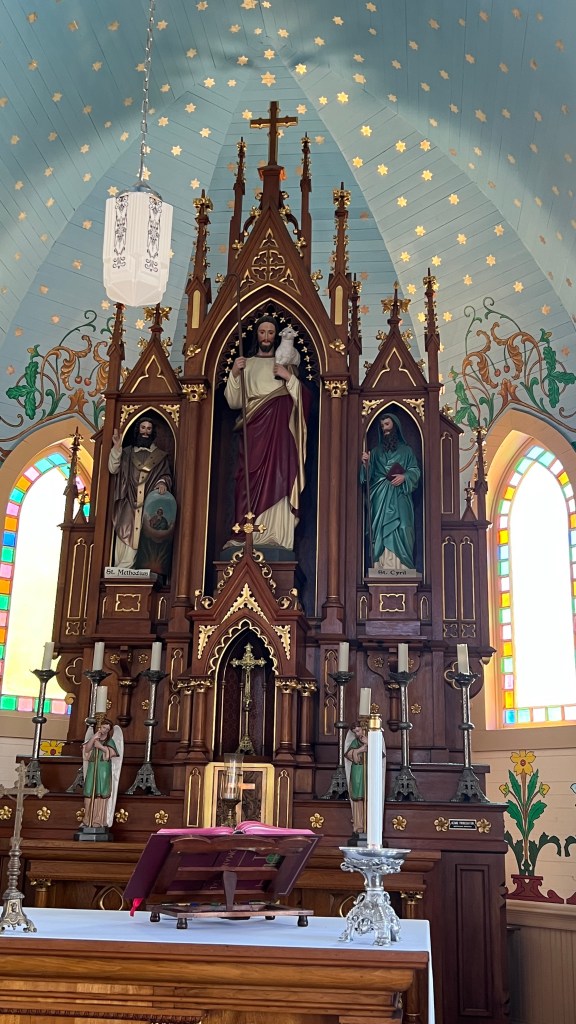
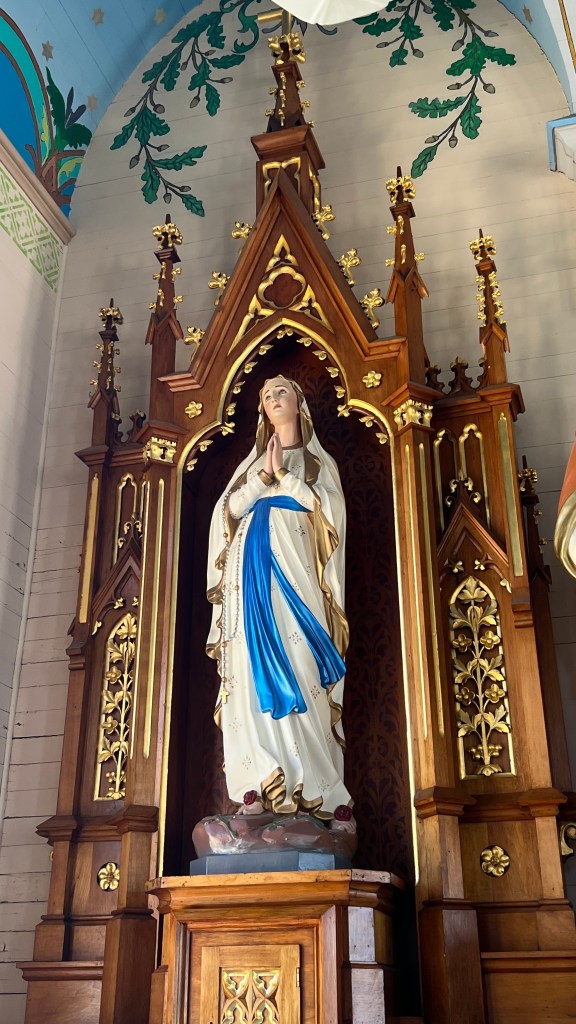
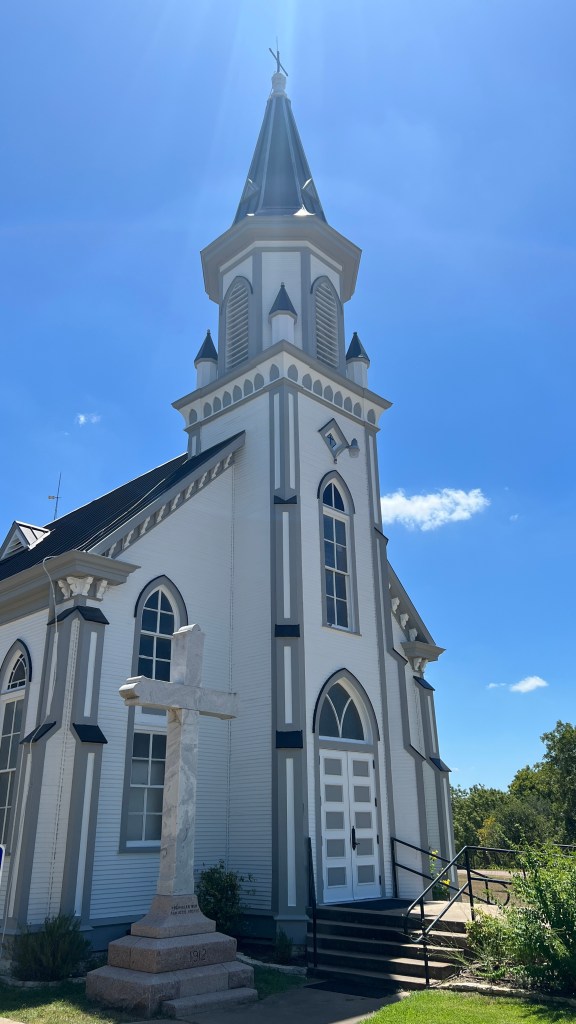
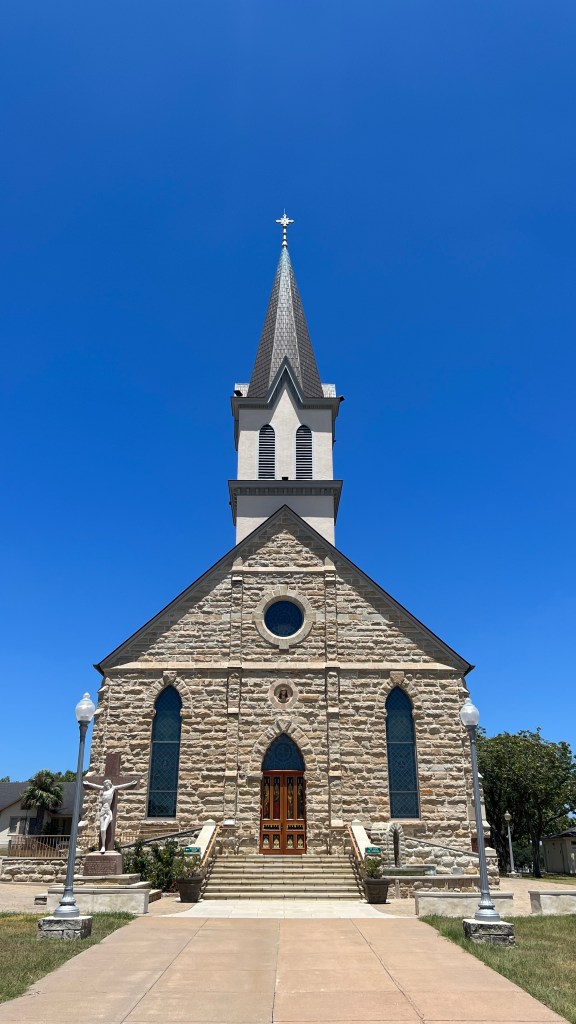
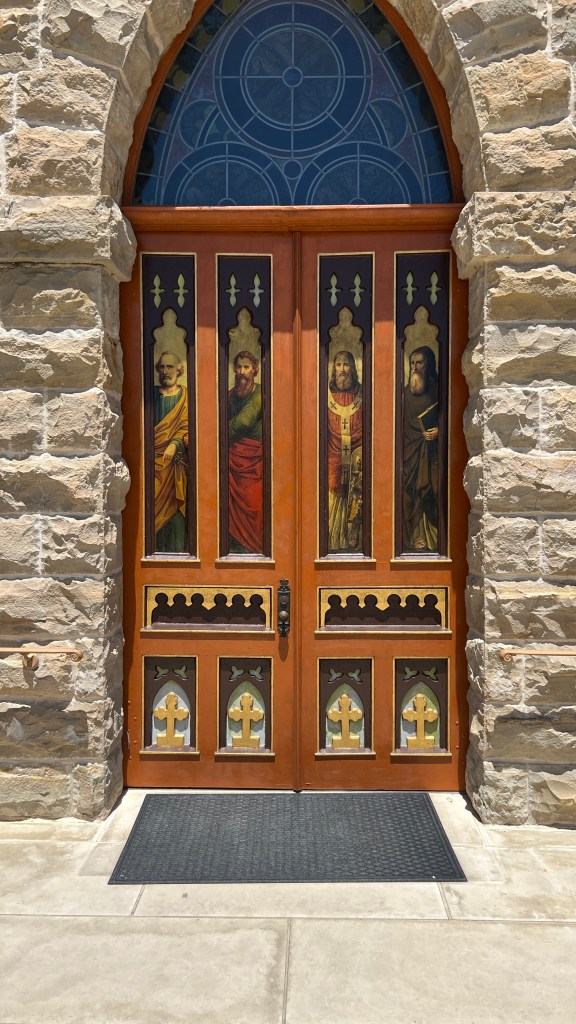
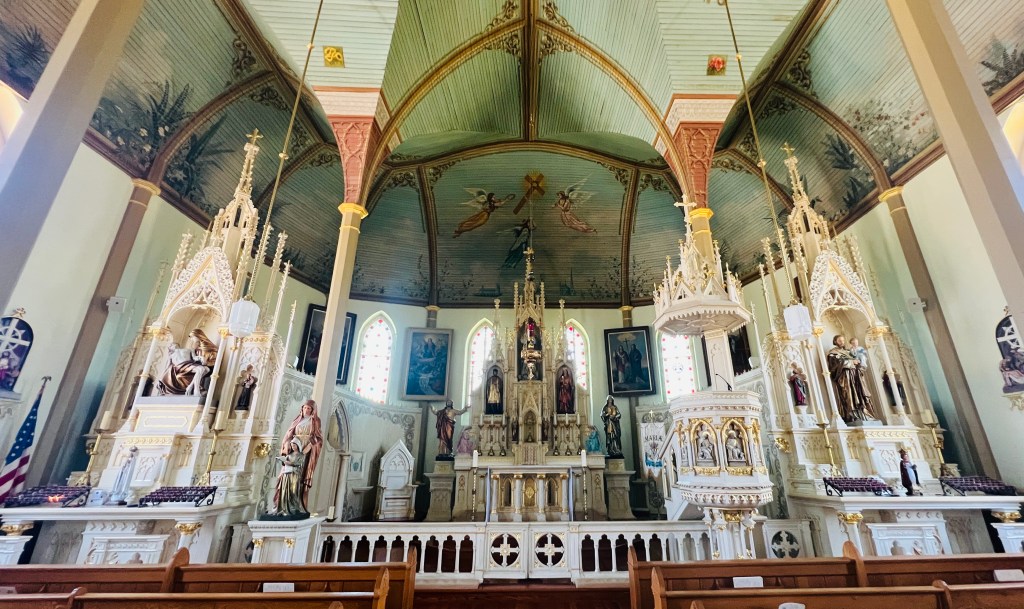
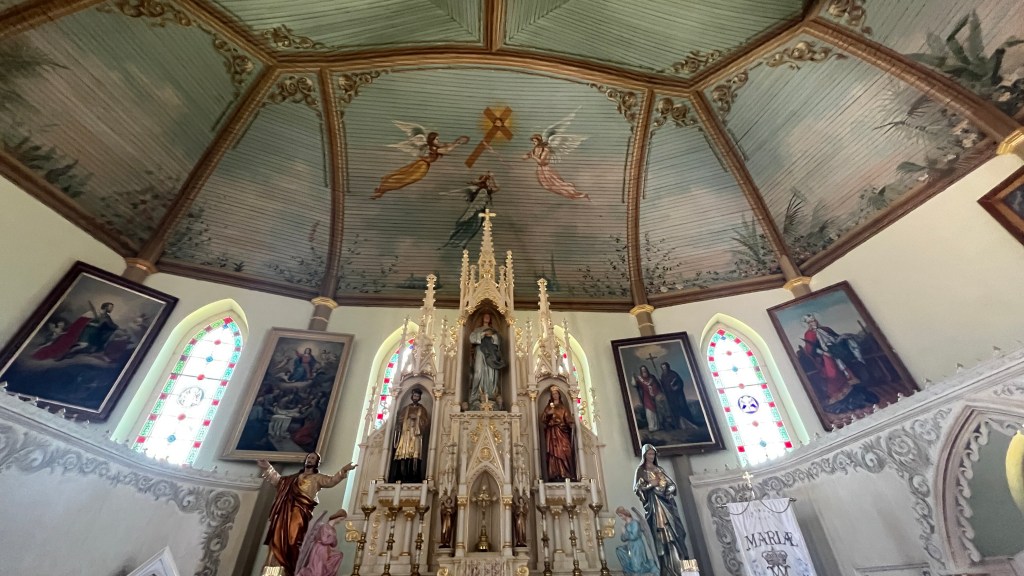
When Czech and German immigrants came to Texas in the 1800s, many settled in the central part of the state and named their towns after the places they’d left—Praha, Schulenburg, Dubina, Fredericksburg. These thriving communities prospered by working hard, helping one another, and praying together.
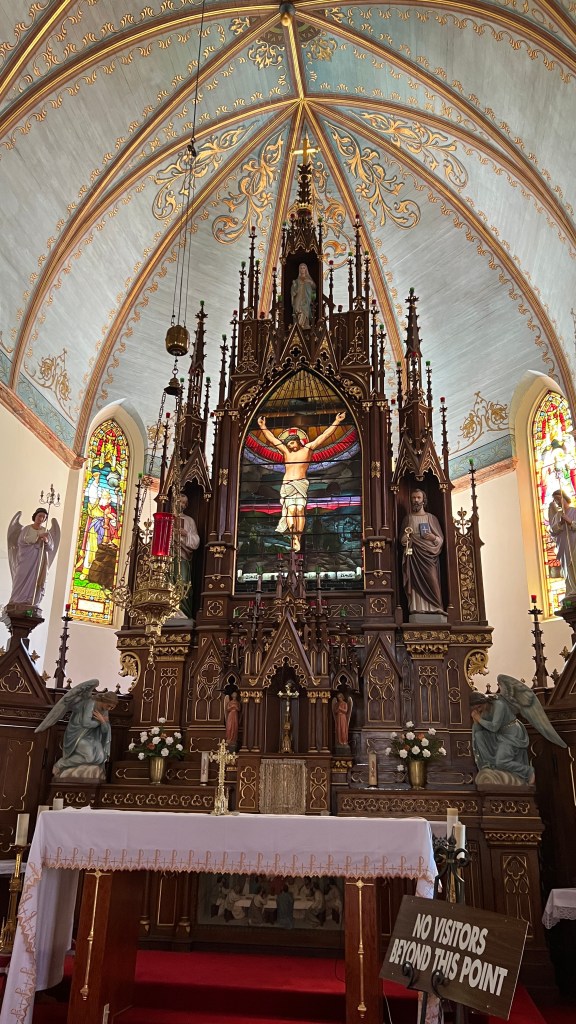
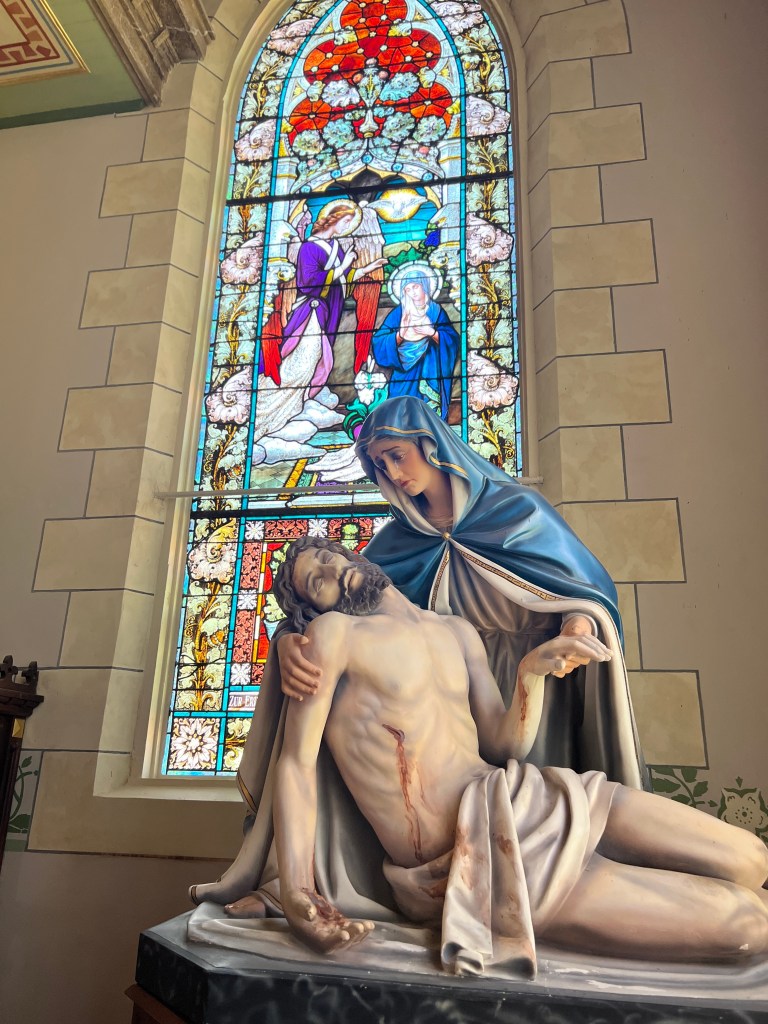
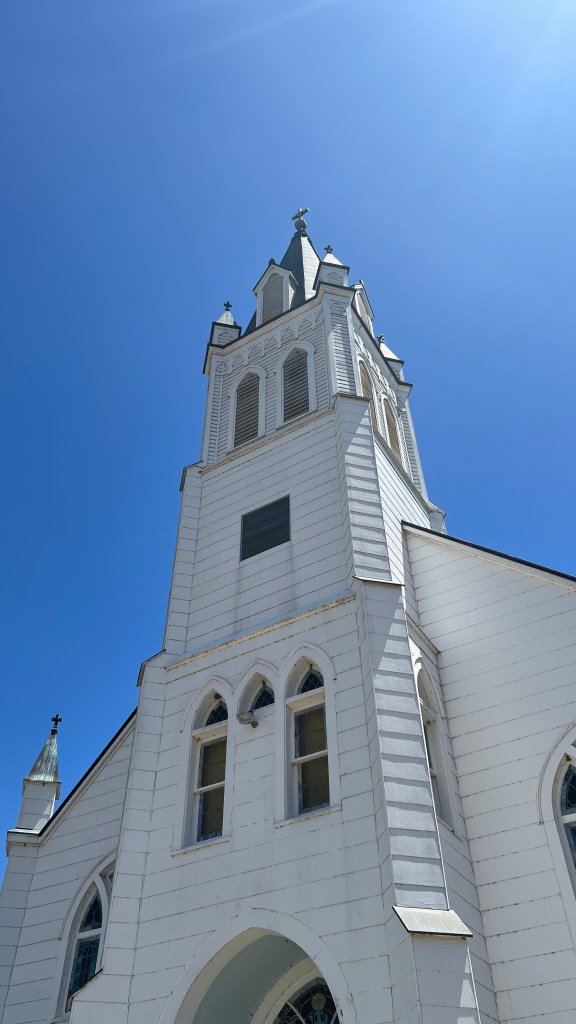
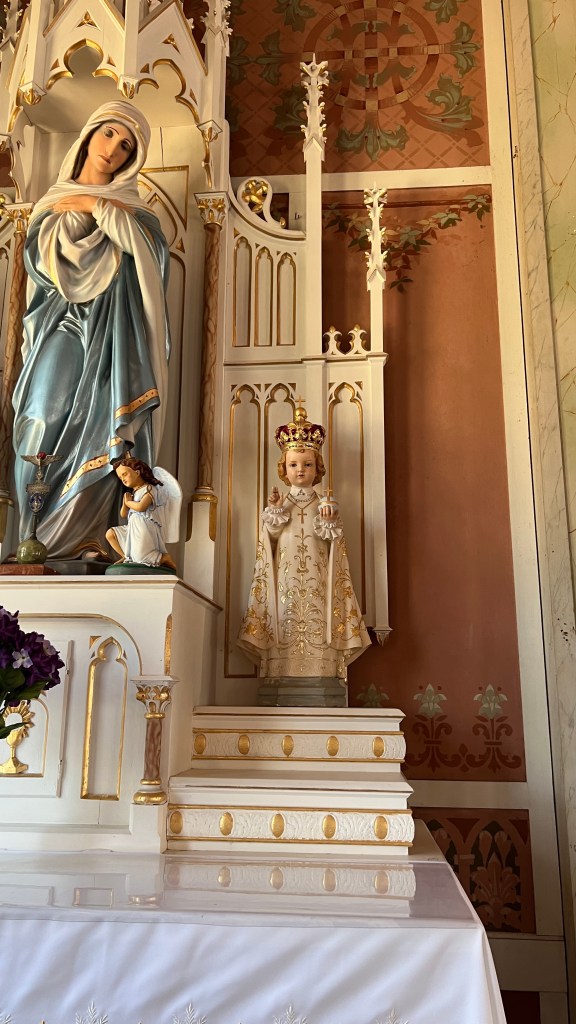
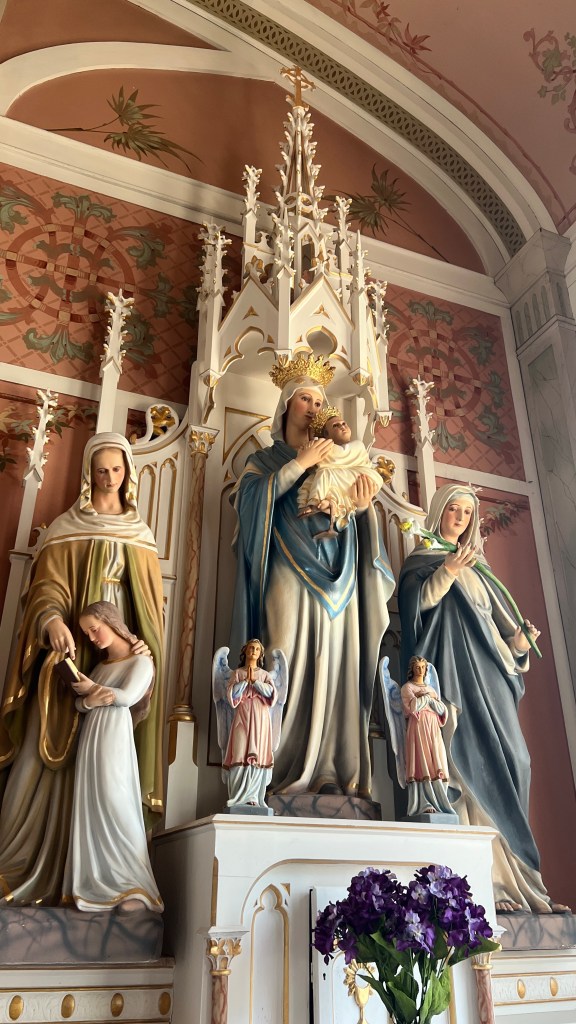
In an effort to make their new churches feel more like the ancient Gothic structures of their homelands, these early settlers painted the walls, altars, and arches of their simple wooden sanctuaries in colorful patterns and clever tromp l’oeil images. These buildings came to be known as the Painted Churches of Texas. Thankfully, they have been preserved and stand today in honor of those whose artistry and devotion created them. (Source)
St. Mary’s is considered the Queen of the Painted Churches located in High Hill
St. John the Baptist in Ammannsville (aka: the pink one)
The time came for Acadia, Thibodeaux’s wife, to deliver her twins. All was set as they rushed into the hospital, and everything was prepped. However, the delivery was too much for Thibodeaux, and he passed out cold. It took hours to revive him, but in the meantime, the doctors insisted on naming the babbies. Since Thib was still out, Acadia turned to Thib’s brother, Remi, to help name the girl and the boy.
“My brother named my kids?!” Thib’s shouted when he woke up. “But my brother’s an idgit! He barely knows his own name.” Pausing and taking a breath, he says, “Ok, what he done name the girl.”
“He named her Denise.”
“Denise?” Said, Thib. “Well, that’s not such a bad name. I kind of like it. And what did he call the little boy?”
“De Nephew.”
Even though it’s relatively common, I kind of like my name, but not everyone can say the same. For example, there was Issur Danielovitch Densky. He changed his name to Kirk Douglas. Frances Gum didn’t think her name would sell, so she became Judy Garland. Archibald Leach became Cary Grant. And who do you think Marion Morrison would become? John Wayne.
How great would it be if all it took was to change your name and become rich and famous? Or to become anything you wanted? To become an astronaut, I’ll become Neil Armstrong. To become a famous writer, call me Stephen King. But what about becoming a Saint? Call me Josemaría, and I’ll be holy.
In the end, “A rose by any other name….” As the philosopher Alan Watts said, “The menu is not the meal.”
Inside all of us is dark and light, and on any given day, one will be more prominent than the other, but the goal of the Christian life is for the light to illuminate every dark crevice and reveal the content of every shadow. Technically, this is known as sanctification.
Simply put, sanctification is the process of becoming holy, allowing the light to shine through every aspect of our lives. There are three major components in the process, and all three are a form of grace given by God: baptism, living a life directed by God, and entry into the Kingdom of Heaven.
Although some traditions believe that a person must make an adult profession of faith before being baptized, we do not—for us, that falls into the category of works; that is, you must do something in order to “earn” God’s grace. Instead, we believe that baptism is God’s undeserved grace being poured out on us, providing us “union with Christ in his death and resurrection, birth into God’s family the Church, forgiveness of sins, and new life in the Holy Spirit.” (BCP 858)
The third component, entry into the Kingdom of Heaven, is also a grace, which we have absolutely nothing to do with. For those who believe, St. Paul tells us, “Neither death nor life, nor angels nor rulers, nor things present nor things to come, nor powers, nor height nor depth, nor anything else in all creation, will be able to separate us from the love of God in Christ Jesus our Lord.” (Romans 8:38-39)
We can view our baptism and ultimate entry into the Kingdom of Heaven as bookends to our life with God, but that bit between those two events gives us so much trouble. It is grace that allows us to live for God, but the sanctification—the making holy—process during our earthly lives is not exactly a smooth ride. Why? The light and the dark are both within us.
Remember the parable of the wheat and tares/weeds? God sowed the good seed of the wheat, but at night, the devil came in and sowed the weeds so that when they began to grow, the wheat and the weeds grew up together. That speaks of the world and the people in it, but it also speaks of the soul. The light and the dark, the wheat and the weeds, are both within us. When we apply the parable to ourselves, the difference is that, with God’s grace, we can actually do something about the darkness, those weeds within our souls. That is the process of sanctification in this life. It is the transfiguration of the individual.
“While [Jesus] was praying, the appearance of his face changed, and his clothes became dazzling white,” Jesus was revealed in His glory. No darkness. No weeds. Not showing us the process of becoming holy, but showing us The Holy and the true image of God. But He was also showing us what we can become.
Brooke Foss Wescott was a 19th-century bishop in the Church of England. He was also someone whom Archbishop Michael Ramsey admired and studied. Bishop Wescott wrote, “The Transfiguration is the revelation of the potential spirituality of the earthly life in the highest outward form…. Here the Lord, as Son of Man, gives the measure of the capacity of humanity, and shows that to which he leads all those who are united with him.” (Glory: The Spiritual Theology of Michael Ramsey, p.59)
The Transfiguration of Christ sets before us a goal for the work of sanctification—the work of becoming holy—in our lives, and this work is the means “by which men and women are restored to the image and likeness of God Himself.” (Ibid.) As Christ was transfigured on the mountain, we seek in our daily lives to be transfigured into the same glory that Jesus revealed on the mountain. So what’s stopping you?
Charlie Brown and Linus were leaning against the fence, both looking rather contemplative. Chuck then asks Linus, “What would you do if you felt that nobody liked you?”
Linus gives it a thought, then says, “I’d try to look at myself objectively, and see what I could do to improve… that’s my answer, Charlie Brown.”
In the final frame, Charlie Brown is not looking so happy and says, “I hate that answer.”
What is stopping you from being transfigured, from becoming holy as your Heavenly Father is holy? From continuing the process of sanctification? There are many factors, but it seems there are two primary ones, and the first one is that we don’t want to put in the effort.
Most of you know that I’ll be taking a sabbatical next year, and for part of the time, I want to walk the Camino de Santiago—a short walk of 500 miles across northern Spain. In order to do this and live to tell about it, I will need to get in better shape. More walking, more strength building, losing a bit more weight, etc. In other words, I need to be training. “I hate that answer.” I really want to walk the Camino, but I’m not putting in the effort to be able to.
The same applies to being holy. I want to be holy. I want to enter into a deeper relationship with my Savior, but am I putting in the effort? Praying as I should, studying as I should, loving as I should, and the list goes on. We know that we need to put in the effort and practice our faith, training our souls, but… “I hate that answer.” Why?
The second factor is also as simple but equally challenging—we don’t want to. Yes, we want to be holy, but we don’t want to change our lives to attain that holiness. Back to the Camino—I need to lose more weight, but I don’t want to put down the cookie. I like the cookie. I’m a big fan, and I’ll become an even bigger if I’m not careful, so I need to put down the cookie. “I hate that answer.” To be sanctified, I need to be willing to set aside those things in my life that separate me from God. I need to be willing to allow the transfiguring light of Christ to shine and banish the darkness within me.
We will not be wholly sanctified until we enter the Kingdom of God, but if we put in some effort and allow our love of God to override our love of self, then we will progress in our sanctification. We’ll be pulling some of the weeds that are growing up with the good wheat of our souls.
We know the names of Saints like Francis, Josemaría, Mary Magdalene, John Paul, and many others. We hold them up as examples of the Christian life, but we also view such a life as unattainable for ourselves. However, we should see the lives of the Saints as something to strive for. In the same way, we should look upon our Transfigured Lord. In seeing Him transfigured, we are witnessing what—by the grace of God—we have the potential to become.
Don’t shy away from this work of sanctification or squelch the desire to attain it. Instead, through your love of God, seek out every opportunity to take steps in the sanctification of your soul.
A few words toward the end of St. Paul’s first letter to the Thessalonians make for a good blessing. I’ll close with them. “May God himself, the God of peace, sanctify you through and through. May your whole spirit, soul and body be kept blameless at the coming of our Lord Jesus Christ. The one who calls you is faithful, and he will do it.” Amen.
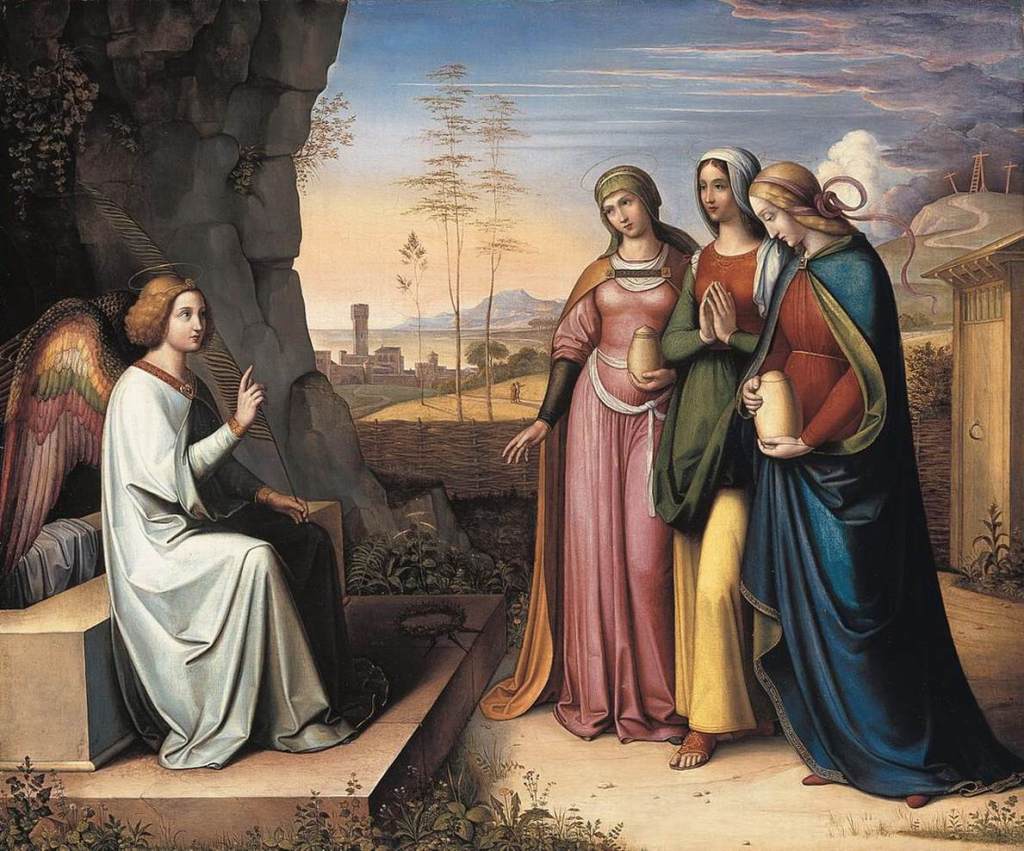
Within the Orthodox Church, the Third Sunday of Easter is celebrated as the Sunday of the Holy Myrrhbearers, those women who came to anoint Jesus’ body following his burial. It falls on our calendar tomorrow.
Today, we read of Mary Magdalene, and Mary the mother of James, and Salome, but in reading the other Gospels, you will find different lists of names—eight in total: the Virgin Mary, Jesus’ mother; “the mother of James and Joses” (reportedly, these are the sons of Joseph by a previous marriage, and she was, therefore, their step-mother); Mary Magdalene; Mary, the wife of Clopas; Joanna, wife of Chouza, a steward of Herod Antipas; Salome, the mother of the sons of Zebedee; Mary and Martha, the sisters of Lazarus; and Susanna. (Source)
It is not believed that the Gospel writers got it wrong when listing the women; instead, it seems to indicate that different groups went separately and had varying experiences at the empty tomb. Whatever the case, because of their great love for him, they all went to the tomb to anoint the Body of Jesus, only to discover that the tomb was empty. But, if there was no Body, did that end their work?
In a sermon, St. John Damascus (d.749) wrote for the Easter Season—“When You [Jesus] did descend unto death, O Life Immortal, then did You slay Hades with the lightening of Your Divinity. And when You did also raise the dead out of the nethermost depths, all the power in the Heavens cried out: O Life-giver, Christ our God, glory be to You. Glory to the Father, and to the Son, and to the Holy Spirit. The noble Joseph, taking Your immaculate body down from the Tree, and having wrapped it in pure linen and spices, laid it for burial in a new tomb. But on the third day You did arise, O Lord, granting great mercy to the world. Now and forever, and unto the ages of ages. Amen. Unto the myrrh-bearing women did the Angel cry out as he stood by the grave: Myrrh-oils are meet for the dead, but Christ has proved to be a stranger to corruption. But cry out: The Lord is risen, granting great mercy to the world.”
They could not anoint His Body because He had risen, but there was still work to be done; therefore, “cry out: The Lord is risen, granting great mercy to the world.”
Their love for Jesus extended into the grave, giving them the courage to go out into the world and proclaim His resurrection. How far does your love for Jesus carry you? Once you learned that He was risen, how did you respond to the angel’s charge to go and tell?
Our work is not nearly done; therefore, as Peter said in our first reading, let everyone “know with certainty that God has made him both Lord and Messiah, this Jesus whom” was crucified.
There is an old legend of a swan and a crane. A beautiful swan alighted by the banks of the water in which a crane was wading about seeking snails. For a moment, the crane viewed the swan in stupid wonder and then asked, “Where do you come from?”
“I come from heaven!” replied the swan.
“And where is heaven?” asked the crane.
“Heaven!” said the swan, “Heaven! Have you never heard of heaven?” And the beautiful bird went on to describe the grandeur of the Eternal City. She told of streets of gold, and the gates and walls made of precious stones, of the river of life, pure as crystal, upon whose banks is the tree whose leaves shall be for the healing of the nations. In eloquent terms, the swan sought to describe the hosts who live in the other world but without arousing the slightest interest on the part of the crane.
Finally, the crane asked, “Are there any snails there?”
“Snails!” repeated the swan. “No! Of course not.”
“Then,” said the crane, as it continued its search along the slimy banks of the pool, “you can have your heaven. I want snails!”
“Jesus put before the crowds another parable: ‘The kingdom of heaven is like…’”… a pond with slimy banks and lots of snails (which, for the record, is snail hell, but that’s another sermon.)
As I thought about these statements of Jesus and the Kingdom of Heaven, I wondered what a first-century Jewish person would have thought. What was their perception of Heaven?
If you go way back to the beginning, it would be easy to see how the Garden of Eden might be the first image of Heaven. “Now the Lord God had planted a garden in the east, in Eden; and there he put the man he had formed. The Lord God made all kinds of trees grow out of the ground—trees that were pleasing to the eye and good for food. In the middle of the garden were the tree of life and the tree of the knowledge of good and evil. A river watering the garden flowed from Eden; from there it was separated into four headwaters.” (Genesis 2:8-10)
It sounds glorious, but early Jews did not have an understanding of Heaven or life after death. It was enough to “sleep with your fathers” and to have your name kindly remembered by others.
However, as the Israelites began to suffer at the hands of their enemies and be hauled off into exile, the prophets began to point to a time when God would redeem His people, and they would live in peace. The Prophet Daniel wrote, “There will be a time of distress such as has not happened from the beginning of nations until then. But at that time your people—everyone whose name is found written in the book—will be delivered. Multitudes who sleep in the dust of the earth will awake: some to everlasting life, others to shame and everlasting contempt.” (Daniel 12:1b-2)
The people waited, but the persecutions and occupations continued, so around 500 BC, the idea of òlam ha-ba began to take precedence. This world, òlam ha-ze, was understood as an ante-chamber (a narthex or entry room) that leads to the Òlam ha-ba, “the world to come.” This understanding made attaining heaven/“the world to come” a more personal matter. The things you do right and wrong in this world determine whether or not you make it out of the ante-chamber and into the next world or are kicked out altogether. This view brings us back to the beginning because the world to come was known as Gan Eden, the Garden of Eden. Perhaps a bit confusing, but I found it fascinating.
As we know, in the time of Jesus, not everyone was convinced of the resurrection to the world to come. The Pharisees said, “Yes,” but the Sadducees, who were in charge of the Temple and the sacrificial system, were a negative. Ultimately, for those who believed, there was no definite answer. Perhaps the closest came early in the second century.
Rabbi Joshua ben Levi’s son, Joseph, died but was somehow restored. “His father asked [Joseph], ‘What did you see?’ Joseph replied, ‘I beheld a world the reverse of this one; those who are on top here were below there, and vice versa.’ He [Joshua ben Levi] said to him, ‘My son, you have seen a corrected world.’” You have seen a world turned upside down. A world that is far different from the one we live in now.
It is into this debate on the existence and understanding of Heaven that Jesus walks. Jesus said, “I praise you, Father, Lord of heaven and earth, because you have hidden these things from the wise and learned, and revealed them to little children. Yes, Father, for this is what you were pleased to do.” (Matthew 11:25-26)
Jesus has just told the parable of the wheat and the tares/weeds and told those listening that the good and evil will grow together. It will not be until the last day when they are separated, but on that day, the Lord will send out the angels to reap the harvest, saying, “First collect the weeds and tie them in bundles to be burned; then gather the wheat and bring it into my barn.” (Matthew 13:30b)
The scriptures read: “Gather the wheat and bring it into my barn.” And then immediately afterward, we hear our lesson for today, “Jesus put before the crowds another parable: ‘The kingdom of heaven is like….’”
The parable of the wheat and tares spoke of judgment and blessing. Judgment for those who do not believe and blessing, that is, the Kingdom of Heaven, òlam ha-ba, Gad Eden, the world to come, for those who do. But why did Jesus say the Kingdom of Heaven was like so many different things? Mustard seed, leaven, treasure, pearl, and so on? If we go through the list, we learn many things.
With the mustard seed, we learn that the Kingdom will grow from something small and become something that makes room for all the birds of the air—all the peoples of the Earth. The leaven tells us it will be everywhere and a part of everything. The hidden treasure is about how we must work to gain it, and the costly pearl speaks of sacrifice. The separating of the great catch reminds us that not everyone will be allowed entry but will instead be cast out. By telling us all these things, Jesus is telling us that there is a Kingdom that is not of this world and that in that place, our God reigns.
I imagine a rush of words as Jesus spoke about these things, and because of so many parables, he is expressing how incomparable and indescribable.
Have you ever been to the Grand Canyon? The immensity of it is overwhelming. In the movie Grand Canyon, Danny Glover’s character, Simon, talks about sitting on the rim and looking out. “I felt like a gnat that lands on the [backside] of a cow that’s chewing its cud next to the road that you ride by on at 70 miles an hour.” Professor of Psychiatry Mark Goulston said, “I can still remember my first experience standing at the edge of the Grand Canyon and looking into it. It was so awesome. It took a fair amount of restraint to prevent me from jumping into it because I was certain I could fly.”
As Jesus was telling these parables of the Kingdom of Heaven, I can imagine him having this vision of heaven in His mind, much like Simon and Goulston’s vision of the Grand Canyon in theirs as they spoke. It could all be summed up, not in a word, but an expression: “Whoa!” So much more than you could ever imagine. A world turned upside down compared to this one, full of God’s riches. By comparison, this world is insignificant.
Rabbi Hofetz Chaim (d.1933) was very influential. A story tells of how he had an American visitor to his home in Poland. The Rabbi’s home was very austere. A simple room, books, a table, and a bench.
The visitor asked, “Rabbi, where is your furniture?”
“Where is yours?” replied the rabbi.
“Mine?” asked the puzzled American. “But I’m a visitor here. I’m only passing through.”
“So am I,” said the Rabbi.
The people in the time of Jesus had a very limited view of the Kingdom of Heaven. They thought of it in terms of the crane looking for snails along the slimy banks of a pool, but it is so much more. It is worth working for and sacrificing for as we pass through this ante-chamber. Therefore, in the words of St. Augustine (or Ignatius, depending on who you believe said it), “Pray as though everything depended on God. Work as though everything depended on you.” The reward far exceeds any price or sacrifice.
Let us pray (a short prayer that is recited at the end of each decade of the Rosary, known as the Fatima Prayer): O my Jesus, forgive us our sins, save us from the fire of hell, lead all souls to heaven, especially those who are in most need of Thy mercy. Amen.
















 Candle in a Cave