Pip: Star Wars, Pharaoh, a donkey with delusions of grandeur — Fr. John is covering a lot of ground this week at Candle in a Cave.
Mara: The sermon for Proper 19 pulls together the Exodus story, the parable of the unforgiving servant, and a question that runs through all of it: what are you actually building with what God has given you?
Pip: Let's get into it.
"What Are You Building?" — Gifts, Empires, and the Kingdom
Mara: The sermon opens with a sweep through history — every great empire, from the British to the Mongol to the Babylonian, eventually collapses. That pattern sets up the Exodus reading, where Pharaoh insists the Nile is his own making.
Pip: And the sermon lands the line that becomes the sermon's spine. After the Israelites cross the Red Sea and receive Egyptian gold as a parting gift from God, they melt it into a golden calf — and the sermon reads that act as Pharaoh's logic recycled: "My Nile is my own; I made it for myself."
Mara: That phrase does the heavy lifting. The Israelites were liberated, given a gift, and then used the gift to rebuild the very thing they escaped — their own version of Egypt, their own small empire.
Pip: Which is where the parable of the unforgiving servant walks in and makes the same point at human scale. The king forgives an impossible debt — the sea parts, the servant walks through free — and then the servant immediately shakes down a colleague for pocket change.
Mara: The sermon draws the parallel directly: "The servant took the gift of mercy and, in his arrogance, began building his own little empire." Liberation received, liberation refused to others.
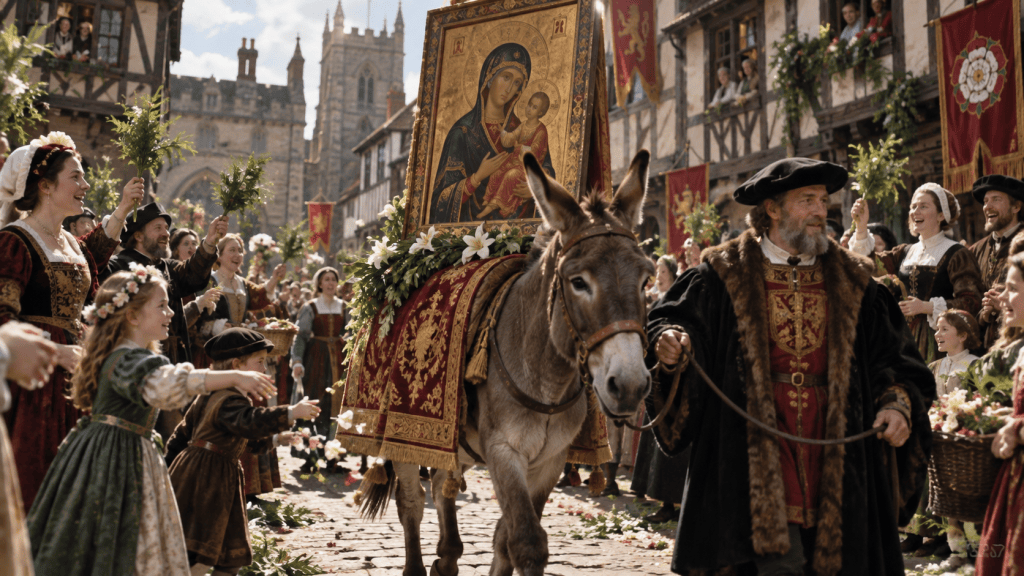
Pip: And then there is the donkey. Decorated with garlands to carry a sacred icon, he stops mid-procession and brays at the crowd, convinced the adoration is for him. The man leading him swats him and says, "The honor is not meant for you but for the image you are carrying."
Mara: That fable lands the sermon's practical point. The gifts — wealth, education, position, talent — are not the problem. The sermon is clear: "The gold was never the problem. Possessing the gold was never the problem. The question was what they built with it."
Pip: Wealth can build an empire or serve the Kingdom. Same gold, entirely different structure.
Mara: Saint James frames it as the law of liberty — freedom from sin that teaches liberated people how to live, and Saint Peter adds: "use it to serve one another, as good stewards of God's varied grace… in order that in everything God may be glorified through Jesus Christ."
Pip: Every empire falls. The sermon closes on that contrast — every empire we build eventually collapses, and God's Kingdom endures forever — and asks why anyone would choose the perishable project.
Mara: The closing prayer puts it plainly: serve without counting the cost, labor without seeking rest, spend yourself for glory that belongs to someone else entirely.
Pip: Pharaoh, a servant, and a self-important donkey — same story, different costumes.
Mara: The question underneath all of it stays simple: the gift is in your hands. What are you building with it?
“A long time ago in a galaxy far, far away … It is a period of civil war. Rebel spaceships, striking from a hidden base, have won their first victory against the evil Galactic Empire.”
Can you see those words scrolling up the screen as the music swells? I was stunned to learn this week that next year will mark the 50th anniversary of the original Star Wars movie. But I have been a faithful follower of those movies and even survived Jar Jar Binx.
As big and powerful as the Galactic Empire was, it went the way of all the real empires we know of. The British Empire of the 1920s was the largest, and it eventually collapsed, as did the Mongol, Russian, and Spanish Empires, among others.
If the empires of history were represented by colors, we would see one color constantly superseding another. Beautiful and chaotic.
The empires we hear about in scripture—Egyptian, Assyrian, Babylonian—dominate Israel’s history, and in today’s reading, the Egyptians take center stage.
Moses came to Pharaoh and delivered the Lord’s message: “Let my people go.” Pharaoh responded, “Who is the Lord, that I should obey his voice and let Israel go? I do not know the Lord.” (Exodus 5:2) Years later, another Pharaoh would say essentially the same thing: “My Nile is my own; I made it for myself.” (Ezekiel 29:3) In their arrogance, they believed they had built the empires they ruled. God has a funny way of humbling such fool-heartedness.
The sea parted, the Israelites crossed on dry land, and the Egyptians followed. In the song of Miriam that we read, Pharaoh said, “I will pursue, I will overtake, I will divide the spoil, my desire shall have its fill of them. I will draw my sword, my hand shall destroy them.” The Lord said, “I don’t think so,” and the waters came crashing down. The Israelites were liberated. What do they do with this newfound freedom?
As you will recall, just before the Israelites left Egypt, Moses told the people to ask the Egyptians for silver and gold, and the Lord disposed the Egyptians to comply.
Today, they passed through the Red Sea, but only a couple of months later, “All the people took off the rings of gold that were in their ears and brought them to Aaron. And he received the gold from their hand and fashioned it with a graving tool and made a golden calf. And they said, ‘These are your gods, O Israel, who brought you up out of the land of Egypt!’” (Exodus 32:3-4) The Egyptian gold they received as a blessing from God was used, with their own hands, to make the Golden Calf, a false god, to replace the one true God who had liberated them. By their actions, they speak in the same spirit as Pharaoh, “My Nile is my own; I made it for myself.” In essence, the Israelites are building their own version of Egypt. They are beginning to build their own empire. How it all plays out is a story for another day, but see the pattern: captivity to liberation, yet instead of living into God’s freedom, they turn from God to self. “My Nile is my own; I made it for myself.” And in that turning from God and in their arrogance, they began building their own empire. When they did, we should not be surprised that God came along and smacked them, as he has done to so many others.
What we must keep in mind is that this applies not only to world empires; it also applies to the individual. Consider it the parable Jesus told today.
The king is settling his accounts and has a servant who owes more than he can ever repay. Because the servant was unable to pay, the king ordered that the servant and the members of his family—wife and children—be sold into slavery to pay the debt. The servant went to the king and pleaded for the king’s patience: “‘Have patience with me, and I will pay you everything.’ And out of pity for him, the lord of that slave released him and forgave him the debt.”
The servant is like the Israelites in Egypt. He is in captivity to his debt. Yet, like the Egyptians’ gift of gold, the king gives the servant a gift—mercy. In doing so, the sea parts for the servant, allowing him safe passage through the debt, and then the sea closes behind him, bringing him into safety. The servant has been liberated.
“But that same slave, as he went out, came upon one of his fellow slaves who owed him a hundred denarii; and seizing him by the throat, he said, ‘Pay what you owe.’ Then his fellow slave fell down and pleaded with him, ‘Have patience with me, and I will pay you.’ But he refused; then he went and threw him into prison until he would pay the debt.” The servant took the gift of mercy and, in his arrogance, began building his own little empire. “My Nile is my own; I made it for myself.” The king, hearing of this, recalled that servant and smacked him about the head and neck.
The Israelites were liberated, and the servant was liberated. In both cases, a gift followed. But the gift never became a way of life. Israel received the gold but forgot the Giver. The servant received mercy but refused to become merciful.
In his epistle, Saint James speaks of the law of liberty. It means that, through Christ, we have been liberated from the empire of sin and death. However, the liberty we received does not mean we are free to do whatever we please or to treat those around us in a sinful manner. Instead, the law of liberty teaches us how liberated people live, using the gifts He has bestowed on us for the good of His kingdom. Why? Because the gift is not about us—me—the gift is about God and His glory. Saint Peter writes, “As each has received a gift, use it to serve one another, as good stewards of God’s varied grace… in order that in everything God may be glorified through Jesus Christ. To him belong glory and dominion forever and ever.” (1 Peter 4:10-11)
Aesop wrote a fable that has evolved over the years but remains essentially the same: A sacred icon of the Madonna and Child was being transported from one church to another. To carry the icon, they decorated a donkey with garlands and ribbons and placed the icon on its back so that, as it passed, all could see it.
As the procession went along, the people came out, adoring the image, singing songs, and casting flowers before it. However, the donkey got it in his pointy little head that all the adoration was for him. In his foolishness and arrogance, he stopped and began to bray loudly, basking in all the praise. Understanding what was happening, the man leading the donkey swatted him on the backside with a stick and said, “Get along with you, you stupid Ass. The honor is not meant for you but for the image you are carrying.”
God has liberated us from sin and death and has given each of us gifts. Some have received wealth, education, position, status, and many other gifts. These are wonderful gifts and great blessings, but like the Egyptian gold or the servant’s mercy, they can be profaned. We can begin thinking like the donkey or Pharaoh: “My Nile is my own; I made it for myself.” In doing so, there’s a very good chance God will come along and swat us with a stick and say, “Get along, you stupid little… yeah.” Why? Because when God liberated us and blessed us with such wonderful gifts, He did so that we might enjoy them to the fullest, but more importantly, He did so that we might bring Him glory.
Remember how they collected gold to build the Golden Calf? Later, they collected gold again, this time to build the Tabernacle and its sacred furnishings, including the Ark of the Covenant. The gold was never the problem. Possessing the gold was never the problem. The question was what they built with it.
Wealth can build an empire or serve the Kingdom. Education can elevate the self or serve the Kingdom. Authority can dominate or serve the Kingdom. Position, reputation, intelligence, talent—all of it. The question is what you build with what God has put in your hands.
The Psalmist says of the Lord,
Your kingdom is an everlasting kingdom, and your dominion endures throughout all generations.
(Psalm 145:13)
Every empire we build eventually falls. God’s Kingdom endures forever.
Question: Why would we ever want to work on our own little perishable empires when we can work to bring glory to the only Kingdom that is imperishable and eternal?
God has parted the Red Sea for you. You are free. He has placed gifts in your hands. Don’t use them to rebuild Egypt. Don’t use them to build yourself a little empire. Build his Kingdom. And whatever he has placed on your back—carry it well. Just remember who gets the glory.
Let us pray: O Dearly beloved Word of God, teach us to be generous, to serve You as You deserve, to give without counting the cost, to fight without fretting at our wounds, to labor without seeking rest, to spend ourselves without looking for any reward other than to bring You glory, knowing that we do Your holy will. Amen.
Pip: There's a sermon on Candle in a Cave that opens with Shakespeare, detours through a shrew the size of a penny, and ends with a butcher knife in a teenager's hand — and somehow it's all about forgiveness.
Mara: Fr. John's recent writing takes us into the hard territory of reconciliation — what the Gospel actually asks of us when someone genuinely wrongs us, and why the answer isn't what we'd prefer.
Pip: Let's start with the sermon itself.
What Reconciliation Actually Costs
Pip: The Gospel passage at the center of this sermon sounds, at first read, like permission — Jesus telling us to go confront the person who wronged us. The question the sermon presses on is what motivation we're actually supposed to bring to that confrontation.
Mara: The setup begins with Katherine from The Taming of the Shrew — a character whose fury is her defining feature. The sermon draws a line from her to what it calls the grouch and the shrew in all of us, and then lands here: "It's as if Jesus is giving us permission to be the grouch or the shrew we know we have every right to be."
Pip: Which is a fair read of the text — until it isn't.
Mara: Right, and that's exactly the pivot the sermon makes. The cockroach exercise is where it gets concrete. A dozen teenagers, a paper box with a cockroach image taped to the lid, and a butcher knife. They shred the cockroach completely — and underneath is an image of Jesus, also shredded. The outrage is immediate.
Pip: Probably not the pastoral risk assessment form they teach in seminary, but the lesson lands.
Mara: The sermon draws the theological line directly from that image: "Whatever you do to them, you do to Jesus." And it holds that against the Gospel's one sentence that's easy to skip past.
Mara: That sentence is: "If the member listens to you, you have regained that one." The sermon reads that as the whole point — the motivation isn't vengeance, it's reconciliation. Paul's letter to the Romans backs it up: "Beloved, never avenge yourselves, but leave it to the wrath of God, for it is written, 'Vengeance is mine, I will repay, says the Lord.'"
Pip: So the upshot is that the passage isn't a license to build a team and stock up on ammunition — it's a call to want the other person back.
Mara: And the sermon is careful about what reconciliation doesn't require. It doesn't mean forgetting, pretending you weren't hurt, or allowing the offender back into your life. What it does mean, as the sermon puts it, is you release the desire to go stab cockroaches — you refuse to let someone else's sin dictate who you become.
Pip: The closing image is the early martyrs who had no great words, just a simple reply when told to renounce their faith or die.
Mara: "I am a Christian." The sermon offers that as the thing to say to yourself in the moment anger tips toward vengeance — not a denial of the harm, but a refusal to be ruled by it.
Pip: And the final line reframes the familiar "where two or three are gathered" — not a formula for a small meeting, but a description of a reconciled community.
Mara: The through-line here is that reconciliation is the shape of Jesus' entire ministry — and the sermon asks whether we're willing to let that be the shape of ours.
Pip: Even when the cockroach really had it coming. More from Candle in a Cave next time.
Why, sir, I trust I may have leave to speak, And speak I will. I am no child, no babe. Your betters have endured me say my mind, And if you cannot, best you stop your ears. My tongue will tell the anger of my heart, Or else my heart, concealing it, will break, And, rather than it shall, I will be free Even to the uttermost, as I please, in words.
If you know your Shakespeare — thank goodness for the internet, because I don’t — you’ll recognize this as a passage from The Taming of the Shrew (Act 4, Scene 3).
For a long time, my understanding of the word shrew was limited to Webster’s Dictionary’s second definition: an ill-tempered, scolding woman. Please do not report me to the bishop for being sexist. It turns out the first definition refers to a small, insect-eating, mouse-like creature. Some weigh as little as a penny. Not very big.
Somewhere along the way, the name of this tiny, noisy creature became a term for an ill-tempered, scolding person—and Shakespeare gave us perhaps the most famous shrew of all. When a shrew gets agitated, it makes a rapid-fire eek-eek-eek-eek sound, as if it were firing a tiny little machine gun. I suppose Shakespeare thought that’s what Katherine sounded like when she got agitated.
My research tells me there’s no masculine version of the shrew, but I can picture someone like Ove from A Man Called Ove embodying one. Just a real grouch.
So, we have the grouch and the shrew—those who are ill-tempered, and when they get irritated, they sound like tiny little machine guns, letting everyone know exactly how they feel. Thank goodness I am never like that.
Throughout his earthly ministry, Jesus offers teachings that are not only difficult to follow but also seem contrary to our natural inclinations. There is the business of loving your neighbor, which we will attempt, but love of your enemy… don’t you think Jesus is asking a bit too much there? Do unto others as you would have them do unto you is great until it starts costing us; then we may have to rethink it a bit. And as for the Beatitudes—blessed are the poor, the meek, the peacemakers—they can certainly seem a little too radical at times. However, today’s Gospel reading is something we can all get behind. It’s as if Jesus is giving us permission to be the grouch or the shrew we know we have every right to be.
“If another member of the church sins against you, go and point out the fault.” Hallelujah. I can get behind that. And when I do, if I’m honest, I hope that person doesn’t repent, because then I can break out my tiny little machine gun and tell everybody. Even better, in most cases, I have such confidence in how right I am that I can actually dispense with that first step and go straight to telling other people. Then I can build my sides, my team, and stock up on ammunition. I can hit the person who offended me with both barrels and then some. No need for peacemakers here. I have been given permission, by Jesus, to embark on this most holy war.
We like this teaching of Jesus a lot because it gives us room to vent our righteous anger and flip over a few tables. Or does it?
When I served in Montana, I ran an after-school program in one of the communities. The kids who attended were not church kids, and they went to high school across the street. They were great kids, but sometimes a little rough around the edges.
I had them for a couple of hours once a week. We gave them a meal and a safe place. I told them they were always welcome, but their attendance would cost them 10 minutes, and those 10 minutes were mine. They agreed, and I taught them the Christian message in creative ways.
It would never work with our kids here at Saint Matthews, but one message sparked a full-on rebellion from that group.
I took a paper box and, on the lid, I attached a large picture of a cockroach with blue painter’s tape. There were about a dozen kids that day, and I told them there was likely someone in their lives who was an irritant. Perhaps someone they truly disliked or who had hurt them, and that this exercise was designed to help them release the frustration and stress they experienced.
The cockroach, I said, represented this evil person in their life, and they should pour all their disdain for that person into the image of the roach. We had some good laughs as they pictured the person. Then I handed the kid nearest to me a butcher’s knife. “Take out your frustrations,” I said. And they all did. They stabbed that poor cockroach so many times that it was a shredded mess by the end.
When they were suitably vented, I peeled off the blue painter’s tape and removed the picture of the cockroach. What I had failed to tell the kids was that beneath the cockroach image was another image of Jesus. It, too, was a shredded mess, and outrage erupted. “You didn’t tell us.” “That’s not fair.” “I never would have.”
Perhaps putting a sharp butcher knife in the hand of an angry teenager and telling them to work out their frustrations wasn’t the wisest pastoral move, but I would wager they still haven’t forgotten that lesson.
We read our gospel today, and we can become the shrew or the grouch. We can go after someone with our tongue the same way those kids went after that cockroach. We can shred our enemies and firmly believe we are within our Christian rights. Yet when we do, we forget Jesus’ words: “Truly, I say to you, as you did it to one of the least of these my brothers, you did it to me.” (Matthew 25:40) From the greatest to the least, from the person you love to the one you hate, whatever you do to them, you do to Jesus.
When we study Scripture, we can study individual passages, but when we interpret it, we must do so through the lens of Scripture as a whole. One part will not negate another. Because that is the case, Jesus is not telling us we have the right to go after the person who offends or hurts us. So what could He possibly be saying in our Gospel?
The answer lies in the motivation. If we read this passage to give ourselves the right to strike out at the cockroach, our motivation is vengeance. Through the lens of Scripture, we know that vengeance is not our department. The Psalmist writes,
Refrain from anger, and forsake wrath! Fret not yourself; it tends only to evil. (Psalm 37:8)
St. Paul tells us in his letter to the Romans, “Beloved, never avenge yourselves, but leave it to the wrath of God, for it is written, ‘Vengeance is mine, I will repay, says the Lord.’” (Romans 12:19) So if the passage isn’t permission for personal vendettas, what then? What should the motivation be? The answer is found in our Gospel lesson. It’s the one sentence that is easily dismissed: “If the member listens to you, you have regained that one.” The motivation is at the heart of Jesus’ entire ministry: reconciliation. Jesus reconciled us to God so that we might be reconciled to one another.
Yes, there will be people who irritate you, and there will be people who genuinely hurt you. Being reconciled does not mean you have to go and be best friends forever, that you have to forget, or even pretend you weren’t hurt, nor does it mean you have to allow the offender back into your life. However, it does mean, at the very least, you will release the desire to go out and stab cockroaches. It means you won’t allow the other person’s sin to cause you to sin or to dictate who you will become. If the offender chooses not to be reconciled, that is between them and God. However, what is between you and God is your actions, your heart, and your life.
Finally, if you are the offender, which you know you can be, don’t be so pigheaded that you can’t accept fault, for you are under the same obligation, and an even greater one, to work toward reconciliation.
Throughout the history of the Church, there have been great persecutions. Persecutions in which thousands were put to death for their faith—for refusing to renounce Jesus. For every one great capital “S” Saint who somehow found wonderful words to denounce their executioners and profess the faith, there were hundreds of others who were kind, simple people. They didn’t have great knowledge, so no one was going to listen to what little they had to say. Like all the rest, these Christians were given the option in plain language: Renounce your faith or die. In response, they gave a simple reply that spoke volumes: I am a Christian. I am a Christian.
When faced with an evil person or someone who is simply disagreeable to you, your first thought is often anger, which can turn to vengeance—a shrew, a grouch, a knife-wielding cockroach killer. In those moments, don’t surrender yourself to such thoughts. They’ll happen. That doesn’t make you a bad person. Just don’t let them hang around. Say to yourself, “I am a Christian.” That doesn’t mean the evil didn’t happen; it doesn’t mean you have to keep taking it, and it doesn’t mean it didn’t hurt. However, “I am a Christian” does mean the other will not be allowed to rule your life, and—as hard and painful as the work may be—you will work toward reconciliation.
Jesus said, “Where two or three are gathered in my name, I am there among them.” This is not a formula. This is not simply two or three church folk hanging out together. Instead, it is a reconciled community where Jesus, the one who reconciled us to the Father, is present, healing and restoring our brokenness.
Let us pray: Most Holy Virgin Mary, help us to heal the broken bonds within our families, our friendships, and all our other relationships. Help us to love others the way that Christ loves us with self-sacrificing love. Intercede for us, O Holy Daughter, Spouse, and Mother, so that through the mercy of God, the chains of division will be broken, uniting us once again as you are ever united to the Most Holy Trinity. We ask this in the name of the Father, and of the Son, and of the Holy Spirit. Amen.
Pip: There's a sermon on Candle in a Cave that opens with a medical transcription disaster and lands, somehow, on the fiery furnace of Daniel. Fr. John has range.
Mara: This episode follows that sermon through three interlocking figures — Shadrach, Meshach, and Abednego, Moses at the burning bush, and Jesus heading toward Jerusalem — all circling the same question about faith under pressure.
Pip: Let's get into the furnace.
—
Defying the Furnace: Faith That Doesn't Negotiate
Mara: The sermon sets up a central tension right away: what does faith actually look like when the outcome is genuinely uncertain — when God might save you, or might not?
Pip: And the sermon's answer comes straight from Daniel, chapter three. The setup is worth naming: three Jewish men in Nebuchadnezzar's court, condemned for refusing to worship a golden statue, standing in front of a king who asks who could possibly save them now.
Mara: The text gives their reply directly: "Our God whom we serve is able to deliver us from the burning fiery furnace, and he will deliver us out of your hand, O king. But if not, be it known to you, O king, that we will not serve your gods or worship the golden image that you have set up."
Pip: "But if not." That's the hinge. They're not bargaining with God, and they're not promising themselves a rescue. They're saying the furnace does not get to decide who they are.
Mara: Right — and the sermon makes the stakes plain: their faith was not contingent on the outcome. It was, as the text puts it, "simply in God and His divine providence, without qualification."
Pip: Which is where Moses comes in, and this is a sharp move. God tells Moses to walk back into Egypt — back into the place he fled, as a wanted man, to confront Pharaoh. God doesn't promise it will be easy. The sermon frames it plainly: "I am sending you into the furnace, and I will be with you."
Mara: That phrase — "I will be with you" — is the thread connecting all three figures. The sermon notes that God never spoke those words directly to Shadrach, Meshach, and Abednego. But Nebuchadnezzar's own testimony proved them true: a fourth figure, unbound, walking in the fire beside them.
Pip: And then there's Peter, flinching when Jesus announces he's headed to Jerusalem to suffer and die. A very human reaction. The sermon doesn't mock him for it.
Mara: It doesn't. The sermon reads Jesus's rebuke as clarification, not condemnation — Jesus already knows the Father is with him, and he's telling Peter: follow me through the furnace, because I will be with you in yours.
Pip: The sermon ends with a kind of stripped-down catechism. Standing in front of the furnace, all the complicated answers fall away. What's left? "I believe in one God, the Father Almighty." Not an explanation. Not a guarantee. Just that.
Mara: The closing line lands it: "I believe does mean we are not walking into the furnace alone."
—
Pip: Faith that holds without a promised outcome — that's a harder ask than most furnace stories let on.
Mara: It is. And that question of what remains when the answers run out seems like territory worth returning to.
Reader’s Digest reported an incident where medical staff who transcribed medical audiotapes were confounded when one of them came upon a perplexing diagnosis: “This man has pholenfrometry!” [spell it out] Being unfamiliar with that condition, they checked the medical dictionary and with co-workers, to no avail. Finding the doctor in charge, they asked him. He listened to the tape, shook his head, and translated: “This man has fallen from a tree!”
There is a wonderful little acronym most are familiar with: KISS—keep it simple, stupid. That is advice we should follow; however, many are more prone to go in the direction of what we could call MESS—make it sound sophisticated. Complicate it. Confuse it.
Chapter 3 of the book of Daniel is a very familiar Bible story. We learned it as children. The story of Shadrach, Meshach, and Abednego (a.k.a. My Shack, Yo Shack, and A Bungalow). They are also known as the three young men.
The Babylonian king, Nebuchadnezzar, has made a statue and decreed that everybody is “to fall down and worship the golden image” or face death. (Daniel 3:5)
Even though they are captured Jews, the three young men and Daniel have risen to high places in Nebuchadnezzar’s court. Their rise to power and fame has also heightened jealousy among many, so these others are looking for a way to destroy them. When the jealous ones learn that the three young men are not worshiping the statue, they turn them over to Nebuchadnezzar.
Nebuchadnezzar confronts them. He tells them, you can worship the statue and live, but if you do not worship, you shall immediately be cast into a burning fiery furnace.” (Daniel 3:15a) It is then, in his ignorance, Nebuchadnezzar adds, “And who is the god who will deliver you out of my hands?” (Daniel 3:15b)
The three young men reply, “If this be so, our God whom we serve is able to deliver us from the burning fiery furnace, and he will deliver us out of your hand, O king. But if not, be it known to you, O king, that we will not serve your gods or worship the golden image that you have set up.” (Daniel 3:16-18)
Hear what they say: “Our God is faithful, and our God is able to save us.” Notice, they did not say, “Our God will save us, only that He is able to save us.” Then they add, “But if not.” That is, “Our God can save us, but if not, if our God chooses not to, so be it. We will remain faithful.”
Nebuchadnezzar is furious. He orders the furnace heated to seven times its normal temperature; the three men are bound and cast into it.
Nebuchadnezzar then watches, scratching his head. He asks his aides, “Did we not cast three men bound into the fire?” (Daniel 3:24b) You are correct; the aides answer. “But,” Nebuchadnezzar says, “I see four men unbound, walking in the midst of the fire, and they are not hurt; and the appearance of the fourth is like a son of the gods.” (Daniel 3:25) He calls the three out of the furnace, and they are unharmed. “The hair of their heads was not singed, their cloaks were not harmed, and no smell of fire had come upon them.” (Daniel 3:27b)
Nebuchadnezzar had asked, “Who is the god who will deliver you out of my hands?” He learns the answer. It is the God of Shadrach, Meshach, and Abednego, who can save. He declares, “There is no other god who is able to rescue in this way.” (Daniel 3:29b)
Looking at this one episode in the lives of these three young men, what can we learn about faith? (Remember KISS and not MESS.) Their faith was not contingent upon whether God saved them or allowed them to die. Their faith was simply in God and His divine providence, without qualification.
Notice, we are not told the three weren’t afraid of burning to death, or that there would be no pain involved, or that they knew for certain what God’s plan was for them. However, their faith did declare, “Nebuchadnezzar, your kingship and your decrees do not rule over our lives; this furnace does not rule over our lives; pain, suffering, and even death do not get to decide who we will become.” The three defied all these things and declared, “We will be bound to no one and no thing, except to the one true God.” What happened? Well, duh. “God saved them from the fire.” However, for the three young men, that was not the main thing. What was? We see it in our reading from Exodus.
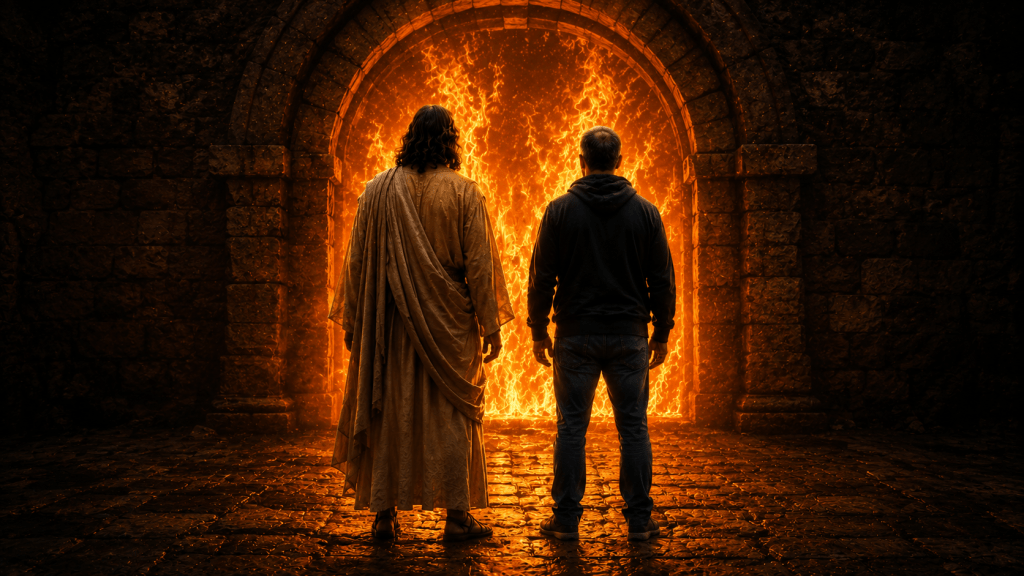
Moses is standing in front of the burning bush. The Lord tells Moses that he is sending him to Egypt to confront Pharaoh and free God’s people. Moses is an Israelite, and God wants him to return to the land he has escaped from—the land where he is a wanted man. The Lord wants Moses to confront and make demands of one of the most powerful individuals in the world—Pharaoh. “Moses,” God says, “I am sending you into the furnace.”
Moses says, “Who? Me? I’m a nobody.” In response, God did not say that it would be easy, that there was no need to be afraid, that Moses would be sleeping in five-star hotels the entire time. No. God said, “I am sending you into the furnace, and I will be with you.”
The Lord never spoke those words to Shadrach, Meshach, and Abednego, but through their faith, God proved they were true. How did Nebuchadnezzar put it? “But I see four men unbound, walking in the midst of the fire, and they are not hurt; and the appearance of the fourth is like a son of the gods.” (Daniel 3:25) God was with them.
For us, God never promises there will be no furnaces in our lives. He never says we’ll come out unscathed, but He does promise, “I will be with you.” Can we believe that?
In our Gospel, we are told, “Jesus began to show his disciples that he must go to Jerusalem and undergo great suffering at the hands of the elders and chief priests and scribes, and be killed, and on the third day be raised.” Jesus said, “I am headed into the furnace.” Peter’s response was very human. Perhaps he was terrified. Perhaps he simply couldn’t imagine losing Jesus. Whatever was going through Peter’s mind, he said, ‘This must never happen.’” Jesus rebuked him. Why? Because Jesus knows He will not be alone in the furnace. He has already said, “The hour is coming, indeed it has come, when you will be scattered, each to his own home, and will leave me alone. Yet I am not alone, for the Father is with me.” (John 16:32-33) Jesus says to Peter, “Follow me.” It is as though Jesus were saying, “I know the furnace is a terrifying place, but follow me, because when you face your own furnace, I will be with you. I will lead you through.”
The three young men defied the furnace. They did not allow it to dictate who they would become. Instead, in their defiance, they declared, “We believe in God.”
Moses defied the furnace in his life and through his words. In doing so, he declared, “God is with me.”
Jesus, fully aware of the furnace, defied it. He declared, “I believe in the Father.”
Jesus says to us, “Follow me, and I will lead you through the furnace, and we will defy it together.”
When you are standing in front of the furnace, all the complicated answers do you no good. If you can even remember them, they fall away. When they do, what remains of your faith?
Imagine: there you are, standing in front of the furnace, burning seven times hotter than ever before.
Why did this happen? How did you end up in such a place?
I don’t know.
Will God save you from all the hurt and the pain?
I don’t know.
How is it going to turn out? Will you live?
I don’t know.
You don’t seem to know very much. Is there anything you do know?
Yes.
What’s that?
“I believe in one God, the Father Almighty. I believe in one Lord Jesus Christ, the only Son of God. I believe in the Holy Spirit, the Lord, the giver of life.” I may not know much, but I do know there is a God and that He is with me.
We can all find ourselves standing in front of any number of furnaces. And it is in those furnaces that our faith becomes costly. They bring with them pain in various forms—evil, loss, death, pain, suffering.
While standing in front of that furnace, we may have no answers as to why any of this is happening or what the outcome will be, but there is one thing we can hold fast to—I believe. We can defy the furnace. It does not mean it won’t hurt. It does not mean that we will not experience great fear, or that we will see a happy outcome, all tied up with a pretty little bow. However—I believe—does mean we are not walking into the furnace alone. So follow Jesus. He has gone before us into the furnace, and He promises, ‘I am with you always, to the end of the age.’”
I believe.
I’ll share with you a portion of Psalm 116:1-10 as a closing prayer. Let us pray: I love the Lord, because he has heard my voice and my pleas for mercy.
Because he inclined his ear to me, therefore I will call on him as long as I live.
The snares of death encompassed me; the pangs of Sheol laid hold on me; I suffered distress and anguish.
Then I called on the name of the Lord: “O Lord, I pray, deliver my soul!”
Gracious is the Lord, and righteous; our God is merciful.
The Lord preserves the simple; when I was brought low, he saved me.
Return, O my soul, to your rest; for the Lord has dealt bountifully with you.
For you have delivered my soul from death, my eyes from tears, my feet from stumbling;
I will walk before the Lord in the land of the living.
I believed, even when I spoke: “I am greatly afflicted.”
Pip: What if the whole arc of history turns on someone you never heard of — a midwife, a sister watching from the reeds, a princess who ignored her father's orders?
Mara: That's the territory Fr. John is working in this week — small actors, enormous consequences, and what Paul's letter to the Romans has to say about how gifts get distributed across a body. Let's start with the sermon itself.
Sermon: Holy Purposes and the People History Forgets
Pip: The sermon opens with a provocation: history's biggest disasters and turning points may hinge on actions so small the people taking them had no idea what they were doing. The question underneath the whole piece is who actually carries the work forward when the famous figure is still in a basket.
Mara: The sermon sets that up early with the Exodus story, and the framing lands here: "The story of Exodus is not just the story of Moses. Instead, it is the story of God and the individuals He endowed with specific gifts so that His will might be accomplished in their lives and in the world."
Pip: And Moses, in this telling, is almost beside the point for this particular passage. He rides in a basket, eats, sleeps — the sermon is blunt about it. Four things. Everyone else is doing the actual work.
Mara: The sermon traces four figures who each carry a piece of that work. The midwives Shiphrah and Puah are summoned by Pharaoh to kill male Hebrew newborns — professionals, the sermon notes, important members of the community — and they simply refuse, fearing God more than Pharaoh.
Pip: There's a quiet observation buried in there worth pulling out: the sermon notes that the Hebrew word for the basket Jochebed builds is tevah — the same word used for Noah's ark. She's not just hiding a baby. She's building an ark.
Mara: Right, and then Miriam watches where the ark goes, and Pharaoh's daughter — the one person in the story with every advantage — sees a Hebrew child and chooses pity over policy.
Pip: Which is where Paul comes in, and the sermon earns the connection. The Romans passage lists gifts: prophecy, ministry, teaching, exhortation, generosity, leadership, compassion. The sermon points out the list is short but the categories are broad — broad enough to hold midwives, mothers, watchers, and wealthy women with the courage to contradict their fathers.
Mara: The sermon then pivots to Peter's confession, and the move is interesting. Jesus asks Peter who he says Jesus is — and the sermon suggests turning that question around: ask Jesus who he says you are. The answer, it argues, is usually already visible in what you can already do.
Pip: God, the sermon says, is not going to make a brain surgeon into a carpenter. He takes what's already there.
Mara: The closing line pulls it together: "If we allow it, God will take our natural gifts and give us opportunities to use them for holy purposes."
Pip: Small actions. Tremendous results. The reeds are still there if you know where to look.
Mara: The thread running through all of it is that the people history skips over are often the ones holding the story together.
Pip: Ask who you are. Open your eyes. Apparently the answer is already in the water.
Many are familiar with the story of Adolf Hitler being rejected from the Academy of Fine Arts Vienna twice. There is no way to know, and many other factors were involved, but might world history have been different if he had been accepted?
One small action, and the result affected everyone on the planet. There are many such stories.
At the Paris Peace Conference in 1919, President Woodrow Wilson received a petition and letter from someone who worked at the Ritz Hotel in France, asking that France withdraw from Vietnam. Another hugely complicated issue, however, it is believed by many that the hotel employee was a young Vietnamese man named Ho Chi Minh. One little thing might have changed much.
Little actions, leading to tremendous results.
Our story from the Old Testament is the beginning of the Exodus and traces the transformation that unfolded in Egypt over many years. When Joseph’s brother came to him, Joseph was held in very high esteem by Pharaoh; however, over time that relationship was forgotten, and the Israelites had become so numerous that Pharaoh and the Egyptians feared them. To weaken the Israelites, they were ruthlessly oppressed.
To further decrease their numbers, two midwives, Shiphrah and Puah, were summoned by Pharaoh. Why them? Scripture does not say. Perhaps they were the ones in charge of others. Whatever the case, they were instructed to kill all male children of the Israelites as soon as they were born.
Unlike Prissy from Gone with the Wind, who didn’t know nothin’ ‘bout birthin’ no babies, these two were professionals. They, like all other midwives, were important members of the community and would have worked day and night, caring for mothers and babies. However, when Pharaoh commanded them to kill the male babies, there was one thing he failed to factor in—these two women feared God more than they feared him. Therefore, they found a way to disregard Pharaoh’s orders. Whether by deception or flat-out lying, they allowed the male children to live. When his covert plan to deal with the Israelites failed, Pharaoh simply demonstrated his own ruthlessness and ordered all male Israelite babies to be thrown into the Nile River—to be murdered.
As the story proceeds, a woman becomes pregnant. We don’t learn her name here, but it is Jochebed. (Exodus 6:20) Jochebed is a woman who is living in very harsh conditions. She is a slave and greatly oppressed. Her child is born, and it’s a boy. Knowing that Pharaoh decreed that all male children be killed, she hides her child for three months. When it becomes apparent that she can no longer hide him, she comes up with a plan.
In English, we read that she made a basket and covered it in pitch. In Hebrew, she made a tevah. The word tevah is used only once elsewhere in Scripture. It is what Noah was told to build—an ark. Jochebed makes an ark for her baby, places the child in it, seals it with pitch, and, in a way, following the command of Pharaoh, casts the ark into the waters of the Nile.
The baby’s sister is also not named here, but we learn it later. She is called Miriam. If Jochebed’s life was hard, Miriam’s was even more so. In the story, she watches to see what happens, as any loving big sister would. She watches the course of her brother’s ark.
The ark and the baby float down the Nile and are seen by Pharaoh’s daughter. We never learn her name, but among all the women in Egypt, she is at the highest point of society. Unlike the midwives, Jochebed, and Miriam, she has everything. She is daddy’s little girl. When she sees the baby in the ark, she immediately knows he is a Hebrew child, but unlike Daddy, she does not see a nemesis or someone to be feared. She sees a child, one to be pitied. Even knowing that Pharaoh has commanded all male Hebrew babies be killed, she finds a way to save this child. Seeing this, Miriam runs over and says she can find someone to nurse the child. Pharaoh’s daughter agrees, and the baby is returned to where he began—in the arms of his mother, Jochebed.
Who was the baby? Moses.
So often, when we read the story of the Exodus, we become so focused on the central characters, God and Moses, that we fail to see the part everyone else played. However, in this part of the story, Moses does only four things: he rides in a basket, he eats, he sleeps, and he poops. That’s it. However, if it hadn’t been for the work of the others, the story would have ended very quickly, and Moses would have drowned in the Nile River.
You are familiar with Saint Paul’s teaching to the Romans that we read today. He says, “As in one body we have many members, and not all the members have the same function, so we, who are many, are one body in Christ, and individually we are members one of another.” He will later expand on this idea, but here he continues by saying, “We have gifts that differ according to the grace given to us: prophecy, in proportion to faith; ministry, in ministering; the teacher, in teaching; the exhorter, in exhortation; the giver, in generosity; the leader, in diligence; the compassionate, in cheerfulness.”
The list is short, but the categories are very broad. It could have easily included midwives—those who care for the poor and the innocent. Those who are willing to stand up against injustice. Those who give of themselves so others might have life.
The list could’ve included the Jochebeds of the world. Those who faithfully fulfill their calling as a mother, father, or guardian, and who, after doing all that is required of them, entrust the work to God.
Paul’s list could also include those like Miriam, who watch and discern. Who know when to speak and what to say. Who know how to put the pieces together so that God’s work moves forward.
The list can include individuals like Pharaoh’s daughter. Those who can use their position and resources to save and care for the less fortunate. Those who can see not a problem to be dealt with, but a child of God made in His image—a human being who deserves the opportunity to survive and to thrive.
The story of Exodus is not just the story of Moses. Instead, it is the story of God and the individuals He endowed with specific gifts so that His will might be accomplished in their lives and in the world. And that is not only the story of the Exodus; it is also the story of the Church.
Each person seated here today has been endowed with a particular grace, a specific gift that can be used in the church and in the fulfillment of God’s purposes. As Paul said, we do not all serve the same function, but together as the body, we serve God.
The gospel reading today is known as the Confession of Saint Peter. Jesus first asks, “Who do the people say that the Son of Man is?” The disciples answer, “Some say this, others say that.” Jesus then makes the question personal: “But who do you say that I am?” Peter answers with his confession, “You are the Messiah, the Son of the living God.” Jesus responds, “Peter, you get the gold star,” but then Jesus does something interesting—He tells Peter who he is: “I tell you, you are Peter, and on this rock I will build my church, and the gates of Hades will not prevail against it.”
Paul tells us that we each have a part to play in God’s kingdom, but sometimes we may not know what that part is. One way to find out is to turn Jesus’ question back to Him. Jesus asks, “Who do you say that I am?” So ask Him the same question. “Lord, who do you say that I am?” Like Peter, you may hear Him come straight up and tell you, or, like Moses, you may encounter a burning bush. However, it is more likely He will say to you, “Open your eyes and look around. What do you see?”
When you do, like Jochebed, you might see those who are vulnerable and in need of nurturing so they can be prepared to go out into the world. Like the midwives, you might see a specific need that must be met for God’s work to continue. Like Miriam, you may be one who has the gift of discernment, organizing others to accomplish the work. Like Pharaoh’s daughter, you may have the resources and compassion to help those less fortunate.
God is funny like that. He’s not going to look at you and say, “You’re a mighty fine brain surgeon, so I’m going to make you a carpenter.” No. God says, as He did with Peter, “You’re a mighty good fisherman, so I’m going to change what you’re fishing for. Instead of fish, it will be people.” If we allow it, God will take our natural gifts and give us opportunities to use them for holy purposes. When we do this, it is called ministry, where a little action can have tremendous results. You may only see one small part. You may not be able to see the wider scope of what is taking place. However, you may see that one piece, that one little thing, that completes the greater work.
Pray, “Lord, who do you say that I am?” Then open your eyes. He will show you. When He shows you, don’t just sit on it. Pick up your call and fulfill your purpose.
Let us pray: Lord Jesus, You call all your people to be your Church, and you give each of us gifts to share. Look with love upon those who serve as lay ministers in your house. May their work build up your kingdom on earth and bring your light to the world. Keep them close to you in daily prayer, and let their lives reflect your great love. We ask this in your holy name. Amen.
Pip: There's a sermon at Candle in a Cave that opens with a man proposing marriage — and his girlfriend immediately asking about someone else. Which, honestly, is a better setup for a theology lesson than most theology lessons get.
Mara: Fr. John uses that story as a way into something the sermon calls "the story of the heart" — what God actually finds when he looks past the surface performance of faith. Let's start there.
Sermon: Proper 15 RCL A — "Story of the Heart"
Pip: The question this sermon is really asking is whether religious observance and genuine faith are the same thing — and the answer, it turns out, is that God is not fooled by the difference.
Mara: The sermon anchors that claim in Psalm 139, with the opening line setting the frame: "O Lord, you have searched me and known me! You know when I sit down and when I rise up; you discern my thoughts from afar."
Pip: So the premise is that the search is already happening, whether you invited it or not. The real question the sermon puts to the listener is whether you actually want God to find what's there.
Mara: And the honest answer the sermon gives is: not always. The words are, "Do I really want God to do that? I mean, I know my heart, and sometimes… it's best left hidden."
Pip: That's a braver thing to say from a pulpit than most people manage.
Mara: The sermon then traces the problem backward through Isaiah, where God tells Israel he is weary of their feasts and offerings — "your hands are full of blood" — while they go through every outward motion correctly. The external performance is intact; the interior is the problem.
Mara: Jesus makes the same move in Matthew 15, quoting Isaiah directly: "This people honors me with their lips, but their heart is far from me; in vain do they worship me, teaching as doctrines the commandments of men."
Pip: And then the sermon does something structurally interesting — it treats the very next scene, the Canaanite woman, not as a change of subject but as the proof of the lesson.
Mara: Right. The disciples tell Jesus to send the woman away. What comes out of their mouths, the sermon says, is "prejudice, contempt, judgment, anger, impatience." The woman, by contrast, keeps pressing — "Lord, help me" — and Jesus names what he finds: "Great is your faith."
Pip: The disciples followed every tradition. She broke every boundary just by being there. And she's the one who gets the blessing.
Mara: The sermon closes by returning to Psalm 139 as an invitation and a request together — not just "search me," but "if you find anything amiss, lead me out of it and into your ways." It calls that a good prayer, and also, honestly, a frightening one.
Pip: The sermon's final question — "what is the story of your heart?" — is one of those that doesn't let you off the hook by answering it quickly.
Mara: And it lands harder because the sermon already admitted the honest answer isn't always flattering. More from Candle in a Cave next time.