I have some excellent yard maintenance skills. Except for a few shrubs, if it is green and grows in my yard… hit it with Roundup. It’s not that I don’t enjoy having flowers; I do, but I don’t want to waste money on plants that are going to die because I know that I’m not going to take care of them. I just really don’t enjoy working in the yard. However, back when the cousin lived in Enid, the yard had all kinds of flowers, and if I planted something, she would take care of it.
Of the few flowers I planted, the one I cherished the most was my John Paul II memorial rose. It was a glorious luminescent white when it bloomed. When that happened, a hundred different types of flowers could be blooming all around it, but that rose would be the only one I noticed.
Have you heard of the Saint we celebrate today, Thérèse of Lisieux, also known as the Little Flower of Jesus? Most say yes. She is often considered one of the greatest modern Saints, having died on October 1, 1897. We read her autobiography, Story of a Soul, for one of our Saints Book Club selections. She is a very “popular” saint. Do you know anything about Verissimus, Maxima, and Julia, or have you even heard of them? No? They are also Saints who share the same feast day as Thérèse—October 1st. All three were martyred in Lisbon, Portugal, under Emperor Diocletian’s persecution in 305 A.D.
When we consider them all together, Thérèse of Lisieux is the St. John Paul II memorial rose, while Verissimus, Maxima, and Julia are seen as little Lantanas or Impatiens.
Thérèse looked at things differently. She writes, “Jesus set before me the book of nature. I understand how all the flowers God has created are beautiful, how the splendor of the rose and the whiteness of the lily do not take away the perfume of the violet or the delightful simplicity of the daisy. I understand that if all flowers wanted to be roses, nature would lose her springtime beauty, and the fields would no longer be decked out with little wildflowers. So it is in the world of souls, Jesus’ garden. He has created smaller ones, and those must be content to be daisies or violets destined to give joy to God’s glances when He looks down at His feet. Perfection consists in doing His will, in being what He wills us to be.”
There are “big” Saints, and there are “little” Saints, but in the eyes of God, they are all Saints. All—whether we recognize their names or not—have submitted to the will of God and fulfilled His purposes; therefore, they reveal His glory in the world. So, if those are the Saints living their eternal lives in Jesus’ garden, where are we? Are we getting hit with the Roundup, or are we also in that garden? Are we those whom God looks lovingly upon as He passes by? You may not always believe it, but you are in that garden. You are one in whom Christ delights.
In our reading from Colossians, Paul said to us, “Set your minds on things that are above, not on things that are on earth, for you have died, and your life is hidden with Christ in God. When Christ who is your life is revealed, then you also will be revealed with him in glory.” (Colossians 3:4)
We may not always believe that we are worthy of being placed in Jesus’ garden with the likes of Thérèse, Verissimus, Maxima, and Julia, and, in our own right, we are not. However, by setting our hearts and minds on Jesus, as all the Saint have done, it is Jesus and His glory that will be revealed in us—that will bloom in us and make us worthy “to share in the inheritance of the saints in light.” (Colossians 1:12)
Little Johnny had gone to the beach with his family. After a short time, Johnny asked his mom if he could go swimming in the ocean. His mother said, “Certainly not. The sea’s too rough, there’s a terrible rip tide and a dangerous offshore current, this coast is infested with jellyfish and sharks, and there’s no lifeguard on duty.” Johnny said, “But Daddy’s gone swimming!” His mother, looking out over the water, replied nonchalantly, “I know, but he has excellent life insurance.”
Last week, as we discussed the Epistle of James, we concluded that we can work at avoiding the sting of sin by drawing near to God and walking in the light. St. James, in his Epistle, said to us, “Submit yourselves therefore to God. Resist the devil, and he will flee from you. Draw near to God, and he will draw near to you.” (James 4:7-8)
From this, a good question would be: How do I draw near to God? How do I walk in the light? We know that through prayer and study, we can accomplish this to some extent. However, the devil is crafty. Even in the beginning in the Garden of Eden, we are told, “Now the serpent—the devil—was more crafty than any other beast of the field that the Lord God had made.” (Genesis 3:1) So, even though we may watch and pray and study, the devil is still looking for ways to deceive us. One of the more successful tactics the serpent may take is not by deceiving us directly but by convincing us to deceive ourselves. This goes back to how we, at times, will dabble in our sins or negotiate with them. As we learned last week, you can’t sin just a little. You are either sinning or not. We deceive ourselves when we think otherwise. Unfortunately, we do this, and even though we may be praying and studying, we can become increasingly mired and stuck in the sin that is killing us.
This is akin to the general confession we make almost every time we gather. On a Sunday, the general confession is the one that we make together following the Creed. It is beneficial, but there needs to be real accountability. Sure, I during the General Confession,I can confess to stealing, but no one is holding me accountable for that sin. No one is asking me to make restitution. No one is around to help me overcome the sin. I confessed the sin of stealing, but I’ve got no skin in the game. So, I am more likely to continue in that sin because I haven’t been “called out” on it and have likely deceived myself and justified my actions. What I really need is for someone to come along and say, “You need to stop stealing, and I’m going to….” Not be your taskmaster, not ride you day in and day out, not condemn you, bash you about the head and neck, none of that. No. What I need is someone to come alongside me and say, “You need to stop stealing, and I’m going to help you to stop deceiving yourself. I’m going to hold you accountable. I’m going to come alongside you and love you.”
This morning, we read the last two verses of the Epistle of St. James. “My brothers and sisters, if anyone among you wanders from the truth—falls into sin—and is brought back by another, you should know that whoever brings back a sinner from wandering will save the sinner’s soul from death and will cover a multitude of sins.” (James 5:19-20)
We come alongside each other and help one another because to save our souls, we need one another. Jesus never sent the disciples out alone, always two-by-two, so he certainly doesn’t want us to go it alone, either. Why? The world we live in can be like rough seas; there can be terrible rip tides and dangerous offshore currents, jellyfish and sharks that can harm us, and there is no lifeguard on duty.” If we go out alone, any number of things can befall us, but if we have someone with us, the chances for our safety are much greater.
As I’ve told you several times before, Christianity does not exist in an individual. Christianity exists in a community. A community of believers that support and care for one another. A community of believers who are, despite all their differences, friends.
If you want warm and sappy, you can always look up quotes about friendship; those quotes often speak about chance encounters. “Friendship is the beautiful chance encounter that enriches our lives.” “In the randomness of life, meeting a friend is a chance worth cherishing.” “A true friend is a rare gem discovered by chance in the vast sea of humanity.” But what if the community we build here and the friends we make are not random chance?
In The Four Loves, C.S. Lewis discusses this. “In friendship,” he writes, “We think we have chosen our peers. In reality, a few years’ difference in the dates of our births, a few more miles between certain houses, the choice of one university instead of another…the accident of a topic being raised or not raised at a first meeting—any of these chances might have kept us apart. But, for a Christian, there are, strictly speaking, no chances. A secret master of ceremonies has been at work. Christ, who said to the disciples, ‘Ye have not chosen me, but I have chosen you,’ can truly say to every group of Christian friends, ‘Ye have not chosen one another but I have chosen you for one another.’ The friendship is not a reward for our discriminating and good taste in finding one another out. It is the instrument by which God reveals to each of us the beauties of others.” (The Four Loves, p.89)
The author of Ecclesiastes confirms the need for these friendships. “Two are better than one, because they have a good reward for their toil. For if they fall, one will lift up his fellow. But woe to him who is alone when he falls and has not another to lift him up!” (Ecclesiastes 4:9-10)
There is no lifeguard on duty, so, for many reasons, we need one another, one of which is to hold one another accountable.
Thomas à Kempis tells us, “God has so ordained, that we may learn to bear with one another’s burdens, for there is no person without fault, no person without burden, no person sufficient to themself nor wise enough. Hence, we must support one another, console one another, mutually help, counsel, and advise, for the measure of every person’s virtue is best revealed in time of adversity—adversity that does not weaken a person but rather shows what they are.” (Imitation of Christ 1.16)
How do we do this? Numerous times, the Bible provides us with instruction, and they all speak of gentleness, love, and humility. However, before you set out on such a task, I suggest you check yourself because, so often, when we seek to correct another person, our actions have little or nothing to do with these traits. Remember the cartoon that made the social media rounds? “You were a believer, yes. But you skipped the
not-being-a-jerk-about-it part.” So often, those things we want to correct in another person have absolutely nothing to do with them and everything to do with us. If you want to hold someone accountable, ensure your heart is in the right place. If you feel that it is, then don’t be a jerk. Go to that person and, with kind and gentle words, speak to them. And don’t do it from a place of superiority or even as a parent would talk to a child. Instead, speak to them as an equal, recognizing that you, too, are a sinner in need of a loving God and also recognizing that tomorrow, it will likely be you who is being spoken to for your sins.
If your heart is in the right place and you truly believe a person needs to be held accountable, correct them. Their very soul may depend on your words. But do so with genuine humility and love.
Jesus said to His disciples, “I no longer call you servants, because a servant does not know his master’s business. Instead, I have called you friends, for everything that I learned from my Father I have made known to you.” (John 15:15)
Jesus calls us friends, so we must be true friends with one another, and the strength of a true friendship can withstand loving one another in such a way that we can hold each other accountable.
In the novel It, my friend Stephen King wrote, “Maybe there aren’t any such things as good friends or bad friends – maybe there are just friends, people who stand by you when you’re hurt and who help you feel not so lonely. Maybe they’re always worth being scared for, and hoping for, and living for. Maybe worth dying for too, if that’s what has to be. No good friends. No bad friends. Only people you want, need to be with; people who build their houses in your heart.” (p.1,043)
I believe this is the kind of friendship that Jesus desires for us. Be that friend to one another.
Let us pray: Guardian Angel, watch over those who have built houses in my heart. Guard over them with every care and make their way easy and their labors fruitful. Dry their tears if they weep; sanctify their joys; raise their courage if they weaken; restore their hope if they lose heart, their health if they be ill, truth if they err, repentance if they fail. Amen.
Part of the time I was in college, I worked at a kennel. During the week, we would be about half full, but on the weekend, the place was usually booked up—200+ dogs, 20 cats, and the occasional bird, snake, lizard, or other family pet. It could be interesting and loud (part of the reason I say, “Huh,” so much.)
There’s quite a bit to do when caring for so many animals, but there are also times when not much happening—even the dogs like an afternoon nap. However, the owner of the place was not big on employees just sitting about, so he was always good at finding something for us to do. On one occasion, he decided that a two-story house on the property needed to be painted, and the job fell on me. I can paint, so no problem, but before I could get at it, I had to remove the thick vines that had grown and covered one entire side of the house.
I worked the lower levels with no problem, then hauled out the ladder and started on the upper level. It was in the middle of summer in Texas, and it was hot, dirty work, so I had peeled off my shirt, so I’m about fifteen feet up, wearing a pair of shorts and sneakers. This is when I yank on one particular vine, which erupts in a horde of yellow jackets. In my humble opinion, the yellow jacket is not one of God’s creations. It is of the devil, for sure.
I make it about three feet down the ladder before I get stung.
That little yellow cuss got me on top of the head, so I reached up to swat it—and this is where the real satanic powers of the yellow jacket kick in; unlike a honey bee, a yellow jacket can sting you as many times as it likes. So, when I swat it off my head, it stings me on the hand. When it stings me on the hand, I slap it to my chest, hoping to be rid of it, and, yes, it stung me on the chest. I’ve no idea how I managed not to fall the remaining twelve feet off the ladder.
I’ve had kidney stones, but I’m pretty sure those three stings were more painful. The pain is absolutely excruciating and all-encompassing. As many of you know, when a yellow jacket stings, you don’t just feel it at the site of the sting; your entire body is jolted, as with an intense electrical shock that courses all the way through.
St. Augustine (he died in the year 430) had a young friend and student, Alypius. Alypius had gone to Rome to study and attempted to keep himself from falling into traps on the seedier side of the great city, so he stayed away from many of the events, including the battles of the gladiators in the Colosseum. However, one day, his friends dragged him there. Alypius said to them, “You may drag me there bodily, but do you imagine that you can make me watch the show and give my mind to it?”
As if to prove they could, they hauled him in. The entire time, Alypius kept his eyes tightly closed, never peaking. However, a battle took place, and at one point, a great cry arose from the onlookers. It was too much. Augustine reports, “So Alypius opened his eyes, and his soul was stabbed with a wound more deadly than any which the gladiator, whom he was so anxious to see, had received in his body. He fell, and fell more pitifully than the man whose fall had drawn that roar of excitement from the crowd. The din had pierced his ears and forced him to open his eyes, laying his soul open to receive the wound which struck it down.
“When he saw the blood, it was as though he had drunk a deep draught of savage passion. Instead of turning away, he fixed his eyes upon the scene and drank in all its frenzy, unaware of what he was doing. He reveled in the wickedness of the fighting and was drunk with the fascination of bloodshed. He was no longer the man who had come to the arena, but simply one of the crowd which he had joined, a fit companion for the friends who had brought him.” (Confessions, VI.8)
The yellow jacket sting is all-encompassing, but after a short time, the pain subsides. When, like Alypius, we open ourselves, our eyes, and our bodies to sin, that “sting” is also all-encompassing, but the effects do not subside. Not only that, but the “sting” of sin infects and corrupts the body and the soul. Like Alypius, once infected, we want more. We get caught up in the madness that is so satisfying for a moment but will eventually kill us if we do not repent.
Matthew, Chapter Five is the beginning of the Sermon on the Mount. It starts with the Beatitudes—blessed are the meek, blessed are the merciful, blessed are the peacemakers—and then continues with a litany of teachings on anger, lust, retaliation, and enemies. While speaking on lust, Jesus says something quite startling, “If your right eye causes you to sin, tear it out and throw it away. For it is better that you lose one of your members than that your whole body be thrown into hell. And if your right hand causes you to sin, cut it off and throw it away. For it is better that you lose one of your members than that your whole body go into hell.” (Matthew 5:29-30)
Now, we know that Jesus does not intend for us to pluck out an eye or cut off our hands. These are deliberate exaggerations, but they are exaggerations that describe how ruthlessly we are to deal with our sins. No dabbling. Sinning a little bit is like being a little bit pregnant. No negotiations. I’ve shared it with you before: if you dance with the devil, the devil doesn’t change. The devil changes you. Be rid of it. Why? Because once you open your eyes to evil, once you touch that which should not be touched, once you begin to sin, it is all-encompassing.
You may have noticed that all this month, our New Testament lesson has been from the Epistle of James. He frequently speaks of this idea of the beginning of sin leading to all-encompassing sin.
In chapter two, James, speaking of the Mosaic Law, says, “You do well if you really fulfill the royal law according to the scripture, ‘You shall love your neighbor as yourself. But if you show partiality, you commit sin and are convicted by the law as transgressors. For whoever keeps the whole law but fails in one point has become accountable for all of it.” (James 2:8-10) It starts small, showing partiality, but it leads to a complete abandonment of all the Law.
Further on, he writes, “How great a forest is set ablaze by a small fire! And the tongue is a fire. The tongue is placed among our members as a world of iniquity; it stains the whole body, sets on fire the cycle of nature, and is itself set on fire by hell.” (James 3:5b-6) How many relationships, be they between individuals, families, friends, and even nations, have been utterly ruined by the tongue? By hurtful words? James is saying, don’t let it start. Don’t give that sin a single spark; it may bring everything down.
We heard today, “Those conflicts and disputes among you, where do they come from? Do they not come from your cravings that are at war within you? You want something and do not have it; so you commit murder. And you covet something and cannot obtain it; so you engage in disputes and conflicts.” (James 4)1-2a) Look at the wars in the world. What brings them on? Peoples or governments wanting what belongs to another. Whether it be land or oil or bragging rights. The same can happen to us if we seek to take what others have.
What is the solution? How can we work to avoid the “sting” of sin and the all-encompassing pain that begins with a single stick but consumes body and soul? Jesus’ exaggeration of plucking out an eye or cutting off a hand is defined for us in the words we heard from James this morning: “Submit yourselves therefore to God. Resist the devil, and he will flee from you. Draw near to God, and he will draw near to you.” (James 4:7-8)
Jesus said, “The light has come into the world, and people loved the darkness rather than the light because their works were evil. For everyone who does wicked things hates the light and does not come to the light, lest his works should be exposed. But whoever does what is true comes to the light, so that it may be clearly seen that his works have been carried out in God.” (John 3:19-21)
We work at overcoming sin by resisting the works of darkness and the devil. Therefore, come into the Light and draw near to God, and the Light of God will draw near to you and embrace you.
“‘O death, where is your victory? O death, where is your sting?’
The sting of death is sin, and the power of sin is the law. But thanks be to God, who gives us the victory through our Lord Jesus Christ.” (1 Corinthians 15:55-57) Amen.
Let us pray: Holy Michael, the Archangel, defend us in battle. Be our safeguard against the wickedness and snares of the devil. May God rebuke him, we humbly pray; and do you, O Prince of the heavenly host, by the power of God, cast into hell Satan and all the evil spirits who wander through the world seeking the ruin of souls. Amen.
“The most terrifying words in the English language are: I’m from the government, and I’m here to help.” Ronald Reagan
For those of you who are married, I warn you up front not to laugh at this one. “‘I am’ is reportedly the shortest sentence in the English language. Could it be that ‘I do’ is the longest sentence?” George Carlin
The English language—words and grammar. One misspelled word, and you’ll either end up being holy, someone approaching sainthood (such as myself), or being wholly, someone who’s been shot up the OK Coral. One forgotten comma can turn “Let’s eat, gramma,” a call to supper, into “Let’s eat gramma,” an unfortunate act of cannibalism.
After the basics, you get into nouns and verbs, pronouns and adverbs, which brings me to Little Johnny. Johnny was sitting in English class and not paying attention. The teacher, looking to bring him back from wherever his mind was, pointed at him and said, “Name two pronouns.” Johnny replied, “Who, me?”
Based on those who laughed, we now know who is good with words and grammar.
“Who, me?”
In the Church of San Luigi dei Francesi in Rome, there are three magnificent paintings by the great Italian artist Caravaggio. Each of the paintings portrays a significant moment in the life of our Patron Saint, Matthew. There is the Inspiration of St. Matthew, the angel giving Matthew the words of his Gospel, and the Martyrdom of St. Matthew, depicting his death. However, the one that concerns us today is the Calling of St. Matthew.
In the painting, Matthew is seated with five other tax collectors who are counting their money. Also in the scene are Jesus and Peter, both of whom are pointing at Matthew.
Matthew’s right hand is stretched out on the table, counting coins, while with his left hand, Matthew is pointing back to himself. The expression on his face—“Who, me?”
I know that feeling. When I first heard God calling me into service, my first response was, “Don’t be stupid.” Yet, God was calling me, and God was calling Matthew. Both of us responded, “Who, me?” And in each case, God responded, “Yes, you.”
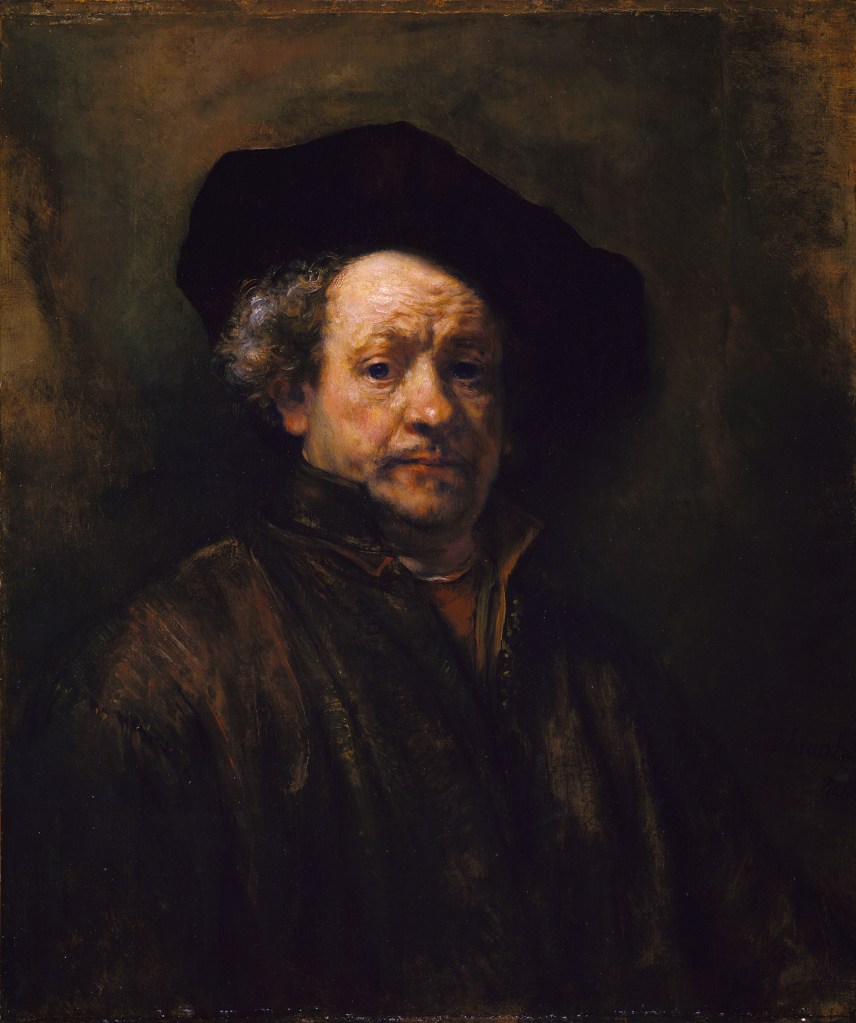
Another of the greatest artists is Rembrandt. In his early career, Rembrandt was wildly successful. Painting and selling portraits, buying the big house, and all the finest art to fill it—living the life. However, all the big spending eventually caught up to him, and he ended up losing it all and dying penniless. Even though he had lost everything, he continued to paint, and the subject he most frequently painted was himself. Rembrandt painted sixty-three self-portraits. This was not an exercise in vanity, nor was it simply to practice his art. He painted himself, year after year, as a “‘search for the spiritual through the channel of his innermost personality.’ Rembrandt felt that he had to enter into his own self, into his dark cellars as well as into his light rooms, if he really wanted to penetrate the mystery of man’s interiority.” (You are the Beloved, Henri Nouwen, June 27) Through those sixty-three self-portraits, Rembrandt was searching for himself. In the process, he understood that as he lived his life, he was also repainting his interior self—a continuous reworking of an interior self-portrait.
Jesus pointed at Matthew, and Matthew pointed at himself and asked, “Who, me?” Jesus responded, “Yes, you.” So, like Rembrandt, Matthew was left with the option of repainting his interior self-portrait or remaining as he was, sitting at a table counting coins, never realizing the life Jesus was calling him to. It is the same for each of us.
We each have an interior self-portrait that is being continuously repainted as we seek to know who we truly are. This interior self-portrait has little or nothing to do with the portrait and all the masks we show to the world. Instead, the interior self-portrait includes all the light and all the darkness that you don’t show to anyone. Sometimes, that interior self-portrait is so fluid it has difficulty maintaining form, and we begin to wonder who we actually are.
During World War II, the great German theologian Dietrich Bonhoeffer was arrested and imprisoned. He would be executed before he could be freed. Although his writing reflects a deep and abiding faith, he, too, had his doubts as to who he truly was. His interior self-portrait was also fluid. During one of those moments, instead of painting an image, Bonhoeffer wrote a poem—Who Am I?
Who am I? They often tell me, I step out from my cell, composed, contented and sure, like a lord from his manor.
Who am I? They often tell me, I speak with my jailers, frankly, familiar and firm, as though I was in command.
Who am I? They also tell me, I bear the days of hardship, unconcerned, amused and proud, like one who usually wins.
Am I really what others tell me? Or am I only what I myself know of me? Troubled, homesick, ill, like a bird in a cage, gasping for breath, as though one strangled me, hungering for colors, for flowers, for songs of birds…
Am I then, this today and other tomorrow? Am I both at the same time? In public, a hypocrite And by myself, a contemptible, whining weakling?
Who am I? Lonely questions mock me.
He then concludes,
Who I really am, you know me, I am thine, O God! (Voices in the Night, p.45)
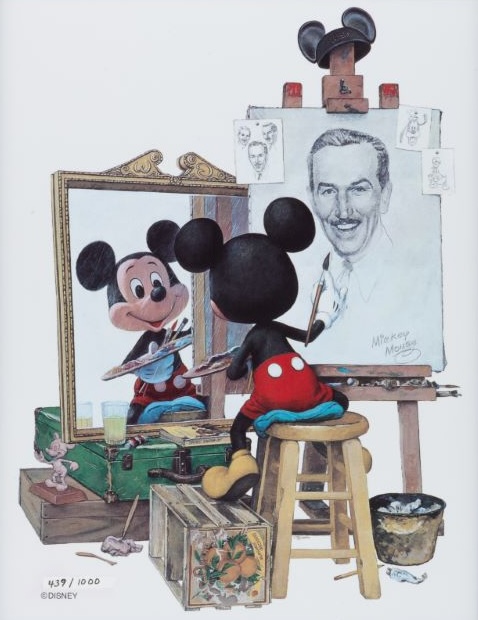
One more artist, perhaps you’ve not heard of—Charles Boyer. Boyer began working for Walt Disney and Disneyland in 1960. In one of his paintings, he has Mickey Mouse painting a self-portrait. Mickey is leaning over, looking in a mirror, and busily painting his portrait. However, the image on the canvas is not that of Mickey Mouse. It is Walt Disney. Mickey Mouse is painting the image of his creator that is within him.
Bonhoeffer asked, “Who am I?” He concluded, “Who I really am, you know me, I am thine, O God!” Bonhoeffer was painting his interior self-portrait and, in doing so, was attempting to paint the image of his Creator that was within him.
Rembrandt looked in the mirror and painted his sixty-three self-portraits, all along, searching for the image of the Creator Who was within him.
Jesus looked at Matthew and said, “Follow me.” In doing so, Jesus invited Matthew to follow Him and repaint the interior self-portrait. At first, Matthew probably thought, “Who, me?” But then we are told, “he got up and followed” Jesus. Matthew repainted the interior self-portrait, and it revealed the image of his Creator.
St. Paul, writing to the Ephesians, tells them “to put off your old self, which belongs to your former manner of life and is corrupt through deceitful desires, and to be renewed in the spirit of your minds, and to put on the new self, created after the likeness of God in true righteousness and holiness.” (Ephesians 4:22-24) We are called to do the same—to put off the old self and to put on the new self. To repaint the interior self-portrait into the image of our Creator… into the image of Jesus.
When Jesus points to us, we, along with so many others, likely say, “Who, me?” Jesus smiles and says, “Yes, you. You follow me. Repaint the interior self-portrait in My Image, for I am your loving Creator, and you are Mine.”
Today, Jesus hands you a set of paints, some brushes, and a fresh white canvas. He invites you to follow Him. He invites you to repaint yourself in the Image of your Creator. In His Image. You say, “But I can’t paint!” From Proverbs, we read,
“Trust in the Lord with all your heart, and do not rely on your own insight.” (Proverbs 3:5)
You can’t paint? Trust in the Lord to guide you. Don’t rely on yourself; He will reveal His Image in you.
Let us pray: God, our Father, You redeemed us and made us Your children in Christ. Through Him You have saved us from death and given us Your Divine life of grace. By becoming more like Jesus on earth, may we come to share His glory in Heaven. Give us the peace of Your kingdom, which this world does not give. By Your loving care protect the good You have given us. Open our eyes to the wonders of Your Love that we may serve You with willing hearts. Amen.
A little bit of sports trivia for you this morning (not that I’m an expert). Who did the Kansas City Chiefs play at Arrowhead Stadium in Kansas City on September 29, 2014? Answer: New England Patriots. The Chiefs won that game 41-14, but the Patriots went on to win the Super Bowl that season. If that is the case, what is so special about the September 29th game? As it turns out, a world record was set—Arrowhead Stadium officially became the world’s loudest NFL arena, reaching 142.2 decibels. How loud is that? You know those cars that pull up next to you, and they’ve got the stereo volume cranked up so loud you can not only hear it but feel it? Well, turn up that volume even more, and you might reach 142.2 decibels. It is about the equivalent of firing off a high-powered rifle right next to your ear, with no ear protection. It is loud enough to be very painful and damaging.
That’s American football, but when you say “football” to the rest of the world, they think of a different sport—soccer. Soccer fans are almost as loud as our football fans. The loudest soccer field is in Turkey. They reached 131.76 decibels. Still enough to blow out a few ear drums. However, earlier this month, a soccer match was played in the 13,000-seat Eiffel Tower Stadium in Paris. The stadium was filled, and the game was very exciting, but for the most part… well, you might not have been able to hear a pin drop, but you could hear the tinkling of a small bell. Welcome to the sport of blind soccer. Yes. You heard that correctly—blind soccer. The fans are very quiet because the ball has a small bell inside that the players listen for. Through that slight sound and the voices of coaches and teammates, they can play the game. If the fans make noise, the game cannot be played.
We know why sports stadiums get loud—people are excited about the game or ticked off at the referees, but why do rooms full of people get loud? You only have to think of our parish hall during a potluck. At first, it is quiet, but then people begin to talk. I don’t think we’ve ever reached 142 decibels, but it occasionally gets pretty loud. Why is that? The answer was discovered by Étienne Lombard, an otolaryngologist (one who studies the relationship between ears, nose, and throat), and the answer was named after him—the Lombard Effect. Simply put, the louder an environment becomes, the louder our voices become. Not only does it affect humans, but animals as well (which provides no explanation as to why the Queen likes to meow loudly in the middle of the night. It is good to be Queen.)
What does any of this have to do with today?
From our Gospel reading: “Jesus set out and went away to the region of Tyre. He entered a house and did not want anyone to know he was there.” And then a little further, after healing a deaf-mute, “Jesus ordered them to tell no one.” Jesus was looking for a quiet place. However, the more Jesus sought quiet places where He could be alone and the more He ordered them to keep quiet, “the more zealously they proclaimed it” and Him.
In a sense, the Lombard Effect was at play, and the decibels were climbing. He wanted them to remain silent, but once one person started talking about Him, another would, and another, until an uproar surrounded Him. Unfortunately, Jesus was trying to hear the tinkling of the bell. Jesus had a very specific goal in mind. All the attention and people seeking Him out were not necessarily a distraction from fulfilling this goal. Yet, He did not want to come to the attention of the religious leaders and other authorities any more than was necessary until everything was in place.
The first encounter we read about today took place in Tyre. This was on the coast and very much a Gentile region. Jesus had hoped to go unnoticed, perhaps thinking that since Jews and Gentiles weren’t the best of friends, they would be ignored. However, while there, He meets the Syrophoenician woman, who, even though a Gentile, dares to speak to a Jew.
Having heard of Jesus, she asks Him to heal her daughter of the demon. Jesus responds, “Let the children be fed first, for it is not fair to take the children’s food and throw it to the dogs.” That sounds like a terribly rude rebuke, but most commentators will agree that Jesus would not have meant it as such when speaking to the woman and that the woman would have known it. They were both playing the game—Jews and Gentiles did not get along, and if you think what Jesus said was rude, well, you should hear how the Gentiles referred to the Jews. They both slipped into their roles, and they both played the game. A bit like two good friends trash-mouthing one another. “Yo mama’s so fat, her picture fell off the wall.” “Well, Yo mama’s so fat, her blood type is marinara sauce.” Things like that. Because of her faith, and in spite of the fact that she was a Gentile, Jesus healed her daughter of the demon. The Scriptures do not indicate it, but do you think she kept quiet when she came home and found her daughter cured? Or do you think decibels increased?
Jesus told His disciples, “They know us here, so let’s head inland to the Decapolis (another Gentile region) and see if we fare any better.” They did not. The people immediately recognize Jesus and bring him to the deaf-mute. Jesus takes the man to a private place so that others will not witness the miracle, but to no avail; the decibels increase. “He has done everything well; he even makes the deaf to hear and the mute to speak.”
The irony of that second healing is apparent. Jesus wants them to remain silent, but He heals a deaf-mute, so there is one more individual who can hear and proclaim. However, now, Jesus is not only a great teacher and miracle worker, but He is also fulfilling prophecy, and the people know it. We read from the Prophet Isaiah,
“Then the eyes of the blind shall be opened, and the ears of the deaf unstopped;
then the lame shall leap like a deer, and the tongue of the speechless sing for joy.”
And the decibels increase, yet Jesus is focused. Like one of the blind soccer players, Jesus is listening for one thing. He has one goal—the Father’s Will. What is the Will for the Father? Jesus said, “This is the will of him who sent me, that I should lose nothing of all that he has given me, but raise it up on the last day. For this is the will of my Father, that everyone who looks on the Son and believes in him should have eternal life, and I will raise him up on the last day.” What did the Father give to Jesus? Everything and Everyone. The Will of the Father was that Jesus redeem all of Creation, and he couldn’t do that, healing one demon-possessed girl at a time or one deaf-mute at a time. In addition, these types of healing only heal the body. Jesus’ goal was to heal the soul. To heal the broken relationship between us and God. Jesus was to say, “Ephphatha,” “be open,” not just so that the ears of the deaf could be opened. He was to say “Ephphatha” so that the souls of all humankind could be opened, and this could only occur through His death and resurrection. For as Jesus said, “Now is the judgment of this world; now will the ruler of this world be cast out. And I, when I am lifted up from the earth, will draw all people to myself.” (John 12:31-32)
During the last years of Jesus’ life, much noise surrounded Him, yet he needed to lower the decibels until this work was complete. You and I are now free to shout Jesus’ goal from the mountain tops, but like Jesus, there are times when we need to lower the decibels of our own lives so that, like Jesus, we can listen for the “tinkling of the bell.” So that we can discover and hear the will of the Father in our lives.
The author of the Book of Ecclesiastes tells us there is “a time to keep silence, and a time to speak.” (Ecclesiastes 3:7b) How might Jesus speak the word “Ephphatha… be opened” to the ears of your soul so that you may hear the voice of the Father? How might you make opportunities to provide the quiet that is necessary to hear above all the noise of your life?
My friend, St. Josemaría Escrivá, writes, “Silence is the door-keeper of the interior life.” (The Way #281) Take the necessary time to find a place to lower the decibels and then listen. In doing so, like Jesus, you can discover the Will of the Father. Then, like Jesus, live your life fulfilling that Will without allowing the noise to distract you from it.
Let us pray: From all eternity, O Lord, You planned our very existence and our destiny. You wrapped us in Your love in baptism and gave us the Faith to lead us to eternal life and happiness with You. Now we ask for the light we so earnestly need that we may find the way of life in which lies the best fulfillment of Your will so on the last day, we may find our reward in union with You forever and ever. Amen.
Before the first day, you were known. On the last day, you will be judged.
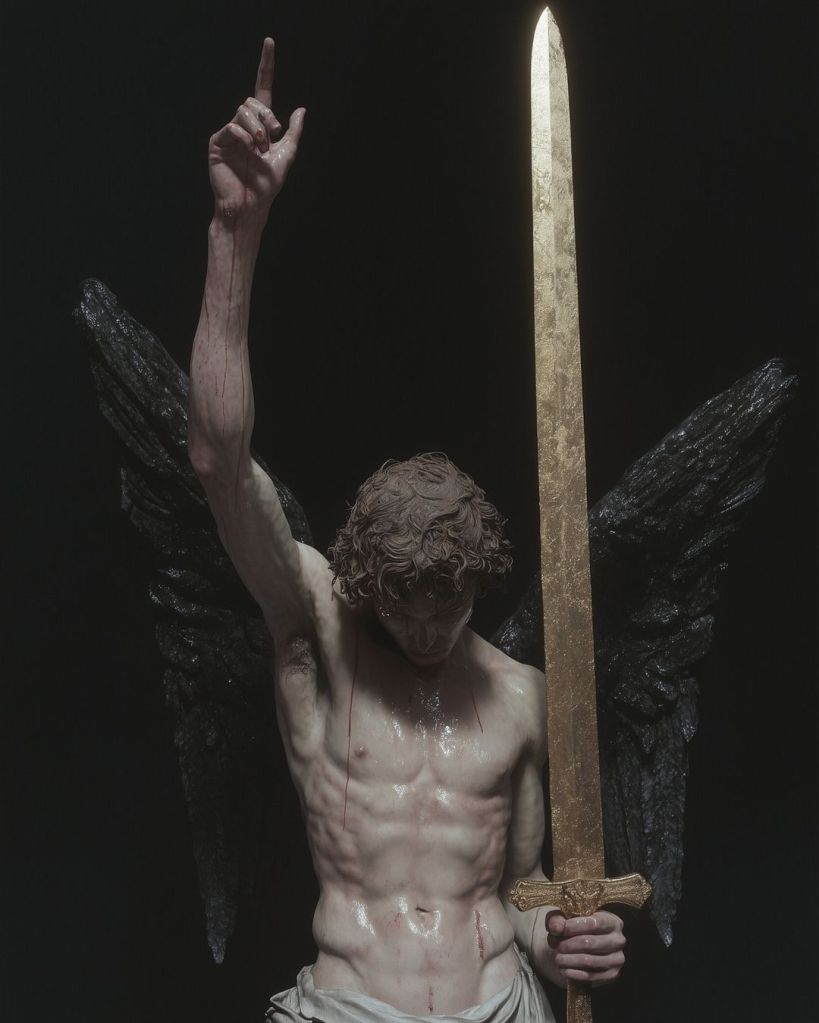
There are swords made to slay the dragon. There are swords to pierce your heart.
An angel guards your path. A fallen one seeks your soul for his own.
There are seven days in a week. There are three hundred sixty-five days in a year. There are only so many days in your life. Live them wisely.
Honor everyone. Love the brotherhood. Fear God. Honor the emperor.
You’re going to die.
Have a little whiskey. Not too much. It can be good for the soul. It can bring you to hell.
Pause. Let the angels go before.
Pause. Say a prayer for you and for me.
This is not the time to speak your mind. This is not the time to allow others to rule your heart. This is not the place to falter or fade. This is the place to stand.
Question. Who is going to live your life for you?
I saw the sun rise. You were there. We shall live. For ever and ever . Amen.
That great storyteller, Garrison Keillor, talks about Episcopalians, and I would say he gets it all correct. It is too much to read, but it is too much fun not to.
We make fun of Episcopalians for their blandness, their excessive calm, their fear of giving offense, their lack of speed, and also for their secret fondness for macaroni and cheese. But nobody sings like them.
If you were to ask an audience in Des Moines, a relatively Episcopalianless place, to sing along on the chorus of “Michael Row the Boat Ashore,” they would look daggers at you as if you had asked them to strip to their underwear. But if you do this among Episcopalians, they’d smile and row that boat ashore and up on the beach! ….And down the road!
Episcopalians believe in prayer but would practically die if asked to pray out loud. Episcopalians like to sing, except when confronted with a new hymn or a hymn with more than four stanzas. Episcopalians believe their Rectors will visit them in the hospital, even if they don’t notify them that they are there. Episcopalians usually follow the official liturgy and will feel it is their way of suffering for their sins. Episcopalians believe in miracles and even expect miracles, especially during their stewardship visitation programs or when passing the plate. Episcopalians feel that applauding for their children’s choirs will not make the kids too proud and conceited. Episcopalians think that the Bible forbids them from crossing the aisle while passing the peace.
And finally, you know you are an Episcopalian when:
It’s 100 degrees, with 90% humidity, and you still have coffee after the service.
You hear something really funny during the sermon and smile as loudly as you can.
Donuts are a line item in the church budget, just like coffee.
When you watch a Star Wars movie and they say, “May the Force be with you,” and you respond,” and also with you.”
And lastly, it takes ten minutes to say good-bye.
As Teyve declares, “Traditions, traditions. Without our traditions, our lives would be as shaky as… as… as a fiddler on the roof!”
Whether we realize it or not, we all adhere to certain traditions. Within religious groups, theologian James Dunn refers to these traditions as “boundary markers.” “Boundary markers are highly visible, relatively superficial practices that serve to distinguish people inside a group from those outside.” (Note: Why Jesus’ Disciples Wouldn’t Wash Their Hands – fascinating article) He says that if you pull up next to a classic VW van with flower power stickers and “Make love, not war” bumper stickers driven by a throwback to Woodstock, then through these boundary markers, you know who you’re dealing with; and the same applies to the—and I quote—hair-moussing, Rolex-wearing, Brie-tasting, chardonnay-sipping 30-year-old, you know his group as well.”
Thankfully, the Episcopal Church has no such traditions or boundary markers! Haha. We, as Episcopalians, are steeped in our traditions, from the order in which we light the candles to the red doors of our church to how we hurdle pews during the Peace. When Dunn says that these boundary markers/traditions are “superficial,” he is not necessarily saying that they are shallow but are instead on the surface. Easily visible. They are what distinguish us from other groups. That in itself is not a bad thing. Those traditions contribute to our identity and enhance our worship experience. However, they become bad when we view them as signs of superiority—when we say that our traditions make us better than others. “When receiving communion, they use Welch’s grape juice. That’s not communion; that’s a children’s birthday party! They are so wrong!” Our traditions are to be enhancements to our worship, not weapons to use against those who don’t observe them. Why? Because at the heart of all we do is Jesus, not our boundary markers or traditions. At the heart of our worship is God. Is Jesus.
Now, within Judaism, there is the Mosaic Law, the Law of Moses, and then there is interpretation of that Law, allowing it to be put into practice. Naturally, putting these into practice led to several habits, which eventually led to traditions within the Jewish faith. Not bad. However, as the tradition became more ingrained in the community, adhering to the tradition was seen as adhering to the Law. Breaking with tradition was, therefore, equivalent to breaking the Law. Worse, those who kept and enforced the boundary markers used them as signs of superiority over others and chains to keep the people enslaved by the Law. Hence, Jesus’ criticism in Matthew’s Gospel is that “They—the religious leaders—tie up heavy burdens, hard to bear, and lay them on the shoulders of others; but they themselves are unwilling to lift a finger to move them.”
Today in our Gospel, the Pharisees confronted Jesus over one of these traditions, “Why do your disciples not live according to the tradition of the elders, but eat with defiled hands?” The Mosaic Law called for the people to sanctify themselves. This was later interpreted as being clean, washing yourself, and a tradition built up around how this was to be done. According to this “tradition of the elders,” the hands were extended, and water was poured over them one time to remove any “defilement,” then, water was poured over them a second time to remove the water that had absorbed the defilement.
It may seem that the Pharisees were onto something and that Jesus and his disciples were in the wrong. However, the Pharisee’s criticism is not about hygiene. The Pharisee’s criticism is about why Jesus and disciples weren’t following tradition. The Pharisees were using the tradition as a weapon. Jesus response:
“’This people honors me with their lips, but their hearts are far from me; in vain do they worship me, teaching human precepts as doctrines.’
You abandon the commandment of God and hold to human tradition.”
Jesus is saying Our Father desires for the people to be holy and sanctified—spiritually clean—but you are so wrapped up in whether or not they accidentally snuffed out the Gospel candle before extinguishing the Epistle side candle that you have forgotten the heart of the matter. You have forgotten the soul, and you have forgotten God. The old saying is true, “God wants spiritual fruit, not religious nuts.”
Perhaps for you and me, the biggest problem is not thinking of ourselves as superior to others or using our traditions as a weapon. The immediate problem for us would be getting so caught up in “doing church” that we forget why we are here. God is not going to smite us dead if we happen to say “Alleluia” during Lent. Yet, we can get so caught up in putting on a good show that we miss the opportunity to truly worship our God and fellowship with one another.
Erma Bombeck wrote a column titled “If I Had My Life to Live Over Again.” Hear some of her points: If I had my life to live over again, I would have waxed less and listened more. I would never have insisted the car windows be rolled up on a summer day because my hair had just been teased and sprayed. I would have invited friends over to dinner even if the carpet was stained and the sofa faded. I would have cried and laughed less while watching television … and more while watching real life. I would have eaten less cottage cheese and more ice cream. When my child kissed me impetuously, I would never have said, “Later. Now, go get washed up for dinner.” There would have been more I love yous … more I’m sorrys … more I’m listenings … but mostly, given another shot at life, I would seize every minute of it.”
That speaks of living life, but it also speaks of how we are to be the Church. Fear not; I love the traditions of our Church. I would add even more if I thought I could get away with it, but in the process of doing church, let’s not forget why we’re here. And why is that? Jesus said to the woman at the well, “The hour is coming, and is now here, when the true worshipers will worship the Father in spirit and truth, for the Father seeks such as these to worship him. God is spirit, and those who worship him must worship in spirit and truth.” We are here to worship our God in spirit and in truth.
These past several Sundays, we have been talking about the Holy Eucharist and our liturgy, and, as I said, it is all steeped in tradition. Allow those traditions to aid you in worship, but remember, we are not here to worship the liturgy or the traditions. We are here to worship God and to fellowship with one another.
Let us pray: O Lord, our God, You called Your people to be Your Church. As we gather together in Your Name, may we love, honor, and follow Your Son to eternal life in the Kingdom He promised. Increase in us the gifts You have given Your Church that Your faithful people may continue to grow in holiness and in imitation of Your Beloved Son, Jesus, in whose Name we pray. Amen.
A man goes to the doctor. He says, “Doc, you gotta check my leg. Something’s wrong. Put your ear up to my thigh; you’ll hear it!”
The doctor cautiously placed his ear to the man’s thigh only to hear, “Gimme 20 bucks; I really need 20 bucks.”
“I’ve never seen or heard anything like this before; how long has this been going on?” The doctor asked, his confusion growing by the second.
“That’s nothing, Doc; put your ear to my knee.”
The doctor put his ear to the man’s knee and heard it say, “Man, I really need fifty dollars; just lend me fifty bucks!!”
“Sir, I really don’t know what to tell you. I’ve never seen anything like this.” The doctor was dumbfounded.
“Wait, Doc, that’s not it. There’s more; just put your ear up to my ankle,” the man urged him.
The doctor did as the man said and was blown away to hear his ankle plead, “Please, I just need one hundred dollars. Lend me a hundred bucks, please, if you will.”
“I have no idea what to tell you,” the doctor said. “There’s nothing about it in my books,” he said as he frantically searched all his medical reference books. “I can make a well-educated guess, though.”
“Please, Doc, anything.”
The doctor says, “Based on life and all my previous experience, I believe your leg is broke in three places.”
Today’s reading from St. Paul’s letter to the Ephesians is a classic—the Armor of God. It is one of those you can read and feel as though you could take on the world—the shield of faith, the breastplate of righteousness, the sword of the Spirit. Hoorah. However, hidden amidst these beautiful words, Paul identifies his real intent for writing them, which is one of the overall themes of this letter.
Paul says, “For our struggle is not against enemies of blood and flesh, but against the rulers, against the authorities, against the cosmic powers of this present darkness, against the spiritual forces of evil in the heavenly places.” “For our struggle is not against enemies of blood and flesh.” Paul could have left that bit out, but the trouble was those he was writing to were divided. They were struggling, fighting against one another.
The fight was not only one the Ephesians were struggling with, but so were many of the other churches and even the twelve original Apostles. The fight was over whether or not a person needed to be a practicing Jew before they could become a Christian or could they convert to the faith, to Christianity, without taking on the burden of the Law of Moses—the prime example being whether or not a non-Jewish male could become a Christian without first being circumcised, a law that God had given Abraham even before Moses.
Some of the Jewish Christians said, “Yes, you must circumcised,” while the pagan converts, along with Paul, said, “No, it is not necessary.” It was enough of a fight that many believers would not worship together; therefore, Paul said, “Our struggle is not against enemies of blood and flesh, but against … the spiritual forces of evil in the heavenly places.” We are not here to fight against one another over trivialities but against true evil in the world.
The issue would not be settled until the Council of Jerusalem in the year 48; however, Pual had provided a solution years before when he had written that original letter to the Ephesians. He said to them all, “You are no longer strangers and aliens, but you are fellow citizens with the saints and members of the household of God, built on the foundation of the apostles and prophets, Christ Jesus himself being the cornerstone, in whom the whole structure, being joined together, grows into a holy temple in the Lord.” (Ephesians 2:19-21) Put another way, your personal opinions and feelings about one another have no bearing on your life together. Why? Because you, as individuals and sects, are not the focal point. You are not the center of your life together. You will not find peace and unity by looking to one another. You will only find peace and unity in your life together by directing your attention solely to Jesus.
Henri Nouwen writes, “When Jesus prays for unity, he asks his Father that those who believe in him, that is, in his full communion with the Father, will become part of that unity. I continue to see in myself and others how often we try to make unity among ourselves by focusing all our attention on each other and trying to find the place where we can feel united. But often we become disillusioned, realizing that no human being is capable of offering us what we most want. Such disillusionment can easily make us become bitter, cynical, demanding, even violent.” (The Road to Daybreak)
Is that true?
In the world today, there are over 8 billion people. Of that, roughly 2.2 billion are Christian. Christians are broken into three major denominations: Catholic, Orthodox, and Protestant. As I’ve shared with you, these are further divided and fractured, leaving us with an estimated 45,000 different Christian denominations. How did we fracture so far? By focusing on each other instead of focusing on Jesus, and we are witnessing the continuing fallout of our actions.
For example, consider the recent kerfuffle in Oklahoma and in our own community—the teaching of the Bible in public schools. You know my position and have heard what many others have said. Last week or the week before, the local Enid Public Schools superintendent held a meeting with the clergy of many different denominations. At that meeting, a majority of the clergy attending concluded that they did not want the Bible taught in public schools. I agreed, so I’m not making myself better than anyone else, but you heard it right—a bunch of preachers of the Gospel of Jesus Christ got together and decided they did not want the Bible to be taught in public schools. Honestly, that is about the dumbest thing I’ve ever heard.
Why wouldn’t a bunch of preachers not want—not scream for the Bible to be taught in school? Answer: we are broken and in a lot more than three places. Those same preachers, myself included, will tell you how much they love their brothers and sisters in Christ, how much they appreciate one another and their proclamation of the Gospel, and how they pray for all, but that’s really only whitewash. The truth is, this entire kerfuffle never was about the First Amendment, or the version of the Bible to be used, or whatever. The truth is we didn’t want the Bible taught in schools because we are broken, we are divided, and we don’t trust one another. We don’t trust one another to properly proclaim Jesus to the children, so we say, “Don’t you dare do it!” That’s pretty sad if you ask me.
We don’t trust one another because we are broken. We are broken because we look to one another instead of looking to Jesus, and this one sad example is a microcosm of what is happening all around us.
By looking at one another and not at Jesus, in the words of Nouwen, we have become “bitter, cynical, demanding, [and] even violent.” Our unity and our community as a Christian people has become broken. We want to sing with Frank Sinatra, “I did it my way.” The emphasis is on “my” way, and the instant we say that, we take our eyes off Jesus.
Today, in our Gospel, Jesus said, “Those who eat my flesh and drink my blood abide in me, and I in them.” This statement divided His followers, and some left, saying, “This teaching is difficult; who can accept it?’ Afterward, Jesus said to the Apostles, “‘Do you also wish to go away?” Jesus asked the Apostles, “Do you also want to take your eyes off me, to excommunicate yourself from the community of faith, and do it your way?”
“Simon Peter answered him, ‘Lord, to whom can we go? You have the words of eternal life. We have come to believe and know that you are the Holy One of God.’” Simon Peter said, “We are not taking our eyes off you. It is your body and your blood that makes us complete. Through our communion with you, we have unity with one another.”
Henri Nouwen said, “Jesus calls us to seek our unity in and through him. When we direct our inner attention not first of all to each other, but to God to whom we belong, then we will discover that in God we also belong to each other.”
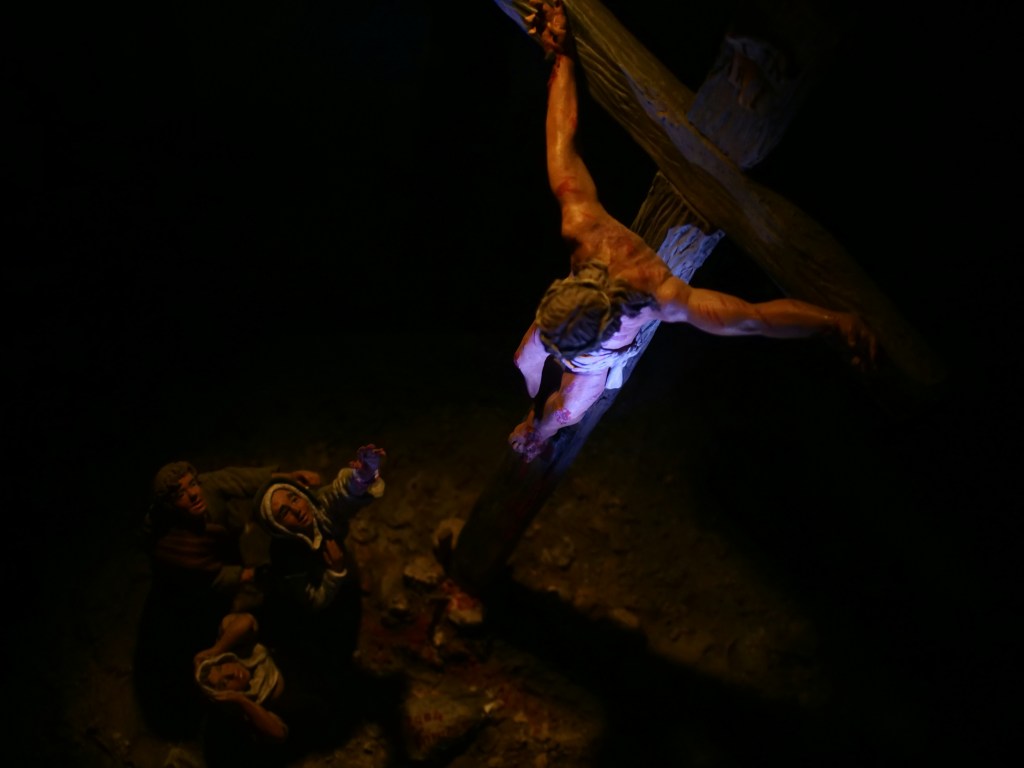
As Jesus hung upon the Cross, Mary, John, and a few others gathered around. They were not concerned about what the other followers thought; they gave no consideration to the religious leaders and others who mocked the Savior, and they showed no regard to the government officials who carried out that terrible deed. When they gathered at the foot of the Cross, they only saw Jesus, His body and His blood. Let’s join with them in this Communion around the Cross, this Community of Faith, and with our eyes on Christ Jesus alone, work toward healing the brokenness that is all around.
Let us pray: Eternal Father, we praise you for sending your Son to be one of us and to save us. Look upon your people with mercy, for we are divided in so many ways, and give us the Spirit of Jesus to make us one in love. We ask this gift, loving Father, through Jesus Christ our Lord. Amen.
A guy is cycling through the country when he spots a sign that reads, “Talking Horse for Sale.” Intrigued, he goes to the stable to check it out. Not expecting much, he walks up to the horse and asks. “So, what have you done with your life?”
“I’ve led a full life,” the horse miraculously answers in a deep voice. “I was born in The Andes, where I herded for an entire village. Years later, I joined the mounted police force in New York and helped keep the city clean. And now, I spend my days giving free rides to underprivileged kids here in the country.”
The guy is flabbergasted. He turns to the horse’s owner and says, “This horse is a bonafide miracle! Why on earth would you want to get rid of such an incredible animal?”
The owner says, “Because he’s a liar! He never did any of that!”
“There are only two ways to live your life. One is as though nothing is a miracle. The other is as though everything is a miracle.” Albert Einstein
Are you a believer in miracles? Let’s find out. Take your red Book of Common Prayer and turn to page 461. What does it say at the bottom, next to the page number? “Ministration to the Sick.” Turn the page. Page 462. What does it say next to the page number? “At Time of Death.” Page 467. “At Time of Death.” And turn the page one more time. Page 468. What does it say? “Burial I.” If you believe in miracles, don’t you think at least one page between pages 467 and 468 is missing? One that says next to the page number, “Raising the Dead.” I’ve probably told you that before, probably about the same time I told you about the time there was a devastating drought in a farming community, so the town entire town gathered in a field to pray for rain, but only one little girl showed up with an umbrella.
Perhaps the biggest problem is that we believe in miracles but don’t really believe they happen. We doubt. So, today, I’m going to ask you to set aside any doubt you might have for just a short time and believe that miracles do happen, in particular, as they pertain to the Holy Eucharist, the bread and the wine, the Body and the Blood—the Blessed Sacrament.
Garabandal is a small village in northern Spain and the site of a Marian apparition to four children. One of the girls, Conchita, was told by an angel that on July 18, 1962, he would give her communion from Heaven. There is a very grainy film of the event, but many witnesses. Conchita was kneeling, with her tongue out to receive as she would from a priest. Nothing was on her tongue. Then, the next moment, a host—the bread—appeared. She held it on her tongue for several minutes so that all could see. Miracle or sleight of hand—or tongue? You can pull that one up on the internet and see the film.
There are three very well-documented occurrences—and many other similar events—where the host (the bread) was found to be bleeding. According to the reports, these were medically examined, and it was shown that not only was it blood on the host, but that the host, in two of those cases, was cardiac tissue from the heart’s interior. In each case, the blood, some of which had not coagulated, even after an extended period of time, was found to be AB+. Just for fun, would you like to take a guess as to the blood type found on the Shroud of Turin?
Some might just mark all this up as an ecclesiastical conspiracy theory, but remember, we’re setting aside our doubt for a short period and believing miracles really do occur.
Last week, we discussed the various understandings of what happens with the bread and wine during the Eucharist. There was memorialism, consubstantiation, and transubstantiation. With memorialism, we said that the bread and wine remain bread and wine—nothing happens. In consubstantiation, the bread and wine truly become the Body and the Blood, but they maintain the outward appearance of bread and wine. And with transubstantiation, the bread and wine truly become the Body and Blood, and, regardless of appearance, are flesh and blood.
You’ll also recall that when the bread and wine have been consecrated, they can be reserved in the Tabernacle. Our Tabernacle is the small cabinet under the red lamp. And some—myself included—believe it contains the Real Presence of Jesus. It is why we bow whenever we come before it.
In October 1995, St. John Paul II visited Baltimore. At one point during the visit, the Pope made a quick schedule change (I suppose being the Pope allows you to do that sort of thing.) Father Arthur Byrne wrote a brief article for the Garabandal Journal.
“On the evening of the last day of his October 1995 visit to the United States, John Paul II was scheduled to greet the seminarians at Saint Mary’s Seminary in Baltimore. It had been a very full day that began with a Mass at Oriole Park in Camden Yards, a parade through downtown streets, a visit to the Basilica of the Assumption, the first cathedral in the country, lunch at a local soup kitchen run by Catholic Charities; a prayer service at the Cathedral of Mary Our Queen in North Baltimore; and finally a quick stop at Saint Mary’s Seminary.
The schedule was tight, so the plan was simply to greet the seminarians while they stood outside on the steps. But the Pope made his way through their ranks and into the building. His plan was to first make a visit to the Blessed Sacrament [reserved in the Tabernacle in the chapel].
When his wishes were made known, security flew into action. They swept the building paying close attention to the chapel where the Pope would be praying. For this purpose, highly trained dogs were used to detect any person who might be present.
The dogs are trained to locate survivors in collapsed buildings after earthquakes and other disasters. These highly intelligent and eager dogs quickly went through the halls, offices, and classrooms and were then sent to the chapel. They went up and down the aisle, past the pews, and finally into the side chapel where the Blessed Sacrament is reserved.
Upon reaching the Tabernacle, the dogs sniffed, whined, pointed, and refused to leave, their attention riveted on the Tabernacle until called by their handlers. They were convinced that they discovered someone there.”
Did those dogs sense the Real Presence of Jesus in the Tabernacle, or had they gotten their wires crossed? You can pull up the pictures of the event on the internet. The internet doesn’t lie, after all.
Now, set aside your doubts for just a few more minutes. Jesus said, “I am the living bread that came down from heaven. Whoever eats of this bread will live forever; and the bread that I will give for the life of the world is my flesh.”
“The bread that I will give for the life of the world is my flesh.” Setting your doubts aside… what if He meant it? What if each Sunday we come into this place where we worship and pray and then, right up there on the altar, witness a bonafide miracle? A miracle that at its very heart is our God saying to us, “I desire to become a part of you. A part of you spiritually, yes, but more importantly, a part of you physically, that we may be one.”
What if the words we speak during the Eucharistic Prayer aren’t just part of some ritual but are, in fact, Heaven—Jesus—breaking into this world? What if, when you come forward to receive communion, God is truly present—truly there, giving Himself to you? What if, when you receive Him in the Eucharist, He truly, physically becomes a part of you? Finally, if all those “what ifs” are true, then what are the implications for your life?
Eight days following the resurrection, Jesus appeared to his disciples in the upper room, and “Thomas was with them. Although the doors were locked, Jesus came and stood among them and said, “Peace be with you.” Then he said to Thomas, “Put your finger here, and see my hands; and put out your hand, and place it in my side. Do not disbelieve—do not doubt—but believe.” I say to you, like Thomas when you put out your hands, you will touch Jesus. Do not disbelieve but believe.
Let us pray: Lord Jesus Christ, Son of the living God, Who, by the will of the Father, with the cooperation of the Holy Spirit, have by Your death given life to the world, deliver us by this Your Most Sacred Body and Blood from all our sins and from every evil. Make us always cling to Your commandments, and never permit us to be separated from You. Who with the same God the Father and the Holy Spirit, live and reign, world without end. Amen.








 Candle in a Cave