Sermon: St. Augustine

The podcast for this sermon can be found here.


In the garden of Eden, the piece of fruit that Adam and Eve took that bite from is never identified as an apple.  Although never named, that apple has perhaps become the most infamous piece of fruit known to humankind.  Today, I would suggest to you that the second most infamous piece of fruit is a pear, because it was a pear that St. Augustine stole when he was sixteen years old.  Why did he steal a pear and what is his significance?

He wrote in his work Confessions, “Yet I was willing to steal, and steal I did [… the pear …] although I was not compelled by any lack, unless it were the lack of a sense of justice or a distaste for what was right and a greedy love of doing wrong. For of what I stole I already had plenty, and much better at that, and I had no wish to enjoy the things I coveted by stealing, but only to enjoy the theft itself and the sin.” Continue reading “Sermon: St. Augustine”

Sermon: Proper 16 RCL A – “Mistaken Identity”

The podcast for this sermon can be found here.


An old cowboy named Bud was overseeing his livestock in a remote mountainous pasture in California when a fella in a fancy car comes skidding up. He gets out and is wearing this outlandish high fashion getup, a Rolex, with his hair slicked back, and a California tan – the works. When he opens his mouth, he’s clearly from “back east.”

Coming over to Bud he asked, “If I tell you exactly how many cows you have in your herd, will you give me a calf?”

Bud sized up the fella another moment then agrees, “Sure, why not?”

The guy pulls out is iPad and iPhone, makes a call, and ask for a photo from a satellite above. Once received he runs it through some computer analysis and has it count the number of animals on the ranch. After a few minutes, he turns to Bud and says, “You have exactly 1,562 cows in your herd.”

“That’s right, pardner,” replied the old cowhand. “Well, I guess I owe you a calf. Pick one out.”

The fellas looks over the herd, picks one out and then proceeds to cram it in the backseat of his car.

Bud interrupts this process. “Listen. If I can tell you exactly what your business is, will you give me back my calf?”

“Why not?”

“You’re a U.S. Congressman.”

The man is shocked. “Yeah, how’d you guess that?” Continue reading “Sermon: Proper 16 RCL A – “Mistaken Identity””

Sermon: Proper 15 RCL A – “Dog?”

You can find the podcast for todays sermon here –


A man goes to see his Rabbi. “Rabbi, something terrible is happening and I have to talk to you about it.” “What’s wrong?” “My wife is poisoning me.” “How can that be?” “I’m telling you, I’m certain she’s poisoning me. What should I do?” “Tell you what. Let me talk to her, I’ll see what I can find out, and I’ll let you know.” “A week later the Rabbi calls the man.” “Well, I spoke to your wife. I spoke to her on the phone for three hours. You want my advice?” “Yes, Rabbi.” “Take the poison.”

The dog on the front of your bulletin – head cocked to one side, trying to hear, trying to understand – can represent us all at times. Something happens, someone says something so out of character, so out of place, that we tilt our heads and can only respond by saying, “Huh?” “Take the poison” is one such remark, but not the only one we’ve heard today: Jesus said, “It is not fair to take the children’s food and throw it to the dogs.” Huh? Did Jesus just call this lady a dog? Continue reading “Sermon: Proper 15 RCL A – “Dog?””

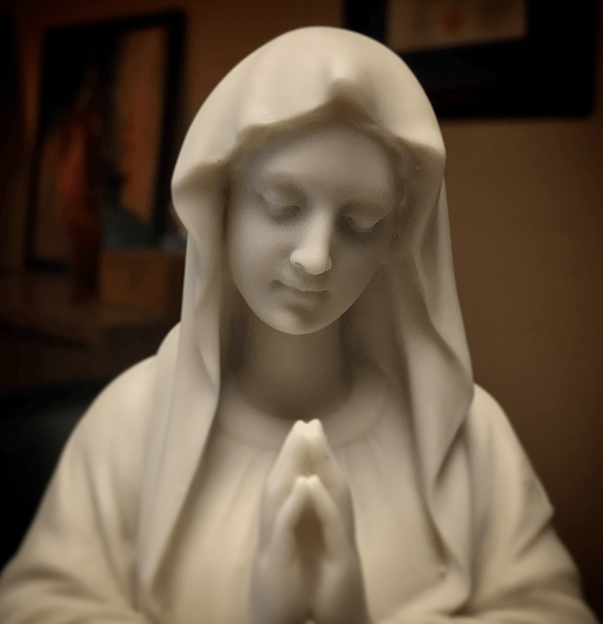
Sermon: Saint Mary the Virgin

Listen to the podcast of this sermon at Podomatic : 

C.S. Lewis summed up a very Anglican perspective of the Virgin Mary in the preface to Mere Christianity (it’s a bit wordy and a bit heady): “There is no controversy between Christians which needs to be so delicately touched as this [that is, the question of Blessed Virgin Mary]. The Roman Catholic beliefs on that subject are held not only with the ordinary fervour that attaches to all sincere religious belief, but (very naturally) with the peculiar and, as it were, chivalrous sensibility that a man feels when the honour of his mother or his beloved is at stake. It is very difficult so to dissent from them that you will not appear to them a cad as well as a heretic. And contrariwise, the opposed Protestant beliefs on this subject call forth feelings which go down to the very roots of all Monotheism whatever. To radical Protestants Continue reading “Sermon: Saint Mary the Virgin”

Sermon: Proper 14 RCL A – “On Dry Land”

In December 1971, Time magazine reported on the volunteer fire department in Genoa, Texas, just outside of Houston. We’d need to ask Michael Baker if its true, but as the article stated, we often think of firemen spending the times between fires polishing brass, playing checkers, and showing kids the firetrucks. Not so for the Genoa VFD. The article states, “In the past three years, eight bored Genoa firemen have set about 40 fires in abandoned buildings and grass fields. As soon as the blazes were going, the arsonists would dash back to the firehouse and rush off to put out their own fires.

The Genoa firemen were quite busy until they made the mistake of setting fire to a barn owned by the brother of a Houston fire department official. An investigation of the blaze led to the Genoa firehouse, and the overeager fire fighters were exposed. Explained one of the firemen charged with arson: ‘We’d hang around the station on the night shift without a thing to do. We just wanted to get the red light flashing and the bells clanging.’” Continue reading “Sermon: Proper 14 RCL A – “On Dry Land””

Sermon: Dominic

About the image: Meeting of St. Francis of Assisi with St. Dominic, Josep Benlliure y Gil.


A man curious about Catholicism approached a Dominican monk.

He asked the Dominican about various subjects and eventually the conversation turned to religious orders. “So you are a Dominican?”

“Yes.”

“What can you tell me about the Dominicans?”

“Well, in short, we were founded by St. Dominic in the 13th century, in part to counter the Albigensian heresy.”

“I see. What about the Jesuits I keep hearing about?”

“They were founded by St. Ignatius of Loyala in the 16th century, in part to counter the Protestant Reformation.”

“Hmmm … so which is the greater order?”

The Dominican pondered this question for a moment and then replied: “Well, when was the last time you met an Albigensian?” Continue reading “Sermon: Dominic”

Sermon: Transfiguration RCL A – “Becoming”

Boudreaux and Thibodeaux decided to go fishing one morning at the pond in back of Boudreaux’s house. It was dark and when they reached the pond they realized they wanted to cross to the other side. But they couldn’t walk around and had no boat or pirogue to cross in. Thibodeaux turned to Boudreaux and said, “Mais Boudreaux, how in the heck we gonna get across.” Boudreaux said, “No problem, I’m gonna shine this here flashlight across the water and you gonna walk on the beam of light all the way across.” Thibodeaux then says, “Mais, Boudreaux, you must think I’m stupid or something, cause just when I get halfway across you gonna turn off the light.”

Light travels at 186,282 miles per second. Put another way, the earth has a circumference of 24,901 miles, so a beam of light could travel around the earth 7.5 times in one second. Light comes in a wide spectrum of electromagnetic radiation, but we can only see a very small portion of that spectrum, which is called visible light. Continue reading “Sermon: Transfiguration RCL A – “Becoming””

Sermon: Proper 12 RCL A – “The Kingdom of God is…”

A mosquito is flying, looking for a snack. He spots a man high on a pole, lands on the man’s arm, and bites.

The man, an electrician who was anxious to finish work, decided not to wait for the “cherry picker,” and instead used a ladder. When the mosquito bit, he quickly moved to swat it. He missed; however, the sudden movement caused him to lose balance and he dropped to the ground and the ladder fell against the wires causing a short, creating a black out across the whole district.

In the zipper factory it suddenly went dark and the machinery stopped. The owner immediately knew that for him it would be a complete disaster. He had too quickly accepted his first big order; he had already had to put all his staff on extended overtime and to save on cost had not yet put in a generator. Now he knew he would have to tell the customer that he would be unable to complete the order in time for the clothing factory. He could only hope that next week’s shipment would be alright. Continue reading “Sermon: Proper 12 RCL A – “The Kingdom of God is…””

Sermon: Thomas à Kempis

Information regarding the image: Title – Thomas à Kempis on Mount Saint Agnes – (1569). In the Our Lady’s Basilica in Zwolle there is a painting on which Thomas van Kempen is pictured, with in the background the building complex of the Agnietenberg monastery. Also on the painting Arnold Waeyer (1606-1692), the archipelago of Salland can be seen. He led an important part of the church life of the Zwolle Catholics in the shelter period. The painting contains a comprehensive Latin text.

If the text is reliable, the painting would date from 1569 and be painted on behalf of Johannes Cuperinus, the last prior of the Agnietenberg monastery. He said, adding the text and self-portrait in 1654. In the Stedelijk Museum Zwolle, a virtually identical painting hangs. (source)  I’ve tried to locate the Latin text, but have not been successful.


The library at Nashotah House is something to behold. Two stories and a basement, wall-to-wall books and periodicals, almost all of which pertain to God and the Church. In addition, in the basement along one wall is a must visit at least once per week section. This is where they have the books that they are giving away. Duplicates, out of date, a bit to worn, etc. copies. It wasn’t every week that you will find one, but occasionally you will come across a gem. And I believe it was in my Junior year that I came across this one: My Imitation of Christ, published by the Confraternity of the Precious Blood. It is The Imitation of Christ by Thomas à Kempis. Continue reading “Sermon: Thomas à Kempis”