Sermon: The Ordination of Janie Koch

The podcast can be found here.


40610016_2309532932406566_1117913479580221440_n


A Bishop visited a parish to administer the sacrament of Confirmation. The Pastor, a young progressive, approved a liturgical dance during the Mass and the Bishop was not advised. During the dance a young lady in flowing robes floated across the sanctuary and in the middle of the dance she presented the Bishop with a rose. As she continued her dance the Bishop leaned over to the Pastor and whispered: “You know of course that if she asks for your head – she will get it.”

Bishop Donald Parsons was my Ascetical Theology professor at Nashotah House.  Over the course of the two semesters that I studied under him, I learned a great deal, but there were two very important points that I have never forgotten.  The first I always share with congregations and St. Matthew’s knows it well: if you want to get along with God, don’t sit in his chair.  The second point is one that is useful to the newly ordained, fail to take heed to it and you’ll find the bishop offering up your head (just ask any of the ordained present).  The second is: bishop’s don’t like surprises.  If you can manage those two things: not sitting in God’s chair and not surprising the Bishop, you’ll probably have a long career as a priest, but there is quite a difference between having a long career as a priest and a ‘fruitful’ calling as a priest.  The career gives you all the perks of any job you might have and plenty of coffee.  The other, the fruitful calling, makes disciples of Jesus, it heals the broken, shines the Light of the Gospel into the darkest corners, it does battle with the devil, it brings the Good News.  But contrary to popular teaching, it is not accomplished by preaching to stadiums of people or by gimmicks or by following the latest “how to” scheme.  So, how does the fruitful calling accomplish this good work of God?  It may not be true for everyone, but for me, I go to another Bishop for the answer: Archbishop of Canterbury, Micheal Ramsey.  In a series of lectures that he presented to a group of young ordinands, he said:

Amidst the vast scene of the world’s problems and tragedies, you may feel that your ministry seems so small, so insignificant, so concerned with the trivial… But consider: the glory of Christianity is its claim that small things really matter, and the small company, the very few, the one man, the one woman, the one child are of infinite worth to God.  Let that be your inspiration… for the infinite worth of the one is the key to the Christian understanding of the many.

You accomplish the work of God, by recognizing the infinite worth of the one.  Yet, our business and our desire to grow, improve the statistics, the ever nagging ASA—Average Sunday Attendance—we can lose site of the one.  Fortunately, the priest has a reminder… it occurs during the celebration of the Mass.

In the fifth chapter of book four of The Imitation of Christ, my friend Thomas à Kempis writes about the priest and the Mass.  He speaks specifically about holding and administering the elements of the bread and wine: “Had you the purity of an angel and the sanctity of St. John the Baptist, you would not be worthy to receive or administer this Sacrament. It is not because of any human meriting that a [priest] consecrates and administers the Sacrament of Christ, and receives the Bread of Angels for their food. Great is the Mystery and great the dignity of priests to whom is given that which has not been granted the angels.”  In the Mass, Jesus becomes present to us and the priests are the ones who hold Him and administer Him.  When we administer the bread and the wine, we do so with the greatest reverence, recognizing the very Body and Blood of our Savior, and it is in this act, that we have our reminder of the one.  For as a priest, we are called upon to handle each individual soul, all of God’s people, in the exact same manner that we handle Christ, for they too are His most precious Body and they are each of infinite worth.  They have his blood running through their veins.  Janie, when you are made a priest, it is not just for Sunday morning, but for every minute of your life, recognizing the Lord’s real presence in everyone you encounter.  Are you ready?

The Apostle Paul wrote a letter to that young Timothy who was just beginning his ministry.  In greeting him, Paul said, “I thank God, whom I serve with a pure conscience, as my forefathers did, and without ceasing I remember you in my prayers night and day, greatly desiring to see you, being mindful of your tears, that I may be filled with joy when I call to remembrance the genuine faith that is in you, which dwelt first in your grandmother Lois and your mother Eunice, and I am persuaded is in you also.  Therefore I remind you to stir up the gift of God which is in you through the laying on of my hands.  For God has not given us a spirit of fear, but of power and of love and of a sound mind.”

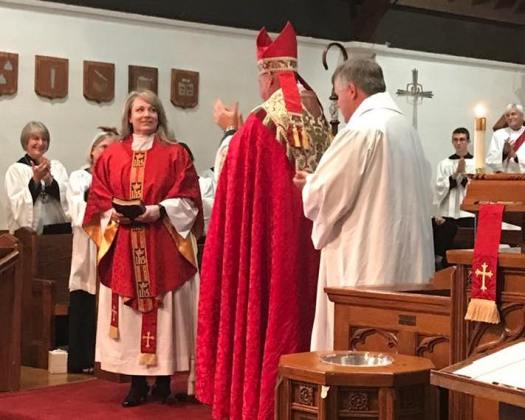
Are you, Janie, ready?  I believe you are, for I call to remembrance the genuine faith that is in you, which first dwelt in your grandmother Janie and your mother Vereda and your father Terry, and I am persuaded this same faith is in you also.  Therefore, remind yourself always of the gifts of God which will be given to you through the laying on of Bishop Ed’s hands, and live into that spirit of power and love and sound mind, which comes from God alone.

One of my favorite stories from the Desert Fathers (you’ve probably heard it before): Abba Lot went to see Abba Joseph and said to him, “Abba as far as I can I say my little office, I fast a little, I pray and meditate, I live in peace and as far as I can, I purify my thoughts. What else can I do?”  Then the old man stood up and stretched his hands towards heaven. His fingers became like ten lamps of fire and he said to him, “If you will, you can become all flame.”

Janie, become all flame.  Touch one soul at a time and in the process, you will “set aflame all the ways of the earth with the fire of Christ that you bear in your heart.”  (St. Josemariá Escrivá, The Way, #1)

On the night before he was ordained a priest, Michael Ramsey wrestled with what was coming for him, then he wrote down a few words that reveal a great self-giving to God.  I’ll close with them as a prayer and ask Janie to consider these words as her own, but not only her, because as a Christian people, as the Royal Priesthood of Christ, they apply to us all.

Let us pray: 
‘My grace is sufficient for thee.’ How I do need to look away from self to God; I can only find satisfaction in him.
My heart to love Him, my will to do his will;
My mind to glorify Him, my tongue to speak to Him and of Him;
My eyes to see him in all things;
My hands to bring whatever they touch to Him;
My all only to be a real ‘all’, because it is joined to Him.
And this will be utter joy – no man can take it away.
Self, self-consciousness, self-will, the self-center cut away,
So that the center which holds all my parts is God.
Amen.

Sermon: Proper 16 RCL A – “Given”

The podcast can be found here.


Malaysian Christians participate in the


Many years ago, a major American company had trouble keeping employees working in their assembly plant in Panama. The laborers lived in a generally agrarian, barter economy, but the company paid them in cash. After a week’s work, the average employee would have more cash than he’d ever seen—so many of the workers were quitting—completely satisfied with what they had already made.  

What was the solution? Company executives gave all their employees a Sears catalog. No one quit then, because they all wanted the previously unimagined things they saw inside that book.

I am not criticizing anyone, because if I did, I would have to criticize myself (Heaven forbid!) but, when you get your paycheck, do you first think about what you can get… or what you can give?  We all have necessities: food, shelter, clothing, etc., but when – and many cases “if” – there is anything left over, do you pull out the Sears catalog?

This same mindset can also apply to how we live our lives.  Goals, dreams, plans are all good and we should all set them.  It helps us to achieve more in becoming who we were created to be, but we can become so consumed with achieving our goals, our dreams, our plans, that we lose sight of our other obligations, which are: “You shall love the Lord your God with all your heart, and with all your soul, and with all your mind.… You shall love your neighbor as yourself.”  In the context of giving, these commandments say that we will give ourselves to our God through our worship and we shall give of ourselves to our neighbor through service.  This is not anything new to you, but as I said, we can become so consumed with our own lives, that we lose sight of the other.  Fortunately, almost every time we gather, we are given a reminder of what it is to worship and to give of ourselves. It occurs when we come forward to receive communion, and specifically when we receive the bread.

The presence of Jesus on the altar is not symbolic.  We discussed a few weeks ago that he is truly present to us in the bread and the wine, but much of what takes place during the Mass is symbolic.  For example: you may not see it from where you are sitting, but prior to beginning the Eucharistic Prayer, the acolyte or Eucharistic Minister pores water over the priest’s hands.  The priest says a short prayer: “I wash my hands with the innocent, O Lord, that I might process about your altar.”  Why do we do this?  Everybody responds, “Because your hands are dirty!”  Possibly, but there is also a symbolic meaning to it as well.

In the plans for the construction of the Tent of Meeting that we read about in the Book of Exodus, Moses is told, “Make a bronze basin, with its bronze stand, for washing. Place it between the tent of meeting and the altar, and put water in it.  Aaron and his sons are to wash their hands and feet with water from it. Whenever they enter the tent of meeting, they shall wash with water so that they will not die.” The priest symbolically washes their hands in remembrance of the worship that took place in the Temple.

The same type of symbolism is found throughout the Mass, from the water being added to the wine, to the vestments, down to the number of steps leading up to the altar and the number of sides on a traditional baptismal font.  And in the way that you receive the bread during communion.

For the most part, people receive the bread by coming forward, kneeling if they are able, and extending their hands – the right hand over the left – and the priest places the bread in their hands.  There are also some who receive by opening their mouth and the priest places the bread on their tongue.  But there are others – and keep in mind, this is symbolism, God is not going to smite you for doing it – but there are others who reach up and take the bread.  What is the difference?  What is the symbolism of the act?

Each Christmas, we read that wonderful passage from Isaiah: 

For a child has been born for us,
a son given to us;
authority rests upon his shoulders;
and he is named
Wonderful Counselor, Mighty God,
Everlasting Father, Prince of Peace.

Later, in John’s Gospel, Jesus speaks of his coming death: “For this reason the Father loves me, because I lay down my life in order to take it up again.  No one takes it from me, but I lay it down of my own accord.”

A son was given for us.  No one takes Jesus’ life, but he gives it freely.  The symbolism is that he is given and we receive.  Yet, not only is the symbolism reminding us of other events, but it is also pointing us to how we are to respond.  To understand this… go back to the night before he was crucified.  Jesus washed the feet of the disciples, then he said to them: “If I, your Lord and Teacher, have washed your feet, you also ought to wash one another’s feet.  For I have set you an example, that you also should do as I have done to you.  Very truly, I tell you, servants are not greater than their master, nor are messengers greater than the one who sent them.”  The bread, the Son of God, is given to you, therefore, you are to give yourself to God and to others.  You become Peter’s “royal priesthood,” and you are the one that is placing the bread of life in the hands of others, you are the one giving.

You are “given” to God that you might worship and to the world so that you might serve.  Jesus said, “There is no greater love than to lay down one’s life for one’s friends.”

In 1941, the Franciscan monk, Maximilian Kolbe was arrested by the Nazis and sent to Auschwitz.  Over short period of time, three prisoners escaped the camp.  In an attempt to deter others, the commander ordered that ten prisoners be sent to a basement cell where they would be starved to death.  One of these was a Polish man, Franciszek Gajownicek.  When he was selected, he cried out, “My wife!  My children!”  Immediately, Maximilian Kolbe stepped forward and said, “I am a Catholic priest from Poland; I would like to take his place, because he has a wife and children.”  He was allowed and died two weeks later.  Franciszek was present on October 10, 1982 when Pope John Paul II canonized St. Maximilian Kolbe.  Kolbe is widely reported to have said, “Let us remember that love lives through sacrifice and is nourished by giving.  Without sacrifice, there is no love.”

I do not know that any of us will be called on to literally lay down our lives for another, but I do know that every day, each of us are called to sacrifice ourselves in small ways and sometimes great, for the good of others.  We are called to worship and to love one another as Jesus loves us.  We are called to worship and to give ourselves to God and to others just as Jesus worshiped and gives himself to us.

At the end of the service, we say the post-communion prayer.  Everyone knows, say this prayer, get the blessing, sing a hymn, go home, but I hope you also hear the words you are saying, because they are not an ending, but a beginning… 

Eternal God, heavenly Father,
you have graciously accepted us as living members
of your Son our Savior Jesus Christ,
and you have fed us with spiritual food 
in the Sacrament of his Body and Blood.

We are thanking our Father for instructing us, forgiving us, accepting us, and nourishing us with the Savior’s body and blood, but then…

Send us now into the world in peace,
and grant us strength and courage
to love and serve you
with gladness and singleness of heart;
through Christ our Lord.  Amen.

Send us now….  The end of the Mass is the beginning of our calling.  We are giving ourselves that we might worship the Lord and serve Him, who gave Himself for us.  

My friend St. Josemaría Escrivá writes: “Apostolic zeal is a divine craziness I want you to have. Its symptoms are: hunger to know the Master; constant concern for souls; perseverance that nothing can shake.”  I pray that we all become divinely crazy in our zeal to love God and to love our neighbor through our worship and in the giving of ourselves to others.

Let us pray:
Dearest Lord, 
teach us to be generous;
teach us to serve You as You deserve;
to give and not to count the cost,
to fight and not to heed the wounds,
to toil and not to seek for rest,
to labour and not to ask for reward
save that of knowing we are doing Your will.
Amen.

Sermon: Proper 15 RCL A – “Broken”

The podcast can be found here.


8c70166be40924ea6d7d8bde45334704.png


A man observed a woman in the grocery store with a toddler-aged girl in her shopping cart. As they passed the cookie section, the little girl asked for cookies, and her mother told her no. The little girl immediately began to whine and fuss, and the mother whispered: “Now Monica, we just have half of the aisles left to go through — don’t be upset. It won’t be long.”

Soon, they came to the sweets aisle, and the little girl began to shout for chocolate. When told she couldn’t have any, she began to cry.

The mother murmured: “There, there, Monica, don’t cry — only two more aisles to go and then we’ll be checking out.”

When they got to the checkout stand, the little girl immediately began to clamor for lollipops and burst into a terrible tantrum upon discovering there’d be none purchased. The mother patiently said: “Monica, we’ll be through this checkout stand in 5 minutes, and then you can go home and have a nice nap.”

The man was very impressed with the woman’s handling of the situations and followed them out to the car park and stopped her to compliment her, “I couldn’t help noticing how patient you were with little Monica.”

The mother sighed and replied: “Oh, no. My little girl’s name is Tammy… I’m Monica.”

I am willing to wager that if I ask each of you how you are doing, almost all of you will respond with, ‘fine’, ‘good’, or the equivalent.  We must maintain the illusion that we are in control, have it together, and that our lives are beautiful.  Social media is great at helping us to perpetuate this illusion.  I’m happy to post a picture of my beautiful meal at the sushi bar, but for every one beautiful meal I’ve eaten there could probably be 50 pictures of me eating a can of sardines from the can while standing at the kitchen sink.  The same is true with life.  I’ll tell you all about the fun things I do, but I’m not likely to confess that I spent Thursday night binge watching “Friends” until 2:00 in the morning.  And, when it comes to my life with God, I would like for you to believe that I’m dang near a Saint, but the truth is, I’m stumbling along with everyone else.  On the outside, everything is calm.  On the inside, things can be a bit frazzled and all I want to do is go home and take a nap.  Even so, I must maintain the image.  Never showing the cracks.

Not only do I want to perpetuate this image of control in my life, but I also want to maintain the illusion of control in my own mind.    I’m important.  Just ask me!  I’m making things happen.  Brother got game.

“It matters not how strait the gate, 
How charged with punishments the scroll. 
I am the master of my fate: 
I am the captain of my soul.” (Source)

And everybody shouts, “Hoorah!”  And we continue to shout ‘Hoorah,’ until things begin to fall apart and the center does not hold.  It is then that we are baffled, at a loss as to how it could have happened.  We had everything under control and then… smoke.  We look for someone or something to blame.  We look for answers outside of ourselves, but the source of the fall is most often within.

These past few weeks, we have been reading the ‘bread of life’ / ‘bread of Heaven’ passage from John’s Gospel.  We looked at how we must place our lives on the paten with Jesus, but that in doing so, we are not simply relying on a memory of Jesus or only the words in the Bible.  Instead when we place our lives on the paten, we are joining with the real presence of Christ.  It is there, on the paten that we are united with Him and become one with Him as He and the Father are one, but we are not yet done.  You see, now that we have been united with Him, something terrible and awesome must occur.  We now must be broken with Him.  We must take our lives, all that we want to control, and allow it to be broken with Christ upon the altar of the Cross.  We, like Christ, in surrendering our lives into the hands of the Father, must, also like Christ, allow our lives, our will, our control, to be broken.  And there the conflict arises, because that part of us that desires to so tightly control our lives, refuses to submit to the Father.  Why do we refuse?  Because we wrongly believe that all will be lost.  That the Lord will take what we give him and what we receive back will be unrecognizable and useless, but nothing could be further from the truth.

It is one of those things many of you have probably seen and heard about, but it perfectly illustrates this point: kintsugi.  Kintsugi is a Japanese word meaning the ‘golden journey,’ and it is an art form of repairing broken pots.

You have one of granma’s heirloom dishes.  Perhaps it is not of great monetary value, but it is precious to you.  You’ve moved all over the country and each time you’ve carefully packed up this one particular dish, always anxious to determine if it made the latest journey.  All is well, but then one day, the cat jumps on the counter knocking if off.  You cry over the pieces, but eventually throw them away.  However, in Japan, an heirloom wouldn’t necessarily be thrown out, instead it would be made new.

kintsugi-768x562An artist takes the pieces of your broken dish and glues them back together with a special lacquer, which is then covered with gold.  The cracks are visible, but they’ve been transformed into these paths of gold, traversing the dish.  Now, not only has granma’s dish been restored to you, but it is now far more valuable and beautiful, a true work of art.
In the same way, when we allow our lives to be broken upon the altar of the cross, God takes the pieces and restores them, bonding our lives to His, making us far more valuable and beautiful than we could have ever imagined or accomplished on our own.  We are remade into a work of art in His image.  Sounds nice and easy, but as a Christian, it is one of the most difficult things we will do.

The Great Divorce by C.S. Lewis was first published in 1945.  I won’t give it away, but the main character finds himself in a place called the Grey Town.  From there he is taken on a bus with several others until they have an encounter with the Spirits who try and convince these individuals to come with them up the Mountain.  It is all an analogy.  Very simply put, Grey Town is hell, the space around it is purgatory, and the Mountain is heaven.  The Spirits are trying to convince those on the bus to take the journey up the mountain to heaven, but one by one, they make their excuses.  They want to maintain control, dictate the rules.  They refuse to submit.  One traveller is asked:

“Will you come with me to the mountains? It will hurt at first, until your feet are hardened. Reality is harsh to the feet of shadows. But will you come?”

“Well, that is a plan. I am perfectly ready to consider it. Of course I should require some assurances … I should want a guarantee that you are taking me to a place where I shall find a wider sphere of usefulness-and scope for the talents that God has given me-and an atmosphere of free inquiry-in short, all that one means by civilization and-er-the spiritual life.”

“No,” said the [Spirit]. “I can promise you none of these things. No sphere of usefulness: you are not needed there at all. No scope for your talents: only forgiveness for having perverted them. No atmosphere of inquiry, for I will bring you to the land not of questions but of answers, and you shall see the face of God.”

“Will you come with me to the mountains?” is another way of asking, will you be broken upon the altar of the Cross?  Will you submit your life to God?

St. Paul writes, “I received from the Lord what I also handed on to you, that the Lord Jesus on the night when he was betrayed took a loaf of bread, and when he had given thanks, he broke it and said, ‘This is my body that is broken for you. Do this in remembrance of me.’” (1 Cor 11:23-24)

Will you go up the mountain with him?  Will you give up control?  Will you submit to the Lord?   Will you be broken with Jesus that you might be made new?  

“Seek first the kingdom of God and His righteousness, and all these things shall be added to you.”  (Matthew 6:33)

Let us pray: Loving Father, faith in Your Word is the way to wisdom. Help us to think about Your Divine Plan that we may grow in the truth. Open our eyes to Your deeds, our ears to the sound of Your call, so that all our actions may help us share in the life of Jesus. Give us the grace to live the example of the love of Jesus, which we celebrate in the Eucharist and see in the Gospel. Form in us the likeness of Your Son and deepen His Life within ours.  Amen.

Sermon: Blessed Virgin Mary

The podcast can be found here.


pexels-photo-977655


Whether accurate or not, I have a certain visual understanding of humankind’s historical relationship with God: it looks like an hourglass, but it doesn’t function in quite the same way.  

In the beginning, in the Garden, the relationship with God was as perfect as it could be, but following the fall, that relationship became more and more narrow as the Israelites moved further and further away from God, eventually reaching a true crisis point.  That relationship did not begin to grow again until after the coming of Jesus, when the Gospel began to go out into the world and the crisis was overcome.  As St. Paul teaches us in his letter to the Galatians, “When the fullness of time had come, God sent his Son, born of a woman, born under the law, in order to redeem those who were under the law, so that we might receive adoption as children.” (Galatians 4:4-5)

This was truly the work of God and could not be accomplished otherwise, but there was a human element as well.  You know the story: an angel of the Lord said to Mary, “‘And now, you will conceive in your womb and bear a son, and you will name him Jesus’…. Then Mary said, ‘Here am I, the servant of the Lord; let it be with me according to your word.’”  These words of Mary began again the great work of God in the world.  What did her ‘Yes” accomplish?

In the year 431 a.d., the Roman Emperor Theodosius II called a church council in Ephesus.  This is the third of seven early major church councils, the first being the Council of Nicaea where the Nicene Creed was drafted.   Presiding over the Council in Ephesus was St. Cyril of Alexander and one of the decisions made at the Council was the calling of the Virgin Mary the Theotokos, meaning “Mother of God” or “God Bearer.”  It was on the topic of the Virgin Mary that St. Cyril preached, and there he answered that question of what Mary’s ‘Yes’ accomplished.

Mary, Mother of God, we salute you. Precious vessel, worthy of the whole world’s reverence, you are an ever-shining light, the crown of virginity, the symbol of orthodoxy, an indestructible temple, the place that held him whom no place can contain, mother and virgin. Because of you the holy gospels could say: Blessed is he who comes in the name of the Lord.

We salute you, for in your holy womb was confined him who is beyond all limitation. Because of you the holy Trinity is glorified and adored; the cross is called precious and is venerated throughout the world; the heavens exult; the angels and archangels make merry; demons are put to flight; the devil, that tempter, is thrust down from heaven; the fallen race of man is taken up on high; all creatures possessed by the madness of idolatry have attained knowledge of the truth; believers receive holy baptism; the oil of gladness is poured out; the Church is established throughout the world; pagans are brought to repentance.

What more is there to say? Because of you the light of the only-begotten Son of God has shone upon those who sat in darkness and in the shadow of death.

Today we celebrate the Blessed Virgin Mary, remembering the part she played in God’s work of salvation by saying ‘Yes’ to the Lord’s call on her life, and recognizing how we too, in saying ‘Yes’ to God’s call on our lives, can impact God’s continued work of salvation in the world through the spreading of the Gospel message.

Sermon: Proper 14 RCL A – “His Presence”

The podcast can be found here.


viktor-vasnetsov-c3a9tude-for-the-holy-eucharist-mosaic-in-st-aleksandr-nevsky-cathedral-warsaw-poland-destroyed-in-1918-by-the-polish-authorities-1901


A successful businessman parked his brand new Porsche Carrera GT in front of the office, ready to show it off to his colleagues. As he goes to get out of the vehicle, a truck speeds by, hitting the car and completely tearing off the driver’s door. Fortunately, a policeman is close enough to see the accident and pulls up behind the Porsche. Before the officer has a chance to ask any questions, the businessman starts screaming hysterically about how his Porsche, which he had just picked up the day before, is now completely ruined. “The vehicle will never be the same, no matter how hard the mechanics work to restore the damage.” After the lawyer finishes his rant, the officer shakes his head in disgust and disbelief. 

“I can’t believe how materialistic you are,” he said. “You are so focused on your possessions that you neglect the most important things in life.” 

“How can you say such a thing?” asked the businessman. 

The officer replies, “Don’t you even realize that your left arm is missing? It got ripped off when the truck hit you!!!” 

“Oh, my God!” screams the businessman. “My Rolex!!”

I’ve been a priest now for almost fourteen years and on average, I would say that I’ve celebrated the Mass at least three times a week.  Do a little math: fourteen years times fifty-two weeks times three… I’ve celebrated the Mass about 2,200 times.  I can honestly say that I have never gotten tired of it.  I’ve never approached it and thought, “Blah, blah, blah… here we go again.”  However, I do confess that there have been some times—not many!—but some times my mind has wandered.  I would like to say that on these occasions when my mind wandered that it was do to some grave concern, but that would probably not be true, but even if it were those concerns when compared to what is taking place on the altar are the equivalent of that businessman worrying about losing his watch when he had just lost his arm.

Today is the second of four Sundays where we will be reading from the Gospel of John.  In fact, during these readings, we only cover 45 verses of the sixth chapter of John’s Gospel that are concerned with the Bread of Heaven, which ultimately points us to the sacrifice of Jesus on the cross and the Holy Eucharist.

Within the context of John’s Gospel, these teachings immediately follow the feeding of the 5,000 and many theologians point to one particular statement of Jesus during this event to explain to us why the Eucharist was given.  We find it in Matthew’s Gospel.  Like in John, the crowd has gathered and it is late in the day.  Jesus calls together his disciples and says to them, “I have compassion for the crowd, because they have been with me now for three days and have nothing to eat; and I do not want to send them away hungry, for they might faint on the way.”  These people have been with us all this time and I am concerned about them.  They are about to take the road leading home, back into the world and their lives, but they do not have the nourishment they need.  Therefore, I will feed them.  We can see how these same words summarize the entire ministry of Jesus.  We are the ones who are following him and we are on the road that ultimately leads us home to our Heavenly Father, but we need food for the journey; therefore, Jesus gives the Bread of Heaven, he gives us himself.  “Very truly, I tell you, whoever believes has eternal life. I am the bread of life. Your ancestors ate the manna in the wilderness, and they died. This is the bread that comes down from heaven, so that one may eat of it and not die. I am the living bread that came down from heaven.”

Not only does Jesus tell us that he is our food for the journey, but we must come to him and eat as often as we will.  My friend Thomas à Kempis writes: “Therefore must I often come to Thee, and receive Thee as the medicine of my salvation, lest perhaps I faint in the way, should I be deprived of this heavenly food.  For so thou, O most merciful Jesus, when thou hadst been preaching to the people and curing the various maladies, didst once say: I will not send them fasting to their home, lest they faint on the way.”

What is so remarkable about the Eucharistic Feast is that it is not a simple memorialization of that first Lord’s Supper.  Perhaps I have shared this with you before: Jesus says, “Do this in remembrance of me,” but the word he uses for remembrance is anamnesis.  “Do this in anamnesis of me.”  Anamnesis means ‘to make present.’  Jesus is not telling us to simply remember him, but is instead telling us to ‘make him present.’  To make that great event of the first Last Supper and his suffering on the Cross present to us today.  To allow him to be truly present to us here and now in the Eucharist, in the breaking of bread.  Archbishop Michael Ramsey states, “The Eucharist is the breaking into history of something eternal, beyond history, inapprehensible in terms of history alone.”  He continues, Jesus’ “presence in heaven is as a sacrifice… He is there as the one who gave himself on the Cross, and who there… unites his people to his own self-giving to the Father in Heaven.  Christ’s unique act in history is the source of what Christians do.”

I could not discover who the author of these short verses was, but they speak to us about who is present with us in this great feast and it is the Lord:

Lord, thou art present — in thy lowliness, and in thy glory:
Thou that dwellest among us, whom we have refused, wounded and slew;
Thou immortal victor, the everlasting king.
Thou in thy strength, and in thy tender love:
Thou with thy yielded life, with thy living Spirit;
Lord, thou art here — my Lord and my God.

Our Lord and our God is made present to us here; therefore, when we come to him, we must be rightly prepared.  As we say in the Exhortation: “[If] we are to share rightly in the celebration of those holy Mysteries, and be nourished by that spiritual Food, we must remember the dignity of that holy Sacrament. I therefore call upon you to consider how Saint Paul exhorts all persons to prepare themselves carefully before eating of that Bread and drinking of that Cup. For, as the benefit is great, if with penitent hearts and living faith we receive the holy Sacrament, so is the danger great, if we receive it improperly, not recognizing the Lord’s Body.”

Jesus is truly present to you in that small piece of bread and that sip of wine.  Love comes down and feeds us for the journey and we come forward, kneeling with hands outstretched desiring to receive him.  But… what if I told you that was the easy part?  “For if you love those who love you, what reward do you have? Do not even the tax collectors do the same?  And if you greet only your brothers, what more are you doing than others? Do not even the Gentiles do the same?”  You see, it is not just about how we approach the Lord, but the Eucharist is also about how we approach one another, because when we receive, we do not receive as individuals, but as the body.  And not just with the body that is present or members of our church, but with the entire Body of Christ; and it is not up to us to judge who is in and who is out.  Judging others is far above our pay grade.  Therefore, we are to approach one another in the same manner we approach our Lord.  Commenting on one chapter of The Imitation of Christ, one priest put it this way: “Thine endeavor should be to cherish within thee throughout the day the same dispositions with which thou shouldst approach the altar.”  We are to approach our every action and every person we encounter in the same manner we approach the Eucharist and Jesus, and in doing so, our lives become a continual celebration of the Mass.  It is then that the real presence of Christ not only breaks into our Eucharistic Feast, but then… he breaks into our lives.  It is then that our souls truly receive the Bread of Heaven, the food for the journey, and are nourished by Him.

Let us pray: Father of Heaven and earth, hear our prayer and show us the way to peace. Guide each effort of our lives so that our faults and our sins may not keep us from the peace You promised. May the new life of grace You give us through the Eucharist and prayer make our love for You grow and keep us in the joy of Your Kingdom.  Amen.

Sermon: Joseph of Arimathaea

The podcast can be found here.


The-Myrrh-bearing-Women-and-Joseph-of-Arimathaea-1024x803-1024x585


My friend, Thomas à Kempis, writes about Joseph of Arimathaea in his book, On the Passion of Christ:

“Venerable Joseph, rejoice because the task you accomplished was most holy and gave you the opportunity to express your unspeakable love for Christ.  Indeed, I am most grateful to you and I laudably commend your noble character in doing what you have done and for carrying it out in a most dignified and deferential manner.  Not only did you request Pilate’s permission to bury Jesus’ body, but you also offered your own sepulcher, which you had prepared for yourself and in which you expected to be placed after your own death.

“How greatly God must have cherished you, for him, whose power extends over the entire world and over all that is contained in the heavenly orbits, to choose to be buried in your tomb, rather than in any other place on earth.  Most illustrious of men, I tell you that as long as this world lasts and there are faithful on the earth, you will be held in honor before God and men.” (p.158-9)

Thomas is referring to the readings that we hear most often during Holy Week, leading up to Easter.  During that time, we can become so focused on the great work that Our Lord is accomplishing, that these details about the acts of others such as Joseph or Simon of Cyrene or the remaining disciples, get pushed to the side.  That is perhaps what these individuals would desire, not wanting to draw attention away from the Savior, however, their actions in service to our Lord were so commendable, the Gospel writers were compelled to mention them by name, and we are therefore invited to think on them.  

As I thought about Joseph of Arimathaea, two thoughts came to mind.  The first, what we set aside for ourselves, we must be prepared to give over to God for his purposes.  It may be that he turns and gives it back to us, but it may also be that he takes it and uses it for Himself.  For example, consider the gifts and talents he has given you.  Quite often we use these for our employment and pleasure, but at times, the Lord needs them.  We must be prepared to give them up to his service without hesitation, knowing his ways are greater than ours.

My second thought is in the form of a question: What place will I offer Jesus to rest?  To go about his work, he gave up a throne in the highest heaven for a bed of straw in a manger, for sleeping rough on the ground or in the bow of a boat.  He gave up his throne for the hard wood of the cross.  When this work was complete, Joseph gave him a new tomb so that he might rest in peace.  Now, what place will I give him to rest?  The answer (at least for me): I will lay the body of my Lord in the tomb of my heart, so that when he rises, he will fill my body, dead with sin, with his resurrected life.

Think on Joseph of Arimathaea and ask how you might serve the Lord in such a way that your name will also be recorded in the annals of Heaven.

Sermon: Proper 10 RCL B – “Politics”

The podcast can be found here.


sjb-g63


You have probably picked up by now that I don’t talk politics during the sermon time.  I know a good many priests who can’t go a Sunday without commenting on a soap box political topic, but I’ve always been a firm believer that the pulpit is the place for the word of God, for hearing and understanding the things of Jesus, and that the preacher should not simply be another political pundit.  I recently read a blog post titled, “If Your Church Doesn’t Preach the Gospel.”  The author stated, “Honestly, I sometimes wonder if preachers, and often hearers too, relish ‘newsworthy’ sermons because it gives us a way to avoid the scandal of the Gospel. Which is a real bummer, since the Gospel gives us a way to respond that has nothing and everything to do with what is on the front page.”  (Source) That said, let’s talk some politics… but probably not the ones you are thinking about. 

On September 19, 1486, Arthur was born, the first son of King Henry VII.  As first born son, he was heir apparent to the throne of England.  In order to strengthen his position as King, it was important Henry VII to have his son married off to the right person, so the arrangements for his wedding were underway before he was three years old, and he was officially engaged to Catharine of Aragorn when he was eleven.  Catharine was the daughter of Queen Isabella and Ferdinand of Spain, and the marriage would create a strong alliance against the French.  Two years later, a month or so shy of Author’s fourteenth birthday, he and Catherine married.  Six months later, Arthur was dead of an unknown sickness.  However, King Henry VII still wanted the alliance with Spain and as luck would have it, he had a second son, Henry.  Only problem: Leviticus 20:21 – “If a man takes his brother’s wife, it is impurity; he has uncovered his brother’s nakedness; they shall be childless.”  Solution: Catharine declared she was still a virgin, so the marriage to Arthur was never consummated.  In addition, the Pope gave special dispensation allowing the wedding to go forward.  Happy wedding, happy couple… for awhile, but then, there were two more problems: no male children, which means no heir to the throne, and a little tart named Anne Boleyn.  Solution: since Catharine had been unable to produce a male heir (certainly no fault of his own!), Henry declared that Catharine must have consummated her wedding with Arthur to the fulfillment of Leviticus 20:21 – “…they shall be childless.”  It was this same issue, some 1,500 years earlier, that cost John the Baptist his head.

Herod the Great, the Herod that was alive at the time of Jesus’ birth, was nuttier than a fruitcake and paranoid.  So much so that he had his only two sons, Alexander and Aristobulus, executed.  At the time, Aristobulus had a daughter, Herodias.  Since Herod the Great felt obligated to care for this girl, she was now an orphan and a minor, he had her married off to her uncle, Philip.

For awhile, all was good.  Philip was next in line to the throne and he and Herodias were happy, even having a child together, Salome.  However, it was discovered that Philip had knowledge of a plot to poison Herod the Great and did nothing about it, so when Herod survived and discovered Philip’s deceit, he punished him, by removing him from the line of succession.  As for Herodias, the Jewish Historian Josephus writes: “Herodias took upon her to confound the laws of our country, and divorce herself from her husband while he was alive, and was married to Herod Antipas.”  Herodias had ambitions and being married to a has-been was not in her plans.  She divorced Philip and married Herod Antipas, one of the other sons of Herod the Great.  Herod the Great would die and Herod Antipas, a.k.a. King Herod (the one reigning at the time of Jesus’ ministry) ascended the throne.

Like Henry VIII who married Catharine, the former wife of his brother Arthur, Herod Antipas has done the same thing, marrying the wife of his brother Philip, therefore Herod Antipas is guilty of the same sin: “If a man marries his brother’s wife, it is an act of impurity; he has dishonored his brother. They will be childless.”

With that background we fill in some of the blanks from our Gospel: Herod Antipas, now King Herod, “sent men who arrested John, bound him, and put him in prison on account of Herodias, his brother Philip’s wife, because Herod had married her. For John had been telling Herod, ‘It is not lawful for you to have your brother’s wife.’”  Herodias had a grudge against John, he had called her out on her sins, and so she wanted him punished, put to death, and the opportunity arose. 

Herod had a big shindig and Salome—Herodias’ daughter from her marriage to Philip—came in and danced the original “dirty dancing.”  She pleased Herod greatly, so he offered Salome anything.  She went and asked momma what to ask for and momma said ask for the head of John the Baptist.  Even though Herod liked John, he had him beheaded, because of all the guest.  He could not lose face.  The guards went immediately, beheaded John, and brought his head to Salome on a platter, who then gave it to her mother.

In the cases of Henry VIII and Herod Antipas, no one wanted them as an enemy, so everyone gave into their desires and overlooked their sins, but there were some who spoke against them, and in the case of King Herod, it was John the Baptist.  John was the voice of one crying out in the wilderness.  We can say that John was beheaded because he pointed at a king and called him a sinner, but the real reason John was beheaded was because He pointed at God and said, “This is the Way.”  

As I said, I don’t like politics mixed with my Sunday morning, but this is truly God’s politics, and whether I like it or not, you and I—every Sunday—are involved in the same type of political activism.  Theologian Jean-Jacques von Allmen writes, “Christianity is a basically political action: it reminds the state of the limited and provisional character of its power, and when the state claims for itself an absolute trust and obedience, Christianity protests against this pretension to claim a kingdom, a power and a glory which belong of right to God alone.  That is why, in gathering together for Christian worship, men compromise themselves politically.” (Source)

By simply gathering on a Sunday morning, we are like John the Baptist, for our actions are crying out in the wilderness, declaring, “Your ways are not God’s ways.  This is the path we must follow.  This is the narrow gate that all must enter who are to be redeemed by God.”  Not only are we declaring to the world that there is truth and another way, but we are also stirring the proverbial pot in a universal way.

Take our prayers, just during the Sunday Liturgy: there are the collects, prayers of the people, confession, the Eucharistic prayer, the Lord’s prayer, our time of worship is a time of prayer.  But, do we know what we are doing?  When we call on the name of Jesus, do we understand what power we are tapping into?  When we make that one simple statement, “Thy will be done on earth as it is in Heaven”: do we comprehend the magnitude of what we are asking?

Poet and essayist Annie Dillard wrote, “On the whole, I do not find Christians, outside of the catacombs, sufficiently sensible of conditions.  Does anyone have the foggiest idea what sort of power we so blithely invoke?  Or, as I suspect, does no one believe a word of it?  The churches are children playing on the floor with their chemistry sets, mixing up a batch of TNT to kill a Sunday morning.  It is madness to wear ladies’ straw hats and velvet hats to church; we should all be wearing crash helmets.  Ushers should issue life preservers and signal flares; they should lash us to our pews.  For the sleeping God may wake someday and take offense or the waking God may draw us out to where we can never return.” (Source)

When we gather to worship, to be with God, it is so much more than simply going through the rituals of the prayer book and reciting nice little prayers.  It is about transforming ourselves and the world we live in, not through our own strength, our own intellect, our own politics, but through the power,  and the politics of God.  And we don’t seek to change ourselves and the world around us according to what we desire, but according to what God desires.

That is what I love so much about the Church.  The Church is not a country club or an audience at a Dr. Phil show.  We are not here to be entertained and we are not solely here for good works and social outreach—the Rotary, Kiwanis, Moose and other civic organizations do a remarkable job in that department—but Christ’s One Holy Catholic and Apostolic Church is the  only place where the radical transformation of peoples lives and the world we live in can take place.  It is a place where John the Baptist still cries out, where Jesus still heals, and where God’s redeeming work is accomplished.

No.  I don’t like the politics of this world.  They are human centered, often selfish, and never fulfilled.  But the politics of God… Yeah.  I’m in.  In God’s politics we are all politicians, cast from the same mold as John the Baptist, crying out in the wilderness and pointing to Jesus.  Where do our politics unfold?  In the least likely of places.  On our knees. 

Let us pray: Heavenly Father, look upon our community of faith which is the Church of your Son, Jesus Christ. Help us to witness to his love by loving all our fellow creatures without exception. Under the leadership of our Bishop keep us faithful to Christ’s mission of calling all men and women to your service so that there may be “one fold and one shepherd.” We ask this through Christ, our Lord. Amen.

Sermon: Proper 9 RCL B – “Joe’s Boy”

The podcast can be found here.


Twelve-Apostles-of-Jesus


In the early 1800’s the Central American country of Poyais became an exceptional place for the British wealthy to invest their money.  The indigenous people were friendly and hard-working, there was a well established harbor for trade, and the capital city of St. Joseph was uniquely English, sporting all the fineries of society, including an opera house.  And it was the Cazique, a princely title, of Poyais that travelled the ocean to England looking for investors, which he found in droves.  They invested in banks, land, corporations, mineral rights, and even titles.

To show off this great land of opportunity, the Cazique hired a boat, and sold tickets to some of those early investors for them to be the first to arrive.  When they did, they found themselves on the Mosquito Coast of what is now Nicaragua.  There was no harbor.  There was no capital city.  There was no friendly labor.  And there was no Cazique of Poyais.  Why?  Because there was no Poyais.  It was a country that had been made-up by a very hardworking and apparently, convincing con-artist.   

Following his scamming tour through the elite of British society, Gregor MacGregor had amassed a substantial fortune: £200,000, the equivalent of £3.6 billion today.  He died some twenty-five years later in Venezuela, a very happy and wealthy fraud.

The fraudster has accomplished some remarkable tricks.  One sold the Eiffel Tower for scrap metal… twice!  Another sold the Brooklyn Bridge… twice!  There’s Bernie Madoff and his Ponzi (another fraudster) scheme and Enron, both managing to steal millions from investors.  Then there are the other frauds.  Milli Vanilli: a pop duo who sold millions of records and even won a grammy.  Turns out they never sang a note and were lip-synching it all.  Add in the cheaters, plagiarist, false credentials, and you really do wonder who you can trust.  Although I do feel that Mrs. Masinga Mbeki is legitimate and really does need someone to help her move $5 million out of an unnamed country.

Fraudsters have been around since the beginning, some of whom have even claimed to be the Son of God.  Take that Jesus fella.  Everyone knows he’s just Joe’s boy.  Disappears for a couple of years and comes back here claiming that he’s the Messiah.  Even got himself a few “followers” to assist with the con.  We’re not going to fall for that one.

Today in our Gospel, Jesus returned to his hometown and it doesn’t seem to go as planned.  He is now being rejected by his hometown, just as he had earlier been rejected by the religious leaders: the people said, “Where did this man get all this? What is this wisdom that has been given to him? What deeds of power are being done by his hands! Is not this the carpenter, the son of Mary and brother of James and Joses and Judas and Simon, and are not his sisters here with us?”  Jesus was not surprised by this reaction: “Prophets are not without honor, except in their hometown, and among their own kin, and in their own house.”  I would like to think that our reaction would have been different, but I suspect that it would have been quite similar.

We all know ____.  He/she is a relatively good person.  Leads a fine life.  Comes to church, etc., but let’s say that _____ disappears for a couple of years, then returns with a small ragtag group of followers, all of who claim that _____ is the Messiah.  They tell us that _____ is in trouble with the religious leaders in Oklahoma City for preaching the Kingdom of God, but Oh!, did we mention, just yesterday he/she raised a little girl from the dead.  And, before I forget, you should also know that his/her mom was a virgin, and that he/she was conceived by the overshadowing of the Holy Spirit and is in fact the Son of God.  Riiight.  I may have been born at night, but not last night.  And like the folks in Jesus’ hometown who took offense at him, we take offense at _____.  Who does he think he is?  He’s just Joe’s boy.  He’s a fraud.

The religious leaders rejected him.  His hometown rejected him.  Some commentators state that his family rejected him.  Many others rejected him as well.  But the disciples… the disciples believed.  What was the difference?

A Chinese boy who wanted to learn about jade went to study with a talented old teacher. This gentle man put a piece of the precious stone into his hand and told him to hold it tight. Then he began to talk of philosophy, men, women, the sun and almost everything under it. After an hour he took back the stone and sent the boy home. The procedure was repeated for several weeks. The boy became frustrated. When would he be told about the jade? He was too polite, however, to question the wisdom of his venerable teacher. Then one day, several months later, when the old man put a stone into the boy’s hands, the boy cried out, “That’s not jade!”

Many believed that Jesus was a fraud, but those who had spent time with him, listening, watching, learning, these understood that he was no fraud.  “You are the Christ, the Son of the Living God.”  Jesus revealed himself to them through word and deed and they received him: “He was in the world, and the world came into being through him; yet the world did not know him.  He came to what was his own, and his own people did not accept him.  But to all who received him, who believed in his name, he gave power to become children of God, who were born, not of blood or of the will of the flesh or of the will of man, but of God.”

You can only know Jesus is Lord through the work of the Spirit.  Paul writes, “No one can say Jesus is Lord’ except by the Holy Spirit.”  But we can cooperate in this work with the Spirit by drawing near to Jesus and entering into that deeper relationship with him.  By entering into friendship with Jesus.  “You are my friends if you do what I command you.  I do not call you servants any longer, because the servant does not know what the master is doing; but I have called you friends, because I have made known to you everything that I have heard from my Father.”  He has called us friends and we must respond.

My friend Thomas à Kempis writes, “You cannot live well without a friend, and if Jesus be not your friend above all else, you will be very sad and desolate. Thus, you are acting foolishly if you trust or rejoice in any other. Choose the opposition of the whole world rather than offend Jesus. Of all those who are dear to you, let Him be your special love. Let all things be loved for the sake of Jesus, but Jesus for His own sake.  Jesus Christ must be loved alone with a special love for He alone, of all friends, is good and faithful.”

By responding to Jesus’ friendship, his drawing near to us – remembering: “We love because he first loved us.” – we come to know him as the Christ, the Son of the Living God.

Pope Francis made this appeal to all during his sermon at the Easter Vigil in 2013: “Let the risen Jesus enter your life, welcome him as a friend, with trust: he is life! If up till now you have kept him at a distance, step forward. He will receive you with open arms. If you have been indifferent, take a risk: you won’t be disappointed. If following him seems difficult, don’t be afraid, trust him, be confident that he is close to you, he is with you and he will give you the peace you are looking for and the strength to live as he would have you do.”

From the beginning, there have been those who reject Jesus for any number of reasons and they condemn themselves by doing so.  There have also been those who keep him at arms length, never allowing him full entrance into their souls, only seeing him as a “nice idea” or a “morally good person;” however, Jesus gives these a warning: “Not everyone who says to me, ‘Lord, Lord,’ will enter the kingdom of heaven, but only the one who does the will of my Father in heaven.”  Therefore, do the will of the Father: repent, believe—enter in and know Jesus as the Son of the Living God.

Let us pray: Father in Heaven, when the Spirit came down upon Jesus at His Baptism in the Jordan, You revealed Him as Your own Beloved Son. Keep us, Your children, born of water and the Spirit, faithful to our calling. May we, who share in Your Life as Your children through Baptism, follow in Christ’s path of service to people. Let us become one in His Sacrifice and hear His Word with faith. May we live as Your children, following the example of Jesus.  In His name we pray.  Amen.