AVOIDING CURIOUS INQUIRY ABOUT THE LIVES OF OTHERS
THE VOICE OF CHRIST
MY CHILD, do not be curious. Do not trouble yourself with idle cares. What matters this or that to you? Follow Me. What is it to you if a man is such and such, if another does or says this or that? You will not have to answer for others, but you will have to give an account of yourself. Why, then, do you meddle in their affairs?
Behold, I know all men. I see everything that is done under the sun, and I know how matters stand with each — what is in his mind and what in his heart and the end to which his intention is directed. Commit all things to Me, therefore, and keep yourself in good peace. Let him who is disturbed be as restless as he will. Whatever he has said or done will fall upon himself, for he cannot deceive Me.
Do not be anxious for the shadow of a great name, for the close friendship of many, or for the particular affection of men. These things cause distraction and cast great darkness about the heart. I would willingly speak My word and reveal My secrets to you, if you would watch diligently for My coming and open your heart to Me. Be prudent, then. Watch in prayer, and in all things humble yourself.
Boudreaux stumbles across a baptismal service on Sunday afternoon down by the river.
He proceeds to walk into the water and stand next to the preacher. The minister notices him and says, “Mister, are you ready to find Jesus?”
Boudreaux looks back and says, “Yes, preacher, I sure am.”
The minister dunks him under the water and pulls him right back up.
“Have you found Jesus?” the preacher asks. “Nooo, I didn’t!” said Boudreaux.
The preacher then dunks him under for quite a bit longer, brings him up, and says, “Now, brother, have you found Jesus?”
“Noooo, I have not, Reverend.”
The preacher, in disgust, holds Boudreaux under for at least 30 seconds this time, brings him out of the water, and says in a harsh tone, “My God, man, have you found Jesus yet?”
Boudreaux wipes his eyes and says to the preacher, “Are you sure this is where he fell in?”
A long time ago, I lost track of the number of funerals that I have performed, but I would be very surprised, if over the course of my career, I have performed more than six weddings. In the time leading up to the wedding, I always have a little talk with the happy couple about their selection of best man and maid of honor. I don’t know that any of them have taken my advice, but it goes like this: don’t ask your drinking buddy or best girlfriend who agrees with everything you say or do to fill this position. That’s not who you want. Instead, you want someone who is not afraid to call you out and tell you when you are messing up. Why? Say you choose your drinking buddy. Imagine the scene:
“Dude, the ol’ ball and chain is really harassing me.”
“Dude, what for.”
“She thinks I should come home after work instead of coming out for a few beers. I’m normally home pretty early.”
“Dude, I told ya not to marry her. You really gonna take that? You need to put her in her place.”
Now say you chose someone who would call you out:
“Dude, the ol’ ball and chain is really harassing me.”
“Dude, what for.”
“She thinks I should come home after work instead of going out for a few beers. I’m normally home pretty early.”
“You know what you should do?”
“No… do tell.”
“You should get your happy behind off that bar stool and go home. Your wife is right. When you married her, you took on the responsibility of being a faithful husband to your wife and father to your children.”
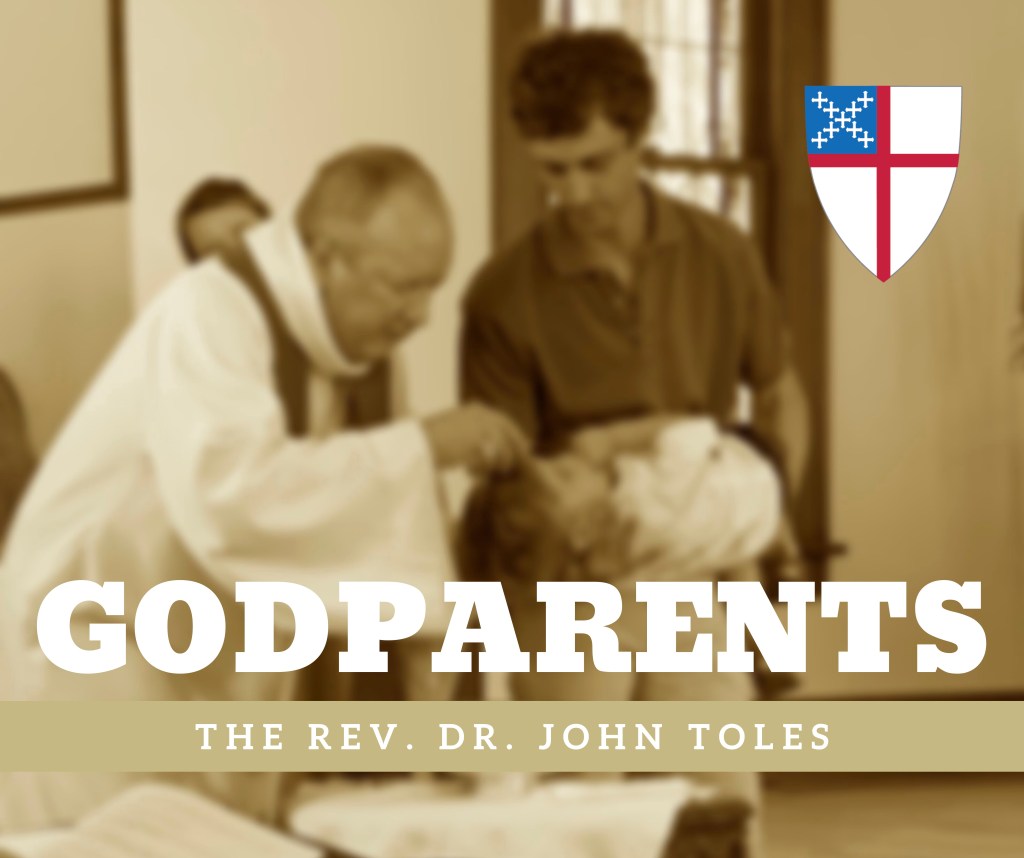
By signing your wedding certificate, the maid of honor and best man are standing as witnesses to the vows you are making. By standing next to you in the church, they are agreeing to assist you in keeping those vows. The Godparents at a baptism are essentially signing on for the same duty, but it goes a bit further for them. Listen to these words that are spoken to the Godparents during this 1892 liturgy:
“DEARLY beloved, ye have brought this Child here to be baptized; ye have prayed that our Lord Jesus Christ would vouchsafe to receive him, to release him from sin, to sanctify him with the Holy Ghost, to give him the kingdom of heaven, and everlasting life. Ye have heard also that our Lord Jesus Christ hath promised in his Gospel to grant all those things that ye have prayed for: which promise he, for his part, will most surely keep and perform.
“Wherefore after this promise made by Christ, this Infant must also faithfully, for his part, promise by you that are his sureties (until he come of age to take it upon himself) that he will renounce the devil and all his works, and constantly believe God’s holy Word, and obediently keep his commandments.”
The Godparents are becoming surety for the one to be baptized. In this context, Merriam-Webster defines surety as, “One who has become legally liable for the debt, default, or failure in duty of another.” By standing up for Sully, the Godparents are taking upon themselves the debt of Sully’s life before God until he is of an age to take that burden upon himself. That is quite a remarkable spiritual responsibility. It says, “If you, Sully, fail in your life with Christ, then I will be the one who takes on that debt and the one responsible for that failure.”
Ol’ Boudreaux may have just stumbled into his baptism and is probably still looking for Jesus at the bottom of a river, but what we do here today is very intentional, with full knowledge of our actions. And if I were a Godparent, I might be looking for an exit before I took this one on, but here’s the good news, the God news: a person baptized is not baptized into the faith alone. A person baptized is baptized into the death and resurrection of Jesus and also into the Body of Christ.
By standing next to Sully at his baptism, the Godparents act as surety for his life before God, but all of you gathered here this day and all those that are baptized into the faith of Christ are also surety for Sully before God. We are all Godparents to him and to one another. Why? Because we are the Body of Christ. St. Paul wrote to the Ephesians, “There is one body and one Spirit—just as you were called to the one hope that belongs to your call—one Lord, one faith, one baptism, one God and Father of all, who is over all and through all and in all.”
There is a question during the baptism in our current Book of Common Prayer that is not included in the 1892 service: “Will you who witness these vows do all in your power to support this person in his life in Christ.” The answer: “We will.” When you were baptized, a congregation stood and took that vow upon themselves. They each vowed to be surety for you. So today, as we baptize Sully, remember the vows that you are all taking for him, but also the vows that were taken for you, and the responsibility that you have as members of the Body of Christ, as “Godparents” to one another.
Let us pray: O Lord Jesus Christ, You said to Your Apostles: “Peace I leave with you, My peace I give to you.” Look not upon our sins, but upon the faith of Your Church, and grant to her that peace and unity which are agreeable to Your will, who live and are King and God, for ever and ever. Amen.
Heresies within the Christian faith have existed since the time soon after the death Christ and the Church has employed various means to rid itself of them. For Dominc’s part, he would have likely remained a cloistered monk, but while traveling through Languedoc, in the south of France, he encountered the Albigensian (Cathari / “pure ones”) heresy, which held to the belief that the physical world was the world of Satan and therefore, all physical matter was evil, thus leading them to deny the Incarnation, baptism by water, the Real Presence, etc. Additionally, the Albigensian priest led very austere lives, quite the opposite of their Roman Catholic counterparts who enjoyed much of the fineries of life. Once encountered, Dominic felt compelled to preach against the heresy, following the practices of a more apostolic way as witnessed in the first disciples. Ten years afterwards, in 1215, Dominic would officially establish the first house for the Order of Preachers in Toulouse, France.
What happened to the religious orders in England during the reign of Henry VIII?
In 1534, the Act of Supremacy was passed in the English Parliament, which established Henry VIII as the Supreme Head of the Church of England, thus resting control of the Church from Rome. Henry, desiring the wealth of the monasteries would pass the First Act of Suppression, which closed all monasteries with income of less than £200. Following the closure, the lands and gold would be confiscated by the Crown. In 1539, the Second Act of Suppression was passed, allowing for the forced closure of all remaining monasteries (by 1540, over 50 monasteries a month were closed.) A few religious remained (those who failed to comply were martyred), but these actions effectively brought the monastic life to an end in England until the revival in the 19th century.
Of the historical figures cited that embody an Anglican Dominican way, which do you find most appealing?
Jackson Kemper (If I say any other, I will likely be stripped of my degrees from Nashotah House!) I pray this is an acceptable way to answer the question. It is a sermon I preached last year on his feast day, and demonstrates my reasoning:
The Apostle of the Western Church, Jackson Kemper, was born on Christmas Eve 1789 and in 1835 he was consecrated bishop. At the consecration, the Bishop of New Jersey began his sermon: “Brethren, we are assembled, under the protection of Almighty God, to partake in, or to witness, the consecration of a missionary bishop. It is a new office in this Church. The event has not occurred before. What we are now to do will go on record, as a precedent…” Toward the end of that sermon, the bishop gave Kemper a charge: “Beloved brother, from the work to which the Lord, we trust, has called you, I may keep you back no longer. You are to go out, in the Saviour’s name, the first Missionary Bishop of this Church. Going with the office, go in the spirit, of an Apostle! You are to preach the gospel of salvation to a ruined world. You are to bear ‘the ministry of reconciliation’ to sinful men, the enemies of God, and of their own souls, by wicked works. Like the Apostle Paul, preach to them ‘Christ crucified.’”
His missionary diocese was small, it only consisted of Missouri, Kansas, Nebraska, Minnesota, Wisconsin, and part of Indiana, 450,000 square miles (by comparison, Oklahoma is 70,000 square miles). Fortunately he had some help—one priest. However, he did not let the size of his missionary territory nor the lack of help daunt him. Instead, he went about the business of establishing churches and to solve the problem of so few priest, he began a seminary. And not just any seminary, but (to this day) the finest seminary in the Episcopal Church: Nashotah House.
His passion for mission was evident in his work and his words. In 1841, he was given the opportunity to preach on mission at the General Convention. “Constrained by the undying love of Christ to love the immortal souls of our fellow beings—let us be ready for the privilege, if it is ever conferred, to scatter the precious seed on every field—to erect the banner of the cross on every mountain. Let us at least hasten the time—by our prayers, our exertions, and our sacrifices—when the joyous sound shall burst from every heart, “How beautiful are the feet of them that preach the Gospel of peace, and bring glad tidings of good things.’”
At the end of his missionary work he had organized seven different diocese, consecrated over 100 churches, ordained more than 200 priests and deacons, and confirmed more than 10,000 individuals. His last words: “I hope I have been faithful; I hope I have kept the faith.”
Going back to his consecration, the Bishop of New Jersey concluded his sermon to Kemper by saying, “Go, bear, before a ruined world, the Saviour’s bleeding Cross. Go, feed, with bread from heaven, the Saviour’s hungering Church. Go, thrice beloved, go, and God the Lord go with you!” From our Gospel reading today, Jesus said, “Go therefore and make disciples of all nations, baptizing them in the name of the Father and of the Son and of the Holy Spirit, and teaching them to obey everything that I have commanded you.”
Jackson Kemper heard the message to “Go” and he went. I pray that we will all hear this message, feel the passion of the missionary, and go out in the mission field that God has set before each of us… even if that mission field only extends to our next door neighbor.
As an aside, part of my duties while at Nashotah was to keep up the mowing of the grounds. Each week, not only did I mow the lawn around Bishopstead, Kemper’s residence, but also the cemetery where he is buried, making sure to greet him kindly each time I passed his grave.
When did the first known efforts at founding a non-Roman Catholic Dominican Order take place?
The Dominican Priory of Christ the King, founded around the time of the Second Vatican Council (1962-1965) in Coos Bay, Oregon.
Who was the founder and first Master of the Anglican Order of Preachers? Did you find anything interesting about the initial beginnings of the Anglican Dominicans?
The Very Rev. Dr Jeffery Mackey, O.P.A. was the first Master of the Anglican Order of Preachers.
I did find it interesting that the order was founded so recently. It is such a beautiful expression of the Catholic nature of the Church. Then again, there have been many in the Anglo-Catholic tradition who have been living out the Dominican life, just not naming themselves as such. It is good to have a home and a community.
As you learn more about the Anglican Dominicans, could you imagine yourself being one? Why or why not?
Yes! As a priest, the study, prayer, preaching, Marian devotion, etc. have always been a part of my life, but what I’m discovering is that the more I practice the rule, the more I want / need to practice the rule. In addition, the more I see of the community online, the more I desire to be a part of it. For my life with God, this ‘feels’ like a very natural next step.
In the comic strip, Calvin and Hobbes, Calvin is at school, and his teacher is attempting to teach the class. She begins, “If there are no questions, we will move on to the next chapter.”
“I have a question,” Calvin says.
“Certainly Calvin, what is it?”
He asks, “What’s the point of human existence?”
The teacher responds, “I meant any questions about the subject at hand.”
“Oh,” said Calvin. “Frankly, I’d like to have the issue resolved before I expend any more energy on this.” (From Calvin and Hobbes, March 3, 1992.)
Cousin Janie and I were discussing the Gospel reading this week in preparation for writing the sermon and we both agreed that at first, it seems like Luke, in writing this passage, had several random quotes of Jesus that he needed to do something with, so he just ran them all together here and moved on. We start with hate everybody, then carry your cross, building a house, going to war, and then getting rid of all of your possessions. Are these random thoughts or are they related? Answer: related, but it is easier to find the thread running through them by first breaking down each of the components.
First, you’ve got to hate everybody. By this time in Jesus’ ministry, we know that he does not want us to truly hate anybody. It would be the complete opposite of his other teachings, particularly that bit about “A new command I give you: Love one another. As I have loved you, so you must love one another.” (John 13:34) It would also be the complete opposite of his every action; from healing the sick to feeding the 5,000 to raising the dead. None of this speaks of hate. So what is Jesus saying? St. Benedict put it best, “Let nothing be preferred to the work of God.” (The Holy Rule of St. Benedict, Ch. XLI) We are to hate no one, but we are not to love or prefer anyone, including ourselves and our very lives, over God.
The next two statements, building a tower and going to war, are closely related, but Jesus had some very specific examples that he was alluding to. With regards to building of the tower, at that time, Herod had undertaken the rebuilding of the Temple. Looking at that project or one similar, anyone could ask, “What does something like that cost? Can you afford it? You’re going to look pretty stupid if you run out of money before the work is done.” As for the going to battle statement, many at that time were looking for a military solution to kick the Romans out. Jesus statement asked them and others the question, “Have you seen the size of the Roman army? Can you finish what you’ve started if you go to war with them?” As an aside, forty years later, the Temple was destroyed. By who? The Romans. Sermon for another day. Anyhow, both of these illustrations, outside of their historical references, ask the question, “Have you counted the cost of this particular venture?”
The final statement is no easier than the first: “None of you can become my disciple if you do not give up all your possessions.” For some, this is a very literal command. Give it all up and follow me, but for most, to follow this literally, would be… well, for starters, it would be to make their families and themselves homeless. I do not believe this is what Jesus intended; however, each of us should be prepared to literally give up all our possessions for the sake of the Gospel. Benedict’s statement applies here as well, “Let nothing be preferred to the work of God.” Let nothing, including all your possessions, be more important to you than the work of God.
Put it all together and what is the message? Calvin said to his teacher, “Frankly, I’d like to have the issue resolved before I expend any more energy on this.” Jesus is saying to us, “Before you expend anymore energy on following me, you need to sit down and count the cost, because there may come a time when you will have to decide what is most important and discard whatever prevents you from following me.”
Many world religions have the practice of taking a pilgrimage—a long journey—to a place of religious significance. Within Christianity, Jerusalem and Rome top out the list, and for many the number three pilgrimage is the Camino de Santiago, The Way of St. James. I shared with you in last month’s newsletter that I would be taking a sabbatical next year and walking that pilgrimage.
Legend has it that the Apostle James was martyred by Herod Agrippa and that the disciples of James took his body and placed it in a rudderless boat and set it out on the Mediterranean Sea. Guided by God, the boat eventually landed on the coast of Spain and King Alfonso II had the Apostle buried near there and a chapel built, which would later become Santiago de Compostela Cathedral.
Since that time, for over a thousand years, people have been making pilgrimage to the Cathedral to kneel and pray before the burial place of the Apostle. There are many different routes, but the most traditional is the Camino Frances. You can begin anywhere you like along the route (anything over 63 miles is considered having walked the Camino), but the full route begins in Saint-Jean-Pied-de-Port on the French side of the Great Pyrenees, which then crosses into Spain. Total, it is a four hundred ninety mile walk across northern Spain. Last year, there were about 33,000 people that walked the full Camino Frances.
The shell became the sign of the pilgrim, for after reaching the Cathedral, pilgrims would continue on to the coast (about 47 miles) to the place where the Apostle’s boat beached and collect a shell as a sign that they had completed the pilgrimage.
I share this with you this morning for two reasons. One, this probably isn’t the last time you’ll hear me talk about it and so I figure you may want some vague idea as to what I’ll be up to. Two, I’ve got at least forty pounds to drop, because not only do you walk the entire trip, but you also carry everything you need in a backpack. When it comes to packing that backpack, people are weighing things, not in pounds, but in ounces. Yeah, it would be fun to have your laptop with you, but schlep those three pounds around for a couple hundred miles and you’ll be looking for a pawn shop or a dumpster. So many stories of people way overpacking and pitching things they didn’t need. So many people not counting the cost of the pilgrimage, expending too much energy on things that are nothing but dead weight, and once they’re on the road, they figure out what is truly important and what is not. What they need to live on, to survive and what’s just an extraneous burden.
From our Gospel: “Now large crowds were traveling with Jesus; and he turned and said to them….” He stopped and he turned to that crowd and said to them, “If you want to be my disciple, then know that you and I are going on a difficult pilgrimage together. Right now, the road is not so bad and you are able to hang onto everything you want, but, there will come a time when the road gets much more difficult and you will be faced with a choice: discard the extraneous things in your life and continue following me, or hang on to all you want and fall away. So, instead of getting half way to the goal and quitting, stop, today, and count the cost, ‘Choose you this day whom you will serve.’”
There are many things that you can and do expend your energies on, but “Let nothing be preferred to the work of God.”
Let us pray: O Blessed Virgin Mary, help us to keep to our purpose of living as faithful disciples of Jesus, for the building up of the Christian society and the joy of His Holy Church. We greet you, Mother, morning and evening; We pray to you as we go on our way; from you we hope for the inspiration and encouragement that will enable us to fulfill the sacred promises of our earthly vocations, give glory to God, and win eternal salvation. Like you, help us to always remain near to Jesus. Amen.
Is the concept of a denomination other than the Roman Catholic Church being “Catholic” new or familiar to you?
Twenty years ago, this was a new idea other than, “We believe in one holy catholic and apostolic church.” As one of the four notes of the Church, I simply understood the word “catholic” to mean universal. Following my studies, I understood the concept in a much broader sense, not only in the way we practice our faith through ritual, but also our understanding of a more ancient church.
What is the argument Anglican Dominicans make in claiming that their Church is an expression of Catholic Christianity?
Anglican Dominicans argue that there was “the existence a primitive or early Catholicism (distinct from Roman Catholicism) that existed for the first one thousand years of Christianity,” (p. 5) which was later folded into the Anglican Church. John Henry Newman, one of the Tractarians would fully support this argument. “In his tracts on the Church of England he claimed that it was truly and purely catholic, based on the customs of the Apostolic Church and the teaching of the Fathers, and corrupted neither by Romanism nor by Protestantism.” (The History of the Church in England, p. 341)
While drawing upon the Catholic tradition of Christianity, the Anglican Dominicans also draw upon the Protestant tradition. What elements of the Protestant Reformation are particularly important to Anglican Dominicans?
St. Paul says to Timothy, “I charge you in the presence of God and of Christ Jesus, who is to judge the living and the dead, and by his appearing and his kingdom: preach the word; be ready in season and out of season; reprove, rebuke, and exhort, with complete patience and teaching. For the time is coming when people will not endure sound teaching, but having itching ears they will accumulate for themselves teachers to suit their own passions, and will turn away from listening to the truth and wander off into myths.” (2 Timothy 4:1–4) Preach the word: “The Protestant Reformation… brought back into the mainstream of Christian life and practice: evangelization, preaching, and the centrality of the Word of God as found in the pages of Holy Scripture…. [which] began to shift the emphasis of priestly office away from the altar and toward the pulpit.” (p. 6, 7)
The state of preaching today is lacking. Mark Galli (Christianity Today), recently wrote a series of articles under the title, “The Elusive Presence” (they are brilliant). In “The Elusive Presence: And Now, the Star of the Show…,” Galli writes, “Preaching is one time in the week when we have the opportunity to hear about something other than ourselves, other than the horizontal. It’s the time to hear about God and the wonder and mysteries of his love, of what he’s done for us in Christ. But more and more, evangelical preaching has become another way we talk about ourselves, and in this case, to learn about the preacher.” (Source) This is one of the great appeals of the Anglican Dominicans, they understand the significance of sound and learned preaching and teaching that is focused not on self, but on the Word. The Reformers got this one right.
How is Anglican Christianity a middle way between Roman Catholicism and Protestantism?
G.K. Chesterton is reported to have said/written, “The Reformer is always right about what’s wrong. However, he’s often wrong about what is right.” As was noted in Anglican Dominicans, the reformers threw the baby out with the bath water; however, in pre-Reformation Roman Catholicism, the priest had become a poorly educated sacramentalist, with little or no emphasis placed on the Word of God. It was about the ritual and not the Person behind it all. As was noted above in answer #3, the reformers brought back the Word, the Tractarians (answer #2) brought back the theology/understanding of the ancient Church, and later the ritual, and from this, the Via Media was born: the “bridge” Church, being both Catholic and Protestant.
What period of church history is particularly important for Anglicans in determining acceptable beliefs and practices?
The 19th century and the Oxford Movement, that I attempted to describe in answer #4. This was a time of accepting some of the corrections of the reformers, without destroying the practices and piety of the Catholic Church, in the process, creating a reformed Anglican expression of the Catholic Church.
So far, what do you find interesting or appealing about the Anglican Dominicans?
“Anglican Dominicans recognize this trend (the pastoral office centered almost exclusively on sacramental functions) is still dangerously present in the Christian Church today and believe the foundational mission is vigorous Gospel proclamation.” (p.7) This is very appealing. With the decline of mainline denominations, we see so many gimmicks being employed to increase attendance and the Gospel is abandoned as “old fashioned.” In addition, many preachers sound more like CNN/Fox News commentators than they do proclaimers of the Good News. However, at the ordination of a priest, the bishop asks, “Will you endeavor so to minister the Word of God and the sacraments of the New Covenant, that the reconciling love of Christ may be known and received.” (BCP p.532) In this, Dominic demonstrated to us how to fulfill this vow: “Wherever the Master was, he always spoke either to God or about God.”
MY CHILD, I will teach you now the way of peace and true liberty.
Seek, child, to do the will of others rather than your own.
Always choose to have less rather than more.
Look always for the last place and seek to be beneath all others.
Always wish and pray that the will of God be fully carried out in you.
Behold, such will enter into the realm of peace and rest.
THE DISCIPLE
O Lord, this brief discourse of Yours contains much perfection. It is short in words but full of meaning and abounding in fruit. Certainly if I could only keep it faithfully, I should not be so easily disturbed. For as often as I find myself troubled and dejected, I find that I have departed from this teaching. But You Who can do all things, and Who always love what is for my soul’s welfare, give me increase of grace that I may keep Your words and accomplish my salvation.
A PRAYER AGAINST BAD THOUGHTS
O Lord my God, be not far from me. O my God, hasten to help me, for varied thoughts and great fears have risen up within me, afflicting my soul. How shall I escape them unharmed? How shall I dispel them?
“I will go before you,” says the Lord, “and will humble the great ones of earth. I will open the doors of the prison, and will reveal to you hidden secrets.”
Do as You say, Lord, and let all evil thoughts fly from Your face. This is my hope and my only comfort — to fly to You in all tribulation, to confide in You, and to call on You from the depths of my heart and to await patiently for Your consolation.
In September of 1864, a treaty was established with the Cheyenne Nation; however, in November of that same year, a Methodist minister who was also a Colonel in the Union Army broke that treaty by attacking a Cheyenne village in Sand Creek, Colorado. One hundred and fifty Cheyenne were killed, one hundred of which were women and children. A general in the Union Army declared the event “a cowardly and cold-blooded slaughter, sufficient to cover its perpetrators with indelible infamy and the face of every American with shame and indignation.”
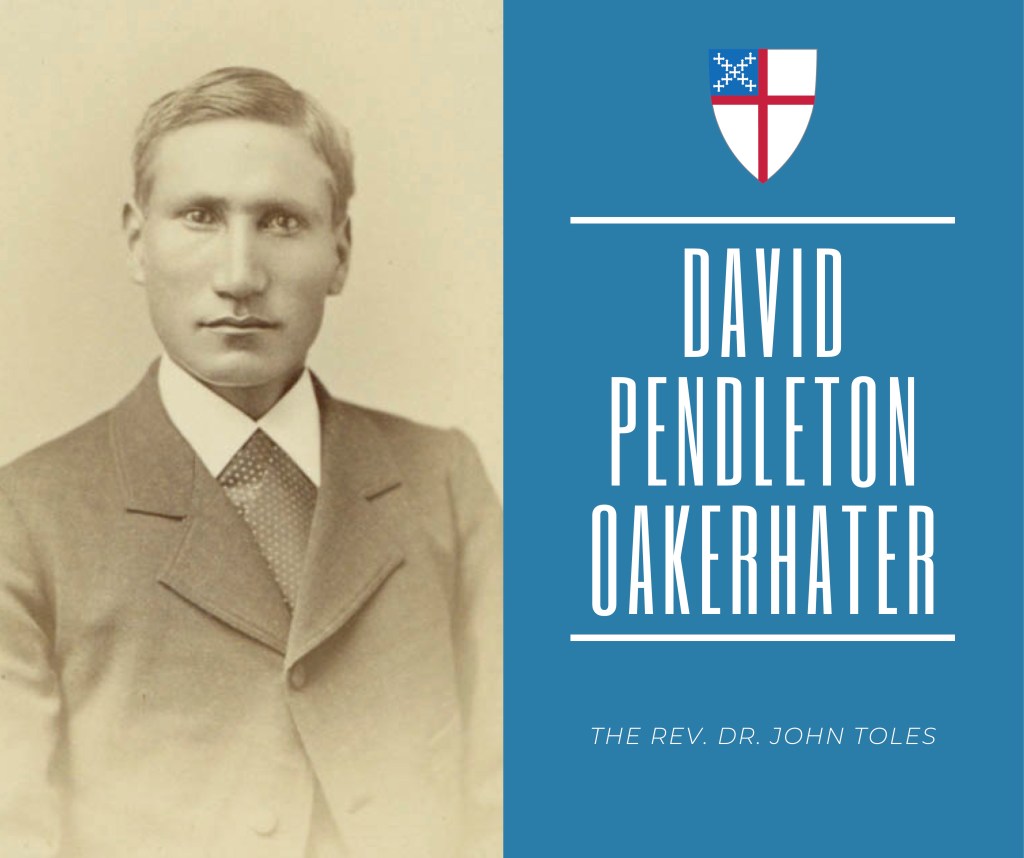
As a result of the attack, a seventeen-year-old Cheyenne warrior from Oklahoma, by the name of “Making Medicine,” declared he would revenge his people. In 1874, he and many others attempted that revenge, but their attack eventually ended in failure. Later, in 1875, Making Medicine was captured, along with many others, and put on railroad cars to St. Augustine, Florida. The time between these events and his death in 1931, demonstrate exactly how dramatically the Lord, working through one person, can effect so many. For Making Medicine went from declaring his revenge, to becoming a deacon in the Episcopal Church. Most of you know him by his Anglicized name, David Pendleton Oakerhater. You all know his history better than I do, but he went from the battlefields, to seminary, and returned to Oklahoma where he ministered among his people for thirty-six years as a deacon. For ten of those years, he was the only Episcopal clergy person in Oklahoma. He started schools for his people and baptized every member of his tribe, including his mother.
Today we heard in the Psalm:
Sing to the Lord a new song; *
sing to the Lord, all the whole earth.
Sing to the Lord and bless his Name; *
proclaim the good news of his salvation from day to day.
Declare his glory among the nations *
and his wonders among all peoples.
From the very first days he arrived back in Oklahoma, Deacon Oakerhater sang that new song. He declared to a gathering of Cheyenne leaders: “You all know me. You remember when I led you out to war I went first, and what I told you was true. Now I have been away to the East and I have learned about another captain, the Lord Jesus Christ, and he is my leader. He goes first, and all He tells me is true. I come back to my people to tell you to go with me now in this new road, a war that makes all for peace, and where we have only victory.”
Today is actually the feast day of Paul Jones (Oakerhater’s was officially this past Saturday, but you can’t be an Oklahoma Episcopalian and not celebrate him). Paul Jones was a great advocate for peace during World War One and the years following, up until his death in 1941. I believe that he and Oakerhater would have gotten along quite well, as they were both ones who sang this new song of peace.
When so many cry for war, it can be difficult to stand for peace, but these two—Oakerhater and Jones—are witnesses to us and to the world of peace and reconciliation, and today we give thanks for their witness.
OK, blog friends, three posts in a day is a bit excessive… sorry. Just getting things done on a restful ‘non-laboring’ Labor Day.
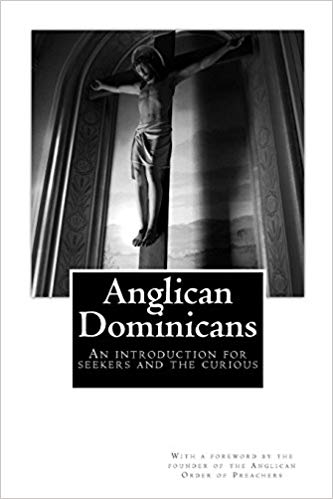
As part of the postulancy program, I will be reading Anglican Dominicans and answering questions. The plan is to post these by chapter. Below are the questions from the ‘Introduction’ and the answers I submitted. The remaining chapters are where the fun begins.
Introduction
Prior to reading this book, had you ever heard of Roman Catholic or Anglican Dominicans?
Yes. Nashotah House, where I attended seminary, is based on the Benedictine rule. There were many times in various classes (church history, spiritual theology, etc) that the different orders, including Dominican, were discussed. In addition, we would have members of various religious orders visit the campus. I confess, at first, I believed they were Roman and just happened to be visiting. It was later that I learned of the religious orders within the Anglican Communion and that I began researching the various orders. As Nashotah is Benedictine, that was my original interest, but the more I learned of the Dominican Order, the more I understood this was perhaps the place for me.
Prior to reading this book, were you aware that there are religious orders in the Anglican Communion?
More or less answered this above, however, while in the Diocese of Montana, it was the Anamchara Fellowship that was promoted and supported. Although a worthy organization, I did not feel a call in that direction. In my readings on Anglican Dominicans, I was delighted to learn that there is collegiality and friendship with the RC Dominicans.
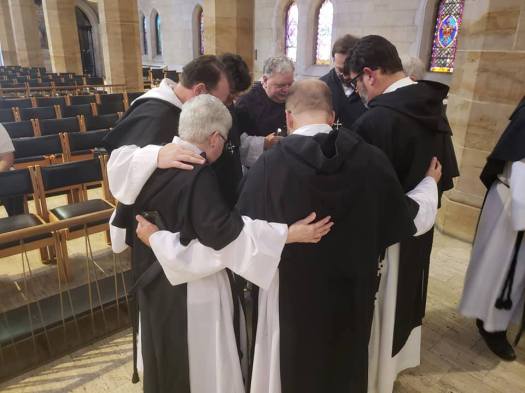
Discernment to the priesthood is not something that ends once you’re ordained, and for sometime, I’ve been discerning mine. My conclusion: I need to go deeper. I need to stop playing around and pretending. I need to further commit my life to the Gospel. With that in mind, after prayer and consultation with my Bishop, I have decided to ‘try’ and become a member of the Anglican Order of Preachers (a.k.a. Dominicans). No. I’ve no plans to leave my current church (unless they kick me out). In fact, this calling into the Dominicans seems to be drawing me even closer to them.
Who are the Anglican Dominicans? From their website:
The Anglican Order of Preachers is an apostolic religious community inspired by the spiritual tradition founded by Saint Dominic de Guzman in the thirteenth century. It was not until the last years of the twentieth century that an expression of Dominican spirituality and life could be found outside of the Roman Catholic Church. The Order is composed of men and women from around the world and various provinces of the Anglican Communion and her sister Churches.
The mission of the order is the proclamation of the Gospel of Jesus Christ, with a particular emphasis on proclamation ministries of evangelism and discipleship. The brothers and sisters surrender their entire lives to an apostolic lifestyle dedicated to God. This lifestyle, inspired by the lives of the first apostles and Saint Dominic, is lived out within the ordinary challenges of life, so that all people in all places can hear the Gospel.
The community is scattered, with brothers and sisters living across the world; by themselves, with their families or in small groups. They support themselves and the order by their work, either within the Church or the world. Brothers and sisters take vows of marriage or vows of celibacy. In everything members are encouraged to live out the words of Saint Dominic, “to speak with God or about God.” You can learn more here.
I’m currently only in the area of discernment, which is known as postulancy. Following this period of time, if accepted, I will become a novice and the novitiate will last for two years. If all goes well, I will make life vows and become a fully professed member.
The purpose of this new page, “Dominicans”, is to document the journey and post the writings that are required throughout this process and other info and pictures. I ask for your prayers.
O Lord Jesus Christ, you became poor for our sake, that we might be made rich through your poverty: Guide and sanctify, we pray, those whom you call to follow you under the vows of poverty, chastity, and obedience, that by their prayer and service they may enrich your Church, and by their life and worship may glorify your Name; for you reign with the Father and the Holy Spirit, one God, now and for ever. Amen.




 Candle in a Cave