Dominicans: AD Questions – Chapter 4

Chapter Four

  • What is Christian Formation?

As I sat in chapel during my time in seminary, I so remember the first time I really heard the words of Psalm 119:99-100:

I have more understanding than all my teachers,
for your testimonies are my meditation.
I understand more than the aged,
for I keep your precepts.

I suspect that I was not the only seminarian to ever smile and suppress a chuckle upon reading these words, but that (innocent?) arrogance demonstrates so clearly the need for formation. A need for the old Adam to be broken down and replaced with the new Adam found only in Christ Jesus. Formation is the process of breaking down who we think we are/who we think we are supposed to be, with who Christ has called us to be. Christian formation is to say with Isaiah:

But now, O Lord, you are our Father;
we are the clay, and you are our potter;
we are all the work of your hand. (Isaiah 64:8)

Christian formation, after recognizing this truth, is then to submit to the work of his hands, so that we take on the identity of the Father. However, it is not a one-and-done event. Formation is the work of a lifetime: “You shall be holy, for I am holy.” (1 Peter 1:16) We are made holy through through the redeeming work of Jesus upon the cross, and, each day, we are to seek to become more holy through the formation and the work of sanctification. “We are deeply moved, and our hearts profoundly shaken, when we listen attentively to that cry of St Paul: ‘This is God’s will for you, your sanctification.’ Today, once again, I set myself this goal and I also remind you and all mankind: this is God’s Will for us, that we be saints.” (Friends of God, St. Josemairía Escrivá, #294) Christian formation is nothing less than the process of becoming a saint.

  • How do Anglican Dominicans receive their training? Are there lessons that local churches or the Church in general could learn from the Anglican Dominican education process?

As I am preparing to walk the Camino de Santiago next year, much of my understanding of our Christian walk falls under the concept of pilgrimage—a journey to a sacred place. Anglican Dominicans receive their training through a pilgrimage of stages: inquiry, postulant, novice, and professed, utilizing several means including: reading, study, group interaction, mentorship, and further discernment of a calling.

These practices can certainly be utilized by a local church. As an example, having a desire to disciple individuals who hoped to further deepen their faith and with the blessing of my Bishop, I began The Confraternity of the Imitators of Christ (CIC) in my current parish. The objectives of the CIC are:

  • To seek holiness in our daily lives and the sanctification of our work in our families, our places of employment, and the Church.
  • To fulfill the vows we make in the Baptismal Covenant (Book of Common Prayer, p. 292).
  • To recognize the real presence of Our Lord in the Blessed Sacrament of His Body and Blood.
  • To deepen our relationship with the Blessed Virgin Mary and to seek her intercessions that we may become a Tabernacle of her Son, Jesus Christ, the Son of God.
  • More info on the CIC can be found here.

The first objective has led to lessons on topics such as: study, rule of life, meditation, fasting, study, BVM, confession, etc. Through this ongoing study and practice, individuals begin to lead a more disciplined, studied, and intentional faith.

  • What is the governance structure of the Anglican Dominicans—is it more democratic or authoritarian?

“One of the unique features—certainly a mark of the changing times of the 13th Century—of Saint Dominic’s initial community, was its democratic and egalitarian character.” That said, I find comfort and peace in submitting to the authority of my Bishop.

For those not feeling called by God to be a Dominican brother or sister, the Order offers two other affiliations: oblates and associates. Do you think you’d benefit spiritually by being an oblate or associate of a religious order, Dominican or not?

I do feel that I would benefit as an oblate or associate, but truly, I feel a sincere calling to become a professed member. Should I not be accepted as such, I would seek to become an oblate or associate, whichever was found more fitting.

  • Anglicans in general, and Anglican Dominicans in particular, embrace a diversity of viewpoints regarding the Blessed Virgin Mary. What is your personal view of Mary?

“Hail, holy Queen, Mother of mercy, hail, our life, our sweetness, and our hope.”

Surprisingly, I had no devotion to the BVM prior to attending seminary and very little while in seminary at Nashotah (please don’t tell them that!), and I’m not real certain as to why or how the shift occurred, but following my ordination to the priesthood… she brings me to Jesus. I would say more, but I truly don’t understand it. I hold her hand while I preach. I cling to her in prayer. I can’t see an image of her without stopping and catching my breath. Her Son is my God, Savior, King, Master… she is…

  • What are some of the challenges facing Christianity in the coming decade? How do you think individuals and churches can respond to these challenges?

The discussion on page 38 of Anglican Dominicans provides a broad outline of the many challenges facing Christianity today. For me, I believe that it can be summed up in the fact that our faith and the practice of our faith has become such a horizontal application of the Gospel that we are no longer aware of the vertical, supernatural or transcendence of God. Church has become a PAC or Rotary or the country club, instead of being a transformational community. Preachers are the talking heads of CNN/Fox, instead of prophetic witnesses. Parishioners are consumers, seeking a denomination or style of worship that fills a need, instead of individuals striving for holiness and an encounter with the Creator of the Heavens and the Earth. I know that is a harsh assessment and it is certainly not true for all, but we have lost our way… THE Way.

Individuals and churches can respond to the challenges by returning to our roots and Archbishop Michael Ramsey stated it so well: “I suggest to you that as the cross and the Resurrection were the spearhead of the gospel’s relevance and potency in the first century so they can be also for our contemporary world. Ours is a world full of suffering and frustration: of what significance to it is Jesus who lived and died nearly two thousand years ago? The answer is: chiefly in this, that in the Death and Resurrection he shows not only the way for man but the very image of God himself. Is there within or beyond our suffering and frustrated universe any purpose, way, meaning, sovereignty? We answer, yes, there is purpose, way, meaning, sovereignty, and the Death and Resurrection of Jesus portray it as loving through dying, as losing self to find self, as the power of sacrificial love.” (The Christian Priest Today, p.32-33)

St. Paul declared to the Corinthians, “For I decided to know nothing among you except Jesus Christ and him crucified.” (1 Corinthians 2:2) The answer to the challenges for individuals and the Church is the exact same.

Sermon: Thecla

The podcast is available here.

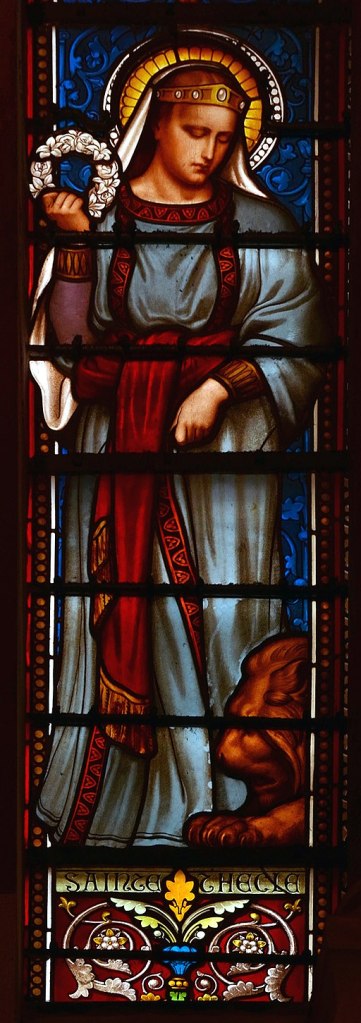
The Apostle Paul was planning to visit Iconium in central Turkey. When he arrived, the people wrote a description of him: “At length they saw a man coming (namely Paul), of a small stature with meeting eyebrows, bald [or shaved] head, bow-legged, strongly built, hollow-eyed, with a large crooked nose; he was full of grace, for sometimes he appeared as a man, sometimes he had the countenance of an angel.” (Source) That description appears in a second century text: The Acts of Paul and Thecla. It is described by an early commentator as “religious romance,” but not a romance between a man and a woman as we understand it, but a shared romance of sharing the Gospel.

Thecla, while Paul was visiting Iconium, sat for three days in her windowsill, without eating or drinking, and listened to Paul teach on chastity and purity. Following that teaching, she swore off marriage, ended her engagement, and pledged to follow Paul as helper. Her fiancé, not at all pleased with this decision, brought charges against her. She had made an agreement to marry, and getting married and having children is what women were for. Not only was her choice to remain unmarried against the will of her fiancé and family, it was also against the will of the state: can’t have women going off with this funny ideas of not producing children. Her sentence: to be burned at the stake. She was tied up, the fire was set, and… there was a great flood of rain. She escaped her death sentence and went to Antioch with Paul.

I’m guessing she was better looking than him, because once there, she caught the attention of a city official who desired her, but she rebuffed him as well, which sent him into fits and he also called for her death. This time, she was set in the arena with wild beasts—twice. The first time, the lioness that was sent in to kill her only licked her feet. The second time, the lioness protected Thecla by killing another lion and a bear and then laid down at Thecla’s feet. In the end, the text reports that the Apostle Paul sent Thecla back to Iconium to do two things: preach and baptize, which is perhaps the reason why the Acts of Paul and Thecla do not appear in the canon of scripture or even the apocrypha, and why it was condemned by Tertullian, who writing on baptism and Paul stated, “For how credible would it seem, that he who has not permitted a woman even to learn with over-boldness, should give a female [Thecla] the power of teaching and of baptizing!” (Source)

Thecla’s feast day was Monday, and the canticle that was appointed was The First Song of Isaiah:

Surely, it is God who saves me; *
I will trust in him and not be afraid.
For the Lord is my stronghold and my sure defense, *
and he will be my Savior.

And then there was our Psalm today:

Because you have made the Lord your refuge, *
and the Most High your habitation,
There shall no evil happen to you, *
neither shall any plague come near your dwelling.
For he shall give his angels charge over you, *
to keep you in all your ways.
They shall bear you in their hands, *
lest you dash your foot against a stone.

As I read Thecla’s story, I considered that canticle and the Psalm and remembered the words Joshua said to the people, “It is the Lord your God who fights for you, just as he promised you.”

So many times, when we come up against an adversary, whether it be someone or something in the world, our own inner ‘demons,’ or events such as sickness or hardships, we can believe that we are in it alone, but if we remember Thecla, then we remember that our God is one who douses the flames and turns back the wild beast. The Lord our God is one who gives his angels charge over us, that our souls and eternal lives will always be saved.

The next time you face trouble, remember Thecla, who even in the face of death, stood and did battle, and through the Lord, overcame her adversary.

Sermon: Proper 20 RCL 20 – “Generosity of Spirit”

The podcast is available here


Photo by Almos Bechtold on Unsplash

A pastor in Dallas tells of a man in the church who once made a covenant with a former pastor to tithe ten percent of their income every year. At the time, both the man and the pastor were young and neither of them had much money, but things changed. The man tithed one thousand dollars the year he earned ten thousand, ten thousand dollars the year he earned one-hundred thousand, and one-hundred thousand dollars the year he earned one million. But the year he earned six million dollars he just could not bring himself to write out that check for six-hundred thousand dollars to the Church. He telephoned the minister he had made the covenant, long since having moved to another church, and asked to see him. Walking into the pastor’s office the man begged to be let out of the covenant, saying, “This tithing business has to stop. It was fine when my tithe was one thousand dollars, but I just cannot afford six-hundred thousand dollars. You’ve got to do something, Reverend!” The pastor knelt on the floor and prayed silently for a long time. Eventually the man said, “What are you doing? Are you praying that God will let me out of the covenant to tithe?” “No,” said the minister. “I am praying for God to reduce your income back to the level where one thousand dollars will be your tithe!”

You can all rest easy, the pledge drive is not starting today (but I won’t apologize if that story tweaked you a little). What the story did get me to thinking about was generosity and how far we are willing to take the idea.

For starters, when we talk of giving, we most often think of money or some other tangible item: food, clothing, etc. And knowing you all, I know that you do just that. You have very charitable and generous hearts in your support of various needs throughout the community. I’ve even had the opportunity to brag on you and your giving through our Community Tithe program (where we give back to the community 10% of all income). You probably saw where news made a big deal over the $500 we gave to Emerson School in paying off their student lunch debt. That’s a good thing and just so you know, we’re also paying off a $750 debt at Adams School and a $2,100 debt at Hayes (that one is in honor of Jean McCollough, who taught there for so many years). But it is not stopping there, we’re looking into helping Taft where Janet Wright worked and Coolidge where Marianne Gray worked. Mary (McDonald), I’m almost afraid to ask what the debt is at the high school, but… Back to Emerson School: you gave $500 and it is a beautiful thing, however, if that was ALL that we’ve done, I would have actually been a bit uneasy by the big todo that was made, but… that’s not all you’ve done. Since we started that program, you’ve given more than $100,000 back into the community. But it doesn’t stop there, because, as we said, we often think of giving in terms of dollars and tangible items, but you also give of your time. You serve on boards and volunteers: from Loaves and Fishes, to Our Daily Bread, to Leonardos, to Vance AFB support, to the CDSA, to so many more; not to mention what you do in the church: Stephen Ministry, Prison Ministry, Nursing Home Ministry, Eucharistic Visitors, Altar Guild, Choir, Acolytes, Lectors, Ushers… I could do this for awhile.

So the question is: how far are you willing to take this spirit of generosity? The fella making six million a year had enough—even an abundance—but then he reached a limit. It became too much, even though it was the same percentage. So when do you say, “Enough. I can’t give anymore. I can’t do anymore.”

Now, understand, I’m not criticizing you… at all. You folks are amazing, yet this spirit of generosity does not end with giving money and time. As you know, it also applies to much greater ideas: mercy, grace, love. So, do you have a limit when it comes to these? How much is too much mercy, too much grace, too much love? “You know what, Padre—I’ll give you $600 worth of mercy, but $6,000… no. I’ll give you $6,000 worth of grace, but $60,000… you’re asking too much. I’ll give you $60,000 worth of love, but $600,000… heck, I don’t even give myself THAT much love.” But you see, when it comes to these, you have to consider the standard that has been set. Want to know what the standard for love is? Most folks don’t, but I’m going to tell you anyways: “Greater love has no one than this, that someone lay down his life for his friends.” (John 15:13) The limit of our mercy, our grace, our love should be as lavish, abundant, and—by the world’s standards—as ridiculous as Jesus’. The limit of our mercy, grace, and love, is the cross.

In our Gospel reading today, Jesus appears to be giving and approving of some very shrewd and dishonest business practices, but what you have to keep in mind is that this is a parable. Jesus is not teaching morals. He’s teaching about how we are to show mercy, grace, and love.

Throughout the Old Testament, God tells the Israelites that they are to be his chosen people, a light to the nations. They are to convey his teachings and his Law so that all can walk in holiness, but instead of conveying the message and living it out, most of the people ended up falling into evil practices. The religious, the priests, upon witnessing this falling away, attempted to legislate morality and holiness by enforcing and passing more and more rules designed to bring about the desired holiness, but instead of drawing people closer, it pushed them further away.

In the parable, the shrewd steward is commended, because he saw the way to win friends was by reducing the cost. So, Jesus is saying to the priests, who are the stewards of the faith of Israel, if you want the current residents of the Kingdom of God to follow you and if you want to bring more into the Kingdom, stop raising the price of admission. Instead, slash the cost. Stop crushing the people under the burden and win them over with lavish mercy and abundant, amazing grace. Set no limits. Have such a ridiculous love for them that instead of cursing you, they run to you; and in running to you, they run to Our Father in Heaven, who for his part, will commend you and praise you.

Think of the words from our Psalm (113), starting at verse five:

Who is like the Lord our God, who sits enthroned on high *
but stoops to behold the heavens and the earth?
He takes up the weak out of the dust *
and lifts up the poor from the ashes.
He sets them with the princes, *
with the princes of his people.
He makes the woman of a childless house *
to be a joyful mother of children.

God does not crush his people into the dust. He lifts them up out of the dust and sets them in places of honor. We are to do the same. We are to do the same with our time, talents, and treasures; and we are to do the same with our mercy, grace, and love.

There is a story of a beggar by the roadside who once asked for alms from Alexander the Great as he passed by. The man was poor and wretched and had no claim upon the ruler, no right to even ask. Yet the Emperor gave the poor man several gold coins. A courtier was astonished at Alexander’s generosity and commented, “Sir, copper coins would adequately meet a beggar’s need. Why give him gold?” Alexander responded in royal fashion, “Copper coins would suit the beggar’s need, but gold coins suit Alexander’s giving.”

When you give, when you show mercy, grace, and love, even if a copper coin is all that is needed or required, give gold. Pour it on so lavishly, so abundantly, that it looks ridiculous to the world, but rises like sweet perfume to the Lord.

Let us pray: Lord, grant us simplicity of faith and a generosity of service that gives without counting cost. A life overflowing with Grace, poured out from the One who gave everything, that we might show the power of love to a broken world, and share the truth from a living Word. Lord, grant us simplicity of faith, and a yearning to share it. Amen.

Dominicans: AD Questions – Chapter 3

Chapter Three

  • What is the nature and purpose of a rule of life?

The Introduction and final chapter of The Rule of St. Benedict begin to answer this question: “Listen my son to the instructions of your Master, turn the ear of your heart to the advice of a loving father; accept it willingly and carry it out vigorously; so that through the toil of obedience you may return to him from who you have separated by the sloth of disobedience. (Introduction)… We have written this Rule so that by following it in monasteries, we may to some extent show that we lead blameless lives and possess a beginning of the monastic way of life.” (Ch. LXXIII)  The rule “provides a blueprint for pursuing holiness and personal sanctification.” (p. 19)  The rule is a source of obedience and discipline that, if followed faithfully, provides the foundation from which a life with God and a life in service to God’s people can be achieved.  In the life of the Dominican rule, prayer brings us into community with God and one another (regardless of geographic location); prayer and community provides accountability, support, and the common purpose of proclamation, which is improved and enflamed through our study.

  • Looking over the Anglican Dominican rule, what do you find attractive about it and what do you find challenging or too demanding about it?

What I find attractive is the same as what I find challenging: the daily discipline of prayer and study.  Prayer is at the heart of all any of us do, but… I was visiting friends, we had prepared a delicious supper, had a few drinks, were laughing and having a wonderful time, then I remember Evening Prayer.  The Old Adam came a calling.  Was I obedient?  I pulled out my iPad and read Evening Prayer while sitting with my friends.  When they asked what I was doing, I told them.  My shame: I am a priest!, but when I realized that I needed to do this, I didn’t ask them to join me.  They are Episcopalians.  It may have been unusual for them to pray Evening Prayer in their house, but… I won’t make that mistake again.

As I was wrestling with the daily commitments of the Order, prior to committing, I came across a statement from St. Benedict, “Prefer nothing to the work of God.” (The Rule of St. Benedict, Ch 43)  I now say that to myself at least a dozen times a day and so, as challenging as the rule may appear, I follow it with joy, because I see it as the work of God in my life and my vocation.

  • Do you think the four pillars of the Dominican life would serve as a good foundation for any Christian?

Prayer, community, and study would be a very natural foundation for any Christian, but for some, the idea of all preaching and ministering may seem reserved for those with such a calling, however, Holy Scripture includes everyone in this task.  For example, St. Peter teaches us, “In your hearts honor Christ the Lord as holy, always being prepared to make a defense to anyone who asks you for a reason for the hope that is in you.” (1 Peter 3:15a)  That is a call for all to proclaim the Gospel of Jesus Christ and give testimony to His works.  And again from St. Peter, “Keep your conduct among the Gentiles honorable, so that when they speak against you as evildoers, they may see your good deeds and glorify God on the day of visitation.” (1 Peter 2:12) A call for proclamation through actions and deeds, which all can perform.  In selecting the rule, Dominic understood that members of the Order would be living lives in the world as they went about the task of proclaiming, therefore, it is a rule that is livable and appropriate not only for the Friars, but for all who are in the world.

  • Anglican Dominicans take three vows in their pursuit of serving God.  What do you think of these vows, and what is your opinion of vows to God in general (e.g. are they a good idea or not)?

My friend Thomas à Kempis writes, “It is a very great thing to obey, to live under a superior and not to be one’s own master, for it is much safer to be subject than it is to command…. Go where you may, you will find no rest except in humble obedience to the rule of authority.” (The Imitation of Christ, Book 1, Chapter 8)  Vows are, in a sense, a master.  Where some see them as restrictive and authoritative, I find within them freedom.  I believe Albert Einstein was one who owned several sets of clothes, but they were all identical.  He didn’t want to waste the time or energy trying to figure out what he was going to wear each day.  A rule of life, vows, all accomplish the same goal: if I am obedient, no longer do I have to think on how I am going to live my life, the rule and vows answer those questions for me, so that I am set free to live for God.

In addition, the vows of the Dominican further refine the vows I took at my ordination, adding a level of specificity that are not found in the ordination rite.

  • Do you think God might be calling you to be an Anglican Dominican? How would a person know if God was calling him or her to be in a religious order, Dominican or other?

As I mentioned before, I think God has been calling me to the Anglican Dominican life for quite some time, I just didn’t know that it had a name or a community.  The final answer as to the calling is prayer, but I have to wonder if living out the life of a religious prior to any knowledge of a religious order is more of a ‘true’ calling.  It is one thing to read the rules and then decide whether or not it is a good fit as compared to living out the rules and discovering the place/order God has prepared for you.  Not sure that makes much sense to anyone except me, but it seems right.

The Imitation of Christ Project: Bk. 3, Ch. 25

Photo by Sean Stratton on Unsplash

THE BASIS OF FIRM PEACE OF HEART AND TRUE PROGRESS 

THE VOICE OF CHRIST

MY CHILD, I have said: “Peace I leave with you, My peace I give unto you: not as the world giveth, do I give unto you.”[34]

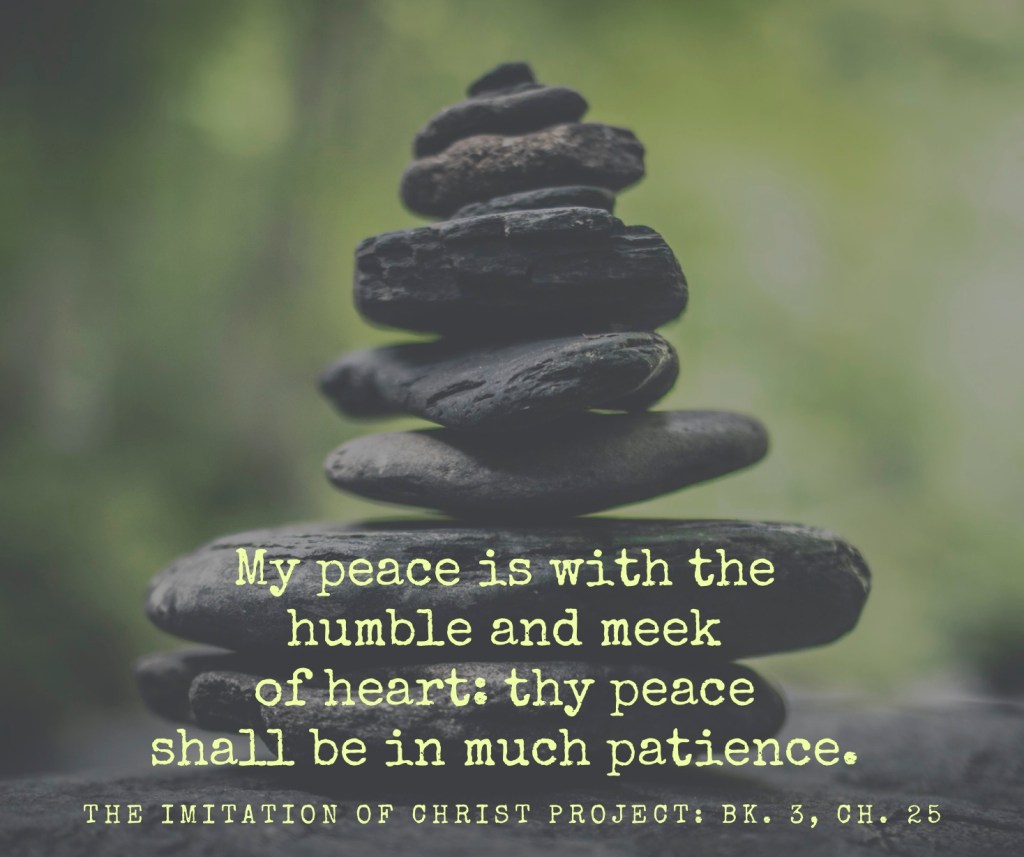
All men desire peace but all do not care for the things that go to make true peace. My peace is with the humble and meek of heart: your peace will be in much patience. If you hear Me and follow My voice, you will be able to enjoy much peace.

THE DISCIPLE

What, then, shall I do, Lord?

THE VOICE OF CHRIST

Watch yourself in all things, in what you do and what you say. Direct your every intention toward pleasing Me alone, and desire nothing outside of Me. Do not be rash in judging the deeds and words of others, and do not entangle yourself in affairs that are not your own. Thus, it will come about that you will be disturbed little and seldom.

Yet, never to experience any disturbance or to suffer any hurt in heart or body does not belong to this present life, but rather to the state of eternal rest. Do not think, therefore, that you have found true peace if you feel no depression, or that all is well because you suffer no opposition. Do not think that all is perfect if everything happens just as you wish. And do not imagine yourself great or consider yourself especially beloved if you are filled with great devotion and sweetness. For the true lover of virtue is not known by these things, nor do the progress and perfection of a man consist in them.

The Imitation of Christ Project: Bk. 3, Ch. 24


Photo by Hatim Belyamani on Unsplash

AVOIDING CURIOUS INQUIRY ABOUT THE LIVES OF OTHERS 

THE VOICE OF CHRIST

MY CHILD, do not be curious. Do not trouble yourself with idle cares. What matters this or that to you? Follow Me. What is it to you if a man is such and such, if another does or says this or that? You will not have to answer for others, but you will have to give an account of yourself. Why, then, do you meddle in their affairs?

Behold, I know all men. I see everything that is done under the sun, and I know how matters stand with each — what is in his mind and what in his heart and the end to which his intention is directed. Commit all things to Me, therefore, and keep yourself in good peace. Let him who is disturbed be as restless as he will. Whatever he has said or done will fall upon himself, for he cannot deceive Me.

Do not be anxious for the shadow of a great name, for the close friendship of many, or for the particular affection of men. These things cause distraction and cast great darkness about the heart. I would willingly speak My word and reveal My secrets to you, if you would watch diligently for My coming and open your heart to Me. Be prudent, then. Watch in prayer, and in all things humble yourself.

Sermon: Heritage Sunday

The podcast is available here.


Boudreaux stumbles across a baptismal service on Sunday afternoon down by the river.

He proceeds to walk into the water and stand next to the preacher. The minister notices him and says, “Mister, are you ready to find Jesus?”

Boudreaux looks back and says, “Yes, preacher, I sure am.”

The minister dunks him under the water and pulls him right back up.
“Have you found Jesus?” the preacher asks. “Nooo, I didn’t!” said Boudreaux.

The preacher then dunks him under for quite a bit longer, brings him up, and says, “Now, brother, have you found Jesus?”

“Noooo, I have not, Reverend.”

The preacher, in disgust, holds Boudreaux under for at least 30 seconds this time, brings him out of the water, and says in a harsh tone, “My God, man, have you found Jesus yet?”

Boudreaux wipes his eyes and says to the preacher, “Are you sure this is where he fell in?”

A long time ago, I lost track of the number of funerals that I have performed, but I would be very surprised, if over the course of my career, I have performed more than six weddings. In the time leading up to the wedding, I always have a little talk with the happy couple about their selection of best man and maid of honor. I don’t know that any of them have taken my advice, but it goes like this: don’t ask your drinking buddy or best girlfriend who agrees with everything you say or do to fill this position. That’s not who you want. Instead, you want someone who is not afraid to call you out and tell you when you are messing up. Why? Say you choose your drinking buddy. Imagine the scene:

“Dude, the ol’ ball and chain is really harassing me.”

“Dude, what for.”

“She thinks I should come home after work instead of coming out for a few beers. I’m normally home pretty early.”

“Dude, I told ya not to marry her. You really gonna take that? You need to put her in her place.”

Now say you chose someone who would call you out:

“Dude, the ol’ ball and chain is really harassing me.”

“Dude, what for.”

“She thinks I should come home after work instead of going out for a few beers. I’m normally home pretty early.”

“You know what you should do?”

“No… do tell.”

“You should get your happy behind off that bar stool and go home. Your wife is right. When you married her, you took on the responsibility of being a faithful husband to your wife and father to your children.”

By signing your wedding certificate, the maid of honor and best man are standing as witnesses to the vows you are making. By standing next to you in the church, they are agreeing to assist you in keeping those vows. The Godparents at a baptism are essentially signing on for the same duty, but it goes a bit further for them. Listen to these words that are spoken to the Godparents during this 1892 liturgy:

“DEARLY beloved, ye have brought this Child here to be baptized; ye have prayed that our Lord Jesus Christ would vouchsafe to receive him, to release him from sin, to sanctify him with the Holy Ghost, to give him the kingdom of heaven, and everlasting life. Ye have heard also that our Lord Jesus Christ hath promised in his Gospel to grant all those things that ye have prayed for: which promise he, for his part, will most surely keep and perform.

“Wherefore after this promise made by Christ, this Infant must also faithfully, for his part, promise by you that are his sureties (until he come of age to take it upon himself) that he will renounce the devil and all his works, and constantly believe God’s holy Word, and obediently keep his commandments.”

The Godparents are becoming surety for the one to be baptized. In this context, Merriam-Webster defines surety as, “One who has become legally liable for the debt, default, or failure in duty of another.” By standing up for Sully, the Godparents are taking upon themselves the debt of Sully’s life before God until he is of an age to take that burden upon himself. That is quite a remarkable spiritual responsibility. It says, “If you, Sully, fail in your life with Christ, then I will be the one who takes on that debt and the one responsible for that failure.”

Ol’ Boudreaux may have just stumbled into his baptism and is probably still looking for Jesus at the bottom of a river, but what we do here today is very intentional, with full knowledge of our actions. And if I were a Godparent, I might be looking for an exit before I took this one on, but here’s the good news, the God news: a person baptized is not baptized into the faith alone. A person baptized is baptized into the death and resurrection of Jesus and also into the Body of Christ.

By standing next to Sully at his baptism, the Godparents act as surety for his life before God, but all of you gathered here this day and all those that are baptized into the faith of Christ are also surety for Sully before God. We are all Godparents to him and to one another. Why? Because we are the Body of Christ. St. Paul wrote to the Ephesians, “There is one body and one Spirit—just as you were called to the one hope that belongs to your call—one Lord, one faith, one baptism, one God and Father of all, who is over all and through all and in all.”

There is a question during the baptism in our current Book of Common Prayer that is not included in the 1892 service: “Will you who witness these vows do all in your power to support this person in his life in Christ.” The answer: “We will.” When you were baptized, a congregation stood and took that vow upon themselves. They each vowed to be surety for you. So today, as we baptize Sully, remember the vows that you are all taking for him, but also the vows that were taken for you, and the responsibility that you have as members of the Body of Christ, as “Godparents” to one another.

Let us pray: O Lord Jesus Christ, You said to Your Apostles: “Peace I leave with you, My peace I give to you.” Look not upon our sins, but upon the faith of Your Church, and grant to her that peace and unity which are agreeable to Your will, who live and are King and God, for ever and ever. Amen.