Sermon: Easter 2 RCL A / Sunday, April 29, 2020

The podcast is available here.

The Youtube service is here.


Paddy O’Sulluivan was in New York .  He was patiently waiting and watching the traffic cop on a busy street crossing. The cop stopped the flow of traffic and shouted, ‘Okay, pedestrians.’ Then he’d allow the traffic to pass.  He’d done this several times, and Paddy still stood on the sidewalk.  After the cop had shouted, ‘Pedestrians!’ for the tenth time, Paddy went over to him and said, ‘Is it not about time ye let the Catholics across?’

I tell you that one, not because it has anything to do with the sermon, but because of our current circumstances.  Many of our Protestant friends have been doing video and streaming their services for quite some time, but for most of us in the more catholic / liturgical traditions, this is all new ground.  I’m delighted that you are watching and that you’ve enjoyed the services, but I do want to let you know that we are working at getting better.  As parts of this service were recorded at different times, you’ll already notice that some parts – including the music – have a better sound quality and we’re looking at ways to get even better.  If you have an idea, let us know.

Ok… Sermon…

On the first Sunday after Christmas (yes, Christmas), we always read the Prologue from John’s Gospel.  On the first Sunday after Easter (today), we always read the passage from John about Jesus appearing to the disciples and the incident with the Apostle Thomas.  It is these two passages that bookend the Gospel of John (some scholars believe that chapter 21 of John’s Gospel was added later, although this doesn’t not effect the the reliability of the message.)  John, when writing his prologue, had this ending of his Gospel that we read in mind.  The Prologue reads, “In the beginning was the Word, and the Word was with God, and the Word was God.”  The Word was God, and what did Thomas say to Jesus in today’s Gospel?   “My Lord and my God!”  In John’s Gospel, Thomas’ declaration, “My Lord and my God” is the first time anyone refers to Jesus as God.  John takes us from God and the Word, Jesus, who were in the beginning before time began, and he takes us all the way through to this Jesus who was prophesied about by the prophets, born in a manger, lived, proclaimed, died, and rose from the dead, and in doing so he is proving to us that this Jesus is in fact God… the God who was in the beginning.  And it is this God who is standing before Thomas and the others.  But he is also showing the Apostles, and thus us, that this Jesus they knew prior to his crucifixion is different, for he is no longer constrained to the same physical limitations that we are and that he was. 

We see this in two passages in today’s Gospel: “When it was evening on that day, the first day of the week, and the doors of the house where the disciples had met were locked for fear of the Jews, Jesus came and stood among them.”  And then, “A week later his disciples were again in the house, and Thomas was with them. Although the doors were shut, Jesus came and stood among them.”  The resurrected Jesus is making these appearances as though “out of thin air.”  That may sound a bit strange to us, but let me ask you this, is it any more strange than turning water into wine, feeding 5,000 people with a few loaves of bread and a couple of fish, or walking on the water?  No.  These appearances of Jesus are more signs of his divinity, and the signs point to the fact that through Jesus, the Kingdom of God – Heaven – has come very near to us.

Now, bear with me a minute and don’t go thinking I’ve gone and slid off the cracker.  Throughout the Old and New Testament, there are many references to when God is very near to His people.  Consider Jacob who had a dream about the angels ascending and descending on a ladder.  Scripture says, “Jacob awoke from his sleep and said, ‘Surely the Lord is in this place, and I did not know it.’”  He believed that the place where he slept was much more near to the Kingdom of God than other places.  Then there was Moses.  He sees the burning bush and goes up the mountain and the Lord says to him, “Do not come near; take your sandals off your feet, for the place on which you are standing is holy ground.”  The ground is holy, because of its nearness to God.   And remember Elijah.  He was afraid and ran to the wilderness where he hid in a cave.  God said to Elijah, “Go out and stand on the mount before the Lord.”  And then there was a great wind that tore the mountains, but God was not in the wind, then an earthquake and a fire, but God was not in them either, but “after the fire the sound of a low whisper.  And when Elijah heard it, he wrapped his face in his cloak and went out and stood at the entrance of the cave.”  God was very near and spoke to him in the whisper.

Way back in the 5th century, Celtic Christianity/spirituality began to arise in Ireland and Scotland, and within their practices and understanding, the places where Jacob, Moses, Elijah and others had these experiences of God would be called “thin places.”  Locales where Heaven, God is much more near to this world and his people than he is in other places.  These are places where heaven and earth seem to mingle and share the same space.  I tell you this because I think it is one of the best ways of understanding how Jesus could have appeared to his apostles as though “out of thin air.”  For a brief time, Heaven and Earth came together, mingled in that place where Thomas and the other Apostles were gathered and Jesus appeared.  It is dramatically different from the appearances in the Old Testament, because God did not simply appear in a dream, or a burning bush, or even a whisper.  Instead, with Jesus, God appeared in the flesh, but it is still a time when Heaven and Earth came together.  Now, within Celtic spirituality, these types of places, these thin places don’t only exist in Biblical times.  They believe that these places, where Heaven and Earth meet, can exist anywhere or at anytime.  

That was something that the Desert Fathers and Mothers, those who went out in the deserts of northern Egypt in the third century, understood.  Although they didn’t call it a thin place, they did understand the desert to be such place.  Italian author Alessandro Pronzato said, “The desert is the threshold to the meeting ground of God and man.”  Elizabeth Hamilton, who wrote a biography on Charles de Foucauld, one of the great desert fathers, said it in a similar way: “The desert is a place where the soul encounters God.”  The desert then, for them, can be understood as a thin place, but Hamilton went onto add, “The desert… can be anywhere.”  And that is what is most important for you and I to understand, especially while we are separated like this.  The desert can be anywhere.  The thin place can be anywhere.  The place where Heaven and Earth come together can be anywhere.   It is the mountain where Moses encountered God.  Behind locked doors where Thomas and the Apostles encountered Jesus.  In this building (Oh, I do certainly believe this is one of those places), where we so often come to worship.  But it doesn’t end there, because these places can also be in your home, where you are sitting at this very moment.

It is very difficult not to be with one another and worship together in this thin place, but I tell you: if you seek him, wherever you are, you will encounter him.  And just as Thomas reached out his hand and touched God, you too can reach out the hands of your soul and do the same.  Whether here or wherever you are.  Doesn’t mean you shouldn’t come back here when we all can, but it does mean that He is with you and that you, where you are at this very moment are near to the Kingdom of God, to Heaven, and God himself.  

Let us pray: Jesus, our Lord, save us from our sins.  Come, protect us from all dangers and lead us to salvation.  Come, Lord Jesus, do not delay; give new courage to Your people who trust in Your love.  By Your coming, raise us to the joy of Your Kingdom, where you live and reign with the Father and the Holy Spirit, one God, forever.  Amen.

In Her Pocket…

I know a man who was walking down an old country road looking for his Mother. He searched up and down the road not seeing Her, but then, off in the distance, in the opposite direction he had been traveling he sees Her. The man tells me…

I began to run toward her as She began to run toward me. She was so much faster and as we approached, I realized She was so much larger. When She was with me, She had become so much larger that she simply scooped me up in the palm of Her hand and…

He was laughing as he told me this and I couldn’t help but join in his joy.

Photo by Jason Leung on Unsplash

…she placed me in the pocket of Her dress. She was not angry that I had wandered off, but neither did She speak. She only continued Her walk down the road.

From inside Her pocket, I tried to see through the weave of the fabric as to where we were going, but could not make out any details. For now we see in a mirror dimly, but then face to face. Now I know in part; then I shall know fully, even as I have been fully known. Eventually, I settled back and was simply comforted to be safe in Her pocket. Then a series of changes began to occur…

I soon realized that where She had placed me was not in Her pocket, but instead, was the wound in His side. She had placed me into Her Son. I entered more deeply and heard so clearly the beating of His heart. I rested there. Such peace. I actually began to wonder if I had been here when the spear had pierced His side… and then it did! As though a second time, but as it retreated, the wound was healed. The Son spoke, “You have always been with me.” In the beginning was the Word, and the Word was with God, and the Word was God.  He was in the beginning with God.  All things were made through him, and without him was not any thing made that was made.  In him was life, and the life was the light of men.  The light shines in the darkness, and the darkness has not overcome it. We were made in Him.

We have always been with Him. We have always been in Him and He in us. He showed me how, as we travelled further back, to when he was a child. And further to when He was conceived by the Holy Spirit. I entered more deeply into Him, until I was clinging to His Heart. His heartbeat was mine. I would die should His heartbeat stop.

He took me even further back — and this happened so quickly — to when He was Light… and then it all abruptly stopped, and in a great reversal of those scenes, I was returned to the road.

“Oh, to have gone further into that Light!” He said this with such deep longing.

I had so many questions for this man, but not enough words to ask them. So when he had finished his story, I came back to the spear. “We were in Him when the spear pierced His side?” I asked, trying to more fully understand. “Yes! As I said, while clinging to his heart, I realized that I would die should he die. And that’s just it. He died and I died with Him. And His Mother took me out of her pocket, and I was alive again to continue to walk the road until its end.

“Where does that road lead?”

“The Light.”

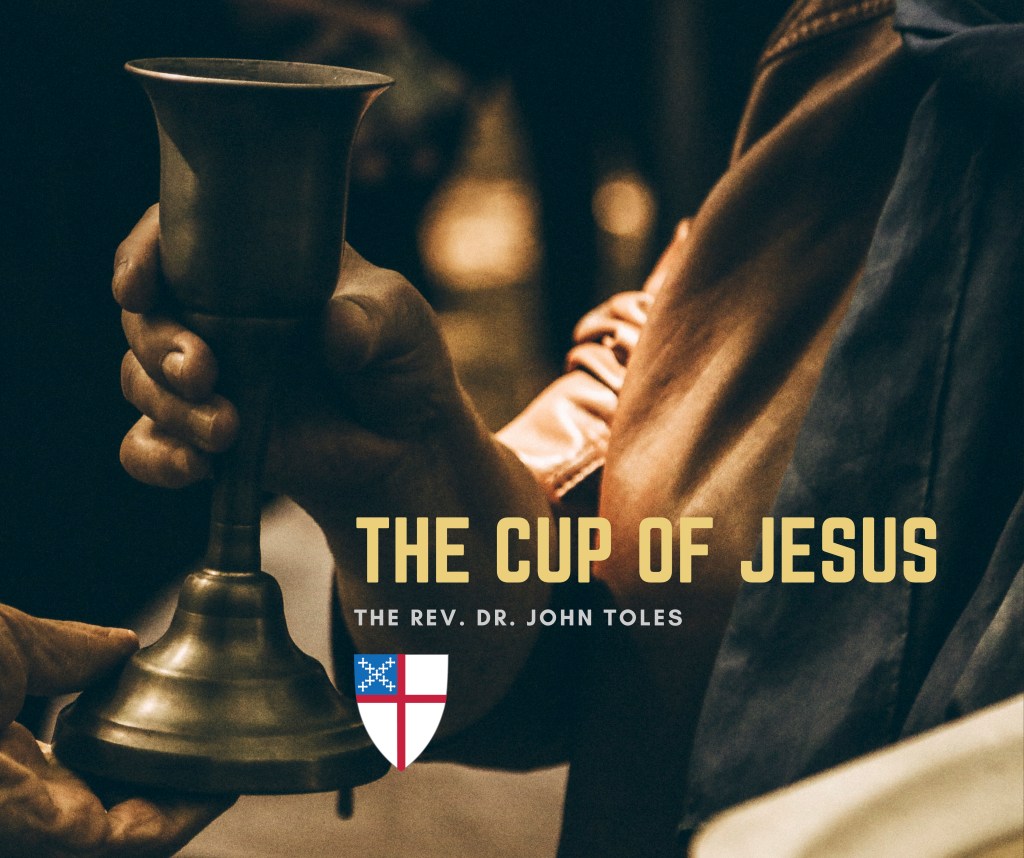
Sermon: The Cup of Jesus


Global Positioning System (aka: GPS): there are 24 satellites circling the earth that send and receive signals allowing for pinpoint accuracy in location. For example, if you were in Berlin and you typed in the coordinates 36.3983 and -97.8847, you would be able to see exactly where I’m standing at this very moment. You can see where the military would be interested in such information, but others have had all sorts of fun with GPS locating, including those who enjoy Geocaching. It’s a thing. People hide objects all over the world, then upload the GPS location of the object to a website and then others will go out and find those locations. There are 130 locations just around Enid. All this to say, one of the most sought after item in the history of humankind could use a GPS location, because we still haven’t found it: the Holy Grail.

It is believed that the Holy Grail was used at the Last Supper for that first Eucharist and a day later used by Joseph of Arimathaea to collect the blood of Jesus as he died upon the cross. Later, legend has it that Joseph took it to England, but then it would be lost. The legend of the Grail and King Arthur and his quest all flow from these stories. True or not? I’ll let you join in the search along with Robert Langdon and the DaVinci Code. But why the search? If true, the religious significance for the faithful is tremendous, but legend tells that the cup also brings health, wealth and happiness to the one who possess it. It brings power. It is believed to drink from the Holy Grail of Jesus, to drink from his cup, is to have power.

“Then the mother of the sons of Zebedee came to him with her sons, and kneeling before him, she asked a favor of him. And he said to her, ‘What do you want?’ She said to him, ‘Declare that these two sons of mine will sit, one at your right hand and one at your left, in your kingdom.’ But Jesus answered, ‘You do not know what you are asking. Are you able to drink the cup that I am about to drink?’ They said to him, ‘We are able.’” James and John had it all wrong. They thought to drink from Jesus’ cup was to share in his power. Oh, yes, they said. We can drink from that cup of power. We can handle the responsibility. The power won’t corrupt us. We can rule with you. They said, Yes, but they made the same mistake that King Arthur and so many others would later make. The cup that Jesus was to drink from was not a cup of power. It was something all together different. In fact, it was the opposite. From the Prophet Isaiah:

Wake yourself, wake yourself,
stand up, O Jerusalem,
you who have drunk from the hand of the Lord
the cup of his wrath,
who have drunk to the dregs
the bowl, the cup of staggering.
(Isaiah 51:17)

From St. John’s Revelation:

“If anyone worships the beast and its image and receives a mark on his forehead or on his hand, he also will drink the wine of God’s wrath, poured full strength into the cup of his anger.” (Revelation 9b-10a)

James and John believed that the cup Jesus was offering was the cup of power. They were wrong. The cup he was offering was the cup of God’s wrath, which awaits those who have done evil, for those who have sinned. Yet Jesus did not sin, but as John teaches us, Jesus “is the propitiation [the atoning sacrifice] for our sins, and not for ours only but also for the sins of the whole world.” (1 John 2:2) The cup that Jesus had to drink was the cup of God’s wrath, not for his sins, but ours and those of the whole world.

Sermon: Lent 2 RCL A – Scourging at the Pillar

This is part two of a five part series on the Sorrowful Mysteries of the Rosary.


The Podcast is available here.


Second Sorrowful Mystery: Scourging at the Pillar

Pilate speaks: It is your custom that I release one prisoner to you on the Pasch. Whom shall I set free, Barabbas —a thief jailed with others for a murder —or Jesus? (Matt 27:17) —Put this man to death and release unto us Barabbas, cries the multitude, incited by their chief priests (Luke 23:18).

Pilate speaks again: What shall I do, then, with Jesus who is called Christ? (Matt 27:22) Crucify Him!

Pilate, for the third time, says to them: Why, what evil has He done? I find no fault in Him that deserves death (Luke 23:22).

The clamour of the mob grows louder: Crucify Him, crucify Him! (Mark 15:14)

And Pilate, wishing to please the populace, releases Barabbas to them and orders Jesus to be scourged.

Bound to the pillar. Covered with wounds.

The blows of the lash sound upon His torn flesh, upon His undefiled flesh, that suffers for your sinful flesh. —More blows. More fury. Still more… It is the last extreme of human cruelty.

Finally, exhausted, they unbind Jesus. —And the body of Christ yields to pain and falls limp, broken and half dead.

You and I are unable to speak. —Words are not needed. —Look at Him, look at Him… slowly. After this… can you ever fear penance?

(Source: Holy Rosary by St. Josemaría Escrivá)

Meditation:

In Matthew, Barabbas is described as a “notorious prisoner,” John has him as a “bandit,” Mark and Luke have him involved in a riot. However we refer to him, the crime he committed was punishable by death. As I meditated on this mystery, I began to see myself in his place and from there, I wondered…

When Pilate asked, “Who do you want me to release for you,” who’s name would I have wanted to hear them shout out? How would I feel if I understood that he was truly innocent and I had been set free? How would I have felt that those who had called for my release really didn’t care about me, they just wanted Jesus dead. And from there, how would I have felt when I realized that the only one who actually cared anything about me was to be scourged by the same soldiers who just set me free. I also wondered what it would have been like, as I was walking away from the guards to have caught Jesus eyes.

As I meditated on this mystery and wondered about these things, I also had answers. Who’s name would I want to hear the crowds calling out? Mine. How would I feel about walking away free, knowing he was the innocent one? I’m sorry for him, yes, but I suppose I would have thought, “Tough break.” Did I care that the crowd really didn’t care for me? No. Don’t much care for them either. What were my thoughts on realizing Jesus was the only one who really cared for me? Well, isn’t that the way it always is?

Yes. I have answers for all these questions, except the last. That last question really haunts me, because although I have an answer, I don’t like it. What would I have seen in Jesus eyes as I walked away free and he condemned? The answer, of course, is love. I would have seen love and gratitude. Grateful that he could even save my wretched life.

As my friend Thomas à Kempis wrote in On the Passion of the Christ, “Woe to me, unfortunate sinner, weighed down with the heavy burden of sin! Because of my evil deeds I deserve to be assigned to eternal punishment, but you, holy, just, and loving God, chose to be despised and detested to deliver me from the devil’s deceits and everlasting death.” (Source: On the Passion of Christ: According to the Four Evangelists, p. 47)

The very difficult truth is that we are all Barrabas. Like him, we have all sinned and the punishment for our sins is the same death sentence that he received for his. “For the wages of sin is death.” (Romans 6:23a) As we meditate on these events, we realize that we are the ones standing with Jesus and facing the crowd, waiting on the verdict from Pilate, and it is there that we understand, though we are guilty we are set free. Not because of anything that we have done or deserve, but because of God’s grace. Because God’s one and only son chose to love us, who are all Barrabas. But here’s the thing, being Barrabas isn’t necessarily bad.

The name Barrabas is made up of two words, Bar Abba. Bar, meaning son and Abba meaning Father, so the name Barrabas means “Son of the Father.” We are all Barrabas, but because of God’s grace, we are all set free, and in being set free, we become Bar Abba, children of the Father. But now, as those children, we must watch Jesus being led away and are witnesses to his scourging. Witnesses to the punishment that was rightfully ours.

Last week we talked about how we must be honest with ourselves and with sincere hearts and minds, confront our own failings, so that we can rightly confess and allow the Lamb of God to take those sins with him to the cross, that through his great love for us, we might be redeemed. Yet, the idea of being honest and confessing often causes us to be fearful. And so, even though it is not possible to hide from God, as the Psalmist says:

Where can I go from your Spirit?
Where can I flee from your presence?
If I say, “Surely the darkness will hide me
and the light become night around me,”
even the darkness will not be dark to you;
the night will shine like the day,
for darkness is as light to you.
(Psalm 139:7, 11-12)

Even though it is not possible to hide from God, we pretend as though we could. We are like Adam and Eve in the Garden, after they had eaten the fruit: “The man and his wife heard the sound of the Lord God as he was walking in the garden in the cool of the day, and they hid from the Lord God among the trees of the garden. But the Lord God called to the man, ‘Where are you?’ [The man] answered, ‘I heard you in the garden, and I was afraid.’” (Genesis 3:8-10) We are afraid to come before God, to confess, because we fear the punishment we so rightly deserve, but—and this is the Good News—the punishment has already been meted out. It is why Josemaría encouraged us to look at Jesus following the scourging: “Look at Him, look at Him… slowly. After this… can you ever fear penance?” Why would you fear to confess, to be penitent, “By his stripes, we are healed.” (Isaiah 53:5)

Consider again the words of The Exhortation: “Examine your lives and conduct by the rule of God’s commandments, that you may perceive wherein you have offended in what you have done or left undone, whether in thought, word, or deed. And acknowledge your sins before Almighty God, with full purpose of amendment of life, being ready to make restitution for all injuries and wrongs done by you to others; and also being ready to forgive those who have offended you, in order that you yourselves may be forgiven. And then, being reconciled with one another, come to the banquet of that most heavenly Food.” (Book of Common Prayer, p. 316)

There should be great fear in not confessing, but you are Bar Abba—you are God’s child and he endured the scourging that you might be with him. As the Lord said through the Prophet Isaiah:

‘You are my servant’;
I have chosen you and have not rejected you.
So do not fear, for I am with you;
do not be dismayed, for I am your God.
I will strengthen you and help you;
I will uphold you with my righteous right hand.
(Isaiah 41:9b-10)

Let us pray:
Father, Your Love never fails.
Keep us from danger
and provide for all our needs.
Teach us to be thankful for Your Gifts.
Confident in Your Love,
may we be holy by sharing Your Life,
and grant us forgiveness of our sins.
May Your unfailing Love turn us from sin
and keep us on the way that leads to you.
Help us to grow in Christian love.
Amen.

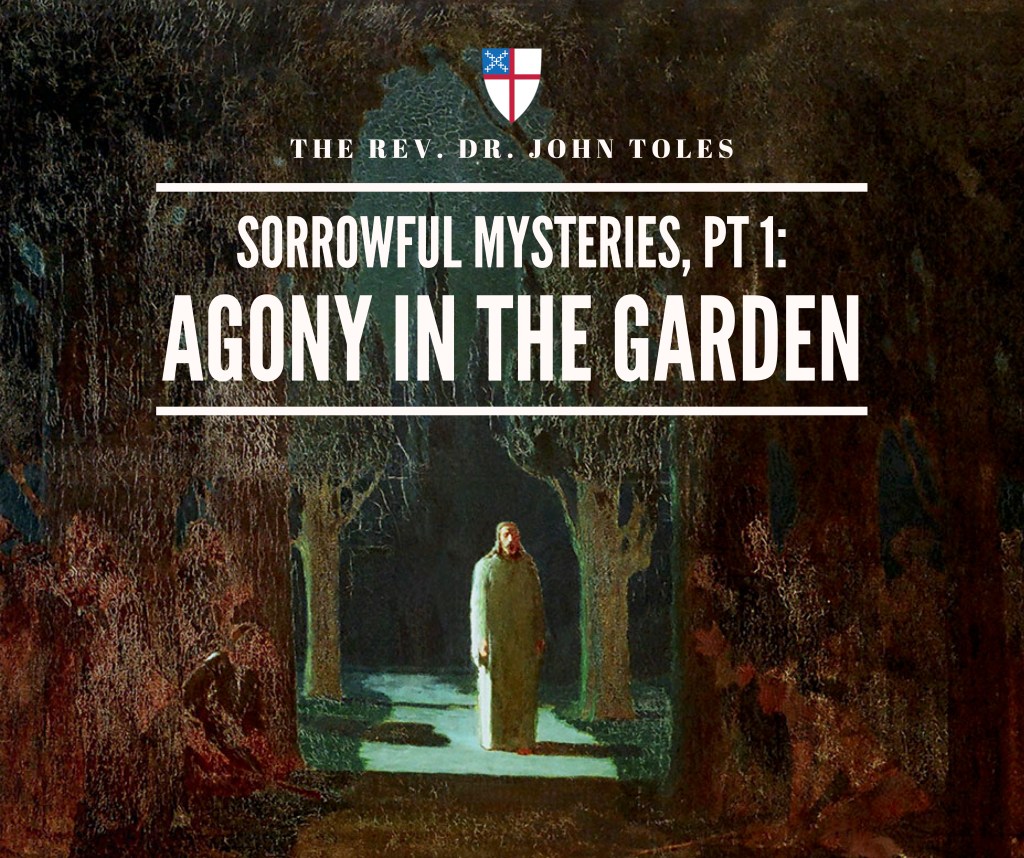
Sermon: Lent 1 RCL A – Agony in the Garden

This is part one of a five part series on the Sorrowful Mysteries of the Rosary.


The podcast is available here.


First Sorrowful Mystery: Agony in the Garden

“Pray that you may not enter into temptation”. —And Peter fell asleep. —And the other apostles. —And you, little friend, fell asleep…, and I too was another sleepy headed Peter.

Jesus, alone and sad, suffers and soaks the earth with His blood.

Kneeling on the hard ground, He perseveres in prayer… He weeps for you… and for me: the weight of the sins of men overwhelms Him.

Father, if Thou wilt, remove this chalice from me… Yet not my will, but Thine be done (Luke 22:42).

An Angel from Heaven comforts Him. —Jesus is in agony. —He continues, praying more intensely… —He approaches us, who are asleep: Arise, pray —He says again—, lest you enter into temptation (Luke 22:46).

Judas the traitor: a kiss. —Peter’s sword gleams in the night. —Jesus speaks: Are you come, as to a robber, to apprehend Me? (Mark 14:48)

We are cowards: we follow Him from afar, but awake and praying. —Prayer… Prayer…

(Source: Holy Rosary by St. Josemaría Escrivá)

Meditation:

On that night, following the Last Supper, the apostles went with Jesus to the Garden of Gethsemane. Most stayed further away, but Jesus took Peter, James and John a little deeper into the garden. Before going on alone even further into the darkness, Jesus said to these three, “Sit here while I go over there and pray. My soul is overwhelmed with sorrow to the point of death. Stay here and keep watch with me.” We know that after awhile, Jesus came back and found them sleeping. Waking them, he said, “Couldn’t you men keep watch with me for one hour? Watch and pray so that you will not fall into temptation. The spirit is willing, but the flesh is weak.” He went away a second time to pray then returned, only to find them again asleep. “Are you still sleeping and resting? Look, the hour has come, and the Son of Man is delivered into the hands of sinners. Rise! Let us go! Here comes my betrayer!” The betrayer was Judas, who had left the Last Supper early to find the soldiers who would arrest Jesus, because he had earlier betrayed Jesus to the religious leaders for thirty pieces of silver.

If I had been there, do you know who I would have been talking about before I fell asleep? Hint: not Jesus. Judas. Yes, Judas. It is the middle of night. I’m tired and a little scared. Jesus was talking about all sorts of things, including betrayal, none of which I fully understood. I’m not sure about what I’m supposed to be doing, because Jesus is over there somewhere and we are simply lost when he is not around. So instead of thinking about all that: “Hey, guys, can you believe Judas tonight? The man is always a bit flaky, but he was so dang nervous tonight he was starting to make me more nervous than I already was. And did you see his face when Jesus washed his feet? He went as white as Lazarus that day when Lazarus stepped out of the tomb after being dead for a couple of days.” Yeah. I would have been talking about Judas.

Do you know who I would have thought about when Jesus woke me up? Yep. Judas again. I mean, let’s be honest, we may have fallen asleep, but we’re here, aren’t we? Who knows where that thief is. Probably out there spending some of the purse. He doesn’t think we noticed that he was running around in new sandals, but we saw and they looked expensive, had those fancy camel knee soles on them. Yeah, we’re here. That’s what really counts.

As I was running through the garden after Jesus was arrested… Judas on my mind. Can you believe the nerve of him. Kissed him! Called him, Teacher! Betrayer! I’ll tell you what—I think I lost those guards who were chasing me, I can slow down some—I’ll tell you, when I get my hands on Judas, I’m going to string him up.

In all these events, Judas is my guy. He makes me look good and I don’t have to think about my own failings. My own betrayals. My own sins.

The Lord told Moses and Aaron how they were to go about making the annual sacrifice during Yom Kippur for the people’s sins, part of which involved two goats. The two goats would be brought before Aaron, he would cast lots and the one selected was sacrificed, but from the sounds of it, the one sacrificed may have been the lucky goat. With the second goat, Aaron would lay his hands on it, thereby transferring all the sins of the people onto the goat. The goat was then taken deep into the wilderness where it was set free to return to Azazel, a demon. A spirit of desolation and ruin. It was believed that the goat was returning all the sins of the people back to their source, Azazel, the demon. This is, of course, where we get the idea of scapegoat. Someone or thing that we can lay our hands upon, thereby transferring all the blame and ridicule for all that has gone wrong, leaving everyone else free of all culpability, blame.

Following the events in the Garden of Gethsemane, Judas is our second goat, our scapegoat. We can lay our hands on him and transfer all the sins to him and then set him loose in the wilderness to carry them away to Azazel. We never betrayed Jesus, we never fell asleep on Jesus, we never abandoned Jesus. We are innocent. So we think, but we are still in our sin. Therefore, we must be honest with ourselves and with sincere hearts and minds, confront our own failings, understanding that this is not an easy task. It is far easier to deny, to blame, to compare, than it is to admit we were wrong. And we are honest, not so that we can run around whipping ourselves, but so that we can rightly confess and allow the Lamb of God to take those sins with him to the cross, that through his great love for us, we might be redeemed.

The garden is the place where Jesus was left alone, betrayed, abandoned, not just by Judas, but by us all. And the garden is the place where Jesus made his final resolve to redeem all those failings: “Yet not my will, but Thine be done.” And it is God’s will that none of us should perish, but be redeemed and share in eternal life with him. “If we confess our sins, he is faithful and just to forgive us our sins and to cleanse us from all unrighteousness.”

Let us pray (based on Psalm 51:1-7):
Have mercy on us, O God,
according to your steadfast love;
according to your abundant mercy
blot out our transgressions.
Wash us thoroughly from our iniquity,
and cleanse us from our sin!
For we know our transgressions,
and our sin is ever before us.
Against you, you only, have we sinned
and done what is evil in your sight,
so that you may be justified in your words
and blameless in your judgment.
Behold, we were brought forth in iniquity,
and in sin were we conceived.
Behold, you delight in truth in the inward being,
and you teach us wisdom in our secret heart.
Purge us with hyssop, and we shall be clean;
wash us, and we shall be whiter than snow.
Amen.