If I told you the number 218, what do you think it would represent? It is roughly the number of times St. Paul speaks the name “Jesus” in his writings. This number doesn’t include the times Paul uses “Christ” instead—just Jesus.
Consider the beginning of Paul’s greeting in his First Epistle to the Corinthians.
“Paul, called to be an apostle of Christ Jesus by the will of God, and our brother Sosthenes,
To the church of God in Corinth, to those sanctified in Christ Jesus and called to be his holy people, together with all those everywhere who call on the name of our Lord Jesus Christ—their Lord and ours:
Grace and peace to you from God our Father and the Lord Jesus Christ.”
He clearly stated from the start who he would be discussing—Jesus.
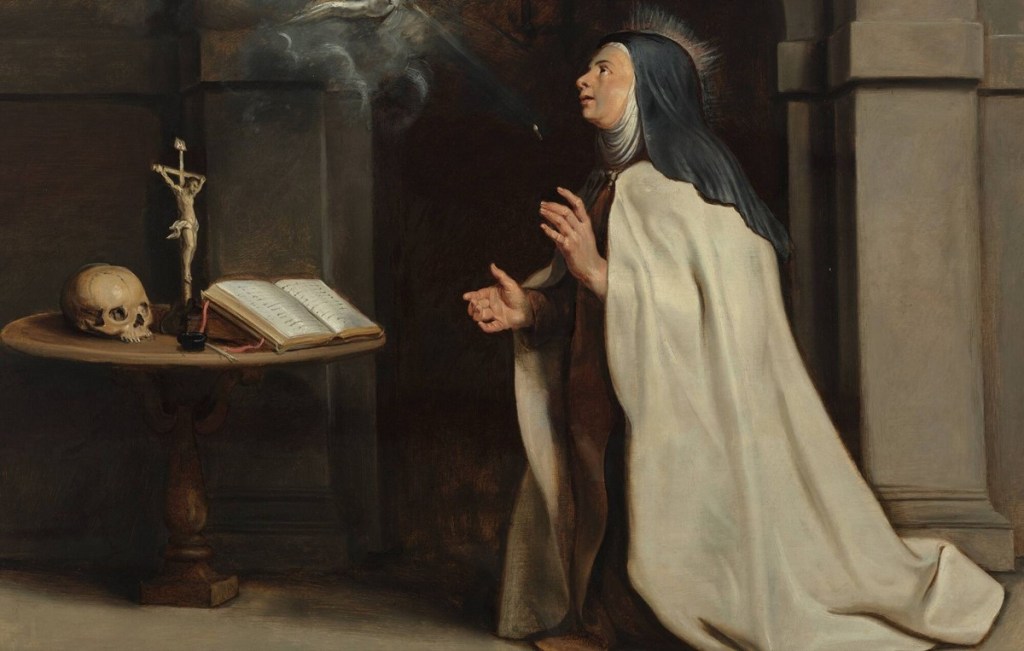
It is this frequent use of the name Jesus that St. Teresa of Avila, whom we celebrate today, noted in her writing (this is a longer selection).
“If Christ Jesus dwells in a man as his friend and noble leader, that man can endure all things, for Christ helps and strengthens us and never abandons us. He is a true friend. And I clearly see that if we expect to please him and receive an abundance of his graces, God desires that these graces must come to us from the hands of Christ, through his most sacred humanity, in which God takes delight.
“Many, many times I have perceived this through experience. The Lord has told it to me. I have definitely seen that we must enter by this gate if we wish his Sovereign Majesty to reveal to us great and hidden mysteries. A person should desire no other path, even if he is at the summit of contemplation; on this road he walks safely. All blessings come to us through our Lord. He will teach us, for in beholding his life we find that he is the best example.
“What more do we desire from such a good friend at our side? Unlike our friends in the world, he will never abandon us when we are troubled or distressed. “Blessed is the one who truly loves him and always keeps him near. Let us consider the glorious Saint Paul: it seems that no other name fell from his lips than that of Jesus, because the name of Jesus was fixed and embedded in his heart. Once I had come to understand this truth, I carefully considered the lives of some of the saints, the great contemplatives, and found that they took no other path: Francis, Anthony of Padua, Bernard, Catherine of Siena. A person must walk along this path in freedom, placing himself in God’s hands. If God should desire to raise us to the position of one who is an intimate and shares his secrets, we ought to accept this gladly.
“Whenever we think of Christ we should recall the love that led him to bestow on us so many graces and favours, and also the great love God showed in giving us in Christ a pledge of his love; for love calls for love in return. Let us strive to keep this always before our eyes and to rouse ourselves to love him. For if at some time the Lord should grant us the grace of impressing his love on our hearts, all will become easy for us and we shall accomplish great things quickly and without effort.”
She wrote, “Love calls for love in return—Jesus’ love for us calls out our love for Him; therefore—Let us strive to keep this [love] always before our eyes and to rouse ourselves to love him.”
How do we accomplish this? As with Teresa, Paul, Catherine, Francis, and so many others, keep the name of Jesus always before you. In all whom you see, in all that you do, speak His Name, and you will rouse yourself to love Him and others.
A man who had regularly prayed for many years began to wonder if God heard his prayers at all. During one of his routine times of prayer, he started this doubting pattern once again. He stopped praying and thought for a moment, finally saying, “Enough of this.” He then lifted his eyes toward heaven and yelled, “Hey up there, can you hear me?” There was no response. He continued, “Hey, God, if you can really hear me, tell me what you want me to do with my life.”
A voice from above thundered a reply, “I want you to help the needy and give your life to the cause of peace!”
As the man was not really expecting an answer and faced with more of a challenge than he really wanted, he answered, “Actually, God, I was just checking to see if you were really there.”
God responded, disappointment in His voice, “That’s alright; I was only checking to see if you were really there.”
Have you ever wondered how you might respond to God if you heard, with 100% certainty, His voice and His calling on your life?
Since the time of Moses, it was the priest who determined whether a person was clean or unclean, and the priest followed the mandates of the Law of Moses. To us, much of the Law might seem silly, but we view it through the lens of some 6,000 years of modernization. Today’s Gospel offers an example.
Leprosy was a catch-all category for any number of skin diseases. Anything from dandruff to—at the time—a deadly disease. The Law required the priest to examine the afflicted person and determine the type of Leprosy and the prescribed outcome. If the priest decided it was not a life-threatening or contagious disease, the person would be considered “clean” and could stay in the camp; however, if it was a contagious type, the law was very clear: Leviticus 13:45-46 says, “Those who suffer from a serious skin disease must tear their clothing and leave their hair uncombed. They must cover their mouth and call out, ‘Unclean! Unclean!’ As long as the serious disease lasts, they will be ceremonially unclean. They must live in isolation in their place outside the camp.” The afflicted did all these things—the tearing of clothes and unkempt hair—not as signs of uncleanness, but as signs of remorse. Grief came from not only being separated from the community but, more importantly, from being separated from God, because they could no longer go to the Tent of Meeting or the Temple, which was the dwelling place of God. After being sent out, if a person is thought to be healed, the Law states that the person “shall be brought to the priest; the priest shall go out of the camp, and the priest shall make an examination.” If deemed clean, the person could return to the community; if not, they remained outside.
It was ten of these unclean lepers that Jesus encountered in our Gospel reading today. From a distance, they cried out, “Jesus, Master, have mercy on us!” Jesus’ response was to set into motion the requirements of the Law: “Go and show yourselves to the priests.” All ten demonstrated their faith in Jesus by immediately going to find the priest, and as they were going, they were all healed. However, only one, the Samaritan, returned to Jesus to give thanks to God. The fact that the one who returned is identified as a Samaritan suggests that the other nine were Jews. The word Judah—Jew—means praise, but the nine, who should have returned to give praise and thanks to God, kept going. Meanwhile, the Samaritan—the one considered unclean even before he became sick—was the only one to return and give thanks.
The Samaritan ran and literally lay his face to the ground in front of Jesus, praising God. Because of his thankfulness, Jesus blessed him a second time by telling him to “get up.” That may seem insignificant, but in the era of the gospel writers, people would have connected that phrase “get up” with resurrection. Someone who is dead lies on the ground with their face in the dirt, yet Jesus tells the Samaritan, “Get up,” and gives him new life.
There is a valuable lesson here about gratitude and giving thanks to God, about recognizing the blessing in each moment and the work of God in our lives, but there is also a lesson about responding to God’s actions in our lives. Not only should we acknowledge these things, but we should respond by being transformed and given new life because of them.
Imagine that you are the Samaritan. Now that you have been healed, you can return to the community, where you may find your wife, children, and job waiting for you, along with the rest of your life. Because your life has been restored, you can return to all these things instead of living in isolated exile.
Imagine running with the other nine to be examined by the priest, and seeing the expressions of joy on their faces as they realize they have truly been healed. You then realize that you, too, have been healed. In that moment, you understand that it was not family, friends, the priest, your job, your social status, your abilities, your gifts, or your money that caused this healing. It was God, and God alone. This is truly one of those defining moments—a point in time when you gain clarity and have the opportunity to consciously choose to do something or stop doing something. It is an event that forever shapes or changes the course of your life.
As the Samaritan ran to the priest to show that he was clean, he experienced his defining moment. He could continue on his current path and reclaim his old life, or he could return to the One who had given him a new life, a transformation. Does anyone have a poem running through their mind right now?
Two roads diverged in a wood, and I— I took the one less traveled by, And that has made all the difference.
God places these moments in everyone’s lives. For Moses, it was the burning bush. For David, it was standing in front of Goliath. But it isn’t always something so dramatic. For Elijah, it was a still small voice, and for Matthew, it was a look and those two simple words, “Follow me.”
We, as a Christian people, are defined by how we respond when that moment arrives. Like the nine who continued on, we can declare that our lives, our wants, and our desires are sufficient and then just keep going, or like the Samaritan, we can have the courage and the faith to respond to God and give thanks for His gift of new life.
The story of the ten lepers concerns gratitude toward God, but it also highlights recognizing blessings, having the courage to take the less-traveled path—to respond—returning to God, and receiving new life in Christ.
In his Revelation, John tells us that one of the elders in heaven approached him, saying, “Who are these, robed in white, and where have they come from?” John said to him, “Sir, you are the one that knows.” Then he said to John, “These are they who have come out of the great ordeal; they have washed their robes and made them white in the blood of the Lamb.”
For this reason they are before the throne of God, and worship him day and night within his temple, and the one who is seated on the throne will shelter them. They will hunger no more, and thirst no more; the sun will not strike them, nor any scorching heat; for the Lamb at the center of the throne will be their shepherd, and he will guide them to springs of the water of life, and God will wipe away every tear from their eyes.”
In our sin, we were the ones forced to cry out, “Unclean! Unclean!” But through the blood of Christ and our response to God, we have been restored, no longer exiled from Him; therefore, let us recognize this great gift, give thanks, and sing praises to His Holy Name. And then, let us respond by living a resurrected life—a life guided by the Holy Spirit in the service of our God.
As a concluding prayer, would you please turn to page 837 in your Book of Common Prayer.
Let us give thanks to God our Father for all his gifts so freely bestowed upon us.
For the beauty and wonder of your creation, in earth and sky and sea. We thank you, Lord.
For all that is gracious in the lives of men and women, revealing the image of Christ, We thank you, Lord.
For our daily food and drink, our homes and families, and our friends, We thank you, Lord.
For minds to think, and hearts to love, and hands to serve, We thank you, Lord.
For health and strength to work, and leisure to rest and play, We thank you, Lord.
For the brave and courageous, who are patient in suffering and faithful in adversity, We thank you, Lord.
For all valiant seekers after truth, liberty, and justice, We thank you, Lord.
For the communion of saints, in all times and places, We thank you, Lord.
Above all, we give you thanks for the great mercies and promises given to us in Christ Jesus our Lord; To him be praise and glory, with you, O Father, and the Holy Spirit, now and for ever. Amen.We thank you, Lord.
Above all, we give you thanks for the great mercies and promises given to us in Christ Jesus our Lord;
To him be praise and glory, with you, O Father, and the Holy Spirit, now and for ever. Amen.
Three local pastors teamed up for a local revival. After the tent was taken down and the dust had settled, they met for coffee to discuss how things went.
The Methodist minister said, “I want to give thanks for this revival. Through our efforts, the Methodist Church gained four new members. It was awesome.”
The Presbyterian preacher grinned and said, “I want to add my thanks to yours, praise God. Through our revival, we gained six new members.”
The Episcopal priest, grinning from ear to ear, sat silent, then said enthusiastically, “I’m just as excited as you both! Between the two of you, you gained ten new members. That is wonderful news. For us at the Episcopal Church, I couldn’t be any more thankful. Through our work together, we managed to get rid of our ten biggest troublemakers! Alleluia.”
The Apostle Paul tells us, “Rejoice always, pray without ceasing, give thanks in all circumstances; for this is the will of God in Christ Jesus for you.” (1 Thessalonians 5:16-18) And I suppose losing the troublemakers is something worth giving thanks for, not that I would ever do anything like that.
Even though Paul encourages us to give thanks in all circumstances, there are moments when even God might roll His eyes. There was a funny meme with an image of Jesus. The look on Jesus’ face says it all—“Are you stupid?” The caption read, “Jesus’ face after you give thanks and then ask Him to bless twenty chicken nuggets, two Big Macs, two large fries, and an extra-large Coke as nourishment unto your body.” Besides that, we should give thanks to God for His providence in our lives. Without it, we wouldn’t even exist.
So, we give thanks to God and we give thanks to others. We feel gratitude and express it. American author Gertrude Stein said, “Silent gratitude isn’t much to anyone.” And it’s true.
There’s a strange little debate about saying, “Thank you.” It involves store cashiers. Question: After they ring you up, should you thank them or should they thank you? On the one side, some cashiers argue that they’ve provided a service and that the right thing for the customer to do is say, “Thank you.” On the other hand, some customers say they shopped at the store, and because the cashier is paid to do their job, they should thank the customer for shopping there. I agree with both sides, although it does seem less common these days for a cashier to thank a customer. It also feels like we get into some ridiculous arguments.
What got me to thinking about all this “Thank you” business was the second part of our Gospel reading. It was short, so I’ll share it again—“Who among you would say to your slave who has just come in from plowing or tending sheep in the field, ‘Come here at once and take your place at the table’? Would you not rather say to him, ‘Prepare supper for me, put on your apron and serve me while I eat and drink; later you may eat and drink’? Do you thank the slave for doing what was commanded? So you also, when you have done all that you were ordered to do, say, ‘We are worthless slaves; we have done only what we ought to have done!’”—and it made me reflect on the nature of gratitude and obedience.
Nowadays, we don’t like talking about masters and slaves, but this is the text we’re given, so let’s work with it.
Put yourself in the place of the master. You own the land, the house… everything. You also own the slave. In Jesus’ time, slaves had some rights but were expected to do what they were told. As the master, you don’t ask your slave to go and plow the field; you tell them to do it, and you expect it to be done. Additionally, as the master, you expect your needs to be met before the slave cares for themselves or others.
If, on the other hand, you were in the place of the slave, then you know that if the master says, “Fix me supper,” you had better jump to it. And as the slave, after you’ve fixed supper and placed it on the table in front of the master, you don’t expect the master to say, “Thank you.” Why? Because, as a slave, you’ve done nothing more than what you are supposed to do. You did it—not because you were being nice, not because you were trying to earn brownie points or favor, and not because you thought you would earn a bonus—you did it because you are a slave, and your obedience is not requested; it is expected. And, as much as we may not always like it, it is this spirit we are to have toward God’s commandments. For example, Jesus said, “A new commandment I give to you, that you love one another: just as I have loved you, you also are to love one another.”
The way we sometimes act may lead us to read that as some good advice applicable in certain situations, but Jesus said, “A new commandment I give to you.” A commandment is not something that is being requested of you. Like a slave, a commandment is something that is expected of you. On the day of judgment (Lord, Lord, what is this coming to… talking about commandments, obedience, and judgment!) On the day of judgment, God is not going to come up to us and say, “I want to thank you for loving others when it was in your best interest or when you felt like it or when you were in a good mood.” No. Instead, God will say, “I thought I told you to love one another. Why didn’t you?” When we love one another, we are not doing so so that God will pat us on the head and tell us what good boys and girls we are. Instead, when we love one another, we should say, “We are worthless slaves; we have done only what we ought to have done!”
Now, here’s the interesting thing: when we say we are slaves, we are not diminishing ourselves, but are in fact raising ourselves up. As St. Paul tells us, “Have this mind among yourselves, which is yours in Christ Jesus, who, though he was in the form of God, did not count equality with God a thing to be grasped, but emptied himself, by taking the form of a slave, being born in the likeness of men. And being found in human form, he humbled himself by becoming obedient to the point of death, even death on a cross.” (Philippians 2:5-8)
For us as followers of Jesus, being slaves and obedient is not about simply following this rule and that rule. Besides, we can see in the Israelites, who had the Law of Moses, that we aren’t so good at keeping rules. Also, being a slave isn’t about being a doormat or being oppressed. Instead, in God the Father’s eyes, our obedience, like that of slaves, is about transformation. Being obedient like a slave involves being transformed into the very image of Christ Jesus. Like Jesus, it means being obedient and taking up our cross. Like Jesus, this obedience isn’t about our own will but the will of the Father. This shows us that such obedience isn’t driven by force or duty. It’s an obedience of love. If you are obedient to God because you’re afraid of going to hell, then you’re acting out of fear of punishment. However, as St. John tells us, “There is no fear in love, but perfect love casts out fear. For fear has to do with punishment, and whoever fears has not been perfected in love. We love because he first loved us.” (1John 4:18-19)
We were slaves to sin, but when we became obedient to God, we began to resemble Jesus. By becoming like Him, we no longer need to be afraid but are set free to experience God’s love. However, in the words of that TV pitchman, “But wait! There’s more!” For as Paul tells us, “When the fullness of time had come, God sent forth his Son, born of woman, born under the law, to redeem those who were under the law, so that we might receive adoption as God’s children. And because you are His children, God has sent the Spirit of His Son into our hearts, crying, “Abba! Father!’ So you are no longer a slave, but a child, and if a child, then an heir through God.” (Galatians 4:4-7) Somebody say, “Amen.”
As slaves in this world, no one will thank you. However, by becoming obedient slaves of God, you will become His children. Not only will you then be set free to love one another and to love God, but you will also gain the freedom and joy to experience God’s true love for you.
Let us pray: Our obedient Lord Jesus, You obeyed the will of Your Father in Heaven to perfection. Through this obedience, You not only experienced the full love and joy of the Father in Your human nature, but You also set for us a perfect example and model for holiness. Help us to see the areas of our lives in which we need to be more obedient, so that we, too, will share in Your holy life and that of the Father’s. Jesus, we trust in You and we give You praise and thanks. Amen.
Some of the old-timey Gospel music can be fun to listen to. Dr. Ruby Holland sang, “Get back Satan, I’m running late Get back Satan, I’m running late Well I’ve got to get to Heaven, before they close the gate Get back Satan, I’m running late.”
And Bishop Neal Roberson pleaded, “Don’t let the devil ride, Don’t let the devil ride, Oh if you let him ride, he’ll want to drive… Please Don’t let him drive your car… Don’t do it, Don’t do it, Don’t do it!”
A simple theology—Jesus never complicated the message! That’s one of the wonderful things about musicians, artists, writers, and poets using their talents to express God’s truths. However, there are some—much like theologians—who go even deeper, creating works that require great skill and intellect to understand. Today, especially, I’m thinking about Dante Alighieri.
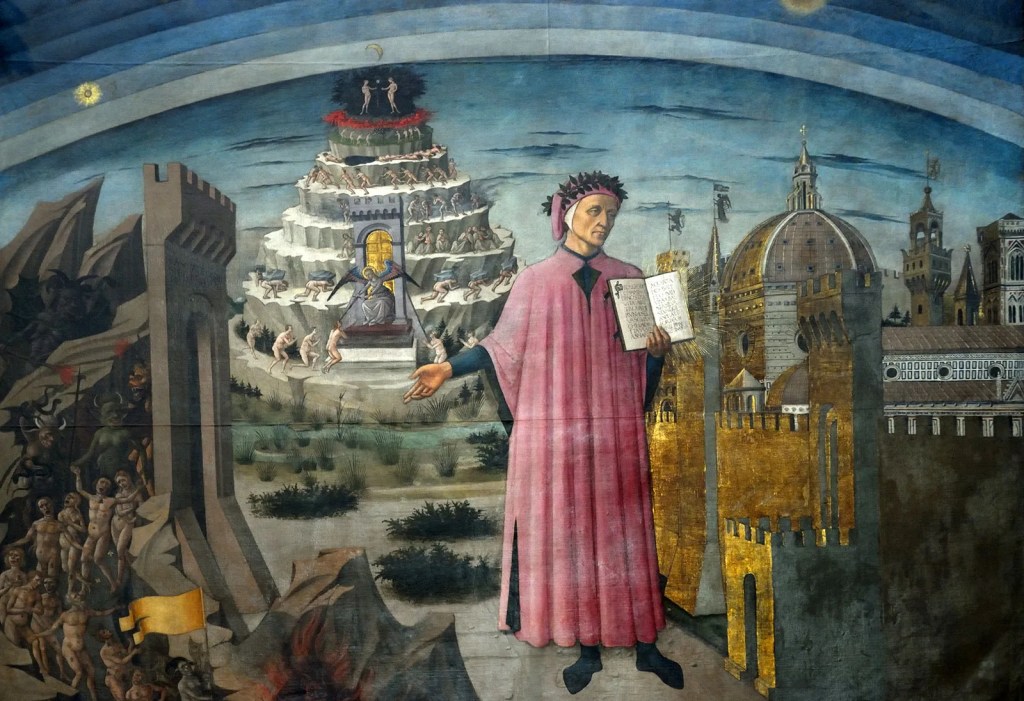
Dante wrote the epic poem The Divine Comedy, which consists of three major parts: Inferno, Purgatorio, and Paradiso (Hell, Purgatory, and Paradise). I’ll be honest and tell you that I have attempted it, but have not yet made it far. My sister-in-law recommended a translation to me, and it is on the way, so I plan to try again. Keep you posted.
For the opening verse of the first part, Inferno, Dante wrote,
“Midway upon the journey of our life I found myself within a forest dark, For the straightforward pathway had been lost.”
For Dante, who acts as both the narrator and poet, finding himself in the dark forest means he has found himself in a place of sin and spiritual confusion. While searching for a way out, he meets the poet Virgil, who will serve as his guide through the nine levels of the Inferno, hell.
The deeper the level, the more heinous the sin. Level one includes the unbaptized and virtuous pagans. Level six is guarded by demons and reserved for heretics. Level nine is the home of Satan, where he chews on the worst traitors, including Judas Iscariot and Brutus, as in, et tu Brute?
For many centuries, Christians held a vivid and imaginative view of hell, but as we became more “enlightened,” that understanding gave way to doubt and disbelief. Now, for many, hell is nothing more than a myth that we tell children to keep them in line on rainy days. The author of the book, The Hell There Is, which we recently discussed at our Saints Book Club, states, “What is more common today, at least among the faithful, is not the outright denial of hell but a kind of practical denial of it by concluding, contrary to Scripture, that very few, if any, go to hell.” (p.2-3) He explains that individuals come to this conclusion because they don’t believe a loving God would condemn anyone to eternal punishment. However, for the author, God is not the one condemning people; rather, they are choosing hell themselves. To demonstrate this, the author references the parable of Lazarus and the rich man (also known as Dives, the Latin word for rich or wealthy). So, how does the parable show the man choosing hell over being condemned to it?
To begin (and I’ll refer to the rich man as Dives), Dives was very well aware of Lazarus’ condition. Lazarus was not sitting at the city gates where he might have occasionally been seen by Dives; instead, Lazarus was sitting at the gates of Dives’ house. Dives would have seen Lazarus every single time he went outside, yet Dives chose to ignore him. Dives did nothing directly against Lazarus, but sin isn’t limited to actions. We pray in the confession, “Most merciful God, we confess that we have sinned against you in thought, word, and deed, by what we have done, and by what we have left undone.” Sins of commission are the wrongs we do, and sins of omission are the good we fail to do, even when we know we should act.
Countless times throughout the history of God’s people, even before the time of Jesus, God called on His people to care for the poor. For example, Deuteronomy 15:11 states, “There will always be poor people in the land. Therefore, I command you to be openhanded toward your fellow Israelites who are poor and needy in your land.”
Disobeying this command, Dives, fully aware of Lazarus’ needs, committed a great sin of omission. He was not compelled to ignore him but chose to. Dives did not choose the ways of God; he chose the ways of self and the devil, making a conscious decision to prefer hell over heaven. Further proof of this choosing is that once there, Dives’ attitude does not change.
In Hades and in torment, Dives looks up and sees Abraham and Lazarus in Paradise. He calls out, “Father Abraham, have mercy on me, and send Lazarus to dip the tip of his finger in water and cool my tongue; for I am in agony in these flames.”
That is the same attitude he had toward Lazarus while he was alive. Lazarus is a non-person to him. He does not ask Abraham to send Lazarus down to where he is so that he can beg for forgiveness. No. Instead, Dives asks for Lazarus to be sent down to serve him. “Abraham, tell that wretch to run this little errand for me.” Neither does Dives ask if he might come up to Heaven so he might escape his torment. He is neither willing to confess nor ask for forgiveness for his sins, which demonstrates that, despite the torments he is currently experiencing, he is still happy with the choices he has made. It is one of those situations where your only regret is that you got caught. Dives chose his current state, and he would rather remain in hell than walk in the ways of God. Do people truly make such an insane choice?
You are familiar with Jesus’ words in John 3:16—“For God so loved the world, that He gave His only Son…,” and John 3:18 tells us, “Whoever believes in Him [Jesus] is not condemned, but whoever does not believe is condemned already, because he has not believed in the name of the only Son of God.” Then Jesus says something quite remarkable in verse 19, “And this is the judgment: the light has come into the world, and people loved the darkness rather than the light because their works were evil.” (John 3:19) “This is the judgment,” may also be translated as “This is the condemnation.” So, if we rephrase 3:19, we could say, “This is the condemnation: Jesus came into the world, and people chose the darkness—they chose hell—rather than Jesus, because they preferred their evil ways over the ways of God.”
Yes. The author of the book is correct in his assertions—God does not condemn a person to hell; they choose it. What makes this choice so woeful is that after death, there’s no second chance. When Dives asked for that cool drop of water, Abraham told him that he had received his reward while alive and ignored the needs of another person. Additionally, Abraham tells Dives, “Between you and us a great chasm has been fixed, so that those who might want to pass from here to you cannot do so, and no one can cross from there to us.” Death is not a threshold we cross. Death is a chasm that, once crossed, cannot be breached.
The author writes, “Think of wet clay on a potter’s wheel. If the clay is moist and still on the wheel, it can be shaped and reshaped, but once it is put in the kiln, in the fire, its shape is fixed forever. So it is with us that when we appear before God, who is a holy fire, our fundamental shape will be forever fixed, our decisions will be final. This is mysterious to us, and we only sense it vaguely, but because heaven and hell are eternal, it seems reasonable to conclude that this forever-fixed state is in our future.” (p.76)
With that understanding, I have some good news for you and I have some bad news for you. Let’s start with the bad news—“All have sinned and fall short of the glory of God,” (Romans 3:23) and “the wages of sin is death.” (Romans 6:23) We have sinned and we are dead in our sin; therefore, we are already on the wrong and unbreachable side of the chasm. We are dead in our trespasses and sins because we too have not followed the ways of God. (Cf Ephesians 2:1-3) That’s the bad news. The Good News is this—like the clay on the potter’s wheel, we have not yet been placed in the kiln. Our final shape, our forever-fixed state, is not yet set. There is still time to make another choice—a better and eternal one—and that is what Jesus offers us all. Jesus has created the one and only way by which we can cross the unreachable chasm, and that Way is through Him. “Jesus said to him, ‘I am the way, and the truth, and the life. No one comes to the Father except through me.’” (John 14:6)
“Midway upon the journey of our life I found myself within a forest dark, For the straightforward pathway had been lost.”
Certain actions we take and choices we make can lead us into that same dark forest where we lose the straightforward pathway. If we persist, then, in the end, the consequences of those actions and choices bring us to that Inferno which is forever fixed. If, however, we choose the Way that Christ Jesus has established, then we are gifted an eternal dwelling place with God in the New Jerusalem. My advice then is this,
Don’t let the devil drive your car. Don’t do it, Don’t do it, Don’t do it!
Let us pray: Loving Father, faith in Your Word is the way to wisdom. Help us to think about Your Divine Plan that we may grow in the truth. Open our eyes to Your deeds, our ears to the sound of Your call, so that our every act may help us share in the life of Jesus. Give us the grace to live the example of the love of Jesus, which we celebrate in the Eucharist and see in the Gospel. Form in us the likeness of Your Son and deepen His Life within us. Amen.
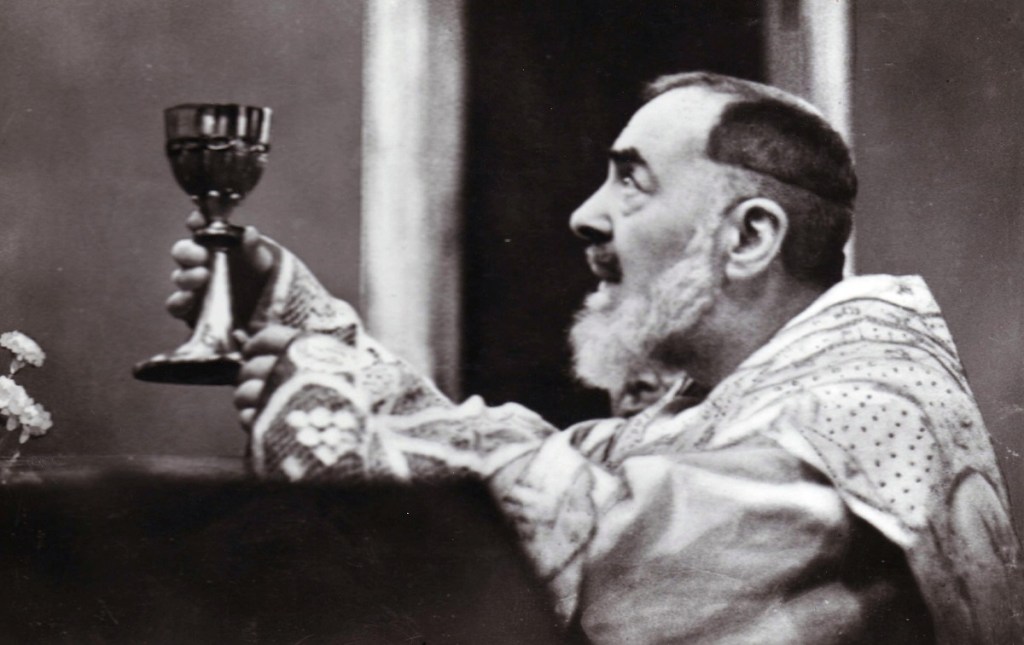
Yesterday was the feast day of St. Padre Pio. His life was remarkable for many reasons. He was a Capuchin Franciscan monk. He received the stigmata, losing a cup of blood per day; he heard thousands of confessions, and countless miracles have been recorded through his intercessions, both during his life and after his death. In 1947, he heard the confession of a young priest. In 2002, Padre Pio was canonized as a Saint by that same man, now called Pope John Paul II. He died in 1968 at the age of 81.
Today, I want to share just a few of the sayings of Padre Pio, but I’m going to reserve a bit of my time until after the Eucharist, because I want to share a prayer he wrote that is to be prayed at that time.
We are only capable of doing a little good. But God, in His goodness, has pity on us, is content with very little, and accepts the preparation of our hearts …. God is infinitely greater than our heart and this overcomes the whole world.
The demon has only one door by which to enter into our soul: the will; there are no secret doors. No sin is a sin if not committed with the will. When there is no action of the will, there is no sin, but only human weakness.
Remember that man has a mind, that he has a brain which serves him for reasoning, that he has a heart for feeling, he has a soul. The heart can be commanded by the head, but not the soul, so there must be a Supreme Being who commands the soul … it is impossible to exclude a Supreme Being.
The desire to be in eternal peace is good and holy, but you must moderate this with complete resignation to the divine will. It is better to do the divine will on earth, than to enjoy Paradise.
In a word: obedience is everything to me.
Before you sanctify others, think about sanctifying yourself.
And what man consider his most famous quote is one worth remembering—Pray, hope, and don´t worry. Worry is useless. God is merciful and will hear your prayer.
After Communion…
Stay with me, Lord, for it is necessary to have You present so that I do not forget You. You know how easily I abandon You.
Stay with me, Lord, because I am weak and I need Your strength, that I may not fall so often.
Stay with me, Lord, for You are my life, and without You, I am without fervor.
Stay with me, Lord, for You are my light, and without You, I am in darkness. Stay with me, Lord, to show me Your will.
Stay with me, Lord, so that I hear Your voice and follow You.
Stay with me, Lord, for I desire to love You very much, and always be in Your company.
Stay with me, Lord, if You wish me to be faithful to You.
Stay with me, Lord, for as poor as my soul is, I want it to be a place of consolation for You, a nest of love.
Stay with me, Jesus, for it is getting late and the day is coming to a close, and life passes; death, judgment, eternity approaches. It is necessary to renew my strength, so that I will not stop along the way and for that, I need You.
It is getting late and death approaches, I fear the darkness, the temptations, the dryness, the cross, the sorrows.
O how I need You, my Jesus, in this night of exile!
Stay with me tonight, Jesus, in life with all its dangers. I need You.
Let me recognize You as Your disciples did at the breaking of the bread, so that the Eucharistic Communion be the Light which disperses the darkness, the force which sustains me, the unique joy of my heart.
Stay with me, Lord, because at the hour of my death, I want to remain united to You, if not by communion, at least by grace and love.
Stay with me, Jesus, I do not ask for divine consolation, because I do not merit it, but the gift of Your Presence, oh yes, I ask this of You!
Stay with me, Lord, for it is You alone I look for, Your Love, Your Grace, Your Will, Your Heart, Your Spirit, because I love You and ask no other reward but to love You more and more.
With a firm love, I will love You with all my heart while on earth and continue to love You perfectly during all eternity. Amen.
“I don’t hate you, I’m just not necessarily excited about your existence.”
“I’m not saying I hate you, what I’m saying is that you are literally the Monday of my life.”
“To me, you are like a cloud. When you disappear, it’s a beautiful day.”
“I don’t hate you, but I’d buy you a toaster oven for your bathtub.”
“I’m not saying I hate you, but I would unplug your life support to charge my phone.”
The state of the world these days has stirred up the same level of hatred (and I would say, dysfunction) in many people, so please do not shout anyone’s name—let’s keep things civil here—but I want you to think about the one person you dislike the most. Imagine them like the Grinch as he was looking at the names in the phone book of the citizens of Whooville, saying, “Hate, hate, hate, double hate, LOATHE entirely.” They pretty much just make you angry when you think about them. You would definitely like to give them a piece of your mind. Got it? Now, turn that feeling inward, where you become the target of that intense hatred.
That may seem very unhealthy for many, but for some, it’s how they feel about themselves. If you hate them, try stepping inside their heads for a few minutes, and you’ll realize they hate themselves even more than you ever imagined.
Experts tell us that there are several reasons why someone might not like or even hate themselves. One reason is the illusory truth effect, also known as the illusion of truth effect. A current example of this is what has come to be known as “fake news.”
Believe it or not, fake news exists. Oy! The trick with fake news is to repeat something enough times, whether it’s true or not, and people will start to believe it. The same idea applies to individuals. If you tell a child enough times that they are stupid, even if they have an IQ off the charts, the child is likely to come to believe they are, in fact, stupid. Tell them or treat them as if they are unloved, and they’ll begin to think that way too. We start to believe what others say about us, whether it’s true or not. What does this have to do with today and our Patron Saint, Matthew? I always imagined Matthew sitting alone at a table while people came up to pay their taxes when they were due. But I was wrong.
As we know, during Jesus’ time, the Romans occupied the Holy Land; therefore, they claimed the right to tax the people. To collect the taxes, the Roman senate appointed wealthy citizens to oversee specific areas of collection. These Roman citizens would then hire managers for those areas, who in turn would hire local individuals fluent in the local language to collect the taxes. These local tax collectors were called publicani.
The rules these tax collectors worked under appears to have been, “Tax everything.” And they were inventive. There were taxes “on axles, wheels, pack animals, pedestrians, roads, highways; on admission to markets; on carriers, bridges, ships, and quays; on crossing rivers, on dams, on licenses—in short, on such a variety of objects that even the research of modern scholars has not been able to identify them all.” Additionally, everyone from the Roman government to the publicani wanted a little piece of the action, so the publicani cheated their own people and charged extra.
Matthew, known in one translation as “The Lord of the Passage,” was in Capernaum, a prime location for collecting taxes. He would have been able to tax people traveling on the roads around the Sea of Galilee, including farmers, fishermen, and those arriving by boat. As a result, he would have been loathed entirely by both Jews and Gentiles. One source states that he would not have even been allowed to enter the Temple, and highly religious Jews would be considered unclean if they so much as touched him.
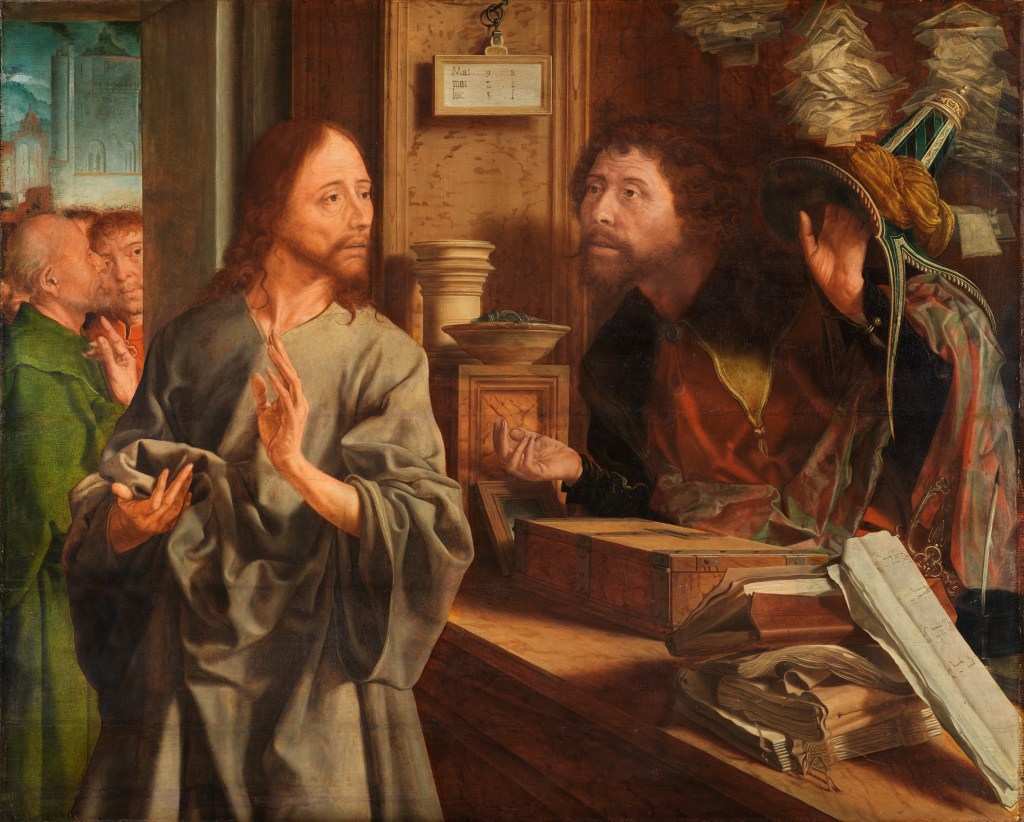
The building he worked in—think toll booth—was a busy place, with Roman guards and soldiers hanging about (seeing to it that everyone paid and no one tried to rob the place) and a line of folks waiting to pay. The mood: hostile and downcast, and there sits Matthew, not caring what you think about paying taxes or what you think about him. Yell, cry, cuss—whatever you please—you’re going to pay, and he doesn’t care. At the end of the day, he’s going home with a fat wallet. Yet, “As Jesus was walking along, he saw a man called Matthew sitting at the tax booth; and he said to him, ‘Follow me.’ And he got up and followed him.”
Without hesitation, Matthew walked away from it all—the job, the money, everything. He walked away from it all to follow a wandering Rabbi. What would make him do it? On that, the Gospel—even Matthew’s own Gospel—is silent, but I can’t help but wonder.
Some folks can be yelled at and cussed all day long without it affecting them one little bit. Like water off a duck’s back. But for most, it may not impact them much initially, yet over time, it begins to wear on them. Just ask anyone who has ever been in an abusive relationship—they start to believe every word—an illusion of truth effect. So I had to wonder, even with the job and the money, do you think it’s possible that Matthew came to hate himself as much as the people hated him? It wasn’t some pity party, but I wonder if, over time, he started to believe he had no real value, no true friends, no real life. Did he come to believe that he was nothing more than the names people called him?
Perhaps he wasn’t a Biblical whiz kid, but he remembers a few things from his youth, like the words of Psalm 22.
I am a worm and not a man, scorned by everyone, despised by the people.
All who see me mock me; they hurl insults, shaking their heads. (Psalm 22:6-7)
And, day after day, as he sat there collecting taxes and enduring all the abuse the people dished out, do you think he might have hoped for something better? A life where he could be accepted and valued? A life where he could be loved?
Again, the Gospel is silent, but I have to wonder: when Jesus walked by, did he catch Matthew’s eyes? And in Jesus’ eyes, did Matthew see it all—everything he truly wanted: acceptance and value? And in those two words, “Follow me,” did Matthew hear Love calling out to him?
The Blessed Virgin Mary. In Luke’s Gospel, we learn that when Mary discovered she was with child, she went to visit her cousin Elizabeth. When she entered Elizabeth’s house, Mary greeted her. Scripture says, “When Elizabeth heard Mary’s greeting, the child leaped in her womb. And Elizabeth was filled with the Holy Spirit and exclaimed with a loud cry, ‘Blessed are you among women, and blessed is the fruit of your womb. And why has this happened to me, that the mother of my Lord comes to me? For as soon as I heard the sound of your greeting, the child in my womb leaped for joy.’” Elizabeth’s unborn son, John the Baptist, heard Mary’s greeting and knew that Jesus was near, so he responded with joy by leaping in the womb. I wonder if, in a similar way, when Matthew heard the voice of Jesus, “Follow me,” did his soul leap for joy within him?
Former Presiding Bishop Michael Curry said, “When you look at Jesus, you see one who is loving, one who is liberating, and one who is life-giving.” Matthew was loved by God, he was liberated from those things that bound him, and he was given new life in Jesus.
I came across a quote this past week attributed to Kahlil Gibran, the Lebanese-American writer and philosopher. After a bit of research, I found that he did not actually say it, but the quote remains quite meaningful—”God said ‘Love Your Enemy,’ and I obeyed him and loved myself.”
Matthew saw, heard, and I believe his soul leapt within him when Jesus called out to him. Matthew no longer hated the enemy; he no longer hated himself but learned to love himself because he finally understood what it meant to be loved. In doing these things and in allowing himself to be loved by Jesus, he became a Saint of God.
That is also true when you see Jesus, and it is true when you hear him. If you will look up into the face of Jesus, listen to his voice, and follow Him, He will do the same for you. And not only will he make you a saint, but He will make you a child of God Most High.
Let us pray: O Glorious St. Matthew, in your Gospel you portray Jesus as the longed-for Messiah who fulfilled the Prophets of the Old Covenant and as the new Lawgiver who founded a Church of the New Covenant. Obtain for us the grace to see Jesus living in his Church and to follow his teachings in our lives on earth so that we may live forever with him in heaven. Amen.
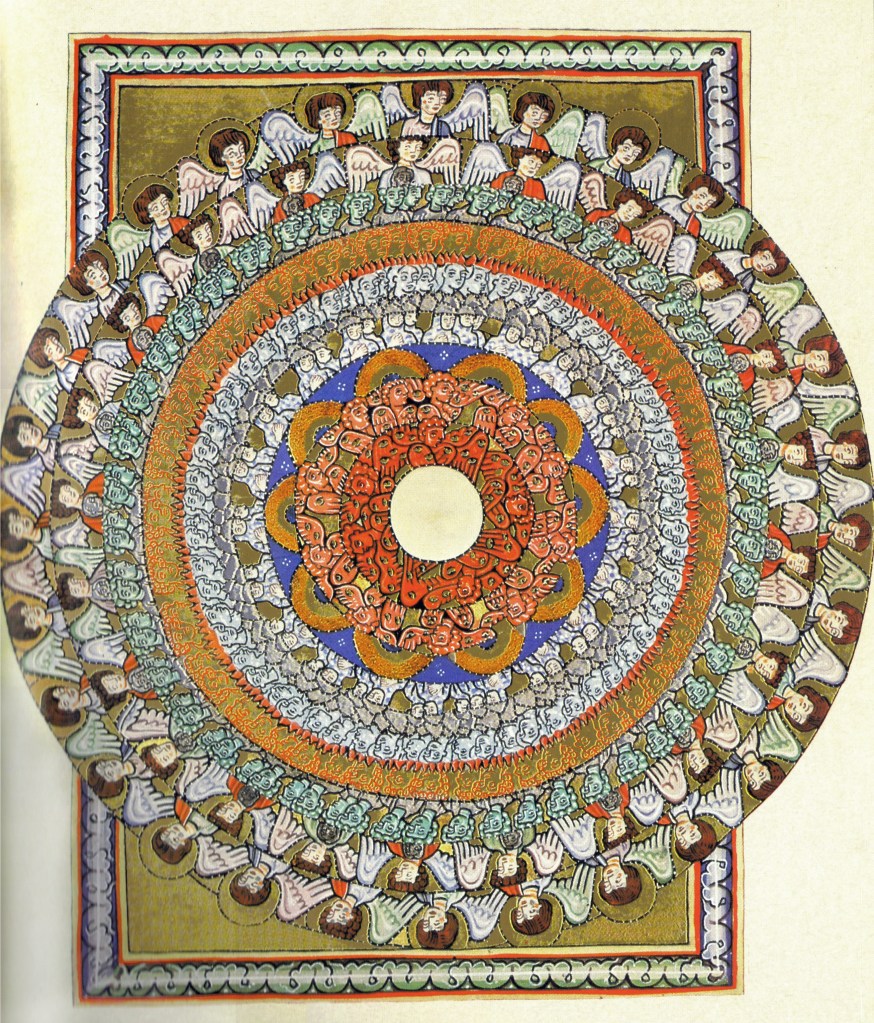
Scivias I.6: The Choirs of Angels. From the Rupertsberg manuscript, folio 38r by Hildegard of Bingen.
Today, we celebrate Hildegard of Bingen, born in 1098. She was highly sought after for her advice and corresponded with kings, queens, abbots, abbesses, archbishops, and popes. She undertook four preaching tours across northern Europe, practiced medicine, authored treatises on science and philosophy, composed remarkable music and liturgical dramas, and was quite the artist. What makes this even more impressive is that in the 12th century, these roles were typically reserved only for men.
Along with her many achievements, she was also someone who had visions, which started to appear to her when she was just three years old. She would later describe them as “The Shade of the Living Light.” She wrote, “These visions which I saw—I beheld them neither in sleep nor dreaming nor in madness nor with my bodily eyes or ears, nor in hidden places; but I saw them in full view and according to God’s will, when I was wakeful and alert, with the eyes of the spirit and the inward ears.”
Here is an example of her writing: It is easier to gaze into the Sun than into the face of the mystery of God. Such is its beauty and its radiance. God says: I am the supreme fire; not deadly, but rather, enkindling every spark of life. I am the reflection of providence for all. I am the resounding WORD; the It-Shall-Be that I intone with mighty power from which all the world proceeds. Through animate eyes I divide the seasons of time. I am aware of what they are. I am aware of their potential. With my mouth I kiss my own chosen creation. I uniquely, lovingly embrace every image I have made out of the earth’s clay. With a fiery spirit I transform it into a body to serve all the world.
To me, she shows a genuine understanding of God’s love. Not as we might view God from a theologian’s point of view, but from a human perspective (not that theologians aren’t human).
In our Gospel reading today, John wrote those beautiful words, “For God so loved the world that he gave his only Son, so that everyone who believes in him may not perish but may have eternal life.” In Hildegard’s poem, it seems she was expressing that same idea: God is saying, I am aware of who they are, their potential. I lovingly embrace them, transform them, and give them my Son to show them this great love I have for them so that they may be where We are.
Hildegard was one who intimately knew of this transforming love of God and was able to express it through music, preaching, poetry, and art, surpassing the boundaries of her time. Perhaps such intimacy with God is not something everyone can achieve, but it is something everyone should strive for. In doing so, we can also become living testimonies, breaking through our own limits.
There is an exceptional German movie about her life, “Vision,” and I recommend it if you don’t mind subtitles (or speak German).
In 2010, Pope Benedict XVI said, “Let us always invoke the Holy Spirit, so that he may inspire in the Church holy and courageous women like Saint Hildegard of Bingen who, developing the gifts they have received from God, make their own special and valuable contribution to the spiritual development of our communities and of the Church in our time.” In 2012, Benedict named her a Doctor of the Church, among thirty-three at the time, with only three being women.
If you’ve spent any time looking at the photos I post, you know I enjoy cooking, and that what I cook isn’t always the healthiest choice. (See example one, hamburger wrapped in bacon… dang, that was tasty!) It used to be that this wasn’t a problem. I had the metabolism and exercise to counteract any negative effects. Now, at 60, apparently not so much. I got my annual blood work done last week. High cholesterol and pre-diabetes. I’m already on blood pressure medicine. (I’m sure most of you just had to look at me and knew this without the blood test.) Folks, I want at least another 25 good years, so it’s time to make some changes. I’m going to keep cooking and keep eating, but I’m on a mission to learn how to make the very best healthy foods. (The picture below was the first attempt: quinoa instead of rice, cornstarch instead of flour, a tablespoon of olive oil instead of deep frying, honey instead of sugar, broccoli instead of no vegetables at all.) I’ve ordered a new cookbook and will be exploring various spices to elevate my cooking. If you’ve got recipes, please share them. I’d love to add them to my repertoire. If you invite me over or bring me food, please, make it healthy. If you see me reaching for the donut, slap my hand. Thanks.
Field Marshal Sam Manekshaw, known as “Sam Bahadur,” served in the Indian Army for forty years and was the first to attain the rank of Field Marshal. His nickname was Sam Bahadur—Sam the Brave. Highly decorated and highly respected. When asked whether he had a fear of death, he replied, “If a man says he is not afraid of dying, he is either lying or is a Gurkha.”
Gurkha refers to the Brigade of Gurkhas, a rifle regiment of the British Army composed of men from Nepal. Of them, Field Marshal Viscount Slim wrote, “The Almighty created in the Gurkhas an ideal infantryman, indeed an ideal Rifleman, brave, tough, patient, adaptable, skilled in fieldcraft, intensely proud of his military record and unswerving loyalty.” However, despite all this praise, at one point, a British Commander asked for volunteers from a unit of 200 Gurkhas to join the Airborne Division—those who parachute into enemy territory. Of the 200, only five volunteered; the rest shook their heads. Hearing of their bravery, he asked the Gurkha commander why so few were willing to join. It was then that the misunderstanding was uncovered—the Gurkhas knew they would be jumping from an airplane, but they didn’t know anything about parachutes.
From that, it’s easy to understand why so few volunteered, but let me ask you this: what the heck was going through the heads of those five who said, Yes?
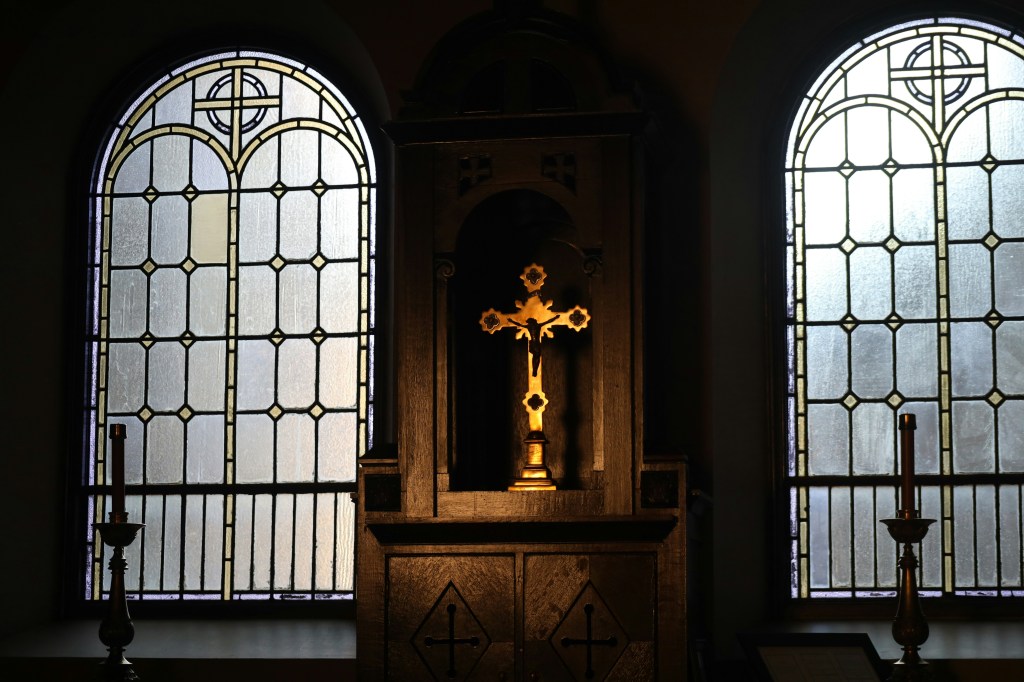
Today, we celebrate the Feast of the Holy Cross. It is a day to remember and honor the Cross of Jesus and to commemorate the day when the true Cross was discovered.
That story begins on May 3, 326. Helena, the mother of Constantine, the first Christian Roman Emperor, is said to have found the true cross in Jerusalem.
Helena went on a pilgrimage to Jerusalem to visit the most important sites in Jesus’ life. After talking to many people, she found out that Jesus’ cross, along with the crosses of the two criminals crucified on either side, had been buried to hide them. Some reports say that when she unearthed the crosses, the one belonging to Jesus still had the sign Pilate had ordered put on it: “Jesus of Nazareth, King of the Jews.” Other reports say that at first, they couldn’t tell which cross was which. So, they brought a dying woman to the site of the three crosses and laid her on each one. Then, St. Macarius, the Bishop of Jerusalem, said a prayer.
“O Lord, who by the Passion of Thine only Son on the cross, didst deign to restore salvation to mankind, and who even now hast inspired thy handmaid Helena to seek for the blessed wood to which the author of our salvation was nailed, show clearly which it was, among the three crosses, that was raised for Thy glory. Distinguish it from those which only served for a common execution. Let this woman who is now expiring return from death’s door as soon as she is touched by the wood of salvation.”
Upon touching the wood of the true cross of Jesus, she was restored to health. True or false? Some might say such stories are nothing more than foolishness. Maybe. But St. Paul tells us, “For the message about the cross is foolishness to those who are perishing, but to us who are being saved it is the power of God.” (1 Corinthians 1:18)
A few weeks ago, we talked about Aleksandr Solzhenitsyn, the author of The Gulag Archipelago. The book describes the ten years he spent in a Russian prison. But before he was imprisoned for speaking out against the Communists, he was actually a supporter. Early in his life, he drank the Kool-Aid and became an atheist. That was what most young Russians were doing as they bought into the system. So, when he went to prison, he was an atheist, but when he got out, he rediscovered the faith of his childhood.
The prison was in Siberia. He was cold, hungry, and feeling defeated there. The story describes a day when he was working outside. The wind was howling, and he felt miserable. Standing there, leaning on his shovel, he finally lost all hope. He simply did not care what would happen to him.
He saw a nearby bench, so he dropped his shovel, walked over, and sat down. As he sat there, he fully expected to be beaten to death by a guard for his actions. It is what happened to any prisoner who was disobedient.
After a short while, he heard someone approaching. He thought it was the guard, but it wasn’t. It was another prisoner—an old, very thin man. The man said nothing to Solzhenitsyn. Instead, he knelt in front of him and, with a small stick, scratched out the sign of the cross in the dirt. Then he got up and hurried back to work.
Solzhenitsyn looked at that crude cross, and some part of the true light of God reached him through it. In that moment, he realized that he did not have to face these terrors alone and that he did not have to survive on his own strength. “With the power of the cross, he could withstand the evil of not just one but a thousand Soviet empires.” (The Sign of the Cross, Gezzi, p.3-4)
Listen to these words of the theologian Stanley Hauerwas.
“The cross is not a sign of the church’s quiet, suffering submission to the powers-that-be, but rather the church’s revolutionary participation in the victory of Christ over those powers. The cross is not a symbol for general human suffering and oppression. Rather, the cross is a sign of what happens when one takes God’s account of reality more seriously than Caesar’s. The cross stands as God’s (and our) eternal no to the powers of death, as well as God’s eternal yes to humanity, God’s remarkable determination not to leave us to our own devices.” (Resident Aliens: Life in the Christian Colony, p.47)
These days, when you sit down to watch TV or the news, you see a great deal of violence. Some of the violence appears in the TV shows or movies we watch. And now, a lot of the violence is in the news. I remember a time (showing my age here) when news reporters would say something like, “Due to the nature of the material, you may want to have your children leave the room.” Not anymore. Now, they just throw it out there, and we all have the opportunity to struggle with PTSD. The concern with this bombardment of violence is that we are becoming desensitized to it. It no longer affects us. What we see on the news might as well be a video game because it all looks the same.
Dietrich Bonhoeffer wrote, “For the great and powerful of this world, there are only two places in which their courage fails them, of which they are afraid deep down in their souls, from which they shy away. These are the manger and the cross of Jesus Christ.” (God Is in the Manger: Reflections on Advent and Christmas) This used to be true, but I believe, like the violence around us, we have become desensitized to the manger and the Cross of Christ. They no longer influence our thinking, our actions, or our way of life. We see the Cross everywhere—jewelry, T-shirts, 100-foot statues beside the road, all the way down to being stitched and bejeweled across the backside of a pair of jeans. It no longer has the power to strike a holy fear in the hearts of those who see it, but it should.
The Cross was once an instrument of torture and death. However, through Christ, the Cross was transformed into—not just “a” symbol—but the very means of our salvation, our victory over Satan and death. St. John Vianney tells us, “The sign of the cross is the most terrible weapon against the devil.” And Thomas à Kempis states, “In the cross is salvation, in the cross is life, in the cross is protection from enemies, in the cross is infusion of heavenly sweetness, in the cross is strength of mind, in the cross is joy of spirit, in the cross is highest virtue, in the cross is perfect holiness. There is no salvation of soul nor hope of everlasting life but in the cross.”
Remember those five Gurkha soldiers—the ones who volunteered to jump out of the plane even before they knew about parachutes? They weren’t crazy. They weren’t blindly risking their lives like suicide bombers. Nor were they so naive that they had no idea what happens when someone falls from a great height. Instead, they had this courage—this faith in themselves and their abilities. Crazy as we might think them, they thought, “I can do that.”
I’m not asking you to jump out of an airplane without a parachute, but I am asking you to have that kind of courage and put that kind of faith in the Cross of Jesus.
Going forward, when you see the Cross, don’t just look at it without recognizing what it represents, for it is nothing less than the power of God working in you, for you, and through you.
I love that verse from Joshua when the Lord says, “Be strong and courageous. Do not be frightened, and do not be dismayed, for the Lord your God is with you wherever you go.” (Joshua 1:9) The Lord our God “gave us a spirit not of fear but of power and love and self-control,” (2 Timothy 1:7) and we can know and experience these things through the Holy Cross of Jesus.
Let us pray: Holy Cross of Jesus, be my true light! Holy Cross, fill my soul with good thoughts. Holy Cross, ward off from me all things that are evil. Holy Cross, ward off from me all dangers and deaths and give me life everlasting! Crucified Jesus of Nazareth, have mercy on me now and forever. Amen.






 Candle in a Cave