Sermon: Epiphany 5 RCL B – “Fulfill”

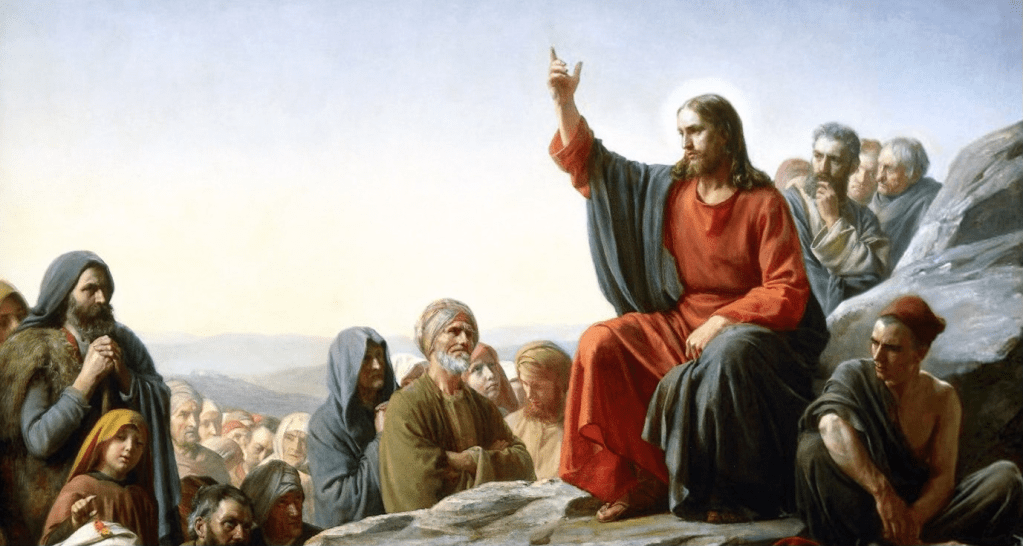
Photo by Travis Grossen on Unsplash

Several years ago, at a passion play, an incident occurred during Jesus carrying the cross. A man in the audience was heckling the character playing Jesus, throwing out jeers, taunts, and dares. Finally, the character could no longer tolerate the heckler; he dropped the cross, went over, and punched out the man. The director was aghast and, after the play, pulled the actor aside and told him in no uncertain terms that he was never to do that again. But the next night, the same heckler was back, and the same thing happened again. Jesus, this time, had to be restrained. The director called the actor in and gave him an ultimatum of quitting or keeping his composure. The young actor assured the director he would keep himself under control. On the third night, the heckler was present again and taunted even stronger than the two previous nights. The man playing Jesus rose to his full stature, gritted his teeth, and told the heckler, โ€œIโ€™ll see you right after the resurrection.โ€

Today our Gospel reading was from Matthew 5:13-20, and they are a part of the Sermon on the Mount, following immediately after the Beatitudes. Verses 13 through 15 of our reading, which speak of salt and light, make for good sermon material. Verse 20โ€”โ€œFor I tell you unless your righteousness exceeds that of the scribes and Pharisees, you will never enter the kingdom of heaven.โ€โ€”also makes for a good sermon, but verses 16 through 19โ€ฆ those are best left alone. What did they say? 

Jesus said, โ€œDo not think that I have come to abolish the law or the prophets; I have come not to abolish but to fulfill. For truly I tell you, until heaven and earth pass away, not one letter, not one stroke of a letter, will pass from the law until all is accomplished. Therefore, whoever breaks one of the least of these commandments, and teaches others to do the same, will be called least in the kingdom of heaven; but whoever does them and teaches them will be called great in the kingdom of heaven.โ€

You wouldnโ€™t be the first if you were confused by the meaning of that statement. In fact, it is still up for debate, but perhaps we can come close, and it primarily hinges on our understanding of the word fulfill

When we consider the word fulfill, we might think of fulfilling an order or fulfilling the requirements for something, but to fulfill can also mean โ€œto bring to an endโ€ (Merriam-Webster) or to bring โ€œto its intended meaning.โ€ (Word Biblical Commentary, p.106) When Jesus said that he did not come to abolish the Law but to fulfill it, he was saying that he came to bring the Law to its end by fulfilling it as it was intended. When Jesus spoke these words, the fulfillment was a work in process. It would not be completed until the Cross.

It was there, on the Cross, that every letterโ€”every jot and tittle of the Law was fulfilled and completed in the life and teachings of Jesus. The Apostle Paul wrote, โ€œFor the commandments, โ€˜You shall not commit adultery, You shall not murder, You shall not steal, You shall not covet,โ€™ and any other commandment, are summed up in this word: โ€˜You shall love your neighbor as yourself.โ€™ Love does no wrong to a neighbor; therefore love is the fulfilling of the law.โ€ (Romans 13:9-10) Love fulfills the Law, and there is no greater act of love than Christ giving Himself on the Cross that we might have life in him. It was then and there that the Law was brought to its intended end, but it was also there that you and I were called to a much higher standard because before he departed, Jesus gave us a new commandment so that we might be His true disciples. Jesus said, โ€œA new commandment I give to you, that you love one another: just as I have loved you, you also are to love one another. By this all people will know that you are my disciples, if you have love for one another.โ€ (John 13:34-35)

Jesus brought the Mosaic Law to its intended meaning, so he did not abolish it; he lived itโ€”every jot and tittleโ€”and He asks us to do the same. Jesus said, โ€œI tell you, unless your righteousness exceeds that of the scribes and Pharisees, you will never enter the kingdom of heaven.โ€ Jesus said, โ€œThe Pharisees lived the Law externallyโ€”they โ€˜clean the outside of the cup and the plate, but inside they are full of greed and self-indulgence.โ€™ (Matthew 23:25b) The Pharisees were all show, but on the inside, not so good. So if like them, you only give lip service to this new commandment, then you are no better than they are.โ€ 

โ€œNo,โ€ says Jesus. โ€œYou must fulfill the Law by loving one another as I have loved you. And โ€˜greater love has no one than this, that someone lay down his life for his friends.โ€™โ€ (John 15:13) That is the new standard. Soโ€ฆ how ya doinโ€™? Is that how you are living your life? Is that the Law you are fulfilling in your life? In answering this, most of us could probably agree with Ernestine, the telephone operator, Lili Tomlin, โ€œIf love is the answer, could you rephrase the question?โ€ Yet, would Jesus have given us this mandate to love as he loves if it were impossible? And if it is, then why donโ€™t we?

I wonโ€™t speak for you, but I will speak for myself. I donโ€™t know how to love like that. I donโ€™t even know if I have it within me, but I also know thatโ€™s the devil within giving me an excuse. A way out of applying my body and soul to live in such a way. If I can set aside those excuses, then why? Well, I can give you some philosophical explanation or discuss the heresy of Pelagianism or something along those lines. Still, if I am honest with myself, the answer to why I canโ€™t love as Jesus loves isโ€”deep down insideโ€”I donโ€™t want to. I want to want to, but I also want to live my life according to my rules. There is this war inside of me, and the good guys donโ€™t always win. Butโ€ฆ that does not give me permission to stop wanting it. To stop trying. As a disciple of Jesus, I have a standard set for my life, and that standard is Jesus, so He must always be my aim. Regardless of my successes and failures, I must never stop trying.

George Herbert wrote The Country Parson. Included at the beginning was a โ€œNote to the Reader.โ€ Here, Herbert writes, โ€œI have resolved to set down the Form and Character of a true Pastor, that I may have a Mark to aim at: which also I will set as high as I can, since he shoots higher that threatens the Moon, than he that aims at a Tree. Not that I think, if a man do not all which is here expressed, he presently sins, and displeases God, but that it is a good strife to go as far as we can in pleasing of him, who hath done so much for us.โ€ (The Classics of Western Spirituality edition, p.54) We aim for the stars. We aim for Jesus. There will be days when we come close to hitting the stars, and there will be days whenโ€”regardless of how hard we try, how many times weโ€™ve been corrected with threats of losing everything,  we will raise our fists and shout, โ€œIโ€™ll see you right after the resurrection.โ€ On those days, the One who fulfilled and completed the Law will fulfill and complete our weak efforts through his grace and mercy. Those are the days when we get back on our feet, confess our sins, and try once more to fulfill the New Commandment to love as Jesus loves.

Let us pray:
God, our Father,
You redeemed us
and made us Your children in Christ.
Through Him, You have saved us from death
and given us Your Divine life of grace.
By becoming more like Jesus on earth,
may we come to share His glory in Heaven.
Give us the peace of Your kingdom,
which this world does not give.
By Your loving care, protect the good You have given us.
Open our eyes to the wonders of Your Love
that we may serve You with a willing heart.
Amen.
Sermon: Epiphany 4 RCL A – “I am so blessed!”


A King had a male servant who, in all circumstances, always said to him; My king, do not be discouraged because everything God does is perfect, no mistakes. 

One day, they went hunting, and a wild animal attacked the king; the servant managed to kill the animal but couldn’t prevent his majesty from losing a finger. Furious and without showing gratitude, the King said; if God were good, I would not have been attacked and lost one finger.

The servant replied, ‘despite all these things, I can only tell you that God is good and everything He does is perfect, He is never wrong.โ€™ Outraged by the response, the king ordered the arrest of his servant. While being taken to prison, he told the king again that God is Good & Perfect. Another day, the king was left alone for another hunt and was captured by savages who used human beings for sacrifice.

On the altar, the savages found out that the king didn’t have one finger in place; he was released because he was considered not “complete” to be offered to the gods. On his return to the palace, he ordered the release of his servant and said; My friend, God was really good to me. I was almost killed, but I was let go for lack of a single finger.

But I have a question; If God is so good, why did He allow me to imprison you? His servant replied; My king, if I had not been put in prison, I would have gone with you and been sacrificed because I have no missing finger.

Finding the good in a good situation is easy, but how difficult is it to find the good in what is perceived as a bad situation?

These days, it is quite common to hear someone say, โ€œIโ€™m so blessed,โ€ which is then followed by an explanation of why. โ€œIโ€™m so blessed because I have good health.โ€ โ€œIโ€™m so blessed because I have a good job and nice things.โ€ โ€œIโ€™m so blessed because ____.โ€ But does this mean that the person with bad health is unemployed or ____ is not blessed? Or is it, when they think of the word โ€œblessed,โ€ weโ€ฆ 

Have you ever seen the movie The Princess Bride? Vizzini is one of the semi-evil characters who occasionally comes up with excellent advice. For example, I can think of one world leader who could have benefitted from: โ€œNever get involved in a land war in Asia,โ€ but no one asked. Anyhow, Vizzini keeps using the word โ€œinconceivable.โ€ After the umpteenth, Inigo Montoyaโ€”heโ€™s looking for the man with six fingersโ€”says to Vizzini, โ€œYou keep using that word. I do not think it means what you think it means.โ€ We keep using the word blessed, but I donโ€™t think it means what we think it means because so often, when we say we are blessed, it is the equivalent of saying, โ€œIโ€™m so lucky.โ€ However, being blessed and being lucky are two very separate things. To understand the true meaning of blessed, we must look for its use in Holy Scripture. 

Consider the Israelites. Following the Exodus from Egypt, the Lord spoke to Moses as the people wandered in the desert. On one occasion, the Lord told Moses to speak to the people and say, โ€œIf you obey my voice and keep my covenant, you shall be my treasured possession out of all the peoples. Indeed, the whole earth is mine, but you shall be for me a priestly kingdom and a holy nation.โ€ Put another way, โ€œIf you obey my commandments, you will be blessed, for I will set you apart from all the other nations of the earth. And in setting you apart, you will serve my purposes.โ€ We hear it again in Deuteronomy, โ€œFor you are a people holy to the Lord your God; the Lord your God has chosen you out of all the peoples on earth to be his people, his treasured possession.โ€ So, to be blessed is to be set apart for Godโ€™s purposes. To say you are blessed because you have good health is only half the equation. If you are blessed because you have good health, what is Godโ€™s purpose for your good health? If you are blessed because you have an excellent job with a good income, what is Godโ€™s purpose for blessing you with these things? But it doesnโ€™t stop there because once you are set apart and discern Godโ€™s purpose, you must respondโ€”you must fulfill the purpose. 

The idea of being blessed applies to individuals, but it also applies to things. Think of the bread and the wine at the Eucharist. During the Eucharistic prayer, we bless/consecrate the bread and the wine for Godโ€™s purpose, that is, to become the Body and Blood of His Son so that we, Godโ€™s children, might have food for our souls.

Yet, bread and wine, a good job, and good health are easily identified as blessings, and if we discern Godโ€™s purposes, we can use these blessings for Him, but what about those things that are not so easily identified as blessings? Take, for example, the flea. Is there ever a time when a flea is a blessing?

We just finished reading and discussing The Hiding Place by Corrie Ten Boom in our Saints Book Club. She wrote about the life she and her family had before the Nazi invasion of Holland. She, her father, and her sister, Betsie, would eventually be arrested and placed in concentration camps. Upon their arrival at Ravensbruck, she and her sister were placed in temporary quarters, and the beds were covered with straw. They crawled into the bunks and were immediately covered in lice. It was miserable, but all the women came together, cut each other’s hair, and endured. After a time, they were moved into permanent quarters.

There, the sleeping arrangements were similar. Three layers of cots shoved closely together and covered in straw. Corrie and her sister were assigned to bunks on the second tier. She writes, โ€œSuddenly I sat up, striking my head on the cross-slats above. Something had pinched my leg. โ€˜Fleas!โ€™ I cried. โ€˜Betsie, the place is swarming with them.โ€™โ€

They scrambled out, and just as Corrie seemed about to lose it, Betsie began to pray. She remembers a passage of Scripture they had read earlier in the day, โ€œGive thanks in all circumstances.โ€

Praying, Betsie says, โ€œThank you for the fleas and forโ€”.โ€

โ€œThe fleas!โ€ Writes Corrie. This was too much. โ€œBetsie, thereโ€™s no way even God can make me grateful for a flea.โ€

โ€œGive thanks in all circumstances,โ€ Betsie quoted. โ€œIt doesnโ€™t say, โ€˜in pleasant circumstances.โ€™ Fleas are part of this place where God has put us.โ€

Corrie wrote, โ€œAnd so we stood between piers of bunks and gave thanks for fleas. But this time I was sure Betsie was wrong.โ€

While housed in this particular barrack, what they found to be so interesting, was the fact that neither the guards nor the supervisors entered the barracks to harass or even oversee them, which allowed them the opportunity to begin to hold prayer meetings inside the barracks with no interference. Soon they were ministering to so many women. Attitudes changed. What had been a place of total despair and self-reliance, and distrust turned into a place of hope, community, and faith. Why? Fleas. You see, Betsie later learned that the guards and the prisoner supervisors knew very well that the building was swarming with fleas, and no matter the need, they refused to put a foot inside for fear of being infected themselves. 

Today in our Gospel, we read, โ€œBlessed are the poor in spirit, for theirs is the kingdom of heaven. Blessed are those who mournโ€ฆ the meekโ€ฆ those who hungerโ€ฆ the mercifulโ€ฆ and more.โ€ Betsie would have added, โ€œBlessed are the fleas, for they shall bite the guards and keep them away.โ€

The lowly flea was created by God and blessed by God, and even it served Godโ€™s purpose. 

We may not always easily see how we are blessed when we mourn, are meek, or are hungry. Still, if we will pray through those circumstances and discern, we begin to understand how all these things can serve God. When we mourn, we know the pain of so many and can seek to find ways to alleviate some of that pain. When we are meek, we can discern the position of many who are dispossessed and look for opportunities to love. When we are hungry, not only can we begin to understand those who go without food, but we can also translate that into those who hunger for God and then provide ways to feed both body and soul.

Are you blessed? As Betsie would remind us, we are blessed in all circumstancesโ€”the pleasant and the unpleasantโ€”so let us discover how we might use all those blessings for Godโ€™s purposes.

Let us pray: 

O Lord our God, Your grace has achieved for us all that You had spoken and promised. Grant us access to the place of Your peace. For You are our Lives, You are our Consoler, You are our life Remedy, You are our Standard of Victory.  Blessed are we, O Lord, because we have known You! Blessed are we, because we have believed in You! Blessed are we, because we bear Your wounds and the sign of Your Blood on our countenances! Blessed are we, because You are our great hope! Blessed are we, because You are our God forever! Amen.

Sermon: The Conversion of St. Paul

The Conversion of Saint Paul by Luca Giordano

I had been working on a house, rewiring some outlets.  The outlets were on the first floor, but the breaker box was down in the basement.  For whatever reason, I could not get this one outlet to work from a switch on the wall, so I would make an adjustment, run downstairs, flip the breaker, run back upstairs, test the switch, and then when it still wouldnโ€™t work, go through it all again.

I donโ€™t know about you, but in the middle of these frustrating projects, Iโ€™ll get some less-than-brilliant idea and try something new.  In this case, my less than brilliant idea: โ€œIโ€™m tired of going up and down the dang stairs.  I can make these adjustments without flipping the breaker.โ€  I was unsuccessful and quickly learned what it felt like to be hit with a cattle prod.

The cattle prod comes in many different forms.  There is the electrical node on the end of a stick used to get cattle to move along, and the bark collar is working off that same principleโ€”a rather unkind way of trying to teach a dog not to bark at everything.  And then there is the ultimate cattle prod known as the police taser, which attempts to teach hardheaded individuals to stop what they are doing.  These devices, especially the cattle prod, are descendants of the ox goad.

The ox goad is a long stick with a sharp metal point on one end.  The farmer, behind a plow, would hold the point of the goad around the oxenโ€™s ankles and use it to guide the animal: a tap on the left, go left.  A tap on the right, go right.  However, the oxโ€”particularly the younger onesโ€”were not accustomed to being harnessed and could become a bit stubborn, so a little prod with that sharp stick was a way to โ€œgoadโ€ them and encourage them along.  Not only that, but if the ox got out of hand and started kicking, they would prick themselves. 

In our reading from Acts, Paul, speaking to King Agrippa, says, โ€œI was traveling to Damascus with the authority and commission of the chief priests, when at midday along the road, your Excellency, I saw a light from heaven, brighter than the sun, shining around me and my companions.  When we had all fallen to the ground, I heard a voice saying to me in the Hebrew language, โ€˜Saul, Saul, why are you persecuting me? It hurts you to kick against the goads.โ€™โ€  In other words, Jesus was saying to him, โ€œSaul, Saul, why are you fighting against my church and me when you know in your heart that I am the Messiah?  It hurts you to kick against the goadsโ€”it hurts you to continue to be stubborn and to doubt what you know is true.โ€  Paul knew in his heart what the truth was, but he remained stubborn.

What is the root of such stubbornness, of failing to be obedient?  Pride.  And, like Paul, we can fall into the same error.  We pray, โ€œMy will be done,โ€ and not, โ€œThy will be done,โ€ and we kick against the goads.  We grab the live wire, even though we know better.

A wonderful saying from St. Josemarรญa Escrivรก: โ€œIf obedience does not give you peace, it is because you are proud.โ€ (The Way #620)

If we do not feel peace about our words or actions, if we feel the sharp prick of the goad in our spirit, then perhaps we need to consider whether or not we are being prideful, seeking our own will and our own ways instead of Godโ€™s; and then remember that the goading is not Godโ€™s way of punishing. His ways are teaching and loving, so that we may stay on the path of righteousness.

Sermon: Epiphany 3 RCL B – “Hedonic Treadmill”

Thomas Merton

After a long dry sermon, the minister announced that there would be a brief meeting of the board immediately after the benediction. Following the services, a stranger was the first to meet the minister up front. โ€œYou must have misunderstood the announcement,โ€ said the minister. โ€œI announced a meeting of the board.โ€ 

โ€œSo I heard,โ€ replied the stranger, โ€œand if there was anyone here more bored than I was, Iโ€™d like to meet him.โ€

To be bored or boredom. A scientist, Winifred Gallagher, says, โ€œ[In the English language] boredom has no derivation: That is, it doesn’t come from any other word but was specially created. Moreover, the word didn’t appear in English until the later eighteenth century.โ€ Someone was so bored that they sat around and created a word to express their boredom, and it began with them thinking about a โ€œbore.โ€ Not as a person but as a tool: an augur.  A tool that goes round and round, drilling a hole. 

Lord Byron, in Don Juan, made use of the new meaning:

โ€œSociety is now one polished horde,

Formed of two mighty tribes, the Bores and Bored.โ€

Whatโ€™s interesting is that westerners are really the only societies that have this idea of boredom. For the rest of the world, tedium/boredom is just a part of life, so they donโ€™t run around saying, โ€œIโ€™m so bored.โ€ They accept that there are times when nothing is happeningโ€”and we think weโ€™re the smart ones. Regardless, we get bored. 

We get bored with our work, our hobbies, and our lives. We can even get bored in the relationships we are in. Why is that?

There are many studies on the topic, but much of it leads back to or rewords what is known as hedonic adaptation or the hedonic treadmill. Hedonic relates to those things experienced as pleasurable or unpleasant. 

Think about falling in love. When you first fall in love, youโ€™re always thinking about the person, you stay up late talking, you canโ€™t wait to see them again, you worry over things like keeping them happy, how you lookโ€”is the hair nicely coiffed, the beer belly hidden, makeup perfect, and so forth. You pour all your energy into it. You are not bored, but the body and the mind cannot maintain this level of tension and enthusiasm. At some point, you will need sleep. You understand that she will eventually recognize that you donโ€™t have a Jason Momoa body. You have other things that you must do, so the mind and the body work to bring all these emotions back down to a more manageable level, the status quo. When this happensโ€ฆ Liza Minnelli. Love Liza. She has a song, Youโ€™ve Let Yourself Go. A few of the stanzas:

And where’s that slender youth I knew
I fear he’s grown an inch or two
Not up and down my joy and pride
But more precisely side to side

You never care the way you dress
You stay unshaven, you look a mess
The smallest thing is too much to do
I even hold the door for you

You see the point. Thereโ€™s all this excitement, but over time, you return to who you really are. 

The hedonic treadmill demonstrates how this happens with those things that are pleasant and unpleasant. There are highs and lows, but our minds and bodies work to bring about more of an equilibrium between the two. When we hit that equilibrium, we say, โ€œIโ€™m so bored.โ€ Iโ€™m bored with my job, my hobbies, my life, my relationship, etc., etc., etc. Put another way, youโ€™ve lost your passion. 

The boredom we experience in our relationships is not limited to our relationships with other people; we can also experience boredom in our relationship with God. Itโ€™s not that you no longer love God, but it can be like the Liza Minnelli song, youโ€™ve let yourself go. 

I wondered about this as I studied the calling of the Apostles. Jesus called Peter and Andrew, and we are told, โ€œImmediately they left their nets and followed him.โ€ It was similar to the calling of James and John, โ€œImmediately they left the boat and their father, and followed him.โ€ There it is, the new relationshipโ€”places to go. People to see. Excitement. Things to learn. Miracles to witness. The curve on the hedonic treadmill leaps, yet, after being with him for three years, things become boring. โ€œDo we really have to go to Jerusalem again? We were just there.โ€ โ€œI mean, seriously, hasnโ€™t he already healed one leper? Now ten more.โ€ โ€œHey, Jesus, are we there yet? My feet hurt.โ€ โ€œDo you think you could make a nice Cabernet next time? Iโ€™m tired of this Chardonnay.โ€ 

That is not what happened. In fact, it would seem that it was just the opposite. The disciples became more intense and passionate as time passed, to the point of giving up their own lives for the sake of Jesus and the Gospel.

Andrew – crucified

Bartholomew – flayed

James – beheaded

Peter – crucified upside down

Philip – crucified

The list goes on, but living for the Gospel to such an extent that you are martyred in such a way is not the action of someone who is bored. These individuals were so passionately in love and relationship with God that they cared nothing for their own lives. It is this sense of passion that we need to kindle in our heartsโ€”a passion for Jesus, God, and His Church.

Today we have our Annual Meeting. It is a bit like a stockholdersโ€™ meeting for a corporation. Those who own stock, the investors, gather with the board members and other executives. Then there are a series of presentations on what the corporation accomplished in the past twelve months, where they are financially, and what they expect for the future. However, at the end of it, no one at a stockholdersโ€™ meeting ever walks away, pumping their fists in the air and shouting, โ€œLetโ€™s do this! This is gonna be great!โ€ Maybe theyโ€™re not to the point of being bored, but no one ever leaves those meetings feeling passionate about whatโ€™s ahead. Based on my twenty-plus years of Annual Meetings, I can assure you that no one walks away from them feeling passionate either. More likely, it’s, โ€œThank God thatโ€™s done for another year.โ€ Butโ€ฆ 

For the last few years, my daily meditation (the first thing I read in the morning) has been from Bishop Robert Barron; however, this year, I switched to Thomas Merton (A Year with Thomas Merton: Daily Meditations from His Journals). The meditations are less than a page long, yet, almost every day has provided some excellent spiritual food for thought. At the top is January 12th. It has held my attention the longest. Merton writes: โ€œI am obscurely convinced that there is a need in the world for something I can provide, and there is a need for me to provide it. True, someone else can do it, God does not need me. But I feel He is asking me to provide itโ€ฆ. The wonder of being brought, by God, around a corner and to realize a new road is opening up, perhapsโ€”which He alone knows. And that there is no way of traveling it but in Christ and with Him. This is joy and peaceโ€”whatever happens.โ€ (p.12)

โ€œThe wonder of being brought, by God, around a corner and to realize a new road is opening upโ€ฆ.โ€ It was that wonder and that realization that gave the Apostles the passion that never wained in their lives. It was never about, โ€œWeโ€™ve done this before.โ€ It was always, โ€œWhat is God going to do next?โ€ And not only that but also, โ€œI get to be a part of it.โ€ 

God could have chosen anyone and any church to accomplish the work that He has called you as an individual to and us as a church, but He chose you, and He chose us. He doesnโ€™t need us, but He wants us, and because God wants us, we should be deeply passionate about Him and this work. 

The hedonic treadmill trundles on in many areas of our lives, but we must step off of it regarding our relationship with God. Restore your passion for God and let it burn as bright as the Holy Spirit will allow. The road that God is opening up before us is calling.

Let us pray:
Heavenly Father,
look upon our community of faith
which is the Church of your Son, Jesus Christ.
Help us to witness to his love
by loving all our fellow creatures without exception.
Under the leadership of our Bishop
keep us faithful to Christ’s mission
of calling all people
to your service so that there may be
one fold and one shepherd.
We ask this through Christ, our Lord.
Amen.

Late Night Options

Now that I have this picture, I suppose a… poem is needed.

I watched as the skin of my hand
made these words upon the page
They lied
but they hoped

You are in the corner
where they canโ€™t see you
where they wonโ€™t see your face
or know your name

but I know you are there
Yes
The lights in the room and the
color of the message
wonโ€™t take that from me

Can you see your life
Can you see the light flowing
from the books
that so many have written
Isnโ€™t it a shame
theyโ€™ve all died
and still
we wait
Wait
Wait

Iโ€™ll continue to dance alone
in the shadows of my own mind
after all
my shadows dance with me
They know the song
They know your name

Weโ€™ll keep silent
for a time
Weโ€™ll let the streets flow
And
And

And

Weโ€™ll dance

Yes

Weโ€™ll dance

Sermon: Epiphany 2 RCL B – “Lost and Anxious”


Mark Twain wrote, โ€œI have found out that there ainโ€™t no surer way to find out whether you like people or hate them than to travel with them.โ€ I think this is probably true and, as most of you know, the day after Christmas, I went traveling again, but this time I went by myself and discovered that Iโ€™m not a bad travel companion.

I went to Portugal on this trip and spent most of my time in Lisbon. However, I was able to travel to several nearby locations, including Fatima, the site of perhaps the most significant Marian apparitions.

I left Monday morning and arrived in Lisbon three flights and roughly twenty-six hours later. I want to be able to sleep on planes, especially flights that long, but that is not the case. In addition, the host of the VRBO that I would be staying in gave me a great restaurant to have lunch in when I arrived, so I passed on the last meal offered on the flight. Bottom line: when I got to Lisbon, I hadnโ€™t slept or had anything to eat in quite some time. From there, the situation began to decline.

I had purchased an international data plan for my phone so that I would have access to Google maps and the like, yet, when I arrived, it would not connect, even after I spent half an hour on the phone with the provider. It was at this point that no sleep and no food gave me my first stupid idea: โ€œI can do this. No problem.โ€ 

My host told me the subway to take and what stop to get off at. How hard could that be? The only piece of information I forgot was that, at one point, I needed to switch trains. I rode that train and rode that train, and when it finally came to a stop, and everyone was getting off, a little older lady leaned down to meโ€”and I must have been looking baffled at this pointโ€”and said, โ€œThis is the end of the line.โ€ I said, โ€œThank you,โ€ but what I thought was, โ€œNoโ€ฆ. kidding.โ€ I then proceeded to make my second mistake: I got off the subway and rode the elevator to street level, the entire time thinking, โ€œSurely Iโ€™ll be able to recognize something.โ€ The problem: no Google maps or any map for that matter. In The Fellowship of the Rings by J.R.R. Tolkien, Gandalf writes a letter to Frodo and the letter includes a poem. A line from that poem reads, โ€œAll that is gold does not glitter, not all those who wander are lost.โ€ I got off that train, and I was one who was not only wandering but also terribly lost andโ€”no sleep, no foodโ€”did not have the sense to figure it out, so I found a spot in the shade and just stood there, staring blankly into a city I knew nothing about.

A wristwatch used to have only one function: tell the time. After a while, they added the date, then Seiko and the others added calculators, etc., and now, we have the Apple Watch and other similar devices that have more computing power than the first rocket to the moon. This little watch can do all sorts of things, but for the most, it is tied to your phone, so if your phone has no signal, your watch isnโ€™t going to do much. If it is connected, then youโ€™ll be able to get notifications on your watch. 

As I stood there in the shade, staring blankly into that unknown city, my watch vibrated and dinged, and I was suddenly elated. That notification could mean only one thing: I had data services and could find my way out of this mess. However, specific functions on the watch work without data, one of which is the healthcare monitoring functions. Specifically, in this case, it was the heart rate monitor. 

I raised my wrist, hoping to have a data-related message, but what I read was this: โ€œHigh Heart Rate: your heart rate rose above 120 BPM while you seemed to be inactive for ten minutes.โ€ You know youโ€™re a little stressed when your watch tells you to chill out.

I took a deep breath and slowly walked around until I spotted a police officer. He didnโ€™t speak a lick of English, but we were able to mime communicate enough that I could tell him where I was trying to get; when he realized where it was, I didnโ€™t understand what he said, but it meant, โ€œHow in blue blazes did you get all the way over here?โ€

I asked, โ€œHow do I get there? Can I walk?โ€ โ€œNo,โ€ he said, wide-eyed. He then indicated he would get me to the train station; I said, โ€œNo. Taxi.โ€ He then gently took me by the arm and led me to the street. Standing there with me, he flagged me a cab. He had a conversation with the taxi driver and told him where I needed to go. There was more to the conversation than this, but I didnโ€™t understand any of it other than the grin, and the eye roll exchanged between them. 

I donโ€™t know either of these two individualsโ€™ names, but the police officer I named Angel because, following a fifteen-minute taxi ride, I was deposited in the exact spot I needed to be. 

For the duration of the trip, when I was out and about, I had no data services, but Andrรฉ, my VRBO host, was brilliant and helped me learn how to get around. After a thirteen-hour nap and some tasty food the following day, I set off into that remarkable city and had a brilliant time. I got lost a few more times and occasionally missed a train stop, but I really had no problem getting around after that first day.

St. Augustine of Hippo (d.430) was one of the greatest theologians the Church has known. One of his books is the City of God. In it, he writes of the City of Man and the City of God, where โ€œthe earthly city glories in itself, the Heavenly City glories in the Lord.โ€ There are many other comparisons: โ€œThe earthly city was created by self-love reaching the point of contempt of God, the Heavenly City by the love of God carried as far contempt of self.โ€ Although there are two cities, they are intertwined, just as in the parable of the wheat and the weeds that grow in the field together. 

Augustine says that it is in this intertwined city that we live, and it is a place where, for the most part, โ€œthe strongest oppress the others because all follow after their own interests and lusts.โ€ It is a city where it is easy to become lost, bouncing from one thing to another, never settled, anxious, and not truly knowing where you are going.

It was in such a city, such a time, that Jesus was born and lived. People wandered in the city, lost with no means of finding their way. Anxious, with no knowledge of how to calm their hearts and their souls. But then, like my angel in Lisbon, along came John the Baptist, who took them by the arm and directed them to the oneโ€ฆ the only one, who could bring peace to their souls and get them to where they needed to be: โ€œHere is the Lamb of God who takes away the sin of the world!โ€ So, coming to Jesus, they asked, โ€œRabbiโ€”teacherโ€”where are you staying?โ€ โ€œWhere are you staying? We are lost. How do we get there?โ€ And Jesus responds, โ€œCome and see.โ€ Jesus says, โ€œCome with me, and I will show you the way through this city. I will show you the path that leads to God, for not only can I show you the way, but I Am The Way.โ€ 

If you are anxious and lost in the city, there are many here who can help show you to the one who is the Way. If you know of someone who is lost, be a John the Baptist to them, be an Angel to them, and point them to the Lamb of God, who will give them safe passage through this City of Man to the Eternal City, the City of Our God.

While in Portugal, I had the opportunity to visit Fatima, the site of the great Marian Apparition. During one of the apparitions, the Virgin Mary gave the children a prayer she asked to be prayed at the end of each decade of the Rosary. It is brief but addresses our most profound need while we walk the streets of this City of Man. Let us pray: โ€œO my Jesus, forgive us our sins, save us from the fires of hell, lead all souls to Heaven, especially those most in need of Thy mercy. Amen.โ€

Sermon: The Baptism of Our Lord

Fra Angelico’s Baptism of Christ

Today is a feria, a word that means weekday and, liturgically speaking, a day when no saint is celebrated, so the readings for the day are the readings we had this past Sunday: The Baptism of Our Lord.

Much of what God continues to do today was prefigured in what he did early on. For the baptism of our Lord, we can begin, โ€œIn the beginning, God created the heavens and the earth,โ€ but it becomes more apparent if we move a little further along in history to the great flood, to when God became grieved because of our sinfulness. โ€œThe Lord said, โ€˜I will blot out man whom I have created from the face of the land, man and animals and creeping things and birds of the heavens, for I am sorry that I have made them.โ€™ But Noah found favor in the eyes of the Lord.โ€

Noah built the Ark and was saved from the rising waters that covered the entire face of the earth. When the rain stopped, Noah sent forth a raven that found no place to rest, then a dove that also returned. Seven days later, he sent forth another โ€œdove out of the ark. And the dove came back to him in the evening, and behold, in her mouth was a freshly plucked olive leaf.โ€ The waters raged, yet Noah and all with him on the Ark were saved. When Godโ€™s wrath was complete, a dove was sent forth and brought back the olive leaf, a sign of peace.

We read today, โ€œWhen Jesus had been baptized, just as he came up from the water, suddenly the heavens were opened to him, and he saw the Spirit of God descending like a dove and alighting on him.โ€ There are the waters and the dove, but what of the olive leaf, the sign of peace? St. Paul tells us, โ€œFor in [Jesus] all the fullness of God was pleased to dwell,ย and through him to reconcile to himself all things, whether on earth or in heaven, making peace by the blood of his cross.โ€ (Colossians 1:19-20) The olive leaf becomes the cross, the sign of peace established between God and us.

The events of Noah prefigured what God would accomplish through his Son and what continues to happen with us. In our baptism, through water and the Holy Spirit, we are baptized into the deathโ€”the crossโ€”and resurrection of Jesus.

St. John Chrysostom writes in his commentary, โ€œThe dove is a gentle and pure creature. Since then, the Spirit, too, is โ€˜a Spirit of gentleness,โ€™ he appears in the form of a dove, reminding us of Noah, to whom, when once a common disaster [the flood] had overtaken the whole world and humanity was in danger of perishing, the dove appeared as a sign of deliverance from the tempest, and bearing an olive branch, published the good tidings of a serene presence over the whole world. All these things were given as a type of things to come. . . . In this case, the dove also appeared, not bearing an olive branch, but pointing to our Deliverer from all evils, bringing hope filled with grace. For this dove does not simply lead one family out of an ark, but the whole world toward heaven at her appearing. And instead of a branch of peace from an olive tree, she conveys the possibility of adoption for all the worldโ€™s offspring in common.โ€

โ€œShe conveys adoption of all the worldโ€™s offspring,โ€ making us the very children of God. God has been working out our salvation since the day of the fall in the Garden of Eden, and it all hinged upon the Cross, the means and sign of peace between our God and us.ย 

Travel: Lisbon (Day Nine)

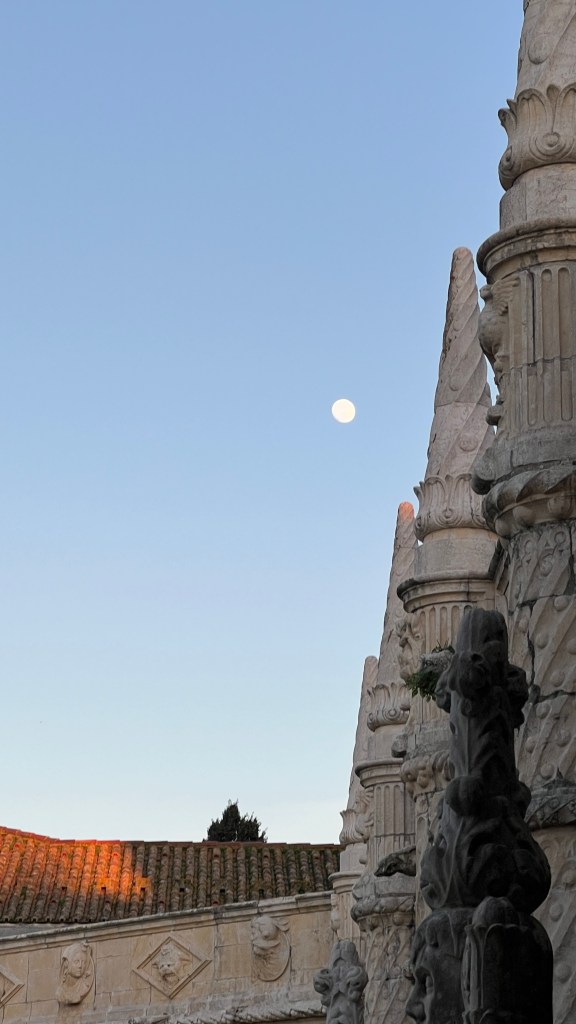
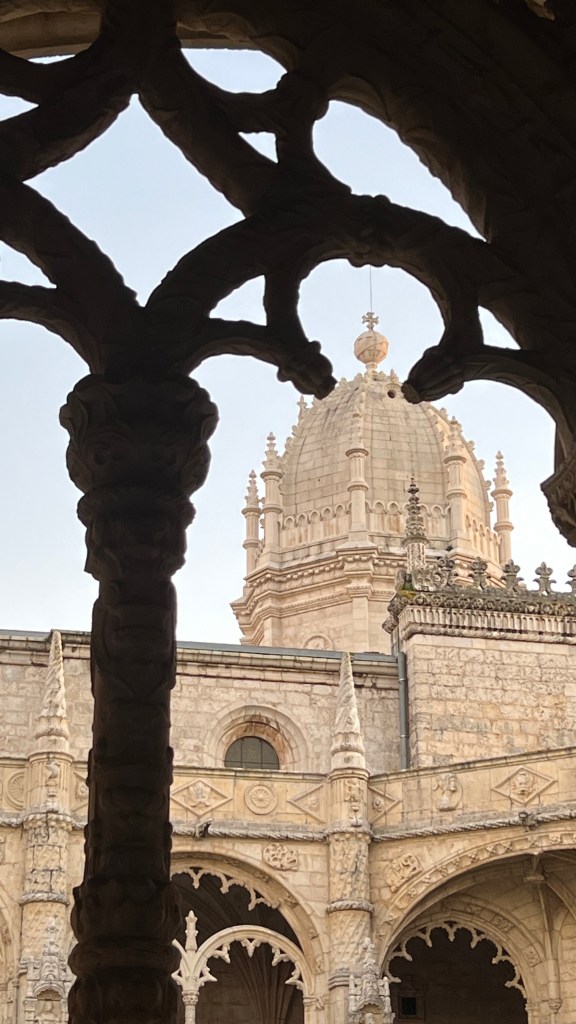
It was going to be a lot of walking and train time if it turned out to be closed again, but I made my way back to Belรฉm because I wanted to have a proper visit to St. Jerรณnimos Monastery. I was not disappointed.

As is the case with most of my train rides, I missed my stop. [insert eyeroll] Most trains have either a scrolling sign or announce the stops; Iโ€™m guessing the one on my train was out of service. I told myself when I got on, โ€˜Itโ€™s the third stop. Get off there.โ€™ But it did not look right, so I remained on the train andโ€ฆ yep. It was the right stop. Got off at the next made my way to the other side of the track to catch the returning train. After ten minutes of waiting and no sign, I stepped off the platform and said, โ€œTaxi!โ€ Four minutes and 6โ‚ฌ later I was deposited at the front door of the monastery. It was worth it.

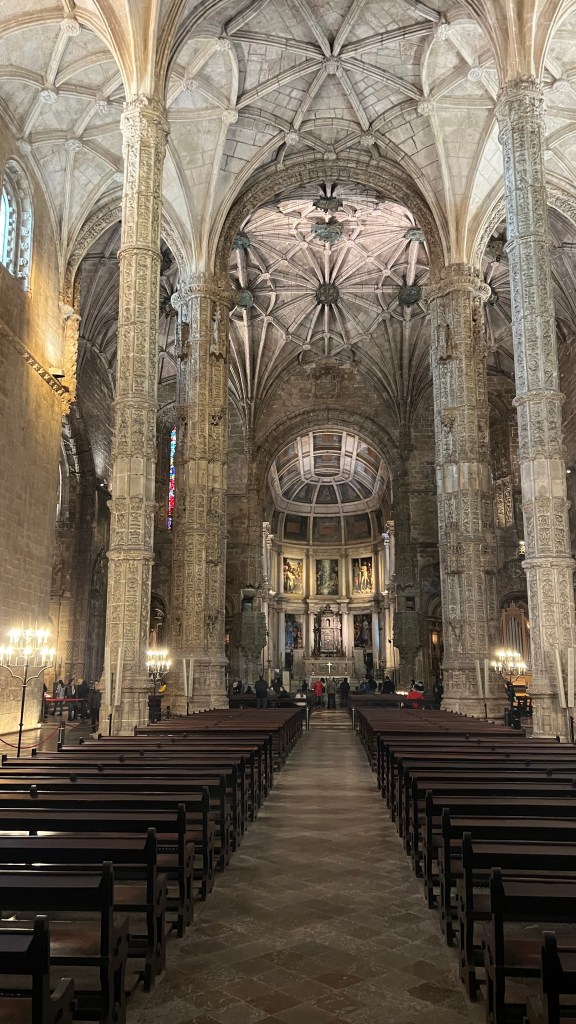
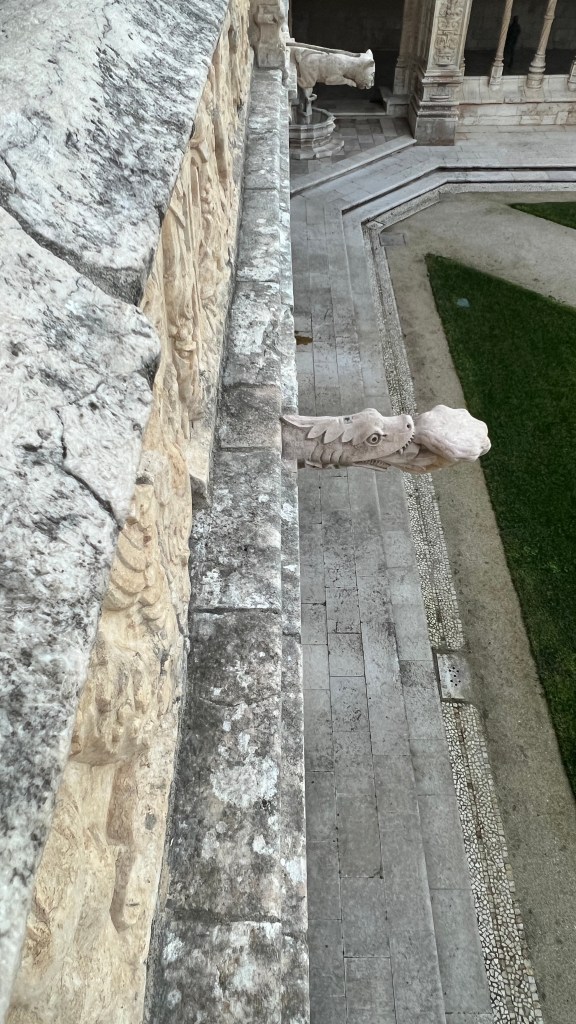
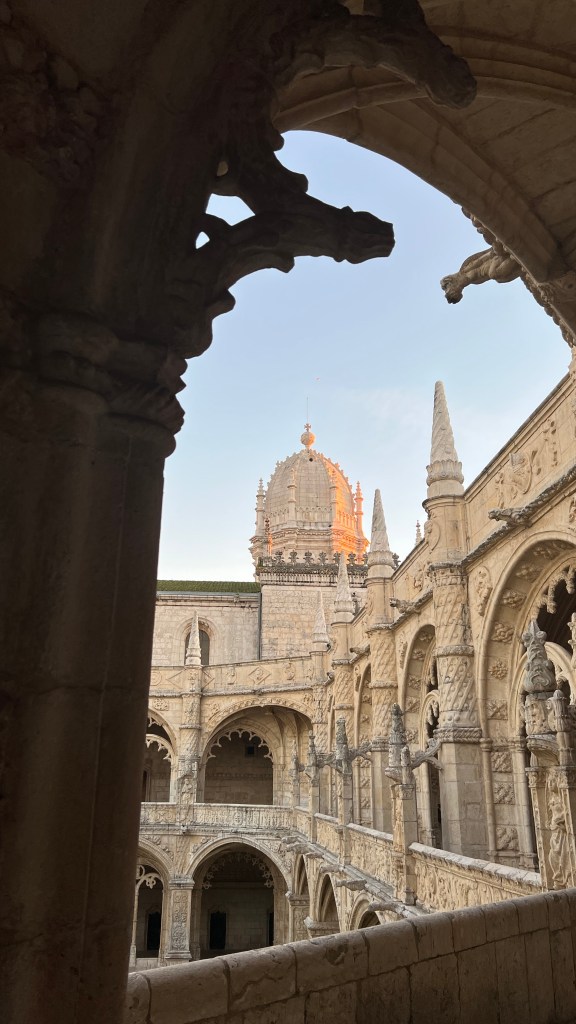
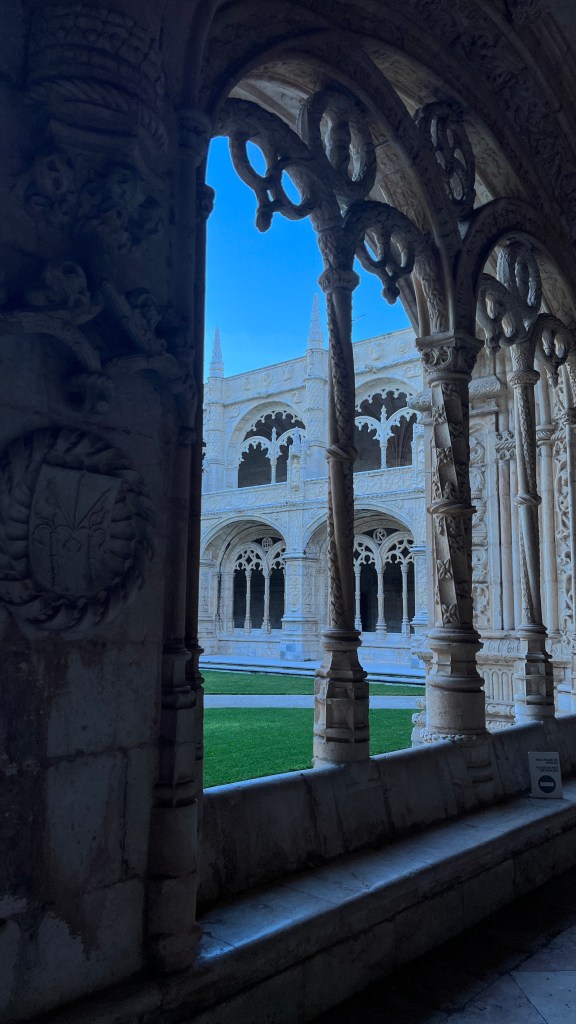
By the time I arrived, most of the other tourists were at supper. I didnโ€™t have it to myself, but when you can capture a photo like thisโ€ฆ

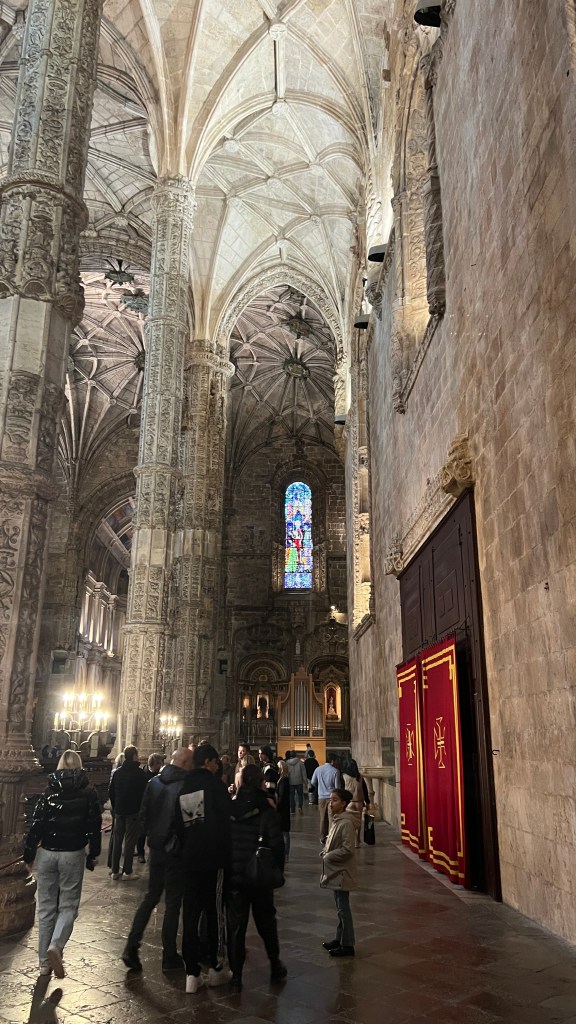
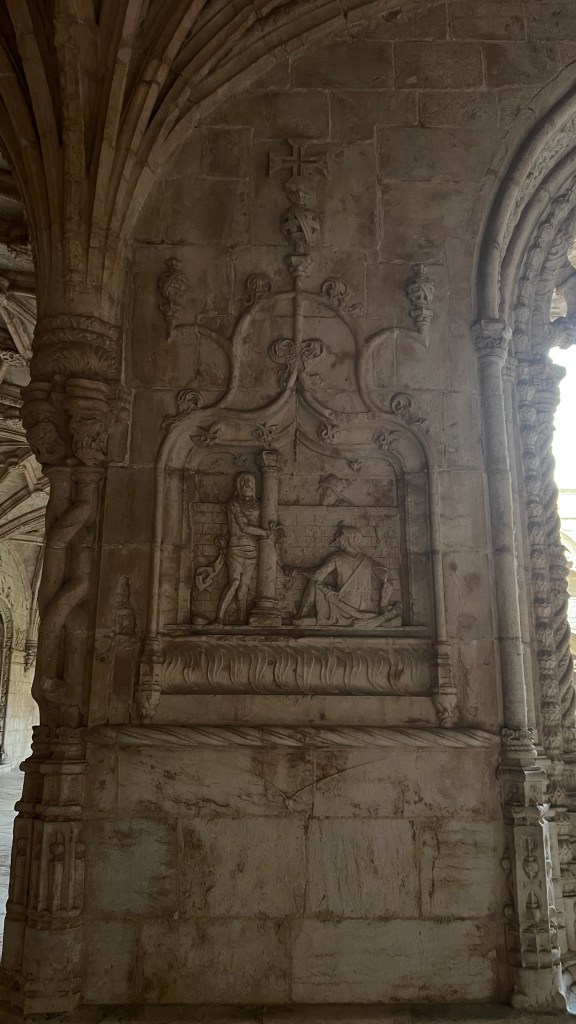
There are two self-guided tours: one through the church and another through the cloisters. I began with the church.

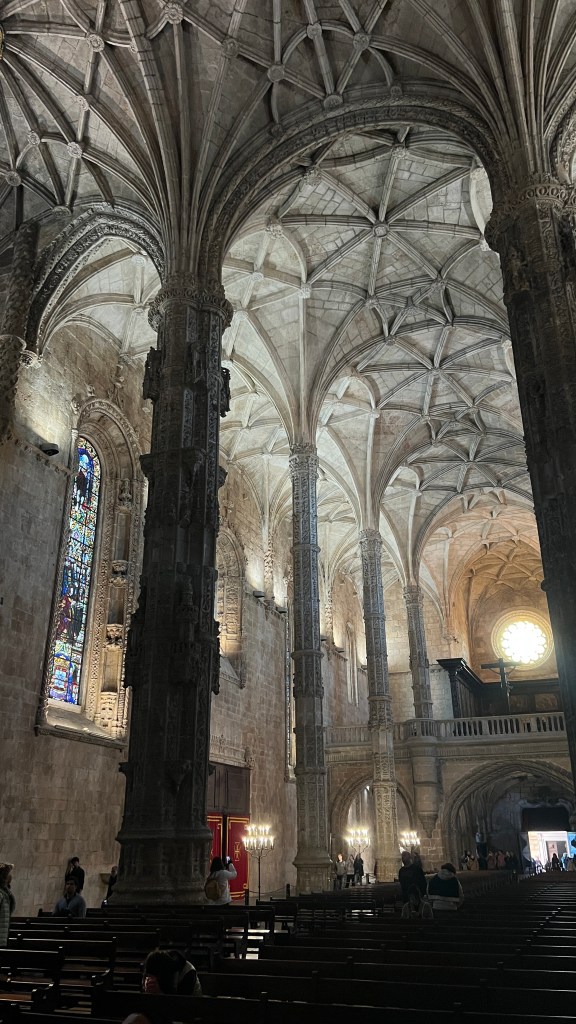
Construction began in 1502 and was one of the reasons why the church in Batalha was not completed: there is only so much stone and so many stonecutters. The king decided that after 129 years of construction at Batalha, they had had enough time to complete.

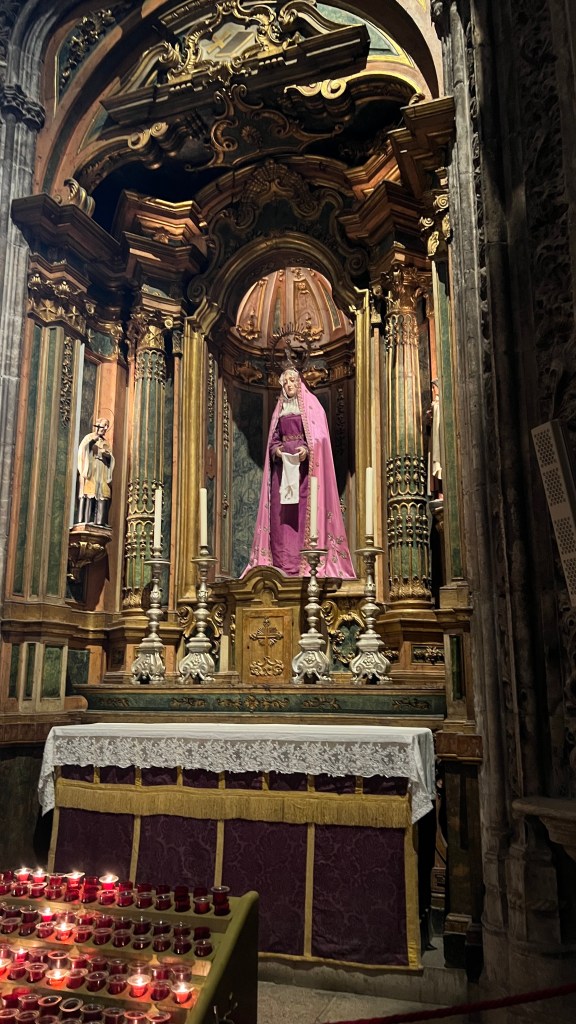
None of the churches are brightly lit, but this was by far the darkest, between fewer windows and electrical lights.

The last entry into the monastery side is 5:30 p.m., and I timed it perfectly.

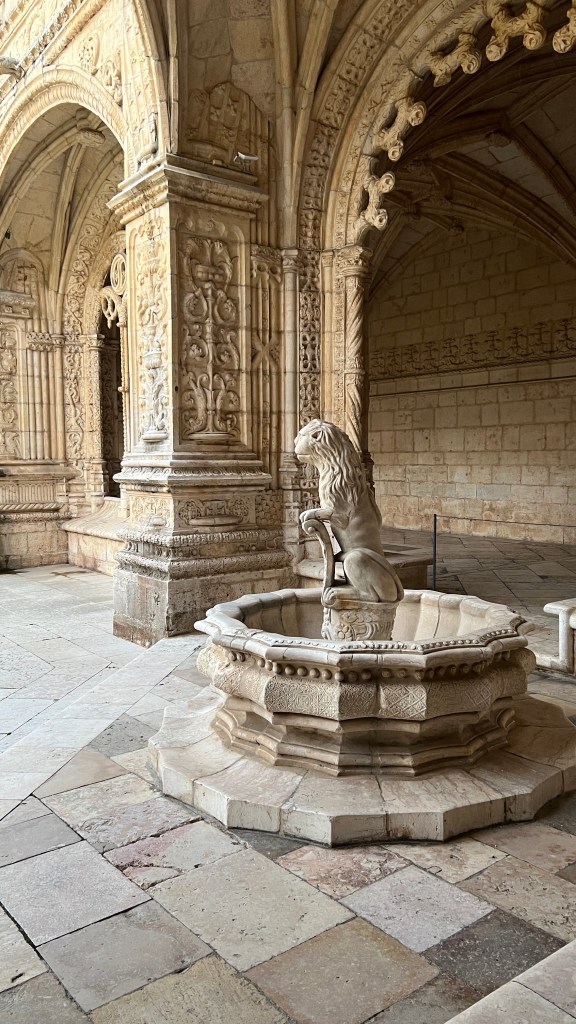
St. Jerome is most often pictured with a lion. This painting greets you at the top of the stairs leading to the second story, and the proud lion sits at the corner of the inner courtyard.

The Golden Legend saysโ€ฆ

One day toward evening, when he was seated with the brethren to hear the sacred lessons read, a lion suddenly limped into the monastery. The other monks fled at the sight of the beast, but Jerome greeted him as a guest. The lion showed him his wounded foot, and Jerome called the brothers and ordered them to wash the animalโ€™s feet and to dress the wound carefully. When they set about doing this, they found that the paw had been scratched and torn by thorns. They did what was necessary, and the lion recovered, lost all his wildness, and lived among the monks like a house pet.

I posted the legend elsewhere, and someone commented that the legend of the lion is based on Jeromeโ€™s temper which he had a difficult time containing. It is easy to see that in the story as well: his life of prayer, cloistered with the other monks, tamed his temper and his soul.

Today is my last day in Portugal and Iโ€™ve no plan. I still havenโ€™t ridden one of the trolleys, but with such long flights coming up tomorrow, Iโ€™m not too interested in spending the day sitting. Maybe Iโ€™ll just walk out the door and see where my feet take me.

I forgot to make a New Yearโ€™s resolution. I think it will be to travel at every opportunity I can.