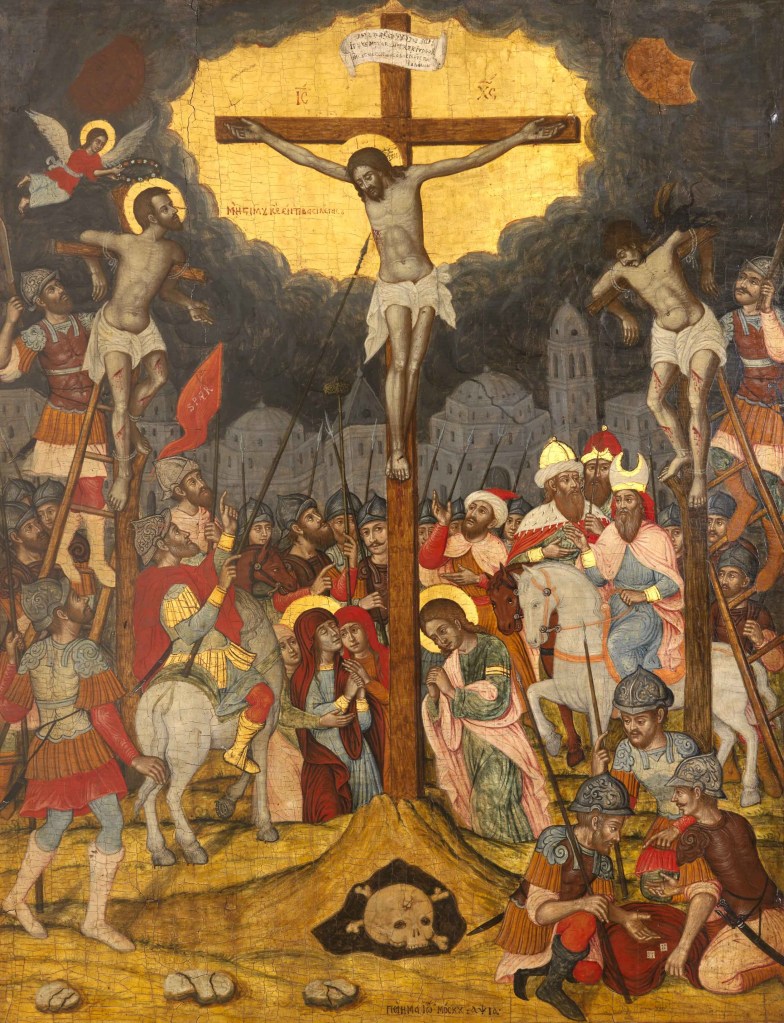
Pilate said to the Jews, “Here is your King!” They cried out, “Away with him! Away with him! Crucify him!” Pilate asked them, “Shall I crucify your King?” The chief priests answered, “We have no king but the emperor.” So the soldiers took him to be crucified. It took Jesus six hours to die; then he breathed his last.
All this time, the people were gathered around or passing by. Yes, there were a few followers, but mostly, it was the soldiers, the religious leaders, and those who had called out, “Crucify him!” Thomas à Kempis describes this mass of unbelievers:
“Like mad dogs they huddled together to attack your innocence. With their mouths they barked like dogs, they gnashed their teeth like lions, and with their tongues they hissed like snakes. They cursed with their lips and their faces they turned into sneers; they clapped with their hands, their feet danced, and their hearts rejoiced, all because they saw you nailed to a Cross—one whom they did not want to see die without first being mocked and jeered. Those who passed by shook their heads like crazed, drunken men, and filled with bitterness, arrogance, and ill will, they shouted: Ah, there’s the man who destroys God’s Temple and rebuilds it in three days.” (On the Passion of Christ: According to the Four Evangelists, p. 91)
Creation itself shuddered and wept at the crucifixion of Our Lord, but those gathered around gawked, laughed, insulted, cheered. All creation wept, but those passing by may have given a quick glance, but they didn’t linger, too afraid to be caught up in these upheavals. All creation wept, but his clothes they gambled for were worth more than his life. All creation wept, but for a few still gathered at his feet—who listened for one last word, who desired one last touch, who refused to let go, even when all appeared lost and without hope.
On that day, two very distinct groups gathered around the cross. Today, those same two groups exist. Be a part of the smaller one—those listening and desiring a touch from the King of Heaven. Christ is upon the cross. Be one who is still hoping.
The deadline for completing the construction of a skyscraper was near, so the crews worked around the clock. The night crew was hard at work on the twenty-first floor when unknown to the others, one of the welders went over the edge.
Dropping everything, he flung his hands into the pitch-black and grabbed an edge. Hanging there, he yelled, screamed, and prayed that someone would come, but because of all the other construction noise, no one heard, and his grip began to slip.
He let out a scream and fell… three feet, and landed on the scaffolding that was below him. Scaffolding he had not been able to see in the dark.
There is a physical darkness, but we also know that there is a spiritual darkness, and it is this spiritual darkness Paul tells us we do battle against it. “Our struggle is not against enemies of blood and flesh, but against the rulers, against the authorities, against the cosmic powers of this present darkness, against the spiritual forces of evil in the heavenly places.” (Ephesians 6:12) Therefore, Jesus tells us, “The light (He is the way, the truth, and the light)… the light is with you for a little longer. Walk while you have the light, so that the darkness may not overtake you. If you walk in the darkness, you do not know where you are going. While you have the light, believe in the light, so that you may become children of light.” (John 12:35-36a) And it is through Jesus, as Paul teaches us again, that we “are all children of light and children of the day.” (1 Thessalonians 5:5a)
Our Gospel tells us, “When Jesus had dipped the piece of bread, he gave it to Judas son of Simon Iscariot. After he received the piece of bread, Satan entered into him. Jesus said to him, ‘Do quickly what you are going to do.’” (John 13:26b-27) Then, “after receiving the piece of bread, Judas immediately went out. And it was night.” (John 13:30) As he turned from Jesus and left, Judas entered the darkness, both physically and spiritually.
Later that evening, “Judas brought a detachment of soldiers together with police from the chief priests and the Pharisees, and they came there with lanterns and torches and weapons.” (John 18:3) “They came there with lanterns and torches”—they came there in the dark and carried out the works of darkness, the works of the “spiritual forces of evil.”
For Judas, there was a threshold, both literally and spiritually, that he crossed when he went out. He intentionally stepped out of the light of the room where Jesus and the others were gathered—the Light of Christ—and, in a similar manner, he intentionally stepped into the spiritual darkness and was lost.
For Judas and for us, the threshold between the light and the dark is the place of testing. It is the place of free will, where we choose light or dark. The biggest mistake we can make is to think there can be a compromise. “I won’t go so far into the night that I can’t see the threshold leading back into the light.” That’s like a woman saying she’s only a little bit pregnant. There is not a little bit of darkness. We either walk in the dark or we walk in the light. Therefore, walk in the light and believe in the light so that you may remain children of light. This is God’s plan for us; through the guidance and strength of his Holy Spirit, we can be obedient.
Most of you are aware that not only do I enjoy reading a good story, but I also like trying to write them. Like with any endeavor, it can be helpful to read how others work, and fortunately, some of my favorite authors have written books on writing. Neil Gaiman, author of Caroline, Good Omens, and other books, in the introduction to his book, Fragile Things: Short Fictions and Wonders, Gaiman talks about stories. He writes,
“Stories, like people and butterflies and songbirds’ eggs and human hearts and dreams, are also fragile things, made up of nothing stronger or more lasting than twenty-six letters and a handful of punctuation marks. Or they are words on the air, composed of sounds and ideas—abstract, invisible, gone once they’ve been spoken—and what could be more frail than that? But some stories, small, simple ones about setting out on adventures or people doing wonders, tales of miracles and monsters, have outlasted all the people who told them, and some of them have outlasted the lands in which they were created.”
Stories, whether fictitious or factual, hold our attention and mold our perception of the world. Whether a believer or not, the story we hear on this day has long outlasted the people who told it and has been changing peoples’ views for over 2,000 years. No other story has affected the world more. My question for you today is this: What kind of story is it?
Most of us can agree that it is non-fiction, but even in that category, we can classify it as a particular genre. Some might say it is history, while others might categorize it as a thriller or even a horror story. There are good arguments for all these, but the one category that probably would not come to mind when reading the Passion Narrative is romance.
In their definition of a romance novel, the RWA, Romance Writers of America, says, “Two basic elements comprise every romance novel: a central love story and an emotionally satisfying and optimistic ending.” (Source) In the reading of the Passion Narrative, do you hear anything of a love story? Is there an optimistic ending?
“For God so loved the world that he gave his one and only Son, that whoever believes in him shall not perish but have eternal life.” (John 3:16)
What we read on this day is the greatest romance, the greatest love story ever written—ever lived out. What we read today is Jesus looking down at you from the Cross and saying, “I love you. I love you and am enduring this so that you may be with me in My Father’s house for all eternity.” The Passion of Our Lord is many things, but at the heart, it is pure romance.
Today, I invite you to experience this romance, this love of God. To not only hear the story but to write yourself into it and become a child of God—the beloved of God.
Joseph learned that Mary was pregnant, and since they were not yet married, he decided to put her away quietly, but the angel of the Lord came to him in a dream: “‘Joseph, son of David, do not be afraid to take Mary as your wife, for the child conceived in her is from the Holy Spirit. She will bear a son, and you are to name him Jesus, for he will save his people from their sins.’… When Joseph awoke from sleep, he did as the angel of the Lord commanded him; he took her as his wife.”
From here, we have a few other accounts of Joseph: the manger, when Jesus was presented in the temple as a baby, the flight to Egypt when they were fleeing Herod, and our scene today when Jesus became separated from him and Mary during the festival in Jerusalem. Outside of these events, we know very little of Joseph, the one who was called on by God the Father to raise his one and only son. If you think your kids got/get into mischief, what do you think it would have been like raising the Son of God?
We’ve talked about the “Infancy Gospels” before. These are writings outside the canon of Scripture, which – although fun to read – are not considered God inspired, and many are classified heretical, one of which is the Gospel of Pseudo-Matthew. It is not the Bible, but it is fun, and the stories tell of Jesus as a boy. Here’s a taste:
“On the first of the week, when Jesus was playing with the children on the roof of a certain house, it happened that one of the children pushed another down from the roof to the ground, and he was killed. And the parents of the dead boy, who had not seen this, cried out against Joseph and Mary, saying: Your son has thrown our son down to the ground, and he is dead. But Jesus was silent, and answered them nothing. And Joseph and Mary came in haste to Jesus; and His mother asked Him, saying: My lord, tell me if thou didst throw him down. And immediately Jesus went down from the roof to the ground, and called the boy by his name, Zeno. And he answered Him: My lord. And Jesus said to him: Was it I that threw thee down from the roof to the ground? And he said: No, my lord. And the parents of the boy who had been dead wondered, and honoured Jesus for the miracle that had been wrought.”
The boy falls off the roof and dies, so in order to defend himself, Jesus raises the boy from the dead and asks him for the truth. True or false? I don’t know (the church would have me tell you, “No.”) Regardless, can you imagine what it must have been like to raise Jesus? However, as God the Father knew who to select as his mother, God the Father also knew the perfect man to choose as his earthly father: a humble carpenter named Joseph.
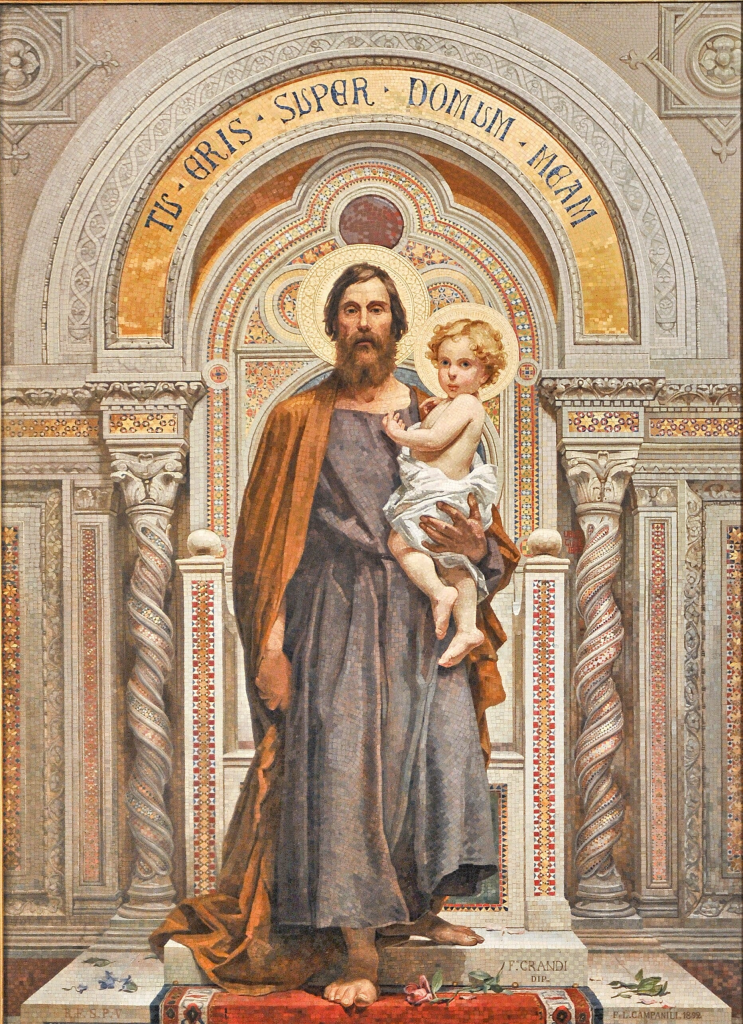
In the shadow of Jesus, Mary, the disciples, and the others, Joseph is almost forgotten by us, but as the head of the Holy Family, his role is significant.
St. Bernard of Clairvaux writes: “St. Joseph was chosen among all men, to be the protector and guardian of the Virgin Mother of God; the defender and foster-father of the Infant-God, and the only co-operator upon earth, the one confidant of the secret of God in the work of the redemption of mankind.”
There is no doubt that Jesus called Joseph his father. Therefore, there is no reason why we shouldn’t call on him as well. He responds in faith and protects not only the Son of God and Mother of God but also us, for we, too, are the sons and daughters of God.
In a conversation with C.S. Lewis, J.R.R. Tolkien said, “We have come from God, and inevitably the myths woven by us, though they contain error, will also reflect a splintered fragment of the true light, the eternal truth that is with God.” Within our legends and myths, there is a certain amount of truth. The same is true with what I would like to share today—a combination of facts, myths, and legends, and it all begins in the year 43 B.C. We can read about it in the Acts of the Apostles.
“Herod the king laid violent hands on some who belonged to the church. He killed James the brother of John with the sword, and when he saw that it pleased the Jews, he proceeded to arrest Peter also.” (Acts 12:1-3a) The Apostle James, brother of John and son of Zebedee, was martyred by beheading. It is from there that our legend begins.
Following his death, his followers, wanting to provide a proper burial for him but also wanting his body to be kept safe, took it to the coast, where they boarded a stone boat. The boat had no rudder or sail but was guided by an angel, which took it on a long journey across the Mediterranean, through the Strait of Gibraltar, and up to the northwest corner of Spain.
At this same time, a father was throwing a huge wedding party for his son. There was food, drinks, dancing, and games. One of the games played was abofardar—the men, riding horses, would take a spear and hurl it into the air as high and far as they could, then, charging forward, they would attempt to catch the spear before it hit the ground—very safe. The groom’s turn came, and he gave the spear a mighty throw. However, he was so focused on the spear that he paid little attention to where his horse was going, and he plummeted into the sea and disappeared. There was high tension as the crowd watched and waited for him to surface. Finally, he did. A way out from shore, the groom and horse popped up. Fortunately for them, there was a boat directly beside them. It was the stone boat carrying the body of the Apostle James.
After rescuing the groom and the horse, it was discovered that they were both covered in scallop shells. The followers of James on the boat saw this as a miracle, so the scallop shell became a symbol of all who were saved by coming to St. James.
Following these events, the body of St. James was secretly buried and essentially lost for almost 800 years until a hermit, Pelayo, noticed strange lights in the sky. Following the lights, Pelayo came to a field where he discovered the hidden tomb. He informed his Bishop, who, with several others, went to investigate and were able to determine that it was, in fact, the remains of the Apostle. A church was built over the tomb, and later a cathedral. The city that grew up around it that supported the pilgrims who came to venerate the saint was named Santiago de Compostella. Santiago is translated as St. James, and Compostella means “field of lights.” For the last 1,200 years, saints and sinners, lay people and clerics, rich and poor, popes and kings, have made the pilgrimage to pray before the remains of St. James the Great—one who was so very close and dear to Jesus.
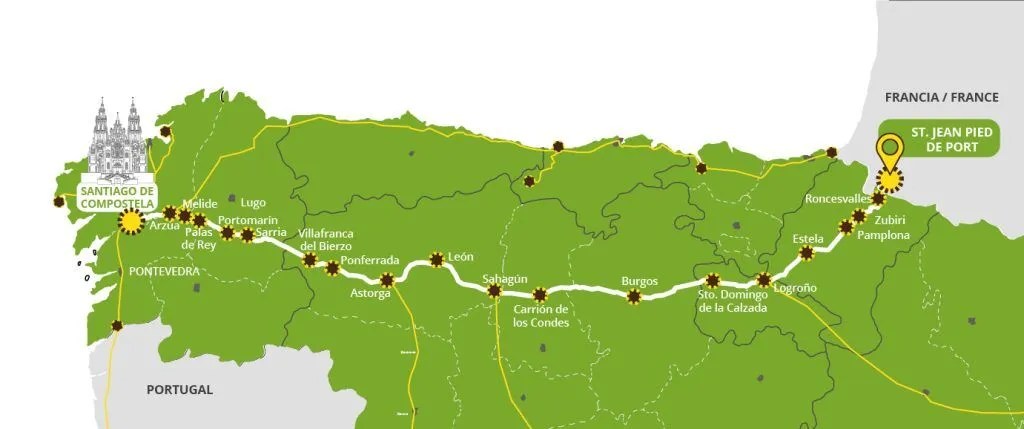
The pilgrimage is called the Camino de Santiago, the Way of St. James, and the starting point for many is Saint-Jean-Pied-de-Port, which means St. John at the Foot of the Pass—the pass is the one that takes you over the Pyrenees Mountains, from France into Spain. On April 10th of this year, I will rename this town Jean-Pied-de-Port—John at the Foot of the Pass (unless, of course, I’m sainted in the next month, then I’ll keep it the same.) The French Way, the route I will be taking, is the most popular and the one pilgrims have walked for 1,200 years.
I’ll take more time and make more stops, but there are traditionally 31 stops along the way, and early on, pilgrims would make the journey there and back, so with the Cathedral counting as their destination, you would have 63 stops. As they did not have the benefit of GPS and a well-marked trail, early pilgrims relied on various maps, one of which was created by the Templars. That early map has evolved into a game still played today (and one our kids will have the opportunity to play while I’m away)—The Royal Game of the Goose. Thus enter Albert the Goose. Why a goose?
It was the Templars who were charged with protecting pilgrims as they made the pilgrimage, and so it was the Templars who made the original map. Looking at our game board, you will see many of the squares have symbols in them. The meaning of most of the symbols is lost. Still, the labyrinth could represent physical and spiritual growth, a well might represent a lousy day, and a bridge—although it may be a specific bridge—can also represent a spiritual crossing. And then there is the goose. For the Templars, the goose represented wisdom, and throughout the Camino, if you keep your eyes open, you will see a goose carved in the base of a statue or a distinctive goose track in various locations. There are also towns with “Goose” in their names: Villafranca de Montes de Oca, Castrojeriz (city of geese), El Ganso, Ocón, Puerto de Oca, Manjarín (man of geese). (Source) While I’m away, Albert will also be traveling, and you may find him at your front door looking for a place to rest.
In the very early days of the Camino, there were tens of thousands of pilgrims, but the numbers waned due to wars and other issues. Eventually, it nearly fell out of use, and in 1979, only twelve people completed the walk. However, popularity has increased dramatically. Last year, which was considered a holy year, over 442,000 individuals walked a Camino.
To officially walk a Camino, you must walk at least 100km (62 miles). From St-Jean, where I’ll start, it is 800km (500 miles), and last year, of the 442,000, about 23,000 made that distance. For each, regardless of the distance, the shell—like the one attached to the groom and his horse—has become the symbol of the Camino de Santiago. It is what designates a pilgrim—they attach one to their pack or hat—and it is what marks The Way, with signposts, wayfaring markers, and various marks in the road.
Finally, the Camino de Santiago is a physical exercise—putting one foot in front of the other for 500 miles—but more than that, it is a spiritual exercise. It is a journey of the soul. It is a way of letting go of all except the most necessary and, hopefully, along The Way, discovering that all you truly need is God and a few items you can carry on your back. As I walk, I hope to declutter my mind and my soul, and just as I might leave some gear that I don’t use along the way, I hope to leave the clutter and discover that life is far simpler than we make it.
I will be on the Camino for 60 days, and I’ll be out for fourteen weeks. I will be very out of touch, but I will pray for you every day. As I’ve told several people, St. Matthew’s was around for 125 years before I got here, so I know you’ll be just fine and in very capable hands. I encourage you to participate in the events and activities that have been planned. In the process, you might just discover the spirit of the Camino and find The Way opening up before you.
Let us pray (this is the traditional pilgrim’s prayer that was written in the 12th century):
O God, who brought your servant Abraham out of the land of the Chaldeans, protecting him in his wanderings, who guided the Hebrew people across the desert, we ask that you watch over us, your servants, as we walk in the love of your name.
Be for us our companion on the walk, Our guide at the crossroads, Our breath in our weariness, Our protection in danger, Our refuge on the Camino, Our shade in the heat, Our light in the darkness, Our consolation in our discouragements, And our strength in our intentions.
So that with your guidance we may arrive safe and sound at the end of the Road and enriched with grace and virtue we return safely to our homes filled with joy. In the name of Jesus Christ our Lord, Amen.
St. James the Greater, pray for us. Holy Mary, Mother of God, pray for us.
A few years back, The Netherlandish Proverbs, a painting by Pieter Brueghel, sold for $9M at Christie’s Auction House in London. Painted in 1559, it depicts seventy-six proverbs, many of which we still say today, or at least a version. A man with his hand over his face, peering through his fingers, is “To look through one’s fingers” or to turn a blind eye. Another, “When the gate is open, the pigs run through the wheat,” is for us; when the cat is away, the mice will play. Some are far more obscure, and one of these caught my attention.
A woman is carrying a bucket of water in her left hand and a set of tongs with a hot coal in the other. The proverb: “She carries fire in one hand and water in the other” means to be two-faced and stir up trouble. It also means to hold two contradictory views. That is not a good thing, and it is a claim that many make about Holy Scripture. It was that issue that I was confronted with this week as I read through the last two verses of our Gospel lesson—“Do not be astonished at this; for the hour is coming when all who are in their graves will hear his voice and will come out—those who have done good, to the resurrection of life, and those who have done evil, to the resurrection of condemnation.” (John 5:28-29) What is the problem?
The last word, “condemnation,” immediately brought to mind our Gospel reading from Sunday. It begins with that most famous of verses, John 3:16, “For God so loved the world that he gave his only Son, so that everyone who believes in him may not perish but may have eternal life.” So far, so good. Jesus continued, “Indeed, God did not send the Son into the world to condemn the world, but in order that the world might be saved through him.” Even more good news, good news that St. Paul will confirm in his letter to the Romans when he writes, “There is therefore now no condemnation for those who are in Christ Jesus.” (Romans 8:1) Everything is coming up roses until you arrive at those verses from today, how some will experience the “resurrection of condemnation.”
I thought Jesus said we were past all that condemnation bit. Is this a contradiction in Holy Scripture? Not at all. It only requires that we read the passage from John 5 more closely. It is easy to miss, but before speaking of condemnation, Jesus said, “The hour is coming.” Coming. Not yet. John 3 is speaking of Jesus’ first coming. John 5 is speaking of Jesus’ second coming. No contradiction.
We are now living in the time when “everyone who believes in [Jesus] may not perish but have eternal life.” However, there is an end date—a time when judgment will come, and for those who do not believe, it is a judgment of condemnation; therefore, the time to choose is not then but now.
In the first verse of our reading from Isaiah, the Lord said, “In a favorable time I listened to you, and in a day of salvation I have helped you.” St. Paul quotes this verse in his second letter to the Corinthians: “In a favorable time I listened to you, and in a day of salvation I have helped you.” Then Paul adds, “Behold, now is the favorable time; behold, now is the day of salvation.”
There is no confusion or contradiction; now is the time to come to God. Now is the day. For all of you sitting here, I believe you have, but who do you know that has not? How might you guide them and share your faith with them so that on the last day, they too will be judged and receive the resurrection of life—life eternal with our God?
I’m a firm believer in Israel’s right to defend. If what happened to them happened to us, we would have dusted off the nukes. I know that we will send billions to help rebuild when it is over. I know that this is not the only aid that will be sent. I know… I know… I know… but…
The tug boat is towing a barge of food to Gaza, which I also firmly believe we should be doing. However, I could only imagine those on the Virgin cruise looking down on it and thinking, “Aren’t we good people for helping out.”
I can’t help but think that this is how we support the world when we could do so much more. We live in The Hunger Games, and we are The Capitol.
This from the hypocrite who is going to Spain to take a walk.
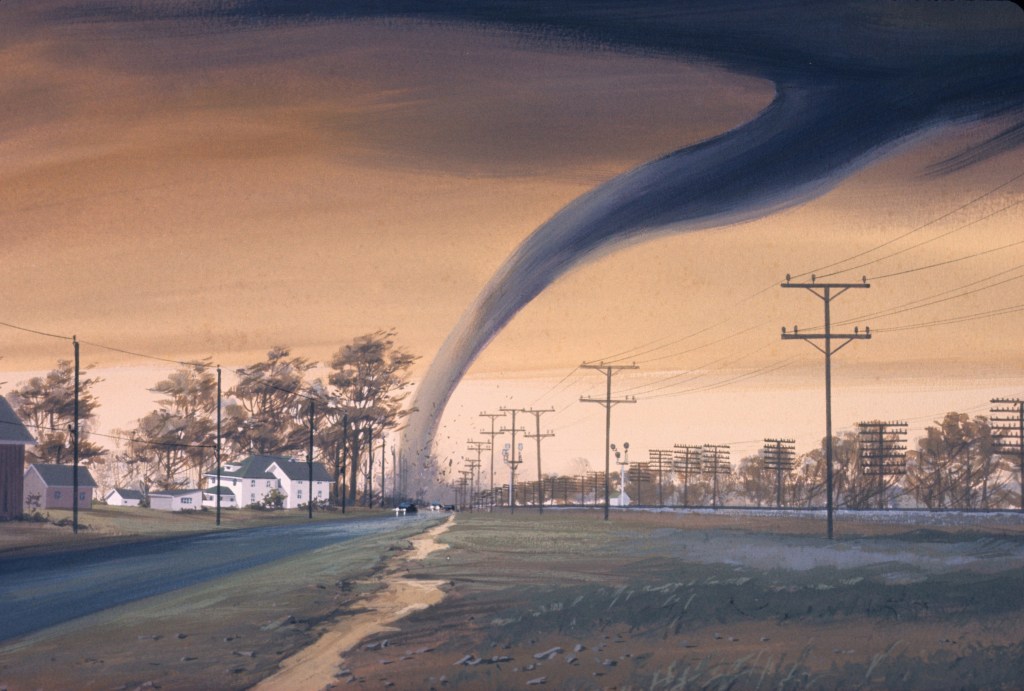
The wind was sucking on Dan’s shirt tails as he dove into the tornado shelter. Quickly, he slammed the door shut and spun the wheel to lock it in place.
Climbing down the ladder, he fumbled for the light switch. Nothing. He had forgotten to charge the batteries.
“Won’t be but a few minutes,” he said to the pitch and settled in, his back against the wall.
He listened, but it wasn’t the sound of the storm that caught his attention. Instead, it was a slurping squelch as something else moved in the dark.
Cautiously, he felt around until his hand fell upon a short metal pipe. He waited. Moments later, something grabbed him, and Dan started beating away with the pipe. He quit when he felt the skull of the intruder give way under a heavy blow.
“Damn zombies,” he said and went back to listening to the storm.
Ol’ Boudreaux had been out carousing all night, so he decided it might be best to go to confession before going home to Clotile. It had been many years since his last confession, so he was a bit surprised when he stepped into the confessional. On one wall was a fully stocked bar with Guinness on tap. A dazzling array of the finest cigars and chocolates was on the other wall. Boudreaux here’s the priest come in on the other side and says, “Father, forgive me, for it’s been a very long time since I’ve been to confession, but I must admit that the confessional box is much more inviting than it used to be.”
The priest responds, “Get out! You’re on my side.”
The Israelites had been set free from their bondage in Egypt, and they passed through the parted waters of the Red Sea, but through their sin, they ended up wandering around for forty years. At one point, they came to Mount Hor, about forty miles south of the Dead Sea. As it was difficult in the land, they again complained against the Lord, so the Lord sent the serpents to punish them. Many died from being bitten by the poisonous snakes. When the people came to their senses, they confessed to Moses—“We have sinned by speaking against the Lord and against you; pray to the Lord to take away the serpents from us.” The Lord heard their cries for mercy, so He said to Moses, “‘Make a poisonous serpent, and set it on a pole; and everyone who is bitten shall look at it and live.’” So Moses made a serpent of bronze, and put it upon a pole; and whenever a serpent bit someone, that person would look at the serpent of bronze and live.” They named the bronze snake Nehushtan, and later in Israel’s history, they’ll turn it into a god and worship it, but that’s for another day. In today’s lesson, the people sinned, and death entered in the form of the serpents. When the people confessed their sins, the Lord provided a way for them to live—look upon the serpent that has been raised up, and you will live.
In our Gospel reading this morning, Jesus said, “Just as Moses lifted up the serpent in the wilderness, so must the Son of Man be lifted up, that whoever believes in him may have eternal life.”
In the time of Moses, the people sinned, and death came upon them. So they confessed their sin, and if they looked up at the bronze snake, they would live.
Today, we know that “all have sinned and fall short of the glory of God” (Romans 3:23) and that “the wages of sin is death.” (Romans 6:23) However, we also know that “If we confess our sins, [God] is faithful and just to forgive us our sins and to cleanse us from all unrighteousness.” (1 John 1:9) In confessing and repenting, we are not looking up at a bronze snake, but within our souls, we are looking up to our crucified Lord, and by doing so, by believing in the sacrifice He made on our behalf, we have eternal life.
Within the teachings of the Old Testament and the New, we know that there is sin and death, as well as forgiveness and life. However, between those two paths lies confession.
There is the general/private confession we make almost every time we gather, and there is auricular confession. Auricular relates to the ear, meaning to be heard, so it is our confession to a priest.
Is the general/private confession just as good as auricular confession? Yes, in that forgiveness of sin is assured. No, in that sometimes, you need to confront and speak a sin—you need to make it real—not for God’s sake, but for yours, so that, as we say in The Exhortation, “you may receive the benefit of absolution, and spiritual counsel and advice; to the removal of scruple and doubt, the assurance of pardon, and the strengthening of your faith.” And there’s one more reason to speak your sins to another that the Prayer Book will not mention—it is humbling, and there are times when we need to be humbled. It is not a pleasant experience, far from it, but it is a cleansing one.
Think of what Jesus said, “All who do evil hate the light and do not come to the light, so that their deeds may not be exposed. But those who do what is true come to the light, so that it may be clearly seen that their deeds have been done in God.” The confession of sin is the hauling out into the light those things we would prefer to keep hidden. It is the recognition that as much as we would like to think otherwise, we are not always good little boys and girls. In my heart, I can speak to God about my unrighteousness, and God says, “Yeah, I know.” However, when I speak to the image of Christ in another person, when I make my sin real, then I also genuinely know of my fallenness. No longer can I deceive myself into thinking that I’ve confessed when I come before another. In Life Together, Dietrich Bonhoeffer writes, “Our brother breaks the circle of self-deception. A man who confesses his sins in the presence of a brother knows that he is no longer alone with himself; he experiences the presence of God in the reality of the other person.” (p. 116) When we confess, we come into the light with all that is dark within us and allow God’s Light to reveal and cleanse us of that darkness.
I know that we always have fun when the topic of confession comes up, but I do believe in its ability to heal, so, all fun aside, I want you to know about it. Do I expect there to be a line on Wednesday for those of you seeking to make confession? Nope. But I do ask you to consider it, and if nothing else, the next time you make a general confession, don’t just say the words. Instead, bring the burden of your sins before God, and seek to make amendment of life, not just with words, but in actions as well. And then—and this is the other half and perhaps the more difficult aspect of confession—receive the absolution. Know in your soul, without hesitation or doubt, that you have been forgiven. You don’t have to carry the weight of your sins. As St. John tells us, “If we walk in the light, as he is in the light, we have fellowship with one another, and the blood of Jesus his Son cleanses us from all sin.” (1 John 1:7) Jesus was lifted up on the cross that you might receive forgiveness of sin. Receive that forgiveness and know that you have been made acceptable to God. From the Book of the Prophet Isaiah,
“Come now, let us reason together, says the Lord: though your sins are like scarlet, they shall be as white as snow; though they are red like crimson, they shall become like wool.”
(Isaiah 1:18)
Today, I’ll close with a portion of Psalm 32,
Blessed is the one whose transgression is forgiven, whose sin is covered. Blessed is the man against whom the Lord counts no iniquity, and in whose spirit there is no deceit. For when I kept silent, my bones wasted away through my groaning all day long. For day and night your hand was heavy upon me; my strength was dried up as by the heat of summer. I acknowledged my sin to you, and I did not cover my iniquity; I said, “I will confess my transgressions to the Lord,” and you forgave the iniquity of my sin. (Psalm 32:1-5)








 Candle in a Cave