Sermon: Lent 5 – Piercing the Side of Jesus


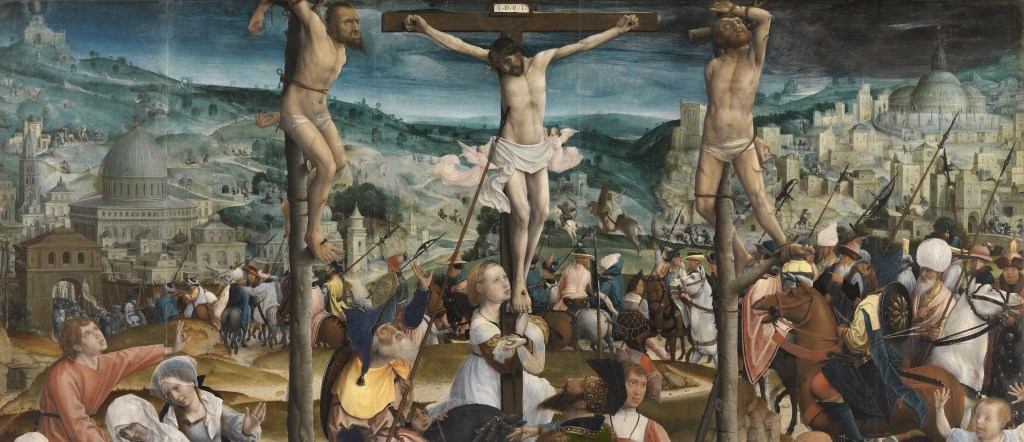
Jesus has spoken His final words, “It is finished” (John 19:30), and given up His spirit, yet the soldiers doubt He is dead. Anne Catherine Emmerich, in The Dolorous Passion of Our Lord Jesus Christ, picks up the story from there in chapter 48, “The Opening of the Side of Jesus.”

The executioners still appeared doubtful whether Jesus was really dead, and the brutality they had shown in breaking the legs of the thieves made the holy women tremble as to what outrage they might next perpetrate on the body of our Lord. But Cassius, the subaltern officer, a young man of about five-and-twenty, whose weak squinting eyes and nervous manner had often excited the derision of his companions, was suddenly illuminated by grace, and being quite overcome at the sight of the cruel conduct of the soldiers, and the deep sorrow of the holy women, determined to relieve their anxiety by proving beyond dispute that Jesus was really dead. The kindness of his heart prompted him, but unconsciously to himself he fulfilled a prophecy. He seized his lance and rode quickly up to the mound on which the Cross was planted, stopped just between the cross of the good thief and that of our Lord, and taking his lance in both hands, thrust it so completely into the right side of Jesus that the point went through the heart, and appeared on the left side. When Cassius drew his lance out of the wound a quantity of blood and water rushed from it, and flowed over his face and body.

The Prophet Ezekiel received a vision from God. In this vision, an angel of the Lord guided him, and Ezekiel saw the heavenly temple and the New Jerusalem, where God brought about the salvation of His people. He reports that the angel led him to “the temple, and behold, water was issuing from below the threshold of the temple toward the east (for the temple faced east). The water was flowing down from below the south end of the threshold of the temple, south of the altar. Then he brought me out by way of the north gate and led me around on the outside to the outer gate that faces toward the east; and behold, the water was trickling out on the south side.” (Ezekiel 47:1-2) However, if we refer back to the original Hebrew Scriptures, we discover that, while accurate, they do not state that the waters originated from the south side of the Temple. Instead, the Hebrew Scriptures indicate that they came from the “right side” of the Temple.

How should we understand the nature of the Temple that Ezekiel describes?   

Following the Triumphant Entry, Jesus went to the Temple in Jerusalem. Upon his arrival, He became enraged because, as He stated, “It is written, ‘My house shall be called a house of prayer,’ but you make it a den of robbers.” (Matthew 21:13) He then drove the moneychangers and others out with a whip. When asked by what authority he was doing these things, Jesus replied, “Destroy this temple, and in three days I will raise it up.” They responded, “It has taken forty-six years to build this temple, and will you raise it up in three days?” But he was speaking about the temple of his body. (John 2:19-21)

Ezekiel prophesied that water would flow from the right side of the Temple and the Temple was Jesus. Catherine spoke of this, and it is confirmed in Scripture: “One of the soldiers pierced his side with a spear, and at once there came out blood and water.” (John 19:34) 

What purpose does the water serve? Fifty years after Ezekiel, the Prophet Zechariah tells us, “On that day”—that is, the day the Lord intends to bring salvation to His People—“On that day there shall be a fountain opened for the house of David and the inhabitants of Jerusalem, to cleanse them from sin and uncleanness.” (Zechariah 13:1) 

The stream flowed from the right side of the Temple, and the Temple was Jesus. Water and blood flowed from Jesus’ right side after He was pierced with the spear, and this water and blood offered forgiveness of sins to all who would believe in Him. Jesus says, “If anyone thirsts, let him come to me and drink.” (John 7:37)

Today, it may seem that the stream from the side of Jesus is only available to us in a spiritual sense, but that’s not the case. Writing in the fourth century, St. Augustine tells us, “The Sacraments flowed out of the side of Christ.”

We who are touched by the waters of Baptism and who partake of the Lord’s body and blood in Holy Communion are the recipients of the same water and blood that flowed from the side of the crucified Lord and in the words of the Eucharistic Prayer, we receive “the innumerable benefits procured unto us by the same.” (BCP 335) That’s good stuff right there. You should say “Amen.”

When Jesus’ side was opened, and his most Sacred Heart pierced,  the very Gates of Heaven were opened. The blood and water, the River of Life, flowed out, creating a pathway for the healing of our souls and bodies.

Following the great tribulation in the Book of Revelation, John tells us, “The angel showed me the river of the water of life, bright as crystal, flowing from the throne of God and of the Lamb through the middle of the street of the” New Jerusalem. (Revelation 22:1-2)

On a scorching day in July 1864, weary from the heat, Robert Lowry, a Baptist minister, lay on a couch with no energy to do anything else. As he rested there, he meditated on this vision of the river of the water of life in John’s Revelation. The story goes, “While he was thus breathing heavily in the sultry atmosphere of that July day, his soul seemed to take new life from that celestial outlook. He began to wonder why the hymn-writers had said so much about “the river of death,” and so little about “the pure river of water of life, clear as crystal, proceeding out of the throne of God and of the Lamb.” (Source)

With this in mind, a hymn started to take shape in his mind. When the lyrics and music finally came together, he leaped up from the couch, sat down at his organ, and composed it in its entirety. You’ve likely heard it. The first stanza and refrain:

Shall we gather at the river,
where bright angel feet have trod,
with its crystal tide forever
flowing by the throne of God?

Refrain:
Yes, we’ll gather at the river,
the beautiful, the beautiful river;
gather with the saints at the river
that flows by the throne of God.

Through the sacraments, we participate in and receive the blood and water that flowed from Jesus’ pierced side. Therefore, with Robert Lowry, we can confidently say, “Yes, we will gather at the river, the beautiful, beautiful river.” 

Give thanks to the Lord our God, for He has literally opened Himself for you so that you may have access to Him.

Let us pray: Lord Jesus Christ, inexhaustible Fountain of love and grace, I bless and thank you for the ruthless piercing of your sacred side after you died.  It was then that you, holiest of all who are holy, were brutally struck on your right side by one of the soldiers holding a military lance.  It pierced so deeply that it entered the most tender part of your heart and from that wide-open wound there flowed a life-giving fountain of blood and water.  Would that the whole world had been sprinkled, it might then be saved!

O most devoted Jesus, you are the source of all our hearts’ secrets and you dwell in the hearts of those who love you!  O crucified Lord; you are the object of all contemplation!  O Divine Treasury of all gifts and graces, Christ the King and Redeemer of the faithful, you permitted your sacred side to be pierced by the head of a lance.  Open for me, I ask, the door of your mercy and permit me to enter through that wide opening in your side to the innermost recesses of your most sacred heart so that my heart may become powerfully inflamed and be united to you by the insoluble bond of love.  May I live in you and you in me and may we remain united forever.  Amen.

“Springhill” is now available on Audible


For those who prefer to listen to their books, Springhill is now available on Audible through Amazon.com. I used KDP’s virtual voice (AI) to create it. For the most part, it does a really good job. There are instances when the inflections are incorrect, and some training is required for unfamiliar words. For example, to pronounce Coushatta, I had to enter it as Kshatta. The total runtime is just over 3.5 hours, so it’s definitely not a long listen. A five-minute sample is available for those who have read the book and don’t wish to purchase it but want to hear the audio version.

Please be sure to leave a review on Amazon if you listen to or have already read it. Those definitely help!

Sermon: James Lloyd Breck


Several years ago, archaeologists began excavating in the courtyard of a medieval monastery and discovered seeds that had remained dormant for over 400 years. King Henry VIII closed the monastery in 1539, causing the herbs tended by the monks to perish, but the seeds sprouted to life again after the archaeologists disturbed the soil. For hundreds of years, the seeds lay there, and then, without warning—life.

A seed is planted in the ground; it may lie dormant for years, or the germination time might last several months, but something is happening below the surface. Like the seeds in the monastery, they may be surviving until a more opportune climate arises, or they might be developing an extensive root system for optimal growth. It is a mystery, but when God breathes life, the plant breaks through the surface of the ground and grows.

The ministry of Jesus was very much the same way. In the beginning, it just didn’t look like much was happening. Twelve bungling fellas, who, like the rest of the folks, didn’t “get it,” had to have private tutoring lessons after class. But just when that seed appears to grow, it gets splayed upon a cross and dies; then the stone is rolled away, and once again—life. 

Jesus said, “The kingdom of God is as if a man should scatter seed upon the ground, and should sleep and rise night and day, and the seed should sprout and grow he knows not how.” What is meant by saying that the man “sleeps and rises” is that after he scattered the seed, the man went about his day-to-day business. He had done all he could do. The sprouting and growing was the work of the Lord. The Lord would do what the farmer could not—give life. The same is true with the work of the Church. We seek to do the will of God. We till the soil, we remove the rocks, we set up the irrigation, we scatter the seed, but it is the Lord who will give life, and He will do it in His own time. Much of this work of the Lord is performed below the surface, out of sight. He instructs us not to make a big show of ourselves and to be humble, so it only stands to reason that He will act in a similar manner. We should never be fooled by the perceived lack of activity or the silence, because when you least expect it—what was hidden will come to life; therefore, just as the farmer in the parable was ready at once to harvest the crop, we also must be prepared for when the harvest comes in.

James Lloyd Breck, whom we celebrate today, was someone who planted many seeds. He planted the seed of Nashotah House, where I attended seminary. He also sowed the seeds for numerous other organizations and churches, which, to this day- over 150 years later- continue to yield fruitful crops. St. Matthew’s is 132 years old this year. If the Lord has not returned by then, I pray that the seeds we are planting will produce bountiful crops 132 years from now, just as the seeds that Breck planted continue to multiply.

Sermon: Lent 4 – The Nails in His Feet


On the first Sunday of Lent, I shared that the movie The Passion of the Christ was heavily inspired by the text we’ve been meditating on for the past three weeks—The Dolorous Passion of Our Lord Jesus Christ by Anne Catherine Emmerich. One of the scenes in the movie, which is not found in Scripture, originates from Chapter 39.

I apologize in advance for reading too much to you today.

In the movie, the cross lies on the ground while Jesus is nailed to it. A hole has been dug at the base of the cross to allow it to stand upright. Now, with ropes tied to it, the soldiers are lifting the cross so that it will settle into the hole. When the cross is finally vertical, it drops violently a few feet into the prepared hole.

In chapter 39, Catherine speaks of this sudden violent dropping, the sound of it, and the result.

The cross was “raised up in the midst of the vast concourse of persons who were assembled all around…. The air resounded with acclamations and derisive cries when they beheld it towering on high, and after vibrating for a moment in the air, fall with a heavy crash into the hole cut for it in the rock. … When the solemn sound of the fall of the cross into the hole prepared for it in the rock was heard, a dead silence ensued, every heart was filled with an undefinable feeling of awe—a feeling never before experienced, and for which no one could account, even to himself; all the inmates of hell shook with terror, and vented their rage by endeavouring to stimulate the enemies of Jesus to still greater fury and brutality; the souls in Limbo were filled with joy and hope, for the sound was to them a harbinger of happiness, the prelude to the appearance of their Deliverer. Thus was the blessed cross of our Lord planted for the first time on the earth; and well might it be compared to the tree of life in Paradise, for the wounds of Jesus were as sacred fountains, from which flowed four rivers destined both to purify the world from the curse of sin, and to give it fertility, so as to produce fruit unto salvation.

The eminence on which the cross was planted was about two feet higher than the surrounding parts; the feet of Jesus were sufficiently near the ground for his friends to be able to reach to kiss them.”

In the New Testament, the Simon we are most familiar with is Simon Peter; however, there is another Simon, Simon the Pharisee, who we hear about in Luke’s Gospel.

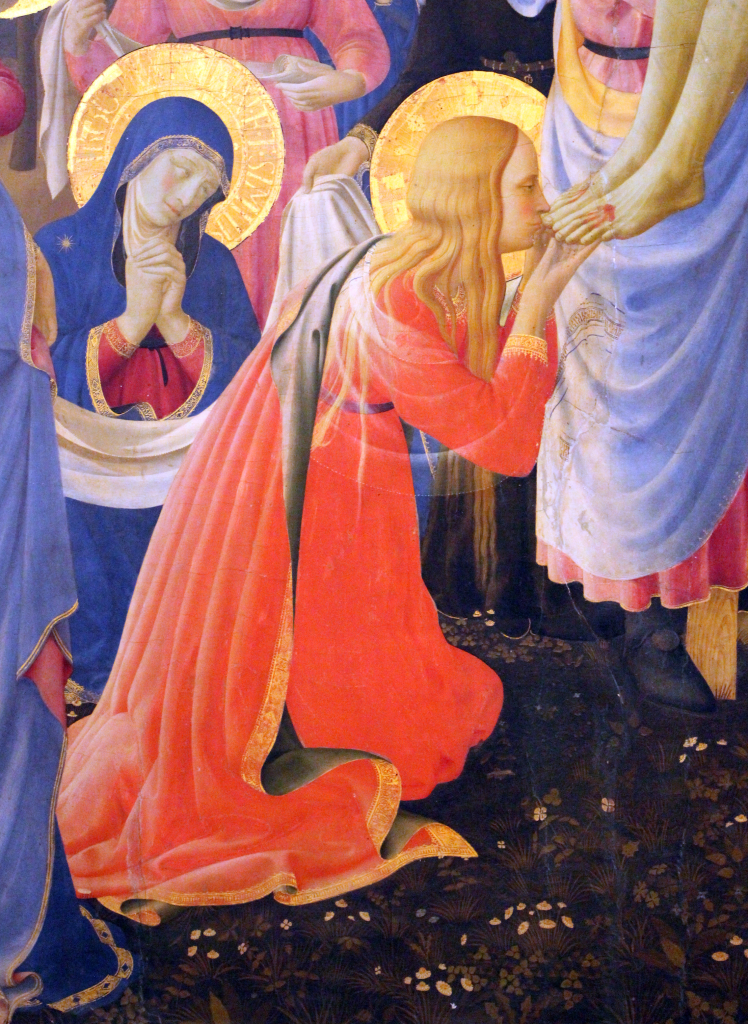
Simon invites Jesus to dinner. While there, “A woman in that town, who lived a sinful life, learned that Jesus was eating at the Pharisee’s house, so she came there with an alabaster jar of perfume. As she stood behind him at his feet, weeping, she began to wet his feet with her tears. Then she wiped them with her hair, kissed them, and poured perfume on them.”

Simon, aware of this woman’s reputation, believes that if Jesus truly is who he claims to be, He would recognize that this woman is wicked. Understanding Simon’s thoughts, Jesus then told a parable. 

“Two people owed money to a certain moneylender. One owed him five hundred denarii, and the other fifty. Neither of them had the money to pay him back, so he forgave the debts of both. Now which of them will love him more?”

Simon replied, “I suppose the one who had the bigger debt forgiven.”

Simon receives the gold star. Jesus then says, “Do you see this woman? I came into your house. You did not give me any water for my feet, but she wet my feet with her tears and wiped them with her hair. You did not give me a kiss, but this woman, from the time I entered, has not stopped kissing my feet. You did not put oil on my head, but she has poured perfume on my feet. Therefore, I tell you, her many sins have been forgiven—as her great love has shown. But whoever has been forgiven little loves little.”

To the woman, Jesus says, “Your sins are forgiven…. Your faith has saved you; go in peace.” (Luke 7:36-50)

Gathered around Jesus as He hung upon His Cross were soldiers, religious leaders, gawkers, and followers. However, Catherine tells us that others were present—demons who cheered on those committing these evil acts and souls in Limbo, witnessing the coming of their salvation. Heaven, Hell, and all of creation witnessed the King upon the Cross, which we can break down into their respective categories. However, in the end, there are really only two categories, and Jesus identified them earlier in His ministry. He stated, “Whoever is not with me is against me, and whoever does not gather with me scatters.” (Matthew 12:30)

Gathered around the Cross were those who were either with Jesus or against Him. Present were those whose sins were forgiven and those who stood condemned. There is no gray area. Those who were forgiven, out of the deepest gratitude and adoration, came forward and, like the woman in Simon’s house, kissed the feet of Jesus. Like the Prodigal Son, they were the ones who knew they had been lost but also understood that they had been found, forgiven, and would be received into the Kingdom of God as sons and daughters. 

What is particularly interesting is the fact that in the past 2,000 years, nothing has changed. There is our crucified Savior upon His Cross, and gathered around Him are Heaven, Hell, and all Creation. As before, we can categorize them into their respective groups—white/black, Republican/Democrat, male/female, rich/poor, Asian/European, etc., etc., etc. However, as before, there are only two categories—those who are with Jesus or those who are against Him. Sons and daughters of God Most High or condemned. Some will time and time again nail Jesus’ feet to the cross, while others will, out of the deepest sense of gratitude and adoration, come forward and kiss His bloodied feet. There are those who will hear Jesus say, “I never knew you; depart from me” (Matthew 7:21), and there are those who will hear Jesus say, “Your sins are forgiven…. Your faith has saved you” (Luke 7:50).

Have faith. Within your soul, come and kneel before the Cross of Jesus, and kiss the nail-pierced feet. He is the only One who can forgive and save, and He endured all of this for you. He is waiting for you.

Let us pray… Lord Jesus Christ, author of our salvation and most gracious Dispenser of pardon, and most patient in tolerating man’s wickedness, I bless and thank you for the great pain, the many stripes, and the bloody wounds inflicted on your tender and noble body. From the soles of your feet to the crown of your head there was no area without its injury or lesion.

O precious wounds, supreme signs of incomparable love, abounding with divine sweetness, it is from you that the sinner learns abiding trust.. otherwise his guilty conscience would cause him to despair. In these wounds we find the medicine for life, abundant grace, full forgiveness, unstinting mercy, and the gateway to promised glory. Whatever defilement I incur or whatever sins of the flesh I commit, it is in these fountains that I wash myself clean, and am purified, and again made new. 

Lord Jesus Christ, fountain of holiness and sweetness, I bless and thank you for your abundant love… Instill in my flesh a fear of you, lest I yield to carnal appetites; pierce my hands, lest I yield to sloth; transfix my feet that I may remain firm and courageously endure toil and sorrows. May your nails enter my heart’s center and there inflict a saving wound, as a consequence of which and because of my overwhelming contrition, may I shed tears and be lost in love of you. Fill me with wonder and increase my devotion, until nothing will be more pleasant or dearer to my heart than Christ Jesus and him crucified. Amen.

Sermon: The Annunciation +1

The Annunciation – Giovanni Lanfranco

During the Season of Lent, there are only two significant feast days on our church calendar. One was last Wednesday, the Feast of St. Joseph; the other was yesterday, The Annunciation. Both of these days are fixed, meaning we cannot transfer them from one date to another. St. Joseph’s Day must be celebrated on March 19, and the Annunciation must be celebrated on March 25. Today is March 26, so today we are celebrating the day after the Annunciation when Mary was only a little bit pregnant.

Why must the Annunciation be celebrated on March 26? Math and biology. It is, after all, only 274 days until Christmas—that would be nine months—when we celebrate the birth of Jesus. Therefore, even though we are only days away from Jesus’ death on a cross outside of Jerusalem, we pause to remember the day that the angel of the Lord came to the Blessed Virgin Mary and told her she would conceive in her womb the very Son of God.

The feast of The Annunciation is a pivotal event in God’s plan of salvation for His people.

For centuries, the prophets had been speaking of the coming of a Savior. Perhaps the prophet whose voice we are most familiar with regarding the Savior’s birth is Isaiah.

The people walking in darkness
    have seen a great light;
on those living in the land of deep darkness
    a light has dawned….

For to us a child is born,
    to us a son is given,
    and the government will be on his shoulders.
And he will be called
    Wonderful Counselor, Mighty God,
    Everlasting Father, Prince of Peace.

The world looked for this child, this Savior, because as St. Paul wrote in his letter to the Romans: “The creation was subjected to frustration, not by its own choice, but by the will of the one who subjected it, in hope that the creation itself will be liberated from its bondage to decay and brought into the freedom and glory of the children of God. We know that the whole creation has been groaning as in the pains of childbirth right up to the present time.”

The world is groaning under bondage and decay, but for the child to be born, Jesus can save it. However, all of this depends on the response of a young teenage girl.

The angel tells Mary, “You will conceive in your womb and bear a son, and you will name him Jesus.” He goes on to tell her about her cousin Elizabeth and then waits for Mary’s response. In the moment before Mary spoke, a deacon observed, “It was the moment when all creation held its collective breath.” (Source) St. Bernard of Clairvaux also wrote in his homily for this day, “You have heard, O Virgin, that you will conceive and bear a son; you have heard that it will not be by man but by the Holy Spirit. The angel awaits an answer; it is time for him to return to God who sent him. We too are waiting, O Lady, for your word of compassion.” (Source)

We know her response, but had we been present, we would also have held our breath. Will she say “Yes” or “No?” Will we be saved, or are we condemned forever?

Mary speaks. ”Here am I, the servant of the Lord; let it be with me according to your word.” And all creation wept for joy.

How does that short prayer begin: “Hail Mary, full of grace.
 The Lord is with thee.
 Blessed art thou among women…”

Our Mother Mary is truly blessed. Her “Yes” to God allowed the birth of our salvation.

I wonder, what would your “yes” to God accomplish?

Sermon: Lent 3 – The Nailing of Jesus’ Hands


From The Dolorous Passion of Our Lord Jesus Christ by Anne Catherine Emmerich, Chapter Thirty-Eight: “The Nailing of Jesus to the Cross.”

“The executioners did not allow Jesus to rest long, but bade him rise and place himself on the cross that they might nail him to it. Then seizing his right arm they dragged it to the hole prepared for the nail, and having tied it tightly down with a cord, one of them knelt upon his sacred chest, a second held his hand flat, and a third taking a long thick nail, pressed it on the open palm of that adorable hand, which had ever been open to bestow blessings and favors on the ungrateful Jews, and with a great iron hammer….” 

You know how that is going to end.

In the beginning, after God created, Adam and Eve were free to live in the Garden, with only one stipulation—God said, “You may surely eat of every tree of the garden, but of the tree of the knowledge of good and evil you shall not eat, for in the day that you eat of it, you shall surely die.” (Genesis 2:16-17) Did they listen? No, they reached out their hand, took, and ate the fruit. What was the first thing they realized afterward? They were naked. Break out the fig leaves. They believed that by eating, by reaching out, and taking what they wanted, even though it was contrary to God’s command, all things would be revealed to them. Instead, they and their sin were the ones revealed, and they became ashamed before God. Ever since, we’ve gone to great lengths to hide our nakedness, both physically (the worldwide fashion industry is worth $1.8 trillion) and spiritually. 

At the other end of Holy Scripture, in the Book of Revelation, we get our clothes—not ones we’ve made, but those gifted by God. Clothes that make known our faith in Jesus. John writes, “I looked, and behold, a great multitude that no one could number, from every nation, from all tribes and peoples and languages, standing before the throne and before the Lamb, clothed in white robes.” (Revelation 7:9) When he asks who these people are, he is told, “These are the ones coming out of the great tribulation. They have washed their robes and made them white in the blood of the Lamb.” (Revelation 7:14) It is only through Jesus that we are properly clothed, enabling us to stand before God. How did Jesus accomplish this great work?

As Jesus walked, a man with leprosy approached Him and fell down before Him. The leper said, “‘Lord, if you will, you can make me clean.’ And Jesus stretched out his hand and touched him, saying, ‘I will; be clean.’ And immediately his leprosy was cleansed.” (Matthew 8:2-3)

While in Sidon, the people brought a man who was deaf and had a speech impediment and begged Jesus to help him. “Taking him aside from the crowd privately, [Jesus] put his fingers into his ears [He touched him], and after spitting touched his tongue. And looking up to heaven, he sighed and said to him, ‘Ephphatha,’ that is, ‘Be opened.’ And his ears were opened, his tongue was released, and he spoke plainly.” (Mark 7:33-35)

One day, while Jesus was teaching, the ruler of the synagogue came and pleaded with him to save his daughter, who was near death. Jesus agreed, but by the time they arrived, the daughter was already dead. Jesus told them not to worry; the girl was only sleeping. The people laughed at Him. “Jesus put them all outside and took the child’s father and mother and those who were with him and went in where the child was. Taking her by the hand, he said to her, ‘Talitha cumi,’ which means, ‘Little girl, I say to you, arise.’ And immediately the girl got up and began walking.” (Mark 5:40-42)

Jesus and the disciples had fed the 5,000. Afterward, Jesus sent the disciples back across the lake in a boat while He went up a mountain to pray. A great storm began to blow. Jesus came to them, walking on the water, and impetuous Peter said, ‘Lord, if that is really you, tell me to come to you.’ Jesus replied, ‘Well, come on.’ Peter got out of the boat and also walked on the water, but “when he saw the wind, he was afraid, and beginning to sink, he cried out, ‘Lord, save me.’ Jesus immediately reached out his hand and took hold of him, saying to him, ‘O you of little faith, why did you doubt?’” (Matthew 14:30-31)

Jesus stretched out His hand, touched the leper, and healed him. Jesus stretched out His hand, touched the deaf/mute, and restored his hearing and speech. Jesus stretched out His hand, touched the dead little girl, and gave her life. Jesus stretched out His hand, grabbed hold of Peter, and saved him. 

Jesus saved us all and made it possible for us to clothe our spiritual nakedness with white robes, making us worthy to stand before His Father by stretching out His hand one last time. When He did, they drove a spike through it. However, what the devil and all the others who opposed the will of God failed to understand was that the result this one last time would be exactly the same as it had always been. He stretched out His hand on the hard wood of the cross, and He healed, He restored, He gave life, and He pulled us from the grasp of the enemy. With the blood He shed, He washed our robes, and He washed our souls.

Too often, we follow the example of Adam and Eve—reaching out our hands and grabbing whatever we desire, regardless of God’s commands. Instead, we should follow the example of Jesus—reaching out to heal, restore, and show others how they might be raised to eternal life. Like the friends of the deaf/mute, we are to bring others to Jesus so that He might touch them.

When you see the outstretched hands of Jesus nailed to the cross, meditate on what those most sacred hands accomplished, and then commit yourself to continuing that work. Jesus said, “Truly, truly, I say to you, whoever believes in me will also do the works that I do; and greater works than these will he do, because I am going to the Father.” (John 14:12) May we stop always grabbing at the things we want and instead stretch out our hands to continue the healing, restoring, life-giving work of Jesus.

Let us pray… Lord Jesus Christ, most gracious Creator of man and Restorer of his wounded nature… I praise and glorify you for your ever-consuming love for our salvation, for your being so violently stretched out on the hard wood of the Cross, waiting there to receive you…. I praise you for the pungent piercing of your hands….

You allowed your hands to be transfixed by evil men, and in this way your sacred hands, while nailed to the Cross, paid back the heavy debt incurred by Adam, who had extended his deadly hands to the forbidden tree.  By your precious blood you wiped away that long-standing debt.

O faithful servant of Jesus, raise your eyes upward, and with a sad heart and grieving face, look upon your God and Redeemer hanging between the lofty arms of the Cross… He stretches out his most loving arms to you; he shows you his open wounds; he bends his head to kiss you; he is prepared to receive you in his favor and without any hesitation to forgive your every sin… Far be it for us to glory in anything but the Cross of our Lord Jesus Christ.

O good and gentle Jesus, beloved Son of God, in following your Father’s will you deigned to take unto yourself the substance of our flesh … and to offer it on the altar of the Cross for the world’s salvation. Have mercy on me, your servant, who now asks your forgiveness and grace.  Relying on your goodness and the infinite merits of your Passion, pardon all my sins committed against you, whether recent or old, knowingly or unknowingly.  Your merits far exceed mankind’s wickedness and your abounding atonement is much greater than all my iniquity, no matter how frequently committed. Knowing this, I come before you under the protection of the Cross and hope for still greater mercy. From the depths of my heart I ask and seek the remedy that will bring me to salvation. Amen. (On the Passion of Christ: According to the Four Evangelists, p.74-78)

Sermon: Joseph


In our study of the Gospels, certain characters beyond Jesus always capture our attention. There is, of course, Jesus’ mother, Mary, the disciples, John the Baptist, and even some antagonists—Pilate, Herod, the religious leaders. However, it seems to me that one character often fades into the background: Joseph, Jesus’ earthly “step-father.” Perhaps that is where he prefers to be, in the background, but as the head of the Holy Family, he should be regarded as one of the primary figures in the life of our Savior.

What do we know about him? He was of the lineage of King David, which was quite special. He worked as a carpenter, an honest trade. He was older than Mary and likely respected in the community. I don’t think he was wealthy, but given his profession, he was comfortable. It seems that his life was probably uncomplicated right up until he discovered that Mary was pregnant. Since they were not yet married, everyone, including Joseph, assumed Mary had committed adultery; therefore, Joseph could have accused her, and she would have faced stoning. Instead, he decided to walk away quietly. However, the angel of the Lord appeared to him in a dream, saying, “Joseph, son of David, do not be afraid to take Mary as your wife, for the child conceived in her is from the Holy Spirit. She will bear a son, and you are to name him Jesus, for he will save his people from their sins.” So, instead of walking away, Joseph followed the angel’s instructions.

It required a great deal of faith, but what Joseph did was truly sacrificial. He would have been justified in accusing her, but he chose not to. He would have had to swallow a bit of pride, yet it would have been even more convenient to just walk away; however, he looked upon Mary and took her as his wife. He regarded her with love. How much did he love her? He loved her enough to say that he would give up everything. He would sacrifice all he had for her. 

The love Joseph demonstrates is a sacrificial love. It is completely about and for another, regardless of whether there is any benefit for the one who loves; in fact, it may cost them a great deal. The purpose of such sacrificial love is to see Christ born in another. This is the sacrificial love that Joseph showed to Mary, and it serves as an example for us. We seek to follow Joseph’s example so that we, too, can see Christ born in another.

It’s not an easy question to answer, but what part of yourself would you sacrifice to witness God being born in another?  What is so important in you that you couldn’t sacrifice it? If that’s not enough, who would you be willing to sacrifice it for? Who wouldn’t you?

St. Josemaria Escriva writes, “This is the truth of a Christian’s life: self-giving and love—love of God and, for God’s sake, love of one’s neighbor—founded on sacrifice.” The life of St. Joseph exemplified both, as seen in his life of sacrifice. He may prefer to remain in the background, but in our Christian walk, we can look to him as a model for how we are to live and love.

Sermon: Lent 2 – The Crowning with Thorns


This week, we continue our meditations on Chapter 26, “The Crowning with Thorns,” from The Dolorous Passion of Our Lord Jesus Christ by Anne Catherine Emmerich. 

In the middle of the court—where Jesus had been scourged—there stood the fragment of a pillar, and on it was placed a very low stool which these cruel men—who had whipped Jesus—maliciously covered with sharp flints and bits of broken potsherds. Then they tore off the garments of Jesus, thereby reopening all his wounds; threw over his shoulders an old scarlet mantle which barely reached his knees; dragged him to the seat prepared, and pushed him roughly down upon it, having first placed the crown of thorns upon his head. The crown of thorns was made of three branches plaited together, the greatest part of the thorns being purposely turned inwards so as to pierce our Lord’s head. Having first placed these twisted branches on his forehead, they tied them tightly together at the back of his head, and no sooner was this accomplished to their satisfaction than they put a large reed into his hand, doing all with derisive gravity as if they were really crowning him king. They then seized the reed, and struck his head… they knelt before him, derided him, spat in his face, and buffeted him, saying at the same time, ‘Hail, King of the Jews!’ Then they threw down his stool, pulled him up again from the ground on which he had fallen, and reseated him with the greatest possible brutality.

Humility. It is something we all need to learn a bit more about. First, what it is not. Humility does not mean walking around believing you are such a lowly worm that the rest of the world shouldn’t even acknowledge your existence. Humility does not mean becoming a doormat or a punching bag for others. Perhaps C.S. Lewis summed it up nicely when he wrote, “Humility is not thinking less of yourself, but thinking of yourself less.” What does that look like?

Many years back, a Black man walked through an affluent neighborhood of Tuskegee, Alabama, when a wealthy white woman approached him. She asked if he would like to earn a few dollars by chopping wood for her. With no urgent business at hand, the man smiled, rolled up his sleeves, and set about the humble task she had requested. When he finished, he carried the logs into the house and stacked them by the fireplace. The White woman did not know who the man was, but a little girl who passed by did and told her after the man had left. It was Booker T. Washington, professor, and president of the Tuskegee Institute.

The following day, the embarrassed woman visited Mr. Washington in his office at the Institute and apologized profusely. “It’s perfectly all right, Madam,” he replied. “Occasionally, I enjoy a little manual labor. Besides, it’s always a delight to do something for a friend.”

In the Sermon on the Mount, Jesus gave instructions on the core characteristics of humility. He said, “Blessed are the poor, those who mourn, the meek, those who thirst for righteousness, the merciful, the pure, peacemakers, and the persecuted.” However, Jesus did not only teach us through His words. As He stood in that courtyard, enduring the scourging, mocking, spitting, and the crown of thorns, He embodied all these qualities.

He was the King of Kings, yet He wore a crown of thorns. He stood there battered, bruised, and bleeding like one who had nothing or a common criminal. He mourned for those who persecuted Him and showed mercy toward them, later saying, “Father, forgive them.” His hunger and thirst for righteousness—not His own, but ours—was so great that He endured all these trials.

Perhaps the Sermon on the Mount could be summed up in one phrase: “Blessed are you when you wear your own crown of thorns,” for that says, “Blessed are you when you are willing to give up what you see as rightfully yours for the sake of someone else.” Which, ultimately, is the very definition of love: “Willing the good of the other.”

Dutch Reform Pastor Andrew Murray wrote, “Humility is perfect quietness of heart. It is for me to have no trouble; never to be fretted or vexed or irritated or sore or disappointed. It is to expect nothing, to wonder at nothing that is done to me, to feel nothing done against me. It is to be at rest when nobody praises me and when I am blamed or despised.

“It is to have a blessed home in the Lord where I can go in and shut the door and kneel to my Father in secret and be at peace as in a deep sea of calmness when all around is trouble. It is the fruit of the Lord Jesus Christ’s redemptive work on Calvary’s cross, manifested in those of His own who are definitely subject to the Holy Spirit.”

When the pride within you begins to swell and you are feeling puffed up, or when you start to think of yourself as more successful or spiritual than your brothers and sisters in Christ, and something is said that stings your ego, meditate on our Lord Jesus Christ. Visualize the King of Kings and Lord of Lords standing before you with His crown of thorns tightly fitted around His head, and remember how He humbled Himself for your sake.

St. Paul teaches us, “Have this mind among yourselves, which is yours in Christ Jesus, who, though he was in the form of God, did not count equality with God a thing to be grasped, but emptied himself, by taking the form of a servant, being born in the likeness of men. And being found in human form, he humbled himself by becoming obedient to the point of death, even death on a cross.” (Philippians 2:5-8)

Let us pray. “Lord Jesus Christ, glorious King of the saints and radiant Crown of eternal glory… with singular devotion and a heart full of compassion, I praise and glorify you for the brutal punishment you most patiently suffered in the crowning of your sacred head with thorns…. Your sacred head, the most blessed of all Nazarenes, was covered with thorns that pierced so deeply.

“What a sorrowful sight to see the Son of God, in whom no sin could be found, so shamefully and horribly crowned! Because of the soldiers’ raging madness, they did not in the least tremble as they pierced with many a sharp thorn so holy, so handsome, so noble, and so revered a head. They likewise dared to salute the King of angels by publicly ridiculing, striking, and mocking him.

“Most gentle Jesus, King most admirable, Crown of Confessors, Strength of the Church Militant, Delight of the Church Triumphant, and model of all who follow you, how shamefully you were treated, how cruelly tortured! While many a blow was outwardly delivered, you experienced great inward distress, and all this for my sake… to save me from eternal punishment in hell, to cleanse my heart from its vicious habits, and to crown me in heaven with undying glory and honor.

“Cleanse me, Lord Jesus, from the contagion of material possessions. Clothe me with true virtue and grant me to rejoice when I meet contempt. Let me not complain about those who laugh at me, or argue with those who reproach me, but by my remembering your crown of thorns may I calmly accept, for the sake of my salvation, whatever pain and affliction may come my way. Amen.” (On the Passion of Christ: According to the Four Evangelists, p.55-61)