Sermon: Mark


Two brothers went to an elder monk who lived alone in Scete. The first one said, “Father, I have learned all of the Old and New Testaments by heart.” The elder replied, “You have filled the air with words.” The other brother said, “I have copied out the Old and New Testaments and have them in my hut.” To this, the elder responded, “You have filled your window with parchment, but do you not know Him who said, ‘The kingdom of God is not in words, but in power?’ and again, ‘Not those who hear the law will be justified before God, but those who carry it out.’”

As holy as scripture is and as life-giving as the sacred texts are, they remain limiting, for if we find Jesus only in the words, He is confined to our intellectual ability to understand that which cannot truly be understood. But, as we know, Jesus is not just a figure in a book, nor a distant memory of ancient events; He is a living presence. Therefore, we are not only called to know about Jesus, but more importantly, we are called to know Jesus. We do this not only by listening to the voices of others, but also by hearing the voice of Jesus for ourselves.

My favorite monk, Thomas a Kempis, wrote, “O God, You Who are the truth, make me one with You in love everlasting. I am often wearied by the many things I hear and read, but in You is all that I long for. Let the learned be still, let all creatures be silent before You. You alone speak to me.”

Unless the Lord speaks to us and writes the words of scripture on our hearts, we are merely engaging in an academic exercise.

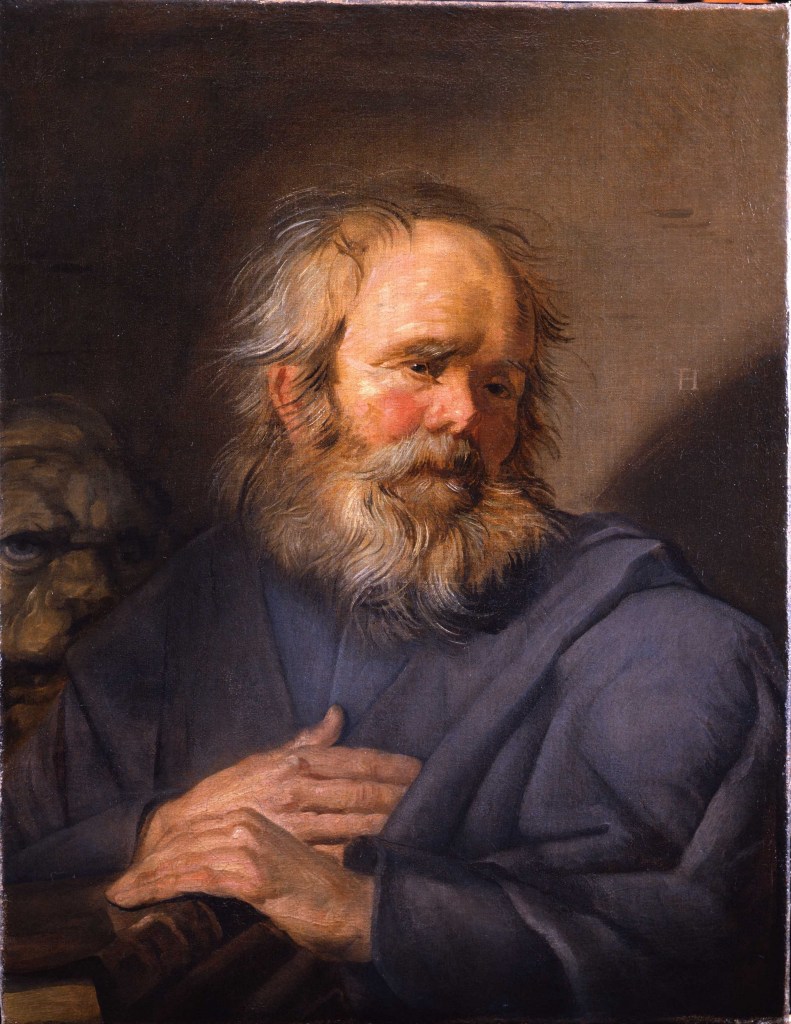
Holy Scripture does not say it specifically, but I feel as though St. Mark was someone who met Jesus, talked with Him, and so on. Scripture also indicates that he went on missions with Paul and Barnabas, and that he sat at the feet of the great Apostle Peter, learning much from him. Yet, even with all this, there had to come a day in his life when he set aside the writings and said, “Lord, You alone speak to me.” There must have been a day when he encountered and witnessed the crucified and resurrected Lord for himself, because his Gospel is a testimony to that encounter and a desire for you to have a similar experience.

The first words of his Gospel are, “The beginning of the good news of Jesus Christ, the Son of God.” From there, he narrates the story of Jesus in very succinct language.

In his Gospel, Mark tells the story of the Good News of Jesus Christ. After the apostles had encountered Jesus for themselves, they went out and proclaimed salvation so that others might experience Jesus—so that you and I might experience Jesus, not just in the words of the text but in our lives.

I encourage you, in your times of prayer and study, to set aside the scriptures and the prayer book—to set aside all those other voices, including your own—and say, “Lord, You alone speak to me,” allowing the One who has been handed down to us in the texts to speak to you personally.

Sermon: Easter 2 RCL C – “Resurrection”


I know I’ve shared this story at a funeral, but I don’t believe I’ve ever shared it with you. 

A man was once sentenced to solitary confinement in a pitch-black prison cell. To relieve his boredom and keep his sanity, he threw a marble against the walls—day in, day out, bang, bang, bang. The marble would bounce off the wall onto the floor and then roll around the room until the man could locate it and repeat the procedure.

One day, he decided to do something different—he would throw the marble up and try to catch it as it came down. Of course, in the pitch black, he missed the catch quite often, so he would listen as the marble hit the floor and bounced around. Feeling around in the general direction of the sound, he would locate it and try again. The longer this went on, the more proficient he became, and the more proficient he became, the higher he would throw the marble. However, when he made his highest throw ever, he did not catch it, and neither was there any sound. The marble simply did not come back down. He became more and more disturbed. What had happened to his precious marble? How could it disappear into thin air like that?! He spent the rest of his life wondering what had happened to his marble, and it eventually drove him to madness, and he died. 

We all have things we wonder about and questions that we seek answers to. Sometimes, we have questions about life: Why does so-and-so not love me? How come all my luck is bad? What did I do to deserve this?

At other times, we question the world around us: Why is the sky blue or the grass green? How was the universe formed? How does Santa get into houses without chimneys? (Just seeing if you were paying attention.)

We also have questions about our faith. Does God hear my prayers? Do I matter to God? Or even, is there a God?

For life’s questions, through our faith, we learn to understand and take each day as it comes. For the questions about the world around us, we explore and study. And for the questions about our faith, we pray and study scripture. However, when it comes to these questions of faith, we also tend to try to make a few deals with God. Why do the hard work if there’s a shortcut?

I’ve never been a Janis Joplin fan in the tiniest little bit, but I remember a song of hers that we would laugh and sing as kids, if only the first verse.

Oh Lord, won’t you buy me a Mercedes-Benz?
My friends all drive Porsches, I must make amends

That’s about all we knew as kids, but it is the third verse that gets to the theological heart of the matter.

Oh, Lord, won’t you buy me a night on the town?
I’m counting on you Lord, please don’t let me down
Prove that you love me and buy the next round

And there it is. “Prove that you love me.” Prove to me that You hear my prayers. Prove to me that I matter to You. Prove to me that You are there.

The first stanza of the poem, Doubt, by Norman Shirk

Let me meet you on the mountain, Lord, just once.
You wouldn’t have to burn a whole bush,
Just a few smoking branches,
And I would surely be your Moses

In the end, it all comes down to the same statement: “Unless I see the mark of the nails in his hands, and put my finger in the mark of the nails and my hand in his side, I will not believe.” 

It is easy to criticize poor ol’ Thomas, but there’s a bit of him—maybe a little or maybe a lot—there’s a bit of Thomas in us all.

Like Thomas, in order to increase our faith, we ask the Lord to meet us halfway. However, He already has. The Lord Jesus met us halfway between heaven and hell. He met us on that hill outside of Jerusalem. He met us outside the empty tomb, and He continues to meet us every day exactly where we are. He also meets us at that altar in the Sacrament of His body and blood.

But you say, “Yes, yes, Father John. That’s real nice, but today, I want to be Thomas. I want to see Him, hear Him, and touch Him. I need the burning bush. I need the missing piece of the puzzle. I need to find the stupid marble that fella pitched up into the air and never came back down. Give me these things, and I will.”

A line from a movie I watched inspired the title of my blog—Candle in a Cave. In the movie, an older priest tells a younger one, “We are all blind men in a cave looking for a candle that was lit 2,000 years ago.” 

In some sense, this is true because I can’t show you a burning bush or guide your hands and allow you to touch the wounds of Christ. Sorry, I can’t do it. If I could, we would have folks flocking to this church by the millions to see it. Why? Because they want God to prove Himself to them, to give them a sign. Like Job, they ask God to explain Himself. 

But remember, the Lord was patient with Job for a while, but after much questioning, the Lord answered, “Who is this that darkens my counsel with words without knowledge?” “Where were you when I laid the earth’s foundation? Tell me, if you understand. Who marked off its dimensions? Surely you know! Who stretched a measuring line across it? Who created the sky, the animals? Were you there when I breathed life into the dust and created you?” 

Like Job, and even during Jesus’ time on earth, we desire signs and wonders, miracles. Scripture states that at one point during Jesus’ ministry, some Pharisees and teachers of the law questioned him: “Teacher, we want to see a miraculous sign from you.” Jesus answered, “A wicked and adulterous generation asks for a miraculous sign! But none will be given it except the sign of the prophet Jonah. For as Jonah was three days and three nights in the belly of a huge fish, so the Son of Man will be three days and three nights in the heart of the earth.”

You see, the problem is not with God; it is with us. The Lord has already given us a sign. After three days and three nights in the heart of the earth, He rose! How? Truly, the Lord only knows. As the Psalmist says, “Such knowledge is too wonderful for me, too lofty for me to attain.” But Jesus rose from the grave. How much more proof does a person need? Just because there were no witnesses to the resurrection, does it mean it did not occur? No. Remember what Billy Graham said, “Can you see God? You haven’t seen him? I’ve never seen the wind. I see the effects of the wind, but I’ve never seen the wind. There’s a mystery to it.”

No one witnessed the resurrection of Jesus, but from that day forward, we have all been witnesses to, and have experienced for ourselves, the effects of the resurrection—this new life in Christ Jesus—and it didn’t involve getting a Mercedes-Benz. Therefore, “Do not doubt but believe.” 

Remember our prisoner and his marble? When the guards later entered the cell to remove his body, a glint of light caught one of the guards’ eyes. He looked up toward the ceiling to see the most astonishing sight—a marble caught in a spider’s web. “Of all the crazy things,” he thought. “How on earth did the spider manage to get a marble up there?” He spent the rest of his life wondering.

There are many mysteries in our lives with God, things we can wonder about and seek answers to throughout our lives. However, the question of the resurrection is not one of them, for the proof is all around us.

Let us pray: Praised be the God and Father of our Lord Jesus Christ, He who in His great mercy gave us new birth, a birth unto hope which draws its life from the resurrection of Jesus Christ from the dead; a birth to an imperishable inheritance, incapable of fading or defilement, which is kept in heaven for you who are guarded with God’s power through faith; a birth to a salvation which stands ready to be revealed in the last days. Amen.

Sermon: 2025 Easter Sunday

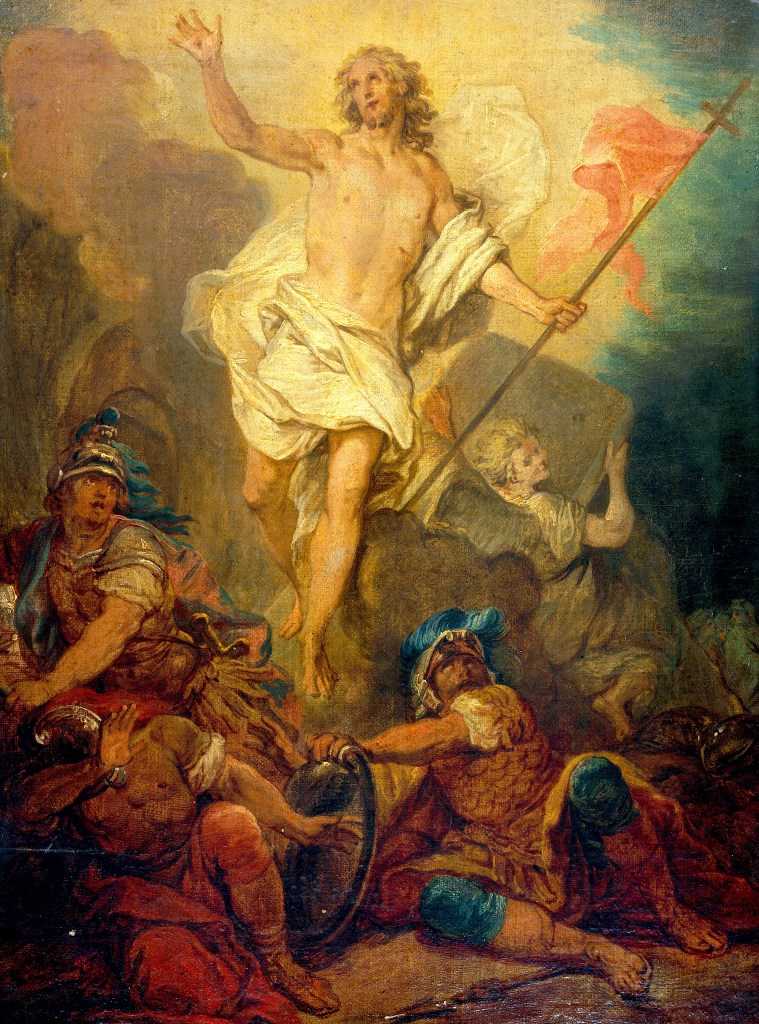
Nicolas Bertin (1668-1736). La Résurrection du Christ

Sam died. His will provided $50,000 for an elaborate funeral.

As the last attendees left, Sam’s wife, Rose, turned to her oldest friend, Sadie, and said, “Well, I’m sure Sam would be pleased.”

“I’m sure you’re right,” replied Sadie, who leaned in close and lowered her voice to a whisper. “Tell me, how much did it really cost?”

“All of it,” said Rose. “$50,000.”

“No!” Sadie exclaimed. “I mean, it was very nice, but really… $50,000?”

Rose nodded. “The funeral was $6,500. I donated $500 to the church for the services, and the reception, food, and drinks were another $500. The rest went for the memorial stone.”

Sadie computed quickly. “$42,500 for a memorial stone?! Wow, how big is it?”

“Five and a half carats,” Rose said, waggling her fingers.

Today is a good day to laugh at death and the devil, for both have been conquered once and for all.

During this past Season of Lent, we’ve been meditating on passages from The Dolorous Passion of our Lord Jesus Christ—a series of visions given to blessed Catherine Emmerich. It was initially published in 1833 and is also the primary source of the movie The Passion of the Christ by Mel Gibson.

The visions provide a brutal account of the events throughout Holy Week, and we’ve looked at some of the more difficult passages, so today, I thought it only fair that I share a portion of the joyous conclusion. When studying these, it is important to keep in mind that they are visions; therefore, they are not biblical—there is no account of the resurrection in scripture. That said, perhaps they may spark our imaginations and offer some insight into that great event. 

Chapter 63: The Resurrection of Our Lord.

“I beheld the soul of our Lord between two angels, who were in the attire of warriors: it was bright, luminous, and resplendent as the sun at midday; his soul penetrated the rock, touched the sacred body, passed into it, and the two were instantaneously united and became as one.  I then saw the limbs move and the body of our Lord, being reunited to his soul and to his divinity, rise and shake off the winding sheet: the whole of the cave was illuminated and lightsome.

“At the same moment, I saw a frightful monster burst from the earth underneath the sepulcher.  It had the tail of a serpent, and it raised its dragon head proudly as if eager to attack Jesus; and had likewise a human head. But our Lord held in his hand a white staff, to which was appended a large banner; and he placed his foot on the head of the dragon, and struck its tail three times with his staff, after which the monster disappeared….

“I then saw the glorified body of our Lord rise up, and it passed through the hard rock as easily as if the latter had been formed of some [soft] substance. The earth shook, and an angel in the garb of a warrior descended from Heaven with the speed of lightning, entered the tomb, lifted the stone, placed it on the right side, and seated himself upon it. At this tremendous sight, the soldiers fell to the ground and remained there, apparently lifeless.”

Can you see the angel of the Lord suddenly appearing before those soldiers, a mischievous grin on his face, asking, “How you doin’?” I somehow suspect that after those boys woke up, they probably had to go home and change their shorts.

Honestly, I don’t know how it all happened, but I do know this: Jesus rose from the dead. Say, “Amen.” We learn from the various Gospel accounts that the women and some of the disciples went to the tomb and found it empty. All that remained were the grave clothes. Some encounter angels, and Mary actually encounters the Risen Lord. Can you imagine what they were all thinking? 

For me, I think at first I would have been like them—afraid, shocked, wondering what those evil men had done with my Lord’s body. Perhaps after a while, pieces would come into focus, only to blow away like wisps of fog. 

The quote from N.T. Wright, which Diane shared with us on Good Friday, holds true not only for John’s Gospel but also for all the Gospel accounts and events of those days. He said, “I don’t know that any of us will ever be able to hold all this in our minds at any one time.  John allows the images to build up, one upon another, upon another, until we’re overwhelmed by them. . . . The only way forward is to allow all the different ideas and levels, the clashes of meaning and misunderstanding, to echo around until they produce prayer, awe, silence, and love.” (John for Everyone, Part Two, p.104)

The same must have been true for the Disciples on that first Easter Sunday. Like us, they had all this information—the prophecies from Isaiah and Ezekiel about the coming Messiah, the salvation of the Gentiles, and the Psalmist’s words regarding the piercing of the Messiah’s hands and feet. They also had the sayings of Jesus: “The Son of Man must be killed.” “Destroy this temple, and in three days, I will raise it up.” “This is my body… my blood.” All this information and so much more before Jesus’ death, yet none of it coalesced until after the Resurrection. However, they kept watching and were patient. They remained focused on God, and then, like a rose blooming, it all came together.

St. Paul said to the Colossians, and it is also true for us, “the mystery hidden for ages and generations” has now been “revealed to his saints. To them”—to you!—“God chose to make known how great among the Gentiles are the riches of the glory of this mystery, which is Christ in you, the hope of glory.” (Colossians 1:25b-27)

It would be like stepping out of that tomb on the first Easter morning. While inside, objects are shrouded in shadows and darkness. Your mind races. What happened here? Then you step out into the clear light of the new day and realize this is all God’s doing, and it is all about God’s love for you. Everything, from the first day when God created the Heavens and the Earth, to Jesus’ first breath in the manger on that first Christmas some 2,000 years ago, to the sunrise of that first Easter Sunday, to this very day, everything has been and is about God’s love for you and His desire to draw you to Himself. 

Laugh at death. Step out of the darkness and the shadows of your self-created tomb and walk in the light and life of Christ Jesus. Rise with Him into life eternal.

Alleluia. Christ is risen.

The Lord is risen indeed. Alleluia.

Sermon: Great Vigil


From Catherine Emmerich: “TOWARDS the close of the Sabbath-day, John came to see the holy women. He endeavoured to give some consolation, but could not restrain his own tears, and only remained a short time with them. They had likewise a short visit from Peter and James the Greater, after which they retired to their cells, and gave free vent to grief, sitting upon ashes, and veiling themselves even more closely.

Later that evening, “about nine o’clock at night,” the Blessed Virgin went out alone. Catherine Emmerich writes, “I saw her stop suddenly in a very solitary spot, and look upwards in an ecstasy of delight, for on the top of the town wall, she beheld the soul of our Lord, resplendent with light without the appearance of a wound, and surrounded by patriarchs. He descended towards her, turned to his companions, and presenting her to them, said, ‘Behold Mary, behold my Mother.’ He appeared to me to salute her with a kiss, and he then disappeared… This sight filled her with inexpressible joy, and she immediately rejoined the holy women, who were busily employed in preparing the perfumes and spices.

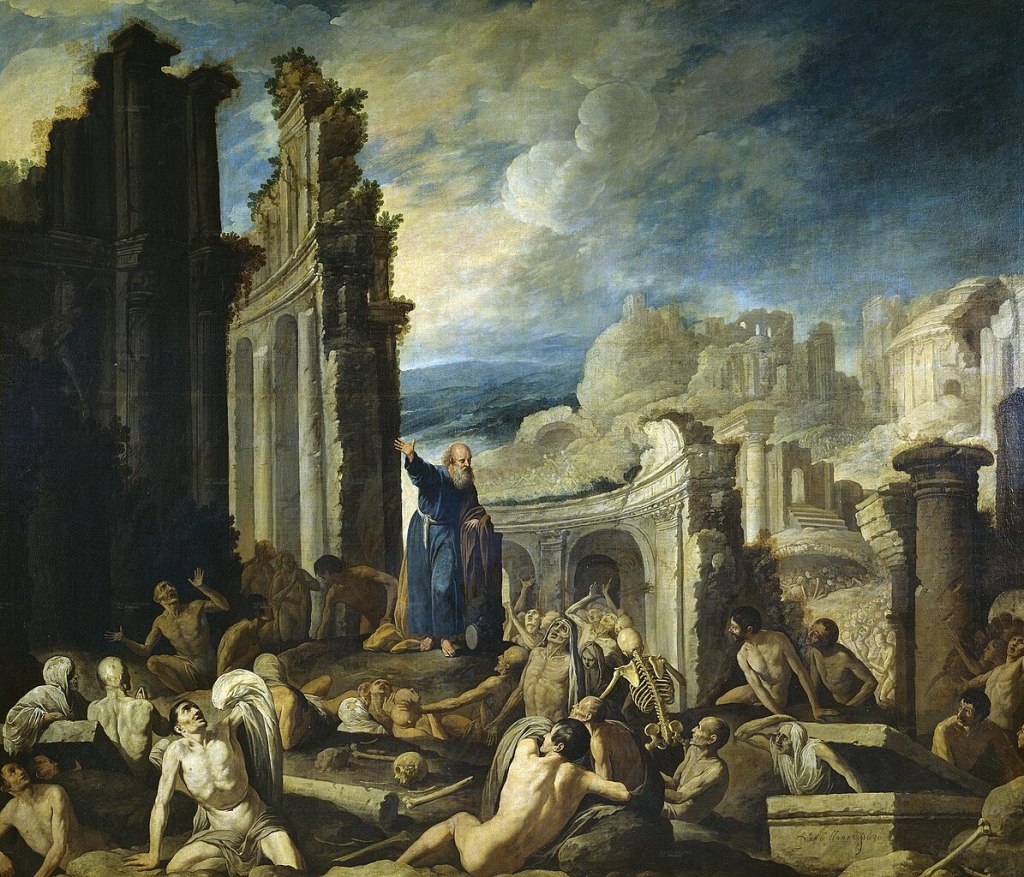
The Lord, speaking through the Prophet Ezekiel, said, “I am going to open your graves, and bring you up from your graves, O my people; and I will bring you back to the land of Israel. And you shall know that I am the Lord, when I open your graves, and bring you up from your graves, O my people. I will put my spirit within you, and you shall live, and I will place you on your own soil; then you shall know that I, the Lord, have spoken and will act.”

On this day, Jesus has been going about His Father’s business, descending into Hell and proclaiming release to those held captive. Now, He is bringing them forth, just as Ezekiel prophesied. 

The bones of those held captive in Hell were restored, and the flesh returned. The sinews and skin were knit back together, and their bodies became whole. Then “the breath came into them, and they lived, and stood on their feet, a vast multitude.” And Jesus, banner in hand, leads them out of the pit and into the light of God. It is this great exodus that Catherine describes and that the Virgin Mary witnessed.

In the end, it is all a mystery, yet we begin to see in that mirror dimly what has occurred; however, we also begin to glimpse our own future.

Gregory of Nyssa, one of the Cappadocian Fathers and a primary contributor to the Nicene Creed, wrote in the 4th century, “Ezekiel, with prophetic spirit, has surpassed all time and space and with his power of prediction has stood at the very moment of the resurrection. Seeing the future as already present, he has brought it before our eyes in his description.” 

There is the release of those held captive in Hell, but it is also a vision of our release from death. It is quite a spectacular scene and offers great hope to those who call upon the Name of the Lord. However, this resurrected life isn’t only about a distant future after we’ve been in the ground for so many years; Jesus has made it available to us today. 

St. Paul, writing to the Romans, states, “Do you not know that all of us who have been baptized into Christ Jesus were baptized into his death? We were buried therefore with him by baptism into death, in order that, just as Christ was raised from the dead by the glory of the Father, we too might walk in newness of life.” Through our baptism, we are raised—resurrected—with Christ Jesus, and the resurrected life is ours today.

So, ask yourself this: If I have been given the resurrected life today, do I still live as though I am nothing more than a pile of bones? Or do I take in this breath of God that has been breathed into me and allow it to fill me with faith, hope, and love? 

This is the night we declare, “Christ is risen!” Believe it. Embrace it. Rise with Him into a glorious new life.

Are you ready?

Alleluia! Christ is Risen!

Sermon: Holy Saturday


We’ve come this far with Anne Catherine Emmerich, so we might as well continue. Chapter 52 of The Dolorous Passion: The Body of Our Lord Placed in the Sepulchre.

The men placed the sacred body on a species of leathern hand-barrow, which they covered with a brown-coloured cloth, and to which they fastened two long stakes. This forcibly reminded me of the Ark of the Covenant. Nicodemus and Joseph bore on their shoulders the front shafts, while Abenadar and John supported those behind. After them came the Blessed Virgin, Mary of Heli, her eldest sister, Magdalen and Mary of Cleophas, and then the group of women who had been sitting at some distance —Veronica, Johanna Chusa, Mary the mother of Mark, Salome the wife of Zebedee, Mary Salome, Salome of Jerusalem, Susanna, and Anne the niece of St. Joseph. Cassius and the soldiers closed the procession. The other women, such as Marone of Naïm, Dina the Samaritaness, and Mara the Suphanitess, were at Bethania, with Martha and Lazarus. Two soldiers, bearing torches in their hands, walked on first, that there might be some light in the grotto of the sepulchre; and the procession continued to advance in this order for about seven minutes, the holy men and women singing psalms in sweet but melancholy tones. I saw James the Greater, the brother of John, standing upon a hill the other side of the valley, to look at them as they passed, and he returned immediately afterwards, to tell the other disciples what he had seen.

The procession stopped at the entrance of Joseph’s garden, which was opened by the removal of some stakes, afterwards used as levers to roll the stone to the door of the sepulchre. When opposite the rock, they placed the Sacred Body on a long board covered with a sheet. The grotto, which had been newly excavated, had been lately cleaned by the servants of Nicodemus, so that the interior was neat and pleasing to the eye. The holy women sat down in front of the grotto, while the four men carried in the body of our Lord, partially tilled the hollow couch destined for its reception with aromatic spices, and spread  over them a cloth, upon which they reverently deposited the sacred body. After having once more given expression to their love by tears and fond embraces, they left the grotto. Then the Blessed Virgin entered, seated herself close to the head of her dear Son, and bent over his body with many tears. When she left the grotto, Magdalen hastily and eagerly came forward, and flung on the body some flowers and branches which she had gathered in the garden. Then she clasped her hands together, and with sobs kissed the feet of Jesus; but the men having informed her that they must close the sepulchre, she returned to the other women. They covered the sacred body with the extremities of the sheet on which it was lying, placed on the top of all the brown coverlet, and closed the folding-doors, which were made of a bronze-coloured metal, and had on their front two sticks, one straight down and the other across, so as to form a perfect cross.

The large stone with which they intended to close the sepulchre, and which was still lying in front of the grotto, was in shape very like a chest* or tomb; its length was such that a man might have laid himself down upon it, and it was so heavy that it was only by means of levers that the men could roll it before the door of the sepulchre. The entrance of the grotto was closed by a gate made of branches twined together. Everything that was done within the grotto had to be accomplished by torchlight, for daylight never penetrated there.

Sermon: Maundy Thursday


From The Dolorous Passion, chapter 7:

“Jesus, in the vestibule, told John to take a basin, and James a pitcher filled with water, with which they followed him into the room, where the chief steward had placed another empty basin.

“Jesus, on returning to his disciples in so humble a manner, addressed them a few words of reproach on the subject of the dispute which had arisen between them, and said among other things, that he himself was their servant, and that they were to sit down, for him to wash their feet. They sat down, therefore, in the same order as they had sat at table. Jesus went from one to the other, poured water from the basin which John carried on the feet of each, and then, taking the end of the towel wherewith he was girded, wiped them. Most loving and tender was the manner of our Lord while thus humbling himself at the feet of his Apostles.”

And then there was Peter. “‘You will never wash my feet.’ Jesus answered, ‘Unless I wash you, you have no share with me.’ Simon Peter said to him, ‘Lord, not my feet only but also my hands and my head!’”

It is easy to pick on Peter, but would we have acted any differently? Jesus is kneeling before you and says He’s about to wash your feet. What do you do? Yeah. Me too. “Lord, this is so far below You, and I am so unworthy of such an honor.” Yet, as with Peter, this act of washing the disciples’ feet points to something beyond itself.

Jesus says, “Unless I wash you, you have no share with me.” The term “share” can also be interpreted as “heritage” or “inheritance.” In the context of the Old Testament, the Lord speaks to Moses about the Israelites’ inheritance, which is the Land of Canaan, also known as the Promised Land. The Lord declares, “This is the land that shall fall to you for an inheritance, the land of Canaan as defined by its borders.” (Numbers 34:2) In the New Testament, we learn that Jesus will say to the righteous, “Come, you who are blessed by my Father, inherit the kingdom prepared for you from the foundation of the world.” (Matthew 25:34) Unless Jesus washes Peter’s feet, Peter will have no part in the New Promised Land, the very Kingdom of God.

However, remember what Jesus said before he washed their feet. He said, “You do not know now what I am doing, but later you will understand.” This indicates that foot washing is not only about humbly serving one another. It is also pointing to something greater than itself, and the Disciples would not understand until after the Resurrection. St. Paul says it plainly in his letter to the Philippians—“Being found in human form, [Jesus] humbled himself by becoming obedient to the point of death, even death on a cross.” (Philippians 2:8)

The washing of the Disciples’ feet is pointing to the cleansing of sin from their souls, but not just theirs “only but also for the sins of the whole world.” We, like Peter and everyone else who desires the Kingdom of God, must submit to the humility of Jesus and allow Him to wash our feet—allow Him to wash our souls, for “no one comes to the Father except through” Him, and these great acts He performed in the Upper Room and on the hill outside Jerusalem, upon the Cross.

Tonight, I invite you to come forward so that I can learn more about the humility of our Savior by washing your feet. However, remember that these acts serve as an example established by Jesus. Therefore, we are not only witnesses to them but also called to practice them. As Jesus tells us, “Very truly, I tell you, servants are not greater than their master, nor are messengers greater than the one who sent them. If you know these things, you are blessed if you do them.”

Sermon: Wednesday in Holy Week

The Last Supper by El Greco

Throughout the Gospels, the disciples struggled to grasp who Jesus truly was, along with the significance of his actions and words. 

The disciples and Jesus are out on the sea when a storm rolls in, and the disciples fear they will drown. Jesus calms the storm, yet the disciples are even more afraid. He asks them, “Why are you so afraid? Do you still have no faith?”

Jesus had fed the 5,000, and he and the disciples were out on the boat, but the disciples had forgotten to bring anything to eat. Jesus said to them, “Watch out—beware of the yeast of the Pharisees and the yeast of Herod.” How did the disciples respond? They said to one another, “It is because we have no bread.” Jesus then asked them, “Why are you talking about having no bread? [Ya nitwits! — Fr. John’s commentary] Do you still not perceive or understand? Are your hearts hardened?  Do you have eyes and fail to see? Do you have ears and fail to hear?”

Jesus tells the disciples that he must die, leading to that unfortunate scene with Peter and the “Get behind me, Satan!” business. And then there is today. 

They are gathered in the upper room for their last supper together. Jesus says, “Very truly, I tell you, one of you will betray me.” Peter wants to know what he means, but seems afraid to ask, so he tells John to ask Jesus, “Who is it that will betray you?” John asks, and Jesus responds, “It is the one to whom I give this piece of bread when I have dipped it in the dish.” Jesus then dips a piece of bread into the dish and hands it to Judas Iscariot, saying to him, “Do quickly what you are going to do.” Scripture then states, “Now no one at the table knew why he said this to him. Some thought that, because Judas had the common purse, Jesus was telling him, ‘Buy what we need for the festival’; or that he should give something to the poor. So, after receiving the piece of bread, he immediately went out.”

Jesus just said, whoever I give this piece of bread to will be the one who betrays me! He dips the bread into the dish and hands it to Judas. Why then do the disciples not understand? Why, instead of saying that Judas went out to do the deed, does scripture not say, “The disciples understood that it was Judas who would betray Jesus, so they pounced on him and beat the living daylights out of him!” Come on, fellas! Seriously? 

Why did the disciples fail to grasp who Jesus truly was, the things He did, and what He said? Answer: for the same reason we don’t fully comprehend who Jesus truly is, the things He does, and the things He says. “For now we see in a mirror, dimly, but then we will see face to face. Now I know only in part; then I will know fully, even as I have been fully known.”

Much of who Jesus—God—is was hidden from the disciples, just as He is hidden from us. Coming into the full knowledge of God would be like walking into the core of the sun. It is beyond our current condition to fathom.

Such knowledge is too wonderful for me;
    it is so high that I cannot attain it.

Instead of understanding everything, God tells us, “Understand this,” and He stretches out His arms upon the hardwood of the cross. You don’t need to understand how it works, what happened, the nature of sin, the Holy Trinity, or why the disciples allowed Judas to walk out and betray Him. You only need to understand the “Why?” behind it all. What is the answer to “Why?” You. 

Sermon: Palm Sunday – “His Most Blessed Mother”


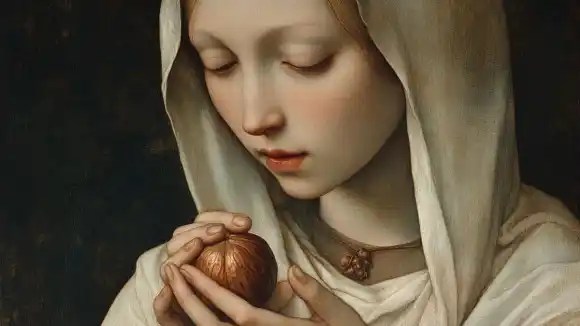
Today, in The Dolorous Passion by Anne Catherine Emmerich, we turn our attention to Jesus’ most Blessed Mother. From Chapter 45:

“What words can, alas, express the deep grief of the Blessed Virgin? Her eyes closed, a death-like tint overspread her countenance; unable to stand, she fell to the ground, but was soon lifted up, and supported by John, Magdalen, and the others. She looked once more upon her beloved Son—that Son whom she had conceived by the Holy Ghost, the flesh of her flesh, the bone of her bone, the heart of her heart—hanging on a cross between two thieves; crucified, dishonoured, condemned by those whom he came on earth to save; and well might she at this moment be termed ‘the queen of martyrs.’”

I wondered about all we have been discussing during this Season of Lent, and then I thought of Jesus’ most blessed Mother. It was thirty-three years ago that she gave birth to him, and she knew Him well. He didn’t have to speak for her to understand how He was feeling. She may have been present when he rode into town on the donkey, the crowds joyful and excited, waving palm branches and shouting, “Blessed is he who comes in the Name of the Lord.” However, one look at Jesus’ face, and she knew something was wrong—terribly wrong. 

Over the course of the next few days, she came to understand the inner torment He was experiencing, but there was nothing she could do. A day later, news arrived through one of Jesus’ terrified disciples that He had been arrested. There was the trial, the long road to Golgotha, the crucifixion, and now… now she sits at the foot of the cross, watching her Son die—the Son who was conceived in her by the Holy Spirit.

She was oblivious to the crowds around her, unconcerned about the danger she was placing herself in. Nothing distracted her from her Son on the cross. Not one thing could make her take her eyes off of God because she knew that if she was going to get through this, it would be only through Him, for He had come to save her as well.

We can learn many things from this most blessed of all women. We can learn love, patience, perseverance. We can learn what it means to hunger for God and to comfort one another. Therefore, I encourage you this Holy Week to take Mary as your companion. Ask her to reveal to you the things she witnessed and to help you experience the true Passion of our Lord. Ask her to guide you beyond your own fears and away from the crowds and the noise. Ask her to allow you to join her at the foot of the Cross, and then ask her to show you perfect love—perfect love that was crucified for her and for you.

Let us pray: O Holy Mary, my most gentle Lady, faithful Advocate of all Christians, in view of the extraordinary merits that were yours and which made you most pleasing to God, and in view of your every comforting gesture you made to your Son, as well as the countless tears you shed during his most bitter Passion, I ask you to have pity on me, poor creature that I am. Take me under your maternal care and include me among the number of your servants, whom you hold dear and embrace with your special love.

O glorious Virgin Mary, my only hope, before my soul should leave this body of mine, come and reveal your face to me. Direct your gentle and beautiful eyes of mercy toward me, the very eyes that had joyfully and so often looked upon the fruit of your womb, Jesus, and were wetted because the many tears shed during his Passion. Most holy Mother of Jesus, come and stand at my side together with your group of attending virgins and the holy assemblage of saints, as you had steadfastly and perseveringly stood unto the end, when your most beloved Son was about to die on the Cross. After my Lord Jesus Christ, your only Son, I find none so generous and eager to console someone in need as you, most amiable Mother of the Afflicted. Amen. (On the Passion of Christ: According to the Four Evangelists, p.117)

Sermon: Dietrich Bonhoeffer


A man was painting the home of an 89-year-old lady in Spokane. She had a large family Bible prominently displayed on the coffee table and remarked that it was 116 years old and a priceless heirloom. The painter commented on how remarkable that was and added, “It doesn’t matter how old the Bible might be; what’s on the inside is what matters.” She immediately replied, “Oh, I know. That sure is the truth. Why, we have family records and births and marriages, and deaths that go so far back, all recorded in that Bible; we could never replace them.” 

Episcopalians may be accused of being the “frozen chosen” or because of the Book of Common Prayer, “Those Who Read to God,” but no one can ever accuse us of not reading our Bibles.  I think we read more Holy Scripture on a Sunday than any other church out there.

In the study of Holy Scripture, I know of some who set themselves a plan to read the entire Bible in a year, some in three years, and others – well, others are pretty much like that lady having her house painted. It’s a good book to have around to record family relations or press flowers, but other than that…  

I suppose we all have our favorite books of the Bible, but I’ve also heard folks say that if it’s not printed in red (meaning the words of Christ), they can’t be bothered.  It is also true for many that they, with perhaps the exception of the Psalms, don’t read any of the Old Testament.  Their reasoning is, “I don’t like the God of the Old Testament.” 

Yet, what we learn from studying the Gospels is that Jesus was a big fan of the Old Testament. He quoted it about 80 times, the most memorable instance being when he spent 40 days in the desert and rebuked the devil. It seems that Jesus was considering Deuteronomy when the devil came along because all three of those rebukes came from that book.

For us, the Old Testament also enhances our understanding of God and shows how everything that occurred points to the need for a Savior.  This is what Jesus referred to in our Gospel today when he said, “Therefore every scribe who has been trained for the kingdom of heaven is like the master of a household who brings out of his treasure what is new and what is old.” To truly know God and Jesus, we must study both the old and the new- the God of the Law and the God of the Law revealed and fulfilled.  The same God, but a more complete and accurate picture.

Dietrich Bonhoeffer, whom we celebrate today, understood this.  He wrote, “My thoughts and feelings seem to be getting more and more like those of the Old Testament. It is only when one knows the unutterability of the name of God that one can utter the name of Jesus Christ; it is only when one loves life and this earth so much that without them everything seems to be over that one may believe in the resurrection; it is only when one submits to God’s law that one may speak of grace. It is not Christian to want to take our thoughts and feelings too directly from the New Testament.”

The Holy Bible is more than just a collection of Sunday school stories and nice sayings; it is the history of our God.  In both the Old and New Testaments, it serves as the place to discover Him, know Him, and be known by Him.