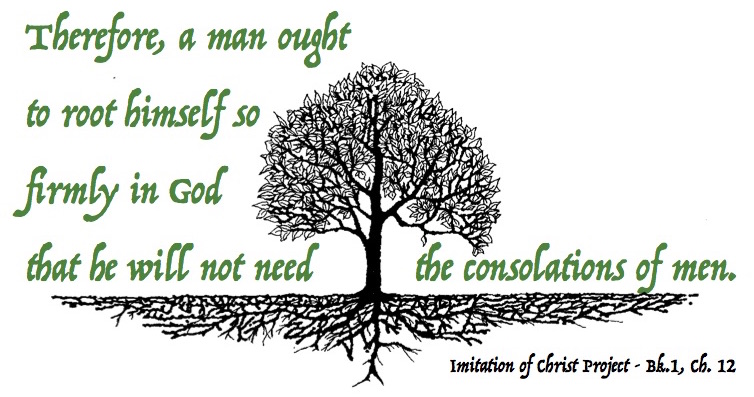

Imitation of Christ Project – Bk. 1, Ch. 4

IOC Ch4PRUDENCE IN ACTION –

DO NOT yield to every impulse and suggestion but consider things carefully and patiently in the light of God’s will. For very often, sad to say, we are so weak that we believe and speak evil of others rather than good. Perfect men, however, do not readily believe every talebearer, because they know that human frailty is prone to evil and is likely to appear in speech.

Not to act rashly or to cling obstinately to one’s opinion, not to believe everything people say or to spread abroad the gossip one has heard, is great wisdom.

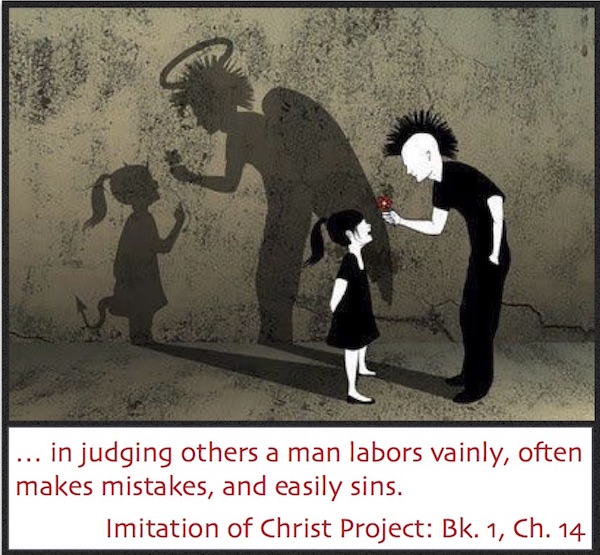
Take counsel with a wise and conscientious man. Seek the advice of your betters in preference to following your own inclinations.

A good life makes a man wise according to God and gives him experience in many things, for the more humble he is and the more subject to God, the wiser and the more at peace he will be in all things.

Imitation of Christ Project – Bk. 1, Ch. 3 – Pt. 2

VanityTHE DOCTRINE OF TRUTH –

Every perfection in this life has some imperfection mixed with it and no learning of ours is without some darkness. Humble knowledge of self is a surer path to God than the ardent pursuit of learning. Not that learning is to be considered evil, or knowledge, which is good in itself and so ordained by God; but a clean conscience and virtuous life ought always to be preferred. Many often err and accomplish little or nothing because they try to become learned rather than to live well.

If men used as much care in uprooting vices and implanting virtues as they do in discussing problems, there would not be so much evil and scandal in the world, or such laxity in religious organizations. On the day of judgment, surely, we shall not be asked what we have read but what we have done; not how well we have spoken but how well we have lived.

Tell me, where now are all the masters and teachers whom you knew so well in life and who were famous for their learning? Others have already taken their places and I know not whether they ever think of their predecessors. During life they seemed to be something; now they are seldom remembered. How quickly the glory of the world passes away! If only their lives had kept pace with their learning, then their study and reading would have been worth while.

How many there are who perish because of vain worldly knowledge and too little care for serving God. They became vain in their own conceits because they chose to be great rather than humble.

He is truly great who has great charity. He is truly great who is little in his own eyes and makes nothing of the highest honor. He is truly wise who looks upon all earthly things as folly that he may gain Christ. He who does God’s will and renounces his own is truly very learned.

Sermon: Pentecost 17 / Proper 22 RCL A – “Listen”

listentogodBack when the telegraph was the fastest method of long-distance communication, a young man applied for a job as a Morse Code operator. Answering an ad in the newspaper, he went to the office address that was listed. When he arrived, he entered a large, busy office filled with noise and clatter, including the sound of the telegraph in the background. A sign on the receptionist’s counter instructed job applicants to fill out a form and wait until they were summoned to enter the inner office.

The young man filled out his form and sat down with the seven other applicants in the waiting area. After a few minutes, the young man stood up, crossed the room to the door of the inner office, and walked right in. Naturally the other applicants perked up, wondering what was going on. They muttered among themselves that they hadn’t heard any summons yet. They assumed that the young man who went into the office made a mistake and would be disqualified.

Within a few minutes, however, the employer escorted the young man out of the office and said to the other applicants, “Gentlemen, thank you very much for coming, but the job has just been filled.”

The other applicants began grumbling to each other, and one spoke up saying, “Wait a minute, I don’t understand. He was the last to come in, and we never even got a chance to be interviewed. Yet he got the job. That’s not fair!”

The employer said, “I’m sorry, but all the time you’ve been sitting here, the telegraph has been ticking out the following message in Morse Code: ‘If you understand this message, then come right in. The job is yours.’ None of you heard it or understood it. This young man did. The job is his.” They weren’t listening. They weren’t listening to the message that was right in front of them the entire time.

Our parable today could be summed up in one simple phrase, “How many times do I have to tell you ____?” Little Johnny got in trouble once by answering that question. His response, “Once more might do the trick.”  We’ve all heard it or said it, “How many times do I have to tell you to turn off the lights?” “How many times do I have to tell you to clean your room?” “How many times do I have to tell you that chocolate and peppermint don’t go together?” Maybe that one is just me.

In the parable, Jesus is talking to the Pharisee, the religious leaders. We have the owner of the vineyard who is God the Father, the vineyard that represents the people, and the caretakers of the vineyards who are the religious leaders.  The parable tells us that God gave the care of the vineyard – his children – into the hands of the caregivers – the religious leaders.  He gave them freedom. He entrusted the people’s spiritual well being to them, but over time, the religious leaders got it wrong, so God sent His prophets to bring correction. Yet, like the applicants for the telegraph job, the religious leaders weren’t listening to the message that was right in front of them the entire time. So time and time again they didn’t properly respond to that message.  God says, “How many times do I have to tell you?”  When they failed to listen to the prophets, God sent His one and only Son to say it again.  But as we know, the religious leaders will end up killing Him.  So what was this message that God kept trying to get across to His children?  We heard it this morning in our Old Testament lesson: The Law. The Law given to Moses and written on the tablets of stone by the very finger of God was the message, but they did not hear it as it was intended.

Instead, the religious leaders took the Law of God and interpreted it. For example, we have the US Constitution. Even with the amendments its not that long of a document, but all the various laws that come from the interpretation of the Constitution go on for volumes and volumes. The religious leaders of Jesus’ time and before did the same thing with the Law of Moses. Instead of teaching it as God intended, they interpreted it and used it to enslave the people and get around the true intent of the Law. Today, Jesus spoke to the religious leaders using a parable to condemn them for their actions. In two more chapters, He is crystal clear, “Woe to you teachers of the law and Pharisees, you hypocrites!… Woe to you blind guides!… You snakes!  You brood of vipers!  How will you escape being condemned to hell?”

I can’t imagine the religious leaders intentionally unleashing this kind of wrath upon themselves, but it happened just the same.  Why?  Because they weren’t listening.  Jesus said to them, “Isaiah was right when he prophesied about you hypocrites; as it is written, ‘The people honor me with their lips, but their hearts are far from me.  They worship me in vain; their teachings are but rules taught by men.’  You have let go of the commands of God and are holding on to the traditions of men.” “Woe to you, teachers of the law and Pharisees, you hypocrites! You give a tenth of your spices—mint, dill and cumin. But you have neglected the more important matters of the law—justice, mercy and faithfulness. You should have practiced the latter, without neglecting the former.  You blind guides! You strain out a gnat but swallow a camel.”  God asks, “How many times do I have to tell you?” The Law is not about rules and regulations that can be numbered and written down in books. The Law is about justice, mercy, faithfulness. The Law is  about the heart and that is what the religious leaders were not hearing.

Now you may be thinking to yourself, “This is the religious leaders problem. This here is Fr. John’s issue – not mine.  God will smite him if he goofs, but I’m off the hook on this on.” Please allow me to retort: 1 Peter chapter 2, “As you come to him, the living Stone—rejected by humans but chosen by God and precious to him— you also, like living stones, are being built into a spiritual house to be a holy priesthood, offering spiritual sacrifices acceptable to God through Jesus Christ.” Peter goes on, “You are a chosen people, a royal priesthood, a holy nation, God’s special possession, that you may declare the praises of him who called you out of darkness into his wonderful light.”

The things of God are not secret knowledge locked up in the heads of the ordained. As Luke says, “The kingdom of God is within you.”   This is not just an issue for religious leaders. It is for God’s chosen people, His royal priesthood, His Holy Nation, and His special possession. It is for you and it is within you. The Gospel of Thomas has been classified as heretical by the church and perhaps by quoting from it I make myself a heretic, but it would seem to contain some truth.  In it, Jesus says, “The Kingdom of God is within you, not in buildings and mansions of stone.  When I am gone, split a piece of wood and I am there, lift a stone and you will find me.” Understanding the things of God is not some secret knowledge. The knowledge of God is within the heart of every believer – you need only to listen.

The words of Jesus teach us that the Law of God was not originally intended for scholars and theologians, for books, and ivory towers. The Law was for the heart.  It was not about whether you could recite it verbatim, but can you live it. Paul said in the letter to the Philippians, “I want to know Christ and the power of his resurrection.” He wants to know Christ by listening to the things of God, not up here – in his head – but here – in his heart. The boxing great Rocky Marciano reportedly once said, “Hit the heart and the head will follow.” He also said, “Why waltz with a guy for 10 rounds if you can knock him out in one?” We can try all sorts of ways to know God, but the quickest way to this knowledge is to listen with our hearts.

Thomas a Kempis wrote, “O God, You Who are the truth, make me one with You in love everlasting. I am often wearied by the many things I hear and read, but in You is all that I long for. Let the learned be still, let all creatures be silent before You; You alone speak to me.”

Say to God, “You alone speak to me.” Then listen.

Imitation of Christ Project – Bk. 1, Ch. 3 – Pt. 1

IOC Ch3.1THE DOCTRINE OF TRUTH –

HAPPY is he to whom truth manifests itself, not in signs and words that fade, but as it actually is. Our opinions, our senses often deceive us and we discern very little.

What good is much discussion of involved and obscure matters when our ignorance of them will not be held against us on Judgment Day? Neglect of things which are profitable and necessary and undue concern with those which are irrelevant and harmful, are great folly.

We have eyes and do not see.

What, therefore, have we to do with questions of philosophy? He to whom the Eternal Word speaks is free from theorizing. For from this Word are all things and of Him all things speak — the Beginning Who also speaks to us. Without this Word no man understands or judges aright. He to whom it becomes everything, who traces all things to it and who sees all things in it, may ease his heart and remain at peace with God.

O God, You Who are the truth, make me one with You in love everlasting. I am often wearied by the many things I hear and read, but in You is all that I long for. Let the learned be still, let all creatures be silent before You; You alone speak to me.

The more recollected a man is, and the more simple of heart he becomes, the easier he understands sublime things, for he receives the light of knowledge from above. The pure, simple, and steadfast spirit is not distracted by many labors, for he does them all for the honor of God. And since he enjoys interior peace he seeks no selfish end in anything. What, indeed, gives more trouble and affliction than uncontrolled desires of the heart?

A good and devout man arranges in his mind the things he has to do, not according to the whims of evil inclination but according to the dictates of right reason. Who is forced to struggle more than he who tries to master himself? This ought to be our purpose, then: to conquer self, to become stronger each day, to advance in virtue.

Imitation of Christ Project – Bk. 1, Ch. 2

IOC Ch2
“The Thinker” by Auguste Rodin

HAVING A HUMBLE OPINION OF SELF

EVERY man naturally desires knowledge; but what good is knowledge without fear of God? Indeed a humble rustic who serves God is better than a proud intellectual who neglects his soul to study the course of the stars. He who knows himself well becomes mean in his own eyes and is not happy when praised by men.

If I knew all things in the world and had not charity, what would it profit me before God Who will judge me by my deeds?

Shun too great a desire for knowledge, for in it there is much fretting and delusion. Intellectuals like to appear learned and to be called wise. Yet there are many things the knowledge of which does little or no good to the soul, and he who concerns himself about other things than those which lead to salvation is very unwise.

Many words do not satisfy the soul; but a good life eases the mind and a clean conscience inspires great trust in God.

The more you know and the better you understand, the more severely will you be judged, unless your life is also the more holy. Do not be proud, therefore, because of your learning or skill. Rather, fear because of the talent given you. If you think you know many things and understand them well enough, realize at the same time that there is much you do not know. Hence, do not affect wisdom, but admit your ignorance. Why prefer yourself to anyone else when many are more learned, more cultured than you?

If you wish to learn and appreciate something worth while, then love to be unknown and considered as nothing. Truly to know and despise self is the best and most perfect counsel. To think of oneself as nothing, and always to think well and highly of others is the best and most perfect wisdom. Wherefore, if you see another sin openly or commit a serious crime, do not consider yourself better, for you do not know how long you can remain in good estate. All men are frail, but you must admit that none is more frail than yourself.

Imitation of Christ Project – Bk. 1, Ch. 1

IOC Ch1
“The Philosopher in Meditation” by Rembrandt Harmenszoon van Rijn

IMITATING CHRIST AND DESPISING ALL VANITIES ON EARTH

“He who follows Me, walks not in darkness,” says the Lord. By these words of Christ we are advised to imitate His life and habits, if we wish to be truly enlightened and free from all blindness of heart. Let our chief effort, therefore, be to study the life of Jesus Christ.

The teaching of Christ is more excellent than all the advice of the saints, and he who has His spirit will find in it a hidden manna. Now, there are many who hear the Gospel often but care little for it because they have not the spirit of Christ. Yet whoever wishes to understand fully the words of Christ must try to pattern his whole life on that of Christ.

What good does it do to speak learnedly about the Trinity if, lacking humility, you displease the Trinity? Indeed it is not learning that makes a man holy and just, but a virtuous life makes him pleasing to God. I would rather feel contrition than know how to define it. For what would it profit us to know the whole Bible by heart and the principles of all the philosophers if we live without grace and the love of God? Vanity of vanities and all is vanity, except to love God and serve Him alone.

This is the greatest wisdom — to seek the kingdom of heaven through contempt of the world. It is vanity, therefore, to seek and trust in riches that perish. It is vanity also to court honor and to be puffed up with pride. It is vanity to follow the lusts of the body and to desire things for which severe punishment later must come. It is vanity to wish for long life and to care little about a well-spent life. It is vanity to be concerned with the present only and not to make provision for things to come. It is vanity to love what passes quickly and not to look ahead where eternal joy abides.

Often recall the proverb: “The eye is not satisfied with seeing nor the ear filled with hearing.” Try, moreover, to turn your heart from the love of things visible and bring yourself to things invisible. For they who follow their own evil passions stain their consciences and lose the grace of God.

Imitation of Christ Project

IOC CoverI have decided to attempt a new project with my favorite devotional, The Imitation of Christ, by Thomas à Kempis.  I won’t be posting every day, but will occasionally post a chapter with a graphic showing what I consider to be the most significant passage from that chapter.  Some chapters are a bit lengthy, so I will break those up over a couple of posts (each post should take no more than a few minutes to read).  I pray you find these writings to be as inspirational as I do.  Feel free to leave your comments on the blog or Facebook.  The first post will be up shortly.

Sermon: “God’s Desire”

denariusDesmond Tutu was once asked why he became an Anglican rather than joining some other denomination. He replied that in the days of apartheid, when a black person and a white person met while walking on a footpath, the black person was expected to step into the gutter to allow the white person to pass and nod their head as a gesture of respect. “One day” Tutu says, “when I was just a little boy, my mother and I were walking down the street when a tall white man, dressed in a black suit, came toward us. Before my mother and I could step off the sidewalk, as was expected of us, this man stepped off the sidewalk and, as my mother and I passed, tipped his hat in a gesture of respect to her! I was more than surprised at what had happened and I asked my mother, ‘Why did that white man do that?’ My mother explained, ‘He’s an Anglican priest. He’s a man of God, that’s why he did it.’ When she told me that he was an Anglican priest I decided there and then that I wanted to be an Anglican priest too. And what is more, I wanted to be a man of God.”

It is quite easy today for us to determine a person’s worth based on color of skin, the clothes they wear, level of education, size of house, income, and so on. Like the whites in South Africa during apartheid, they looked at the color of the skin and declared in their hearts, “I am worth more than you.” What struck Desmond Tutu so about the priest was the fact that the priest, by his actions said, “No. This is not true. We are equal.”

The parable of the generous landowner is curious in how it ends – a standoff. You can see the steward standing with hand extended offering the upset worker his denarii and the worker glaring back in his anger. Jesus does not tell us what happens next because he wants us to figure it out on our own. What we must figure out is that the parable is not about the amount of work an individual worker has done. Instead, the parable is about what the landowner and the steward are doing. The parable is about God the Father, God the Son, and the work they are accomplishing.

The landowner kept going to town looking for more workers, just as God the Father keeps coming to us, pursuing us – pursuing his children that we might return to him. The steward, Jesus, pays for each of us. He places that denarii, that coin in our hands and that coin is our salvation. Whether you come early in life or late, the same reward is made available to you. Why is God doing this? Because it is God’s desire that all return to Him.

As Paul states in his first letter to Timothy, “This is right and is acceptable in the sight of God our Savior, who desires everyone to be saved and to come to the knowledge of the truth.” Or as Peter says in his second epistle, the Lord “is patient with you, not wanting any to perish, but all to come to repentance.” We have this tendency to judge others by how we perceive their worth. God, on the other hand, sees all as his beloved children and he desires that all should be saved. To what extent will God go to save His children? You need only to look to the cross to know the answer.

Sermon: Pentecost 14 / Proper 19 RCL A – “Standing before God”

soul viewIn the Far East the emperor was growing old and knew it was time to choose his successor. Instead of choosing one of his assistants or his children, he decided to do something different. He called young people in the kingdom together one day. He said, “It is time for me to step down and choose the next emperor. I have decided to choose one of you.” The children were shocked, but the emperor continued. “I am going to give each one of you a seed today–one very special seed. I want you to plant the seed, water it, and come back here one year from today with what you have grown from this one seed. I will then judge the plants that you bring, and the one I choose will be the next emperor.”

One boy, named Ling, was there that day and he, like the others, received a seed. He went home and excitedly, told his mother the story. She helped him get a pot and planting soil, and he planted the seed and watered it, carefully. Everyday, he would water it and watch to see if it had grown. After about three weeks, some of the other youths began to talk about their seeds and the plants that were beginning to grow. Ling kept checking his seed, but nothing ever grew. Three weeks, four weeks, five weeks went by, still nothing. By now, others were talking about their plants, but Ling didn’t have a plant and he felt like a failure. Six months went by–still nothing in Ling’s pot.

He just knew he had killed his seed. Everyone else had trees and tall plants, but he had nothing. Ling didn’t say anything to his friends, however. He just kept waiting for his seed to grow. A year finally went by and all the youths of the kingdom brought their plants to the emperor for inspection. Ling told his mother that he wasn’t going to take an empty pot. But his mother asked him to be honest about what happened.

Ling felt sick at his stomach, but he knew his mother was right. He took his empty pot to the palace. When Ling arrived, he was amazed at the variety of plants grown by the other youths. They were beautiful–in all shapes and sizes. Ling put his empty pot on the floor and many of the other children laughed at him. A few felt sorry for him and just said, “Hey, nice try.”

When the emperor arrived, he surveyed the room and greeted the young people. Ling just tried to hide in the back. “My, what great plants, trees, and flowers you have grown,” said the emperor. “Today one of you will be appointed the next emperor!”

All of a sudden, the emperor spotted Ling at the back of the room with his empty pot. He ordered his guards to bring him to the front. Ling was terrified. He thought, “The emperor knows I’m a failure! Maybe he will have me killed!”

When Ling got to the front, the Emperor asked his name. “My name is Ling,” he replied. All the kids were laughing and making fun of him. The emperor asked everyone to quiet down. He looked at Ling, and then announced to the crowd, “Behold your new emperor! His name is Ling!”

Ling couldn’t believe it. Ling couldn’t even grow his seed. How could he be the new emperor?

Then the emperor said, “One year ago today, I gave everyone here a seed. I told you to take the seed, plant it, water it, and bring it back to me today. But I gave you all boiled seeds that would not grow. All of you, except Ling, have brought me trees and plants and flowers. When you found that the seed would not grow, you substituted another seed for the one I gave you. Ling was the only one with the courage and honesty to bring me a pot with my seed in it. Therefore, he is the one who will be the new emperor!”

“Then I saw a great white throne and him who was seated on it. The earth and the heavens fled from his presence, and there was no place for them.  And I saw the dead, great and small, standing before the throne, and books were opened. Another book was opened, which is the book of life. The dead were judged according to what they had done as recorded in the books.  The sea gave up the dead that were in it, and death and Hades gave up the dead that were in them, and each person was judged according to what they had done.  Then death and Hades were thrown into the lake of fire. The lake of fire is the second death.  Anyone whose name was not found written in the book of life was thrown into the lake of fire.”

Many read the Book of Revelation and are frightened by things like the dragon, the woman in the desert, the crashing star, Wormwood, not to mention the Four Horsemen, but this little section toward the end should really grab our attention. Everything that takes place before is leading up to this event. It is the time of God’s final decision with regards to our soul’s eternal destination.

Now, you’ve probably picked up on the fact by now that I’m not a “Hellfire and Brimstone” kind of preacher, and I’m not going to start today, but it was the passage from Paul’s letter to the Romans that we read today that made me consider this. Paul writes:

“We will all stand before the judgment seat of God. For it is written,
‘As I live, says the Lord, every knee shall bow to me,
and every tongue shall give praise to God.’
So then, each of us will be accountable to God.”

During your lifetime, whether you confess Jesus as Lord or not, on this day of judgment, you will, for Paul and John both state that we will all come before the throne of God. Therefore, the question for us is: what will we present?

In the story of the Emperor, all the children had been given the same opportunity and the same place to begin. Each had the command to take what they had been given and care for it. Each experienced the same frustration when their seed did not grow. Each had the choice to persevere, even though they believed they had failed, but only one chose to be true and faithful to the Emperor.

Jesus says, “many are invited, but few are chosen.” Why is that? The Book of Genesis states, “The Lord God formed the man from the dust of the ground and breathed into his nostril the breath of life, and the man became a living being.” God has placed within each of us the gift of his breath, of life, of spirit – a soul. Although our external circumstances may be different – some are rich others poor, slave or free, male or female, American or Zambian – we all have different external circumstances, but internally regarding the matters of the soul, we all have the same opportunity when presented with the knowledge of God. Our soul is ours to care for and to nurture. It is also ours to corrupt and neglect. In light of our failures, we all have the choice to persevere and remain faithful, or abandon what God has place within us for something that is unfit for the Kingdom of Heaven. So, coming back to the question: what will you present?

Paul wrote in his letter to the Romans, “I appeal to you therefore, brothers and sisters, by the mercies of God, to present your bodies as a living sacrifice, holy and acceptable to God, which is your spiritual worship. Do not be conformed to this world, but be transformed by the renewing of your minds, so that you may discern what is the will of God—what is good and acceptable and perfect.”

What will you present? “Present your bodies as a living sacrifice, holy and acceptable to God.” By doing so, on the day of God’s final decision, He will say to you, “Come, you that are blessed by my Father, inherit the kingdom prepared for you from the foundation of the world.”