
A man goes to the doctor. He says, “Doc, you gotta check my leg. Something’s wrong. Put your ear up to my thigh; you’ll hear it!”
The doctor cautiously placed his ear to the man’s thigh only to hear, “Gimme 20 bucks; I really need 20 bucks.”
“I’ve never seen or heard anything like this before; how long has this been going on?” The doctor asked, his confusion growing by the second.
“That’s nothing, Doc; put your ear to my knee.”
The doctor put his ear to the man’s knee and heard it say, “Man, I really need fifty dollars; just lend me fifty bucks!!”
“Sir, I really don’t know what to tell you. I’ve never seen anything like this.” The doctor was dumbfounded.
“Wait, Doc, that’s not it. There’s more; just put your ear up to my ankle,” the man urged him.
The doctor did as the man said and was blown away to hear his ankle plead, “Please, I just need one hundred dollars. Lend me a hundred bucks, please, if you will.”
“I have no idea what to tell you,” the doctor said. “There’s nothing about it in my books,” he said as he frantically searched all his medical reference books. “I can make a well-educated guess, though.”
“Please, Doc, anything.”
The doctor says, “Based on life and all my previous experience, I believe your leg is broke in three places.”
Today’s reading from St. Paul’s letter to the Ephesians is a classic—the Armor of God. It is one of those you can read and feel as though you could take on the world—the shield of faith, the breastplate of righteousness, the sword of the Spirit. Hoorah. However, hidden amidst these beautiful words, Paul identifies his real intent for writing them, which is one of the overall themes of this letter.
Paul says, “For our struggle is not against enemies of blood and flesh, but against the rulers, against the authorities, against the cosmic powers of this present darkness, against the spiritual forces of evil in the heavenly places.” “For our struggle is not against enemies of blood and flesh.” Paul could have left that bit out, but the trouble was those he was writing to were divided. They were struggling, fighting against one another.
The fight was not only one the Ephesians were struggling with, but so were many of the other churches and even the twelve original Apostles. The fight was over whether or not a person needed to be a practicing Jew before they could become a Christian or could they convert to the faith, to Christianity, without taking on the burden of the Law of Moses—the prime example being whether or not a non-Jewish male could become a Christian without first being circumcised, a law that God had given Abraham even before Moses.
Some of the Jewish Christians said, “Yes, you must circumcised,” while the pagan converts, along with Paul, said, “No, it is not necessary.” It was enough of a fight that many believers would not worship together; therefore, Paul said, “Our struggle is not against enemies of blood and flesh, but against … the spiritual forces of evil in the heavenly places.” We are not here to fight against one another over trivialities but against true evil in the world.
The issue would not be settled until the Council of Jerusalem in the year 48; however, Pual had provided a solution years before when he had written that original letter to the Ephesians. He said to them all, “You are no longer strangers and aliens, but you are fellow citizens with the saints and members of the household of God, built on the foundation of the apostles and prophets, Christ Jesus himself being the cornerstone, in whom the whole structure, being joined together, grows into a holy temple in the Lord.” (Ephesians 2:19-21) Put another way, your personal opinions and feelings about one another have no bearing on your life together. Why? Because you, as individuals and sects, are not the focal point. You are not the center of your life together. You will not find peace and unity by looking to one another. You will only find peace and unity in your life together by directing your attention solely to Jesus.
Henri Nouwen writes, “When Jesus prays for unity, he asks his Father that those who believe in him, that is, in his full communion with the Father, will become part of that unity. I continue to see in myself and others how often we try to make unity among ourselves by focusing all our attention on each other and trying to find the place where we can feel united. But often we become disillusioned, realizing that no human being is capable of offering us what we most want. Such disillusionment can easily make us become bitter, cynical, demanding, even violent.” (The Road to Daybreak)
Is that true?
In the world today, there are over 8 billion people. Of that, roughly 2.2 billion are Christian. Christians are broken into three major denominations: Catholic, Orthodox, and Protestant. As I’ve shared with you, these are further divided and fractured, leaving us with an estimated 45,000 different Christian denominations. How did we fracture so far? By focusing on each other instead of focusing on Jesus, and we are witnessing the continuing fallout of our actions.
For example, consider the recent kerfuffle in Oklahoma and in our own community—the teaching of the Bible in public schools. You know my position and have heard what many others have said. Last week or the week before, the local Enid Public Schools superintendent held a meeting with the clergy of many different denominations. At that meeting, a majority of the clergy attending concluded that they did not want the Bible taught in public schools. I agreed, so I’m not making myself better than anyone else, but you heard it right—a bunch of preachers of the Gospel of Jesus Christ got together and decided they did not want the Bible to be taught in public schools. Honestly, that is about the dumbest thing I’ve ever heard.
Why wouldn’t a bunch of preachers not want—not scream for the Bible to be taught in school? Answer: we are broken and in a lot more than three places. Those same preachers, myself included, will tell you how much they love their brothers and sisters in Christ, how much they appreciate one another and their proclamation of the Gospel, and how they pray for all, but that’s really only whitewash. The truth is, this entire kerfuffle never was about the First Amendment, or the version of the Bible to be used, or whatever. The truth is we didn’t want the Bible taught in schools because we are broken, we are divided, and we don’t trust one another. We don’t trust one another to properly proclaim Jesus to the children, so we say, “Don’t you dare do it!” That’s pretty sad if you ask me.
We don’t trust one another because we are broken. We are broken because we look to one another instead of looking to Jesus, and this one sad example is a microcosm of what is happening all around us.
By looking at one another and not at Jesus, in the words of Nouwen, we have become “bitter, cynical, demanding, [and] even violent.” Our unity and our community as a Christian people has become broken. We want to sing with Frank Sinatra, “I did it my way.” The emphasis is on “my” way, and the instant we say that, we take our eyes off Jesus.
Today, in our Gospel, Jesus said, “Those who eat my flesh and drink my blood abide in me, and I in them.” This statement divided His followers, and some left, saying, “This teaching is difficult; who can accept it?’ Afterward, Jesus said to the Apostles, “‘Do you also wish to go away?” Jesus asked the Apostles, “Do you also want to take your eyes off me, to excommunicate yourself from the community of faith, and do it your way?”
“Simon Peter answered him, ‘Lord, to whom can we go? You have the words of eternal life. We have come to believe and know that you are the Holy One of God.’” Simon Peter said, “We are not taking our eyes off you. It is your body and your blood that makes us complete. Through our communion with you, we have unity with one another.”
Henri Nouwen said, “Jesus calls us to seek our unity in and through him. When we direct our inner attention not first of all to each other, but to God to whom we belong, then we will discover that in God we also belong to each other.”
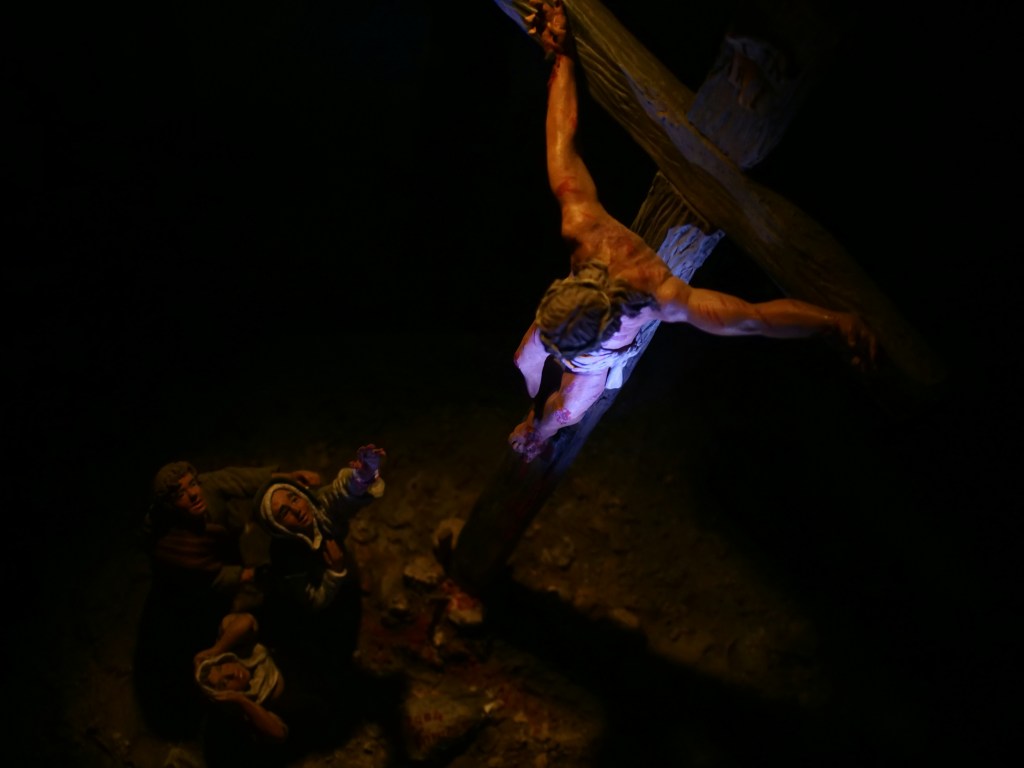
As Jesus hung upon the Cross, Mary, John, and a few others gathered around. They were not concerned about what the other followers thought; they gave no consideration to the religious leaders and others who mocked the Savior, and they showed no regard to the government officials who carried out that terrible deed. When they gathered at the foot of the Cross, they only saw Jesus, His body and His blood. Let’s join with them in this Communion around the Cross, this Community of Faith, and with our eyes on Christ Jesus alone, work toward healing the brokenness that is all around.
Let us pray:
Eternal Father,
we praise you for sending your Son
to be one of us and to save us.
Look upon your people with mercy,
for we are divided in so many ways,
and give us the Spirit of Jesus to make us one in love.
We ask this gift, loving Father,
through Jesus Christ our Lord.
Amen.
 Candle in a Cave