
At 55, Ol’ Boudreaux hadn’t been feeling all that well, so he made an appointment with Dr. Pierre. After undergoing a few basic tests and some questioning about how he lives his life, Boudreaux says, “Well, doc, what do you think?”
“From what I can see from your test results, Bou,” replies Dr. Pierre, “and from the answers you gave to my questions, you definitely need to make some significant changes to your lifestyle.”
“Like what?” asks Boudreaux, looking a bit worried.
Doc Pierre replies, “Like giving up drinking all those glasses of wine and whiskey, reducing all that fried food you have most nights of the week, and giving up smoking. Doing all this is the best way for you to improve your health and life expectancy. It’s your best course of action. So, what do you say?”
After taking some time to think about what he’s just heard, Boudreaux replies, “What would be the second best course of action?”
Have you ever played the game of chess? It is not a terribly difficult game to learn how to play, but that’s only the beginning. From there, it can become hugely complicated.
I’m not very good at it. I’m lucky to be able to see all the options of one move and usually lose because of some stupid option that I missed. However, it is reported that some chess masters can see some 20 moves ahead—moves and countermoves—and then select the best option. How complicated is that? Consider this. White always moves first, and with that first move, there are 20 options. (16 pawn moves and four knight moves). After black makes its first move, there are 400 distinct options for white. From there, it gets crazy. In seeing ahead, after only three moves per player, there are 120,921,506 total options. All told, “In a usual board [of chess], there are 30⁶⁰ possible pathways. This is greater than the number of atomic particles that exist in the known universe.” The rules of chess are easy enough to learn, but the game of chess is more complicated than any human mind (or computer) can fully grasp or master. (Source)
Jean-Luc Marion, a philosopher and Roman Catholic theologian, defines circumstances and events such as this as “‘saturated phenomena.’ According to Marion, some phenomena are filled with meaning and intuition to the point of exceeding any concepts or limiting horizons that one can impose on them. They are… saturated with relevance and thus inexhaustible, always undetermined.” (Source)
The game of chess, when viewed as a whole, is far too complicated for us to comprehend. It is a saturated phenomenon. Yet, even children can play it, not by seeing every available option, but by seeing a very limited spectrum of the available options.
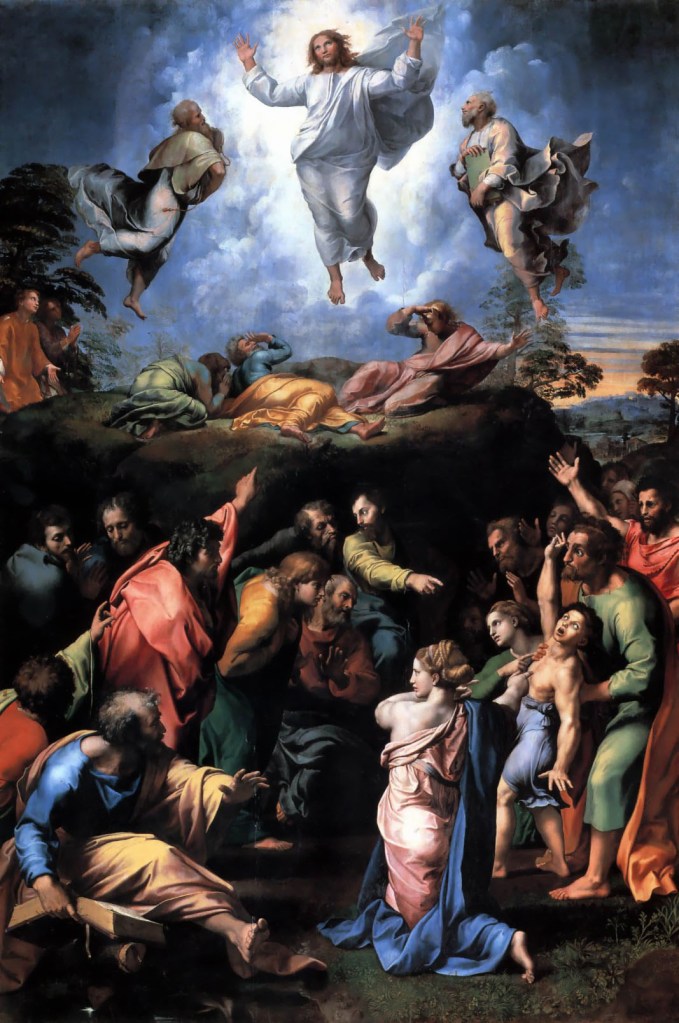
“Jesus took with him Peter and James and John, and led them up a high mountain apart, by themselves. And he was transfigured… his clothes became dazzling white, such as no one on earth could bleach them… [Peter] did not know what to say, for they were terrified… a cloud overshadowed them, and from the cloud there came a voice, ‘This is my Son, the Beloved; listen to him!’”
When we read this, we believe that the Transfiguration is being described to us, but what is actually being described is a saturated phenomenon—an event far beyond understanding and description. Clothes so white that the white is beyond description. A fear, an awe-inspiring emotion so great that Peter is essentially babbling. A cloud appears that is real but also indicates the disciples’ inability to comprehend what they are seeing. And a voice that speaks that only provides a very limited understanding of it all—“This is My Son. This is God. Understand all that He says to you.”
Like a child who can play the highly complicated game of chess even though they cannot possibly comprehend all the options, Peter, James, and John were able to witness the Transfiguration but only grasp a very limited spectrum of understanding. They were not going to understand all the implications of the Transfiguration, so God the Father said to them, “Listen to what Jesus says and do what He does. In that way, you will begin to understand, and in doing and understanding, you will begin to be like Him—as He is…transfigured.”
And everyone says, “Thank you, Father John, for the academic exercise, but what has this got to do with me? What does it mean?”
It means that Jesus, by allowing us to witness His Transfiguration—showing us His true self as best we can comprehend—is saying to us, “Follow me. Be transfigured. I want you also to become a saturated phenomenon—someone so saturated in the holiness of God that your life is essentially beyond understanding to the dark world around you. So shine your light into the dark that it has no option but to see and understand something of God, if only a little.” How do we do this?
I came across a poem this week—Small Kindnesses by Danusha Laméris. I liked it so much that I wanted to share it with you, so, even though I don’t know her, I wrote Danusha and asked for permission to share it with you. She responded, “Poems should go where they are useful… So—a big yes!!!”
I’ve been thinking about the way, when you walk
down a crowded aisle, people pull in their legs
to let you by. Or how strangers still say “bless you”
when someone sneezes, a leftover
from the Bubonic plague. “Don’t die,” we are saying.
And sometimes, when you spill lemons
from your grocery bag, someone else will help you
pick them up. Mostly, we don’t want to harm each other.
We want to be handed our cup of coffee hot,
and to say thank you to the person handing it. To smile
at them and for them to smile back. For the waitress
to call us honey when she sets down the bowl of clam chowder,
and for the driver in the red pick-up truck to let us pass.
We have so little of each other, now. So far
from tribe and fire. Only these brief moments of exchange.
What if they are the true dwelling of the holy, these
fleeting temples we make together when we say, “Here,
have my seat,” “Go ahead—you first,” “I like your hat.”
(Used with permission of the poet)
How do we shine in the darkness? It begins with recognizing those brief moments of loving connection with others—even the stranger in our midst—are, in fact, holy moments. They are moments of the brightest white because, in them, we truly see the other, and we set ourselves aside and not only desire but work toward the good of the other. A person who lives in such a way has not only witnessed the Transfiguration of Jesus but is also beginning to understand it and put that understanding into action.
A quote from a person named Anonymous: “Someone once told me the definition of hell: on your last day on earth, the person you could have become will meet the person you became.” The person you become depends upon hearing and responding to Jesus’ call to follow Him and be transfigured. That is the best course of action. Don’t be like ol’ Boudreaux and ask about the second-best course of action. There’s not one. Be transfigured and enter into those holy temples of great and small kindnesses. Become that saturated phenomenon of God’s love and let the world around you encounter God in a way it has never experienced before.
Let us pray:
Eternal God,
you revealed to the disciples
the everlasting glory of Your Son, Jesus.
Grant us, who have not seen and yet believe,
the gift of your Holy Spirit,
that we may boldly live the Gospel
and shine with your transforming glory,
as people changed and changing
through the redeeming presence of our Savior. Amen.
And for the record… I like your hat.
 Candle in a Cave