
One of the great comedians was Red Skelton. He could bring down the house without a single foul word, but his wife tended to be the topic of more than a few one-liners.
“Two times a week, we go to a nice restaurant, have a little beverage, good food, and companionship. She goes on Tuesdays, I go on Fridays.
We also sleep in separate beds. Hers is in California, and mine is in
Texas.
I take my wife everywhere….but she keeps finding her way back.
I asked my wife where she wanted to go for our anniversary. ‘Somewhere I
haven’t been in a long time!’ she said. So I suggested the kitchen.”
He does concede that he is also to blame. He said, “The last fight was my fault, though. My wife asked, ‘What’s on the TV?’ He said, ‘Dust!’”
Like all married couples, they had their ups and downs, but there are those special few that seem to transcend the norms. Marriages where there are differences, but the love shared between the two is far greater than all those differences combined. Take a young couple from the Netherlands as an example.
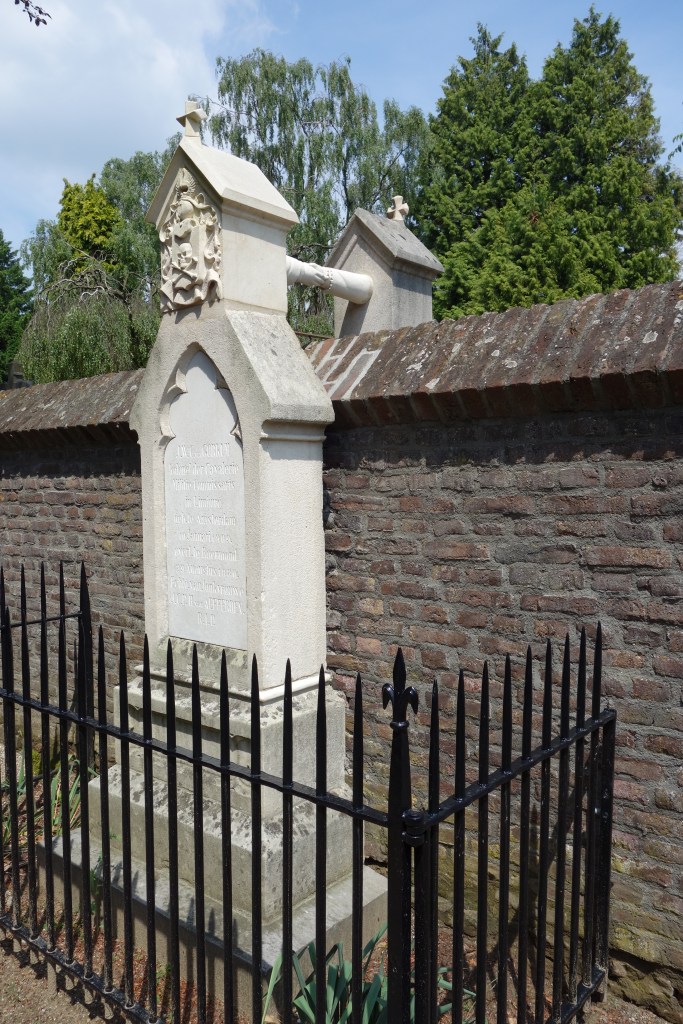
As their names are Dutch, I don’t have a chance of pronouncing them correctly, so we’ll describe them as the Colonel and the Lady. During their lifetimes in the Netherlands, the separation between Protestants and Catholics was severe. Separate schools, hospitals, neighborhoods, and even sections of the cemetery were divided by an eight-foot wall. All of these rules of separation were strictly enforced.
The Colonel was born and raised Protestant, and the Lady was Catholic. They shouldn’t have gotten along at all, so it created a great controversy when they decided to get married. Their love was greater, and despite the obstacles and objections, in 1842, they wed, living happily ever after for thirty-eight years until the Colonel’s death in 1880. Because he was born and raised Protestant, he was buried in the Protestant section of the cemetery. Eight years later, when the Lady died, she was to be buried in the family plot on the Catholic side, but she had other ideas. She had no intention of being separated from her husband, so she made arrangements to be buried next to the wall that separated the Protestant and Catholic sections of the cemetery. She then had their tombstones constructed tall enough so that a pair of hands could be joined over the top of the eight-foot dividing wall. (A picture is on the front of your bulletin.)
Remember a few weeks back when we talked about signs—as in signs and wonders? I would suggest that these joined tombstones are a sign. Something that is pointing to something even greater. They are a sign that demonstrates how, within the human soul, the love between two people can overcome many obstacles, which then points to how this same love can overcome the barriers between peoples. This love reaches over walls to meet the other and to bring healing to individuals, cultures, and nations. It is a sign that points outward—to something greater than one couple—but it is also a sign that points inward to the soul of each of us. That’s the direction I would like to focus on today—the healing of the soul—because within… it is almost like two people are living in each of us (No. I’m not schizophrenic.)
This pointing inward relates to what St. Paul says in his letter to the Romans, “We know that the law is spiritual, but I am of the flesh, sold under sin. For I do not understand my own actions. For I do not do what I want, but I do the very thing I hate.” (Romans 7:14-15) Within is a side that knows what God calls us to, and within—on the other side of the wall—there is a side that does whatever the heck it pleases. A life with God and a life in the world—both working independently and often having very different desires. However, our goal as a Christian people is to have those two operating together. Not so that our worldly side can drag down our faith but so that our faith and our life with God can cooperate and inform our life in the world. Within, we need to join hands over the wall so that our life in the world and our life of faith are in concert with one another.
For example, working in the world is necessary. We have jobs to do and responsibilities to our families and communities. Working in the world is not a bad thing; it is actually very good and beneficial, but while there, we don’t always act in a manner that reflects what we profess on Sunday morning. In the world, we may gossip, become angry, cheat, be uncharitable toward others, and so on. In our Baptismal Creed, we say we will “seek and serve Christ in all persons, loving our neighbor as ourselves.” On Sunday, we love our neighbor. Monday through Saturday, all bets are off. That wall, a very solid division between our Sunday selves and our Monday through Saturday selves, keeps those two selves within us separated. What is curious—almost humorous, but not in a funny way—is that when our God side tries to reign in our world side, the world side gets a little bent out of shape.
Think about our Gospel reading. The man with the unclean spirit. What did the unclean spirit say when it encountered Jesus? “What have you to do with us, Jesus of Nazareth? Have you come to destroy us? I know who you are, the Holy One of God.” When our God side attempts to reign in our world side, our world side can sometimes say the same thing. “What have you got to do with us, Jesus? Your day is Sunday! This is a Thursday. Get back on your side of the wall!” That’s not how it is supposed to work.
Jesus said, “If you were of the world, the world would love you as its own; but because you are not of the world, but I chose you out of the world, therefore the world hates you.” (John 15:19) We must live in the world, but we are from God, so our life in the world must reflect our life in God. Our life in the world and our life in God must reach over that wall and take hands so that they both follow the way that leads to eternal life in Jesus.
Jesus responded to the unclean spirit: “Be silent, and come out of him!” That must also be our response when the world part of us attempts to reign over God within us. “Be silent! You are not the one who rules over my life.” In doing so, we begin to bring healing to our souls. Repairing the brokenness within.
Have you noticed that some people cross themselves during the Lord’s Prayer when we pray, “Deliver us from evil?” Ever wonder why?
The Lord’s Prayer is given to us in Matthew 6:9-13. The second part of verse 13 is “deliver us from evil,” but looking at the footnotes in most Bibles, you will see that this can be translated in two ways. The first is what we pray it. In that context, evil is very general, and we can take it to mean those bad things or people that come against us. However, the second way of translating the verse is “deliver us from the evil one.” (This is how the Eastern Orthodox churches pray it.) In this case, evil is not general. Instead, evil is very specific and personified. We cross ourselves as a means of blessing and protection from this evil one. Sometimes, as I pray that line, I take a little liberty with it and pray, “And lead me not into temptation, but deliver me from the evil one that is within me.” It is a way for me to say, “Be silent!” to the side of me that wants to rule over the ways of God. It is a way for God to reach over the internal wall and take the hand of the side of me that must be in the world and show it the way.
When you sense any voice attempting to lead you from the voice of God, speak to it clearly and boldly, “Be silent!” Then pray, “Deliver me from the evil one,” join hands with Jesus, and live out your faith in every aspect and every day—Monday through Sunday—of your life.
Let us pray: Saint Michael the Archangel, defend us in battle. Be our protection against the wickedness and snares of the devil. May God rebuke him, we humbly pray; and do Thou, O Prince of the Heavenly Host, by the Power of God, cast into hell Satan and all the evil spirits, who prowl through the world seeking the ruin of souls. Amen.
 Candle in a Cave