
There was a priest who was such a golf addict that one Sunday, he called in sick and went golfing instead. An angel saw this and reported to God. “Let me handle this,” God said. The angel watched, but to his horror, the priest was playing the best game of his life. On the par three, seventh hole, the priest hit the perfect hole-in-one. The angel was livid. “I thought you were going to do something about this,” he said to God. “I am,” God replied. “Who’s he going to tell?”
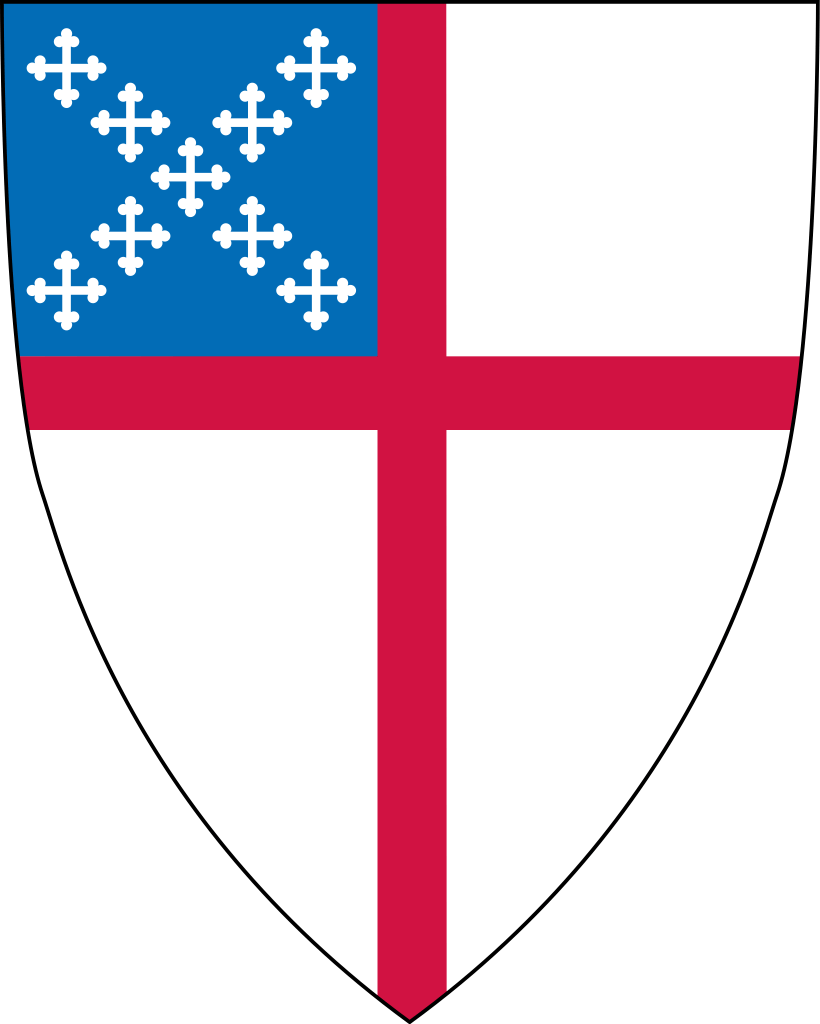
Why a golf story? Because the game of golf was invented in Scotland. Why think of Scotland? The Apostle Andrew, the Saint we celebrate today, is the Patron Saint of Scotland. How did a Jewish fisherman from Israel end up the Patron Saint of Scotland? That answer is a bit more fuzzy, but there are two likely scenarios. The first legend tells of Andrew’s extensive travels and that on one occasion, he did come to Fife, a region of Scotland on the northeast shore of England, and established a church there, now known as St. Andrew’s. Perhaps more believable, the second legend is that some of Andrew’s relics were brought to Fife in the 4th century, and a church was built to house them. Whichever the case, Andrew became widely known throughout Scotland, and many churches were named in his honor. As Episcopalians, we also have a connection to Andrew, which is memorialized in the shield of the Episcopal Church.
Our connection starts, of course, with Holy Scripture. We know that Andrew was Peter’s brother and that he was the one, at least in John’s Gospel, who introduced Peter to Jesus. We also know that Andrew was the one who brought the loaves and fish to Jesus before the miraculous feeding. From there, history and legend tell us that, like the other Apostles, Andrew went out proclaiming the Gospel, which eventually led to his arrest and martyrdom. He was to be crucified like Jesus, but he did not deem himself worthy to be crucified in the same manner, so he was instead crucified on a saltire, an “X” shaped cross. This “X” was incorporated into the flag of Scotland, which has a blue background with a large white “X” across it.
As we learned a few weeks ago, following the American Revolution, the fledgling United States had no Bishops, so Samuel Seabury first went to England in an attempt to be consecrated, but when that failed, he went to Scotland, and the bishops there consented. The following two American bishops were consecrated in England, so when James Madison was consecrated by those three, Madison became the first fully American bishop and reunited the Scottish and English lines of the Episcopacy, which brings us to the Episcopal Shield.
As you are aware, on the shield is a large red cross in the center, the Cross of St. George—a shout-out to England because George is the Patron Saint of England, but also, in the upper left quadrant of the shield is that blue field, with the nine small white crosses. Those nine small crosses represent the nine original dioceses of the Episcopal Church, but they are also in the shape of a saltire, an “X” on a blue field, the Scottish flag, and a shout-out to Andrew.
As a Christian people, we are a part of something much larger than ourselves. We, gathered here today, are the Body of Christ, but we, gathered throughout the world and across the centuries, are also the Body of Christ. We stand alongside Andrew and all the others as a Testament to the wondrous workings of our God and the truth of His Word.
 Candle in a Cave