
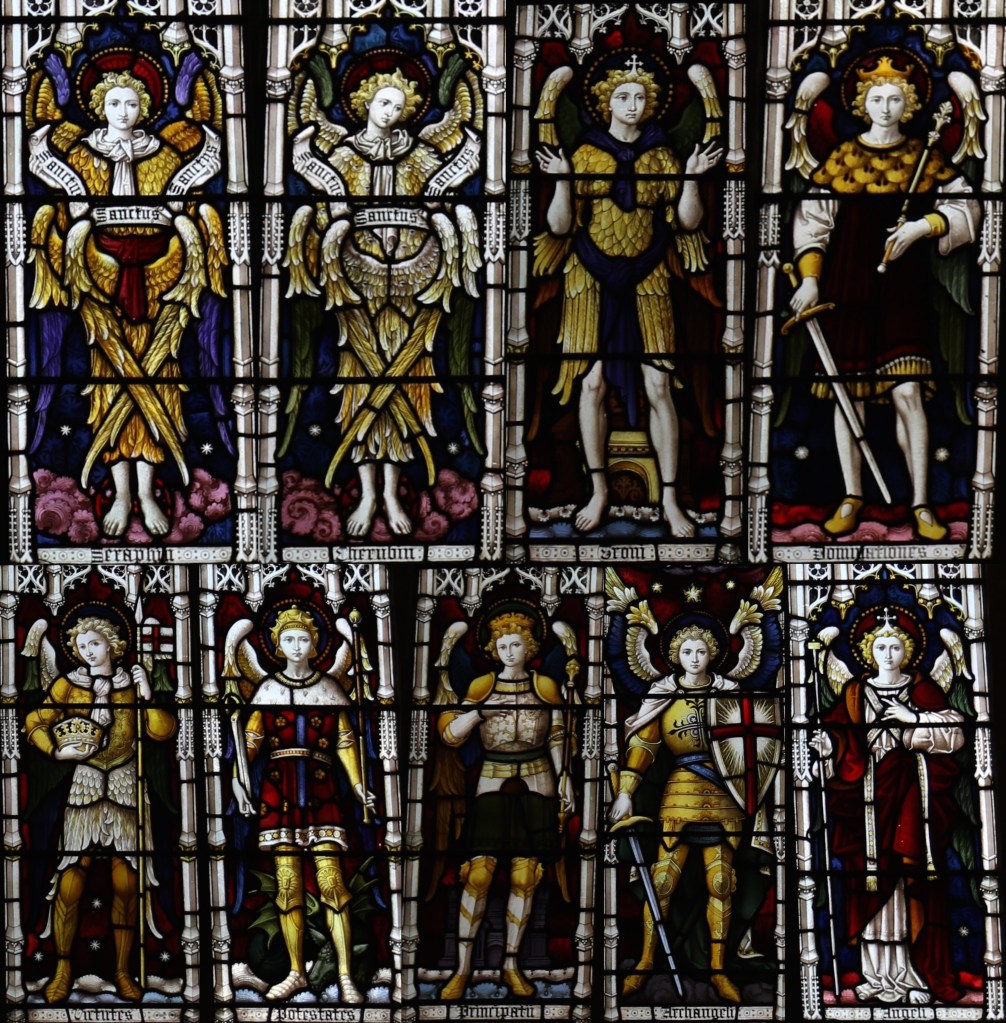
The Shepherd of Hermas is a second-century text, sometimes attributed to the brother of Pius, the Bishop of Rome. It is primarily an allegory and contains several visions. For many, it should have been included in the New Testament and was for a time, but eventually fell out of favor. The author’s understanding of Jesus and who He was is quite different from the teachings of the Council of Nicea. Even so, it almost made the cut.
Included in the fifth vision is an explanation of the role of angels. If you’ve ever seen the cartoon of an individual with an angel on one shoulder and a devil on the other, then you get the gist of it. Still, as it is the Feast of St. Michael and All Angels, I wanted to share the text with you. The shepherd begins:
“There are two angels with a man—one of righteousness, and the other of iniquity.”
And I said to him, “How, sir, am I to know the powers of these, for both angels dwell with me?”
“Hear,” said he, and “understand them. The angel of righteousness is gentle and modest, meek and peaceful. When, therefore, he ascends into your heart, forthwith he talks to you of righteousness, purity, chastity, contentment, and of every righteous deed and glorious virtue. When all these ascend into your heart, know that the angel of righteousness is with you.
“These are the deeds of the angel of righteousness. Trust him, then, and his works. Look now at the works of the angel of iniquity. First, he is wrathful, and bitter, and foolish, and his works are evil, and ruin the servants of God. When, then, he ascends into your heart, know him by his works.”
And I said to him, “How, sir, shall I perceive him, I do not know.”
“Hear and understand,” said he. “When anger comes upon you, or harshness, know that he is in you; and you will know this to be the case also, when you are attacked by a longing after many transactions, and the richest delicacies, and drunken revels, and divers luxuries, and things improper, and by a hankering after women, and by overreaching, and pride, and blustering, and by whatever is like to these. When these ascend into your heart, know that the angel of iniquity is in you.
“Now that you know his works, depart from him, and in no respect trust him because his deeds are evil and unprofitable to the servants of God.
“These, then, are the actions of both angels. Understand them, and trust the angel of righteousness; but depart from the angel of iniquity, because his instruction is bad in every deed. For though a man be most faithful, and the thought of this angel ascend into his heart, that man or woman must sin.
“On the other hand, be a man or woman ever so bad, yet, if the works of the angel of righteousness ascend into his or her heart, he or she must do something good. You see, therefore, that it is good to follow the angel of righteousness but to bid farewell to the angel of iniquity.”
That may not be exactly our understanding of angels and devils, but perhaps it is a glimpse. The word “angel” is from the Greek angelos (ἄγγελος), which translates messenger. Jacob saw the angels of God ascending and descending the ladder, and Jesus told Nathanael that he would see the angels of God ascending and descending upon the Son of Man. I believe the angels they saw were fulfilling their duties, bringing messages to God’s people. I believe that work continues to this day, so the next time you think about a word or deed, ask yourself, “Is that one of God’s messengers come to bring me a word, or does it come from the other fella?”
 Candle in a Cave