
Mr. Moore was teaching map reading in his earth sciences class at Delacroix High School. After explaining latitude, longitude, degrees, and minutes, the teacher asked, “Suppose I asked you to meet me for lunch at 23 degrees, 4 minutes north latitude and 45 degrees, 15 minutes east longitude…?”
After a moment of silence, T Boudreaux volunteered, “I suppose you’d be eating alone.”
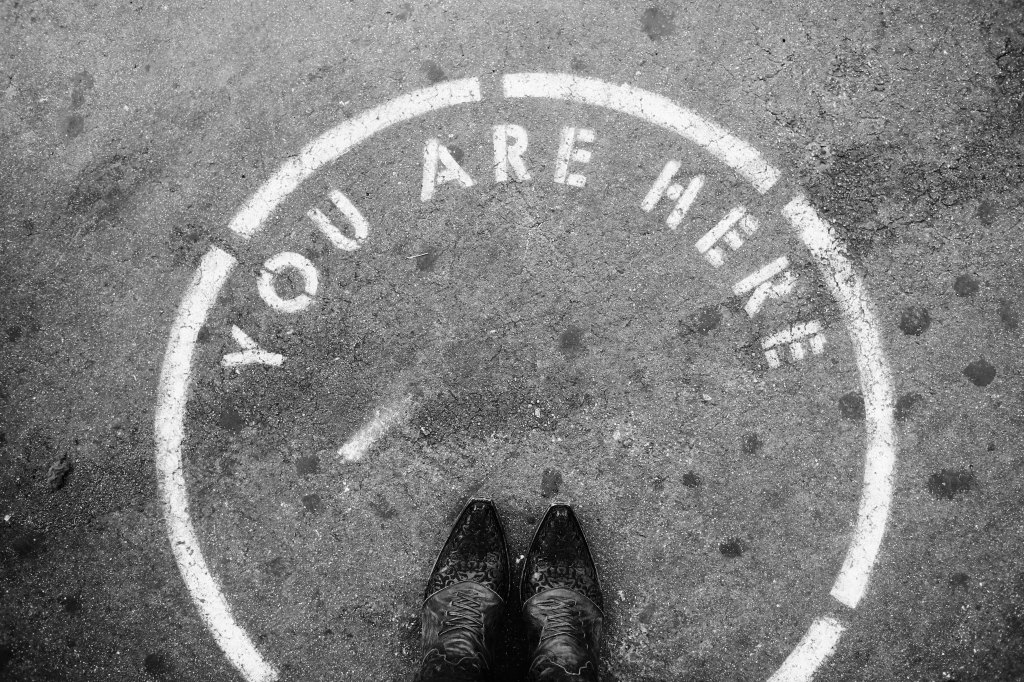
T Boudreaux is one of those who would look at a wayfaring map with a “You are here” arrow and ask, “How do it know?”
“Jesus began to show his disciples that he must go to Jerusalem and undergo great suffering… be killed, and on the third day be raised.” Peter likely heard that last bit but did not understand it, so he said to Jesus, “God forbid it, Lord! This must never happen to you.” Jesus turned and said to Peter, “Get behind me, Satan! You are a stumbling block to me; for you are setting your mind not on divine things but on human things.”
How easy it would be to criticize Peter. “Who are you to question God? Why are you being so thick about all this? You have failed again.” Read the right way; we can hear all those things in Jesus’ voice, but that ‘voice’ we can imagine does not reflect the character of Jesus we know.
Jesus, who knew the hearts and minds of so many, would also have known the heart of Peter. He would know that Peter was saying these things because Peter was distraught at the thought of losing his Lord. The one who said, “Love one another,” would not lash out in such a manner we can imagine. If anything, I think Jesus’ voice was one of love and compassion but also firm. He didn’t want Peter, or any of the others, deceiving themselves at this point. What was coming was going to happen. No question.
If Jesus had shown Peter a map, there would be a single road. A road that led to Jerusalem and onto Golgotha—the hill on which Jesus was crucified. There would be one of those arrows that said, “You are here,” implying that you are going there, and there’s no changing it.
Jesus was saying to Peter, ‘I am exactly where I am supposed to be. This cannot be changed. I must be obedient to the Father and not to my emotions or desires.’ Could Jesus have fought it? Could he have turned and forged a new road, a new direction for His life? Yes. Jesus had as much free will as you and I. Did Jesus have every reason to complain bitterly? To pitch a fit about how unfair His life was? To take out His anger and frustrations on those around Him? Absolutely, He could have. ‘This is so unfair! I deserve better than this! I am entitled!’ Jesus could have done and said whatever he liked, but He chose to submit to the will of the Father and be obedient.
With that in mind, Jesus said to Peter and the other disciples, “If any want to become my followers, let them deny themselves and take up their cross and follow me.” Jesus said, ‘You are here—at this place and at this time. This is—right now—your life. Take up your cross. You also, be obedient and take up this life the Father has given you, and follow Me.’ You are here regardless of the circumstances—good, bad, or indifferent, so submit and be obedient to the will of the Father. That is a message for us as well.
As we seek to follow the will of God, our path will not be as clear as the one that Jesus was following. There are days if we know the next step, we are doing good, but what doesn’t change is the fact that at this very moment, “You are here.” Where you are is not random. In addition, you may not be happy with where you are, but you are not outside of God’s will for your life. Trust me. You don’t have that kind of power.
The Psalmist writes,
O Lord, you have searched me and known me!
You know when I sit down and when I rise up;
you discern my thoughts from afar.
You search out my path and my lying down
and are acquainted with all my ways.
Even before a word is on my tongue,
behold, O Lord, you know it altogether….
in your book were written, every one of them,
the days that were formed for me,
when as yet there was none of them. (Psalm 139:1-4, 16b)
If you believe those words, then you believe that God knew your every step, every choice, every breath before you were even created. Therefore, if “You are here,” God ordained that you be here. You are here. This is your life; therefore, the call on your life—at this very moment—is to take up your cross and follow Jesus. That is easy to say, yet amid life’s circumstances, we can sometimes experience the same emotions as Peter and say, “God forbid it, Lord! This must never happen! This is unfair! I deserve more! I am entitled to more!” There can be weeping and gnashing of teeth. We can strike out in anger and frustration at others and ourselves, but God persists, “You are here.” If we persist in our rantings to God, I suppose He might eventually come back on us the same way He did Job,
“Who is this that darkens counsel by words without knowledge?
Dress for action like a man;
I will question you, and you make it known to me.
“Where were you when I laid the foundation of the earth?
Tell me, if you have understanding.” (Job 38:2-4)
God said to Job, ‘You, sir, are out of order. It is not your place to question why certain things happen.’
So, consider this: if God ordains that you be here—with the circumstances good, bad, or indifferent—could it be that “You are here,” and “here” is exactly where you are supposed to be, just as Jesus was exactly where He was supposed to be? Is that fatalistic? No. It’s just the opposite. If we are where we are supposed to be, then God is here with us. Instead of being frustrated and angry, we should be rejoicing that we are not alone. It doesn’t mean life won’t be difficult and we are supposed to do the happy dance for everything that comes our way, but it does mean we can calm our souls and be at peace, taking up our cross and following Jesus. But what about those times when it all becomes too much? Hans Urs von Balthasar was a Roman Catholic theologian. In one of his books, he was writing specifically for priests, but what he wrote applies to all. “The weight of pastoral Office becomes heavier than any man even in official position can bear. Therefore it is no longer the man who bears the cross, but the cross which bears the man.” (Source, p.124) The weight of our life, our cross, can become too much to bear, so in those circumstances, it is no longer us that carry our cross; the cross—Jesus, carries us.
Rainer Maria Rilke (d.1926) was an Austrian poet. Some of his poems were mystical and spoke of his search for understanding God. His poem, Extinguish My Eyes, speaks to this idea of encountering God, even in loss.
Extinguish my eyes, I still can see you,
Close my ears, I can hear your footsteps fall,
And without feet I still can follow you,
And without voice I still can to you call.
Break off my arms, and I can embrace you,
Enfold you with my heart as with a hand.
Hold my heart, my brain will take fire of you
As flax ignites from a lit fire-brand—
And flame will sweep in a swift rushing flood
Through all the singing currents of my blood.
Regardless of our circumstances or our state—without eyes, ears, feet, and all—we can still grasp Christ and be grasped by Him. Still burn with the joy of our cross, the life we have been blessed with.
My friend Thomas à Kempis understood the joy of the cross that Christ offers us, so he wrote, “Why, then, do you fear to take up the cross when through it you can win a kingdom? In the cross is salvation, in the cross is life, in the cross is protection from enemies, in the cross is infusion of heavenly sweetness, in the cross is strength of mind, in the cross is joy of spirit, in the cross is highest virtue, in the cross is perfect holiness. There is no salvation of soul nor hope of everlasting life but in the cross.” (Source: TAK IOC Bk 2, Ch 12)
You are here. With joy and peace, take up your cross and follow Jesus.
Let us pray:
Eternal Father,
May we see Your Son, Jesus, clearly
Pouring out love
Pouring out mercy
Pouring out peace
May we kneel before him in humble adoration
May we take up our cross and follow
And walk with Christ into the ways of life.
Amen.
 Candle in a Cave
According to 1 Cor. 12:18, God puts us right where He want us. And in Matt. 13:8 a good seed must lodge in the good soils if there is to be a harvest. So like that old saying, “Bloom where you are planted” seems appropriate here. Also God is omnipresent, meaning He is everywhere at every time, so whenever you look at the “You are here” sign, He is there too! I love this post brother!
Thank you, I needed this today!