
I have shared a quote from Archbishop of Canterbury Michael Ramsey with you in the past: “The Church is not the society of those labeled virtuous. It is the mixed community of sinners called to be saints.” Unfortunately, the Church can sometimes be more sinner than saint.
The Reformation in the English Church was more political before it was theological, and the issues between the monarch and the Pope were going on long before Henry VIII, but it very much came to a head during Henry’s reign.
The theological issues had to do with Luther and the protestant message, but the political had to do with who gets to be boss. Would it be the monarch or some guy in a pointy had a thousand miles away? The issue would not resolve itself for years to come, so it was still at play when Elizabeth I ascended the throne in 1558.
There was no love lost between Rome and Queen Elizabeth I, and finally, in 1570, Elizabeth was excommunicated by Pope Pius V. I don’t think it bothered Elizabeth; however, what did bother her was the fact that the Pope said that Roman Catholics living in England no longer had to be obedient to her. What exacerbated the problem was that Mary, Queen of Scots, was in Scotland, and she was a Catholic stalwart and beacon to all those disgruntled Catholics who were no longer required to be obedient. Therefore, Elizabeth feared Mary might raise an army and come against her. We know that Elizabeth would eventually sign Mary’s death warrant, but in the meantime, she enacted several measures attempting to reign in the Catholics.
The first measure was the 1581 Act of Persuasion against the recusants. (A recusant is one who is disobedient.) The act stated that if you were disobedient to the monarch, you would face steep fines (this got the attention of the rich) and imprisonment. However, it did not affect the changes Elizabeth had hoped for, so in 1585, she signed the Act against Priest.
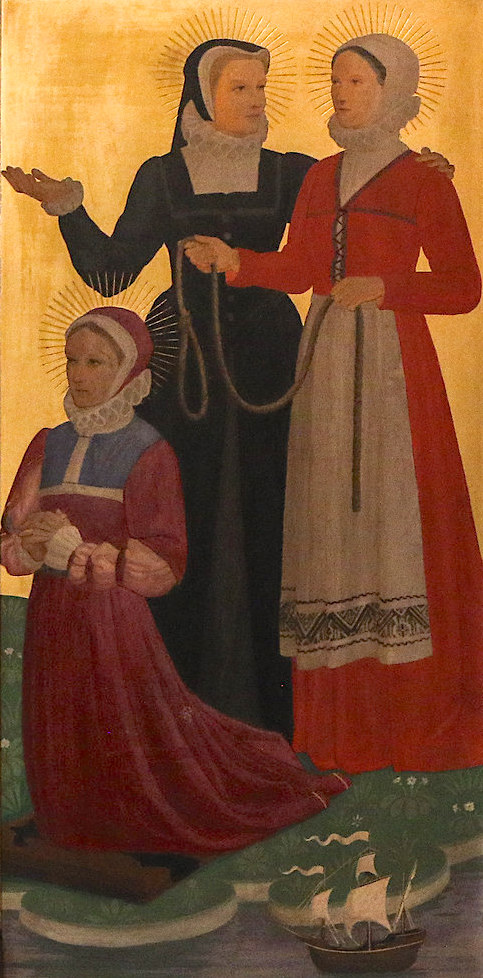
This act stated that any priest ordained abroad since 1559 was automatically deemed a traitor and given forty days to leave the country or face arrest and execution. Furthermore, anyone attempting to harbor a Roman priest was also to be arrested and executed. This is where the three women we remember today enter: Margaret Ward, Margaret Clitherow, and Anne Line.
All three of these women were martyrs, and Margaret Clitherow was the first. Her home was searched, and a young boy who was afraid revealed the priest hole (where priests were hidden). Although pregnant with her fourth child, she was executed.
Next was Margaret Ward. She helped a priest escape prison by smuggling in small pieces of rope, which he wove together and made a proper rope. The priest managed to escape, but Ward’s actions were discovered. Before her execution, she rejoiced, for, as she said, “Having delivered an innocent lamb from the hands of those bloody wolves.”
Finally, a raid on Anne Line’s home resulted in her arrest for the same crime as the others. The priest she was harboring also managed to escape (it bothers me a bit to think of them escaping while these women were dying). She told her accusers she was only grieved because she “could not receive a thousand more” priests to save.
St. Paul tells us in his letter to the Romans, “For one will scarcely die for a righteous person—though perhaps for a good person one would dare even to die.” (Romans 5:7) Jesus tells us, “Greater love has no one than this, that someone lay down his life for his friends.” (John 15:13)
Were the priests that were being saved, good people? I don’t know—not my department—but I do know that these three ladies showed the “greater love” that Jesus spoke of. We may never be called on to give our lives in such a way, but we are all called to demonstrate “greater love” to the world by making sacrifices so that the word of God may be proclaimed.
 Candle in a Cave