
Sermon: Proper 11 RCL A – “Identifying Weeds”


Charlie Brown rests his head in his hands while leaning against the wall. He looks miserable when his friend Lucy approaches. “Discouraged again, eh, Charlie Brown?” Charlie Brown does not even answer. “You know what your trouble is?” Lucy asks. Without waiting for a response, she announces, “The trouble with you is that you are you!” Charlie Brown says, “Well, what in the world can I do about that?” Lucy replies, “I don’t pretend to be able to give advice. I merely point out the trouble!”

Lucy demonstrates a human failing that has truly plagued us from the beginning. According to our assessment, ___ is the trouble. After this determination has been made and solidified in our minds, we decide that something must be done about ___. However, this is not how the Lord would have us operate.

The Lord, speaking through the Prophet Isaiah, describes a great leader. He says,

Thus says the Lord to his anointed…
whose right hand I have grasped,
to subdue nations before him
and to loose the belts of kings,
to open doors before him
that gates may not be closed.
(Isaiah 45:1)

Of this anointed one, the Lord declares:

I have stirred him up in righteousness,
and I will make all his ways level;
he shall build my city
and set my exiles free,
not for price or reward,”
says the Lord of hosts.
(Isaiah 45:13)

One clue to the person’s identity is the title “anointed.” That word can also be translated as “messiah.” From this, you might think the Lord is speaking of one of the great Israelite heroes: David, Gideon, or Esther. Or perhaps we might think the Lord is talking about Jesus, but as it turns out, the Lord is actually speaking of a pagan king, a worshiper of idols, and a believer in false gods.

For roughly 70 years, the Israelites had been in exile in Babylon after being conquered. However, as with all empires, the next one is already on deck, waiting for its turn to dominate the world scene. Enter Persia, and the anointed one whom God was praising: Cyrus.

Cyrus conquered the Israelites’ enemy, the Babylonians, and then set the Israelites free. Free to return home and rebuild Jerusalem and the temple. Free to worship the one true God. Cyrus did these things and much more for the Israelites, even though he himself was not a believer.

The Israelites would have looked at Cyrus and been appalled by the kind of person he was. When Isaiah told them who their messiah would be, they were. Even so, the Lord looked at Cyrus and said,

I will give you the treasures of darkness
and the hoards in secret places,
that you may know that it is I, the Lord,
the God of Israel, who call you by your name.
(Isaiah 45:3)

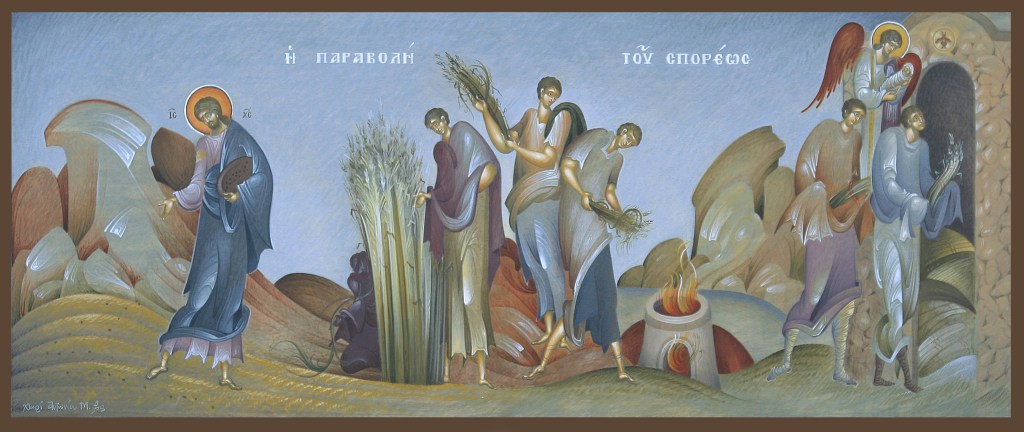
Today in our gospel, Jesus tells the parable of the wheat and the weeds. A farmer sends out his servants to scatter wheat seeds. However, at night, when no one is watching, an enemy comes in and scatters weed seeds. Everyone believes all is well until the plants begin to mature. It is then that the weeds are discovered.

There is widespread agreement that the weed in question was Darnel, a poisonous grass. I am no farmer, but apparently, the wheat plant and the Darnel weed are nearly identical when young. It is not until the wheat begins to form its head of grain that the problem is identified. Yet by this time, the wheat and the Darnel have been growing side by side long enough that their root systems are intertwined. If you pull up the Darnel, the wheat will come with it. Therefore, the farmer tells his servants to wait until the harvest before doing anything about the problem.

Jesus uses this parable to describe the world around us, and the church fathers have gone one step further, saying it also describes the church—the righteous and the unrighteous growing together side by side. The rub is that, like the farmer’s servants, we are unable to tell the difference between wheat and weed, the righteous and the unrighteous, the evil. Like Lucy, we are remarkably confident in our ability to diagnose everyone who is a problem. However, I suspect that Jesus is rarely pleased with our diagnoses.

Many Israelites, if they had heard Jesus’ parable, could have easily looked at Cyrus and said, “That man is a weed. He needs to be pulled up and cast into the fire.” Yet God looked at Cyrus and said, “You are my anointed.”

Saint Augustine wrote, “How many sheep are outside, how many wolves within! And how many sheep are inside, how many wolves without!… How many are blaspheming Christ who will yet believe in Him!… In like manner, how many are praising within who will yet blaspheme.” (Tractate 45.12)

We see this problem throughout scripture. Think of Saint Paul. He began as one of the church’s greatest persecutors. He was present when St. Stephen was stoned to death and approved of it. Even after his conversion, the young church looked at him with great fear. They saw him as a weed or a wolf. Yet God looked at Paul and saw the Apostle to the Gentiles.

You and I lack the knowledge and ability to know who is righteous and who is not. As for pulling weeds, that particular job is above our pay grade. Jesus said, “Just as the weeds are collected and burned up with fire, so will it be at the end of the age. The Son of Man will send his angels, and they will collect out of his kingdom all causes of sin and all evildoers, and they will throw them into the furnace of fire.” There will come a day when the wheat and the weeds will be separated. There will come a day of judgment, but that judgment and the casting of the weeds into the fire will not be accomplished by us. It will be accomplished by God’s holy angels.

Now, please don’t think I’m saying those who do wrong shouldn’t be punished or locked up. I’m not saying that at all. I am saying that we can’t truly know a person or their final outcome. Therefore, we must allow the wheat and the weeds to grow side by side until the Lord sends His workers to bring in the crop.

So what are we to do when we believe the evil, the enemy, is near? We must recall and practice what Paul teaches: “Repay no one evil for evil, but give thought to do what is honorable in the sight of all. If possible, so far as it depends on you, live peaceably with all. Beloved, never avenge yourselves, but leave it to the wrath of God, for it is written, ‘Vengeance is mine, I will repay, says the Lord.’ To the contrary, ‘if your enemy is hungry, feed him; if he is thirsty, give him something to drink; for by so doing you will heap burning coals on his head.’ Do not be overcome by evil, but overcome evil with good.” (Romans 12:17-21) When you see evil, a person you believe to be a weed, do not allow their sin to cause you to sin. The enemy of us all has won if you do.

Can this be frustrating? Absolutely. Don’t we all want to go out and yank a few weeds? I’d wager each of you just imagined someone you’d go after first. Yet Jesus is calling us to walk a different way, the way He walked. Why? For there were many who looked at Him and saw a weed that needed pulling, even though He was here for their salvation. Yet they condemned Him and nailed Him to a cross. Did they believe they were doing evil? No. They thought they were clearing God’s field of just one more weed. Instead… they crucified the Lord of the harvest.

Our job is not to go around trying to identify weeds, and most certainly not to pull those we believe we have identified. Our job is to go where Jesus has led the way, to take up our cross and follow Him so that we may also bring glory to our Father in Heaven.

Let us pray:
Lord, enlighten our understanding,
Strengthen our will,
Purify our hearts,
and make us holy.
Help us to repent of our past sins
And to resist temptation in the future.
Help us to rise above our human weaknesses
And to grow stronger as a Christian.
Amen.
Sermon: Proper 11 RCL A – “Pulling Weeds”


Mark it up as an urban legend or an actual event; whatever the case may be, the myth persists: on June 26, 1963, President John F. Kennedy, while visiting West Berlin, gave one of the finest speeches of the Cold War. He said, “Two thousand years ago, the proudest boast was civis romanus sum [I am a Roman citizen]. Today, in the world of freedom, the proudest boast is ‘Ich bin ein Berliner! [I am a Berliner]. All free men, wherever they may live, are citizens of Berlin, and therefore, as a free man, I take pride in the words ‘Ich bin ein Berliner!’” 

According to the legend, Kennedy was supposed to say, “Ich bin Berliner!” Not “Ich bin ein Berliner!” In the first, Kennedy is, in fact, saying, “I am a Berliner.” In the second, he proudly proclaims, “I am a jelly doughnut!”

I mention this in recognition that we all make mistakes, and hope you will show me compassion for the one I made during last week’s sermon. 

For whatever reason, I got it in my pointy little head that the Parable of the Sower—seeds that fell on rocky ground, the road, etc.—was the only time we benefitted from Jesus’ explanations of the parables. If you were just listening to the Gospel, you would have heard I was mistaken. Please accept this as my apology for that misinformation… I am a jelly doughnut. Moving on.

There is a good bit of speculation on what heaven will actually be like and quite a bit more speculation on who actually gets in, but I was wondering, would you allow me to choose for you?

When we were younger, I suppose we all had to endure that humiliating ritual of choosing sides, especially when it came to sporting events during recess or P.E. The teacher always chose the captains of the teams, and it seemed that the captain was always Mr. Jock and he always had his jockettes that he would choose first. When the good picking was over, you knew he and his buddies were no longer choosing who they wanted on their team. Instead, they were deciding who they would rather be stuck with. If it were up to them, they would likely not choose the losers but force them to sit on the sideline, which they did anyways because there was no way on God’s green earth they intended to jeopardize the balance of world power which hung on the outcome of this particular bout of dodge ball.

Now, perhaps you wouldn’t mind me picking or not picking you for a dodgeball game, but again I ask you, would you allow me to choose whether or not you get to go to heaven? If you are smart, you will answer that question with a resounding “NO!” I am so desperately in need of God’s grace myself that I don’t want anyone or anything getting between me and it; however, what I find so curious, is that we don’t want someone to choose for us, but we are more than willing to choose for others.

In our parable today, Jesus tells us that he is the sower of the seed and that the seeds represent the righteous—the children of God. The weeds sown with the good seed are the unrighteous—the children of the father of lies. And on God’s appointed day, He will send his angels to clear the field of weeds and throw them into the fire.

When we get a bit too big for our britches, we mistakenly believe that we are either God or an angel, that we have the knowledge, the right, and by golly, the responsibility to go into that field and pull some weeds because we know who they are. If God is too busy taking care of other business, we will happily step in. Sometimes we step in for what we consider to be noble reasons, “That person is a heretic! Burn them at the stake!” While at other times, our reasons aren’t quite so noble.

You won’t like this story—Stephen Covey, the author of The 7 Habits of Highly Effective People and other books, tells of the time on a lovely quiet Sunday afternoon when he was taking the subway through New York City. There were a few other passengers in the car with him, but not many, and all were enjoying the peace of the day. However, at the next stop, a man and his two sons burst onto the train, and the boys created all sorts of havoc. They ran absolutely wild up and down the car, screaming, shouting, wrestling—destroying the peace of that Sunday afternoon. I guess Covey thought the father of these two terrorists was a weed that needed pulling, so after a particularly noisy moment, he turned to the father and said, “Sir, perhaps you could restore order here by telling your children to come back and sit down.”

Have you ever been in that place? So confident that you were right and the other person wrong? That you could look at someone with all confidence and judge them? Of course, you have. We all have. We believe we have God’s infinite knowledge and wisdom to make these sorts of snap decisions, but how often are we wrong?

After Covey told this weed to get the terrorist under control, the weed said, “I know I should do something. We just came from the hospital. Their mother died an hour ago. I just don’t know what to do.” Covey had not snatched out some weed worthy of the fires of hell. Instead, he had only further bruised a broken heart that was in desperate need of the love of God.

Consider the fact that Jesus knew all along that Judas Iscariot was going to betray him. He knew that Judas was a weed among the wheat, but Jesus never threw him out. Instead, Jesus washed Judas’ feet, just as he had washed Peter’s, James’, John’s, and all the rest. Judas betrayed Jesus unto death, yet Jesus never condemned him and allowed Judas to participate in the Lord’s Supper. Question: how many have we renounced for far more trivial offenses by comparison?

In the parable, Jesus tells us we are neither God nor angels. Because we are not God, then we are not the judge. Because we are not angels, we are not the ones called to go into the fields and pull the weeds. We are, however, the grain of wheat, and if our work is not to judge or reap, then what is it? Jesus says, “Very truly I tell you, unless a kernel of wheat falls to the ground and dies, it remains only a single seed. But if it dies, it produces many seeds.”

What is our work? Jesus said, “This is to my Father’s glory, that you bear much fruit, showing yourselves to be my disciples.” Jesus says, “You did not choose me, but I chose you and appointed you so that you might go and bear fruit—fruit that will last.” One of the desert fathers said, “If a man settles in a certain place and does not bring forth the fruit of that place, the place itself casts him out, as one who has not borne its fruit.” For me, this brings to mind a rather unpleasant thought: if we are not producing good fruit, could it be that we are the weeds? We won’t entertain that one.

St. Josemaría Escrivá writes, “The Lord’s field is fertile and the seed he sows of good quality. Therefore when weeds appear in this world of ours, never doubt that they spring up because of a lack of correspondence on the part of men, Christians especially, who have fallen asleep and have left the field open to the enemy—Don’t complain, for there’s no point; examine your behaviour, instead.” If the weeds are truly growing amongst the wheat, we must consider that the fault might be ours and that we may be acting like a weed when we should be working on producing good fruit.

Only God chooses who goes to heaven, and thanks be to God for that! But we do have a role to play, and that is to produce good fruit. The person you’ve discounted, cast off, considered a weed in this world that must be yanked out, might just need someone—and not just any someone—but you. They just might need you to help them produce the fruit in their own life; therefore, be brave, have patience, and persevere in loving them, bringing glory to Our Father in Heaven.

St. Francis stated this best in a prayer. Let us pray: “Lord, make me an instrument of Your peace. Where there is hatred, let me sow love; where there is injury, pardon; where there is doubt, faith; where there is despair, hope; where there is darkness, light; where there is sadness, joy. O, Divine Master, grant that I may not so much seek to be consoled as to console; to be understood as to understand; to be loved as to love; for it is in giving that we receive; it is in pardoning that we are pardoned; it is in dying that we are born again to eternal life. Amen.”